Friday, October 16, 2015

CLDJ Holds Change of Command Ceremony in Djibouti


By Lt. Cmdr. Erik Wells, Camp Lemonnier Public Affairs

DJIBOUTI (NNS) -- Camp Lemonnier (CLDJ), Djibouti, the U.S. military's only enduring base in Africa, held a change of command ceremony, today, Oct. 14.

Capt. Geoffrey T. Colpitts took command from Capt. Matthew P. O'Keefe during a ceremony presided over by Rear Adm. John C. Scorby, Jr., commander of Navy Region Europe, Africa, Southwest Asia.

Scroby spoke of O'Keefe's accomplishments while leading Camp Lemonnier for the past ten months that has allowed the critical missions in the region to continue.

"At Camp Lemonnier, our warfighters are able to focus on the mission because Skipper O'Keefe and his team take care of everything else by providing stellar customer service to the fleet, the fighter and the family," Scorby said.

During O'Keefe's tenure major construction projects were completed such as a new warehouse and the U.S. military's first permanent barracks on the African continent. O'Keefe said the construction efforts at CLDJ demonstrate to the Djiboutian government and its citizens that the U.S. is here to stay to improve the security of the region and to fight violent extremists.

"It has been my distinct pleasure in building and continuing to build the relationship that exist between our great nations," O'Keefe said.

O'Keefe's greatest praise was for the men and women - military and civilian - who he called "the finest group of patriots on the planet" and thanked them for "serving our country overseas so that our loved ones may enjoy peace at home."

Camp Lemonnier's new commanding officer is no stranger to the importance the role CLDJ plays in the region.

Colpitts spent 18 months assigned to Combined Joint Task Force - Horn of Africa which is a tenant command on the base. During his deployment in 2012, Colpitts was the officer-in-charge of the first permanent U.S. military presence in Mogadishu, Somalia in 20 years. He was also the senior U.S. military officer in Somalia coordinating all U.S. military support to Somalia and the African Union combat troops operating in Somalia.

"I believe that the greatest legacy that we as U.S. military members and civilians will leave on this continent is not buildings and not structures, but the influence of our character," Colpitts said.

Colpitts added that he has been impressed during his month-long turnover at the skill, pride and professionalism of the military and civilian personnel on the base.

"The men and women of Camp Lemonnier are the heart and soul of this tremendous and dynamic place here in the Horn of Africa," Colpitts said. "Each and every one of you are incredible people. The safety and health of everyone on Camp Lemonnier is my number one priority."

Camp Lemonnier supports Combined Joint Task Force Horn of Africa and other tenant commands protecting United States interests in Africa, and provides full spectrum individual support to personnel stationed on Camp Lemonnier. Camp Lemonnier partners with its host nation, Djibouti, to be a valued part of the community by fostering long-term common interests.

Nuclear Treaty Monitoring Center activates five new squadrons

by Susan A. Romano
AFTAC Public Affairs


10/16/2015 - Patrick Air Force Base, Fla. -- The Air Force Technical Applications Center here activated five newly-designated squadrons this week as the center takes steps to reorganize after becoming a wing equivalent in August 2014.

The ceremonies were historic events for the center as well as the Air Force.  AFTAC was first organized in 1959 as the 1035th U.S. Air Force Field Activities Group.  For the next several years, five technical operations squadrons carried out specific portions of the nuclear treaty monitoring mission.  In 1980, the 1035th was renamed the Air Force Technical Applications Center and became a direct reporting unit to Headquarters Air Force.  The squadrons were deactivated at that time.

Now that AFTAC falls under Air Combat Command (major command) and 25th Air Force (numbered Air Force), leadership reasoned that as a wing equivalent, the squadron structure should be revived and returned to AFTAC's unit composition.

A squadron is the Air Force's most basic unit, responsible for critical, day-to-day operations - it's where the job gets done.  Each new squadron held an activation and assumption of command ceremony, with an Air Force field grade officer respectively taking command.

Two of the squadrons will be aligned under AFTAC's Directorate of Operations; the remaining three will align under the Directorate of Mission Support.

The new squadrons and their associated missions are as follows:

Technical Surveillance Squadron (TESS) - this squadron, now commanded by Lt. Col. Ehren Carl, provides the nation with persistent surveillance to monitor treaty compliance through AFTAC's 24/7 Operations Center and the U.S. Atomic Energy Detection System to detect, identify and locate nuclear explosions underground, underwater, in the atmosphere or in space.

Technical Operations Squadron (TOPS) - this squadron, led by Lt. Col. Robert Light, conducts Olympic Titan (mobile maritime platform foreign missile and space activity operations) and worldwide reconnaissance missions via technical sensors radar systems and aerial sampling operations to provide national authorities quality technical measurements to monitor treaty compliance involving weapons of mass destruction that threaten national security.

Technical Support Squadron (TSUS) - this squadron, under the command of Lt. Col. Dennis Uyechi, provides a broad range of world-class operations support to AFTAC, including intelligence support, training, standardization and evaluation, command staff and operations support to 17 worldwide locations employing more than 1,000 personnel executing the center's nuclear treaty monitoring mission.

Technical Sustainment Squadron (TSMS) - this squadron, with Maj. Patrick Carpizo at the helm, empowers AFTAC with quality sustainment of the U.S. Atomic Energy Detection System and innovative global logistics and maintenance support to the Department of Defense's sole nuclear treaty monitoring mission.

Cyber Capabilities Squadron (CYCS) - this squadron, commanded by Lt. Col. Brian Hippel, provides AFTAC with decisive and assured cyberspace capabilities through innovative and robust global network architecture, data management, systems engineering and integrations services with unrivaled expertise and commitment.

"As an organization, AFTAC is changing rapidly and we must embrace these changes to ensure our continued success," said Col. Jennifer P. Sovada, AFTAC commander.  "All of our officers taking command have the responsibility to lead and take care of their Airmen while still executing the mission.  I have full confidence in their abilities to do just that and to carry on with the rich legacy of excellence at AFTAC."

October is Domestic Violence Awareness and Prevention Month

by Airman 1st Class Kyle Johnson
JBER PA


10/15/2015 - JOINT BASE ELMENDORF-RICHARDSON, Alaska -- October is Domestic Violence Awareness and Prevention Month.

To raise awareness of the threats domestic violence can have to families and the military's mission as a whole, the Family Advocacy Program is hosting and participating in a series of events throughout the remainder of October.

"We have two big events this month; the first one is 'Swap, Swap, 'til You Drop'," said Sarah Blanning, a family advocacy outreach manager for Joint Base Elmendorf-Richardson. "It is a recipe and clothing swap, the price of admission is a travel-sized toiletry for donation to Alaska family services which is the domestic violence shelter in Palmer."

The clothing swap event is at the Dallas community center on the Elmendorf side of base and is scheduled to begin at 6:30 p.m. and finish by 8:30 p.m.

"Next Thursday evening, we have our declaration of intention which is essentially a vow renewal," Blanning said. "But it is open to anybody in a committed relationship, you don't need to be married, it's an opportunity to come together and reaffirm your commitment to have a healthy, respectful and violence-free relationship."

The Arctic Warrior Events Center is scheduled to host the event Oct. 22 from 6 p.m. until 8 p.m.

"There will be a chaplain to perform a blessing and it'll be everyone coming together and saying we affirm we want to have respectful relationships and we don't want violence to be any part of it."

Additionally, at various locations on base, family advocacy is setting up interactive display tables to raise awareness of resources available to military members.

"We call them interactive display tables; yes they have information and resources for people, but they are meant to be interactive - to engage in discussion and play some games to make sure people are getting information and getting any questions answered that they may have."

The next interactive display is scheduled for Oct.16 at the Wilderness Inn from 11:30 a.m. until 1 p.m.

For other domestic violence awareness events taking place this October., contact the Family Advocacy Program at 580-5858.

Hill commemorates new era in combat airpower


By Nathan Simmons, 388th Fighter Wing / Published October 15, 2015

HILL AIR FORCE BASE, Utah (AFNS) -- Base officials and the Top of Utah community officially welcomed the F-35 Lightning II at a ceremony here Oct. 14, an event that formally marked the beginning of F-35 operations for the 388th and 419th Fighter Wings.

Members of the Utah congressional delegation, Lockheed Martin and the Air Force addressed a crowd of more than 500 people, which included Airmen and their families, local civic leaders and the media. Col. David B. Lyons, the 388th FW commander, said he was blown away with how well Hill's F-35s have performed during the first month of flying.

"Since September 2, we've flown our new jets hard. We've flown advanced handling sorties, pushing the jets further than earlier versions,” Lyons said. “We've also flown basic surface attack, air-to-air intercepts, opposed surface attack and light suppression of enemy air defenses. The airplanes have met all our expectations in the air, but notably, we have not lost a single flight to a maintenance-related issue thus far. Obviously we can't stay perfect forever, but if our first month is any indication, this jet is going to be a workhorse."

A common theme addressed by many of the speakers was the increased threat environment around the world, and the need for air superiority to meet that threat. Gen. Hawk Carlisle, the commander of Air Combat Command, said the security challenges we face today are the greatest we've faced in our nation's history, and that the F-35 is key to keeping America on top of the threat.

"The current state of world affairs represents the most complex and challenging environment our nation has ever faced with respect to national security challenges across the spectrum," Carlisle said. "The capability over our adversaries is narrowing, and the potential for a near-peer conflict is increasing. Not only will the F-35’s advanced capabilities allow us to operate effectively in the anti-access, aerial denial environment, but the F-35 is a force multiplier. It makes every other airplane in the battlespace that much better because of what it brings to the fight."

Utah's senior senator, Sen. Orrin Hatch, said Americans are blessed to live in a nation that protects its cherished freedoms and liberties, and that the F-35 makes those liberties even more secure.

"This weapons system will be a powerful deterrent to those enemies who would tear down our freedom, and destroy our peace," Hatch said. "In protecting our nation against our foes, we need the F-35 now more than ever."

Utah Sen. Mike Lee described modernization as a key ingredient in America's success in defeating its adversaries.

"The success of the U.S. armed services has always depended not only on the extraordinary bravery of our men and women in uniform, but also on the superiority of our technology," Lee said. "In one theater after another we haven't just out-fought our enemy, we've also out-innovated our enemy, and that's been a key to our success. When it comes to innovating, testing, training, maintaining America's aircraft, missiles and avionics, northern Utah has long been our nation's leader."

Col. Bryan Radliff, the 419th FW commander, noted in his closing remarks that those making history don't realize it until after the moment has passed.

"We are honored to be a part of history. Today we pause to recognize the sacrifices of our community and our families for your selfless support," Radliff said. "Our team is strong and steadfast, our past is robust, but it is your resolute support which allows us to pour our hearts and souls into ushering in the next chapter in American aviation exceptionalism -- the F-35."

On Dec. 2, 2013, Hill AFB was selected to host the first Air Force combat units to fly combat-coded F-35s. The jet, which arrived at Hill on Sept. 2, is the first of 72 scheduled to arrive by 2019. The 388th FW currently has three F-35s, with one or two scheduled to be delivered each month through 2019.

Earlier this year, the reactivation of the 34th Fighter Squadron marked a historic milestone for the Air Force, as the unit became the first operational Air Force unit to fly combat-coded F-35s.

A1C Stone released from hospital after stabbing attack

Secretary of the Air Force Public Affairs / Published October 15, 2015

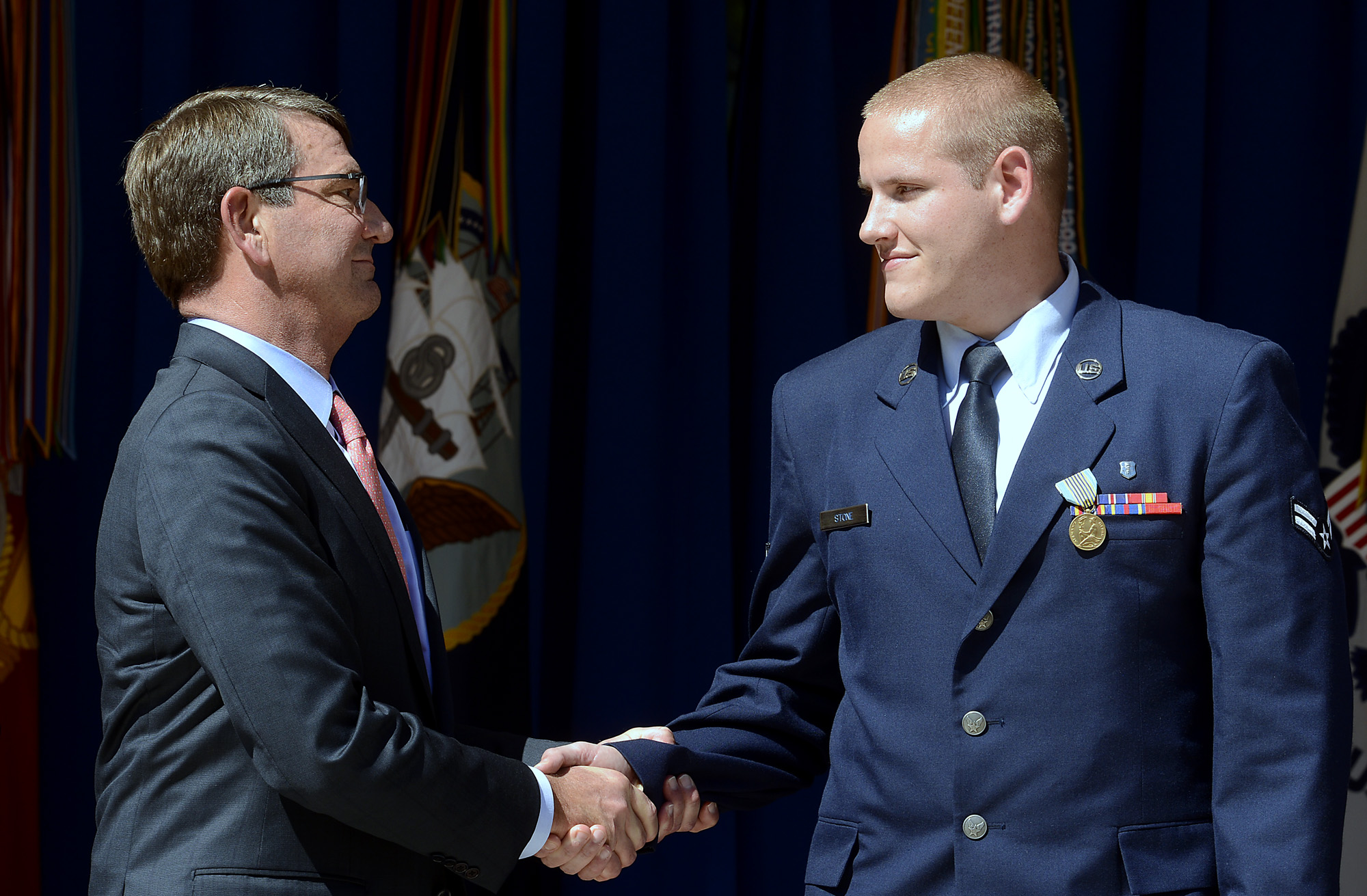
WASHINGTON (AFNS) -- Airman 1st Class Spencer Stone was released from the University of California Davis Medical Center on Oct. 15 after receiving treatment for multiple stab wounds following an altercation in Sacramento last week.

Stone was recently honored for his heroic actions in thwarting a gunman’s attack on a French train in August.

“It’s great to leave the hospital,” Stone said. “Thanks very much to the first responders and the team here at UC Davis Medical Center for taking good care of me. Thanks also to my amazing family and friends for their love and support. And, thanks to everyone who's sent encouragement during this challenging time. I'm focused on my healing and recovery and look forward to the next part of my journey."

Stone was reassigned from Lajes Field, Azores, to Travis Air Force Base, California, in October and is scheduled for accelerated promotion to staff sergeant in November through a special promotion authority.

The stabbing incident is under investigation by local law enforcement. Please call Air Force Public Affairs at 703-695-0640 for further information.

Clarke expresses confidence in 157 ARW

by Tech. Sgt. Mark Wyatt
157th Air Refueling Wing Public Affairs


10/16/2015 - PEASE AIR NATIONAL GUARD BASE, N.H.  -- The director of the Air National Guard expressed his confidence in the Airmen of the 157th Air Refueling Wing during an all-call Oct. 15 here.

Lt. Gen. Stanley E. Clarke III said the Air Force selected the right organization to lead the Air National Guard through the transition of the Air Force KC-135 to the KC-46A Pegasus air refueling aircraft expected to arrive at Pease in 2018.

"All the excellence that this wing brings, all those awards that you have, all of the pride that I see in the faces of this wing -- I have no doubt you will be able to conquer those challenges," said Clarke, whose visit comes less than a month after the wing broke ground on a KC-46 hangar expansion and modernization project that is expected to be complete in 2017.

Clarke said Pease's highly successful active duty association with the 64th Air Refueling Squadron played a role in it being selected as the first Air National Guard-led main operating base. The 64th Air Refueling Squadron is part of the 22nd Operations Group at McConnell Air Force Base, Kan., but operationally assigned to the 157 ARW. The squadron was activated in October 2009.

"Part of the reason this wing was selected to receive the new tanker is because of how well you are doing active association," he said. "I have no doubt that this is going to be a wing that knocks it out of the park when it comes to establishing themselves as the first Air National Guard KC-46 wing."

In a total force environment, Clarke told the Airmen not getting caught up in what status they're serving in, but for them to understand their mission to fly, fight and win.

"I am very proud that I am an Airman first and foremost," said Clarke, a command pilot with more than 4,000 hours in the A-10, C-26 and F-15 aircraft. "I never worried about what status I was in, I had a mission to do."

The general, spent two days at Pease before visiting with the Vermont Air National Guard, said his visit is an important tool to hear feedback from Airmen on the ground level and find ways to improve a variety of things that can impact Airmen. He also took time to highlight the many ways they are making a difference.

"We have an opportunity to serve in three different ways: warfighting, homeland operations and security," he said. "We're doing a lot on behalf of the nation."

In addressing security, Clarke highlighted the National Guard's State Partnership Program, including New Hampshire's partnership with El Salvador, and the important role it plays in building "enduring relationships" with foreign nations.

His focus on warfighting, the homeland and operations resonated with Staff Sgt. Amanda Harriman, who was coined by Clarke for her outstanding service with the 157 Medical Group.

"I really appreciated the values that he spoke about," said Harriman. "I think it truly defines who we are as National Guard members and what our future holds."

Modular Airborne Firefighting System returns to Wyoming after 14 months in Utah

by Capt. Megan Hoffmann
Wyoming National Guard


10/15/2015 - CHEYENNE, Wyo. -- A C-130H equipped with a Modular Airborne Firefighting System landed without functioning nose gear at Hill Air Force Base, Utah.

Almost 14 months later, on Oct. 13 that C-130H, tail number 1533, returned to its home at the Wyoming Air National Guard.

During an aerial firefighting mission over Utah, the crew, comprised of Guard, Reserve and active duty personnel, successfully landed the aircraft on a foam-covered runway without injury to the crew or damage to the runway when the nose landing gear failed to extend.

"The pilot made a smooth landing," said William Ferrell, a C-130 crew chief at Hill AFB and a member of the Crash Damage, Disabled and Recovery Team. "The only damage was to the underside of the aircraft."

According to sources at Hill AFB, Ferrell and eight others used a crane to lift the front of the aircraft, tow it to a maintenance area and secure it with an emergency nose landing gear extension, a process that took a little more than four hours.
Following a five-month investigation into the cause, it was determined that a broken support rod for the landing gear uplock actuator caused the failure. This damage eventually led to a fleet-wide inspection, which resulted in several other defective rods being detected.

Since that time, the C-130H has been at the 572nd Aircraft Maintenance Squadron, at Hill AFB, where the estimated $850,000 in damages caused by that landing were repaired.

Col. Steve Mehring, Air National Guard advisor to the commander at Hill AFB, said that this was a one-of-a-kind rebuild.

"A lot of creativity and ingenuity was needed since many of the C-130H structural parts that were needed are no longer made," said Mehring. "The team here did a tremendous amount of work to cross-reference parts from the current generation "J" model C-130 to find suitable parts that could be adapted. They also had to locally manufacture some parts from original blueprint drawings. It was akin to rebuilding a classic car."

"That ($850,000) is fairly low when you consider it's a $37 million aircraft," said Maj Brett Goebel, the Wyoming Air National Guard navigator who was on the flight last August. "We now have another tail back, which means we are able to better accomplish our mission, which is always our top priority."

Lt. Col. Todd Davis, 153rd Aircraft Maintenance Squadron commander, said he was pleased with the timeline and quality of the repair.

"Getting 1533 back to flying required more than just maintenance crews," said Davis. "Funding for the repair funneled quickly from National Guard Bureau to Hill and the team did an amazing job. They reskinned everything on the bottom. It looks brand new, which is pretty good for an aircraft that is that 23 years old."

Goebel said the crew knew something was wrong with the nose gear as they were on approach to Hill last summer.

"After trouble-shooting for two-and-a-half hours, it became apparent we were not going to get a fix for our problem," said Goebel.

Along with Goebel, members of the crew that were able to successfully land the aircraft were Maj. Jack Berquist, aircraft commander; his co-pilot, Maj. Derik George; flight engineer Tech. Sgt. Damian Hoffmann; and load masters, Master Sgts. Brandon York and Christian Reese - all who received the Air Mobility Command Aircrew of Distinction Award for their efforts that day which resulted in no loss of life and minimal damage to a multi-million dollar airframe.