Monday, April 27, 2015

USS Theodore Roosevelt Returns to Arabian Gulf


From U.S. Naval Forces Central Command Public Affairs

MANAMA, Bahrain (NNS) -- The aircraft carrier USS Theodore Roosevelt (CVN 71)
escorted by USS Normandy (CG 60), transited the Strait of Hormuz from its station in the Arabian Sea to the Arabian Gulf April 24, to rejoin other U.S. and coalition forces supporting Operation Inherent Resolve.

Theodore Roosevelt and Normandy had operated in the Arabian Sea since April 19 conducting maritime security operations to ensure the sea lanes in the region remained open and safe.

In recent days, the U.S. Navy had increased its presence in this area as a result of the current instability in Yemen. It is not uncommon for the U.S. Navy to position its forces in those areas requiring more focused attention in order to ensure the freedom of navigation. The United States remains committed to its regional partners and to maintaining security in the maritime environment.

Independent Deployer Certification Exercise Set to Kickoff


From Commander, U.S. 3rd Fleet Public Affairs

SAN DIEGO (NNS) -- U.S. Navy ships are scheduled to participate in an independent deployer certification exercise (IDCERTEX) in the Southern California operating area April 25-May 3.

IDCERTEX will provide a multi-ship environment to train and certify independent deployers in surface warfare, air defense, maritime interception operations, command and control/information warfare, command, control, computers and combat systems intelligence and mine warfare.

The exercise, led by Commander, U.S. 3rd Fleet (C3F) and executed by Commander, Carrier Strike Group Fifteen (CSG 15), will include Commander, Carrier Strike Group (CSG) 3, Commander, Naval Mine and Anti-Submarine Warfare Command (NMAWC), Commander, Carrier Air Wing Nine (CVW 9), Commander, Destroyer Squadron 21 (DESRON) 21, the aircraft carrier USS John C. Stennis (CVN 74), the guided-missile cruiser USS Mobile Bay (CG 53), the guided-missile destroyers USS Higgins (DDG 76), USS Chung Hoon (DDG 93), USS Kidd (DDG 100), USS Stockdale (DDG 106), USS William P. Lawrence (DDG 110), and Littoral Combat Ship USS Freedom (LCS 1).

IDCERTEX will serve as CSG 15's final opportunity to evaluate and certify Higgins and Sailors from USS Fort Worth (LCS 3) Crew 101, embarked aboard Freedom, across multiple warfare areas prior to regularly scheduled deployments.

The exercise involves training between multiple ships and aircraft and consists of flight operations, submarine tracking, strait transit formations, replenishment-at-sea and other required mission evolutions.

"This exercise not only serves as an opportunity to certify Higgins and LCS Crew 101 to execute a wide variety of missions while deployed, but also leverages other units scheduled to be underway, such as the John C. Stennis Carrier Strike Group, to provide integrated training that Higgins and LCS Crew 101 wouldn't otherwise have," said Rear Adm. Joe Kuzmick, commander of CSG 15.

Freedom and Higgins are homeported in San Diego as part of U.S. 3rd Fleet.

Leading the naval forces in the Eastern Pacific from the West Coast of North America to the international date line, U.S. 3rd Fleet provides realistic, relevant training necessary for an effective global Navy.

Oklahoma City Visits Yokosuka During Routine Patrol


By Mass Communication Specialist 2nd Class Brian G. Reynolds, Commander, Submarine Group 7 Public Affairs

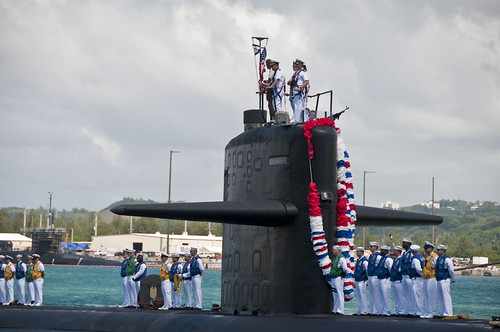
FLEET ACTIVITIES YOKOSUKA, Japan (NNS) -- The Los Angeles-class fast-attack submarine USS Oklahoma City (SSN 723) arrived at Fleet Activities Yokosuka April 22, for a port visit during its deployment to the Western Pacific.

This was the first port visit for Oklahoma City's crew during its current deployment.

Measuring more than 360 feet long and weighing over 6,000 tons when submerged, Oklahoma City is one of the most modern attack submarines in the world. The submarine's stealth, mobility, endurance, and firepower allow this covert, multi-mission platform to operate independently or in conjunction with a carrier strike group or joint forces to support the interests of the United States wherever and whenever needed.

The scheduled visit gave Oklahoma City crew members the opportunity to explore the rich history and culture of Japan.

Oklahoma City is the second U.S. ship to be named for Oklahoma City, Oklahoma. Commissioned on July 9, 1988; Oklahoma City is the 35th nuclear-powered fast-attack submarine of the Los Angeles class. Oklahoma City is currently homeported at U.S. Naval Base Guam.

Joint Warrior: Behind the rotors

by Senior Airman Erin O'Shea
48th Fighter Wing Public Affairs


4/24/2015 - ROYAL AIR FORCE LOSSIEMOUTH, Scotland -- Many miles from their duty stations, thousands of NATO military members from 14 countries gathered together for exercise Joint Warrior 15-1 in Scotland.

RAF Lakenheath's 56th and 57th Rescue Squadrons, comprised of HH-60G Pave Hawk helicopters and Guardian Angel pararescuemen, are taking part in this year's exercise.

Over land, over the seas and through the skies, the rescue Airmen train as if every flight is a critical, life-or-death extraction operation. Although training at their home station is important, these rescue squadrons fully embrace the significance of training with other countries in order to fully understand how they each operate in real-world situations.

In order for the HH-60s to fly, and for the pilots and pararescue forces to operate, there are many moving hands and technical skills in maintenance that make the mission possible.

"We're here to help support the training of the 56th RQS," said Senior Airman Timothy Nicoll, 56th Helicopter Maintenance Unit assistant dedicated crew chief. "On a day-to-day basis, we usually come out, prepare the helicopters and do any modern maintenance we can to help prepare them for the day."

Many maintainers and crew chiefs, like Nicoll, arrive on-scene early in the mornings to ensure the aircraft are properly maintained and ready for daily operations.

"I feel proud that I can help contribute to the training of the aircrew so they can perform their mission; which is to help save lives," Nicoll added.

Before aircrew can board their aircraft, aircrew flight equipment, or AFE, personnel ensure flight suits and equipment work properly. The AFE team is in charge of providing all necessary aircrew equipment needed for rescue operations, like survival radios and night vision goggles.

"Our specific mission is to make sure the gear they fly with is ready to go all the time, no matter what," said Staff Sgt. Whitney Tuttle, 56th RQS AFE.

All members of the rescue team benefit from the training at Joint Warrior - whether they're in the air or on the ground.

"It's important for all of us to do these exercises because it helps us in the real-world and gives us the ability to see the difference between here and working from our home stations," Tuttle said. "The interaction builds not only a bond, but builds open communication with other nations."

While aircraft require maintenance to be ready for flight, so do the weapons they carry.  The personnel maintaining these weapons are another integral part of the rescue mission.

"Our job's important because our weapon systems provide the coverage for extracting people from a hazardous area," said Staff Sgt. Austin Gorbet, 56th HMU weapons expediter. "Without us, they couldn't enter these areas to save lives. We ensure our weapons operate efficiently so the member can be extracted."

When an aerial gunner or pilot pulls the trigger on their weapon, its accuracy depends on the hands of these weapons personnel.

"They fire a lot of ammunition downrange, and, if we aren't giving the training to the aircrew, they won't be ready for the real situation," Gorbet added. "That's what we're doing here."

Many moving parts come together to ensure the rescue rotors continue moving in full circle. With all Airmen working simultaneously in their respective specialties, the squadron continuously trains and prepares to ensure every task before them amounts to mission success.

Joint Warrior: It's what we train for

by Senior Airman Erin O'Shea
48th Fighter Wing Public Affairs


4/27/2015 - ROYAL AIR FORCE LOSSIEMOUTH, Scotland -- They train for air-to-air combat missions, are rapidly deployable, execute worldwide combat search and rescue, and sustain operations around the world during both war and peace.

They are RAF Lakenheath's 56th and 57th Rescue Squadrons, comprised of two weapon systems: the HH-60G Pave Hawk helicopters and the Guardian Angel pararescuemen, respectively.

Both squadrons recently completed a two-week, multinational exercise know as Joint Warrior 15-1 in Scotland.

"Here at Joint Warrior we are training for different scenarios that provide us with training for various possibilities we could encounter in the future," said Staff Sgt. Henry Flores, 56th Rescue Squadron special missions aviator. "We started off with different threat possibilities that we could encounter."

Special mission aviators , like Flores, are tasked with firing the Pave Hawk's .50-caliber machine gun. They also provide CSAR capabilities for both their aircrew and downed personnel, control the aircraft's hoist and provide protection to the aircraft using their weapons.

During the multinational training, military personnel from 14 countries practiced threat-reaction scenarios and flew long missions, both day and night.

"Training out here allows us to step away from that possibility of getting complacent of the things that we're used to seeing every day," Flores said. "Opening up to a different environment allows us to see different things, provide approaches, and encounter different possibilities we may need to maneuver around."

According to Flores, the rescue squadrons find it important to attend exercises like Joint Warrior, to train in various types of situations. During the exercise, they performed tactical combat maneuvers over both land and sea to prepare for real-world operations.

"We performed terminal area engagement as well as mountain flying, which gave us the ability to perform high-density altitude training," said Capt. Sky Jensen, 56th Rescue Squadron pilot and chief of weapons and tactics. "They have a great range here for us to be able to shoot our weapons so we can do land training."

Practicing flying and operating in different environments is an essential part of training for special mission operations, as the squadron can respond to incidents worldwide.
"We train for personnel recovery, combat search and rescue missions, medical evacuations; basically a wide variety of what the helicopter can provide," Flores added.

The Guardian Angel pararescuemen, also knows as PJs, are responsible for recovering and medically treating personnel involved in hazardous situations. These elite, combat forces are trained to survive in harsh environments.

"We try to make every full mission profile or whatever training we're doing as realistic as possible," said Staff Sgt. Christopher Sanders, 57th RQS pararescueman journeyman. "We use it as a time to bring up short falls we haven't realized yet so that hopefully they come out in training and not when we're downrange."

The pararescue community is small, which provides motive for the PJs to work closely together, in an integrated working environment.

"PJs by nature - we are all pretty diverse," Sanders added. "Even though we have a lot of the same training, we have slightly different ways of thinking. By doing training like this, it gets us all on the same page. So, when we do it for real, we don't have to think about it as much - we pretty much know what's going to happen."

For Airmen like Flores, who are new to the unit, getting to know the people you fly and train with can be vital.

"A lot of these training sorties are helping me get to know the rest of the crew," Flores said. "So future missions we will be able to mesh a lot better."

Joint Warrior provides them the opportunity to work closely with not only their units, but also military members from different countries.

"It's a great opportunity for us to teach about combat search and rescue, personnel recovery, as well as build that partnership with our allies that play in the exercise and learn about their contribution to future combat capabilities," Jensen said.

Having open communication and learning from one another is a concept that is greatly enforced during these multinational exercises.

"The British have been awesome," Jensen added. "They have housed, supported us, and given us a place to work out of, so building partnership with them has been a great experience for everyone here."