Wednesday, July 15, 2020

U.S. Navy Amphibious Assault Ship USS Tripoli Joins the Fleet

July 15, 2020

The U.S. Navy commissioned USS Tripoli (LHA 7), today, July 15, 2020.

Although the Navy canceled the traditional public commissioning ceremony due to public health and safety restrictions on large public gatherings, the Navy commissioned the USS Tripoli administratively and the ship transitioned to normal operations. Meanwhile, the Navy is looking at a future opportunity to commemorate the special event with the USS Tripoli’s sponsor, crew and commissioning committee.

“USS Tripoli is proof of what the teamwork of all of our people – civilian, contractor and military – can accomplish together,” said Secretary of the Navy Kenneth J. Braithwaite. “This ship will extend the maneuverability and lethality of our fleet to confront the many challenges of a complex world, from maintaining the sea lanes to countering instability to maintaining our edge in this era of renewed great power competition.”

Rear Adm. Philip E. Sobeck, commander, Expeditionary Strike Group THREE, welcomes the Navy’s newest amphibious assault ship, and crew, to the amphibious force.

“Tripoli is an example of the continued investment in our Navy, to increase and maintain our edge on the battlefield,” said Sobeck. “Congratulations to Tripoli’s crew for all of your hard work, amidst these challenging times, to reach this milestone. We welcome you to the amphibious force, of combat ready ships and battle-minded crews to go to sea and support sustained combat operations.”

LHA 7 incorporates key components to provide the fleet with a more aviation-centric platform. Tripoli’s design features an enlarged hangar deck, realignment and expansion of the aviation maintenance facilities, a significant increase in available stowage for parts and support equipment, and increased aviation fuel capacity. The ship is the first LHA replacement ship to depart the shipyard ready to integrate the entire future air combat element of the Marine Corps, to include the Joint Strike Fighter.

Along with its pioneering aviation element, LHA 7 incorporates gas turbine propulsion plant, zonal electrical distribution, and fuel-efficient electric auxiliary propulsion systems first installed on USS Makin Island (LHD 8). LHA 7 is 844 feet in length, has a displacement of approximately 44,000 long tons, and will be capable of operating at speeds of over 20 knots.

Tripoli’s commanding officer, Capt. Kevin Myers, highlighted Tripoli's accomplishments over the past several months getting through initial sea trials. The hard work and dedication of the entire team during the past few years was evident in the successful execution of at-sea testing.

“Being the third ship to bear the Tripoli namesake is a profound honor and this crew stands ready to carry on the legacy of our longstanding Navy and Marine Corps amphibious community,” said Meyers. “These sailors and Marines will pave the way for those still to come. What’s remarkable is seeing the dedication, perseverance and resilience these new plank owners have shown since day one, and more recently, through uncertain times as the Navy and nation work through a pandemic. There is no doubt in my mind that this team is ready to answer the nation’s call at any time or place.”

LHA 7 is the third Navy ship to be named Tripoli. The name honors and commemorates the force of U.S. Marines and approximately 370 soldiers from 11 other nationalities who captured the city of Derna, Libya, during the 1805 Battle of Derna. The battle resulted in a subsequent peace treaty and the successful conclusion of the combined operations of the First Barbary War, and was later memorialized in the Marines' Hymn with the line, “to the shores of Tripoli.”

Media may direct queries to the Navy Office of Information at (703) 697-5342. For more information about the Amphibious Assault Ships class:  http://www.navy.mil/navydata/fact_display.asp?cid=4200&tid=400&ct=4.

Tuesday, July 14, 2020

Sea Squad

Two Navy MH-60S Seahawk helicopters conduct a vertical replenishment with the USS Nimitz in the Philippine Sea, July 13, 2020.

Craft Competition

Marines dash into the water carrying a combat rubber raiding craft during a squad competition in Okinawa, Japan, July 7, 2020. The competition tested the Marine’s ability to maneuver the craft and demonstrate safe capsize procedures.

Guardsmen Assist Ohio's COVID-19 Testing Effort

July 14, 2020 | BY AIR FORCE STAFF SGT. AMBER MULLEN

Airmen assigned to the Ohio Air National Guard's 178th Wing augmented the staff of Centerpoint Health at the Community Building Institute in Middletown, Ohio, to help with drive-thru coronavirus testing of the local community.

The airmen worked alongside Ohio Army National Guard medics from the 174th Air Defense Artillery Brigade and the 285th Medical Company. Teamed up in groups of two, they were in charge of verifying patient information, performing nasal swab COVID-19 testing and properly packaging and storing the testing specimens. The guardsmen partnered with Centerpoint Health personnel who were in charge of facilitating the drive-thru testing event and getting patients checked in.

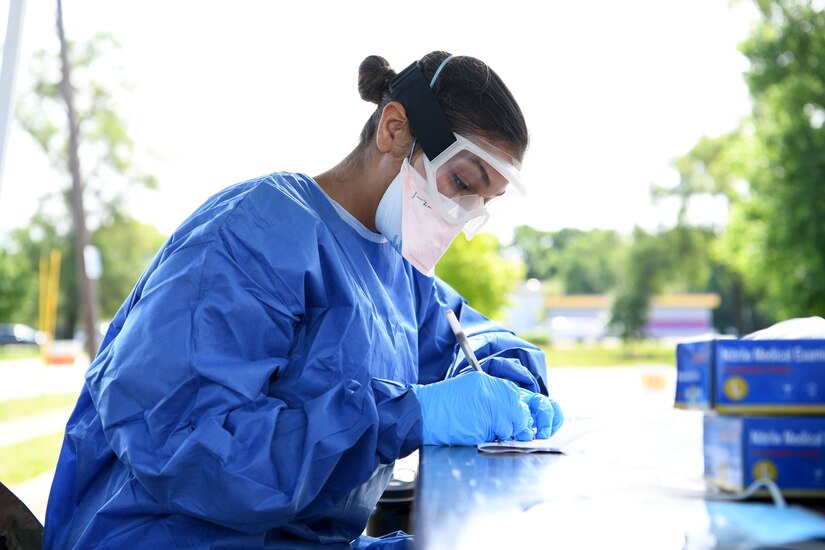
An airman wearing protective gear fills out patient information.
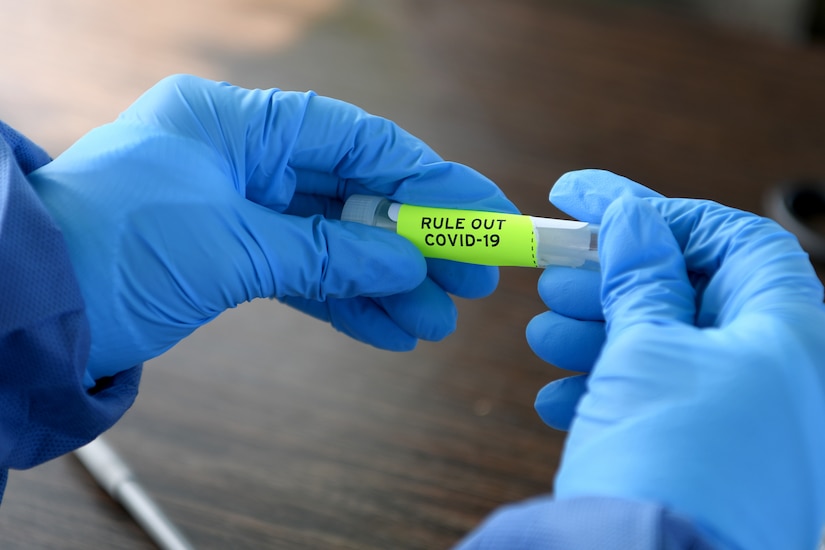
An airman wearing protective equipment holds a vial containing a COVID-19 sample.

Air Force Senior Master Sgt. Sarah Berzes-Vaughn, the superintendent of Dental Services in the 178th Medical Group, served as the squad team lead and helped facilitate the community testing while overseeing the guardsmen involved in the effort. Air Force Staff Sgt. Christina Pumphrey, a medical technician assigned to the 178th Medical Group, Air Force Staff Sgt. Luis Morales, a dental technician assigned to the 178th Medical Group, and Air Force Tech. Sgt. Diane Broadnax, a medical technician assigned to the 123rd Air Control Squadron, verified patient information and performed the COVID-19 nasal swab tests.

"The community members check in with Centerpoint Health, and they are given a bag and lab requisition form," Berzes-Vaughn said. "Once they get to the testing pod, they'll be swabbed in each nostril, and then the swab goes into the reagent. Then we'll make sure the patient identifiers are on the sample and properly stored until they are ready to be sent to the lab."

Coming out here and helping out lets them know that we are here to help our state and our country in times of need."
Air Force Staff Sgt. Luis Morales, a dental technician, 178th Medical Group

On June 11, Gov. Mike DeWine announced that anyone in Ohio could receive a coronavirus test, even if they were low-risk or not showing symptoms. Recent data showed an upward trend in cases in southwest Ohio, and this prompted the creation of pop up testing sites statewide. With the increased demand for individuals seeking a test, the Guard members were able to support to their fellow Ohioans.

"[The testing] is going to be able to save lives by being able to do contact tracing," Berzes-Vaughn said. "It's really important for us to be able to help out our community."

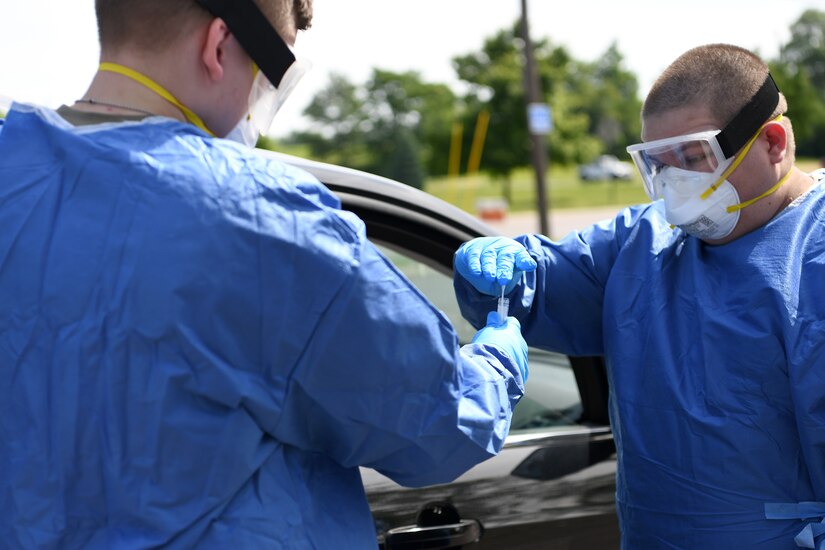
A soldier wearing protective equipment places a COVID-19 testing swab into a vial.

"It's been a great opportunity to be out in the community and talking to patients that come through the drive-thru for testing," Morales said. "I think it’s important for us to come out here and help out the community in a time of need."

It's important for the National Guard to be out in the community. "Coming out here and helping out lets them know that we are here to help our state and our country in times of need," she said. "Being able to give back is the reason why I joined the Guard. I am thankful for this opportunity to help out in any way that I can."

(Air Force Staff Sgt. Amber Mullen is assigned to the 178th Wing.)

Guardsmen Bring Food, Hope to Community During COVID-19

July 14, 2020 | BY Army Spc. Hannah Tarkelly

Soldiers from the North Carolina Army National Guard's 449th Theater Aviation Brigade worked alongside volunteers from Team Rubicon, a veteran disaster relief service organization, Action Pathways, a nonprofit organization; and the Second Harvest Food Bank Southeast to distribute food to about 250 families at the Midway Elementary School in Dunn, North Carolina.

Guardsmen assigned to the 2-130th Airfield Operations Battalion and the 1-130th Attack Reconnaissance Battalion worked together with local organizations to help feed citizens during COVID-19.

"It's a very humbling experience," Army Sgt. 1st Class Jason Norris, assigned to the 1-130th ARB, said. "You actually get to see, face to face, the families that you're helping."

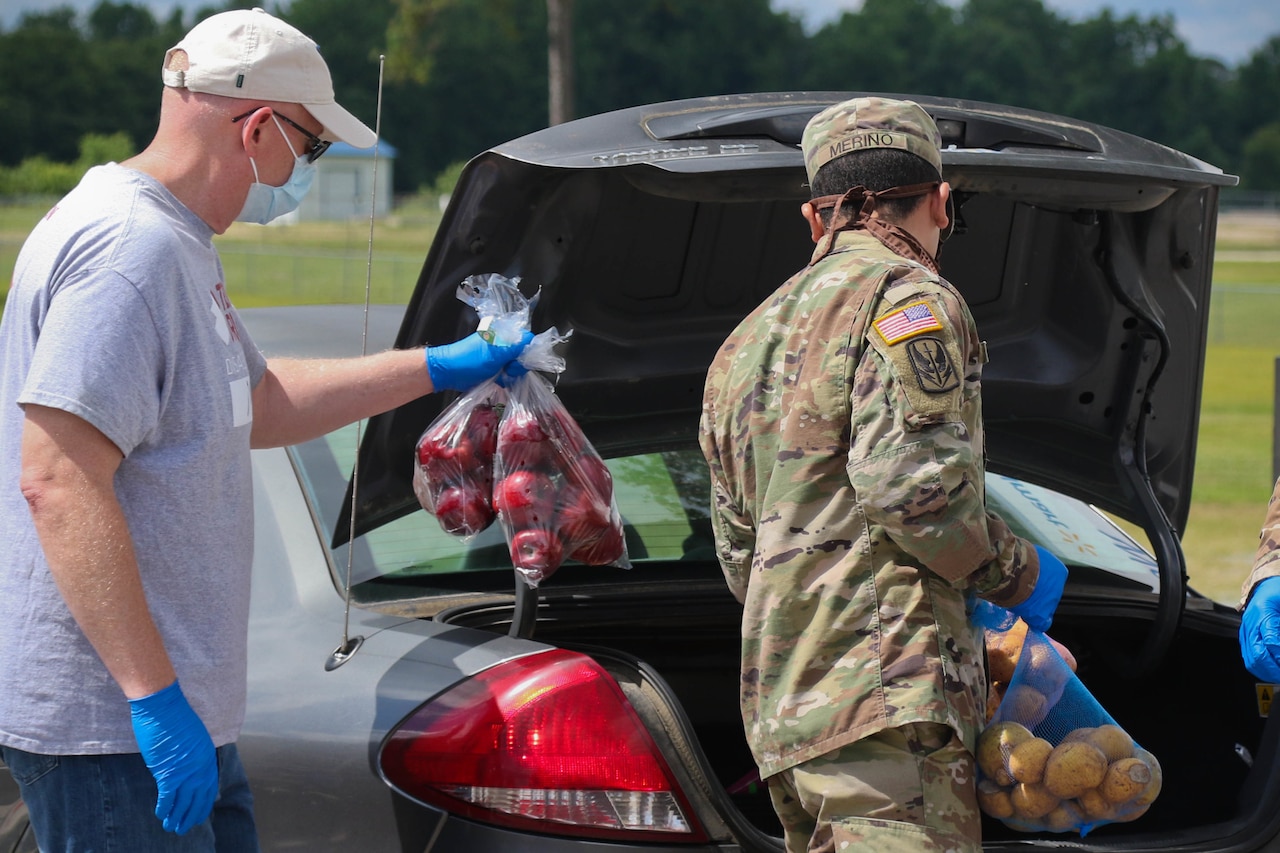
A soldier and a civilian place bags of food into a vehicle.

The guardsmen helped distribute meals and fresh produce such as potatoes, apples, watermelons, oranges, lettuce and meat.

As food rations dwindle and unemployment rises, families have found themselves in difficult circumstances. Therefore, the Guard is working with state agencies and local food banks to help support COVID-19 relief efforts.

"It feels good," Army Spc. William Best, assigned to the 2-130th AOB, said. "You actually get to see that you're making a difference."

Team Rubicon worked alongside the guardsmen during the food distribution to help provide the community with nutritious meals and produce. Team Rubicon and the guardsmen communicated and worked in an organized fashion to distribute an accurate amount of food to each family in an efficient and timely manner.

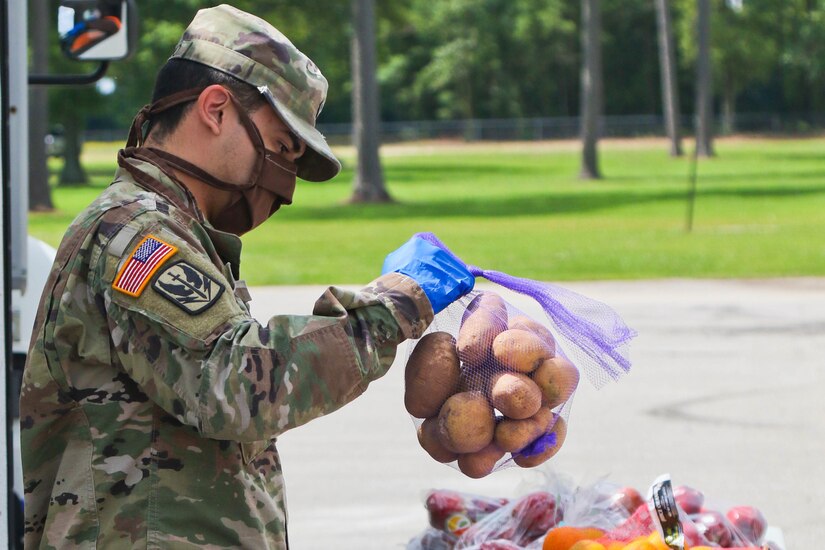
A soldier wearing a face mask sorts produce for distribution.
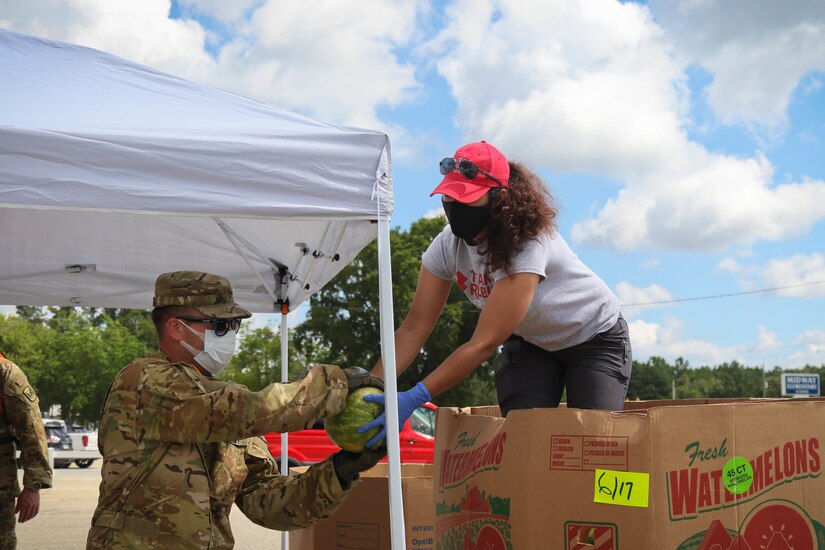
A soldier hands a watermelon to a woman in the bed of a truck. Both are wearing face masks.

"It's a wonderful working relationship," Norris said. "The camaraderie these groups have is absolutely astounding."

Team Rubicon's efforts have made a tremendous impact in helping with COVID-19 relief operations. Volunteers from across the state gathered to dedicate their time and help fellow Tar Heels in need.

"It's been a pretty amazing dynamic," Claudia Suarez, a volunteer for Team Rubicon, said. "As a volunteer I've worked with the National Guard in the Patriot Southeast exercise and now here at the food bank. We're two different organizations, but we have similar missions and similar goals as humans."

(Army Spc. Hannah Tarkelly is assigned to the 382nd Public Affairs Detachment.)

Sports Heroes Who Served: Once an Olympic Hopeful, Army Captain Finds Victory in Nursing

July 14, 2020 | BY David Vergun , DOD News

Almost every sporting event in the United States has been postponed due to the COVID-19 pandemic. To help fill the void, this series looks at sports heroes who also served in the military.


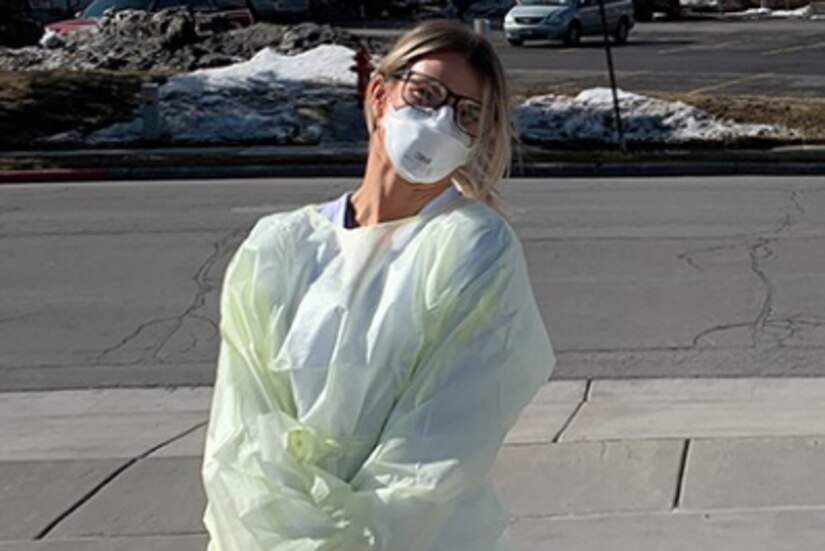
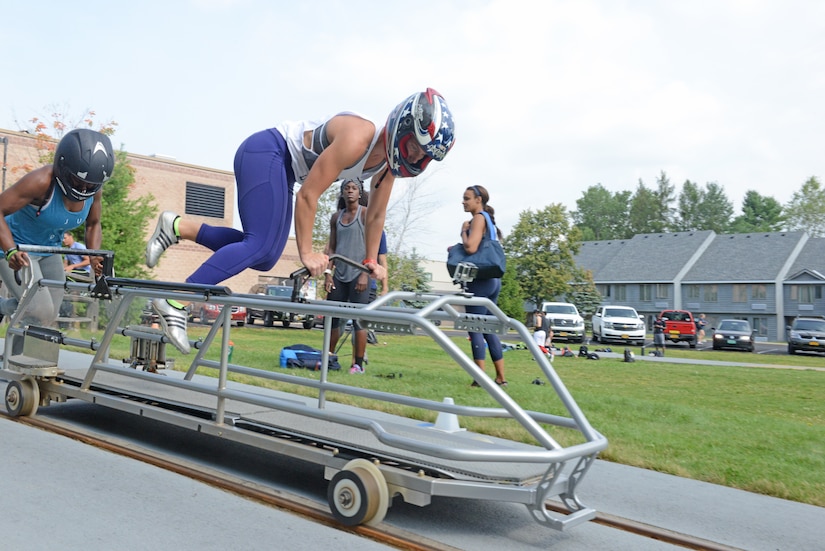
Kristi Koplin has an impressive athletic background in track and field. She currently holds Southern Utah University's school record in the hammer throw, discus and weight throw. She was an alternate in the 2014 Olympics and is a former member of the Army's World Class Athlete Program in the bobsled.

These days Koplin is experiencing victory as a captain in the Army Nursing Corps with the 328th Field Hospital at Fort Douglas, Utah; a nurse at Urgent Care in Heber City and Park City, Utah; and a graduate of U.S. Army Airborne School.  

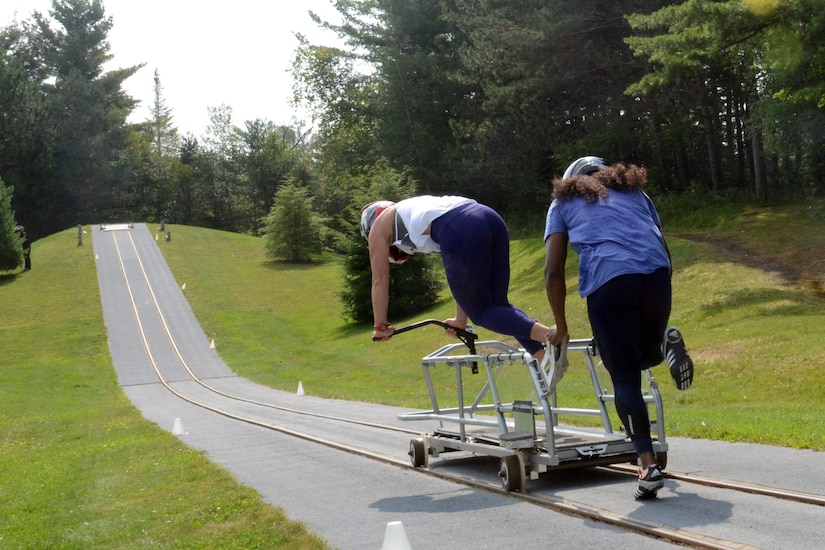
Bobsledders barrel down a railway track.

In 2014, Koplin was selected as an alternate in the Winter Olympics in Sochi, Russia. For the next three years she competed on the North American and World Cup circuits. In 2018 and 2019, she began training for the 2022 Winter Olympics in Beijing, China. 

In early January 2020, Koplin crashed during her second-to-last run of the North American Cup Bobsled and Skeleton in Lake Placid, New York, suffering head and neck injuries.

"I was knocked unconscious and woke up with the bobsled smashing my head against the ice and crushing my neck," she said during a recent interview with DOD News. "The crash ended my season early and I left for home to recover. By some miracle, I was not seriously injured."

Koplin announced June 23 that she's retiring from the sport. 

"I still have concerns about my brain health. I have suffered a few concussions and I worry about the cumulative effect of these," she said. "I love bobsledding so much, the speed and racing, the opportunity to represent our nation as an athlete and the process of working towards a goal that I have been envisioning for a large part of my life. However, I also value my health and the decision has been something weighing on me since the accident."

"I am always looking forward to my next dream to chase. I am absolutely positive that everything works out exactly like it is supposed to," she added.

Bobsled can be a dangerous sport where speeds often exceed 75 mph. A number of athletes have been killed and most have experienced mild to severe injuries in crashes.

These days Koplin is very busy nursing and dealing with COVID-19 patients.

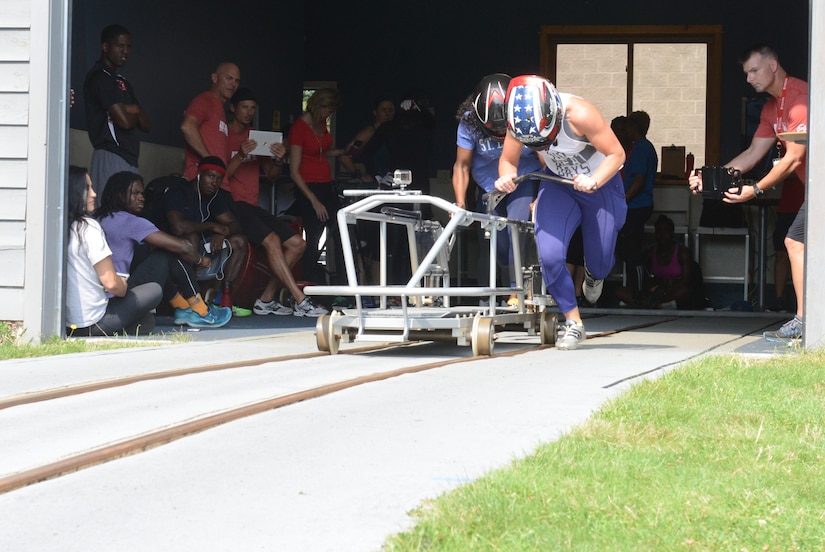
A bobsledder pushes her sled on a competition track.
Bobsledders barrel down a railway track.

"I remember the day when they announced that two of the Utah Jazz [basketball] players had tested positive and the entire NBA season would be postponed," she said, referring to the National Basketball Association. "The news itself shocked me. The virus felt like it had hit home. From that point forward, everything changed."

The Urgent Care in Park City became one of the nation's first testing sites for COVID-19, she said. A lot of people tested positive in the area because it's a tourist destination for international travelers, particularly during the Sundance Film Festival, which took place in January and February, as the coronavirus was beginning to rapidly spread.

About that time, she said "We started testing people and educating the community about how to stay safe. With all the unknowns and uncertainty, I could feel the panic emoting from most of the patients I saw." 

"My focus shifted," she continued. "I was no longer worried about my recovery from the bobsled injury but how to react to this unknown virus invading our lives."

Koplin said some of her most rewarding experiences were caring for wounded and injured soldiers returning from Iraq and Afghanistan at Landstuhl Regional Medical Center in Germany.

Woman in personal protective equipment poses for photo.

Being a nurse has been a good fit for her Olympic ambitions too, she said. Her training gives her an appreciation and understanding of how the body works and the important roles played by exercise and nutrition.

Also, her expertise was occasionally needed during training, such as when a bobsled crashes and once when an athlete from another sport was injured by a javelin.

As a former member of the World Class Athletic Program, Koplin urges others to use that organization as a means for achieving their dreams. She said there are perhaps many soldiers who have it in them to compete and would love to become Olympians, but don't realize how easy it is to apply, simply by visiting the WCAP website, looking up the criteria for a chosen sport and filling out an application.

Koplin mentioned that even with drive and determination, she would have struggled without the support of WCAP in terms of coaching, providing first-class training facilities and financing. "Being in WCAP took away any worries so I could focus 100% on training."

There are several factors that aspiring athletes should consider, she said. First and foremost, the person should be a good soldier. While training, it is up to each soldier to continue to meet the Army's requirements, including the physical fitness test and annual weapons qualification. Also, living the Army values, she said.

Bobsledders barrel down a railway track.

Training and diet play an enormous part too, she said, noting that she does rigorous workouts with weights and sprinting six days a week.

One final factor that Koplin said it takes — and she hesitated to mention it for fear of sounding mean — is genetics.

"No matter how self-motivated and hard-working you are, if you don't have the genes for your chosen sport, you won't succeed," she said.

Monday, July 13, 2020

Parachute Salutes

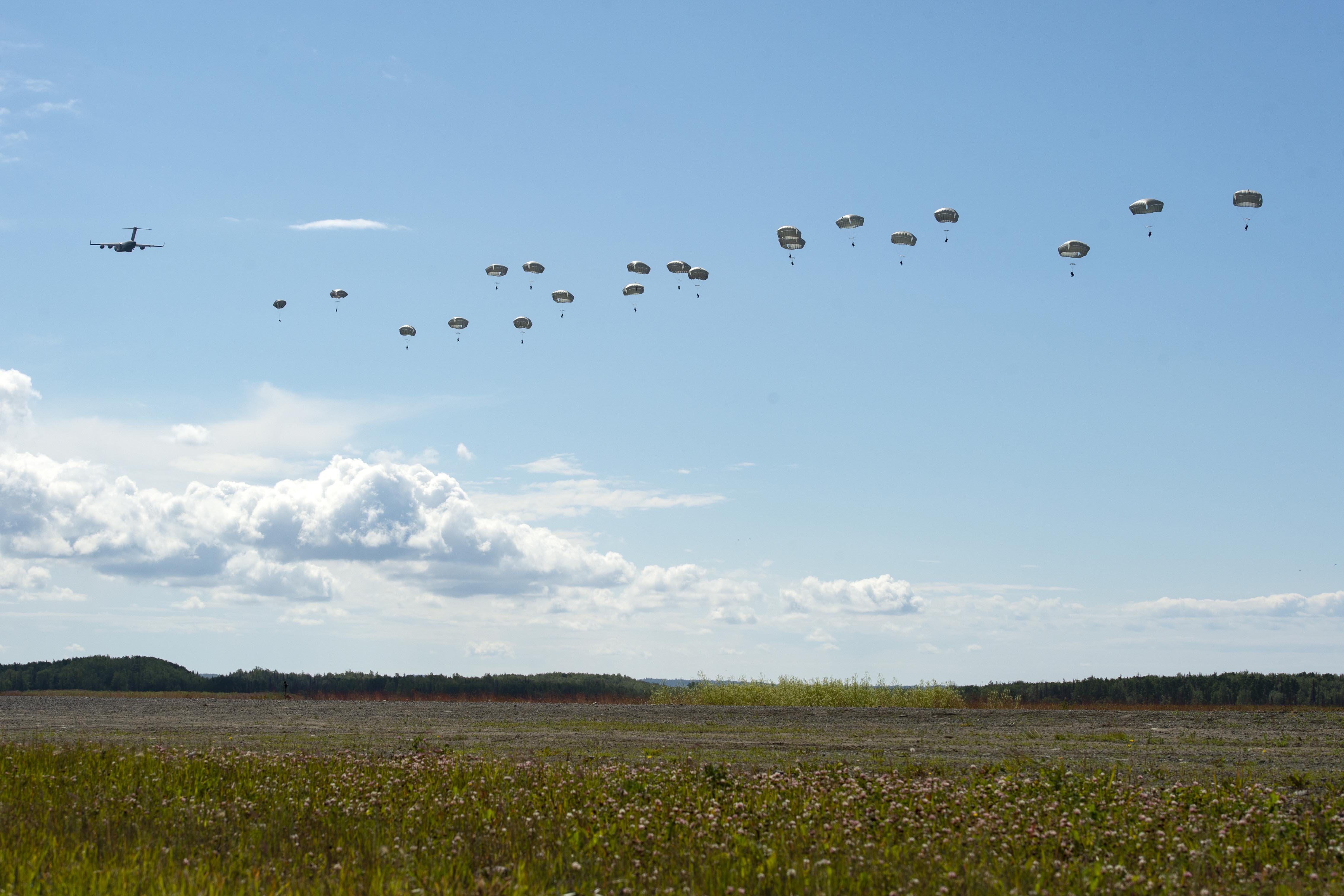
Army paratroopers jump from an Air Force C-17 Globemaster III over Joint Base Elmendorf Richardson, Alaska, July 10, 2020, as part of JBER Salutes, a two-day event to show appreciation to service members, nearly 100 Anchorage-area “COVID Heroes” and their guests.

Michigan Guardsmen Conduct Free COVID-19 Testing

July 13, 2020 | BY Army Staff Sgt. Tegan Kucera

Soldiers with the Michigan National Guard's Task Force 182nd provided free COVID-19 drive-thru testing in Cadillac, Michigan, for anyone who wanted to be tested.

"For the past couple of months, we've been assisting with COVID-19 testing across the state with prisons, long-term care facilities, community events and even soldiers for pre and post [annual training] testing," said Army Sgt. 1st Class Emanuel Mosley.

As the platoon sergeant for the task force within the 272nd Regional Support Group, Mosley was in charge of all the teams at the Cadillac testing site. All of the soldiers want the participants to feel as comfortable as possible while taking the test, he said.

"Any way I can help, it doesn't matter what it is, if I'm able to assist anything to ease that anxiety that people may have," Mosley said. "I understand this is a dynamic that no one ever experienced before, unless you're over 100 years old. This is something different that the world has to deal with, and I support it all the way. As long as I'm here to help, I'll do what I can."

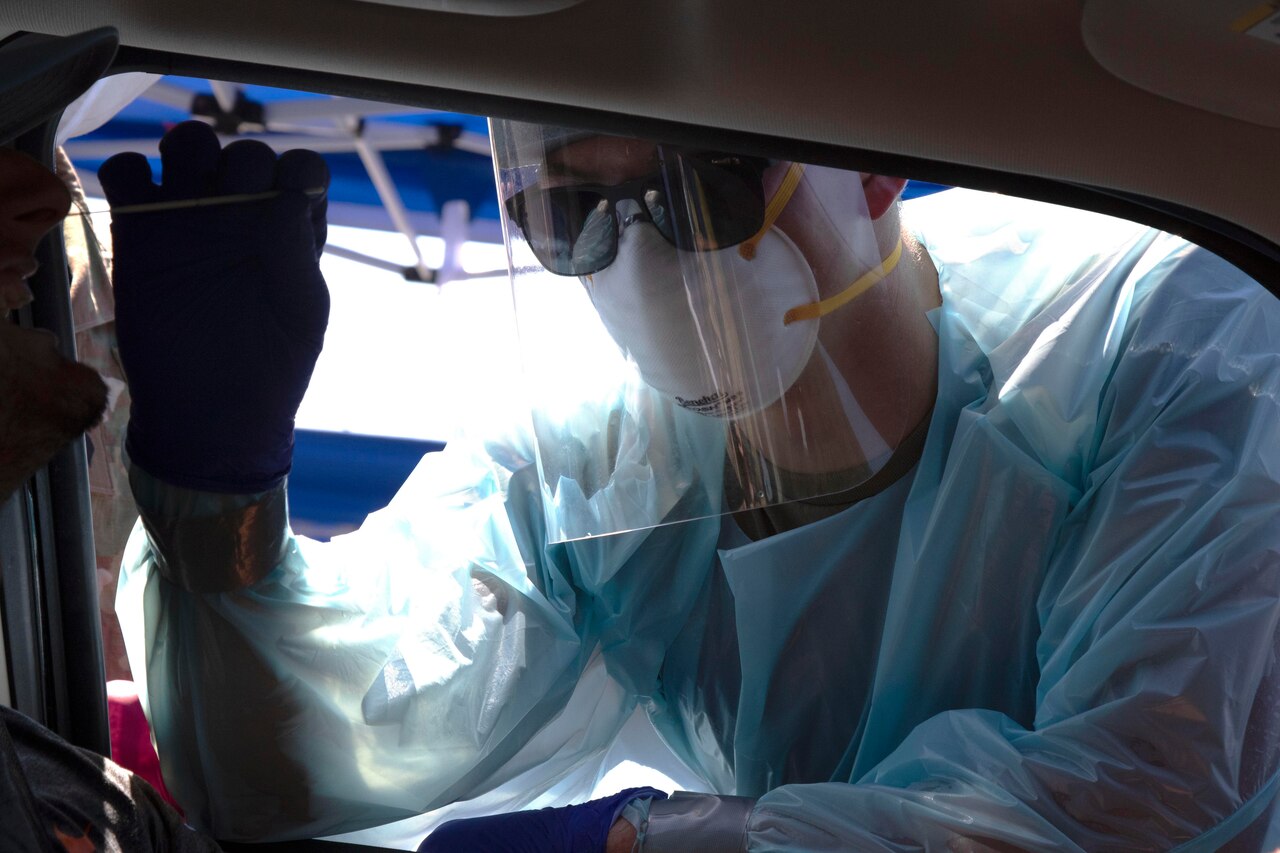
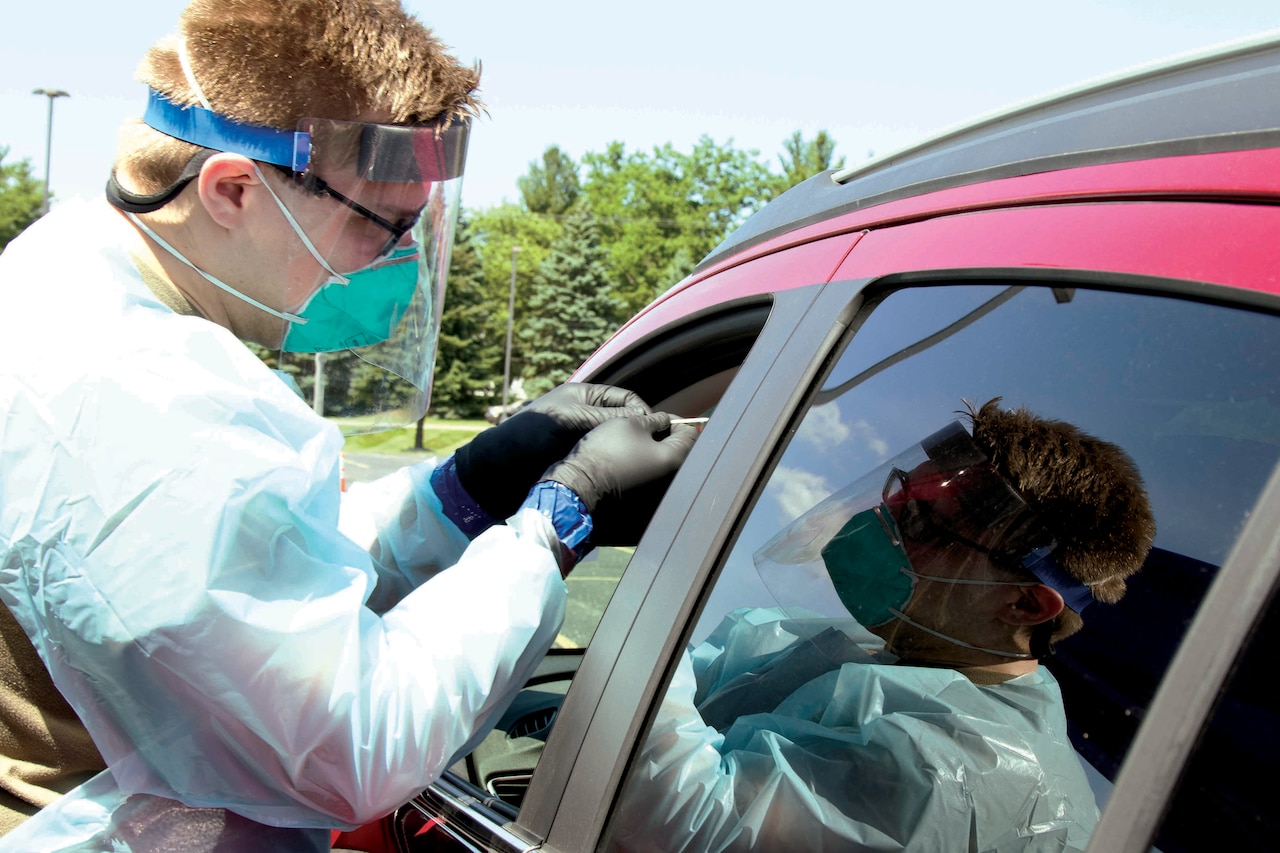
A soldier wearing protective equipment administers a COVID-19 test to a motorist through the car’s open window.

For Mosley, this means talking with the citizens, explaining what they are doing and just easing the pressure they may be feeling. He said he hopes the participants will go and tell others, so they will be more inclined to get their own test done.

Testing the communities is just the current stage of the task force's mission. They started out testing prisoners and then moved onto testing long-term care patients. They are still delivering testing kits to any long-term care facilities that request them.

"I enjoy this,' Mosley said. "Having more than 19 years in, and being toward the end of my career, this is something different. This virus hit the world unexpectedly, and we were called up to participate. This has been great, and we've been enjoying ourselves as well as learning new things."

After so many years in the guard, this is the first time Mosley has participated in a state relief effort. But some guardsmen, like Army Pvt. Tyler Stone, were greeted by the pandemic straight out of the gate.

"It definitely threw me in the deep end, but I love it," Stone said. "I'm actually really glad I get this opportunity, because things like this don't come along that often. I'm just really glad I got out of training in time for this, and that I was able to help in any way that I could."

Stone completed his advanced training to become a medic a month before he was called up to be on this mission. He did not even have the opportunity to attend his first drill before he started performing tests across the state.

A soldier wearing protective gear administers a COVID-19 test to a motorist through a car’s open window.

"Since we've opened, we've had nonstop people coming in, which is just fantastic because that's what we're here for. We love to see a big crowd," Stone said. "We love to help the community in any way we can."

Although the testing was conducted in the middle of the week, the turnout was far greater than expected. Task Force 182nd normally operates testing sites on the weekends, but for this one, they had old and young coming through, along with a young adult baseball team coming after practice.

"After doing this I think I will appreciate what the National Guard does even more, because a lot of people don't really understand all that we do," Stone said. "Getting to be out here and actually working to make a difference in my community is great. I've loved every second of it. I think enlisting was the best decision of my life."

Whether it comes at the beginning of a career or at the end, the soldiers who are conducting the COVID-19 tests really appreciate what they are doing. After conducting more than 60,000 tests, the teams with Task Force 182nd are making a difference all around the state.

(Army Staff Sgt. Tegan Kucera is assigned to the Michigan National Guard.)

Pennsylvania National Guard Augments State's Incident Management Team

July 13, 2020 | BY Army Lt. Col. Angela King-Sweigart

Several Pennsylvania National Guard soldiers integrated with the Pennsylvania Emergency Management Agency's incident management team to assist in planning the agency's COVID-19 response.

PEMA officials realized early that this response would be larger and more complex than prior responses, explained Army Maj. Jim O'Shea, the Pennsylvania National Guard’s emergency preparedness liaison officer for PEMA and the domestic operations exercise officer.

''So, one of the first augmentations they asked for were planners from the Pennsylvania National Guard,'' O'Shea said. “The Pennsylvania Guard is frequently mobilized to assist in emergencies like snow storms or flooding event. But those responses are often limited to a few counties for a few days.

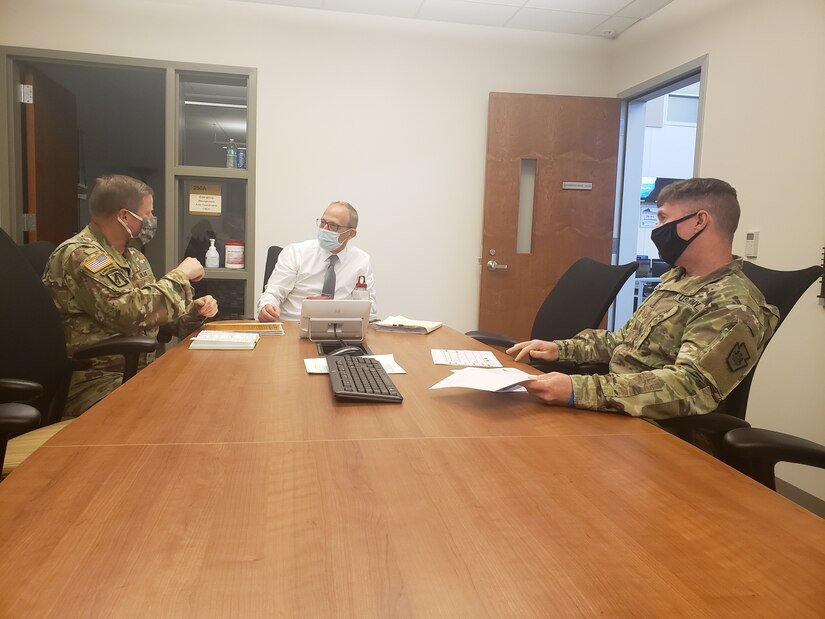
Two soldiers and a civilian, all wearing face masks, talk as they sit at a conference table.

''We are always ready to assist with troops that can provide capabilities like transportation as well as providing liaisons [at PEMA] and at the County Emergency Operations Centers,'' he continued. ''However, we have not previously provided planning support to the state incident management team. For COVID-19, we assisted the IMT as well as provided PEMA and [Department of NHealth] support with the Pennsylvania National Guard military medical planning team.''

Military members — with their experience in dealing with complex, prolonged, fluid and emergency events — are well-suited to assist in planning a large-scale and extended emergency response like COVID-19, said Army Lt. Col. Travis Shick, one of the planners who assisted.

''We don't do anything without formalized plans and analysis,'' Shick said. ''We may not always have the perfect answers, but if you needed planners in a rapid way, mobilizing the Pennsylvania National Guard was the right thing to do.''

You are ensuring those first responders and National Guard members on the ground are getting the information they need to help people.''
Army Maj. Jim O'Shea

Shick is the guard's branch chief for domestic operations, stationed at the joint operations center at Fort Indiantown Gap, the Pennsylvania National Guard’s headquarters. He deployed in 2009 as a brigade planning officer in Iraq and also worked as a division planning officer.

The planners assigned to PEMA were all senior officers with decades of military experience. They were able to assist with modeling expected COVID-19 infection timelines, establishing the five alternate care sites that were located throughout Pennsylvania and assist in other medical and logistics planning support throughout the crisis.

''Since we were available to provide more generalized planning support, we could free these experts up for planning that required their special knowledge,'' Shick said. ''Our presence helped PEMA staff members with specific skill sets, like a physician, work on issues that required their expertise.''

The planners were impressed by the skill of the PEMA personnel they were augmenting, Shick added.

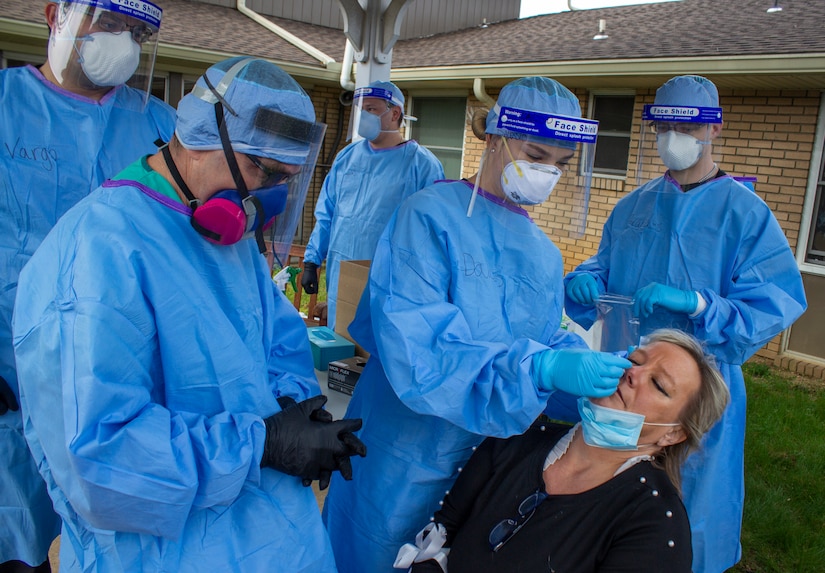
Soldiers and airmen wearing full protective gear receive training on how to administer a COVID-19 test.

''My biggest takeaway I had was not having had served at PEMA before,'' he said. ''I am extremely confident in their ability to handle emergencies after seeing it firsthand,'' he said. ''The other takeaway was the depth of horsepower PA has for dealing with emergencies.''

Both O'Shea and Shick thought being part of the COVID-19 response was worthwhile.

''You know you are part of something important,'' O'Shea said. ''You are ensuring those first responders and National Guard members on the ground are getting the information they need to help people.''

The guard has continued to provide a broad range of COVID-19 support to PEMA, including assistance at testing sites and nursing homes. Thousands of National Guardsmen nationwide are assisting with the COVID-19 response in a broad array of missions.

The Pennsylvania National Guard  is one of the largest and most deployed National Guards in the nation. In addition to its federal mission, the Pennsylvania National Guard responds to domestic emergencies, working with the PEMA, the Federal Emergency Management Agency, U.S. Northern Command and dozens of federal, state and local agencies. The guard maintains a joint operations center at Fort Indiantown Gap staffed by Pennsylvania Guard members 24/7 to support its domestic mission.

(Army Lt. Col. Angela King-Sweigart is assigned to Joint Force Headquarters, Pennsylvania National Guard.)

COVID-19 Sharpened Focus on Trans-Atlantic Security Gaps, Defense Official Says

July 13, 2020 | BY David Vergun , DOD News

The COVID-19 pandemic has highlighted a range of security issues that previously hadn't made it into NATO's discussions, a senior Defense Department official said.

Michael C. Ryan, performing the duties of assistant secretary of defense for international security affairs, spoke on NATO and trans-Atlantic security at the Brookings Institution's European Union Defense Washington Forum July 9, participating in the discussion via video from the Pentagon. Ryan also serves as the deputy assistant secretary of defense for European and NATO policy.

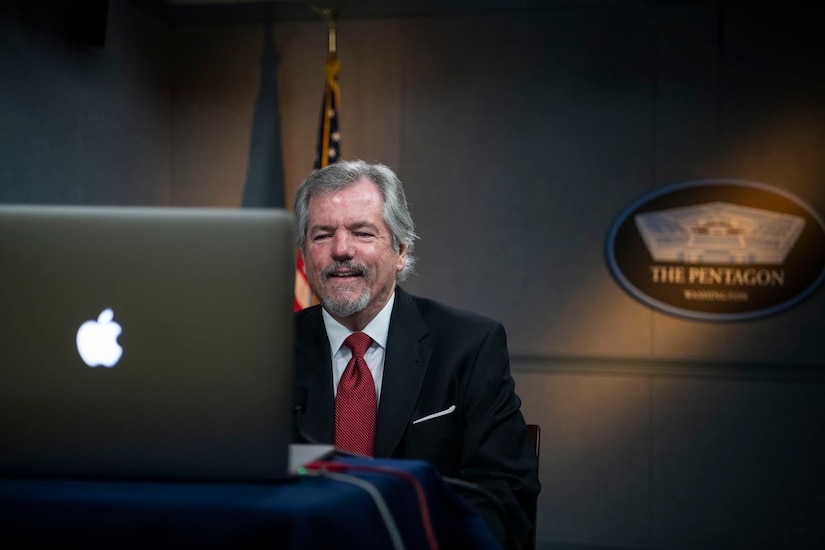
A man sits at a computer while a Pentagon sign hangs behind him.

Russia and China already were conducting disinformation campaigns, but the pandemic only accelerated it, Ryan said, noting disinformation in the areas of medicine and diplomacy that were designed to ''sway our populations away from commitments to security, commitments to the alliance and commitments to trans-Atlantic cooperation.''

Harmful foreign investment from authoritarian regimes that don’t share democratic values has also been exposed, he said. Ownership of critical infrastructure by authoritarian regimes can result in that infrastructure becoming unavailable in a crisis, he added.

Also, dependencies on supply chains that are unreliable have clear security ramifications are ''very much on our mind in the Pentagon,'' Ryan said.

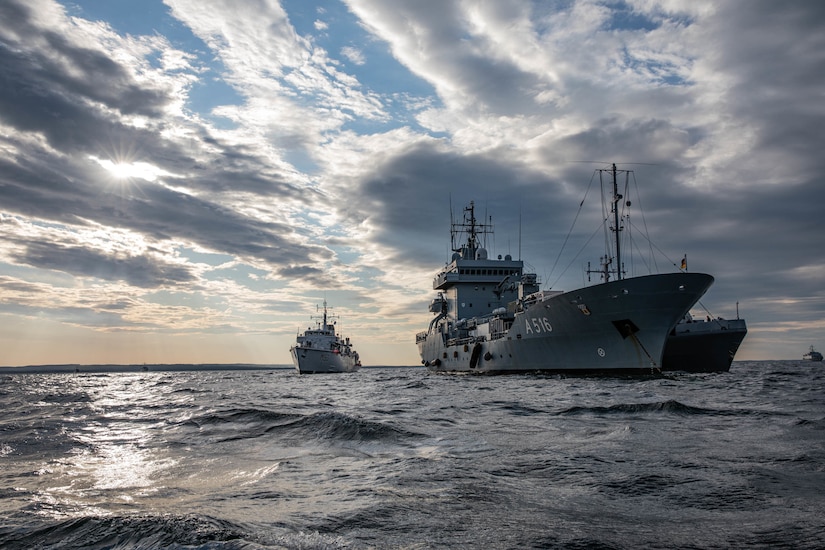
Three military ships are sailing near each other.

Military readiness and resilience in NATO, while very important, aren't enough —  nations also need political, economic and information readiness and resilience, he said.

One other area that needs to be improved, he said, is finding a way to merge law enforcement intelligence with military intelligence. Instead of confronting NATO's military directly, adversaries are conducting criminal activities that diminish trans-Atlantic security, he explained.

At a meeting of NATO heads of state and government held in London in December, leaders reiterated their declaration that NATO is the indispensable forum for trans-Atlantic consultations on security and defense, Ryan said. 

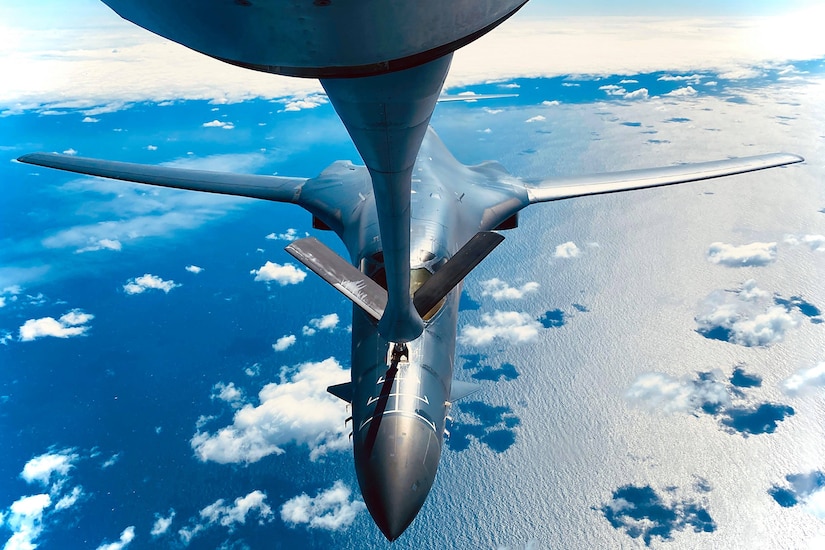
A military aircraft is refueled in midair.

''Those consultations drive decisions in specific areas [that] are absolutely critical for bringing Washington together with allies and partners, and even European Union members who are not NATO members, to move in an effective direction so we can defend consensus, sustain deterrence and be prepared to act in our own defense when necessary,'' he said.

North America and Europe working together cooperatively can deal effectively with any malign influence coming from Russia or China, he added.

Marching Drills

Air Force basic cadets participate in the first phase of their training with marching drills at the U.S. Air Force Academy in Colorado Springs, Colo., July 8, 2020. The COVID-19 pandemic changed the way in which the more than 1,100 basic cadets train because of social distancing and wearing face masks.

Saturday, July 11, 2020

9th Mission Support Command Responds to COVID-19 Pandemic

July 10, 2020 | BY AIR FORCE MAJ. MELODIE TAFAO

The 9th Mission Support Command, headquartered in Honolulu, has mobilized close to 400 personnel throughout the Pacific to assist in defense support of civil authorities in response to the COVID-19 pandemic.

The 9th MSC is the most geographically dispersed command in the Army Reserve, and it provides U.S. Indo-Pacific Command with capable forces at key points. The command spans two U.S. states, two U.S. territories, a commonwealth and two foreign countries across seven time zones.

''As a U.S. Army Reserve geographic command designated as a principal ready force unit, and based on our wide array of forces across the Indo-Pacific theater, the 9th MSC prepares for such contingencies year-round,'' said Army Col. Joseph Thomas Jr, the 9th MSC deputy chief of staff for operations, plans and training. ''The 9th MSC was more than ready to answer the call, mobilize, and in some cases, forward-deploy forces in order to execute and command and control validated [Federal Emergency Management Agency] mission assignments and other Theater Joint Force Land Component Command requirements in support of COVID-19 response efforts.''

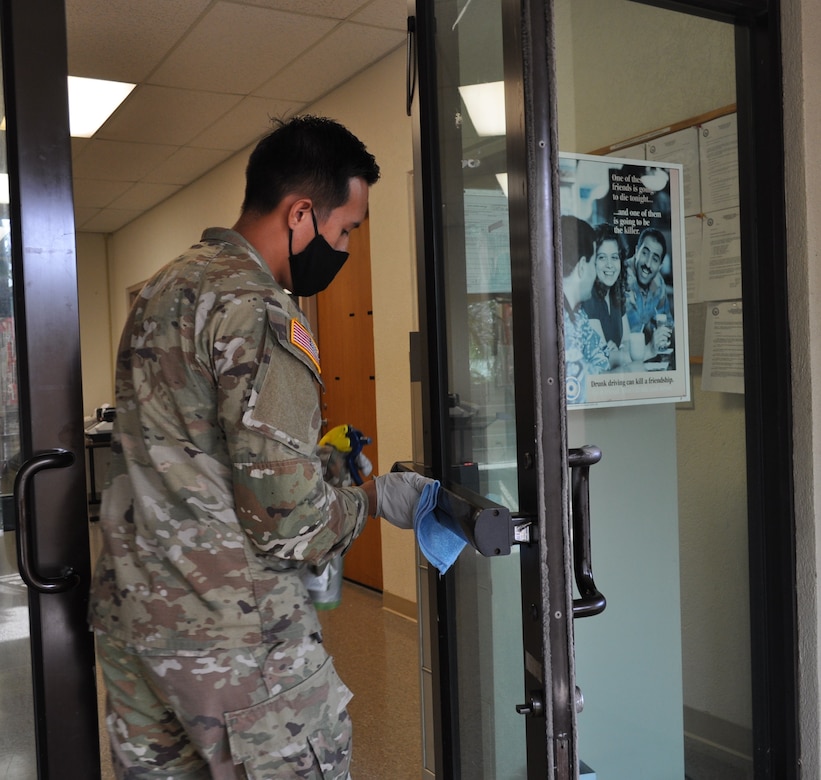
A soldier wearing a mask cleans a door handle.

The 9th MSC proved their training effective as they seamlessly transitioned from steady-state operations to their efforts in support of civil authorities. It activated its crisis action team, or CAT and immediately began working with the joint force land staff to match capabilities against emerging requirements.

''The CAT was immediately stood up through an initial team huddle of all personal staff and special staff,'' said Army 1st Lt. Lauren Brown, with the COVID-19 fragmentary order team. ''The COVID-19 FRAGO team ensured the information pertaining to [9th MSC] from Army Headquarters, [U.S. Army Pacific] and U.S. Army Hawaii was documented.''

The command quickly organized personnel and supplies to match the need of the mission, people and location, eventually resulting in 376  personnel completing seven FEMA mission assignments and Theater Joint Force Land Component Command and U.S. Army Hawaii taskers.

''Mobilization of 9th MSC forces started with multiple tactical-level units to provide Joint Reception Staging and Onward Movement for other joint and interagency partners, and to operate federal staging areas in American Samoa, Guam, and Saipan,'' Thomas said. ''We then mobilized a team of planners to augment Task Force West in Guam, a team of nurses to provide medical augmentation in the Commonwealth of Northern Mariana Islands, and additional staff personnel from 9th MSC headquarters and its subordinate theater support group to round-out those operational-level staffs and keep pace with planning, reporting, and command and control requirements.''

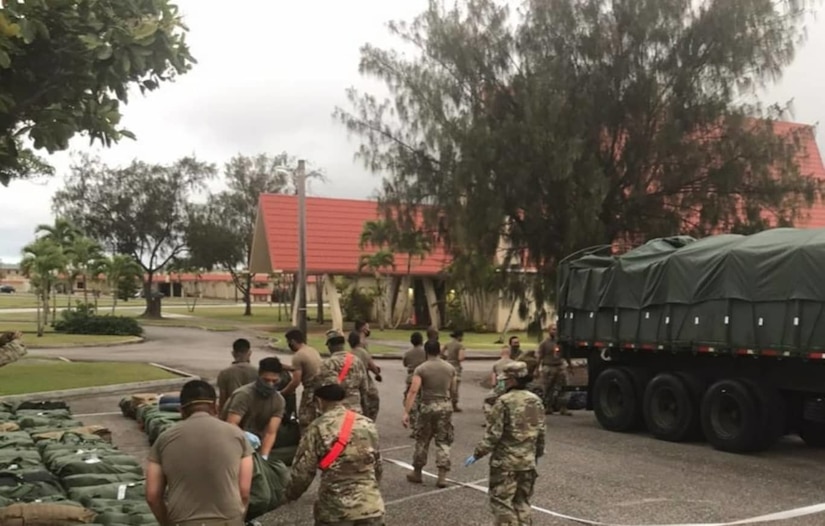
Soldiers transfer duffel bags lined up on the ground into a truck.

In addition to mobilizing nurses, medical planners and staff personnel, soldiers with the 9th MSC smoved 273 personnel, four pallets, 16 boxes, eight bags of medical equipment and cargo and more than 11,500 units of personal protective equipment into Guam, Saipan and American Samoa. The command exercised emergency preparedness liaison officers in Hawaii, Guam, American Samoa and the Commonwealth of the Northern Marianas Islands.

The 9th MSC also provided personnel to support increased Force Protection/Health Protection Condition measures on installations across U.S. Army Hawaii’s area of operations, and it provided COVID-19 cleaning tand contact tracing teams.

''With COVID-19 being a condition that is new, it did present the challenge of lack of knowledge on how to keep everyone safe while maintaining a workflow,'' Brown said. ''At times it has almost been like building a ship while it is flying.''

Throughout this pandemic, the 9th MSC adapted to these conditions.

''In the end, the 9th MSC enterprise rose to the challenge and completed all requirements while executing in a COVID-19 environment with social distancing, virtual collaboration and facing other unforeseen circumstances and challenges,'' Thomas said.

(Air Force Maj. Melodie Tafao is assigned to the 9th Mission Support Command.)

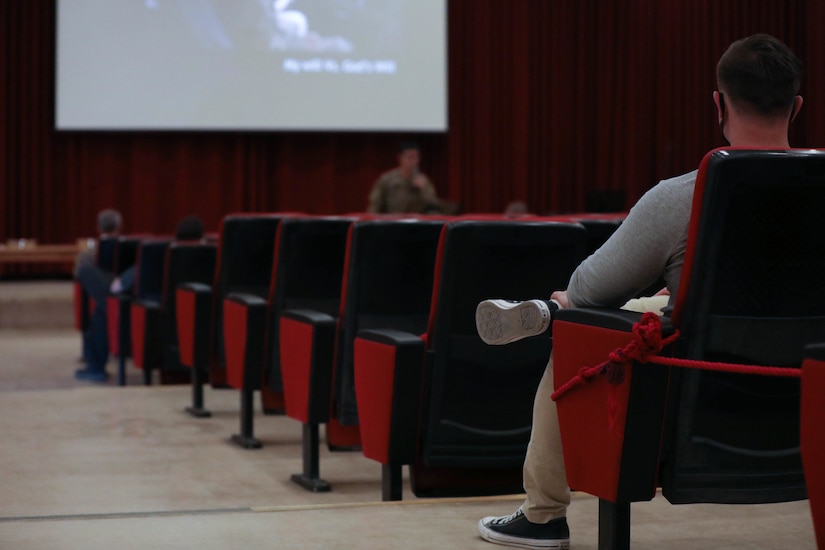
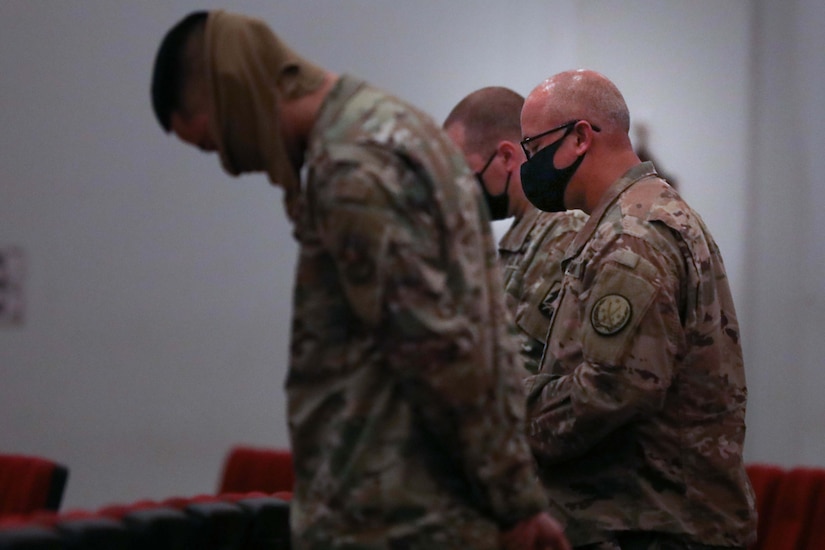
Chapels at Camp Arifjan Reopen for In-Person Gatherings

July 10, 2020 | BY ARMY SGT. KHYLEE WOODFORD

After months of being closed due to COVID-19, chapel doors have reopened for in-person services at Camp Arifjan, Kuwait.

Services were halted earlier this year in response to COVID-19.

A man seated in a pew holds a book open during a chapel service.

With social distancing implemented, attendance capacity is limited to 25 personnel, along with limited seating. Despite these restrictions, Army Chaplain (Maj.) Jung Lee, assigned to the 595th Transportation Brigade, noticed the pandemic did not deter attendance.

"We are starting to see new faces; there is steady growth," Lee said. "This was a pleasant surprise." Lee led the contemporary services June 20.

Along with seeing new faces in the crowd, a new sense of fellowship fostered amid the precautionary changes in typical services, the chaplain said.

"We talk with a mask on, but there is conversation now, and eye contact," Lee said. "There is a sense I can just feel. People enjoy the atmosphere of community."

Army Chaplain (Capt.) James Johnson, deployed with the 3rd Medical Command and a member of the praise team, also participated in the reopening day of contemporary service.

Soldiers and civilians attend worship service.
Soldiers attend worship service.

"You can be in great shape and have a great education and still lose your connection to meaning while on mission," Johnson said. "Connecting with the community is a wonderful way to stay connected with meaning. [In-person] chapel services help to provide that."

During the temporary closure, chaplains within the Area Support Group Kuwait provided service members and Defense Department civilians access to online fellowship.

"Some services were already being recorded; however, virtual services will continue even after the pandemic," Army Sgt. Jamel King, a chaplain assistant and the ASG-KU Operations noncommissioned officer in charge of chaplain services, said. "It is our job to offer our service members and civilians these services. The pandemic did not disrupt our battle rhythm."

DOD Announces $84.4 Million in Defense Production Act Title III COVID-19 Actions


Today, the Department announces seven Defense Production Act Title III actions to help sustain and strengthen essential domestic industrial base capabilities and defense-critical workforce in the small unmanned aerial systems, space technology, and shipbuilding industries.  These actions will help to retain critical workforce capabilities throughout the disruption caused by COVID-19 and to restore some jobs lost because of the pandemic. The Department remains closely partnered with FEMA and HHS, providing almost $2.9 billion in life-saving medical services, supplies and equipment to service members and federal agencies in the nation's whole-of-government approach to the coronavirus pandemic.

DoD Announces $13.4 million DPA Title III Investments in U.S. Small Unmanned Aerial System Industrial Base

As part of the national response to COVID-19, and to support the domestic small unmanned aerial system (sUAS) industrial base, the Department of Defense awarded contracts totaling $13.4M to five companies to sustain the capabilities of this critical domestic industrial base. Using funds authorized and appropriated under the CARES Act, these DPA Title III investments will further enhance the U.S. warfighter’s situational awareness, improve human-machine teaming, and provide engineering support for aiding the integration of sUAS capabilities into DoD programs.

The DPA Title III funds across five companies saved 14 jobs, created 20 new positions, and will support continued advancement of capabilities providing the companies additional paths for recurring revenue. The following is an overview of each company’s award:

  • AirMap, located in Santa Monica, California, received $3.3M to aid product development and engineering support for integration of sUAS mission planning, post-mission analysis, and unmanned traffic management software.
  • ModalAI, located in San Diego, California, received $3M to develop their next generation U.S.-made flight controller that will enable advanced autonomy including GPS-denied navigation, and all-environment obstacle avoidance. 
  • Skydio, located in Redwood City, California, received $4M to improve the flight controller hardware/software and data link for their sUAS so that highly capable components can be purchased and used across U.S. Government unmanned systems.
  • Graffiti Enterprises, located in Somerset, New Jersey, received $1.5M to modify their commercial data link for DoD’s sUAS use including operation in restricted frequency bands, reduction in the size, weight, and power of the hardware, and software developments to improve security and resiliency of their data link.
  • Obsidian Sensors, located in San Diego, California, received $1.6M to build a low-cost, dual thermal sUAS camera that can be mounted onto a stabilization gimbal and then integrated and flown on small, packable, ISR systems.

The five awards were provided under Defense Innovation Unit’s (DIU’s) Commercial Solutions Opening. DIU is leading the Department’s UAS framework development intended to provide secure, trusted sUAS capability to the Department of Defense and other Federal Government stakeholders.

DoD announces $15 million Defense Production Act Title III Agreement with LeoLabs to Strengthen Domestic Space Industrial Base

As part of the national response to COVID-19, the Department of Defense entered into a $15 million agreement with LeoLabs, Inc. to ensure the continued viability of space surveillance capability through the operation and maintenance of a world-wide highly capable phased-array radar network.  The ability to surveil and analyze spacecraft in low earth orbit is essential to national defense. LeoLabs, Inc. is the only domestic commercial supplier with demonstrated capability in this critical area.

Using funds authorized and appropriated under the CARES Act, this DPA Title III investment will offset direct workforce and financial distress brought about by the coronavirus pandemic to a sole-source capability within the defense industrial base and ensure resultant critical capabilities are retained within the U.S.

LeoLabs, Inc. is based in Menlo Park, California, with operating locations throughout the United States.

DoD announces $56 million Defense Production Act Title III Agreement to Strengthen Domestic Shipbuilding Industrial Base

As part of the national response to COVID-19, the Department of Defense (DoD) entered into a $56 million agreement with ArcelorMittal Inc. to sustain critical domestic industrial base shipbuilding capability and capacity.  This investment will expand ArcelorMittal’s plate processing footprint and heat-treating capability, subsequently increasing its alloy steel plate production and ensure the U.S. Government gets dedicated long-term industrial capacity to meet the needs of the nation.

Using funds authorized and appropriated under the CARES Act, this DPA Title III investment will protect jobs in a region hit hard by the COVID-19 pandemic and ensure critical capabilities are retained in support of U.S. Navy operational readiness.

ArcelorMittal is a steel and mining company headquartered in Chicago, Illinois. The principal place of performance is at ArcelorMittal’s facility in Coatesville, Pennsylvania.

Website resources:

DoD Coronavirus update: https://www.defense.gov/Explore/Spotlight/Coronavirus/    

DoD Industrial Policy: https://www.businessdefense.gov/coronavirus/

Joint Acquisition Task Force: https://www.acq.osd.mil/jatf.html  

Defense Production Act Title III: https://www.businessdefense.gov/Programs/DPA-Title-III/

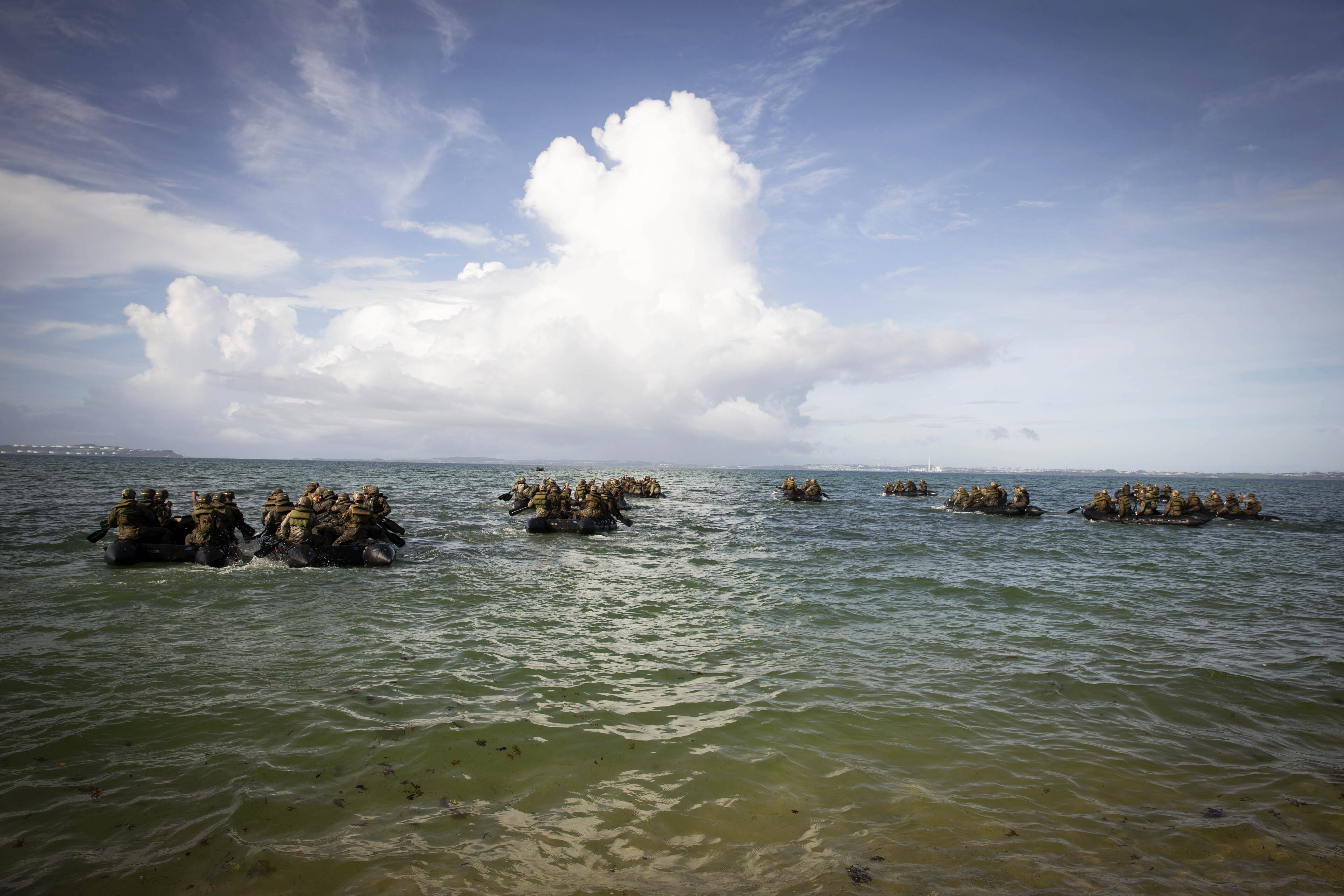
Crafty Marines

Marines in inflatable crafts participate in a squad competition after a small-boat exercise at Kin Blue Beach, Okinawa, Japan, July 7, 2020.

Thursday, July 09, 2020

San Diego, California Man Sentenced To Federal Prison For His Role In Million Dollar Scheme Targeting Thousands Of U.S. Servicemembers And Veterans

A federal judge in San Antonio sentenced 32-year-old Trorice Crawford of San Diego, California, to 46 months in federal prison for his role in an identity-theft and fraud scheme that victimized thousands of U.S. servicemembers and veterans, the Department of Justice announced today.

In addition to the prison term, Chief U.S. District Judge Orlando Garcia ordered that Crawford pay $103,700 in restitution and be placed on supervised release for a period of three years after completing his prison term.

On December 5, 2019, Crawford pleaded guilty to one count of conspiracy to launder monetary instruments.  By pleading guilty, Crawford admitted that from May 2017 to July 2019, he conspired with Robert Wayne Boling, Jr. (a U.S. citizen), and others to steal money belonging to U.S. Servicemembers and veterans.  By pleading guilty, Crawford admitted to recruiting at least 30 individuals (aka “money mules”) who provided their bank account information to receive funds stolen from military affiliated individuals.  On average, each unauthorized transfer from a victim’s accounts ranged from between $8,000 to $13,000.  Crawford kept a percentage of the withdrawn funds for himself and oversaw the transmission of the remaining amounts by means of international money remittance services to Boling and others in the Philippines.

“The Department of Justice will not tolerate fraud on America’s warfighters and veterans,” said Acting Assistant Attorney General Ethan P. Davis of the Department’s Civil Division.  “Working with our partners and using all tools available, we are committed to protecting those who protect us.”

In October, Crawford’s co-defendant Frederick Brown, age 38 of Las Vegas, NV, pleaded guilty to federal charges in connection with this scheme.  Brown, a former civilian medical records administrator for the U.S. Army at the 65th Medical Brigade, Yongsan Garrison, South Korea, admitted that while logged into the Armed Forces Health Longitudinal Technology Application, he illegally captured on his cell phone personal identifying information (PII) of thousands of military members, including names, social security numbers, DOD ID numbers, dates of birth, and contact information.  Brown further admitted that he subsequently provided that stolen data to Boling so that Boling and others could exploit the information in various ways to access Department of Defense and Veterans Affairs benefits sites and steal millions of dollars. 

As asserted in the federal grand jury indictment, Boling, together with his Philippines-based co-defendants Allan Albert Kerr (Australian citizen) and Jongmin Seok (South Korean citizen), specifically used the stolen information to compromise a Department of Defense portal designed to enable military members to access benefits information online. Once through the portal, the defendants are alleged to have accessed benefits information.  Access to these detailed records enabled the defendants to steal or attempt to steal millions of dollars from military members’ bank accounts. The defendants also stole veterans’ benefits payments. Evidence of the defendants’ scheme was detected earlier this year, advancing the investigation that led to the indictment.

The Departments of Defense and Veterans Affairs are coordinating with the Department of Justice to notify and provide resources to the thousands of identified victims.

Boling, Kerr, and Seok are charged with multiple counts of conspiracy, wire fraud, and aggravated identity theft.  Boling, Kerr, and Seok remain in the Philippines.  Measures are being taken to effect their transfer to the Western District of Texas.  Brown remains in federal custody awaiting sentencing scheduled for 10:30 am on September 17, 2020, before Judge Garcia in San Antonio. 

It is important to note that an indictment merely alleges that crimes have been committed. All defendants are presumed innocent until proven guilty beyond a reasonable doubt.

The United States is represented by Trial Attorneys Ehren Reynolds and Yolanda McCray Jones of the Department of Justice Civil Division’s Consumer Protection Branch and Assistant U.S. Attorney Joseph Blackwell of the U.S. Attorney’s Office for the Western District of Texas. The matter was investigated by agents of the Defense Criminal Investigative Service, and counsel Matthew Freund, along with substantial investigative support from the U.S. Postal Inspection Service, the U.S. Army Criminal Investigation Command, and the Veterans Benefits Administration’s Benefits Protection and Remediation Division. The U.S. Department of State’s Diplomatic Security Service, Philippine law enforcement partners, and the U.S. Attorneys’ Offices for the District of Nevada, the Southern District of California, and the Eastern District of Virginia also provided assistance. Resources from the Department of Justice’s Servicemembers and Veterans Initiative and its Transnational Elder Fraud Strike Force aided in the matter’s investigation and prosecution.

Since President Trump signed the bipartisan Elder Abuse Prevention and Prosecution Act (EAPPA) into law, the Department of Justice has participated in hundreds of enforcement actions in criminal and civil cases that targeted or disproportionately affected seniors.  In particular, in March 2020, the department announced the largest elder fraud enforcement action in American history, charging more than 400 defendants in a nationwide elder fraud sweep.  The department has likewise conducted hundreds of training's and outreach sessions across the country since the passage of the Act.

Additional information about the Consumer Protection Branch and its enforcement efforts can be found at www.justice.gov/civil/consumer-protection-branch.  For more information about the U.S. Attorney’s Office for the Western District of Texas, visit its website at https://www.justice.gov/usao-wdtx. Information about the Department of Justice’s Elder Fraud Initiative is available at www.justice.gov/elderjustice; information on the Servicemember and Veterans Initiative is at https://www.justice.gov/servicemembers.

Leap Frogs

Members of the Navy Parachute Team, the Leap Frogs, perform a tethered flag with smoke brackets during a demonstration in San Diego, July 4, 2020.

Howitzer Training

A member of the West Virginia National Guard mans a self-propelled howitzer during training at Camp Dawson, W.V., June 17, 2020.

EOD Team Sharpens Skills, Maintains Proficiency During Pandemic

July 9, 2020 | BY AIR FORCE TECH. SGT. DELLA CREECH , 315th Airlift Wing

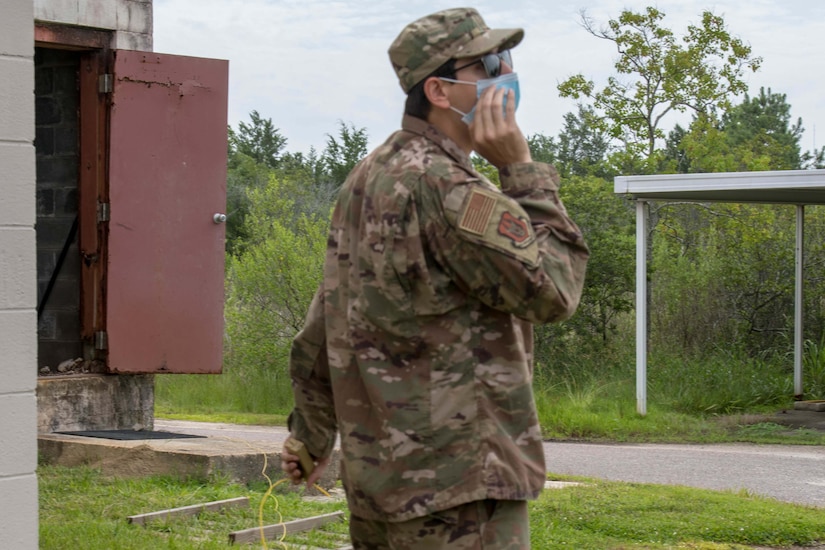
The 315th Civil Engineer Flight's explosive ordnance disposal team held a live-explosives demolition training at the EOD range near the Naval Weapons Station Charleston, South Carolina.

Training evolutions like the live-explosives demolition help the reservists with the 315th CEF maintain mission readiness while gaining training time imperative to mission and unit proficiency, giving them the ability to answer the nation's call when needed — even during the global COVID-19 pandemic.

"This demo will help the EOD team to protect others in the event that an explosive runs the risk of detonating," Air Force Tech. Sgt. Brendan Mcavey, the explosive ordnance technician team lead with the 315th CEF, said. "Our technicians can accomplish a myriad of assignments, so these demolition exercises are crucial to learning how explosives work and how to perform the mission."

An airman wearing a face mask and holding some yellow wire in his left hand cups his right hand to his face to yell an instruction.
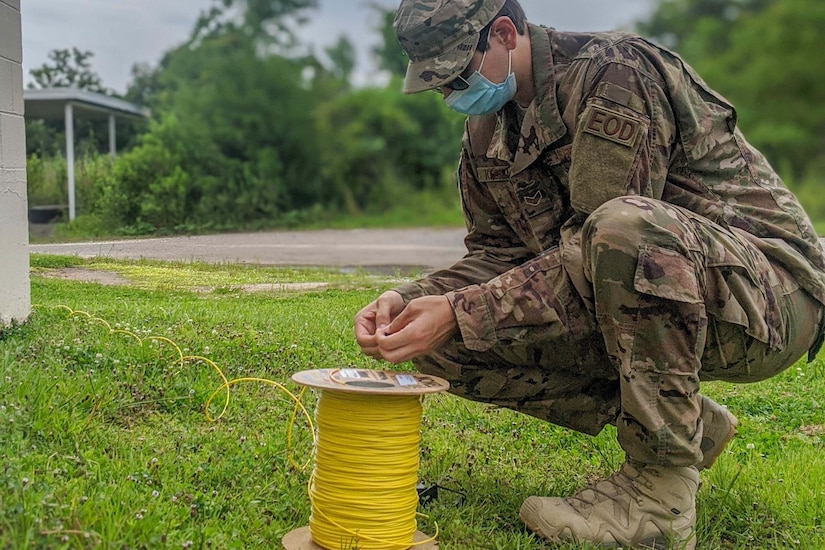
An airman wearing a face mask kneels next to a large spool of yellow wire.

With a vision to be integrated, experienced and relevant, the 315th CEF conducts monthly explosives training to remain proficient in tackling any task, domestic or abroad. The tasks can range from defusing Civil War- era relics to safely disposing of improvised explosive devices.

The variety of experience held by these EOD reservists range from every day skills to the unique expertise to be able to determine the required safety distance from an explosive if it should detonate.

"Due to the nature of the work, there is no way to train our airmen virtually to properly dispose of explosives," Air Force Master Sgt. Mark Johnson, the EOD program manager with the 315th CEF, said. "The live-contact approach provides them important time using the tools needed to do the job, ensuring that they stay on the leading edge of what they do."

This proficiency demolition training used a remote detonation barrel to pinpoint a mock IED to sharpen the reservists' skills. This is a hands-on irreplaceable skill to the EOD team. Many of these skills strengthen the EOD airman both on and off of duty, Johnson said.

"The professionalism from EOD, and the discipline from the military, help me to stay focused on our goals during COVID in my civilian life working cybersecurity at Bank of America," Air Force Senior Airman Alexander Keskinen, an explosive ordnance technician with the 315th CEF, said.

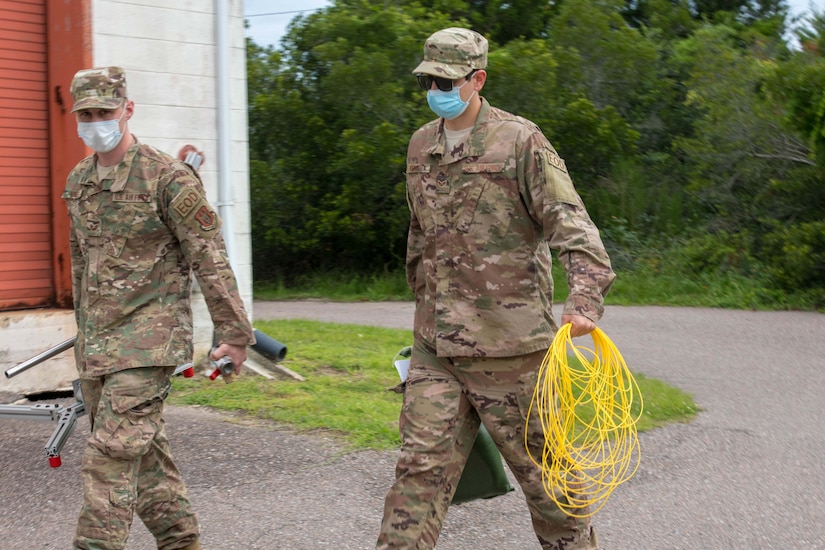
Airmen wearing face masks walk side by side. One is carrying equipment, and the other is carrying a rolled-up length of yellow wire.

Keskinen not only sharpens his skills with the 315th CEF, but also transfers them to his rotational master's degree program. Keskinen explained that in cybersecurity, staying on the cutting edge and sharpening his skills as much as possible makes all of the difference when the pressure is on. He uses this discipline to strengthen the 315th CEF EOD team as well.

"I appreciate having the opportunity to train through such crazy times and remain qualified," Keskinen said. "Plus, I love blowing stuff up."

Task Force Boosts Spirits With Mail During COVID-19 Pandemic

July 9, 2020 | BY ARMY SGT. ANDREW WINCHELL , Task Force Spartan

Not rain, snow, sleet, extreme heat or even COVID-19 can stop the mail.

"There are 58 mailrooms here on [Camp] Arifjan alone," Army Staff Sgt. Robert Harris, the mail operations noncommissioned officer in charge for Task Force Spartan, said. "We alone are responsible for 1,300 people."

Harris and his team start their day at 8 a.m. and play a critical role in getting the mail to service members and civilians who serve Task Force Spartan, among other organizations.

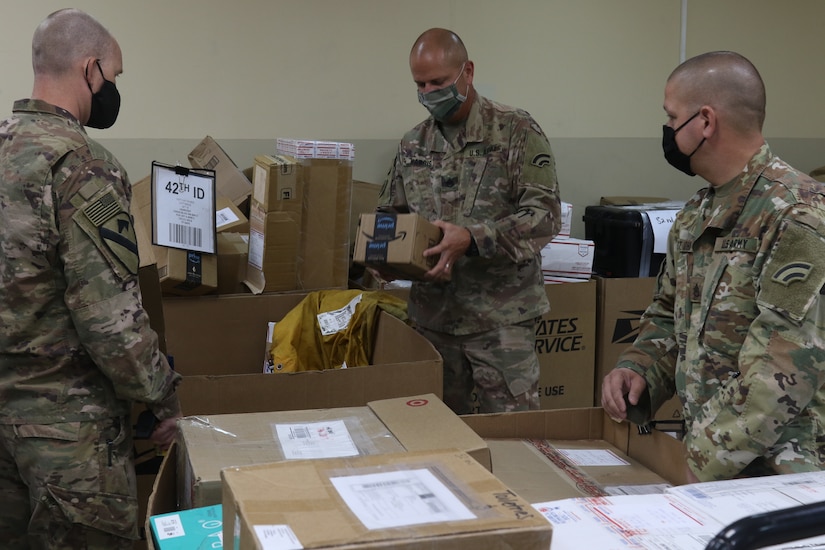
Soldiers work in a mailroom.

"We start our day picking up the mail from the main mailroom," Harris said. "The main mailroom sorts things out by the smaller mailrooms we have on post. Then we come and pick it up to sort it out by person."

"When we arrive to pick up the mail, we never know how much there will be — could be just a few packages or over 200 packages," he continued. "There was a short time when COVID really started shutting things down, and we didn't see much coming in, but that was a very short time."

COVID-19 has affected the world and changed the way many businesses operate, so it comes as no surprise that it would affect mail delivery also.

"COVID only slowed down mail for a short time, maybe a week or so," Harris said. "Getting mail to service members and contractors is of the utmost importance, especially during these times when people look forward to packages from home or something they've ordered like a book to help pass downtime."

Receiving mail can help boost morale not only for service members and civilians overseas, but also for friends and family members who get mail from loved ones abroad.

"Sorting the amount of mail we receive sometimes can become overwhelming," Harris said. "We have had to shut down the mailroom twice since being here. We never want to make that call, but when we get over five or six bins full of mail, it can be very difficult to get it sorted in time for pickup that day."  

Soldiers work in a mailroom.

There can be many reasons for mail to be delayed, especially due to the restrictions during a worldwide pandemic. 

"Mail may be delayed sometimes, but my team and I make sure that when we get things in, we process it and update the roster as quickly as possible," Harris said. "With so many things closed down because of COVID-19, mail is one of the few morale-boosting things left."

Harris and his team work hard every day to make sure service members and civilians get their mail.

"At the end of the day, we are here to make sure people are getting their mail with as little delay as possible," Harris said. "For some getting a letter or package from home can turn a bad day or week around."

The soldiers of Task Force Spartan are being led by the New York Army National Guard's 42nd Infantry Division. The mission is a unique, multi-component organization, made up of active Army and National Guard units, rounded out by Army Reserve support units.

Through Operation Spartan Shield, Task Force Spartan maintains a U.S. military posture in Southwest Asia sufficient to strengthen defense relationships and build partner capacity.