Tuesday, March 03, 2026

DoW Identifies Army Casualties

The Department of War announced the death of four Army Reserve Soldiers who were supporting Operation Epic Fury.

Capt. Cody A. Khork, 35, of Winter Haven, Fla.; Sgt. 1st Class Noah L. Tietjens, 42, of Bellevue, Neb.; Sgt. 1st Class Nicole M. Amor, 39, of White Bear Lake, Minn.; and Sgt. Declan J. Coady, 20, of West Des Moines, Iowa, died on March 1, 2026, in Port Shuaiba, Kuwait, during an unmanned aircraft system attack. All Soldiers were assigned to the 103rd Sustainment Command, Des Moines, Iowa. The incident is under investigation.

For more information regarding Capt. Cody A. Khork; Sgt. 1st Class Noah L. Tietjens; Sgt. 1st Class Nicole M. Amor; and Sgt. Declan J. Coady, members of the media may contact U.S. Army Reserve Command Public Affairs Office, Fort Bragg, N.C., at usarmy.usarc.usarc-hq.mbx.press-desk@army.mil.

Face of Defense: Aeromedical Nurse Practitioner Bridges Medicine, Mission

The small, brain-shaped coin felt heavier than its size, a quiet symbol of gratitude that brought tears as she recalled its meaning. It was a gift from an Air Force airman she once treated for lymphoma, presented to her after he not only completed treatment, but beat the cancer.

He honored his doctor by coining her — a tribute usually performed by senior leaders to recognize airmen. The gesture represented the trust placed in her during one of the most difficult moments of the airman's life. 

"This is my favorite coin, and it reminds me how special this [moment] was for both of us," said Air Force Maj. Elizabeth Kuss, 325th Operational Medical Readiness Squadron flight medicine flight commander. "I don't do this job to be thanked, but it was so special to be thanked in this way." 

The experience was shaped by a path she once believed she would never take; one she believed was not for her.

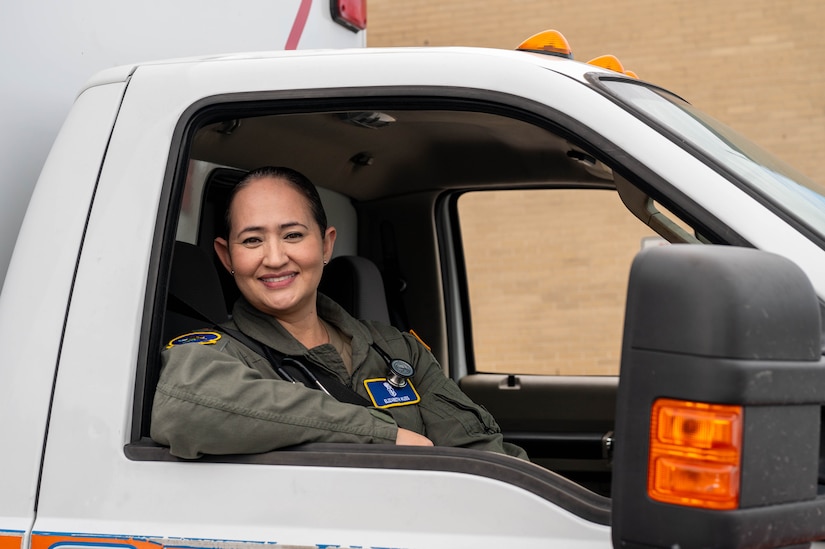
Air Force Maj. Elizabeth Kuss
An airman sitting in the passenger seat of an ambulance smiles and looks out of an open window during daytime, with a building in the background.
Job: Aeromedical Nurse Practitioner
Stationed: Tyndall Air Force Base, Fla.
Unit: Air Force
Hometown: Prattville, Ala.

Wanting More 

Raised as an "Army brat" and surrounded by military service, Kuss had long resisted joining the military. Her father served for 30 years in the Army and for another 20 as a civilian supporting Army aviation, while her brother joined the Air Force in 2000. 

"I was the one saying, 'I'm not joining the military,'" she said, laughing. "Turns out my dad was right." 

By 2020, amid the COVID-19 pandemic and nearing a milestone birthday, Kuss said she felt professionally stagnant. 

"I wanted more — personal growth and professional growth," she said. "I was asking myself, 'Is this it?'" 

The need for a new challenge is what drew her to military medicine. After nearly two decades working in emergency rooms in Alabama, Kuss became an Air Force nurse practitioner at 40 years old, trading night shifts and a familiar hospital system for operational medicine, intense training and a role few in uniform have ever filled. 

"I knew this was not going to be easy. This was not going to be a cakewalk kind of job," Kuss said. "But this is my dream job. I get to take care of the most amazing people while doing the things I love."

A Turning Point in Alaska

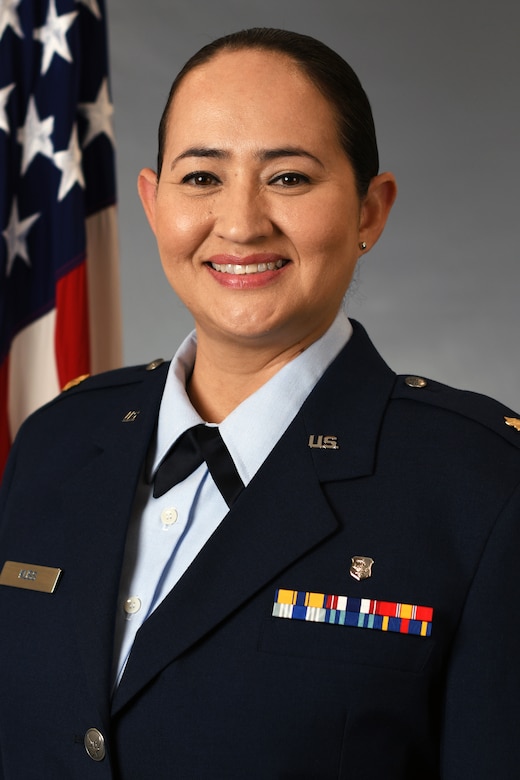
An airman in a dress uniform smiles for a photo, with an American flag in the background.
Inspired by Air Force nurse practitioners who were deploying, leading and operating far beyond the clinic, Kuss commissioned directly into the Air Force in 2021 as a family nurse practitioner. She was assigned to Joint Base Elmendorf-Richardson, Alaska, which quickly became a turning point.

Within months, Kuss attended military mountain medicine training, climbing and rappelling with litters, navigating austere terrain and learning trauma care under simulated combat conditions. 

"They made it as real as possible and that was the moment I thought, 'This is what I signed up for,'" she said. "You don't get to do this [training] on the outside. It really solidified my decision to do this." 

After two years in active-duty medicine, she was selected for the Air Force's aeromedical nurse practitioner training pipeline, a career field that was created in 2019 to bridge the gap between medicine and mission. The pipeline included aerospace physiology, altitude chamber exposure, centrifuge training and flight operations. 

"The goal is to have a better understanding of what aviators and defenders go through," Kuss said. "Does this [medical] condition impact their ability to fly? Their ability to see screens? If I understand what duties they're undergoing, I can better understand how that might impact them medically." 

Beyond the Usual Care 

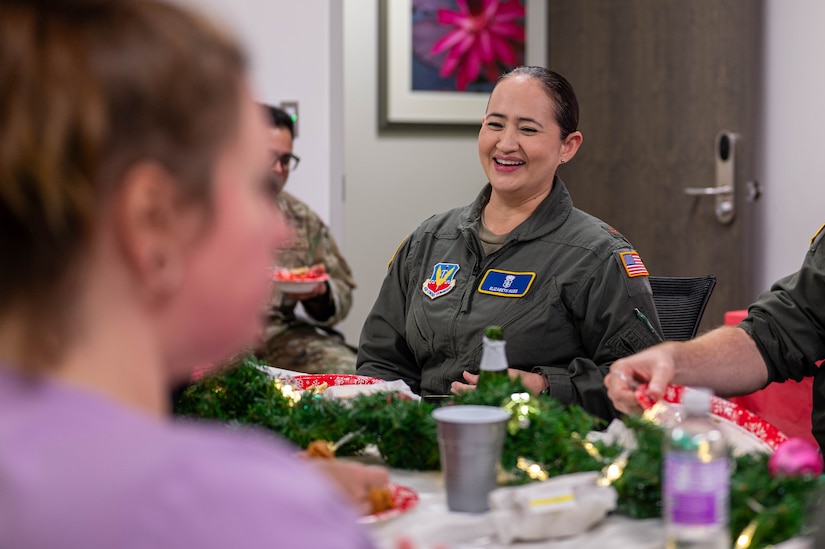
An airman in a flight suit sits and smiles at a table with food on paper plates, green decorations and other people indoors.

As an aeromedical nurse practitioner, Kuss does far more than traditional primary care. Her role spans occupational health, deployment clearances, public health and flight-related medical emergencies. Between these responsibilities, she also manages administrative tasks such as reviewing profiles, signing medical clearances and advising commanders on readiness risks. 

"It's always a balance," she said. "You're taking care of someone as a person, but you're also responsible for military readiness and mission safety, and asking yourself, 'Is it going to compromise the mission because they aren't able to perform their duties?'" 

Trust between the patient and provider sits at the core of Kuss' work as one of roughly 50 aeromedical nurse practitioners across the Air Force. In April 2024, she arrived at Tyndall Air Force Base, Florida, as the base's first aeromedical nurse practitioner, stepping into a role that brings both opportunity and pressure. 

"I want to show that we're value-added," she said. "I want to show that we support the mission and that as a [career field], we're needed. When I leave, I want them to say, 'We need another one.'" 

As an emerging career field, Kuss said aeromedical nurse practitioners often face misconceptions, including being underutilized or misunderstood. 

"People don't always know what we can do," she said. "That knowledge gap is probably the biggest barrier. With more exposure and time on the lines, we can break those barriers and learn how we fit within a squadron and how we can be an asset to the team."

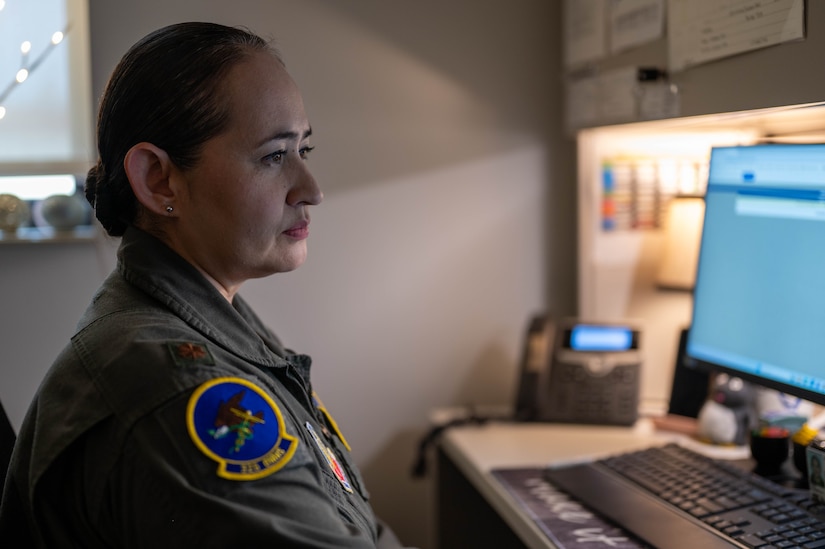
An airman in a flight suit looks at a computer screen in an indoor office setting.

Making an Impact 

For those who work with her, her impact and influence are already clear. 

"She's everything you'd want in a provider and a flight commander," said Air Force Tech. Sgt. Joseph Smith, 325th OMRS flight operational medical technician. "She listens. She's empathetic. She treats everyone like a person first." 

Smith said Kuss' aeromedical expertise has been especially valuable during in-flight emergencies involving F-35A Lightning II pilots experiencing hypoxia-like symptoms. 

"Her being an aeromedical nurse practitioner makes all the difference sometimes," Smith said. "She already knows what's going on when it comes to altitude, aircraft systems, all of it. She's always clocked in with the engine running. 

"She's big on readiness because she knows if we don't take care of pilots and maintainers, the mission doesn't happen," Smith continued. "She sets the standard — anyone who comes into this role should look at her and say, 'That's what an aeromedical nurse practitioner should be.'" 

Looking ahead, Kuss hopes to deploy, support humanitarian missions and continue shaping a career field still defining itself. 

"I've only been in five years, and I've already done things I never imagined," she said. "And there's still so much more to do, so many more boxes I want to check off. I'm ready for whatever comes my way."

Medal of Honor Monday: Navy Petty Officer 3rd Class Jack Williams

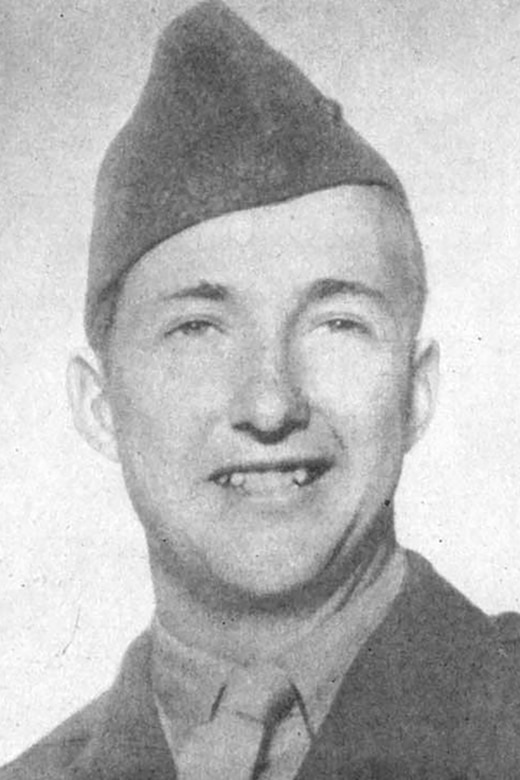
As a hospital corpsman in World War II's Pacific theater, Navy Petty Officer 3rd Class Jack Williams' job was to save the lives of the Marines who fought around him. During the bloody Battle of Iwo Jima in 1945, Williams saved more than a dozen Marines and sacrificed his own life so they could live. His selflessness led him to receive a posthumous Medal of Honor.

A man wearing a cap smiles for a photo.

Williams was born Oct. 18, 1924, in Harrison, Arkansas, to William and Dorothy Williams. He had a younger sister named Fern.

During high school, Williams worked at a local theater and was a member of the Future Farmers of America. As World War II raged during his senior year, he registered in the Selective Service System but didn't wait to be drafted. As soon as he graduated in June 1943, he enlisted in the Naval Reserve.

Within a few months, Williams had completed training to become a hospital corpsman. By May 1944, he'd reached the rank of pharmacist's mate 3rd class and was assigned to the 3rd Battalion, 28th Marines, 5th Marine Division.

In late December 1944, the division deployed to Hawaii and began training for the invasion of Iwo Jima, a tiny island in the Pacific with strategic airfields that could better position the Allies for an assault on mainland Japan.

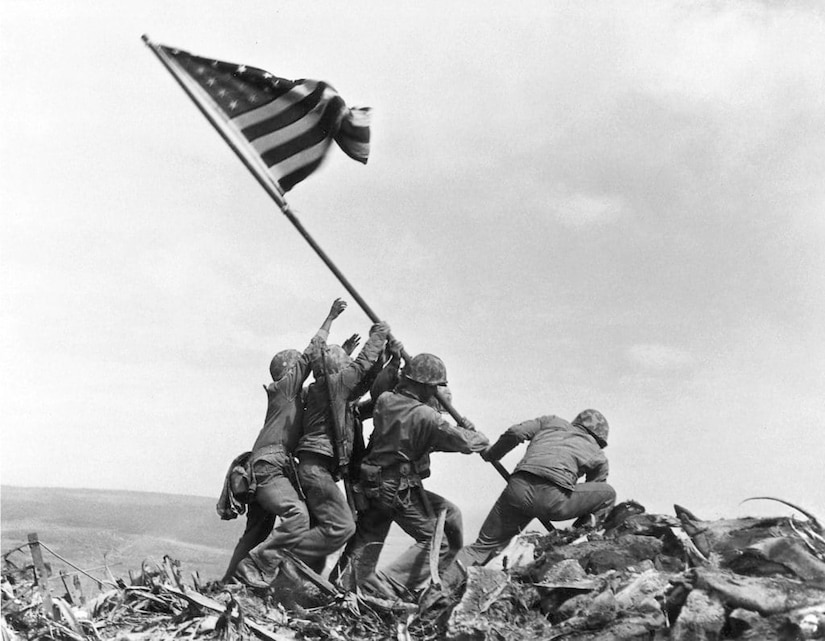
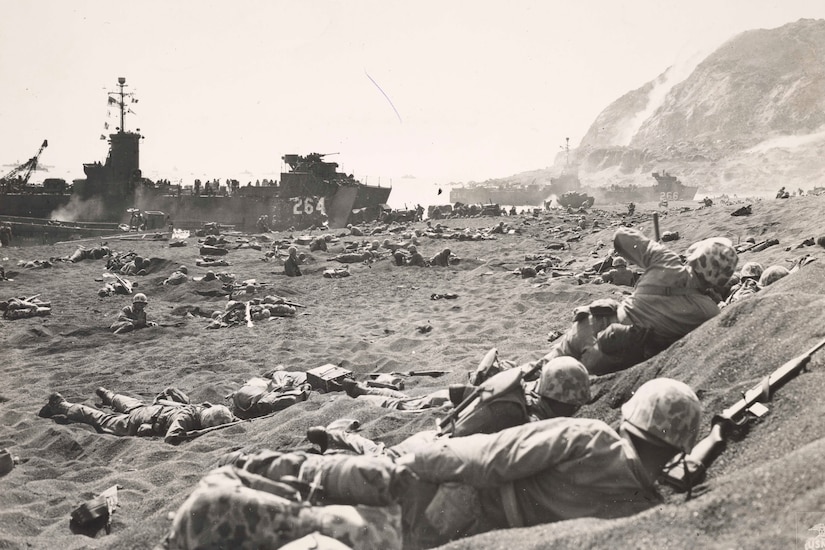
Williams' unit arrived off the volcanic island's coast in mid-February and was part of the first assault waves to land there. Over the next several days, the 28th Marines took part in efforts to isolate and secure Mount Suribachi, where the now-iconic photo of Marines raising a U.S. flag was taken.

About half a dozen men in uniform work to establish a flagpole into the ground.

On March 3, 1945, the unit had moved into rugged terrain to continue fighting an entrenched enemy. Williams had already given aid to more than a dozen wounded Marines, but when he saw his friend, Marine Corps Pfc. James Naughton, lying in no-man's-land after being wounded in a fierce grenade battle, he ran to him.

Williams dragged Naughton to a shallow depression and knelt to give him first aid, using his own body as a screen from the continued enemy fire, which hit Williams in the abdomen and groin three times.

Williams was momentarily stunned, but he quickly recovered and finished aiding Naughton before applying bandages to his own wounds.

Hundreds of helmet-clad men lie on sand and in foxholes dug into a beach. In the distance, about three ships sit near the shore.

Despite needing urgent medical attention himself, Williams continued his work. He stayed in the perilous, fire-swept area to help yet another Marine he found there. Through his pain and profuse bleeding, Williams dressed that man's wounds before trying to make his way to the rear of the fight to get aid for himself. Along the way, he was struck down by a Japanese sniper bullet.

Williams collapsed and later died, giving his life to help his fellow warfighters survive. For his sacrifice, he was awarded a posthumous Medal of Honor, presented to his mother at the family home March 8, 1946.

Williams is buried in Springfield National Cemetery in Springfield, Missouri.

In total, 27 Medals of Honor were awarded to men who fought on Iwo Jima, the most of any World War II battle. Aside from Williams, three other pharmacist's mates received the medal: Navy Petty Officer 1st Class Junior Pierce, Navy Petty Officer 2nd Class George Wahlen and Navy Petty Officer 1st Class John Willis.

A large ship with dozens of people on the deck moves through water past forested land.

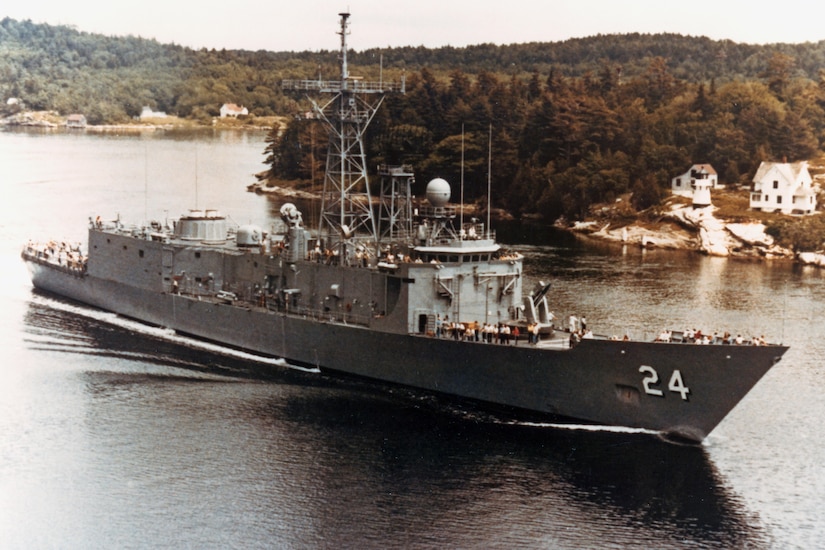
To honor Williams, the Navy commissioned a guided missile frigate, the USS Jack Williams, in 1981. The ship was in service until 1996, when it was sold to Bahrain's navy. According to the Central Arkansas Library System's Encyclopedia of Arkansas, the ship's bell was removed after service and now resides in the lobby of the county courthouse in Harrison.

Just a few years ago, Williams' hometown also opened the Jack Williams Veterans Resource Center as a place to serve local veterans.

Thursday, February 26, 2026

Senior Air and Space Force Leaders Discuss Defense of Homeland

The War Department's 2026 National Defense Strategy, released Jan. 23, prioritizes defending the homeland as its first line of effort.

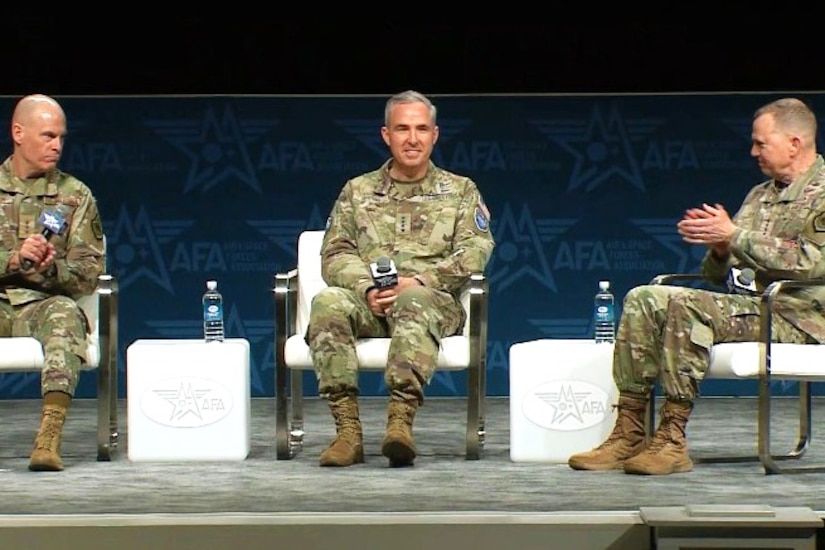
Three men wearing camouflage military uniforms sit on a stage in white chairs; two are holding microphones while the other claps with a microphone in his lap.

Yesterday, during a panel on homeland defense at the Air and Space Forces Association's annual warfare symposium in Aurora, Colorado, three senior Air and Space Force generals discussed how their respective combatant commands are working to do just that.

Space Force Gen. Stephen N. Whiting, commander of U.S. Space Command; Air Force Gen. Gregory M. Guillot, commander of U.S. Northern Command and North American Aerospace Defense Command; and Air Force Lt. Gen. Michael J. Lutton, deputy commander of U.S. Strategic Command, spent just under 45 minutes discussing what they view as the biggest threats to the homeland and how they foresee the development of the Golden Dome for America missile defense system, among other topics.

Regarding the threat assessment to North America, two of the three leaders agreed that cyberattacks from U.S. adversaries are near the top — if not at the top — of the list.

"The cyber threat is the most persistent and present threat that we have. I'm often asked when doing congressional testimony, 'What's our next attack going to be?' And I say we are under attack right this second in cyber[space] from nation states and proxies to them, trying to get into our systems to the tune of hundreds of millions [of] attempts a day," said Guillot, whose combined NORAD and Northcom commands focus on homeland defense in all domains.

Lutton, whose command conducts global operations to deter strategic attacks — particularly nuclear — and employs tailored forces to guarantee the security of the nation and its allies, concurred with Guillot's assessment.

"With respect to cyberspace, the ability of cyber to disrupt or deny or degrade — that has a different tempered dimension, if you will, than a ballistic missile [and] there's potential ambiguity with cyber that is very much a focus of [Stratcom]," Lutton said.

As commander of Spacecom — the command responsible for conducting, planning and integrating joint military space operations with allies to deter aggression, defend national interests, and defeat threats in, from and to space — Whiting said his primary concern is Russia's reported development of a space-based, nuclear-powered anti-satellite capability designed to destroy or disable satellites, particularly in low Earth orbit.

"If Russia were to launch that, of course, it would violate the Outer Space Treaty that they're a signatory to, [and] it would be an incredibly destructive and indiscriminate weapon that would hold all nations' space capabilities at risk," Whiting said.

"And, of course, that's just something that we wouldn't want to tolerate," he added.

In terms of the development of the Golden Dome — which President Donald J. Trump authorized via Executive Order 14186 on Jan. 27, 2025 — all three leaders said their respective commands are working closely together and with Space Force Commander Gen. Michael A. Guetlein, the director of the Golden Dome mission.

Guillot said that as soon as Guetlein was confirmed to lead Golden Dome, he flew out to meet with Guillot and Whiting to begin basic planning for the program.

"And the three of us left the room, without any exaggeration, 100% aligned with what we thought Golden Dome for America should look like," Guillot said.

He added that the program is moving along at such a clip that it might have demonstrable capability much faster than initially anticipated.

"When Golden Dome first was discussed, I think some thought it would be a 2040 … type of capability [but] it's not; it's much closer, and a lot of the capabilities are [already] there," Guillot said.

Acquisition Reform Means a Focus on Warfighter Success

The War Department aims to modernize how acquisition — the buying of weapons and other materiel from manufacturers — is done to ensure American warfighters get the best tools, at the right price, and as quickly as possible. 

In November 2025, for instance, Secretary of War Pete Hegseth announced a reorganization of the existing program executive offices into portfolio acquisition executives. 

"The acquisition chain of authority will run directly from the program manager to the PAE," Hegseth said at the time. "Each PAE will be the single accountable official for portfolio outcomes and have the authority to act without running through months or even years of approval chains. And they'll be held accountable to deliver results." 

The secretary said PAEs will be empowered with authorities to make decisions on cost, schedule and performance trade-offs that prioritize time to field and mission outcomes.  

During a panel discussion yesterday as part of the Air and Space Forces Association's warfare symposium in Aurora, Colorado, Air Force Gen. Dale R. White, director of critical major weapon systems, said that effort will be transformational in the acquisition community. 

"I think now we take it down to the next level and just think about where we are with our [program offices], what we're doing with the PAEs, giving them authority to make decisions in real time, make trades, and be able to do probably the most important thing with this whole transformation," White said. "[And that] is not measure ourselves against acquisition outcomes but measure ourselves against mission outcomes, allowing that PAE to look at the operational problem and work to figure out a solution to that problem and be able to have the decision space to do so." 

White said it's not just PAEs that must be empowered to do their job, but the acquisition enterprise as a whole must be aligned to make acquisition success about meeting mission requirements for the warfighter, not just a positive business outcome. 

"We're just not empowering PAEs; the idea is you get unity of command," he said. "You get unity of effort. You allow that contracting officer to have a voice in solving that operational problem, that [financial management] person, that engineer; you change the cultural mindset of how we look at what we're doing." 

There are plenty of examples, White said, of where there was acquisition success that didn't result in operational mission success. 

"We may have done well on the acquisition side, but how well did that align to the operational need and what we're trying to do," he asked. "It is really that hard reset. It's the empowerment piece and changing the dynamic by which we study the problems that we have." 

For acquisition professionals, White said, acquisition reform will require them to lead with conviction. 

"Lead with vision, lead ruthlessly and lead with an intent to solve the operational problem," he said. "If you want to know what acquisition as a warfighting function means, it means come together as a team, the operational team, the acquiring team, and deliver on the outcome. Sometimes that means you're going to make some tough decisions that you have to have courage to make; make the decision, drive for the outcome."

Secretary of War Pete Hegseth Travels to Arkansas for 'Arsenal of Freedom' Tour

Secretary of War Pete Hegseth will depart tomorrow for Camden, Arkansas, to visit General Dynamics and L3 Harris. Secretary Hegseth will also administer the oath of enlistment to new recruits.

Secretary of War Pete Hegseth is concluding his nationwide "Arsenal of Freedom" tour, a call to action to revitalize America's manufacturing might and reenergize the nation's workforce. The tour's message will emphasize that our national security and the peace of the world move at the speed of our Defense Industrial Base (DIB) and rely on the hard work of our American workforce.

The tour will highlight the urgent need to rebuild our Defense Industrial Base to ensure that we continue President Donald J. Trump and Secretary Hegseth's peace through strength agenda.

American manufacturing is the bedrock of American strength. The men and women fueling this work are on the front lines, alongside our warfighters, furthering the nation's efforts every day they show up to work.

The tour will champion a new approach to defense acquisition, one that prioritizes and awards speed, innovation, and a "commercial-first" mindset.

This includes cutting bureaucratic red tape, empowering program leaders, and providing the stable, long-term contracts necessary for industry to invest and expand.

The goal is to create a defense ecosystem that is more agile and accountable, capable of delivering the tools our warfighters need, when they need them.

The "Arsenal of Freedom" tour is more than a series of speeches; it is a movement to restore our nation's industrial prowess and secure our freedom for generations to come. It is a reminder that the strength of our nation is not just in our military, but in the ingenuity and spirit of the American people.

Hegseth: National Guard Aligned With National Defense Strategy – Homeland First, Borders Secured, Peace Through Strength

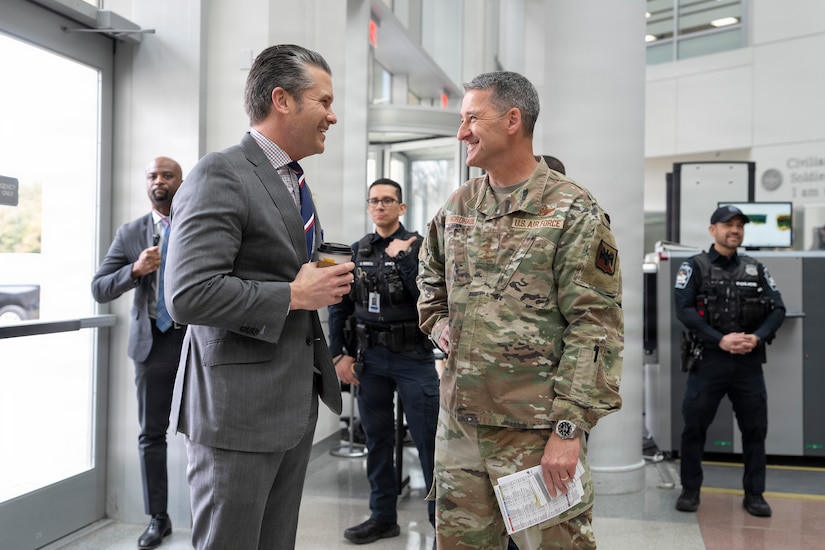
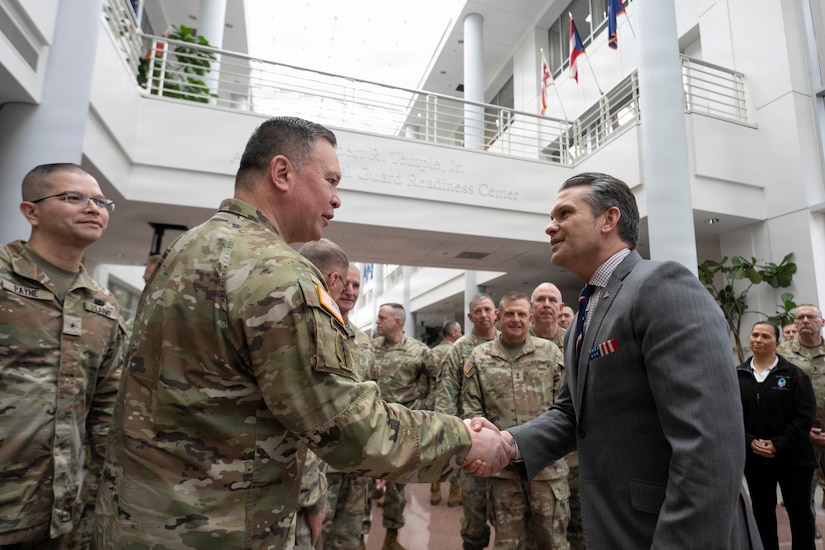
Secretary of War Pete Hegseth addressed National Guard leaders today at the Herbert R. Temple Army National Guard Readiness Center in Arlington, Virginia, where he underscored the War Department's top priorities: restoring the warrior ethos, rebuilding the military and reestablishing deterrence.

A man wearing a business suit smiles as he speaks with a man in a camouflage military uniform. There are people dressed in police gear and one man in a business suit standing in the background.

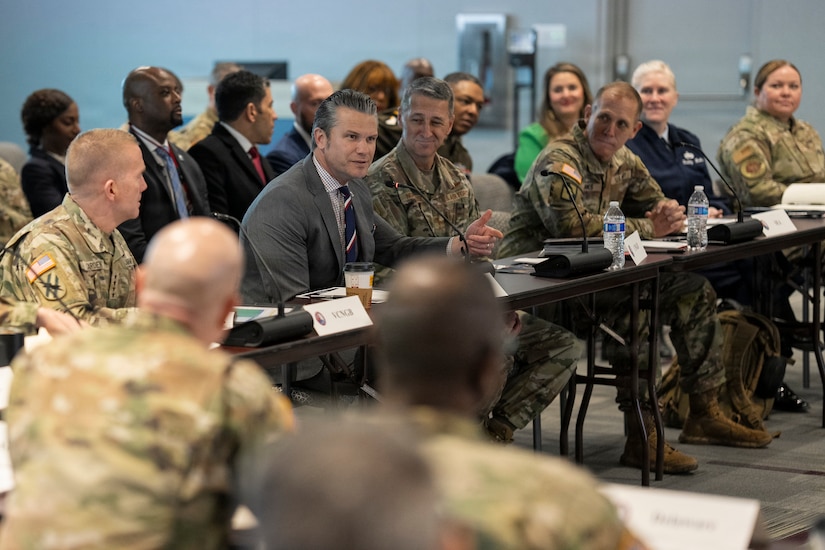
In attendance were: the National Guard adjutants general — the senior Army and Air National Guard officers representing each state, three territories and the District of Columbia; along with Air Force Gen. Steven Nordhaus, National Guard Bureau chief,  and Senior Enlisted Advisor John Raines; as well as Army Gen. Thomas Carden, National Guard Bureau vice chief. 

During the meeting, Hegseth outlined the guard's critical alignment with the 2026 National Defense Strategy — the War Department's guiding document for implementing the core pillars of President Donald J. Trump's National Security Strategy: America first, peace through strength and common sense. 

A man wearing a business suit sits at a table surrounded by people, also seated, dressed in camouflage military uniforms; one woman is wearing a blue military dress uniform. There are people in business attire seated in the background.

Hegseth praised the "great work being done" by the National Guard in support of the NDS, which prioritizes homeland defense first, deterring China in the Indo-Pacific region through strength rather than confrontation, increasing burden-sharing with allies and partners and supercharging the U.S. defense industrial base. 

"This group is central to reestablishing the United States' deterrence," Hegseth told the adjutants general. "That charge fell quickly to the National Guard, which has been instrumental in establishing 100% operational control of our southern border — the baseline of our deterrence. The guard fills gaps as we are layering more effects to close them."  

Hegseth emphasized that the U.S. cannot be a sovereign country without control of its own borders. Since January 2025, more than 18,000 National Guardsmen have supported operations on the southern border, contributing to the lowest level of U.S.-Mexico border crossings in over 50 years. 

The secretary also highlighted cities like Memphis, Tennessee, New Orleans and Washington, which have each seen sharp reductions in violent crime, due in part to a uniformed National Guard presence working alongside law enforcement partners, as Trump spotlighted in yesterday's State of the Union.

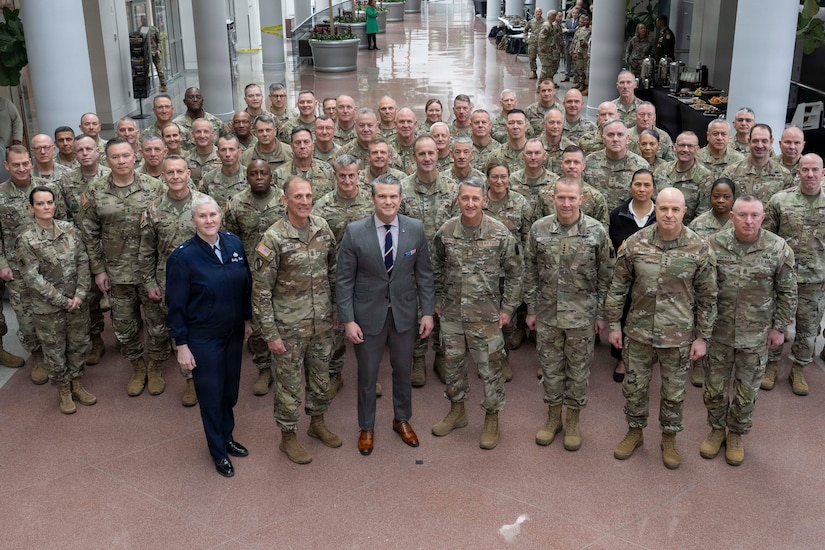
A man wearing a business suit poses for a photo with a group of people, mostly dressed in camouflage military uniforms. There is also a woman dressed in a blue military dress uniform and another woman in civilian attire.

"I salute those who embraced coming alongside law enforcement agencies to make our cities safer," Hegseth said. "It's just like in the aftermath of natural disasters — the guard adds huge value, and they make people feel safer where they live. Their incredible professionalism goes a long way." During the State of the Union, Trump awarded two West Virginia National Guardsmen, Air Force Staff Sgt. Andrew Wolfe and Army Spc. Sarah Beckstrom, the Purple Heart, following the attack in Washington that took Beckstrom's life while both were on duty as part of the D.C. Safe and Beautiful Task Force.
"President Trump showcased our best warriors, past and present," Hegseth said. "They don't do it to be recognized." 

The secretary reminded the generals that the National Guard is vital to homeland defense.  

Army Guardsmen in Alaska, California and Colorado operate the department's only capability to defeat intercontinental ballistic missile strikes with defensive interceptor missiles. Sixteen of the 17 Aerospace Alert Control sites are operated by Air Guardsmen in conjunction with North American Aerospace Defense Command, to launch fighters at any time to intercept, inspect, influence and defeat potential airborne threats, 24/7. National Guardsmen also sustain enduring missions in counter-drug operations and cyber defense. 

A man dressed in a business suit shakes hands with a man wearing a camouflage military uniform. There are people in camouflage military uniforms surrounding them.

With 435,000 total service members, the National Guard provides 20% of the U.S. joint force at about 4% of DOW's budget. Regarding force strength, the Army Guard constitutes 40% of the Army's operational force, fielding eight full divisions, while the Air National Guard provides 30% of the Air Force's operational forces across 90 wings. Hegseth applauded the National Guard's integral role in high-profile missions such as Operation Midnight Hammer, which showcased exquisite warfighting capabilities and combat experience. 

"I don't have to remind you all of that," he said. "[Midnight Hammer] and Operation Absolute Resolve demonstrated the ripple effect of American power. You have to prove you can TKO again and again." 

Hegseth, a former Army National Guard infantry officer who served in units across six states, noted the unique skill sets that reside in the National Guard, where members balance civilian careers with service.  

He stressed the guard also advances both the second and third pillars of the NDS — deterring China in the Indo-Pacific region through strength rather than confrontation and increasing burden-sharing with allies and partners — through DOW's National Guard State Partnership Program. The SPP now encompasses partnerships with 116 nations linked to the National Guard of a state, territory or D.C. Of those, 18 are in the Indo-Pacific area of operations, and 30 are in Central and South America, supporting counter-narco-terrorism efforts and enabling partners to lead regionally. 

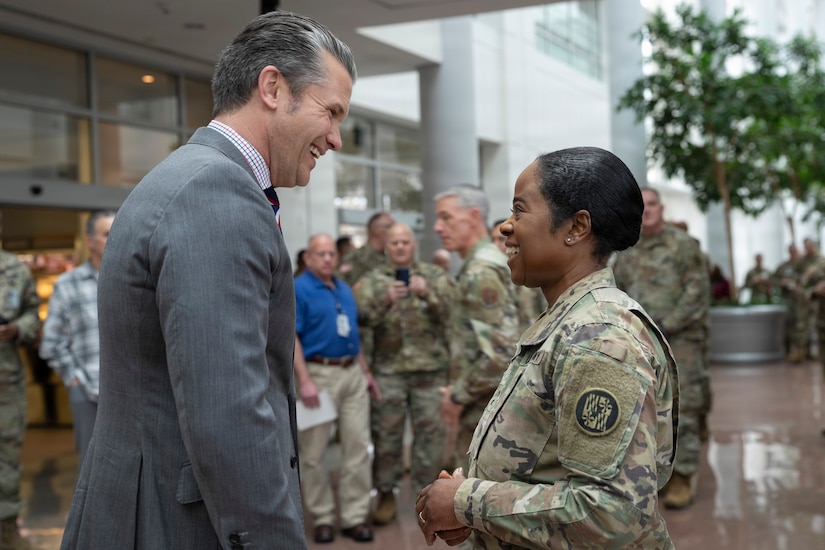
A man wearing a business suit smiles as he converses with a woman, who is also smiling, dressed in a camouflage military uniform.

Globally, the U.S. is enabling allies and partners to "step up and take the lead" in their own defense. Hegseth applauded the guard's partnerships in the Western Hemisphere, where he said the department has "only just begun to counter narco-terrorists and cartels." 

"Military-to-military partnerships pay off in spades, and the SPP is a bedrock of that," he said. "Countries are ready to go when they see we are with them." 

He noted the ingenuity of guard soldiers and airmen in leveraging skills and experience to help shape future warfighting equipment.  

"We welcome your feedback and bottom-up input from the troop-level to know we're fielding the right systems, when and where we need them." 

On the personnel side, Hegseth said one facet of restoring the warrior ethos is to reduce or eliminate unnecessary "mandatory" trainings and slideshow briefings and instead, empower commanders and noncommissioned officers to lead lethality-focused training. 

"We hope it makes drill weekend and annual training a little better," he said.

Hegseth Inducts Naval Aviator, Medal of Honor Recipient Into Pentagon Hall of Heroes

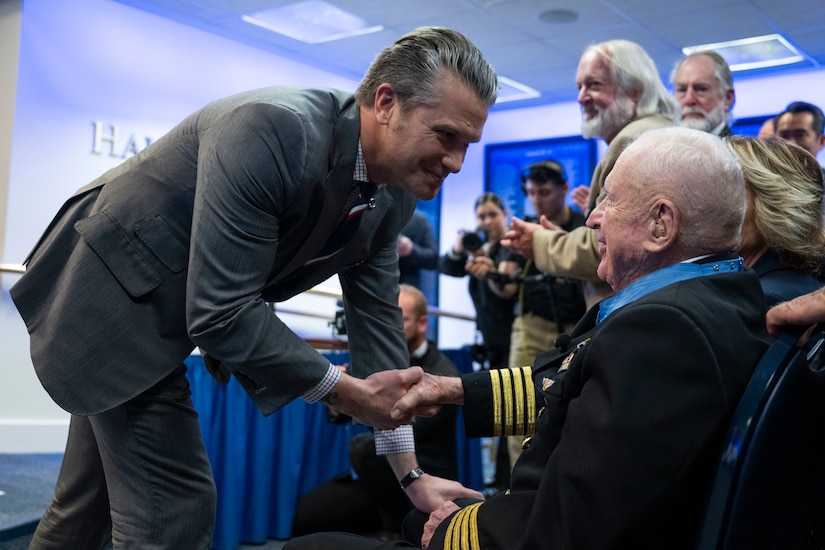
Last night, retired Navy Capt. Elmer Royce Williams received the Medal of Honor from President Donald J. Trump during the State of the Union address at the U.S. Capitol. Today, Secretary of War Pete Hegseth, Secretary of the Navy John Phelan and Chief of Naval Operations Adm. Daryl Caudle inducted Williams into the Pentagon's Hall of Heroes for his heroic actions during the Korean War.

A man in business attire leans down to shake hands with a seated man in a formal military uniform; a crowd of people stands and claps inside a large ballroom.

"Capt. Royce Williams did what warriors are called to do when the moment comes — he stood his ground, took the fight to the enemy and protected his fellow Americans. Outnumbered, outgunned and alone in the sky, he prevailed through sheer skill, courage and will," said Hegseth. "Today, we honor not just a remarkable dogfight, but a lifetime of quiet strength and service. Capt. Williams embodies the fighting spirit of the United States Navy and the warrior ethos that keeps this nation free."

Williams was joined by an audience of family, friends, fellow Naval Aviators and senior Navy leaders.

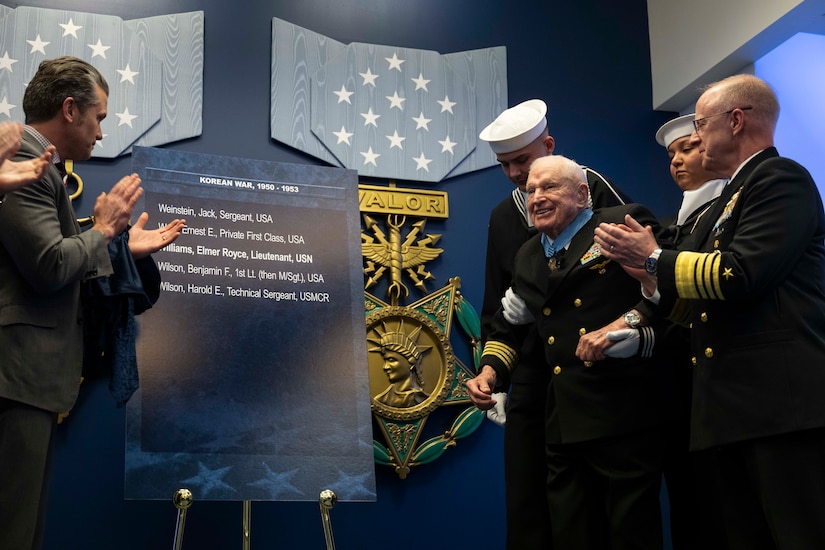
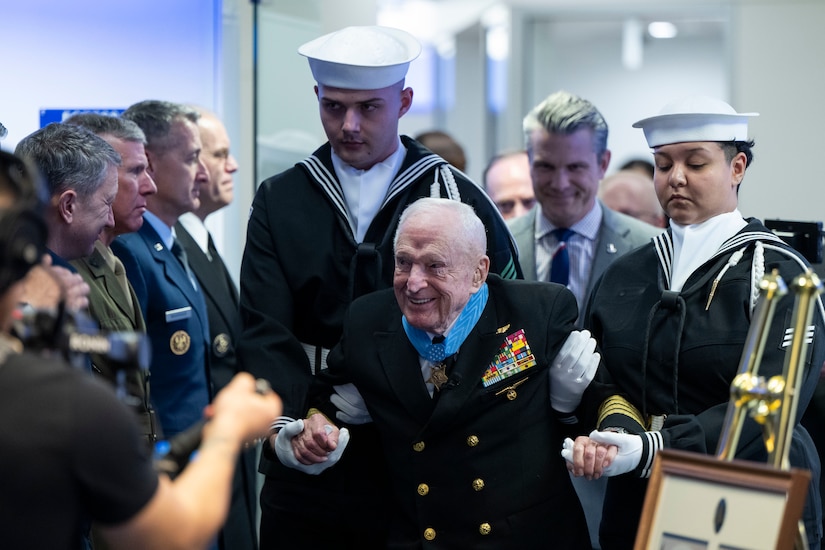
An older man in a formal military uniform smiles and stands with the assistance of another man in similar attire, as people in business attire and formal military uniforms clap. On the left of the man is a large sign displayed on an easel with the names of several service members.

"Capt. E. Royce Williams represents the very best of the United States Navy," said Phelan. "On Nov. 18, 1952, flying from USS Oriskany and outnumbered in the skies over North Korea, he chose to engage to protect the ships of Task Force 77 and the sailors aboard them. In a 35-minute dogfight, he shot down three MiG-15s and severely damaged a fourth one. For decades, much of this story remained classified, but the facts never changed. His courage, airmanship and devotion to duty saved lives and upheld the highest traditions of the Naval service. Today, we are proud to formally recognize a Naval Aviator whose example will endure for generations."

Yet when reflecting on that historic day and the recognition it brought, Williams did not speak of skill or courage, but of humility and faith.

An older man in a formal military uniform smiles and walks with the assistance of two people in similar attire. Behind them is a man in business attire, and to the left is a crowd.

"I know how momentous this moment is, and I never imagined myself or allowed myself to think it was going to happen to me," Williams said. "I imagined it as God reaching in and dipping his hand in to pick somebody up for the most unusual reasons and displaying him in front of his fellow citizens."

He continued, emphasizing that the honor was never something he expected or sought.

"And to be entirely amazed and appreciative for the accommodations and accolades. But that's so unusual that you don't fool around thinking that it's ever going to come your way," he said. "This is God doing something usual, with his finger in the pie and with his influence. And what did I have to do with it? Well, I was the principal, in a way, that is receiving the recognition, but maybe some of that recognition misses the influence that really caused this special recognition."

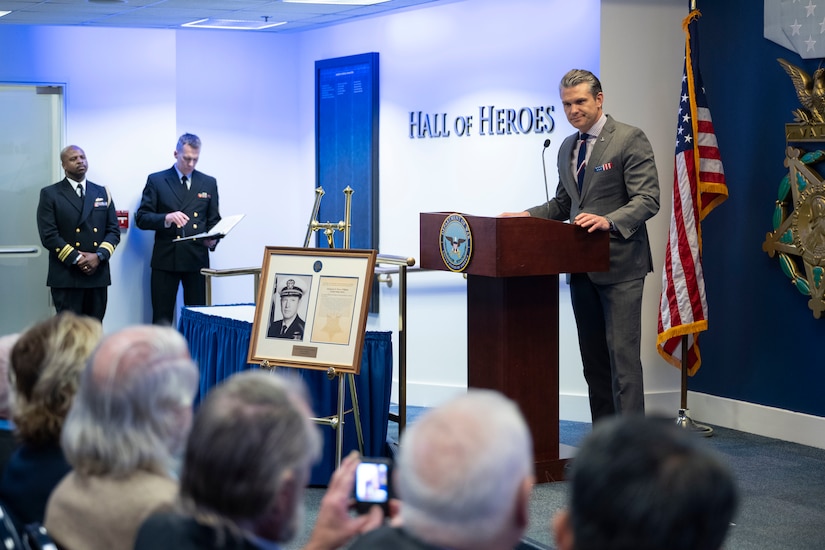
A man in business attire stands at a lectern and talks to an audience in a ballroom. In front of him is an easel with a framed picture displayed on it, and behind him is the American flag.

Williams was born in Wilmot, South Dakota, and enlisted in the Army at 16 years old in Ortonville, Minnesota. Upon completion of basic training, he returned to Ortonville to train with his unit in a reserve status until he finished high school. Once he turned 17, Williams was eligible for the Naval Aviation Cadet program and joined the Navy, where he began flight training in 1943. Among many other aviation platforms, Williams learned to fly the F9F-5 Panther jet and was assigned to active duty in the Korean War, during which he flew 70 missions. Williams went on to serve in the Vietnam War, flying over 110 missions in the A-4 Skyhawk and F-4 Phantom from the USS Kitty Hawk. Williams later served as commanding officer of the command ship USS El Dorado from September 1969 to January 1971. He retired from the Navy as a captain in 1980.

His Medal of Honor is an upgrade of the Navy Cross he was previously awarded in January 2023, which was an upgrade to the Silver Star Medal he was previously awarded while assigned to the "Pacemakers" of Fighter Squadron 781 in 1953.

Wednesday, February 25, 2026

The Decisive Edge: How the Defense Mapping Agency Shaped the Gulf War

Thirty-five years ago, on Feb. 24, 1991, coalition troops began the Operation Desert Storm ground offensive, seeking to liberate Kuwait from Iraqi occupation.

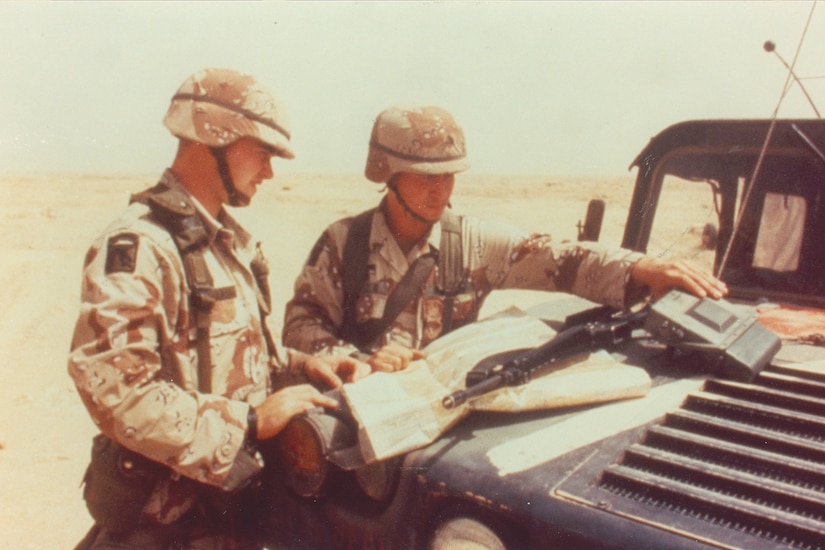
Two men wearing military camouflage uniforms stand in the desert and look at an electronic device and a map that is open on the hood of a vehicle.

Before the day ended, the Iraqi army was devastated — 10,000 troops were held as prisoners and a U.S. air base was set up deep within Iraq's borders. Within 100 hours, Iraq agreed to a ceasefire and pledged to honor the peace terms.

Instrumental to this offensive — and efforts across the entirety of the Gulf War — was the Defense Mapping Agency, whose work marked a turning point for geospatial support.

Before the Gulf War, maps of Kuwait, eastern Saudi Arabia and southern Iraq were largely based on data from the British colonial period. These existing products were rapidly becoming obsolete due to explosive growth in Kuwait and the surrounding areas, leaving limited or nonexistent coverage for military operations. This deficiency led to the rapid retargeting of space-based imagery platforms that mapping agency analysts used to map the region at unprecedented speed, scope and scale.

One core product was 1:50,000-scale topographic line maps, which were key to ground operations. In response to the incredible demand for these products, the mapping agency compressed its map production time from six months to six weeks.

A map depicts the western portion of the Middle East, centered on the Persian Gulf, including Iraq, Iran, Kuwait and Saudi Arabia, with roads, airfields and international boundaries emphasized. The top, left-hand corner contains a legend.

The Defense Mapping Agency was also instrumental in providing data that fueled the targeting of precision-guided missiles. The Gulf War was one of the earliest major conflicts to see widespread use of these weapons. In past conflicts like the Vietnam War, commanders shouldered a difficult burden — the primary tools for decisive action, namely large-scale strikes and area bombing, were blunt instruments often resulting in widespread collateral damage.

Precision-strike capabilities, fueled by the mapping agency, alleviated much of this burden, significantly reducing collateral damage and allowing commanders to quickly and decisively strike Iraqi forces. The agency's impact extended beyond precision targeting, with hydrographic and bathymetric products that proved critical to military and logistical operations.

The Navy was uncertain of its ability to conduct extended carrier battle group operations in the confined waters of the Persian Gulf and Red Sea before the war. Aided by Defense Mapping Agency marine charts, the Navy confidently deployed much closer to the Kuwait theater, boosting carrier effectiveness and increasing the range of the force's cruise missiles. The agency's products also supported amphibious assaults, counter-mine activities and special operations.

When Saddam Hussein sabotaged an oil tanker facility, coastal hydrographic charts were used to plot and predict the advance of the oil slick, which posed an immediate environmental impact and operational threat. Furthermore, 90% of all equipment and supplies entering the Gulf theater were delivered by sea, reliant not only on local charts but also on global Defense Mapping Agency maritime products.

The agency's Operation Desert Storm logistics team, comprising civilian and military members, prepared and shipped over 44 million map sheets in support of the war. Because of the team's attention to detail, dedication and teamwork, the Defense Mapping Agency was the only element that never lost a shipment during the conflict. For its work, the team was inducted into the Geospatial-Intelligence Hall of Fame in 2018.

The Gulf War demonstrated a fundamental shift in how warfare was conducted. The growing demand for satellite imagery, along with the increased sophistication of modern weapon systems, created a direct dependency on precise geographic intelligence — a need the mapping agency rose to meet, ultimately producing more than 1,900 unique maps and charts and printing more than 54 million paper maps.

The Defense Mapping Agency's timely and detailed support for air, land and sea operations proved critical, not only for the contingency planning of Operation Desert Shield but also for the successful execution of real-time combat in Operation Desert Storm, cementing its vital role in a new era of warfare and creating a legacy that is carried on today by its successor, the National Geospatial Intelligence Agency.

Tuesday, February 24, 2026

Justified Accord 2026 Begins in Kenya, Tanzania

Exercise Justified Accord 2026 the U.S. Africa Command's largest annual, multinational exercise in East Africa, officially began yesterday across Djibouti, Kenya and Tanzania.

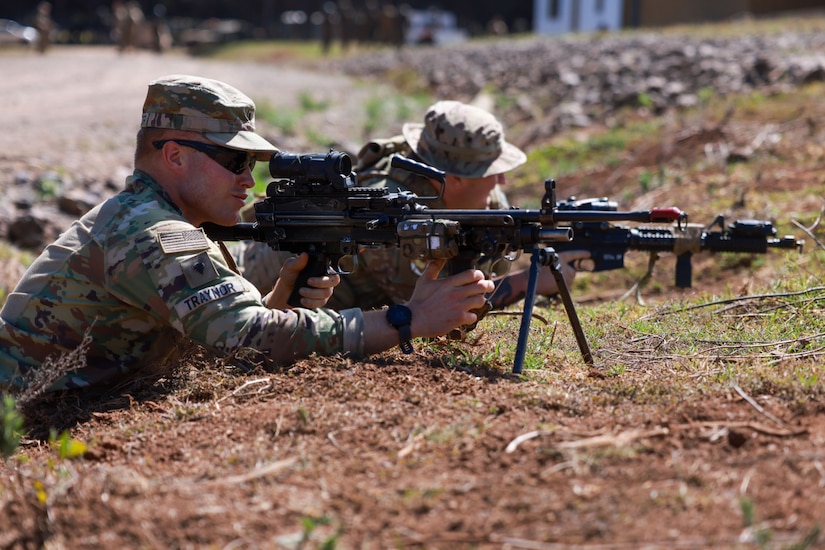
Two men wearing camouflage military uniforms point weapons at something outside of the photo frame while lying on the ground in the prone position.

Led by U.S. Army Southern European Task Force, Africa, JA26 integrates approximately 1,500 personnel from Djibouti, Kenya, Tanzania, the United States and several other nations to build readiness, deepen partnerships and strengthen regional security. 

The exercise, that continues through March 13, is designed to strengthen cooperation and advance regional security by enabling partner-led security operations against shared counterterrorism threats. It serves as a premier innovation hub in East Africa to validate new technologies in austere environments.  

"The true strength of Justified Accord lies in our partners taking the lead," said Army Lt. Col. Jason Fernandez, the Justified Accord branch chief assigned to SETAF-AF. "This exercise embodies the principle of burden sharing, creating a powerful, partner-led security network capable of shouldering the responsibility for a stable and prosperous East Africa."

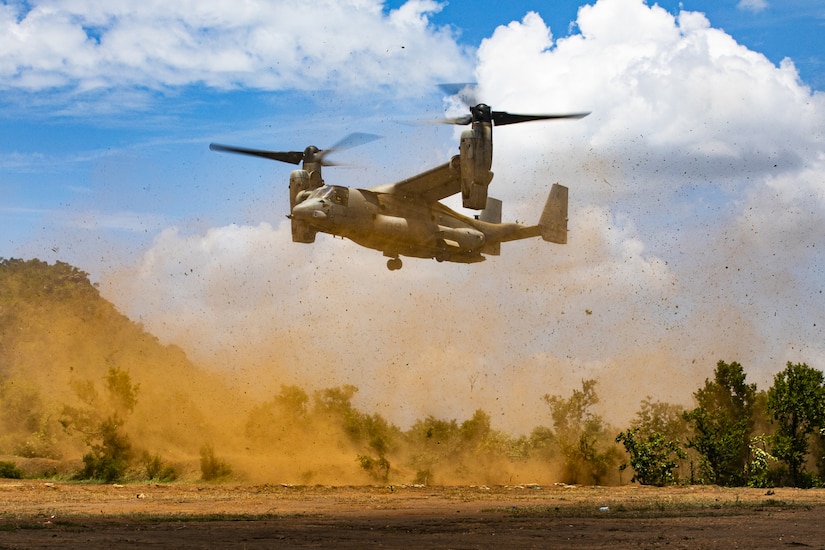
A tilt-rotor aircraft lifts off spreading dust through the air in a desert-like environment.

JA26 features a training approach tailored to shared regional security needs.

In Kenya, activities focus on enhancing joint command and control, including a multinational live-fire exercise, a command post exercise integrating special operations and conventional forces, air-to-ground integration, and defensive cyber operations centered in Nairobi and Isiolo. 

In Tanzania, the focus is on readiness, global force projection and joint readiness for crisis response. The exercise features a bilateral field training exercise on jungle warfare and counter-improvised explosive devices, alongside a medical readiness exercise to support local communities and increase U.S. medical readiness.

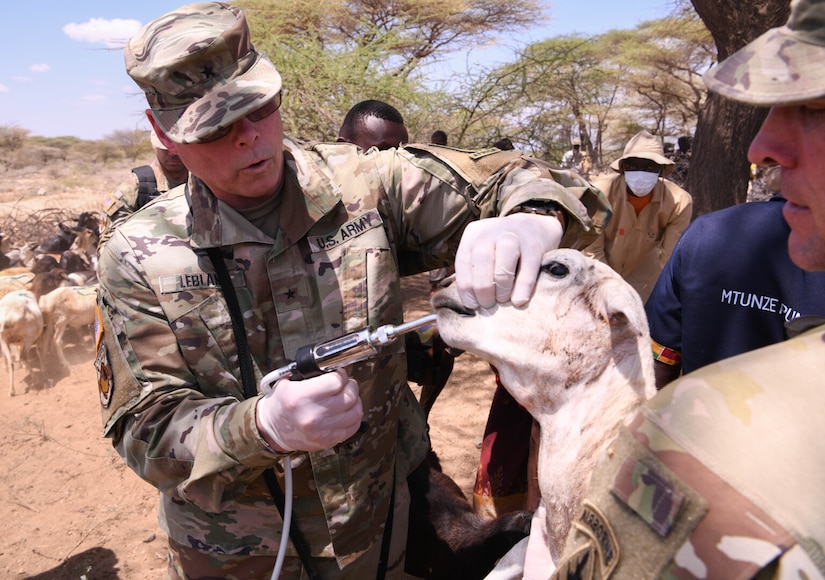
A man wearing a camouflage military uniform administers medication to a goat while another man wearing in similar attire holds the animal.

JA26 heavily leverages the National Guard Bureau's State Partnership Program to deepen long-term military relationships. 

The Massachusetts National Guard continues its decade-long partnership with Kenya, leading complex kinetic training, while the Nebraska National Guard builds on its newly developed partnership with Tanzania, focusing on expeditionary medical and ground force readiness.

The training concludes with distinguished visitor days, showcasing the tangible return on investment of this multinational partnership and shared security cooperation.

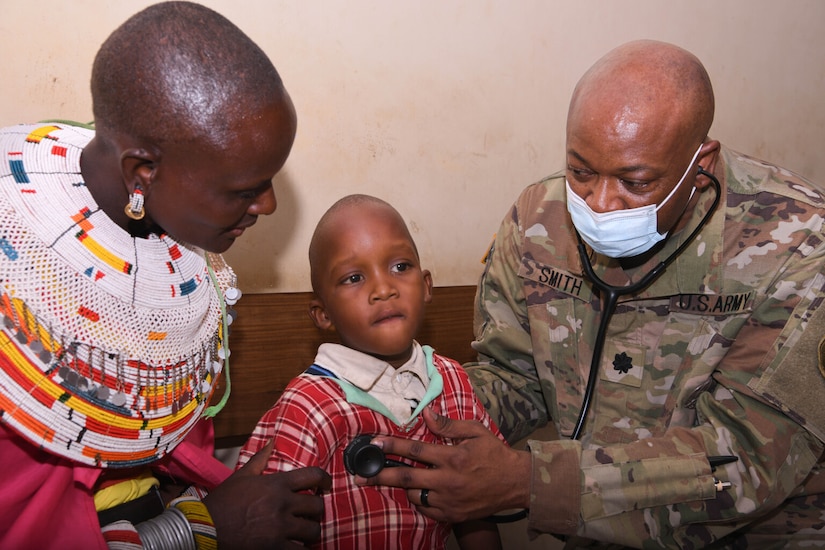
A man wearing a camouflage military uniform places a stethoscope on the chest of a child while a woman wearing traditional Kenyan clothing watches.

During the JA26 distinguished visitor days, in coordination with the U.S. military and the U.S. Department of Commerce (U.S. Embassy Nairobi), selected U.S. and African vendors will set up technology expositions. The industry day will directly connect commercial technological solutions with military and interagency end-users, fostering collaboration and aligning innovation with operational requirements focused on counterterrorism, unmanned aerial systems, and counter-UAS capabilities. 

"A truly resilient joint force is powered by a thriving defense ecosystem," Fernandez said. "What you will see is that ecosystem in action, a strategic partnership between our warfighters and commercial innovators from both the U.S. and our partners." 

Joint Interagency Task Force Announces Counter-UAS Marketplace

Joint Interagency Task Force 401 announced today that its revolutionary counter-unmanned aircraft systems marketplace has reached initial operational capability.

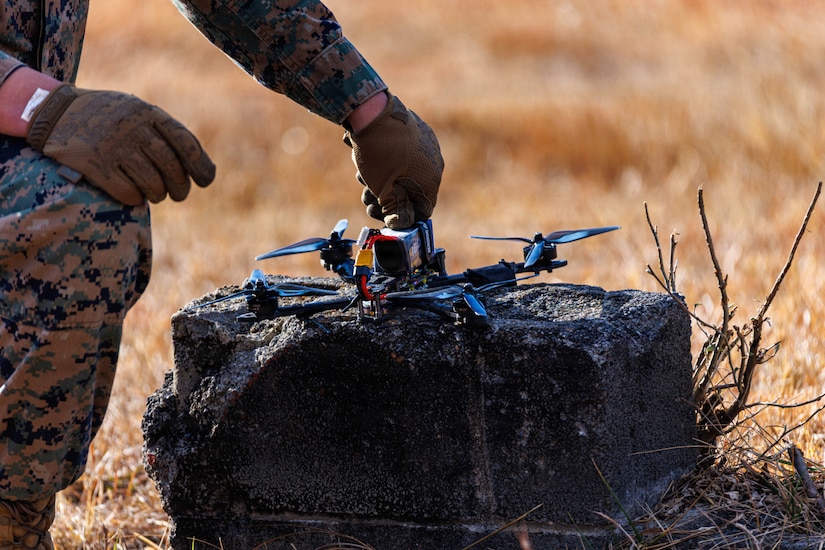
A person wearing a camouflage military uniform and sitting off-screen, kneels and places a drone on a rock.

The online platform, hosted on the common hardware systems electronic catalog, will revolutionize how the War Department and its interagency partners acquire critical counter-UAS technology. 

The marketplace streamlines the process for users to identify and procure the right equipment to meet their specific needs, featuring a growing catalog of validated counter-UAS systems and components, with plans to include performance data from the task force's authoritative test and evaluation repository. It allows customers to compare systems based on real-world performance against a variety of threats and in different environments. 

"The JIATF 401 [counter]-UAS marketplace is a critical step forward in our whole-of-government approach to countering the threat of small drones," said Army Brig. Gen. Matthew Ross, JIATF 401 director. "Our goal is to integrate sensors, effectors and mission command systems into a responsive, interoperable network that protects service members and American citizens alike." 

The marketplace is built on an established indefinite delivery, indefinite quantity contract, enabling customers to place orders immediately and significantly reducing the lengthy contracting process typically associated with defense procurement. The common hardware systems website provides an intuitive interface for users to browse available equipment, review technical specifications and compare pre-negotiated contract options. 

"Building and maintaining the [counter]-UAS marketplace has been a collaborative effort focused on delivering a user-friendly and effective tool for the warfighter," said Army Maj. Matt Mellor, the lead acquisitions specialist assigned to JIATF 401. "We've worked to create a platform that not only simplifies the procurement process but also provides the crucial data and expert support necessary for our customers to make informed decisions. This is about getting the best technology into the hands of those who need it as quickly as possible." 

The marketplace is actively expanding its inventory to include all validated counter-UAS equipment not already designated as a program of record. The common hardware systems electronic catalog already lists over 1,600 items, demonstrating its capacity to support a comprehensive, growing selection of counter-UAS solutions. 

Access to the marketplace is available to users throughout the War Department and interagency partners via a common access card or other government-issued smart card. 

Air Force Secretary Outlines Priorities

The Department of the Air Force's priorities are readiness, modernization, defending the homeland — including the entire hemisphere, border security, missile defense, nuclear deterrence and people, said Air Force Secretary Troy Meink, who spoke yesterday during the Air and Space Forces Association's 2026 Warfare Symposium in Aurora, Colorado.

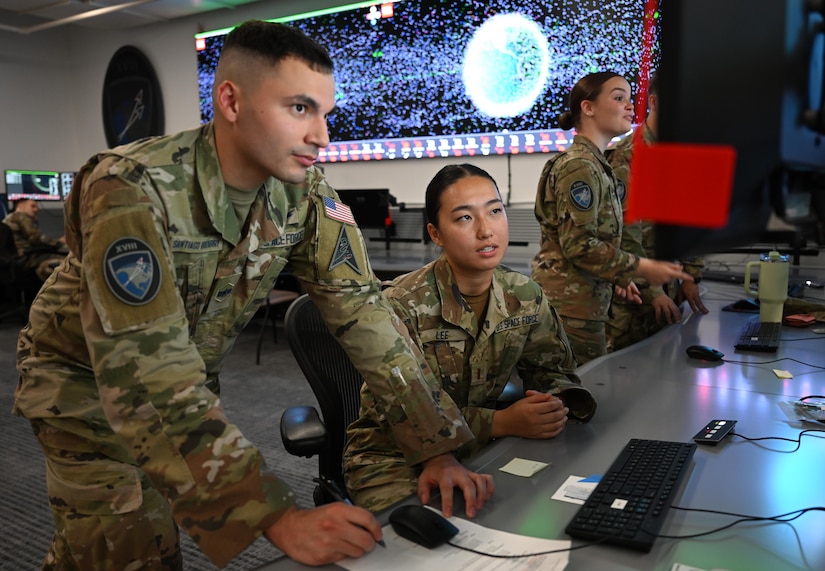
Two members in Space Force uniforms look at information on a computer screen.

From a conventional deterrence perspective, the focus is on China, which continues to expand and modernize its military at an extremely fast pace, making deterrence in the Indo-Pacific region the biggest challenge by far, he said.

"Given that threat environment, the Air Force and the Space Force must be ready at any time for any threat across the entire spectrum of conflict," Meink said.

One of the challenges is scaling up production of weapon systems and munitions. Accomplishing that requires the revival of the defense industrial base, which has experienced decades of neglect, he said.

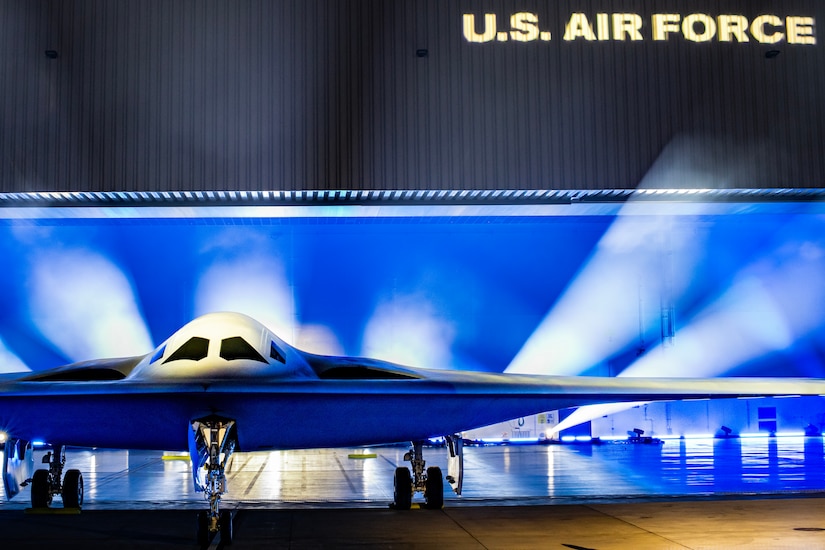
A B-21 Raider aircraft is unveiled, with blue and white lights in the background.

The good news is that beginning last year, production of advanced aircraft and munitions has ramped up. Not as fast as needed, but faster than in the past, the secretary said, adding the testing program for the LGM-35A Sentinel is proceeding well.

The Air Force will replace the aging LGM-30 Minuteman III intercontinental ballistic missile with the Sentinel ICBM. This represents the modernization of the land-based leg of the nuclear triad.

An image of a Sentinel intercontinental ballistic missile in a cloudy sky.

In the space domain, an increase in rocket launches has put more capability into orbit than ever before, thanks to help from commercial partnerships and other military services, as well as the National Reconnaissance Office.

Acquisition transformation includes delivering mission-effective capabilities faster.

"To do that, we must innovate faster than our adversaries," the secretary said.

To accomplish this, the workforce must be empowered to unleash their talent, take the initiative and know that supervisors have their backs, Meink said, adding that the Department of the Air Force has a phenomenal team.

Monday, February 23, 2026

Military Working Dogs Get New Home at Joint Base Charleston

Joint Base Charleston, South Carolina, hosted a ribbon-cutting ceremony Feb. 19, officially unveiling a state-of-the-art military working dog kennel facility and marking a significant investment in enhancing the well-being and mission readiness of the dogs and their handlers.

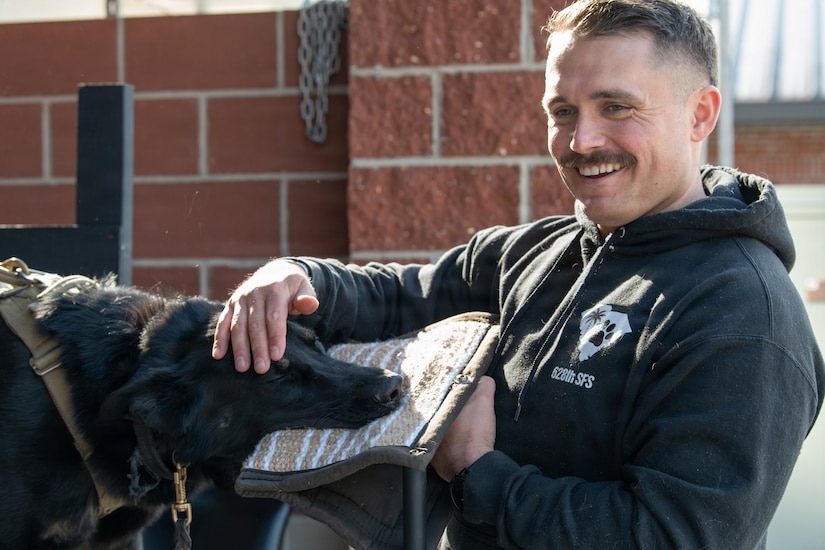
A man in casual attire smiles as he pets the head of a dog that is biting a padded training tool.

The project began in November 2023 and was completed in December 2025, with a total investment of $3.2 million in upgrades.

The renovated facility has built-in housing to increase capacity by two dogs, sound-dampening panels to reduce kennel anxiety, angled chain-link fencing to prevent visual agitation, epoxy flooring to minimize moisture and skin-related issues and an expanded obedience yard to support enhanced training and enrichment. The new arrangement of the kennels aims to reduce agitation and anxiety, reducing the risk of behavioral issues and injury.

"Health is paramount with these dogs. They have enough room for enrichment to keep them happy and healthy," said Air Force Tech. Sgt. Kyle Titus, military working dog kennel master assigned to the 628th Security Forces Squadron. "So far, we've had zero injuries in the new facility, which has been great!"

Since the remodeling, handlers have observed how the new layout fosters a healthier, safer and more efficient environment for the dogs' health, training and recovery.

"It was like a night and day difference that you could see in them and their behavior," Titus said. "You can walk through the building now, and the dogs will remain sleeping. We can definitely tell the difference in the dogs' health and morale with this new facility."
The military working dogs conduct extensive training to secure the installation's strategic assets through actively detecting explosives, deterring potential threats and defending personnel.

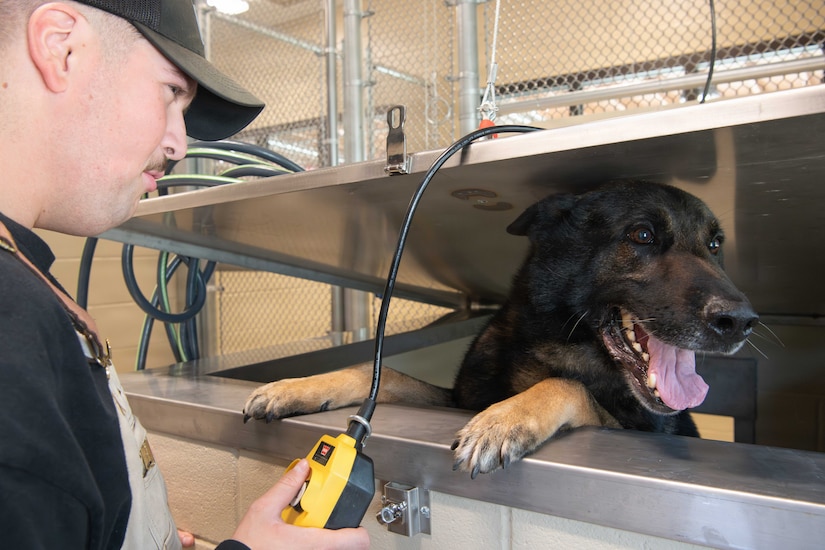
A man in casual attire presses a button to open the top of a container as a dog greets him in the opening. The dog has its two front paws on the top ledge and its mouth open.

"The Green Kennel Initiative started about 10 years ago, and the new facility reflects our overall goal to make a massive impact on the military working dogs' health and wellness," said Air Force Staff Sgt. Reginald Conyers, military working dog trainer assigned to the 628th Security Forces Squadron.

Looking ahead, the squadron hopes the new facility will extend the working life of the dogs while significantly reducing injuries and stress-related issues.

"We need to be doing our part as far as giving dogs ample time to get [their] energy out," Titus said. "Providing longevity to their careers with better conditions and more space to move around is a big goal for us."
The new facility supports the squadron and its military working dogs' readiness and capability to defend the mission every day, symbolizing the installation's continued commitment to resilient infrastructure and operational excellence.

"The ceremony showcases that we're going forward in the right direction in improving the life conservation of our military working dogs and making a massive impact for mission accomplishment," Conyers said.

CIO Says 'Bold' Changes Coming to War Department IT Efforts, 2025 Award Recipients to Play Role

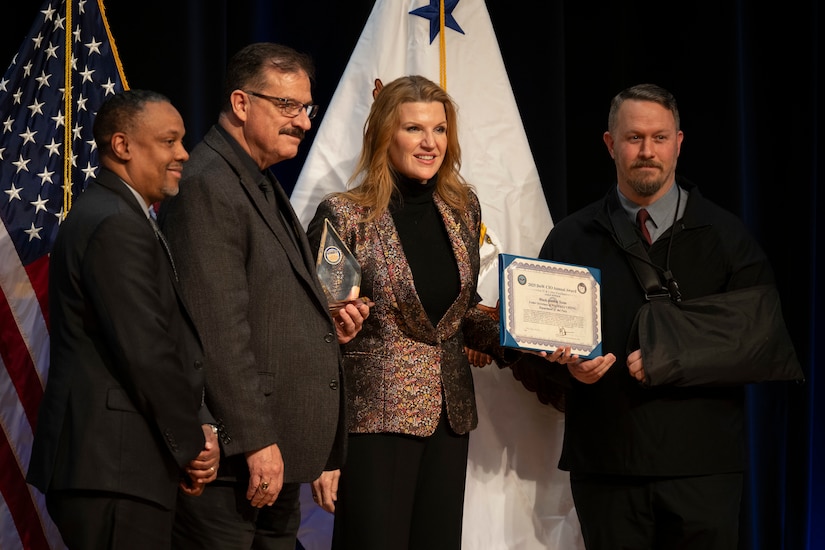
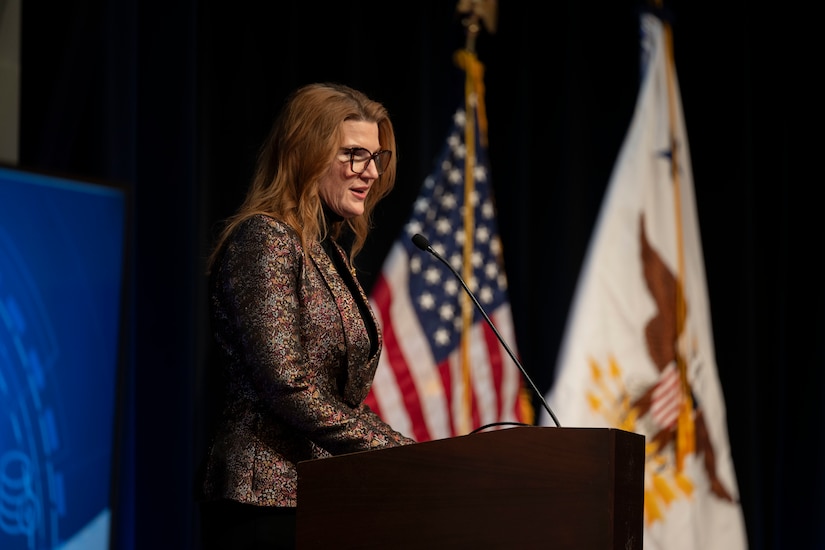
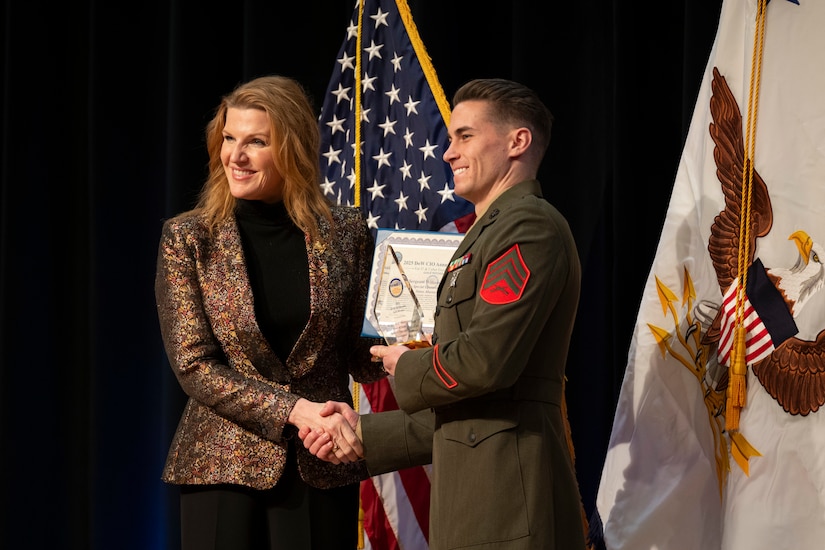
The War Department's chief information officer, Kirsten Davies, today recognized more than a dozen individuals and teams for delivering information technology capabilities and management practices that advanced warfighter lethality, readiness and network efficiency during the 2025 War Department CIO annual awards ceremony at the Pentagon. 

A woman in business attire presents an award to a man in a formal military uniform as they shake hands and smile to a camera off-screen; behind them are an American flag and a white flag with an eagle in the center.

This year marked the 25th iteration of the awards. 

"It's important today and every day that we recognize all of the efforts that are happening across our technology and cybersecurity ecosystem at the department," she said. "This is a time of significant change for the department, and it's only going to be successful if we have innovative individuals and teams like you to drive transformation."

Three men and a woman, all in business attire, pose for a photo. One man holds a diamond-shaped trophy, and the woman holds a certificate; behind them are an American flag and a white flag with an eagle in the center.

Two months into the job as the DOW CIO, Davies said President Donald J. Trump and Secretary of War Pete Hegseth have given her a mandate to take bold action with the department's IT and cyber portfolio. The ongoing work of this year's award winners will be an important part of how that bold action is implemented across the department.

"[We have] the potential to truly transform the way the department operates and provides capability straight to our warfighters," she said. "Our challenge is to deliver capabilities to the warfighter that have operational impact but are also secure and delivered at speed and scale; not a small task. The secretary has accepted acquisition risk today to decisively reduce operational risk tomorrow. And we're going to follow [in the] footsteps there."

A woman in business attire stands behind a lectern and speaks into a microphone, with an American flag and a white flag with an eagle in the center behind her.

Davies noted that this year's awards program covered four broad areas: cybersecurity; the information enterprise — including cloud modernization, network, transport and software; command, control and communications; and a broader area that includes, among other things, financial and management audits, a cyber budget and electronic records management.

As part of the ceremony, both teams and individuals were either named recipients of awards or given honorable mentions. Those honored include:

Individual Gold Winners

  • Air Force 1st Lt. Diego Castanon 
  • Marine Corps Sgt. William Smail, U.S. Special Operations Command 
  • Air Force Maj. Jean-Luc Duckworth, Defense Contract Management Agency 

Individual Silver Winners

  • Air Force Master Sgt. Kenneth Bricker 
  • Aaron Ford, Army 

Individual Bronze Winners

  • Air Force Capt. James Lockatell 
  • Richard Edwards, Defense Health Agency 
  • Navy Cmdr. Matthew Manship, Joint Chiefs of Staff 
  • Marine Corps Staff Sgt. Joshua Small, U.S. Special Operations Command 

Team Gold Winners

  • Europe Infrastructure Services Team, Defense Information Systems Agency 
  • Individual Longitudinal Exposure Record Program Management Office Team, Defense Health Agency 
  • National Nuclear Security Administration Assured Communications Team, Energy Department 
  • Black Ansible Team, Office of the Undersecretary of War for Research and Engineering/Navy 
  • Enterprise Business Systems Convergence Capability Requirements Team, Army 

Team Silver Winners

  • BLANKTELEGRAM Team, National Security Agency 
  • DCI Information Command, Control Communications and Computers Networks Team, Marine Corps 
  • Information Command Active Defense Campaign Team, Marine Corps 
  • J6 Spectrum Branch Team, Joint Chiefs of Staff 
  • Digital Advantage Division SQAD Team, Space Force/Air Force 
  • Zero Trust Tactical Team, Navy 

Team Bronze Winners

  • 607th Air Communications Squadron Team, Air Force 
  • Joint Worldwide Intelligence Communications System Cybersecurity Inspection Program Team, Defense Intelligence Agency 
  • Customs and Border Protection, Office of Information and Technology, Team Awareness Kit Team, Department of Homeland Security 
  • 0648 Spectrum Manager Military Occupation Specialty Mod Team, Marine Corps 
  • MyAuth Team, Defense Manpower Data Center 

After recognizing the winners, Davies thanked both the winners and those who recognized their contributions.

"Let me thank the leaders who nominated you, as well as each of you here, as individuals and as team members," Davies said. "I speak on behalf of the secretary when I say, thank you for all the hard work you are doing every day. You're seen, you're appreciated and your work matters to our warfighters."


Medal of Honor Monday: Army Staff Sgt. Clifford Sims

Many Medal of Honor recipients come from humble beginnings, but perhaps none more so than Army Staff Sgt. Clifford Chester Sims, who spent much of his early life with nowhere to call home. Sims grew into a humble and thoughtful man, so when an explosive device threatened his fellow soldiers in Vietnam, he didn't hesitate to give his life to save theirs.

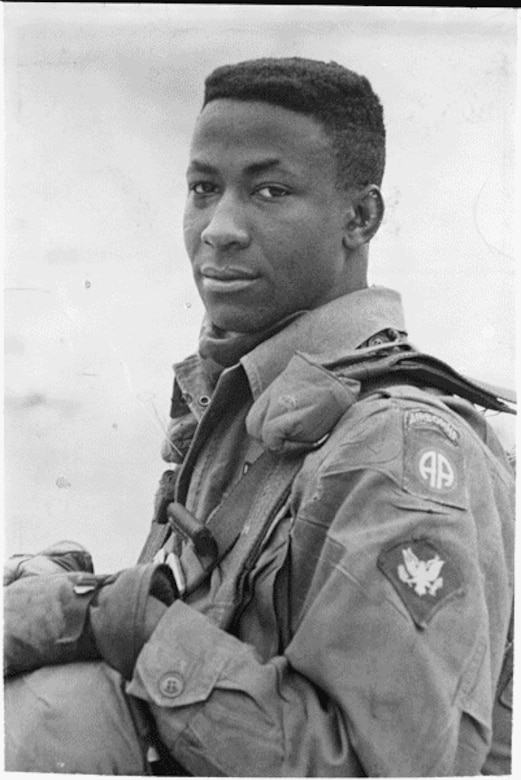
A man wearing a military uniform looks into the distance.

Sims was born June 18, 1942, in Port St. Joe, Florida, as Clifford Pittman. He was orphaned at an early age and sent to live with his stepfather's family, according to an account from his wife, Mary, in a 2015 The Leaf-Chronicle newspaper article out of Clarksville, Tennessee.

However, that family already had many children, so Sims decided he wouldn't stay. To get by, he either spent the night with acquaintances or in an old, abandoned bus shelter in Panama City, Florida, The Leaf-Chronicle article reads.

At age 13, however, the young man was adopted by James and Irene Sims and took their family name. Through all that adversity, he continued his education and made it to high school, where he became inseparable from his girlfriend, Mary. They married on Christmas Day 1961, just a few months after he enlisted in the Army.

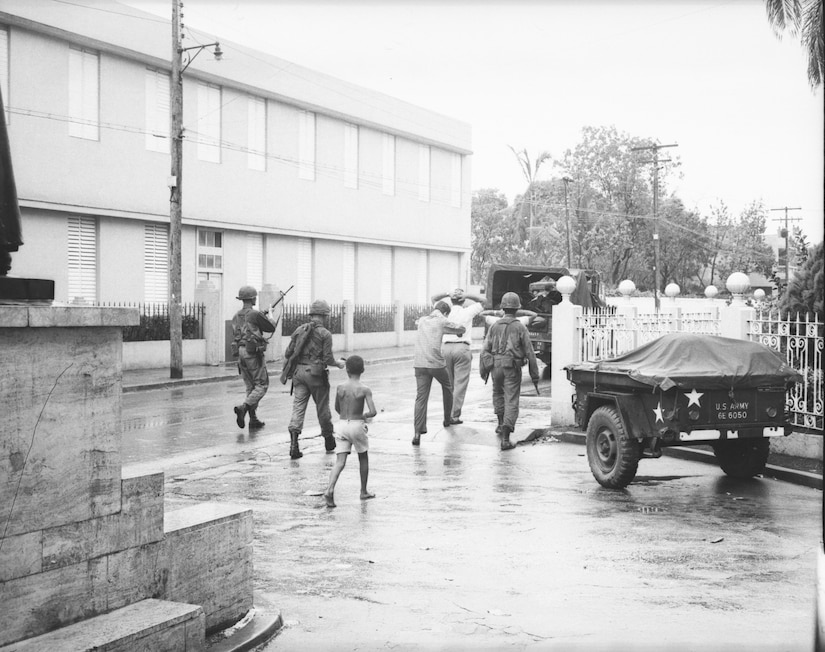
Sims initially served with the 82nd Airborne Division. In 1965, the unit was sent to the Dominican Republic to protect American interests there during the country's civil war. 

A boy walks behind three people in military uniforms as they usher two men, including one with his hands on his head, toward a military vehicle. They’re walking along an empty street with a building in the background.

Once Sims returned to the U.S., and as the Vietnam War was escalating, he was transferred to the 101st Airborne Division, where he was assigned to Company D of the 2nd Battalion, 501st Infantry Regiment — known as the Delta Raiders.

Shortly before Sims was deployed to Vietnam in late 1967, he and his wife adopted a young daughter, named Gina, who was born to his wife's sister.

Sims was not in Vietnam long before the Tet Offensive began, when North Vietnamese troops and their Viet Cong sympathizers flooded into South Vietnam in an onslaught that caught American and South Vietnamese troops off guard.

While U.S. and South Vietnamese troops were able to retake most of the territory the enemy had taken rather quickly, the fight over Hue City — known as the Battle of Hue — led to weeks of urban combat. That is where Sims gave his last full measure of devotion.

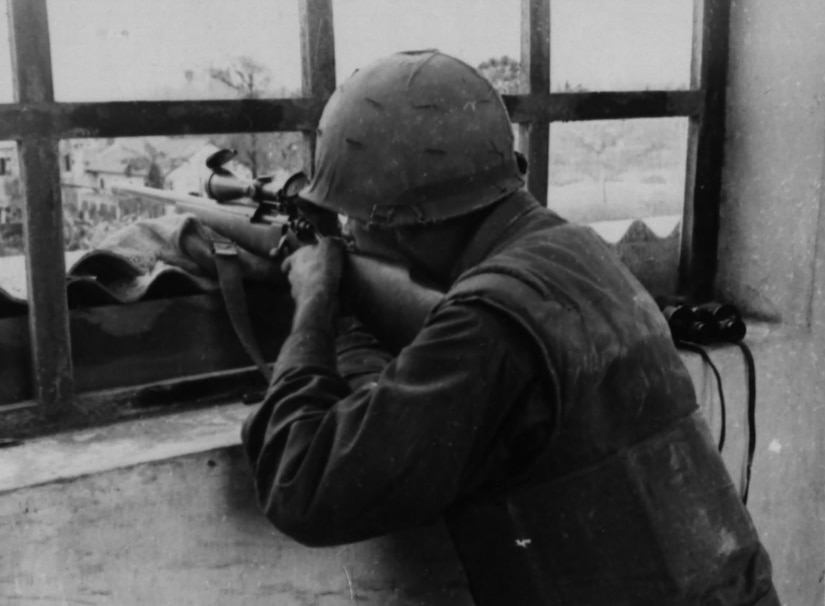
A man wearing a military uniform and a helmet, crouches down and aims a rifle out of the window.

On Feb. 21, 1968, Sims' squad was assaulting a heavily fortified enemy position in a densely wooded area when they came under heavy enemy fire. Sims furiously led his squad in an attack against their aggressors, helping free a platoon that had been pinned down and nearly overrun.

Sims was then ordered to move his squad to provide cover fire for the company command group while linking up with another platoon that was under heavy enemy pressure.

After they had moved about 30 meters, Sims noticed that a brick building stocked with ammunition was on fire. An explosion was imminent, so Sims immediately moved his squad away from it, but not before the stockpile blew and injured two of his squad's soldiers. Still, Sims' prompt actions kept more people from getting hurt.

The squad continued through the dense woods while under fire. As they neared a bunker, they heard a noise no one ever wanted to hear — the sound of a hidden booby trap being triggered.

Without hesitation, Sims quickly yelled a warning and threw himself on top of the device as it exploded. He sacrificed his life so his fellow soldiers could live.

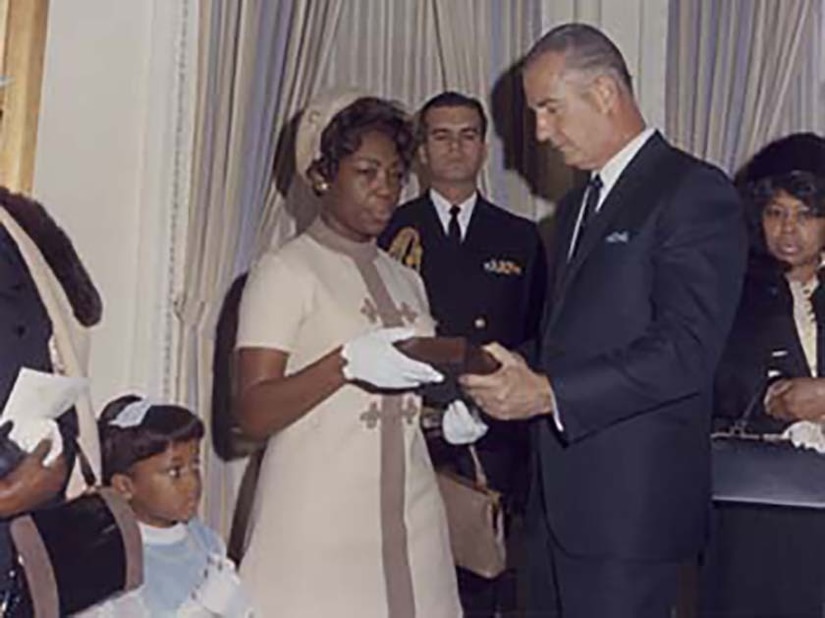
A woman in formal attire is handed a small box from a man in business attire, as people around them, including a little girl, watch.

"Sims saved the lives of at least three of his squad and two of the company headquarters by absorbing the shock of the blast himself," Sims' commander, Army 1st Lt. Cleo Hogan, later wrote in an eyewitness statement. "Sims made the greatest sacrifice a soldier can make … and no mark of tribute can be too great."

For his valor, Sims' wife and daughter received the Medal of Honor from Vice President Spiro Agnew during a White House ceremony on Dec. 2, 1969.

Three other men also received Medals of Honor for their actions during the Battle of Hue: Army Staff Sgt. Joe Ronnie Hooper, Marine Corps Sgt. Alfredo Gonzalez and Army Chief Warrant Officer Frederick Ferguson.

Sims is buried in Barrancas National Cemetery in Pensacola, Florida.

His name has not been forgotten. A state veterans nursing home in Springfield, Florida, and the garrison headquarters building at Fort Campbell, Kentucky, are both named in his honor. And since 2019, the Florida county where Sims grew up has celebrated every June 18, his birthday, as Clifford Sims Day.