Thursday, October 08, 2020

DOD Acquisition & Sustainment Leaders Update Reporters on Improvements to Defense Acquisition System

 Oct. 7, 2020

Ellen M. Lord, Under Secretary Of Defense For Acquisition And Sustainment; Kevin M. Fahey, Assistant Secretary of Defense for Acquisition; Stacy A. Cummings, Principal Deputy Assistant Secretary of Defense for Acquisition

STAFF: All right, good morning, everybody, thank you for joining us here and over the phone.

We have Under Secretary Lord today, we have Assistant Secretary of Defense for Acquisition Kevin Fahey, and Principal Deputy Assistant Secretary of Defense for Acquisition Stacy Cummings.

Today, they will discuss the rewrite of the overarching policy on the Defense Acquisition System, DOD Directive 5000.1, and the significance of this effort as well as the impact of the Adaptive Acquisition Framework.

Following some opening remarks from Ms. Lord, they will take some questions. We ask that you keep your questions within the scope of today's topic. We do have a hard stop of noon today, so we'll get to as many questions as possible. If there are any we don't get to, I'm happy to work over e-mail with you.

With that, I will turn it over to Ms. Lord.

UNDER SECRETARY OF DEFENSE ELLEN M. LORD: Great, thank you, Jessica.

Good morning, ladies and gentlemen, and thank you for joining us both here in the room and virtually. As many of you know, last month, Deputy Secretary Norquist signed DOD Directive 5000.01 into effect. It is the overarching policy that describes the principles governing the Defense Acquisition System. This completed a comprehensive redesign of the entire DOD 5000 Series Acquisition Policy.

Today, I would like to discuss the work products we have produced, why we undertook this effort, and how one of the most transformational changes to acquisition policy in decades is already enabling the services and our warfighters.

When I came into this job in 2017, the department was at a strategic inflection point. A new National Defense Strategy was being developed that emphasized the need to restore our nation's competitive advantage, focusing on near-peer competition versus violent extremist organizations.

We were reorganizing the former AT&L office into A&S and R&E as mandated by the 2017 NDAA, National Defense Authorization Act.

Our acquisition system used a one-size-fits-all model for all acquisition programs, one that focused on a culture of tailoring out and what acquisition professionals don't have to do. This way of doing business resulted in a checklist approach that was susceptible to prescriptive processes and rarely enabled speed.

For 100 of our largest programs at that time, the median duration from milestone B -- the decision point to enter development of a product and generally considered the start of a program of record -- to initial operational capability was nearly eight years. We need to build a more lethal force and speed delivery of capability to the warfighter. In other words, DOD acquisition needs to move at the speed of relevance.

I brought 33 years of industry experience into this job, 22 in -- I'm sorry, 11 in automotive, and 22 years in aerospace and defense. That experience drives me to constantly consider our continuous improvement in terms of cost, schedule, and performance.

So coming into the job, I asked myself, "How could we redesign our defense acquisition system to incorporate the agility and best practices in industry while also creating a culture that not only facilitates critical thinking and creative compliance, but actually encourages it." I was looking for a way to shift our mindset from piecemeal reform in favor of true overarching innovation.

One of the first individuals I brought in to help tackle this problem was Ben FitzGerald, a former professional staff member for the Senate Armed Services Committee and senior fellow at the Center for a New American Security. Having a broad understanding of the AT&L reorganization, both from the congressional and department perspectives, I charged Ben with driving innovation, to deliver capability to our warfighters faster and cheaper.

With this mission in mind, Ben and his team came up with the idea for a new acquisition system that afforded program managers flexibility and empowered common-sense decision-making to accelerate delivery times. Thus, the foundation was laid for what we now know as the Adaptive Acquisition Framework, or AAF. From there, Kevin Fahey and Stacy Cummings, who have joined me here today, came aboard in 2018 and 2019, respectively, to take the AAF concept to implementation.

A career Defense Acquisition executive, Kevin brought an institutional knowledge of both the Defense acquisition system and the program management, or PM, and program executive officer, or PEO experiences. His insights and lessons learned directly informed how we could better enable our acquisition professionals to tailor programs and bridge the gaps between our conceptual design and statutory and regulatory requirements as policy was streamlined and simplified. He also drove the idea of tailoring in, versus tailoring out, to force the acquisition community to think critically and work together to create the right acquisition strategy.

Similarly, in leading our Acquisition Enablers Office, Stacy and her team worked tirelessly to detail, document and coordinate, the new policies to take the effort across the finish line, ensuring a versatile, scalable, and data-driven solution that would deliver warfighting capability at the speed of relevance. Stacy brought a depth of experience from across the interagency, and most recently, implementing electronic health records at DOD.

Kevin and Stacy leverage the collective experience and expertise of the department.

Throughout the process, I chaired an executive steering committee to facilitate and drive progress. The service acquisition executives, Bruce Jette, Hondo Geurts, and Will Roper, have all been outstanding partners every step of the way. From the collaboration of these colleagues at the senior defense levels to the skill, initiative and relentless pursuit of the men and women across the Defense Acquisition Enterprise, I am grateful to everyone who contributed to making this a reality. It was truly a team effort. The result is the most transformational change to acquisition policy in years, perhaps decades, and an effort we expect to have a long-lasting, positive impact across the department.

The 5000 rewrite decomposed a large policy document into six clear and separate pathways that make up the AAF, each of which is tailored to the unique characteristics of the capability being acquired. By design, these pathway implement the six main tenets of the Defense Acquisition System to simplify policy, tailor in approaches, empower program managers, facilitate data-driven analysis, actively manage risk and emphasize sustainment.

I want everyone to remember that $0.70 to $.80 on the dollar over the lifecycle of a program is focused on sustainment, so that's where the big dollars really are. I believe the rewrite puts much more emphasis on designing for sustainment. We are all in the precipice of a cultural shift that leadership at all levels must continue to push. Whether responding to urgent needs or acquiring major capabilities or services, the AAF affords program managers and their teams multiple ways to field capability faster, which is what our job is.

We have an interactive version of the AAF available online, and I encourage you to -- to visit the Defense Acquisition University, DAU website to explore this great tool. Take, for example, the middle tier of acquisition pathway. Prior to the development of our MTA pathway, statute required compliance with added layers of oversight aimed at risk aversion, often in -- in the form of ensuring items were, quote, "checked off," unquote, and approved at high levels before proceeding. As a result, the acquisition system became an impediment rather than an enabler to deliver capability and outpace the threat.

In order to utilize the MTA authorities Congress gave DOD, I made the decision to quickly implement an interim policy which ultimately informed the creation of DODI 5000.80, the permanent MTA policy in place today that established a dedicated pathway. I wanted to actually practice using middle-tier acquisition with a minimal viable product in order to learn.

So using this policy, which was published in 2019, we have 74 programs today using the middle-tier acquisition pathway, including the Army's Integrated Visual Augmentation System, or IVAS. Use of rapid prototyping and the new authorities afforded by the MTA pathway allowed the program to shave significant time from the schedule, streamline metrics to better inform decisions and reporting, and provide greater flexibility to manage risk. As a result, IVAS intends to rapidly field the capability in fiscal year '21 after conducting dozens of hardware prototype and thousands of software builds through a continuous iteration with soldiers. This would represent only 34 to 36 months from program start to fielding capability for the warfighter. The MTA pathway incentivized powerful behaviors across the acquisition enterprise to quickly restore the Army's advantage in individual situational awareness, navigation, communications, and target acquisition.

I'm also pleased to see emerging programs utilizing the flexibility of the entire AAF. I recently saw a service proposal to begin a program using the MTA pathway before transitioning into a traditional major capability pathway. Another program is proposing to use several of the pathways in combination to facilitate rapid delivery of capability. While these plans are still into review, I'm excited to see the acquisition community embracing creative compliance to use these new tools and authorities while demonstrating critical thinking.

Hybrid approaches like these allow program managers, in partnership with functional leaders and their decision authority, to start programs quickly, drive down risk, and solidify detailed requirements and engineering approaches, while still ensuring the proper level of analysis, risk management, and oversight.

Similarly, the software pathway, the AAF's newest policy signed just last week, represents a substantial departure from the department's usual way of doing business. The Acquisition Enablers Team has worked to deliver the software policy rapidly, given the interest from the services and OSD partners. In fact, the team may have set a new acquisition-policy-conceptualization-to-publication record. It took nine months to move from an interim to a final policy. This is three months earlier than promised and one year earlier than congressional expectations. Technology is accelerating and disrupting business models and we must adapt accordingly to keep pace and close the knowledge gap.

Given that software is central to every DOD mission and system, we must acquire and deliver software with greater speed, agility, and cybersecurity. Stemming from the Defense Science Board and Defense Innovation Board's software acquisition and practices, or SWAP, study, the software pathway is designed to enable continuous integration and delivery of software capabilities.

Recognizing that modern software development is a continuum, from development to production, and during sustainment the pathway is built upon commercial principles that enable innovation and swift delivery in response to conditions of uncertainty, such as rapidly changing user needs, disruptive technologies, and threats on the battlefield.

By removing procedural bottlenecks and regulatory bureaucracy, programs are pushed to embrace the goal of delivering capabilities with much faster cycle times, in one year or less, while emphasizing and ensuring cybersecurity.

A great example of this is the Air Force's ground-based strategic deterrent, or GBSD, a critical program requiring uncompromised security, dependability and 24/7 availability. Coupled with digital engineering to support unprecedented speed and clarity during industry reviews, the program is leveraging modern, iterative development practices like Agile and development security and operations, or DevSecOps, methodologies.

GBSD's DevSecOps enterprise services and infrastructure support mission requirements while streamlining the acquisition process and have allowed the program to gain accreditation and begin early development with industry in less than four months.

The Navy's “Compile to Combat in 24 Hours”, or C2C24, is also employing DevSecOps and other modern software practices to move towards rapid capability insertion with speed, scale and rigor. Pilot programs conducted by the Navy indicate the effort is making progress towards its goal of deploying new software capabilities to ships afloat in under 24 hours, a game-changing improvement from the typical 18 month timeframe.

In addition to each of the AAF pathways, it's also important to highlight that the 5000 series redesign includes DOD instructions for overarching functional areas, such as intellectual -- intellectual property, product support, and cybersecurity.

Creation of a new DOD instruction for cybersecurity, for example, will provide the acquisition community consistent guidance to implement appropriate cyber processes and practices for every acquisition throughout the supply chain, regardless of which AAF pathway is used.

This new policy, which we expect to be signed out later this month, ensures cyber hardening is designed in at the beginning of a program and ties in closely to our cybersecurity maturity model certification, or CMMC, program.

Similarly, under Bob Behler's leadership, creation of the test and evaluation instruction is game-changing. It encourages better coordination and integration between developmental and operational testing, resulting in cost savings and accelerated test programs.

In conjunction with the AAF pathways, these functional area policies ensure delivered systems are sustainable, upgradable, affordable, exportable, and secure throughout the entire life cycle. These functional area policies are available on our acquisition enablers website.

So what's next in this acquisition innovation effort? From the onset, the AAF was designed to be a living document, to provide our defense acquisition system an adaptable, responsive foundation capable of satisfying emerging requirements.

We are focused on ensuring we provide the right tools to deliver end-to-end operation -- operational capability and we are exploring the creation of additional acquisition pathways to address unique systems. For example, the department is working with the Space Force to determine whether there are any tools missing and is committed to developing a tailored space vehicle pathway if needed.

Additionally, restructuring policy and governance is only one piece of the puzzle. We continue to drive hard along each of our other acquisition lines of effort -- contracting at speed of relevance, strengthening and securing our defense industrial base, and effectively training our acquisition workforce.

When it comes to our tremendous acquisition professionals, I'd like to highlight the launching of our back to basics initiative, the first major reform of the defense acquisition workforce management framework in nearly three decades.

Like the AAF, we are pivoting from a one size fits all certification construct to a component and workforce-centric, tailorable, continuous learning construct. By streamlining the structure of the workforce into six functional areas, this shift to modern talent management will empower the workforce for success today and in the future.

In closing, we still have work to do, but I couldn't be more proud of the momentum we've generated. I want to thank you for the opportunity to discuss these milestones with you and their impact on the way the department acquires and delivers capabilities to our warfighters.

With that, Kevin, Stacy and I welcome your questions. Thank you.

STAFF: All right. Let's go to the phones first. Tony Capaccio, Bloomberg?

Q: Hi, Ms. Lord, thanks for the update. I have a question on how the -- the new acquisition adaptive strategy will apply to the Navy's battle force 2045 goal that the Secretary laid out yesterday. You know that the -- the Navy has had a history of cost overruns, delays on all its major programs for the last 15 years. What tenets of the new strategy might help break that paradigm of poor performance?

MS. LORD: Let me make just a couple of comments, Tony, and then I'll turn it over to Kevin and Stacy. I think, as you know, the Navy was a big part of designing this AAF. They also have many low volume, high complexity, high cost ships that they develop -- ships and subs. So we're looking at potential pathways to address these very issues.

What we want to do is make sure that we give the Navy flexibility to be able to design contracts that incentivize the behavior from our industry partners that we need to deliver capability rapidly but compliantly with all of our requirements.

With that, I'll hand over to Kevin and Stacy.

ASSISTANT SECRETARY OF DEFENSE KEVIN M. FAHEY: Yeah, I would add a -- a few things, right?

First and foremost is as part of the -- Ms. Lord's creative compliance is also focused on basically having acquisition data and data-informed decisions, right? So part and parcel to everything we're doing, basically right now on all major acquisition programs we report to the deputy every month on the status of all of the programs and to the Secretary every six weeks, right? And so that gives you a real time data to show where the status of the program is.

In addition to that, to the programs like Columbia, right, that Ms. Lord is still the milestone decision authority, she has semi-annual reviews of -- of those programs, which the focus is on data, right? So Tony, to answer your question, as part of that process we continue to ask, you know -- we're thinking the adaptive framework really is adaptive, that you can -- you can tailor it for specific capabilities you're doing and how do we focus on data-driven decisions so we have the data.

As you know, all of the decisions we make are focused on when do I need the data to make the decision I'm making. So we have that construct around the adaptive framework and we are talking with the -- with the Navy -- are there things -- because ship building is unique, right? It's an eight-year development process for an individual boat -- are there things that aren't covered in the adaptive framework, that we're continuing to have those dialogues.

STAFF: All right, okay.

Kasim, did you have a question?

Q: Yeah. Thank you very much for this, Ms. -- Ms. Lord.

You have emphasized the National Defense Strategy's importance in framing this AAF. One of the lines of defense -- the National Defense Strategy, one of the lines of effort in this strategy document is partnership -- building partnership and strengthening alliances.

So we have seen that -- Senate reports that some key members of the Congress, either individually or collectively, have quietly frozen all major arms sales to Turkey over the course of last two years. Apart from the F-35 program and the S-400 crisis quagmire, Turkey has been a longstanding defense partner of the United States.

Have you ever raised this issue with the congressional leaders in that respect and are you concerned about it?

MS. LORD: We constantly talk with Congress about international relations, whether it be our supply base or exporting, and in fact right now we have an effort under Secretary Esper that we call defense trade modernization, where we are trying to, at the outset of programs, design in exportability and we are also constantly looking at what we can release in terms of technology.

So we do look at each of the AORs under the COCOMs and we constantly evaluate what we will export and what we won't.

Q: So -- so is it a concern for you that by doing this, the Congress is somehow pushing a partner away from the United States or not?

MS. LORD: We -- we constantly discuss the pros and cons of a lot of this. Your specific question is really a little bit more in the policy realm and I'd defer to my policy colleagues for that. I look at how we can actually conduct an acquisition process to give our policymakers the most flexibility possible.

STAFF: All right, back to the phones. Let's go to Jackson of FedScoop.

Q: Hi. Thank you.

I wanted to follow up on the software pathway. Does this have any changes to the ATO process? And could you enumerate if there was any -- what were the -- kind of the biggest bottlenecks that this rewrite gets rid of and -- and changes?

Thank you.

MS. LORD: Well, I think for the second part of that -- and I'll answer it and then I'll hand it over to Kevin and Stacy for any other comments -- the biggest bottleneck, the biggest challenge with modern software development is that it's a continuum from development to production and then sustainment, and it's really a virtuous cycle.

Because of the way we receive our funds, we have very clearly marked money for each of those three activities. The biggest challenge is to get a single color of money, if you will, for software so that we can really do Agile and DevSecOps and keep going. And Congress has really partnered with us to authorize a number of pathway projects that we are just getting going on with a single color of money to show how that's an enabler.

In terms of ATOs, what we're doing is coupling these modern software development techniques with our migration to the cloud using common stacks in the cloud, which will do a number of things for us once it really enables security of the code that we are developing. But by using those common stacks, we also get automatic authorities to operate.

So all of these things come together, but let me hand over to Stacy.

PRINCIPAL DEPUTY ASSISTANT SECRETARY OF DEFENSE STACY A. CUMMINGS: Yeah, thank you for that question about the software pathways. So some of the important aspects of this policy include working very closely with the user community on an iterative basis, but it also moves to the left.

So earlier in the program life cycle, building in cybersecurity, building in developmental and operational tests so that we are identifying, in the build of our software applications, leveraging enterprise solutions and ability to more quickly get testing certification, your authority to operate from a cybersecurity perspective.

And that's what enables us to deliver capability faster for the first time to the user, but also to provide updates that are cybersecure in meeting the exact needs of the user because they're involved up-front.

MR. FAHEY: I would just add, right -- so in addition to what Ms. Lord said, right, so the software pathway is big on DevSecOps by definition, DevSecOps -- right? -- has security into the software. So one of the biggest efforts is how do we do better as both of them said, in reciprocity when one organization gets an ATO that we can give that to other programs.

And then a big part of that -- which is another thing that we're working on the early stages across the department, is the digital engineering piece, right? Where we have the information -- as Ms. Lord said -- in the cloud so we have the right data that will allow us to better get to an ATO as the data's developed, especially in the software arena.

STAFF: All right, let's get in one more question here.

Sara Friedman from Inside Cybersecurity, did you have one?

Q: Yes. (inaudible) related to cybersecurity framework that you're going to be putting out with CMMC. Can you provide any detail on how that will be tied to the CMMC program? And will it be based on the controls or the maturity levels?

MR. FAHEY: Want me?

Yeah, so yeah, so basically right now -- and there has never been -- there's an instruction that talks about cybersecurity, right? And basically you probably know the whole background on you know, Cyber Maturity Model Certification was we realized how critical cybersecurity is on our programs, in our defense-industrial base, right?

And there was some thought process that basically says, "Oh, we'll make it a tradeoff between cost, schedule, performance." Our thing was, "No, cyber's a requirement," right? And that's where the CMMC idea came up with, the instruction.

It would have been published now, but when the interim rule was published with the comment period, as we pulled it back, it didn't have CMMC in there because you can't have it in there until it's a FAR rule. So when it became an interim rule and out for comment, Ms. Lord said, "Well, why don't we pull it back and make that part of the plan?"

So right now, that should be in the next 60 days. And as you probably know, you know, this is a little different. Usually when a FAR rule goes into effect, every contract thereafter has to be compliant because we have an implementation plan over the next couple years, working with industry.

And that's one of the things we're working with the services and with our industry partners, picking very good pilots or pathfinders that show how we will flow down. Because part of the instruction explains, just because your prime contract is level three, it doesn't mean that your level seven sub-supplier is level three. That you need to flow down the requirement, and depending on what that company's specifically doing, it may be a level one.

And so that's part of the training and what that instruction says is how do you do that critical thinking of security, and how do you determine what levels as we flow it down.

MS. LORD: I think this is a really good example of the process we've been using where we get a policy out there and start using it and learn from it, and then continue to refine it. But again, we're getting a minimally viable product out there most of the time, and getting the cycles of learning, and we will continue to improve it and that's what we're trying to do with the acquisition.

STAFF: All right, we are about out of time, so I wanted to give the team an opportunity to make any closing comments.

Ms. Lord, if you have anything? Or Mr. Fahey?

MS. LORD: I just want to say that I'm incredibly proud of this team, of the work that Kevin and Stacy have done. Incredibly collaborative, and I believe we have irreversible momentum here in terms of DOD acquisition.

Kevin?

MR. FAHEY: Yeah, I would just add the one thing that, you know, we get asked a lot about is our relationship -- if you look at a lot of these things, it's with other partners across the Department of Defense. And with the split of AT&L, the relationships were different. But if you look at the T&E one, which was usually focused on just operational tests, is really integration of operation and development, which is also an R&E thing.

And our relationship with R&E -- because big part of us being able to go fast is how do you mature technology not only the technology's mature, but it's focused on the capability that we want to deliver. And I would tell you, hypersonics is the poster child on how A&S and R&E's supposed to work, that we're all in that together, using the pathway. Even in S&T, we're thinking about the capability, not the technology maturation only.

So I think that's a big part of it, is working with the other members, you know, the CAPE, the comptroller, they all have been part of making this a reality.

MS. LORD: Absolutely.

Stacy?

MS. CUMMINGS: The one thing I would say is that the publishing of these policies does not represent the end of an effort, but the beginning of an effort. And we are going to continue to work with program teams, program managers and their teams to look at the policy we've published, learn from them, and then incorporate improvements that we hear from the teams around the country, incorporate them in as lessons learned so that we can make this policy even better and continue to deliver to the warfighter at the speed of relevance.

STAFF: All right. Thank you, everybody, appreciate your time and we will see you soon. Thank you.

DODEA Pacific Conducts COVID-19 Tabletop Exercise

 Oct. 8, 2020 | BY NAVY PETTY OFFICER 3RD CLASS MACADAM WEISSMAN

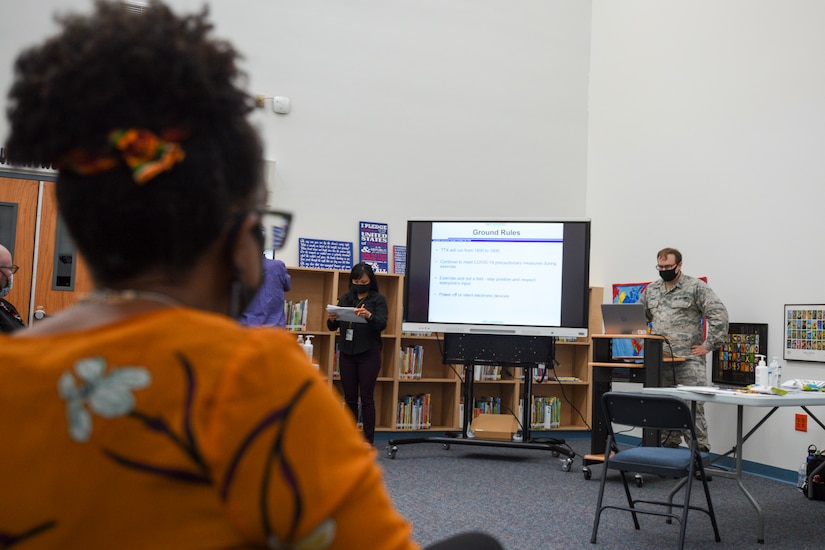
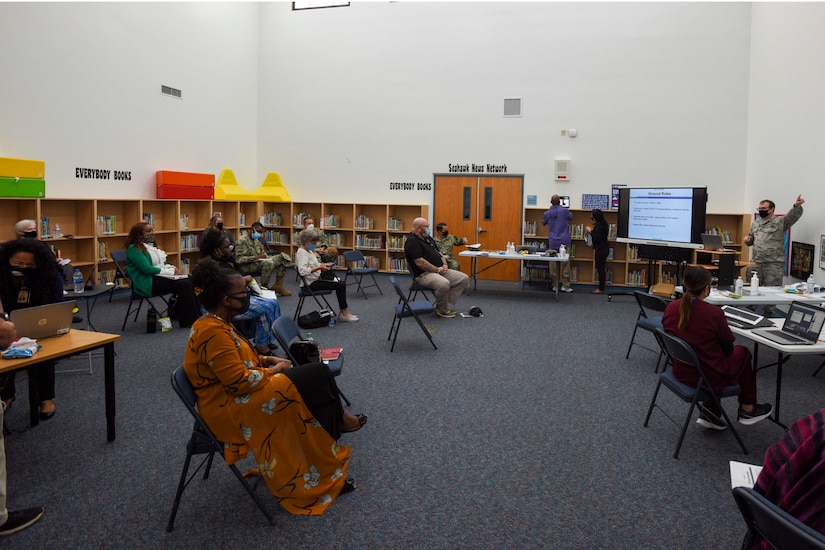
Department of Defense Education Activity Pacific and local military leaders conducted a COVID-19 tabletop exercise at Cmdr. William C. McCool Elementary and Middle School, Santa Rita, Guam, Oct. 1, 2020.

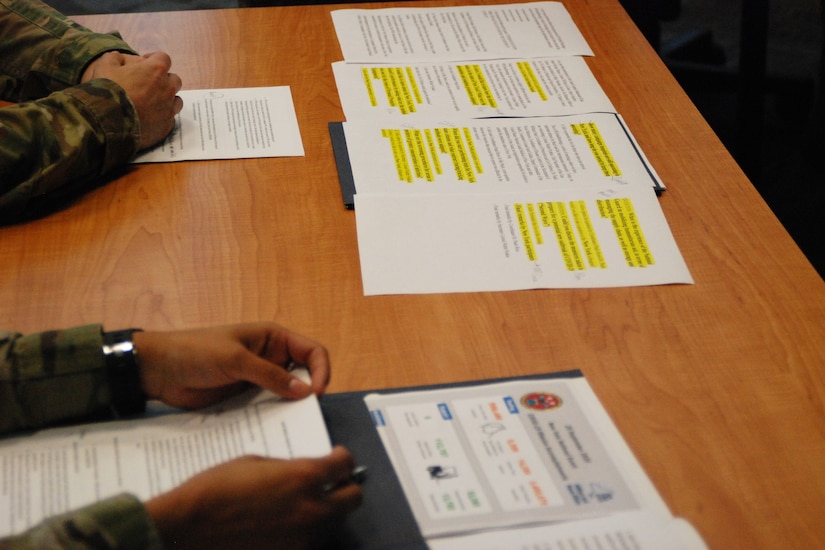
People wearing face masks and following social distancing guidelines participate in a meeting.

The exercise was designed to put DODEA staff and military partners through a series of scenarios that could occur when Guam DODEA schools reopen for classroom learning.

"We discussed the various steps required to safely and quickly respond to possible COVID-19 hazards at DODEA schools of Guam," Tiana Guerrero, joint region Marianas emergency management planner, said. "It was important to determine gaps or shortfalls in the plan and take action to remedy them prior to schools reopening. The scenarios we discussed can easily turn into real-world situations, and by preparing now, we can better handle unknown variables before they occur."

We thank our military partners and DODEA leadership for their continued guidance and direction in planning."
Gail Wiley, superintendent, Department of Defense Education Activity Guam community

Participants worked through practice scenarios, discussing roles and responsibilities and documenting questions and concerns in order to develop and evaluate plans for responding to potential COVID-19 vectors into DODEA schools.

"The training went very well," Navy Lt. Joshua Owens, U.S. Naval Base Guam emergency operations center director, said. "We were able to take positive steps forward to be prepared for the real world situations and respond appropriately. We fleshed out any concerns we had and identified areas where we can continue to improve."

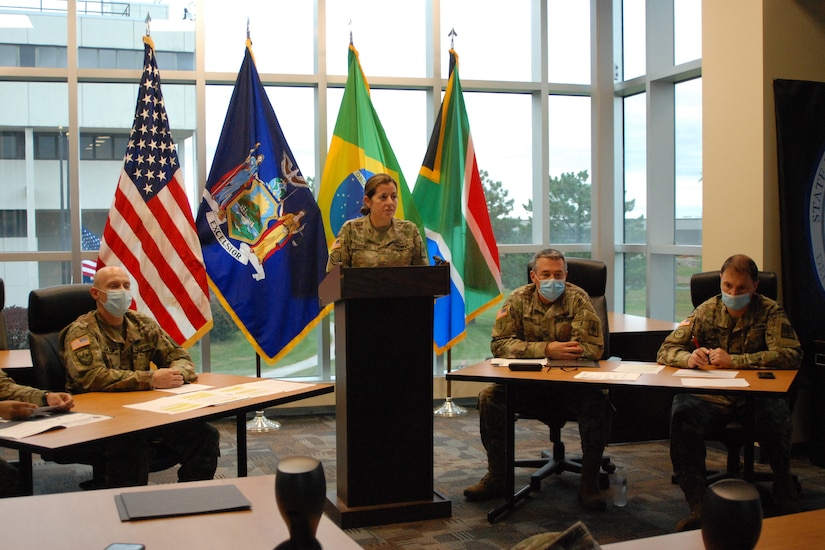
People wearing face masks and following social distancing guidelines participate in a meeting.

DODEA and military officials will evaluate the possibility of restarting classroom learning by continuing to assess the prevalence of COVID-19 cases islandwide as well as school safety and response plans.

"Our military counterparts have been very supportive of DODEA," Gail Wiley, DODEA Guam community superintendent, said. "We thank our military partners and DODEA leadership for their continued guidance and direction in planning."

(Navy Petty Officer 3rd Class MacAdam Weissman is assigned to Joint Region Marianas).

Cactus COVID-19 Task Force Protects Reserve Force

 Oct. 8, 2020 | BY ARMY MAJ. DINO DE LA HOYA

The COVID-19 pandemic continues to impact the operational and training landscape throughout daily activities and mission sets. As operations continue, leaders plan and implement policies and procedures. These efforts help to ensure the health and safety of the force, while maintaining readiness to be prepared for the next fight.

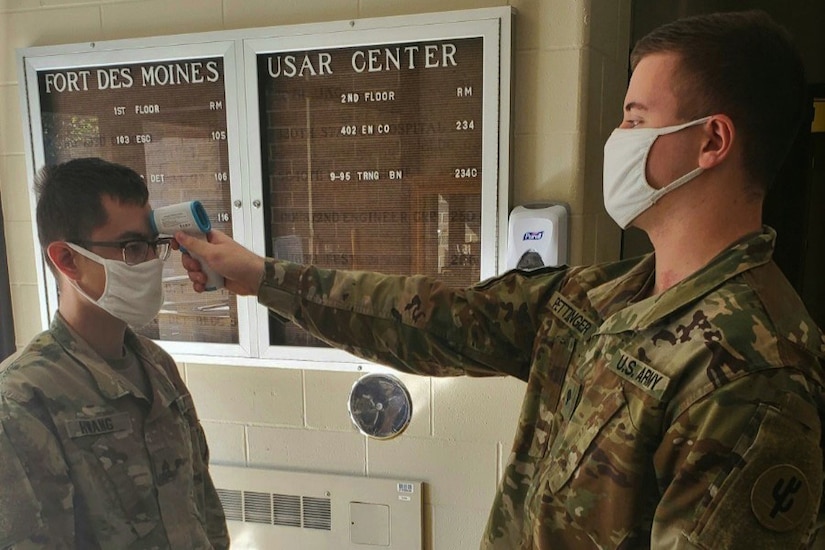
A soldier wearing a face mask takes the temperature of another soldier wearing a face mask.

The 103rd Sustainment Command (Expeditionary), Headquarters and Headquarters Company, recently came home from a nine-month deployment to the U.S. Central Command area of responsibility. While deployed, cactus soldiers underwent COVID-19 safety practices, ensuring their safety upon redeployment. However, they also came back to a very different U.S., where COVID-19 created socioeconomic impacts that continue to affect us to this day.

Upon return, the 103rd ESC created a "Cactus COVID Task Force" in July, the first of its kind throughout the ESCs. The task force's mission is to mitigate COVID-19 risks throughout its regional support groups, sustainment brigade and numerous reserve centers, impacting more than 7,000 soldiers. This important and proactive approach is focused on protecting the force, preventing the spread and maintaining strong readiness levels across the force.

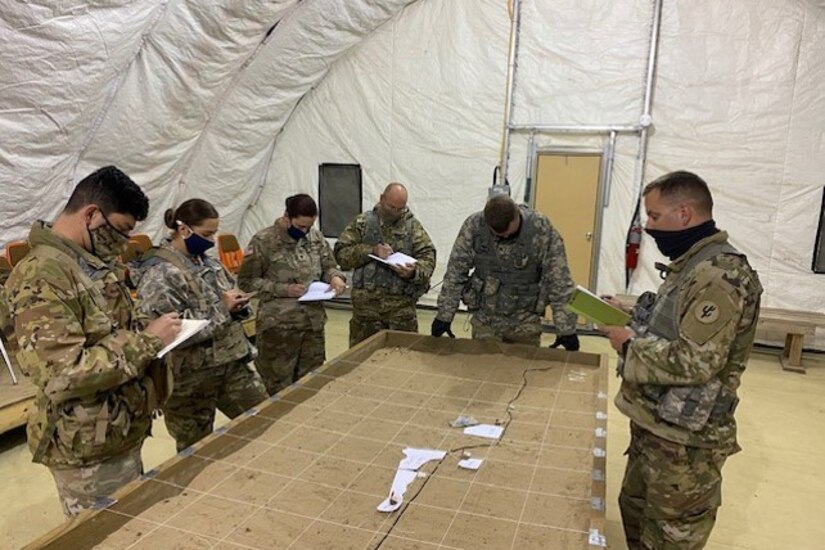
Army Col. Tomika Seaberry, assistant chief of staff, support operations officer, leads this task force. As the staff lead, she works with a small cadre of soldiers who coordinate with subordinate units, medical staff and higher headquarters elements on an ongoing basis. A day in the life of the task force is comprehensive; it provides training and operational guidance, analyzes COVID-19 local and regional impacts, drafts mitigation plans, provides risk analysis and both disseminates and implements the defense secretary's COVID-19 guidance.

Army Lt. Col. Kelly Bell, nurse advisor, is a key part of the task force. "Being part of this task force has been extremely rewarding," Bell said. "We are all working together to protect the force, that, as a nurse, is my number one priority. The task force is nice because it helps to balance readiness and training needs with health protection. We are able to really collaborate and ensure units' needs are met across the board."

The task force works daily with the ESC headquarters and subordinate elements to ensure that information flows up, down and laterally across its formation. The task force works with logisticians, public affairs, communication specialists, medical professionals, as COVID-19 requires an all-hands approach to keeping personnel and their families safe.

Soldiers wearing face masks having a meeting.

Seaberry, as the task force officer in charge, takes these efforts seriously. "While [I was] deployed, several of my family members contracted COVID-19. Even though they are recovering, I was very worried and was unable to come home," Seaberry said. "I needed to stay focused for my soldiers overseas, and now that I am home, I stay focused to ensure our soldiers are safe."

The ESC and task force leverages available resources to decrease soldier exposure for battle training assemblies. This includes virtual battle assembly, drafting exceptions to policies for travel, using telework through Microsoft Teams and ultimately reducing the amount of personnel present at respective reserve centers.

The task force leans forward as the ESC faces new stateside or overseas missions. As the Army continues to fight, the ESC maintains its readiness to ensure it is ready to fight when called upon. The COVID-19 response operation has constituted one of the largest domestic mobilizations in Army Reserve history — in excess of 3,000 soldiers at the height of the response.

"COVID-19 impacts our daily lives, and it is our duty to ensure we do everything possible to ensure the safety of our soldiers," Seaberry said.

The 103rd Sustainment Command (Expeditionary) is a U.S. Army Reserve Sustainment command based in Fort Des Moines, Iowa. The command oversees Army Reserve logistics units in Iowa, Minnesota, Wisconsin, Illinois, Michigan and Louisiana. Its headquarters organization is the 79th Theater Sustainment Command, Los Alamitos, California.

(Army Maj. Dino De La Hoya is assigned to the 103rd Sustainment Command).

Wednesday, October 07, 2020

Hawaii Hurdler


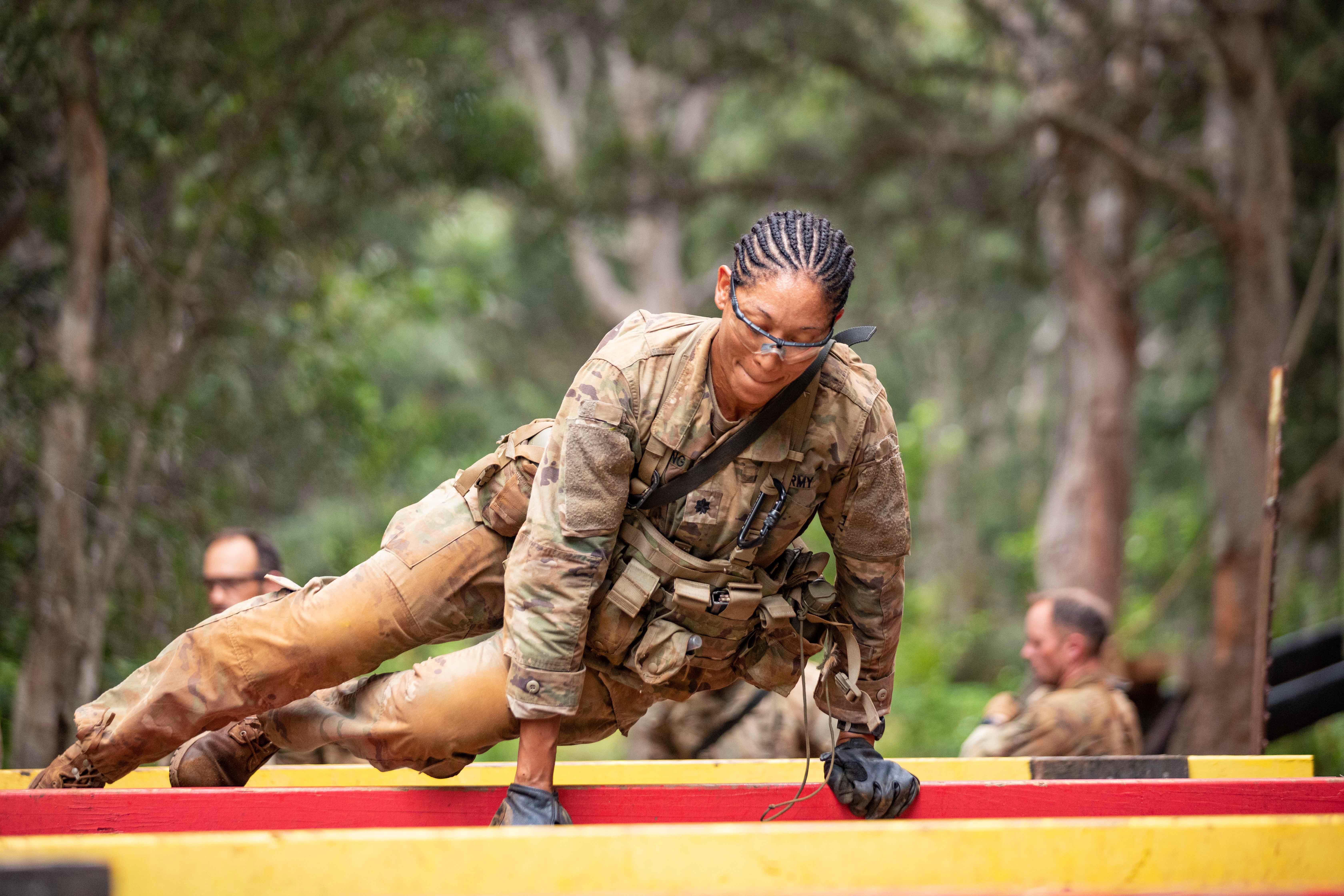
Army Lt. Col. Paula Young takes on an obstacle during the Green Mile, a physical endurance course at the end of jungle training at East Range, Hawaii, Oct. 1, 2020. Senior leaders certified in tactics, techniques and procedures required in any jungle environment.

Live-Fire Force


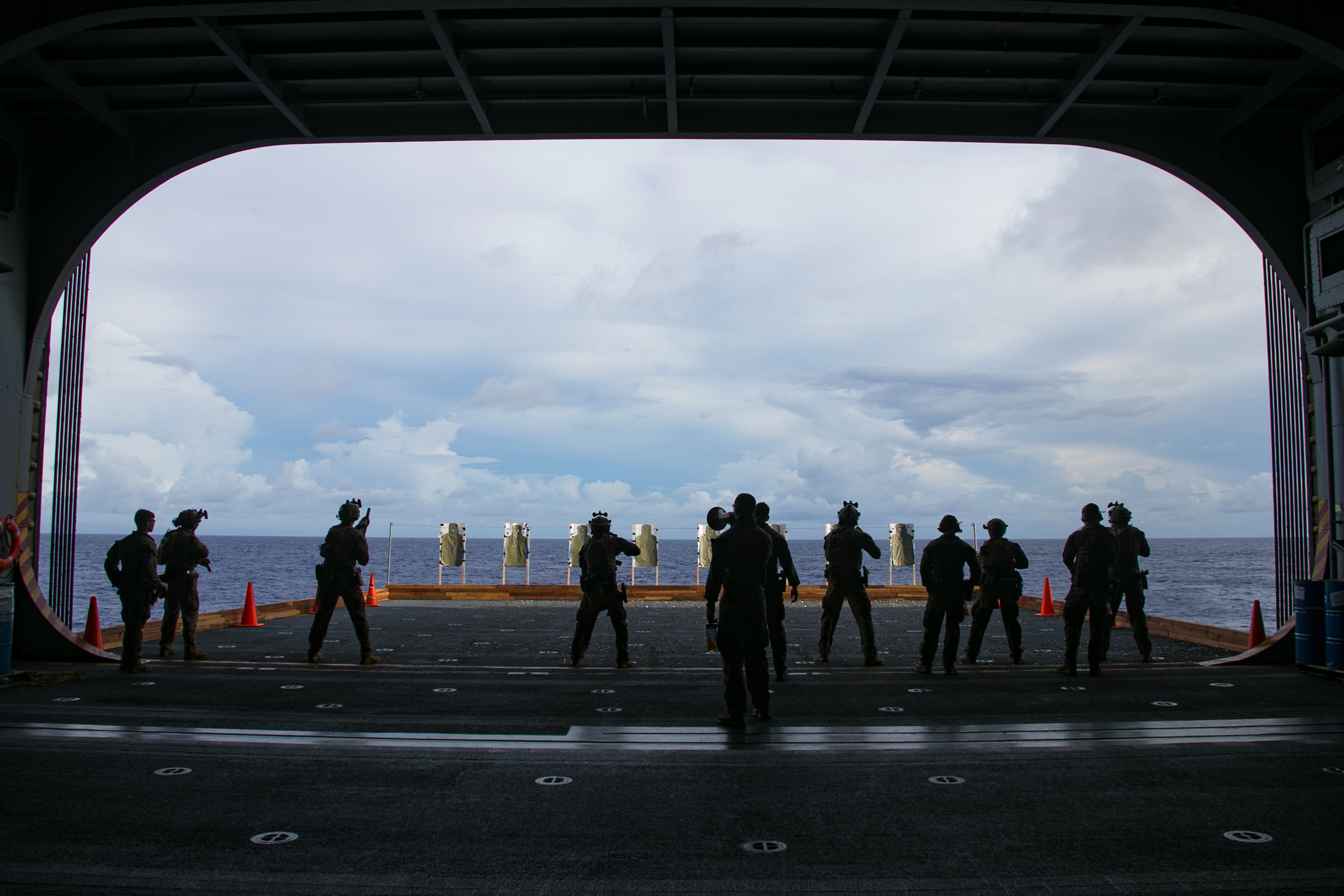
Marines conduct a live-fire exercise aboard the amphibious assault ship USS America in the Philippine Sea, Oct. 3, 2020.

Readout of U.S. Secretary of Defense Esper's Phone Call With Republic of Korea Minister of National Defense Suh Wook October 7, 2020


Oct. 7, 2020

Secretary of Defense Mark T. Esper spoke today with Republic of Korea (ROK) Minister of National Defense Suh Wook and the two leaders reaffirmed their commitment to a steadfast ROK-U.S. Alliance and to the combined defense posture.

During the call, Secretary Esper congratulated Minister Suh on his new position and noted that he looked forward to hosting Minister Suh at the Pentagon for the 52nd Security Consultative Meeting (SCM) later this month.
 
Minister Suh expressed his appreciation for Secretary Esper’s hospitality and committed to proactively cooperate for a successful SCM.
 
Minister Suh and Secretary Esper reaffirmed the importance of strengthening the ROK-U.S. Alliance and to continuing close coordination between the two countries on defense issues. The two leaders also pledged to continue cooperation and to deepen and develop the ROK-U.S. Alliance in a future-oriented and mutually reinforcing manner.

Twilight Training


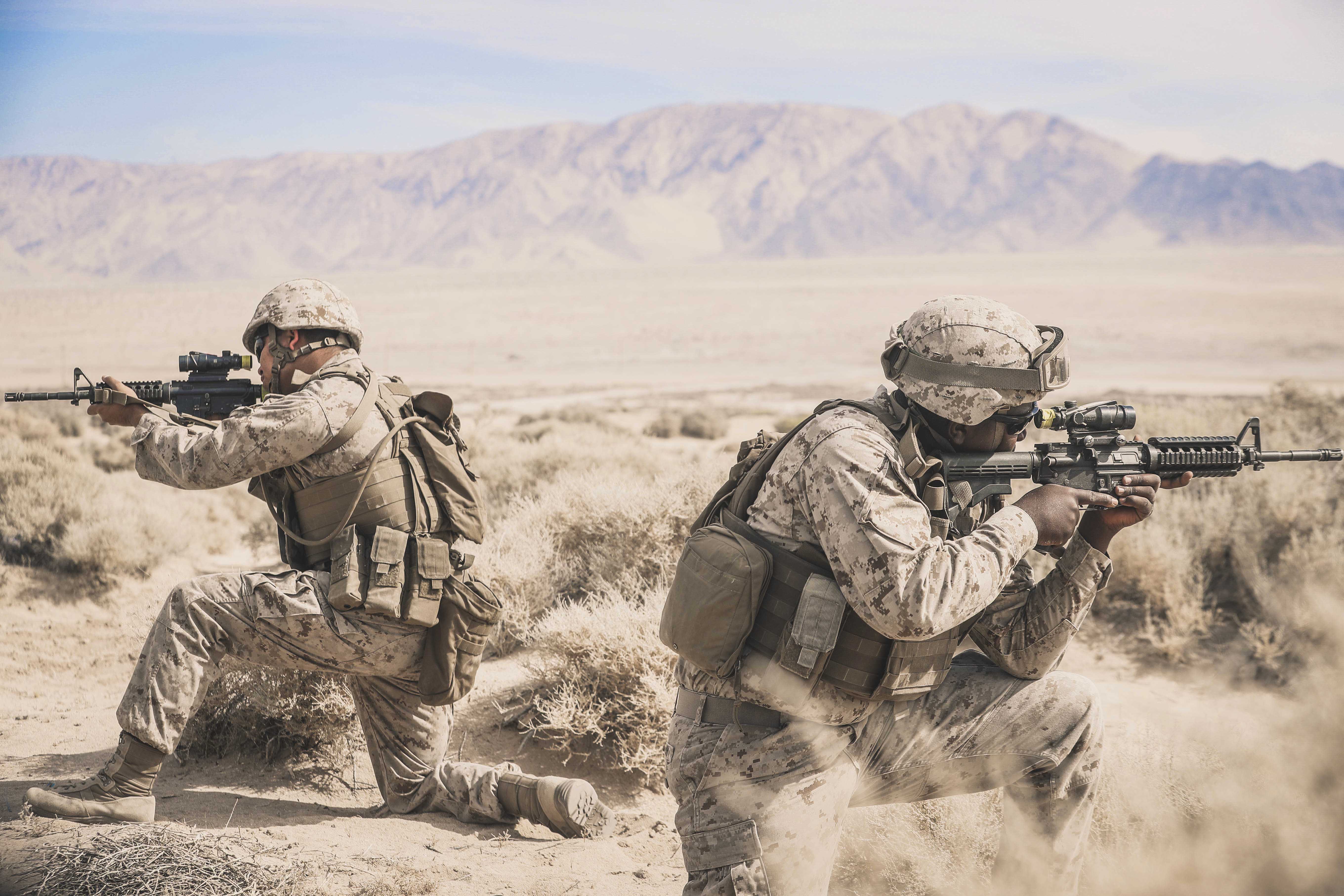
Marines stand together at twilight during an integrated training exercise at Marine Air Ground Combat Center Twentynine Palms, Calif., Oct. 5, 2020.

Secretary Of Defense Remarks at CSBA on the NDS and Future Defense Modernization Priorities

 Oct. 6, 2020

Secretary Of Defense Mark T. Esper; Tom Mahnken, President And CEO, Center For Strategic & Budgetary Assessments

CSBA PRESIDENT TOM MAHNKEN:  For a quarter century now, we've been in the business of developing and promulgating new ideas about national defense, new ideas about policy and strategy, concepts and capabilities, and budgets and resources.  And throughout our history, we've sought to be an independent, objective voice promoting innovative solutions to the nation's problems.

Given that focus, it's altogether appropriate that we welcome Secretary Esper here today to speak about future defense modernization priorities.  So I'd like to turn the floor over to Secretary Esper for his remarks, followed by a discussion.

Secretary Esper, welcome to CSBA.

SECRETARY OF DEFENSE MARK T. ESPER:  Well, good afternoon, everyone, and thank you, Dr. Mahnken, Tom, thank you for that kind introduction and for moderating the discussion after I'm done.  So it's great to be back, it's been some time, and I'm pleased that we could do this today.

So it is great again to be here at the Center for Strategic and Budgetary Assessments, whose nonpartisan research has been instrumental in shaping national security decisions for more than two decades.  In the years to come, we will need your expertise more than ever as we continue to implement the National Defense Strategy and adapt the United States Military to an era of great power competition.

As many of you know, we are doing so along three lines of effort.  First, building a more lethal force.  Second, we are strengthening alliances and partnerships.  And third, we are reforming the department to redirect our time, money and manpower to our highest priorities.  I'd also add a fourth line of effort.  That is, taking care of our service members and their families.

As I reported last summer -- I'm sorry – as I reported this summer, at my one-year anniversary as secretary of defense, we have made solid progress on these lines of effort, which we further distilled into 10 discrete objectives.  These include tasks such as focusing the department on China and designing a coordinated plan to strengthen our allies and build partners, and updating our key war plans.

It also extends to reforming the fourth estate, achieving a higher level of readiness and implementing enhanced operational concepts such as dynamic force employment.

I've spoken about some of these accomplishments previously.  Today, I'd like to focus on another key objective:  our plans to modernize the force, specifically our great Navy.

For more than seven decades, the United States Navy has maintained unmatched superiority on, above, beneath, and from the seas.  But this wasn't always the case.  After the Civil War, the United States Navy fell into decline at a stunning pace.  Our nation's bloodiest war had taken its toll and weary Americans sought to redirect the country's resources elsewhere.

The size of the fleet plummeted from hundreds of vessels to less than 50, and many of the ships in commission were in disrepair.  For a maritime nation, the United States was ill prepared for a naval conflict.

That is until a new generation of innovators and forward thinkers led the charge to rebuild the nation's fleet.  At one end were strategic planners and theorists like Captain Alfred Thayer Mahan and his seminal work on the influence of sea power.  At the other end were statesmen such as then-Assistant Secretary of the Navy Theodore Roosevelt.

Inspired by Mahan's writings, Roosevelt recognized the outsized impact of naval superiority in an increasingly interconnected world.  As fate would have it, Roosevelt later ascended to the presidency and, along with a cadre of likeminded leaders and partners in Congress, set the Navy on course to becoming the most advanced and powerful fleet in the world.

We are at a similar historical crossroads today.  Over the past several years, the department had to recover from the crippling effects of sequestration, inadequate funding, continuing resolutions, and years of budget uncertainty.  We also placed insufficient attention on the high-end fight, which many believed was behind us with the Cold War's end.

The good news is that we are now on the road to recovery by first restoring the readiness of the current fleet and second, by divesting from legacy systems and lower priorities in order to modernize the force.  We are now at a point where we can -- and indeed we must -- chart a new path to a future fleet that will maintain our naval superiority long into the future.

Today, cutting-edge technologies are fundamentally altering the character of warfare and expanding the geometry of the battlefield in multiple ways.  In the maritime domain, artificial intelligence autonomous systems, ubiquitous sensors, and long-range precision weapons will play an increasingly leading role in a future high-end fight.

Whoever harnesses these technologies first will have a clear advantage on the high seas for years to come.  Getting there ahead of everyone else demands a whole-of-nation effort.  It will require innovative thinking backed by first-rate data analysis and modeling such as the work done right here at CSBA.

It will require a modern industrial base and skilled workforce with the capacity to match our future needs.  And it will require the same type of bold decision-making that transformed the United States Navy from a fledgling 19th century fleet into the finest naval force in history.

The challenge before us today is clear.  Near-peer rivals -- namely China and Russia -- are rapidly modernizing their militaries in an effort to erode our longstanding advantages and shift the balance of power in their favor.  They want to rewrite the international rules especially in areas such as freedom of navigation and commerce and are willing to do so at the expense of others.  Moreover, Beijing and Moscow seek to undermine our military edge through precision long range fires, anti-access and aerial denial systems, and other asymmetric capabilities designed to counter our strengths.

The Chinese Communist Party, in particular, intends to complete the modernization of its Armed Forces by 2035 and to field a world class military by 2049.  At that time, Beijing wants to achieve parity with the United States Navy, if not exceed our capabilities in certain areas and to offset our overmatch in several others.

For instance, the PRC is investing in long range missiles and autonomous unmanned submarines it believes can be cost effective counters to conventional American naval power.  Moreover, the CCP seeks control over critical waterways, such as the South China Sea, to exert veto power over the economic and security decisions of smaller nations, fundamentally undermining their sovereignty and way of life.

Equally troubling are the brazen destabilizing activities of the People's Liberation Army we are witnessing today, to include sinking a Vietnamese fishing vessel, intimidating Malaysian oil and gas development, escorting Chinese fishing fleets into Indonesia's claimed exclusive economic zone, and militarizing occupied features in direct contravention of commitments under international law.

This aggression would only grow worse should the Chinese Communist Party achieve its stated modernization goals and build a military that can fully implement its nefarious plans.  We cannot let that happen.  That is why earlier this year, I charged the Deputy Secretary of Defense to lead a future naval force study that would assess an ambitious range of future fleet options designed to maintain our overmatch in this new era of great power competition long into the future.

The Navy, Marine Corps, Joint Staff, the Office of the Secretary of Defense, as well as outside advisors, conducted a comprehensive, cost-constrained, and threat-informed assessment aligned with the National Defense Strategy.

First, the team examined our current naval forces.  Second, they assessed China's future naval construct.  Next, they explored three force options in order to evaluate a variety of platforms for the future flight - fight.  And finally, they modeled and war gamed these options, analyzing the strengths and weaknesses of each combination of ships against different future mission sets.

The team's findings are insightful and serve as an enduring framework that will drive a major shift in how we design, build and sustain our fleet and conduct naval operations in the years and decades to come.  The results will enable the department to achieve our objectives in a timely and cost effective manner, balancing tomorrow's threats with today's readiness.

In February, I made a commitment to Congress that the department would submit this year the future naval force study and the 30 year shipbuilding plan, which is informed by the findings of the study.  The - though delayed by COVID, we are in the process of fulfilling that promise through proper coordination, beginning with our partners in the Office of Management and Budget.  In the near future, we aim to release the 30 year plan and provide the study to Congress.  But today I want to discuss the outlines of our proposed Battle Force 2045 that is derived from the future naval force study. 

More work needs to be done in some specific areas and the future fleet I will describe will be further refined as joint operational plans are approved, enhanced readiness and deployment concepts are implemented, advanced technologies emerge, and a new all-domain joint warfighting doctrine, another one of our top ten NDS objectives, is adopted.

However, as we look toward the future, if we are to sustain a free and open international order in the years ahead while also guaranteeing victory in a high-end fight, should deterrence fail, we propose a future fleet that optimizes the following core operational attributes.

First, distributed lethality and awareness.  Second, survivability in a high intensity conflict.  Third, adaptability for a complex world.  Fourth, ability to project power, control the seas, and demonstrate presence.  And fifth, capability to deliver precision effects at very long ranges.

At the same time, the fleet design must meet the following non-warfighting requirements – affordable in an era of tight budgets, sustainable over the long term and operationally ready and available at higher rates. 

Battle Force 2045 calls for a more balanced Navy of over 500 manned and unmanned ships. 

Further, we will reach 355 traditional Battle Force ships prior to 2035, the time at which the PRC aims to fully modernize its military.  And most importantly, we now have a credible path for reaching 355 plus ships in an era of fiscal constraint.

Under our proposal, Battle Force 2045 will possess the following characteristics.  First, a larger and more capable submarine force.  The study reached a clear consensus on the need to rapidly increase (our number) of attack submarines, the most survivable strike platform in a future great power conflict, to the range of 70 to 80 in the fleet.

If we do nothing else, the Navy must begin building three Virginia class submarines a year as soon as possible.  Additionally, we intend to refuel the seventh Los Angeles class submarine and continue investing in the future attack submarine SSN(X).  Meanwhile, we will continue to modernize the undersea strategic deterrent, the most survivable leg of the nuke - nuclear triad. 

Second, nuclear powered carriers will remain our most visible deterrent, with the ability to project power and execute sea control missions across the globe.  And to continue enhancing their survivability and lethality, we are developing the air wing of the future, capable of engaging at extended ranges.

At the same time, we continue to examine options for light carriers that support short takeoff or vertical landing aircraft.  One model we are considering is the USS America [ed.  class ship] that is equipped with more than a dozen F-35Bs.  Light carriers provide additional presence and capacity to carry out day-to-day missions and free up supercarriers for more critical high-end fights. 

While we anticipate that additional study will be required to assess the proper high-low mix of carriers, eight to 11 nuclear powered carriers - carriers will be necessary to execute a high end conflict and maintain our global presence, with up to six light carriers joining them.

Third, our future force will comprise between 140 to 240 unmanned and optionally manned surface and sub-surface vessels of all types with the potential to perform a wide range of missions from resupply and surveillance to mine laying and missile strikes these are another (key enabler) of distributed maritime operations.  Moreover, they will add significant offensive and defensive capabilities to the fleet at an affordable cost in terms of both sailors and dollars. 

Earlier this month, the Sea Hunter prototype complete operations with the USS Russell, demonstrating that unmanned surface vehicles are technologically feasible and operationally valuable. 

Fourth, the future fleet will contained more and smaller surface combatants.  Study results indicate the introduction of 60 to 70 smaller combatants into the fleet will not only increase capacity to conduct distributed maritime operations, but it will also free other critical assets for more efficient mission distribution. 

As a preview of where we are headed; earlier this year the Navy awarded a $795 million contract to purchase the first ship of a new class of guided missile frigates with the option to purchase nine more totaling $5.6 billion.  This is the first new major ship building program the Navy has sought in more than a decade and will support the full range of military options. 

Fifth, sufficient strategic lift and logistic vessels are key to the sustainability of distributed operations.  Initial estimates identify the need for 70 - 70 to 90 combat logistic ships.  But further work is underway to determine if the number of logistic forecasted in this report are sufficient for the future fight.  Our ship building report will also address our sea lift plans to ensure ground combat forces can get to the fight on-time and with sufficient combat power.  

Sixth, it will possess unmanned ship based aircraft of all types.  The Navy must develop and deploy carrier based unmanned aircraft of all types.  This includes fighters, refuelers, early warning, and electronic attack aircraft.  While this was not analyzed in detail in the study, we will continue to assess the proper mix and range needed to overcome tomorrow's threats. 

Seventh and finally, we will integrate the Marine Corps new force design.  The Marine Corps is currently in the process of implementing its force structure plan and I support the Commandant’s visions to recalibrate to great power competition.  As such, we see a need for more amphibious warfare ships than previously planned, in the 50 to 60 range, but more work needs to be done in this area, as well. 

The five operational attributes and three non-war fighting imperatives I listed above will drive Battle Force 45 to be a more lethal, survivable, adaptable, sustainable, modern, and larger force than we have seen in many years.  It will also be more balanced.  A more balanced naval force that will have a greater number of smaller surface combatants and unmanned or optionally manned ships.  Along with an ample submarine force and a modern strategic deterrent. 

It will also be able to deliver overwhelming fires balanced across four domains from the air, from the land, from the sea, and from under the sea.  And it align with the national defense strategy as we optimize force posture and implement novel concepts that make us more agile, less predictable, and fully capable of rapidly shifting to combat operations when needed. 

In the years and decades to come, the Navy and Marine Corps will serve even more prominently under Battle Force 45 as an ever present, resilient, and dominant fighting force that our adversaries dare not challenge. We will project power through long-range fires, more capable ships and next-generation aircraft, linked by advanced sensors and enabled by A.I., to stay ahead of the competitive and retain our decisive over match for decades to come.

We will employ Marines, trained and equipped for littoral warfare, synchronized with unmanned systems and networked to the advanced weapons systems and firepower of the total force and we will operate at the forward edge of American interests as the Navy and Marine Corps team have always done, providing a highly visible deterrent and positioning us to win the joint fight at a moment's notice.

Achieving Battle Force 2045 over the long run will not be easy.  Parochial interests, budget uncertainties, industrial capacity, and other competing factors will contest our ambitions.  As a plan for the future we would do well to learn from the past. Last week I had the opportunity to visit Malta, whose partnership with the United States dates back to the Revolutionary War.  In 1804, the U.S. deployed one of its six original frigates, the U.S.S. Constitution, to Malta to combat piracy.  At the time, these six frigates represented a remarkable whole-of-nation achievement for a country still in its infancy.

Through the Naval Act of 1794, Congress initiated the construction of what would soon become the Corps of the United States Navy.  Instead of converting merchant vessels into warships, the final designs called for a more innovative approach, to build the six craft from the keel up, with features that would give these ships the power to dominate other frigates but also the speed to outrun larger ships of the line.

Moreover, rather than consolidate the manufacturing at one shipyard, Secretary of War Henry Knox advocated for six sites in six different states with timber and other materials sourced from throughout the union.  Standing up our nation's firstly was as much an exercise in bolstering national defense as it was in promoting a diversified industrial base that drove economic growth and innovation across the country.

We intend to pursue a similar approach for Battle Force 2045.  To start, we have charted an incredible path to reaching 355 ships that works within real world budget constraints.  Through its own reviews and reforms, the Navy did good work these past several months, bringing up funds in the coming years for the building of new ships.  The Navy must continue these initiatives; they are essential to ensuring an adequate shipbuilding account for the task ahead.

Given the serious reform efforts put forward by the Secretary of the Navy and the Chief of Naval Operations and their commitment to continue them, I agreed to provide additional funding from across the Department of Defense enterprise, funding that was harvested from ongoing reform efforts such as combatant command reviews, Fourth Estate reforms, and other initiatives.  Together, these additional funding streams will increase the shipbuilding accounts to 13 percent within the Navy's top line, matching the average percentage spent for new ships during President Reagan's build-up in the 1980s.

Additionally, we will need assistance from Congress to achieve Battle Force 45.  To deliver this future fleet, we first need Congressional support for sustained, predictable, adequate and timely budgets, which means no more continuing resolutions.  Second, the Department must be able to divest from legacy systems and lower-priority activities and then redirect those savings to our highest priorities.

And finally, we request statutory authority to put unused end-of-year Navy funding directly into the shipbuilding account, with appropriate congressional oversight, instead of watching it expire.  The combination of these funds, reforms, and authorities will help ensure that Battle Force 2045 is adequately resourced.

Furthermore with respect to our industry and private sector partners, we understand the challenges in building a robust and healthy industrial base with modern shipyards, quality infrastructure, and highly-skilled workers.  I have met with and personally spoken to many industry leaders over the past year about these issues.  We believe our proposal provides predictability for the supply chain, top-to-bottom, along with the sustainable demand you need to invest in, train, and retain a (talented work force).

Likewise, we will need industry support to fulfill our vision by delivering innovation on time and on budget.  Investing in game-changing technologies is another top 10 NDS objective upon which we are making solid progress.  Designing a future fleet built upon these next-generation technologies and concepts is not just bold, but imperative to maintaining our advantage.  The keys to delivering the cutting-edge technology, leveraged by Battle Force 45, (are early) testing, (prototyping, and) operational experimentation.

On a recent trip to California I saw firsthand how American entrepreneurs are doing just that, as they advance the development of autonomous surface and undersea vehicles. We have already witnessed successful demonstrations with the Sea Hunter as well as the extra-large, unmanned, undersea vehicle and we are planning training events to continue developing tactics, techniques, and procedures for these platforms.

We also recognize what has been the Navy's Achilles' Heel – shipyard capacity and maintenance delays.  We cannot build and sustain our proposed fleet without the ability to service and repair a greater number of vessels in a more timely fashion; nor can we sacrifice shipbuilding for maintenance.  The objective is to have as many ships continuously at sea as possible.  To maintain a high level of readiness; we must do both.  We can do both.  We will continue our efforts to revitalize and expand the Navy's four shipyards while promoting partnerships with private shipyards across the country without pulling from the shipbuilding account.

To our friends right here at CSBA and across think tanks and academia, we need your innovative research, ideas, and analysis to refine Battle Force 2045 and our war-fighting concepts and to drive the decision points that will keep us ahead of the competition. 

Finally, to our allies and partners around the world, we will continue to uphold the international rules-based order and norms that have benefited all of us for generations.  Our Navy will continue to fly and sail and operate wherever international law allows.  But as we invest more into our Armed Forces, we need you to do the same and we need you sailing alongside us for the sake of our collective security and global stability.

Over the past year I have visited with all types of U.S. Navy ships and units, from submarines and destroyers to aircraft carriers and large deck amphibious ships and including a variety of unmanned vessels as well.  I can assure you that we command the best and the most capable Navy on this planet.  Nations around the world look to us to preserve freedom in navigation, protect the global commons, and deter aggression from competitors and adversaries alike.

Our brave sailors and Marines will continue to do so now and long into the future so long as we deliver a future fleet that meets the needs of our great country and the demands of an increasingly complex security environment.  If we can assemble the collective will and determination to see it through, I am confident that Battle Force 2045 will maintain our maritime superiority far into the future and ensure the United States Navy remains the greatest in the world for generations to come.  Thank you.

MR. MAHNKEN:  Well, thank you.  Thank you, Mr. Secretary for those remarks and there's a lot to dig into.  And we've collected a number of questions to kind of continue the conversation, but in fact, before I get to my list here, just a question really about you being here giving this speech about the future Navy.  I mean I think, my personal view that it's a great thing when one service gets the attention of the secretary of defense, the big boss.  But you know there's also sort of a narrative out there that this -- (somehow) represents a failure as a Navy or something like that.  What message are you trying to send by really personally delivering this message about the future of the Navy?

SEC. ESPER:  Well, I think as I said in my remarks, the Navy for generations has been absolutely critical to the national security and also the economic security of our country and will remain so in the future; and the challenge before us is to maintain the greatest Navy in the world and I recognize that.  I recognized that as Secretary of Defense from day one; this is why I made it a priority.  It's not news to anyone that the Navy has wrestled with the challenges of maintenance and training and readiness.

And so when I came into office I made this the priority, working with the CNO at the time and the Secretary of the Navy and so that's why it's so incredibly important to me; it's also very important to the president, it's very important to Congress and so the ability for me, for this time, attention and efforts on subjects as important as the nation's security as this is important. And so that's why I feel a personal responsibility and it should not be taken that the message is just because I'm delivering it means only I'm behind it.  That's not the case.  We work hand-in-glove with entire Navy/Marine Corps team, our OSD staff, others outside of the building as well, and the position I take and the remarks I gave today are fully supported by the Navy/Marine Corps team, my team, CAPE, the OSD staff; we believe that this is the vision for the future that will ensure that we maintain the greatest Navy in the world, and we can deliver the national security and economic security that the United States (needs) for decades to come.

MR. MAHNKEN:  Let me pick up on one of your themes in your remarks, which is balance.  And I know one of the challenges that you face on a day-to-day basis -- it's not, like, you know, weekly is -- is striking that balance between the priority that you outlined, modernization, and day-to-day requirements, and certainly when it comes to naval, of course, is Navy/Marine Corps, that's a very common consideration.  How do you think about striking that balance?  And how do you think we should think about striking that balance going forward?

SEC. ESPER:  Well, you touched upon a very important word that I emphasized a few times in my remarks that we've talked about throughout the course of the last several months within the building.  That is a balanced force, and so as we looked at the challenges ahead and as the studies were conducted, we looked at how do you balance surface, sub-surface, effects from the air, effects from the ground, and what we came up with the future force, Battle Force 2045 is a more balanced force, allows us to conduct all those missions that are critical to the Navy's success. 

And now, the other issue that you're tagging on is the one that has -- has -- has been a constant challenge and has been for me and my predecessors, who do you balance of today the readiness of today with investment in the future? 

And clearly that has been a challenge, particularly with the Navy, because the demands placed on the sea surface from the Combatant Command as they face threats and challenges in competition, whether it's in the Indo-Pacific, EUCOM, or the CENTCOM AOR. 

And so, I had the privilege of seeing this tension as a service secretary and as I -- as I fleeted up, as you will, got into the Secretary of Defense job, I brought that background as well and made a commitment to make sure that I worked closely with the Navy to help strike a better balance, one that will allow them to -- to get on a better path to readiness, but at the same time, make sure that we were doing the day-to-day business that was demanded of the Combatant Commanders.

That said, as the NDS, the National Defense Strategy tells us at the end of the day, while we have to do both, it's more important to prioritize modernization and future readiness over the demands of today. 

That's why we have identified economy of force theaters, if you will.  That is why I have conducted a series of combatant command reviews in order to optimize our forces that are serving under respective Combatant Commanders and optimize them for the mission.  So, that could do a few things, either reties them to the Indo-Pacific, our priority theater, or return them back home to retrain, to refit, to build maintenance and readiness. 

So, that is the balance that -- that is the tension that I experience every day.  I take good advice from all of my advisors, the Joint Chiefs, the Chairmen, OSD Staff, that that is the thing that we continue to work on and I think the Navy is on a good path.  But we've got to be able to do both and the plan we set forth today will allow us to maintain that near-term readiness we need, build the future fleet without creating a hollow Navy, that's the important thing.

MR. MAHNKEN:  Well thank you.  You -- in laying out Battle Force 2045, you laid out an ambitious set of things that need to happen and I think you did good job of portraying just how massive that enterprise is. 

Fleet modernization, sea-based nuclear design modernization, ship yards, new concepts, new capabilities, and you talked a little bit about the barriers, but I guess, as you think about going forward and implementing that -- you know, that vision, how do you see the priorities within -- within that vision?  The different components?

SEC. ESPER:  And so, well first and foremost, one of the most important things we had to modernize the strategic triad, and not just the sea base, but all legs of the triad, and we have invested enormous sums and put a great deal of effort into that and I update myself quarterly from the team on our progress in terms of doing that. 

So, we will, of course, maintain the strategic leg -- I'm sorry -- the -- the under sea leg of the triad, it's our most survivable one and I've -- I've been up to the ship yard to check on the progress.  And so, that will always be priority number one. 

Priority number two then is, as you look at in Battle Force 2045, I noted this is my remarks, but there was clear consensus over months of study and war-gaming and analysis that we need to build more submarines, more attack submarines. 

And if we do nothing else we should invest in attack submarines, because of the lethality that they can deliver under the sea and the survivability that they have in clear overmatch that we have when it comes to the under sea domain and submarines in particular.  So that would be first priority when you think about conventional side of the - of Battle Force 2045.  Next, you've got to look at the (inaudible) lethal effects and then we start talking about, you know, smaller surface combatants being able to - to deliver those fires.

The key thing we took about - I take from the study and from a - my own - my own work on these topics is that what's increasingly becoming more and more important is the ability to deliver long range precision fires accurately, in volume, enabled by A.I., and linked through ubiquitous sensors and - and - and networking to do that.  That's - that is - seems to be essential right now and that will increasingly - I - I believe drive how we think about warfighting in the future, and not just in the naval domain but in all domains - in - in - in air and ground domain, as well.

MR. MAHNKEN:  What - picking up on that, you talked about precision - precision fires and, you know, in your remarks you wrote - you know, you referred to history, you know, a number of times.  I think at least history shows me or tells me, it's really operational problems, operational challenges really serve as the spur of - of innovation.

I - I know the 2018 NDS has its own list of operational problems, it's classified.  The National Defense Strategy Commission, which I was a part of, had our own list that was unclassified.  More recently, there's been a - a proposal to say "well, we should adopt a goal of, you know, seeking large numbers of - of Chinese ships within the fixed, you know, short time period as a - as a driver for innovation."

I guess what - what's - what's your response to a proposal like that narrowly, but more generally, you know, the need for some concrete problems to - to drive us as we move forward?

SEC. ESPER:  Well you - you don't build a force, whether it's a air, ground, or - or - or naval force around a single scenario, if you will.  We do know we need to build a force around the high-end fight and that includes multiple scenarios.

But the Navy also has an ambitious mission set that includes peacetime activities, competition activities - you have to demonstrate presence - forward presence, the ability to control sea lanes, the ability to work with partners and allies and do those things.

So any one day, we have nearly 100 or so ships deployed doing these things.  So - so you - you don't build a force around a single scenario.  That said, we know the challenges that are before us.  One of the things that I set out to do as my top 10 list of implementing the NDS is to make sure we update our war plans and we are well on the way to doing that.  So that's one thing we're making solid progress on.

But the reviewing and updating war plans informs us of how the fight may look.  That - that also is helpful in terms of framing up the future fleet architecture.  We also know, as I mentioned, that we're going to develop a joint warfighting concept.  That will (drive) additional change.

So as we think about this, we think about how do you build a - a fleet that can do the full spectrum of operations, from peacetime engagement all the way to the high end fight, and make sure you can handle those - those difficult scenarios? 

Then you have to think through, well, what's the best way to do them?  I (inaudible) and (inaudible) how - how might that fight play out and that's where I go back to.  We looked at how do you deliver effects from the air, from the ground, from the sea, and from under the sea.  And that's what drives you to this more balanced force, this battle force 2045 that gives you the ability to deliver those effects, lethal effects consistent with the NDS, at - at a more survivable way of doing so through distributed ops, et cetera, et cetera.

So that's kind of how we - we - we look at the problem set, if you will.

MR. MAHNKEN:  Well thank you for that.  And let me - let me actually - let me - let me - let me push you on a scenario.  So, talked about China being a priority and I think one of the - one of the priority contingencies to think about when it - when it comes to China has to do with Taiwan and (inaudible) the - the military balance across the Taiwan Strait as - has been shifting.  The most recent Military Power Report illustrates that in a number of ways.

Presumably, this - you know, the - the - the future force will be more - more capable, adopting the attributes you talk about, to include, you know, the Battle Force 2045, including every - every other aspect of the joint force.

I guess the question is, you know, if we move in this direction with these changes, are - are - are we going to be able to - to prevail in a - in a - in a future - a future conflict, say in a - across the - across the Taiwan Strait?

SEC. ESPER:  Well look, I'm - I'm confident we would prevail today in any conflict and I'm confident, certainly with this proposal, that we will - we will prevail in any future conflict.  That's why we - we - that's why we continually look at the - at the capacity and capabilities of the force, not just the naval force but the, you know, Navy, Marine Corps team, the Air Force, the Space Force, I look at the ground force as obviously Army, and then we have cyber and all of the other domains that - that we look at.

So look, I'm fully confident that Battle Force 2045 will be - will enable us to - to prevail across all scenarios and - and allow us to be victorious, should deterrence fail.  But look, the key is just so much of that force is time we spend in the competition phase too.

And it's also important not to forget - and you know this from the NDS - is we - we look to our allies and partners to assist also and that's why in my remarks I said to our allies and partners, we need you - we need you to also make investments into your Armed Forces and we need you out there with us training and patrolling and - and exercising and do those things that - that are important because we recognize China's direction and we know what we need to do and that's why Battle Force 2045, we want - we want to be in a position by 2045 to prevent conflict and again, if deterrence fails, to win decisively, because their goal is to have that world class military by 2049.

MR. MAHNKEN:  Well picking up on that, on allies.  As you say, allies - key - key tenet of the National Defense Strategy, key to our success overall and the need for them to - to - to share some of the burden, to participate more fully.

I want to ask about - about kind of how we - you know, how we do that.  We have foreign military sales system.  I guess the question is, you know, in - in the future, with the types of things that you're envisioning, is there more scope for thinking about an increase in commercial acquisition programs, you know, innovative ways for us to work closely with our - with our allies, developing the capabilities that we collectively are going to need for the future?

SEC. ESPER:  Sure.  Well let me - let me work through the macro down to the micro and - and - and get to your answer here in a minute or so.  So another one of the top 10 objectives for the NDS - and by the way, I made clear that my top priority would be implementing the National Defense Strategy and we've made great progress - I - I - I laid that out this summer and we continue it every week as - as the entire leadership team, military and civilian alike, meets to update ourselves on progress being made.

One of those top 10 objectives was to develop a comprehensive strategy to - to - to build our allies and partners.  And so what we were looking at - at - in that area, if you will, was everything from key leader engagements as we go overseas, key leader engagements here in the United States.

I just left a meeting with the Bulgarian Minister of Defense, where we're talking about how do we bolster the southern flank of NATO as we look at repositioning our forces and doing other things.  So key leader engagements; how do we get more of our allies and partners into professional military education is part of the IMET program.  How do we do those things?  Training and exercises.  Another one of our top 10 objectives is to improve joint training and exercises for the joint force.  And Chairman Milley is working on that one. 

But there's also foreign military sales.  Because as we know military sales build not just interoperability but it also helps us build capacity.  It also gives us the means to reinvest and it relationships between military and armed forces.  So, there are typically two paths you go foreign military sales or direct commercial sales, both have pluses and minuses.  But on the foreign military sales piece and I talk a lot about this with my counterparts abroad, we recognize that we need to do better.

We need to build exportability into our products.  We need to improve releaseability of technologies.  We need to hasten the process by which foreign military sales are approved.  We need to do all those other things, otherwise we risk ceding the market to the Russians and Chinese.  And that's not good for all the opposite reasons.  So we recognize that, we're working hard on that.  One of the things we (inaudible) part of that objective is what I call the FMS dashboard, the foreign military sales dashboard.

So, now I'm looking every quarter at the top 25 or so foreign military sales that we are thinking - that we think are most important, most critical, to advancing the NDS and the capabilities and capacity of our allies and partners.  That's just one example of how we're trying to implement the NDS and that particular objective.  Because it is critical and it's not just about building their capability – capacity, but it's the interoperability, it's the relationships that will endure. 

One of the advantages that we have, asymmetric advantage that we have that the Russians and Chinese don't have is we have allies and partners.  You could probably name all of theirs on one hand.  But have dozens of allies and partners with shared values and shared interest and shared goals.  And we are aligned of what needs to be done out there.  We just need all of them to invest more in their defense and to build their own capability and capacity so that when the time comes they're with us in the fight.

MR. MAHNKEN:  Let me follow-up on that because, you clearly control some of the levers when it comes to FMS and commercial actions; you don't control all of them.  What are the types of reforms that would - that would make your life easier?  And would make it easier for us to work with our allies?

SEC. ESPER:  Well, like I said, you've got to build exportability upfront, otherwise you end up with a system that, you know eventually you're probably going to export it unless it's some rally high-end item.  So you might as well think about that upfront. 

And then number two, is how do we get better at releasing technology?  You know, the administration made a good move this year with regard to UAVs and how we deal with unmanned aerial systems.  Why was that?  Because we saw that other countries, countries that we prefer not to were starting to gain greater marketshare.   We went on the market or we went Western countries to own the market, our allies and partners, not Russia and China. 

So exportability, working with the Congress in terms of the process by which we - our foreign military sales are reviewed and approved.  That's a State Department-led process, and I know Secretary Pompeo feels very strongly about that and we agree on the importance of this.  So, those are just examples of what could happen.  Again I just came out of Minister of Defense meeting today, we discussed foreign military sales.

Last week I was in North Africa; all three countries we discussed foreign military sales.  I was in Kuwait and Qatar last week, as well, discussed foreign military sales.  Countries recognize that we not only provide very high quality equipment but the maintenance and everything comes with it.  But also the relationship.  That's the key thing, the relationship and interoperability it builds is critical.

So we need to find ways to hasten the process while protecting the crown jewels -- if you will -- but hasten the process so we can continue to build those allies and partners.

MR. MAHNKEN:  I think your mention of export controls and loosened export controls resonates with me.  From the very first job I had in the Pentagon last millennium, it was on the missile technology control regime, and I understand why the MTCR guidelines were created to prevent the spread of nuclear-capable systems.

But (inaudible) today’s UASs are nuclear-capable systems...

SEC. ESPER:  I worked on export controls for 20-some years as well, and it's -- you know, you probably agree, it's not necessarily post, you've got to know, you've got to optimize what -- who can you share them with, when and how, right?  Some of our closest allies clearly rise to the top, and others you can make adjustments.  And then it depends on the situation at hand.

So I think we just need to -- we shouldn't -- we just need to take an approach that asks, "What are we trying to achieve?  And what's the quickest way?  And is this a technology, you know, we can release now or what" -- you know, so there are different ways to approach it, but we've got to take -- we've got to put in a larger context of what's happening out there and not in its own silo.

MR. MAHNKEN:  Well, Mr. Secretary, I know your time is precious.  Let me just ask one more question to kind of put this into context.  Which is, you know, as you said a few minutes ago, your top priority has been implementing the NDS, and you did issue a report of how you're doing, how the department's doing.

Putting this into context, you know, during your tenure as secretary, where do you feel that you know we've done the best or are doing the best as far as addressing the top challenge posed by China?  And then conversely, where -- you know, where is the area where -- not just in regard to China, but just regarding our defense strategy overall -- that maybe hasn't gotten the attention that it probably deserves?

SEC. ESPER:  So I think with regard to China, I think about it in two ways.  One is at the -- at the political or national level, it is clear that a consensus has formed that China is behaving and acting in ways inimical to our long-term interests.  They are seeking to overturn the international rules-based order, the expected norms, if you will, of behavior.

I've cited a number of examples in my remarks.  We know that, really, China aims to dominate Asia if not at some point in time to have outsized influence globally.  So I think there is a consensus that's formed, bipartisan, across the country that we need to deal with this threat and we need to -- this challenge, and we need to address it. 

And DOD has done a number of things, State Department, all the agencies have recognized, it's become -- and needs to further become a whole-of-government approach to doing that.  And the NSC has done a good job organizing that whole-of-government approach, if you will.  So me at the political level, that's important.

At the DOD level, I will tell you, again, I think we've made incredible progress over the past 15, 16 months I've been in the job.  Another one of those top 10 items has been to focus the department on China.  So we have a China policy office now, a DASD for China. 

You know, I put out a directive that our -- we would start teaching more about China in our schoolhouses, not just at the geopolitical strategic level but down to, you know, our understanding Chinese order of battle, and things like that.

We're looking at issues such as how many Chinese speakers we have in our armed forces, and do we need more.  We're looking at - I've talked about refining our war plans, our operational plans.  We're building partners.

I've traveled more to the Indo-Pacific than anywhere, and I've met with countries ranging from, most recently, Palau to New Guinea, from you know, the Philippines to Thailand, of course our longstanding allies Japan, Korea, Australia -- but many others in between.  And so we across the government have made reaching out and building those allies and partners a priority.

And then again, even at the modernization, another one of our top 10 things, we are building systems that certainly fare very exceptionally well in the Indo-Pacific, where you face, you know, extreme distances. 

So think about you know, long-range cruise missiles, ground-based missiles, hypersonics, all those things you need, going back to what I said, I think it's the future game-changer, long-range precision weapons.  We are making those investments now to ensure that we have overmatch in the future.

The last question I think you said is, so where do we need to do better?  I -- we need to keep pressing our allies and partners to recognize China for what it is.  And we've -- we were making good progress last year, but I think China's behavior at the beginning and throughout this COVID process has really awakened many other countries to what China's malign intentions really are and their willingness to behave as a responsible country in -- on the world stage.

And so I think we need to further rally other countries to recognize China for what it is, for what their intentions are.  And not that we're seeking a conflict, but we need China to adapt its own policies and procedures.  Their view of the future world order, if you will, is one based on them, an authoritarian regime that represses human rights, restricts religious freedom, limits the press, all those things we know well.

Or we could fight and defend our own values and interests -- think about individual rights, freedom, liberty, opportunity, sovereignty, self-determination, those things.  That's what's at stake, and we need to get more of our allies and partners around the globe focused and rowing with us as we address China (inaudible).

MR. MAHNKEN:  (inaudible), Mr. Secretary.  Thanks for joining us.  You're always welcome at CSBA, it's great to have you.

And thanks to all of you who are joining us virtually for this session.  And wherever you are -- if it's a typical CSBA webinar, you're all the way from -- you know, from one part of the globe to the other -- wish you all the best.  Good afternoon, good evening, probably been good morning for some of you.  Take care, thank you.

Military Medicine


Navy Petty Officer 3rd Class Branyn Trejos, left, and Navy Petty Officer 3rd Class Drew Dougherty perform a medical procedure in the cardiac catheterization laboratory at the Naval Medical Center San Diego, Calif., Sept. 29, 2020.

Uniform Excellence


Marines assigned to the 4th Recruit Training Battalion participate in a battalion commander’s inspection at Marine Corps Recruit Depot Parris Island, S.C., Oct. 2, 2020. The event is the final inspection and last chance to correct any discrepancies before the Marines graduate.

Orientation Flight


Soldiers in a UH-60 Black Hawk helicopter conduct aviation operations in the Middle East supporting Operation Inherent Resolve, Oct. 5, 2020.

Training Partners


Marine Corps Cpl. Sathya Breckinridge and Lance Cpl. Keavious Blackmon provide simulated cover during an integrated training exercise at Marine Corps Air Ground Combat Center Twentynine Palms, Calif., Oct. 5, 2020.

Flare Affair


Hawaii Air National Guardsmen prepare to deploy a flare from the back of a C-17 Globemaster III over Hawaii, Sept. 29, 2020, while supporting NASA's SpaceX Human Spaceflight program. The high-intensity illuminating flares enhance the ability to conduct contingency astronaut rescue operations in various lighting conditions.

Super Sailor


Navy Petty Officer 3rd Class Collins Clark works on an F/A-18E Super Hornet aircraft aboard the USS Dwight D. Eisenhower in the Atlantic Ocean, Oct. 1, 2020.

Food and Supply


Arizona National Guard service members deliver food and supplies for Navajo Nation residents at a food bank in Black Mesa, Ariz., Oct. 6, 2020. The Arizona Guard has assisted in other domestic emergencies, including airport security after 9/11, the Monument Fire in 2011, Hurricane Harvey in 2017 and the Havasupai floods in 2018.

New York National Guard, Brazil Share COVID-19 Experiences

 Oct. 7, 2020 | BY Air Force Tech Sgt. Ryan Campbell , New York National Guard

New York was one of the states impacted the most by the COVID-19 pandemic, so New York National Guard members passed on lessons learned in mitigating the effect of the virus to their Brazilian counterparts during a Zoom call, Sept. 29, 2020.

The New York National Guard is developing a relationship with Brazil's military through the National Guard's State Partnership Program.

Paperwork on a desk.

Soldiers assigned to the states' medical command laid out how New York dealt with COVID-19, going from having some of the highest rates of infection in the country, to one of the lowest.

The shared experiences between New York and Brazil were aimed at creating a better understanding as to which responses are more successful at handling the pandemic. The discussion included Brazilian ambassadors, doctors and members of the Brazilian military.

During the conversation, the Brazilians said their perception of the pandemic was that “it was a terror in New York.”

Brazil, with a population of 210 million, has recorded nearly 5 million COVID-19 cases. The U.S., with a population of 330 million, has reported 7 million cases.

"New York was one of the first epicenters in the United States," said Army Col. Dennis Deeley, who commanded the Javits Medical Center in New York City. "The governor requested assistance [from] the National Guard at the early stages of the pandemic."

At its peak, more than 3,600 members of the New York National Guard were on duty responding to the pandemic across the state. Ultimately, one in four New York Guardsmen served in a COVID-19 response capacity.

Deeley explained to the Brazilians that the state set up five joint task forces across the state to manage personnel, logistics and medical assets.

Because of this structure, Deeley was able state when asked, that at no point were New York's resources overwhelmed. However, he did say that testing was an issue at first.

"This was originally a limiting factor for New York," Deeley said. "New York encountered this in early March and saw an improvement in May once increased quantity was available. Drive-thru testing was very effective."

With one concern being encouraging citizens to take all precautions, the Brazilians asked if the guard was ever used to enforce quarantine measures.

"No," Deeley said. "The people in New York got the message very quickly. They took the brunt of it."

Soldiers take part in a Zoom call.

The New Yorkers and Brazilians discussed the use of field hospitals, as each have had their own epicenters. New York had New York City and Brazil had Sao Paulo, with 247,000 and 972,000 cases, respectively.

Deeley talked about how New York built up four alternate care facilities across the state, with only the one established at Manhattan's Javits Convention Center coming online.

The point he explained to the Brazilians though, was that even though one was used, New York was ready for things to get worse before they got better.

So far there have been more than 32,000 COVID-19 deaths in New York, and more than 145,000 in Brazil. The two sides wrapped up their video call with a better understanding of how each dealt with the pandemic, and how the two sides can continue to work together on major issues such as this.

Dr. Paulo Rossi Menezes, disease control coordinator at the Brazilian State Department of Health, and Col. Walter Nyakas, chief secretary of the Military House and state coordinator of civil protection and defense of the State of Sao Paulo, wrapped things up by expressing their appreciation to New York for discussing these topics and the level or cooperation between the two entities.

Speaking through a translator, they both concluded with an eloquent “thank you” and hopes for further discussion.

“This is the reality of what we're living with,” they said.

(Air Force Tech. Sgt. Ryan Campbell is assigned to the New York National Guard).

Air National Guard Volunteers Assist at Alaska Kitchen

 Oct. 7, 2020 | BY Army Sgt. Seth Lacount , Alaska National Guard

Since mid-August, Alaska Air National Guardsmen assigned to the 176th Force Support Flight Sustainment Services, who are local to the Matanuska-Susitna Borough area, have been volunteering their time to assist the Five Loaves, Two Fish Kitchen in Wasilla, Alaska.

Alaska National Guardsmen preparing meals.

"As a force in readiness, the relevancy of the National Guard increases through the flexibility of these Airmen," said Air Force Master Sgt. Franz Deters, the senior noncommissioned officer in charge of the volunteer effort.

The kitchen relies on donations from the Food Bank and other foundations to prepare quality meals for local Mat-Su residents in need. The organization employs only one professional chef, Air Force veteran Mike Gordon, and the rest of the staff is completely made up of unpaid volunteers. The kitchen is next door to Good Shepherd Lutheran Church, whose kitchen committee heads up the operation.

"When the guard started volunteering here, we were very short staffed," said Duane Hanson, one of the kitchen's dedicated civilian volunteers. "Their work here has kept us on track in our efforts to help as many people as we can."

The airmen work twice a week for three hours each day, preparing about 600 meals per month.

We get to help Alaskan citizens, filling in at a time when there are fewer available volunteers, all while getting training that allows us to gain additional experience in our jobs that we do for the guard."
Air Force Master Sgt. Franz Deters, Alaska Air National Guard

The airmen are certified in food handling, with years of experience cooking in the Air Guard. They have been assisting the kitchen in food preparation, which consists of peeling, cutting, dicing and cooking various food items, before being put into sealed packages.

"I take pride in the fact that I work with a team that never says 'It's not my job,'" Deters said. "I work with men and women who will volunteer to go where they can have the biggest impact."

Alaska National Guardsmen preparing meals.

According to Deters, this unique volunteer opportunity to serve the local community also helps his team meet mission essential training requirements for their work in service career fields for military service.

"We get to help Alaskan citizens, filling in at a time when there are fewer available volunteers, all while getting training that allows us to gain additional experience in our jobs that we do for the guard," Deters said. "It's really a win-win."

Good Shepherd Pastor Rick Cavens, retired Alaska National Guard chaplain, oversees the kitchen staff. The kitchen provides meals to My House Homeless Teens Resource Center, Knik House and Family Promise. Recently, the kitchen started a meal program for Mat-Su School District families, with the intention of providing a food portion big enough to feed an entire family.

"I have two extended families, my church and my military family," Cavens said. "The National Guard has offered a tremendous helping hand during this difficult time of uncertainty. We're very thankful for their hard work and dedication to helping the local community."

(Army Sgt. Seth LaCount is assigned to the Alaska National Guard).