Friday, August 21, 2020

Rapid Response Team Fights Pandemic at the Deckplates

 Aug. 21, 2020 | BY Navy Petty Officer 2nd Class Taylor M Dimartino , USS Germantown

Sailors aboard the amphibious dock landing ship USS Germantown received nasal swab tests to determine whether or not they had contracted COVID-19, and within the week, all test results came back negative.

Much of the ship's success at fighting the pandemic can be attributed to its COVID-19 Rapid Response Team, or CRRT. Navy Petty Officer 2nd Class Clint Woods leads the team as Germantown's preventive medicine technician.

"I came up with the idea during our last underway period to start a rapid response team on board," Woods said. "We were juggling a lot of evolutions, and our relatively small medical team ensured that all COVID-19 risks were being mitigated. We had to properly sanitize everything."

In March, during the early phases of Navy COVID-19 policy development, Woods realized it would take more than just the ship's medical personnel to prevent COVID-19 from getting aboard the ship, he said .
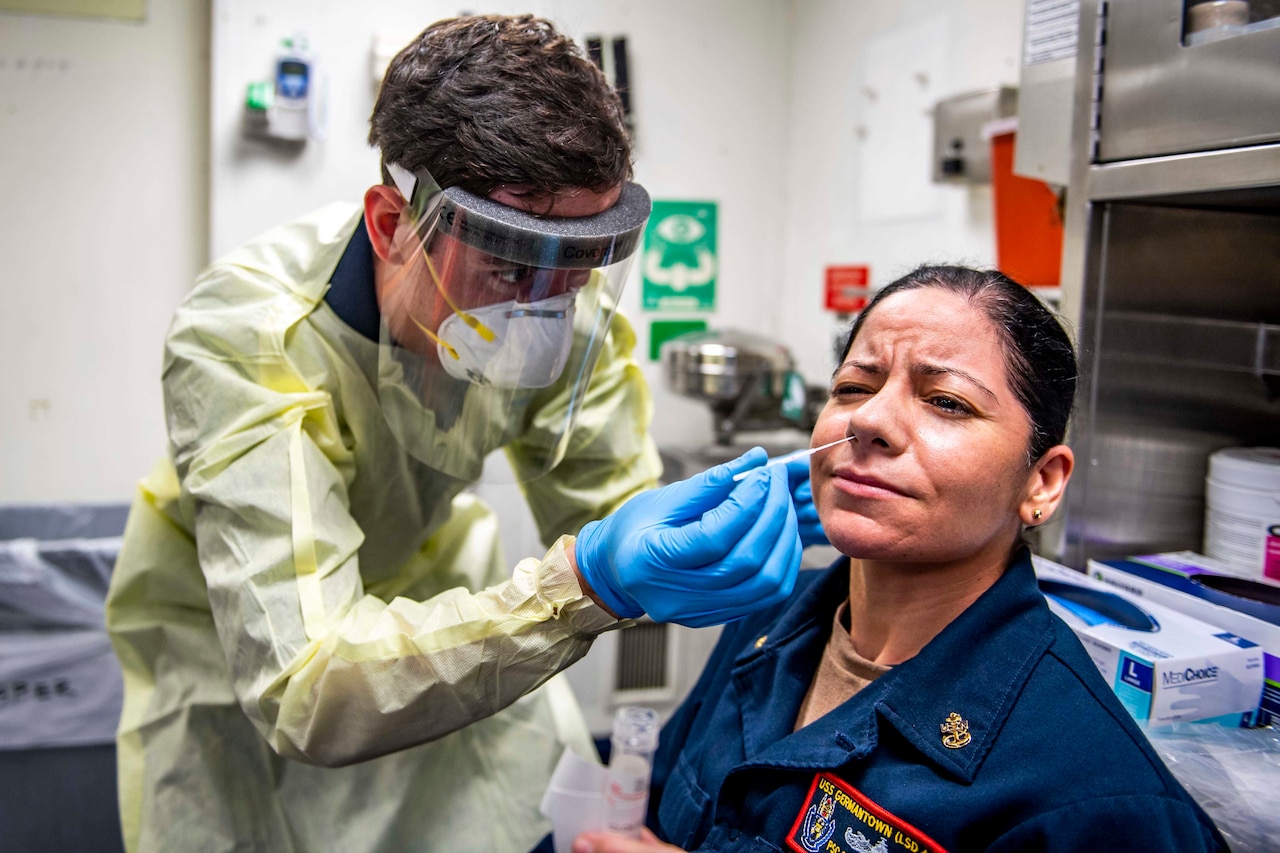
A sailor tests another sailor for COVID-19.

"It was all about being available to be at more than one place at a time," Woods said. "I needed people I could train and trust to be an asset in the fight against the coronavirus, people willing to push back against the pandemic."

On April 6, Navy Cmdr. Christopher Causee, Germantown's commanding officer, designated 15 sailors, representing each shipboard department, to serve with the CRRT.

Woods said the Germantown's medical department spent more than a month training CRRT members on everything from proper personal protective equipment wear to disinfectant and quarantine procedures. They are also trained to help with COVID-19 testing and are certified under the Health and Insurance Portability and Accountability Act to handle patient records the same way a hospital corpsman might, he added.

"Each CRRT member has stepped up in such a big way," Woods said. "They have no problem dropping whatever they are doing for their regular work and hopping into an evolution to support all of the medical team's efforts. We made sure they were more capable than the average sailor of identifying COVID-19 related risks and carrying out the proper procedures when mitigating those risks."

Fighting COVID-19 on-ship, and keeping Germantown and our embarked crews safe and ready to take on our mission, is important. We are fortunate to have a team trained and ready."
Navy Lt. Kimberley Engols

It is now commonplace to see sailors wiping down surfaces around the ship with disinfectant two to three times each day. In addition to regular flight deck crews, members of the CRRT, equipped with handheld sprayers, now stand ready at the flight line to disinfect incoming supplies delivered by helicopter. Other members stand nearby, disinfectant solution in hand, ready to spray each wrapped pallet as it is brought off the flight deck.

"Our ship was underway when the COVID-19 pandemic started, and we had to come up with a plan to remain free of the virus, keep our crew safe and continue on with our mission," said Navy Lt. Kimberley Engols, the Germantown's dental officer and appointed "COVID officer."

"Our first few planning meetings consisted of gathering the limited available data of the virus and finding ways to adapt protocol to our unique shipboard environment," Engols said. "Working in confined spaces where distancing sailors is challenging, we realized how strict protocol needed to be in order to prevent COVID-19 from entering our ship."

Engols added that Germantown's protocol is adapted from the Centers for Disease Control and Prevention recommendations to meet Navy operational requirements. It is continuously reviewed as new evidence emerges about transmission and disinfection, she said.

While his team's actions have not always been convenient for the Germantown's crew, Woods said, everyone understands the importance of setting a new routine for life aboard a warship during the pandemic.

Woods said the CRRT is responsible for implementing strict social distancing controls while underway by periodically shutting down the gyms and ship's store, limiting the number of personnel eating on the mess decks at any given time and maintaining a 6-foot distance between sailors in the chow line. The team also ensures that masks are worn properly by every member of the crew.
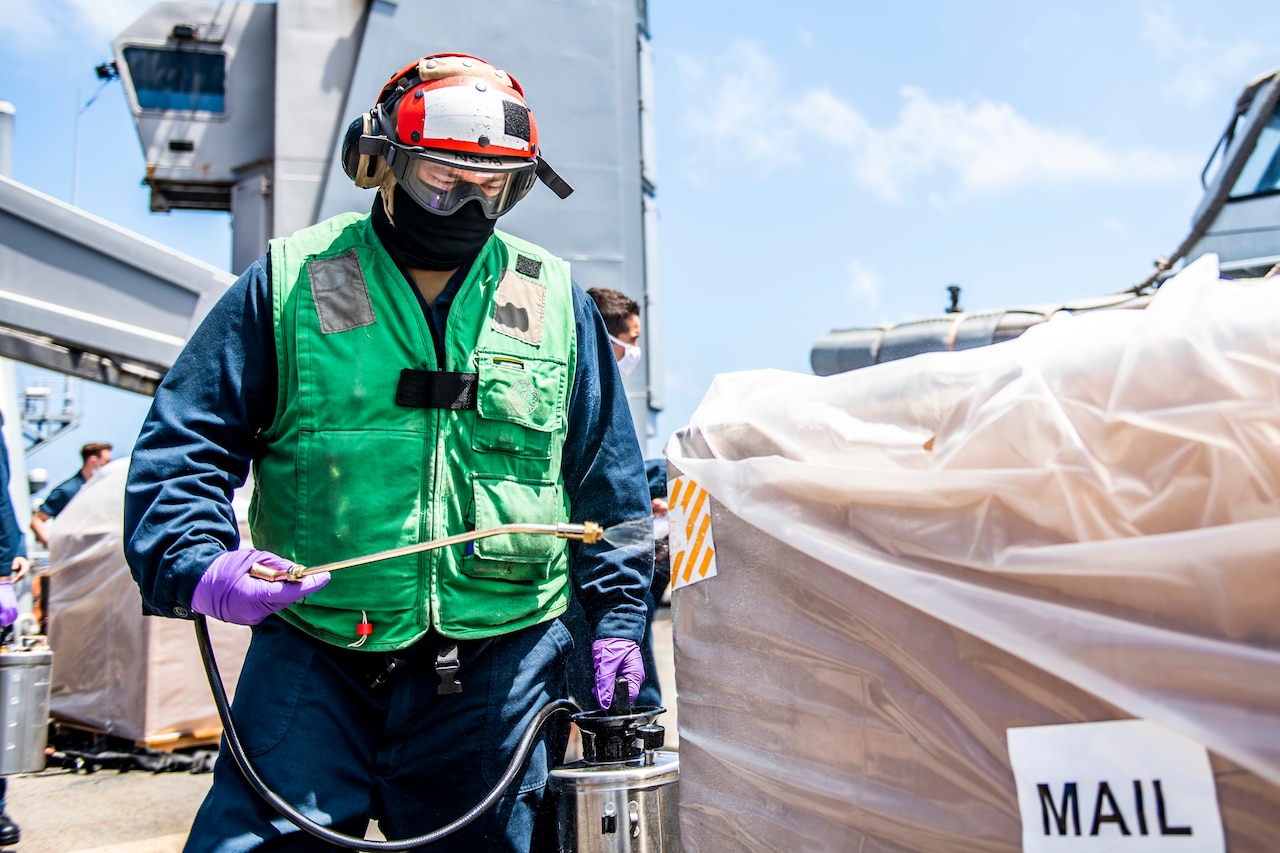
A sailor sprays disinfectant on a pallet to prevent the spread of COVID-19.

"Everyone on board recognizes how serious the virus has become," Woods said. "Even if these decisions are unpopular, they are necessary, and I have the CRRT members to thank for all of their incredible work enforcing these policies."

Engols said the CRRT has played a vital role in keeping Germantown's crew safe.

"The team continues to adapt to our mission and is ready to muster at any time of day, as needed, in response to any potential threat vectors," Engols said. "Fighting COVID-19 on-ship, and keeping Germantown and our embarked crews safe and ready to take on our mission, is important. We are fortunate to have a team trained and ready."

Woods said he agrees that the CRRT's goal is keeping everyone on the ship healthy.

"We haven't had a single case of COVID-19 on the ship, and I recognize that as evidence of how effective our team has been," Woods said. "If we can keep concern about coronavirus at the back of everyone's mind and allow sailors to focus first on all the hard work they are doing on a daily basis at sea, then I know we are on the right track to beat this virus. My team's ability to adapt and overcome has been phenomenal and has made all the difference in keeping our crew safe from coronavirus."

The Germantown, part of America Expeditionary Strike Group, is operating in the 7th Fleet area of operations to enhance interoperability with allies and partners, and serves as a ready response force to defend peace and stability in the Indo-Pacific region.

Pathfinder Medical Technician Discovers Safer COVID-19 Swab Technique


Aug. 21, 2020 | BY AIR FORCE AIRMAN 1ST CLASS JENNIFER ZIMA

A medical technician at Royal Air Force Croughton, England, discovered a COVID-19 testing technique that needed to be changed, so he elevated the concern and affected testing procedures across the entire Defense Department.

Air Force Tech. Sgt. Steve Zavala, 422nd Medical Squadron medical operations flight chief and Trusted Care champion, along with three other medical technicians, have been testing patients for COVID-19 at the 422nd MDS using the same testing procedure used for the seasonal flu.

''The particular method to collect the COVID-19 swabs is called the nasopharyngeal swab,'' Zavala said. ''The training that we received is dictated down from [the Defense Health Agency]. The DOD Global Respiratory Pathogen Surveillance questionnaire lays out, step by step, how to do a nasopharyngeal swab.''

The questionnaire said that one of the steps when collecting a sample was to have patients blow their nose into a tissue. However, while watching COVID-19 testing on the news, Zavala noticed other medical professionals were not having their patients blow their noses before collecting samples.

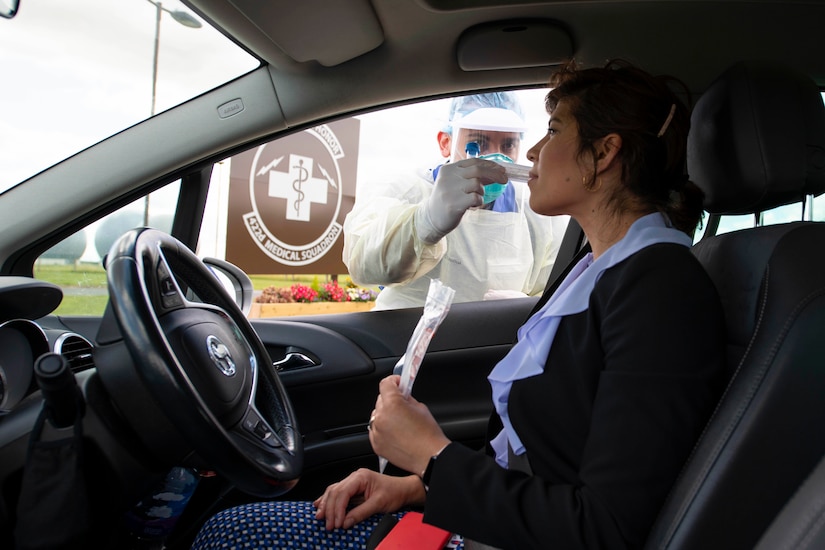
An airman wearing personal protective equipment administers a medical test on a woman sitting in a car.

''I was pretty confident we were doing something wrong here — something just didn't seem right to me.'' Zavala said. ''I did some research and finally came across a step-by-step guideline according to the [Centers for Disease Control and Prevention] on what you should do for nasopharyngeal swabs.''

Zavala noticed that the CDC procedures had no recommendation that patients have to blow their noses. He then searched the Air Force Medical Service Knowledge Exchange COVID-19 page and didn't find that recommendation.

''There’s this big push for medical Trusted Care, not only in the Air Force, but across DOD,'' Zavala said. ''We're trying to mirror the reliability that the nuclear industry and commercial aircraft have. ... Medical has been trying to adopt the principles that those industries have, and we call it Trusted Care.''

Trusted Care is not a program, but a type of culture focused on improved communication, he explained.

''It took us three years to get to the point where we're starting to see some of the positives from doing all of the Trusted Care work,'' Zavala said. ''Every department has their own daily huddle. That's the time to bring up any safety concerns — it's all safety driven. Every meeting that we have starts with safety moments and safety stories.

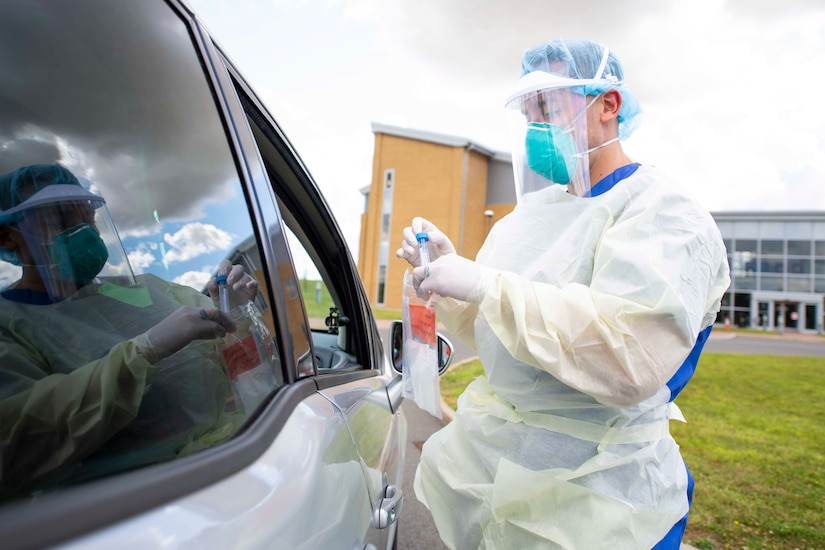
An airman wearing personal protective stands outside of a car.

''It's hard for people sometimes,'' he continued. ''They just fix things on the fly — they don't think of things as a safety moment. The way that people learn the best is from stories. It's to get people to look at things in a different way, and maybe it will trigger that story in their mind when they see something else. In a hospital, anyone can find something that can be a huge issue.''

A Situation, Background, Assessment, Recommendation report is part of Trusted Care. It's a technique used in health care to facilitate communicating recommendations to improve patient care. ''You're recommending an action be taken,'' Zavala said. ''You're not just complaining about something wrong, but you're recommending up to the highest levels.''

Zavala sent a SBAR report to his leadership, explained the situation and asked for clearer guidance on testing procedures to have more accurate results. They sent the SBAR, and the recommendations to discontinue nose-blowing, to the U.S. Air Forces in Europe Trusted Care regional and head laboratories. From there, the report gained Air Force-level attention.

''The form that is DOD-wide is going to be changed to match the CDC,'' Zavala said.

Zavala shared some suggestions from his experience.

''Speak up if you see something that doesn't jibe with what you've been taught,'' he said. ''A big thing in Trusted Care is to exercise a questioning attitude. It's always good to ask people for a crosscheck — 'Hey, does this seem right to you?' It ties into our core value of excellence in all we do. Why are we taking the time to do this, if you feel it’s not the best method?''

(Air Force Airman 1st Class Jennifer Zima is assigned to the 501st Combat Support Wing.)

Space Command Leadership Changes Hands

Aug. 21, 2020 | BY TERRI MOON CRONK , DOD News

For decades, the world has enjoyed the freedom to operate in space, and today, billions of people worldwide rely on space-based capabilities. ''Yet we now find that space has become highly contested, and the gains the United States possesses are threatened,'' Defense Secretary Dr. Mark T. Esper said at the U.S. Space Command change-of-command ceremony in Colorado Springs, Colorado. 

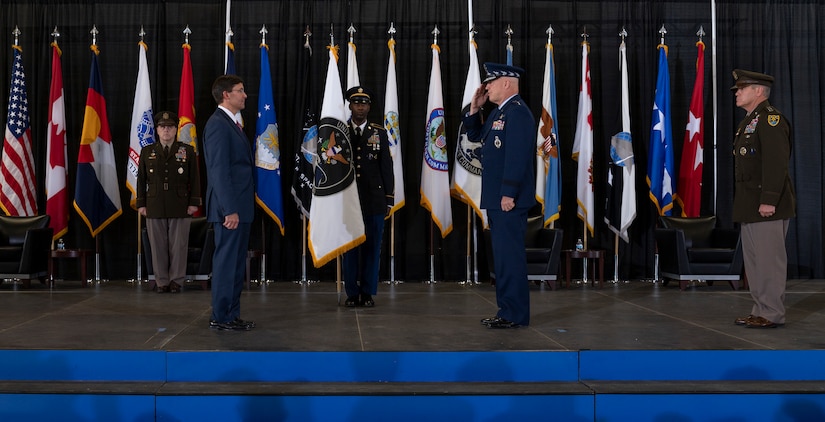
Army Gen. James H. Dickinson succeeded Space Force Gen. John W. ''Jay'' Raymond as Spacecom commander, the 11th and newest DOD combatant command. Raymond, the chief of space operations, had also led Spacecom since its inception.

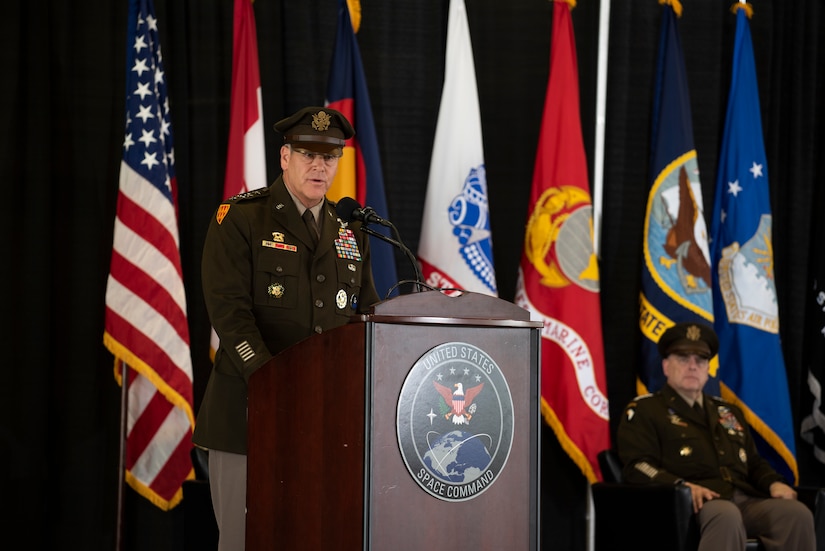
A man in military uniform speaks at a podium.

''[As] we continue to push the limits of science and innovation, we recognize that our competitors are seeking new ways to exploit our systems and to undermine our military advantage,'' Esper said. ''We know, for example, that China and Russia are weaponizing space through the development of anti-satellite missiles, directed energy, weapons and more — all designed to hold the United States and allied space systems at risk. They have turned a once peaceful arena into a warfighting domain.''

Space power will be essential in any future conflict. The National Defense Strategy underscores the importance of modernizing our space capabilities to effectively respond to this rapidly changing and complex security environment, the secretary said.

Fortunately, he added, Space Command has been in Raymond's capable hands, and that will continue with Dickinson.\

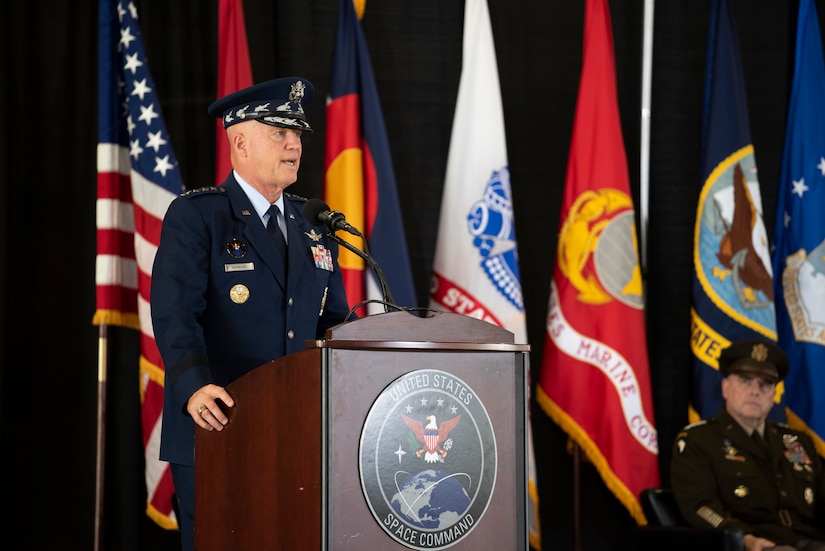
A man in military uniform speaks at a podium.

As Spacecom's top officer, Raymond pushed joint warfighting excellence in the space domain by focusing on the organization, training and equipping of our nation's finest space professionals, Esper said.

Dickinson, prior to becoming Spacecom's deputy commander, commanded the U.S. Army Space and Missile Defense Command, Army Forces Strategic Command and the Joint Functional Component Command for Integrated Missile Defense, a seminal experience that has equipped space operations in a joint environment, Esper said.

''Jim Dickinson is a man of enormous character. And in this particular job, he's going to need every ounce of that character, because he's going to have to continually render his best military advice to the secretary of defense and the president in times of crisis in good times and bad times,'' Army Gen. Mark A. Milley, the chairman of the Joint Chiefs of Staff, said.

People stand on stage, some in military uniforms, performing a ceremony.

''Jim Dickinson's foot will now be on the accelerator, pedaling,'' Raymond said of his Spacecom successor. ''Thank you for serving so closely with me over the past six months, and I couldn't be more excited. There is no one more qualified to serve as commander in chief of space operations.''

''I am truly humbled and deeply honored to assume command of your Space Command … I am thankful to the chairman of the Joint Chiefs of Staff and the secretary of defense, the president of the United States and our congressional leader for the trust and confidence they have placed in me to lead our nation's newest combatant command in its role to protect, defend and advance our nation's interest in space,'' Dickinson said.

Command Senior Enlisted Leader Assignment

 Aug. 21, 2020


The Office of the Senior Enlisted Advisor to the Chairman of the Joint Chiefs of Staff (OSEAC) announced today the following assignment:

Army Command Sgt. Maj. Sheryl D. Lyon, currently assigned as the command senior enlisted leader for the U.S. Army Cyber Command, Fort Belvoir, Virginia, has been selected to assume responsibility as the command senior enlisted leader for the U.S. Cyber Command and National Security Agency, Fort Meade, Maryland.

DOD Announces $17.4 Million in Defense Production Act Title III COVID-19 Actions

 Aug. 21, 2020


Today, the Department announces four Defense Production Act Title III actions to sustain and strengthen essential domestic industrial base capabilities in molecular diagnostic testing, satellite communications, laser electronics, and aircraft engine repair.  These actions will help to retain critical workforce capabilities throughout the disruption caused by COVID-19. The Department remains closely partnered with FEMA and HHS, providing almost $2.9 billion in life-saving medical services, supplies and equipment to service members and federal agencies in the nation's whole-of-government approach to the pandemic.

DOD & HHS Announce $3.1 Million Defense Production Act Title III Agreement with BioFire Defense, LLC to Expand Domestic Production Capacity for Molecular Diagnostic Testing

As initially released on August 10 and as part of the national response to COVID-19, the Department of Defense (DOD), in coordination with the Department of Health & Human Services (HHS), signed an agreement with BioFire Defense, LLC, a subsidiary of bioMérieux, to expand the production of the BioFire® COVID-19 Test for the DOD. Government funding allocated was $3.1 million.

The current COVID-19 pandemic created a global demand for diagnostic tests for the virus, including a requirement to maintain operational readiness and the health of our armed forces.  The investment in BioFire Defense will enable the company to increase manufacturing capacity through expansion of its facility in Salt Lake City, Utah. By installing two new production lines, BioFire Defense will triple its manufacturing capacity of tests starting in September 2020, which are compatible for use with BioFire® FilmArray® instruments that are fielded across the DOD and Department of State.

This effort has been led by the DOD’s Joint Acquisition Task Force (JATF), in coordination with the Department of the Air Force’s Acquisition COVID-19 Task Force (DAF ACT), and funded through the Defense Production Act (DPA) Title III program. This project is part of the interagency effort to ensure timely availability of medical resources essential for national defense.

DOD Announces $3.6 Million Defense Production Act Title III Agreement with AQYR Technologies to Strengthen Domestic Space Industrial Base

As part of the national response to COVID-19, the Department of Defense entered a $3.6 million contract with AQYR Technologies under Title III of the Defense Production Act to sustain and expand critical industrial base capability for the Global Broadcast Service (GBS) Portable Receiver Suite (PRS).

AQYR Technologies is a Small Business Innovation Research (SBIR) company and is the sole source supplier of the PRS tactical and portable terminals which enable warfighters to receive extremely large intelligence products (streaming video, imagery, geospatial, etc) while reducing the chances of discovery by enemy signals detection systems. Using funds authorized and appropriated under the CARES Act, this DPA Title III investment will sustain and expand critical capabilities and capacity that revolutionizes the way the warfighter operates by allowing them to receive important information broadcasted over satellite communication (SATCOM) channels deployed globally.

This investment will ensure the U.S. Government receives dedicated long-term industrial capacity to meet the needs of the nation while maintaining and protecting a skilled workforce during the disruption caused by COVID-19.

AQYR headquarters in Nashua, New Hampshire will be the principal place of performance.

DOD Announces $7.0 Million Defense Production Act Title III Agreement with Leonardo Electronics US Inc. to Strengthen Domestic Electronics Industrial Base 

As part of the national response to COVID-19, the Department of Defense entered into a $7.0 million agreement with Leonardo Electronics US Inc. to sustain critical industrial base capabilities for Diode Pumped Alkali Laser (DPAL) systems.

Leonardo Electronics US Inc. intends to continue production of laser diode modules for DPALs to sustain production operations and stabilize the supply chain, ensuring that the U.S. Government continues to have access to this critical domestic capability.

Using funds authorized and appropriated under the CARES Act, this DPA Title III investment will offset financial distress brought about by the COVID-19 pandemic and enable Leonardo Electronics US Inc. to retain critical core competencies and capabilities required to produce DPALs, as well as support their supply chain, which includes many small businesses, put at risk by COVID-19.

The principal place of performance will be the Leonardo Electronics US Inc. facility in Tucson, Arizona. 

DOD Announces $3.7 Million Defense Production Act Title III Agreement with Aero Turbine to Strengthen Domestic Aircraft Industrial Base 

As part of the national response to COVID-19, the Department of Defense entered into a $3.7 million agreement with Aero Turbine under Title III of the Defense Production Act to sustain critical industrial base capability and capacity for U.S. Air Force J85 engine and parts manufacturing.  

Aero Turbine is a small business that provides turbine engine and accessory overhaul, repair, and testing services for the U.S. Air Force, U.S. Navy and U.S. Army. Using funds authorized and appropriated under the CARES Act, this investment will expand its domestic production capability and capacity for J85 engines and parts to meet vitally important demand in support of the DOD. The investment will positively impact operational readiness by reducing delay times and driving time and cost savings for the U.S. Government. Additionally, Aero Turbine will be able to retain critical workforce capabilities throughout the disruption caused by COVID-19 and to restore some jobs lost due to the pandemic.

Aero Turbine headquarters in Stockton, California will be the principal place of performance.

Website Resources:

Night Watch


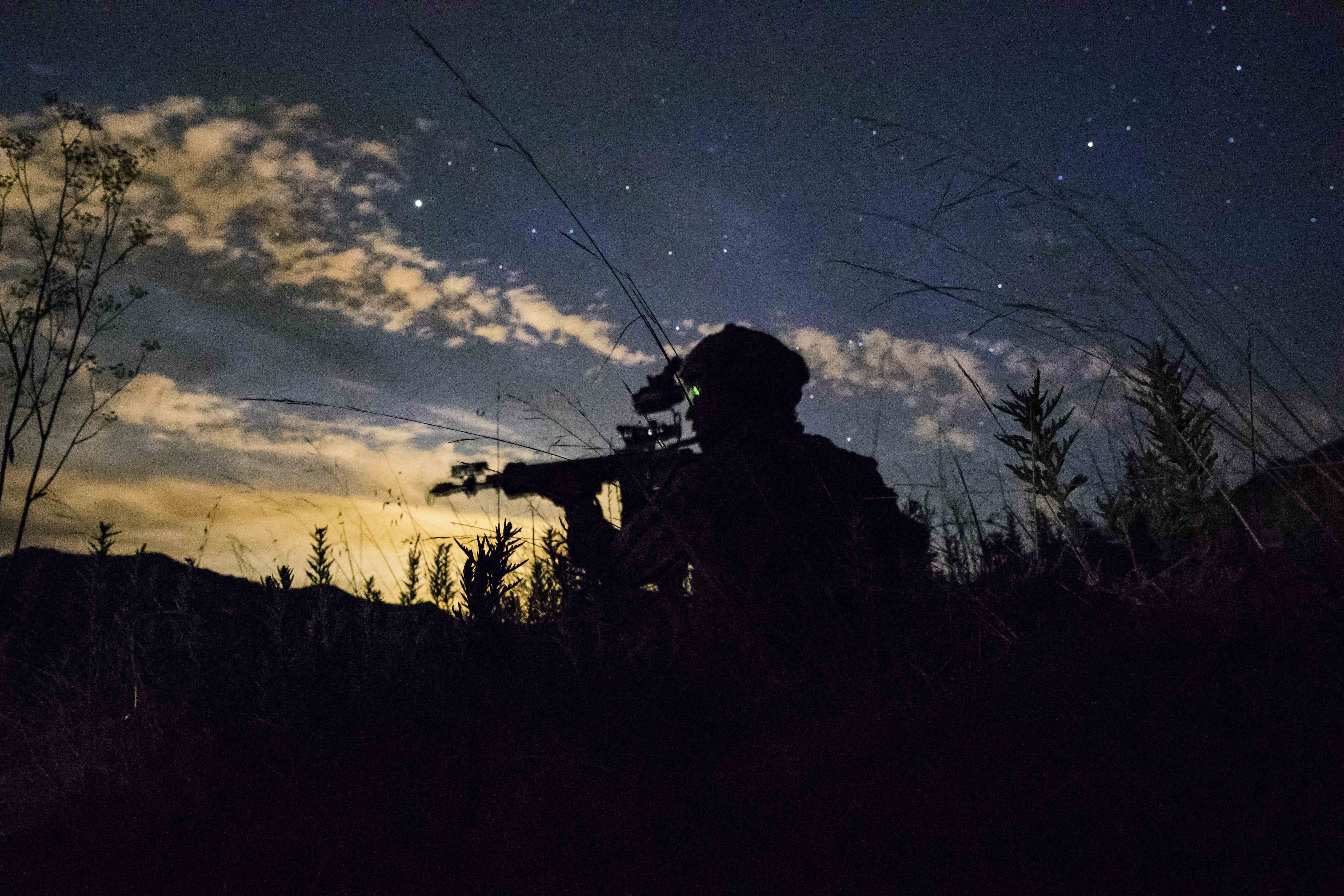
Marine Corps Lance Cpl. James Esquibel scans a road for simulated enemies during an evaluation at Marine Corps Base Camp Pendleton, Calif., Aug. 12, 2020.

Tent Team


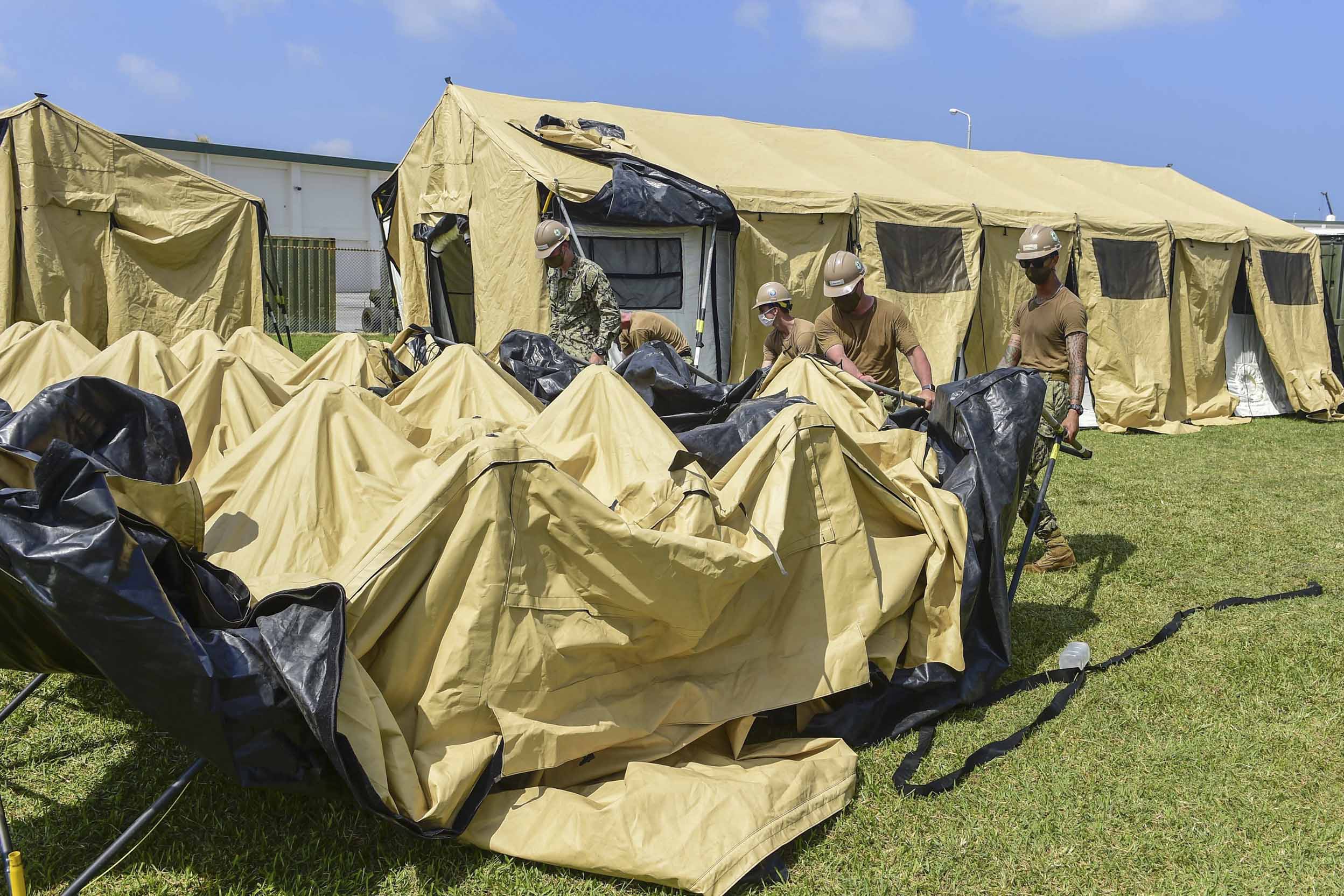
Sailors set up a naval enterprise tactical command control tent before an exercise in Okinawa, Japan, Aug. 17, 2020.

Blue Angels


The Blue Angels, the Navy’s flight demonstration squadron, fly with the team’s new C-130J Super Hercules over Naval Air Station Pensacola, Fla., Aug. 17, 2020. The Blue Angels’ previous C-130 “T” model served the team for 17 years and was retired in May 2019.

DOD Announces Winners of the 2020 Commander in Chief's Annual Award for Installation Excellence

 Aug. 21, 2020


Secretary of Defense Dr. Mark T. Esper has announced the 2020 recipients of the Commander in Chief’s Annual Award for Installation Excellence.

The Commander in Chief’s Annual Award for Installation Excellence recognizes the outstanding and innovative efforts of the people who operate and maintain U.S. military installations. The five recipients of this highly competitive presidential award were selected for their exemplary support of Department of Defense missions.

Recipients of the 2020 Commander in Chief’s Annual Award for Installation Excellence are:

U.S. Army Garrison Fort Drum, New York
Senior Commander: Major General Brian J. Mennes, U.S. Army
Garrison Commander:  Colonel Jeffery P. Lucas, U.S. Army

Naval Station Norfolk, Virginia
Commanding Officer: Captain Bradley N. Rosen, U.S. Navy

Marine Air Ground Task Force Training Command, Marine Corps Air Ground Combat Center, California
Base Commander: Brigadier General Roger Turner, U.S. Marine Corps

Joint Base Elmendorf-Richardson, Alaska
Commanding Officer: Colonel Patricia A. Csànk, U.S. Air Force

Defense Distribution Depot, San Joaquin, California
Commanding Officer: Colonel Tiffany. N. Harris, U.S. Marine Corps

Installations compete on how well they achieve the department’s objectives in several areas of installation management, including mission support, energy conservation, quality of life and unit morale, environmental stewardship, real property management, safety, health and security, communications, and public relations.

Excellent installations enable better mission performance and enhance the working and living conditions for military men and women, DOD civilians and their families.  Each of the winning installations succeeded at being the best in achieving excellence in performing installation management within their military service and the Defense Logistics Agency.

Each winning installation will receive a commemorative trophy and flag and a congratulatory letter from the president.

For information about each winning installation’s accomplishments, read these narratives.

For more information about the award program, read this fact sheet.

Former Army Special Forces Officer Charged in Russian Espionage Conspiracy

 Former Green Beret Allegedly Conspired to Provide National Defense Information to Russian Intelligence

A Gainesville, Virginia, man was arrested today for conspiring with Russian intelligence operatives to provide them with United States national defense information.

According to court documents, from December 1996 to January 2011, Peter Rafael Dzibinski Debbins, 45, a former member of the U.S. Army, allegedly conspired with agents of a Russian intelligence service.  During that time, Debbins periodically visited Russia and met with Russian intelligence agents.  In 1997, Debbins was assigned a code name by Russian intelligence agents and signed a statement attesting that he wanted to serve Russia.

“Two espionage arrests in the past week — Ma in Hawaii and now Debbins in Virginia — demonstrate that we must remain vigilant against espionage from our two most malicious adversaries — Russia and China,” said John C. Demers, Assistant Attorney General for National Security.  “Debbins violated his oath as a U.S. Army officer, betrayed the Special Forces and endangered our country’s national security by revealing classified information to Russian intelligence officers, providing details of his unit, and identifying Special Forces team members for Russian intelligence to try to recruit as a spy.  Our country put its highest trust in this defendant, and he took that trust and weaponized it against the United States.”

“Our military is tasked with the awesome responsibility of protecting our nation from its adversaries, and its service members make incredible sacrifices in service of that duty,” said G. Zachary Terwilliger, U.S. Attorney for the Eastern District of Virginia.  “When service members collude to provide classified information to our foreign adversaries, they betray the oaths they swore to their country and their fellow service members.  As this indictment reflects, we will be steadfast and dogged in holding such individuals accountable.”

"The facts alleged in this case are a shocking betrayal by a former Army officer of his fellow soldiers and  his country," said Alan E. Kohler, Jr.,  FBI Assistant Director of the Counterintelligence Division.  "Debbins is accused of giving Russian intelligence officers sensitive information about the units in which he once served and also providing the names of other service members so Russia could try to recruit them.  These actions cannot stand and the FBI will aggressively pursue such cases."

“According to the allegations, Mr. Debbins knowingly provided information to self-proclaimed members of Russia's Intelligence Service, the GRU,” said James A. Dawson, Acting Assistant Director in Charge of the FBI Washington Field Office. “As a member of the U.S. Armed Forces, the American people and his fellow service men and women should have been able to trust Debbins with secrets and information.  Debbins allegedly fell very short of that and exploited his role in the military and his fellow service members to benefit one of our top adversaries for years. Today’s charges are another example of the dedicated and unrelenting efforts of the FBI and our partners, domestic and international, to aggressively pursue and bring to justice those who violate this sacred trust and place our national security at risk.”

Over the course of the conspiracy, Debbins allegedly provided the Russian intelligence agents with information that he obtained as a member of the U.S. Army, including information about his chemical and Special Forces units.  In 2008, after leaving active duty service, Debbins disclosed to the Russian intelligence agents classified information about his previous activities while deployed with the Special Forces.  Debbins also provided the Russian intelligence agents with the names of, and information about, his former Special Forces team members so that the agents could evaluate whether to approach the team members to see if they would cooperate with the Russian intelligence service.

Debbins is charged with conspiring to provide United States national defense information to agents of a foreign government.  If convicted, Debbins faces a maximum penalty of life in prison.  Actual sentences for federal crimes are typically less than the maximum penalties.  A federal district court judge will determine any sentence after taking into account the U.S. Sentencing Guidelines and other statutory factors.

John C. Demers, Assistant Attorney General for National Security; G. Zachary Terwilliger, U.S. Attorney for the Eastern District of Virginia; James A. Dawson, Acting Assistant Director of FBI Washington Field Office made the announcement.  Assistant U.S. Attorneys Thomas W. Traxler and James L. Trump, and Trial Attorney David Aaron of the National Security Division’s Counterintelligence and Export Control Section are prosecuting the case.

Assistant Attorney General Demers and U.S. Attorney Terwilliger greatly appreciate the assistance of the FBI’s Minneapolis Field Office, and Army Counterintelligence, along with the United Kingdom's Metropolitan Police and MI5.

An indictment is merely an accusation.  The defendant is presumed innocent until proven guilty.

Thursday, August 20, 2020

Blue Yonder


An F-35 tears through the sky during a rehearsal performance for the 2020 OC Air Show in Ocean City, Md., Aug. 14, 2020. The airshow featured numerous performers including the Air Force Thunderbirds, F-22 Raptors, A-10s, and F-35 demonstration teams.

Setting the Example: 31st MEU Marines Clean Up Kin Blue Beach

 Aug. 20, 2020 | BY MARINE CORPS LANCE CPL. KOLBY LEGER

Reveille was at 5:30 a.m. on the morning of July 25. Combined Anti-Armor Team 1 had completed its platoon internal training at Kin Blue, Okinawa, Japan, the night before. The Marines were all tired and ready to go home, but CAAT 1 had one more task to complete.

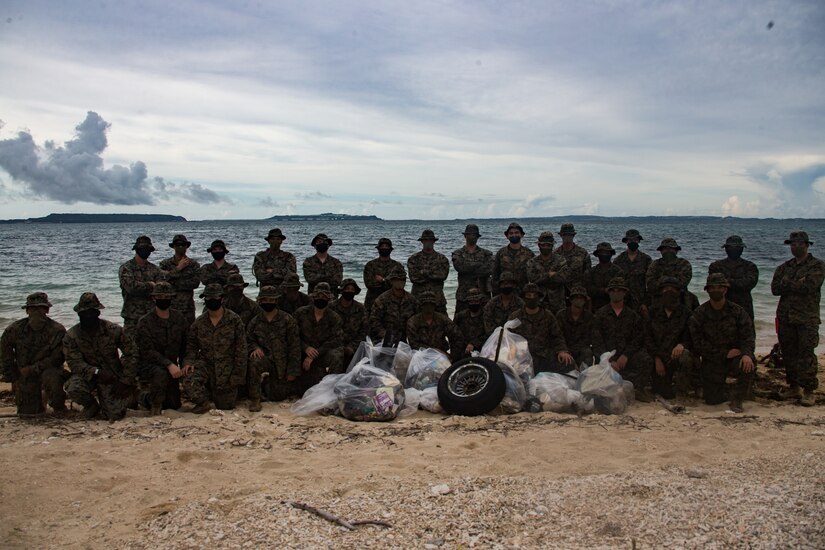
CAAT 1 is part of Battalion Landing Team, 2nd Battalion, 4th Marines, 31st Marine Expeditionary Unit. After spending three days and nights patrolling and practicing basic infantry skills in the heat, the team spent the morning clearing the beach of trash and debris that had washed up over time.

Marines and sailors who use the area for training are expected to clean it after training is complete, but CAAT 1 decided to take it a step further by cleaning the beach and all the washed-up trash as well. The Marines were happy to volunteer and show appreciation to the community.

Marines pick up trash on a beach.

To prevent the spread of COVID-19, all personnel assigned to the 31st MEU are required to maintain a strict bubble. Interactions between MEU and non-MEU personnel were strictly prohibited following the appearance of case clusters throughout Okinawa. While unable to interact with anyone from the local community, the Marines of CAAT 1 hope to demonstrate gratitudes and respect for the island through simple actions whenever possible.

Although Kin Blue is a training area, the beach is opened to the public in March every year for an event called Hama Uri. At the traditional Okinawan event, women go to the ocean to pray for their health and purify themselves by dipping their feet and hands in the water. Camp Hansen and Kin Town have been opening Kin Blue to local residents during Hama Uri for more than 20 years.

''With all the negativity going on in the world, even one positive action can help in a major way,'' said Marine Corps Sgt. Collin Rogers, a squad leader with CAAT 1, ''As leaders, we can't just think about ourselves.''

Rogers said that after the training was complete, CAAT 1 cleaned the entire training area as expected. Noticing the beach was covered in trash that had washed up from the ocean, platoon leadership decided to leave the beach better than they found it to demonstrate respect for the environment they are allowed to operate in.

Marine Corps Gunnery Sgt. Steven Habon, platoon sergeant of CAAT 1, said he wants his up-and-coming leaders to know that this is how Marine leaders are expected to act.

Marines pose for a group photo following a beach cleanup.

''Hopefully, we become the example for the battalion,'' Habon said. ''Our goal is to inspire the units that come after us, to demonstrate service through action in order to strengthen the bond between the Marine Corps and the people of Okinawa.''

''It really was a great way to end training,'' said Marine Corps Sgt. Michael Asbell, a squad leader. ''Given the current circumstances, I don't think there's a better way to show respect to the community.''

The Marines of the 31st MEU hope that, by similar actions, they can continue to express gratitude for the opportunity to be in Okinawa, Asbell said.

The 31st MEU, the Marine Corps' only continuously forward-deployed MEU, provides a flexible force ready to perform a wide range of military operations as the premier crisis response force in the Indo-Pacific region. The 31st MEU has implemented strict health protection measures and will continue to conduct mission essential training in support of regional security and stability, officials said.
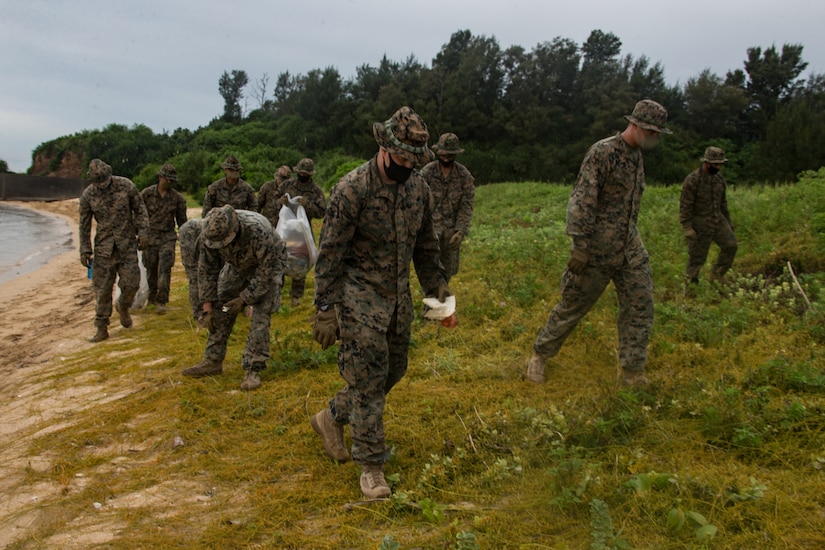
(Marine Corps Lance Cpl. Kolby Leger is assigned to the 31st Marine Expeditionary Unit.)

Southcom Task Force Donates COVID-19 Supplies in Honduras

 Aug. 20, 2020 | BY Maria Pinel , Joint Task Force Bravo

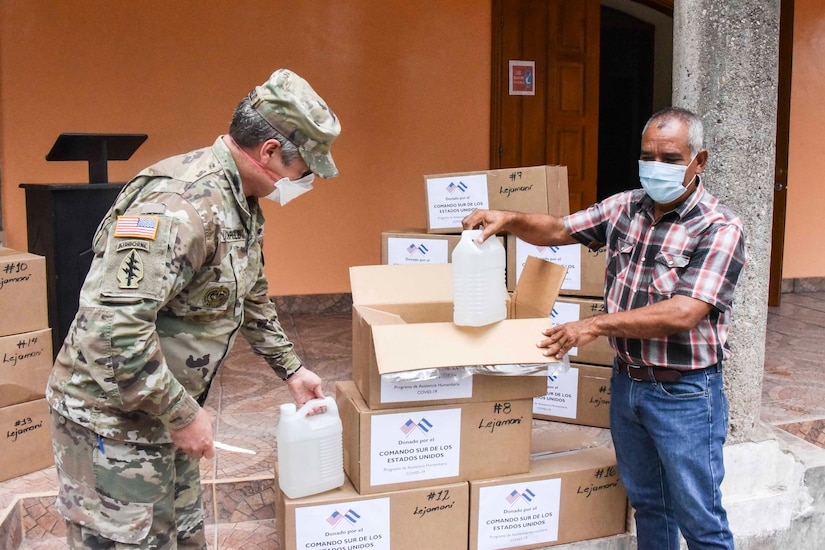
U.S. Southern Command's Joint Task Force Bravo donated personal protective equipment and medications through Southcom's humanitarian assistance program to support the municipalities of Villa de San Antonio, La Paz, Ajuterique and Lejamani in Honduras.

A soldier and a civilian, both wearing face masks, unpack boxes of medical supplies.

The donation included KN95 masks, gloves, gowns, booties, head covers, disinfecting supplies and medication to benefit the health care providers of the Roberto Suazo Cordova Hospital, a regional hospital that receives patients from all over La Paz. Donations were also provided to the emergency committees in the municipalities of Villa de San Antonio in the department of La Paz, and Ajuterique and Lejamani in the department of Comayagua for distribution to local health care clinics. The donations are valued at more than $52,000.

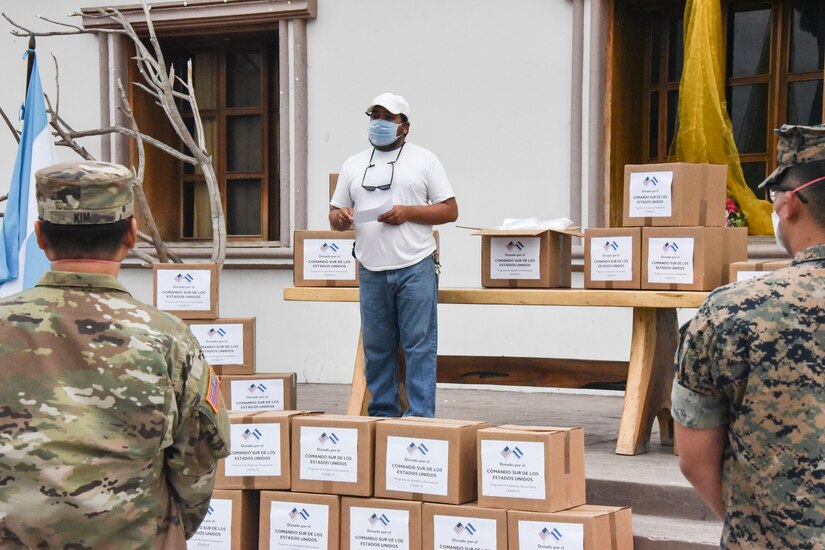
A man wearing a face mask, a white baseball cap, a T-shirt and jeans stands amid boxes of humanitarian aid supplies and speaks to the soldiers who delivered the items.

The task force continuously works to build partnerships to foster security, stability and prosperity for Honduran citizens through a variety of missions, including personal protective equipment donations in response to COVID-19 throughout the country, officials said.

Army Col. John Litchfield, the new task force commander, personally delivered the donations to meet with local mayors, health care leaders and authorities and to underscore the task force's commitment to supporting its partners and hosts in this time of need.

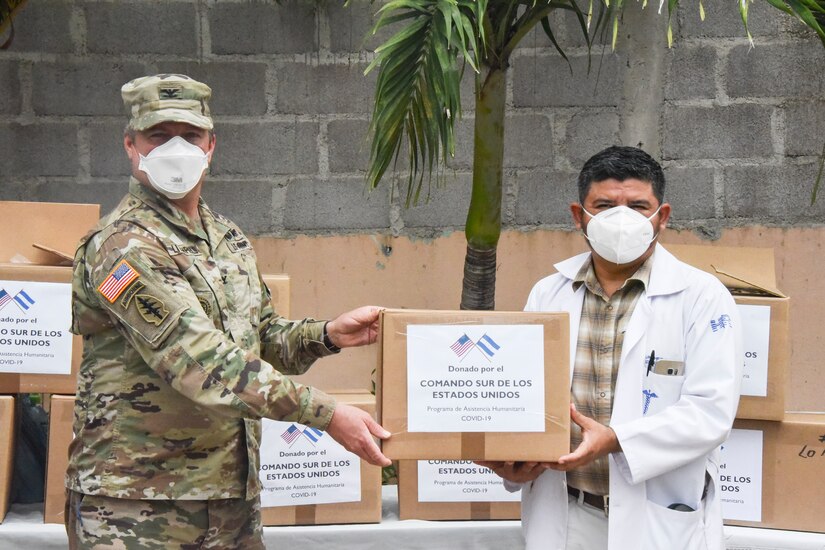
A soldier and a civilian, both wearing face masks, pose for a photo as they hold a box.

"We are committed to supporting your efforts in the fight against COVID-19," Litchfield said. "We are part of this community, and we are in this together. Your success is our success, and I look forward to continuing strengthening our partnership. We are together in this fight, and we are committed to supporting you as friends and neighbors."

DOD Developing Small, Unmanned Aerial System for Warfighters

 Aug. 20, 2020 | BY David Vergun , DOD News

For the first time, the Defense Department and the entire federal government will have access to secure, trusted, and American-made commercial drones on the General Service Administration schedule, Acting Undersecretary of Defense for Research and Engineering Michael Kratsios announced at a virtual event hosted by the Defense Innovation Unit. 

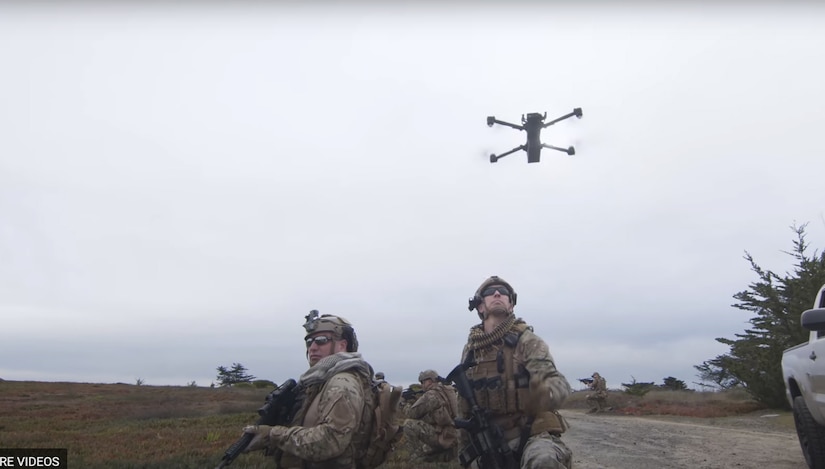
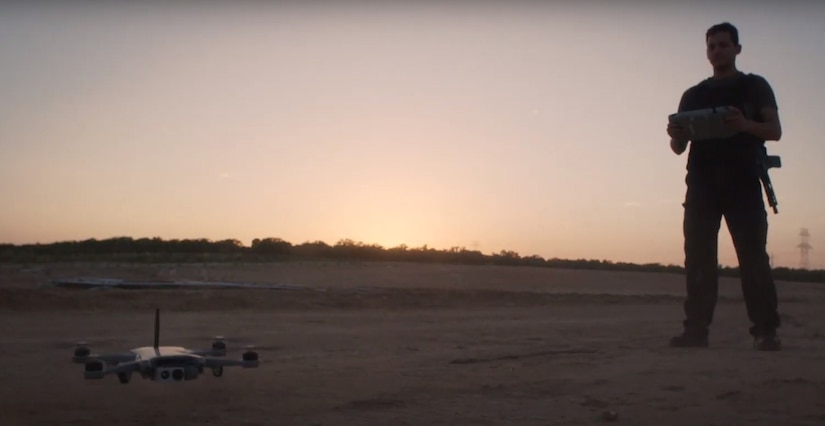
Small drone flies.

This new DIU initiative, dubbed Blue sUAS, is the culmination of 18 months of work by the Army and DIU to tailor the best technology from U.S. and allied companies to develop small unmanned aircraft systems that can be safely adopted by men and women in uniform. During the Aug. 18 DIU event, Kratsios said it also has important impacts for the nation's broader economic and national security. 

"UAS technologies have incredible promise and potential to not only provide great economic benefit for the American people, but also to enhance safety and security for our nation. We need a strong, secure domestic UAS manufacturing base to ensure American leadership in this critical field," he said. "Blue sUAS represents a tremendous first step toward building a robust and trusted UAS domestic industrial base that ensures sustained delivery of highly-capable, secure UAS to the warfighters that depend on it."  

Small drone flies.

DOD recognizes the growing value and capabilities of sUAS, from providing on-demand intelligence and reconnaissance capabilities in contested battle spaces, to routine monitoring of critical infrastructure, to transporting products, he said. However, until now, the Department was not able to adopt these systems safely due to security and supply chain concerns posed by Chinese-made sUAS, he added.

Through the work of Blue sUAS, five U.S.-manufactured drone configurations will be made available to provide trusted and secure sUAS options to the military and U.S. government. 

Small drone flies.

Blue sUAS also showcases how DOD partners with industry and allies to quickly pilot and scale cutting-edge technologies across the joint force and the other federal agencies.

Haven Wynne, General Services Administration supply chain management branch chief and program manager, said GSA is drawing up a 20-year contract, to include five-year options. He noted that the contract allows for the growth of additional accessories to be added to the platforms at a later time if required.

Small drone flies.

"Blue sUAS is a great example of DOD acquisition reform by lowering the barrier to entry for nontraditional companies to rapidly iterate shoulder to shoulder with warfighters to deliver highly capable sUAS tailored to mission needs," Ellen M. Lord, undersecretary of defense for acquisition and sustainment, said at DIU's virtual event. 

Chris O’Donnell, deputy assistant secretary of defense for acquisition and sustainment, platform and weapon portfolio manager, said that warfighter experiences in Iraq and Afghanistan demonstrated the importance of small UASs to warfighters on the battlefield. 

Small drone flies.

DOD awarded $13.4 million to five companies to begin producing sUASs beginning next month: Vantage Robotics, Skydio, Parrot, Teal and Altavian.

According to DIU's website, the sUASs will have a range of at least 3 kilometers, 30 minutes or more flying time, the ability to fly through rain and dust, assembly time of two minutes or less, a weight of under 3 pounds on takeoff, high-resolution day and night optics, thermal imaging, open source protocol architecture, and simple integration with ground controllers.

Wednesday, August 19, 2020

Ohio Guard Continues to Support Food Bank

 Aug. 19, 2020 | BY ARMY SGT. 1ST CLASS THOMAS VEGA

Since mid-March, hundreds of service members from the Ohio National Guard have been serving in response to Gov. Mike DeWine's request for support in the state's fight against COVID-19.

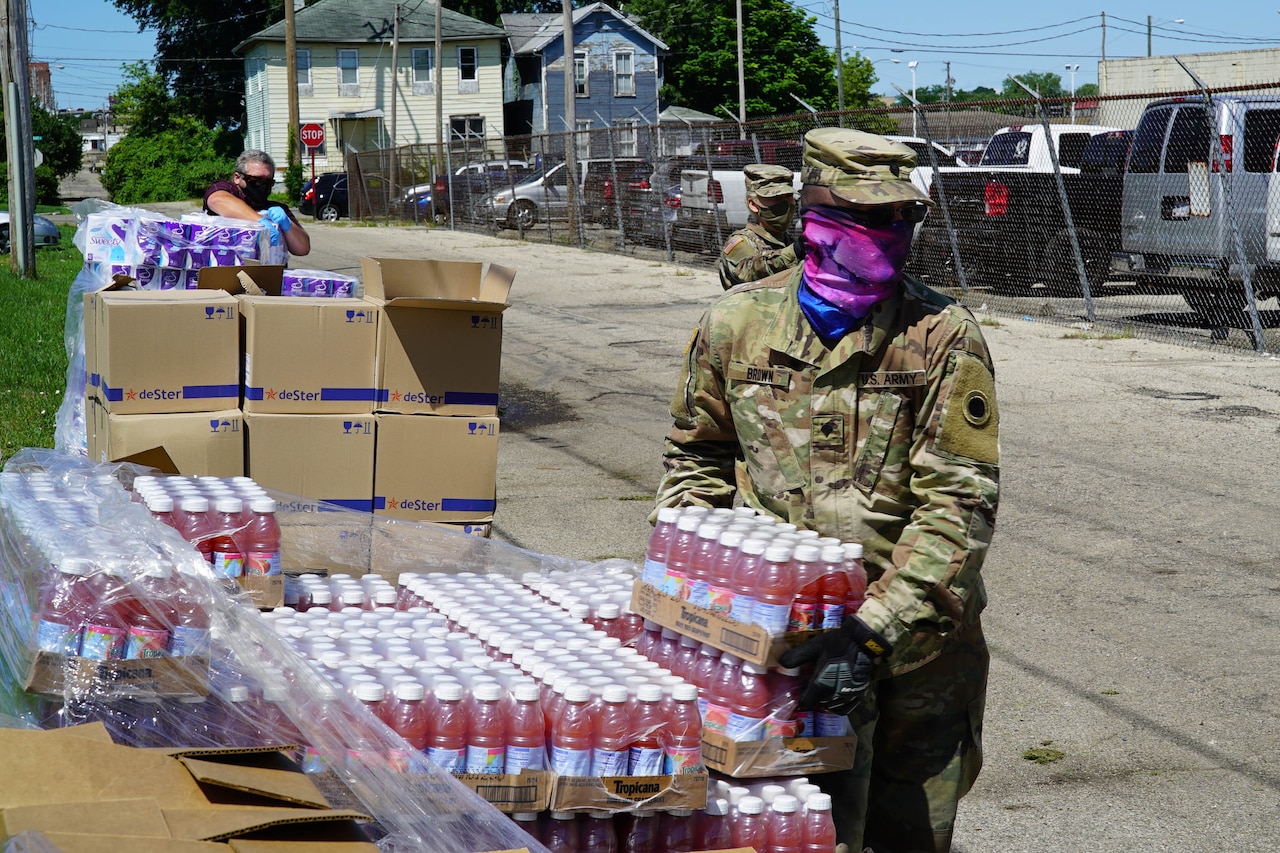
Soldiers wearing face masks load food into waiting vehicles.

Recently, funding to extend the mission through Dec. 31 was approved to support the different aspects of the response. One of the more familiar missions is assisting food bank partners to address food insecurity across the state.

"I've been on the food bank support mission for about four weeks now, and morale is high here," Army 1st Sgt. Warren Barrett of the Ohio Army National Guard's 371st Sustainment Brigade, said. "Everyone wants to be here helping the community for as long as it takes."

As relief efforts continue across the state, service members assisting food banks continue to build strong relationships with the communities they serve.

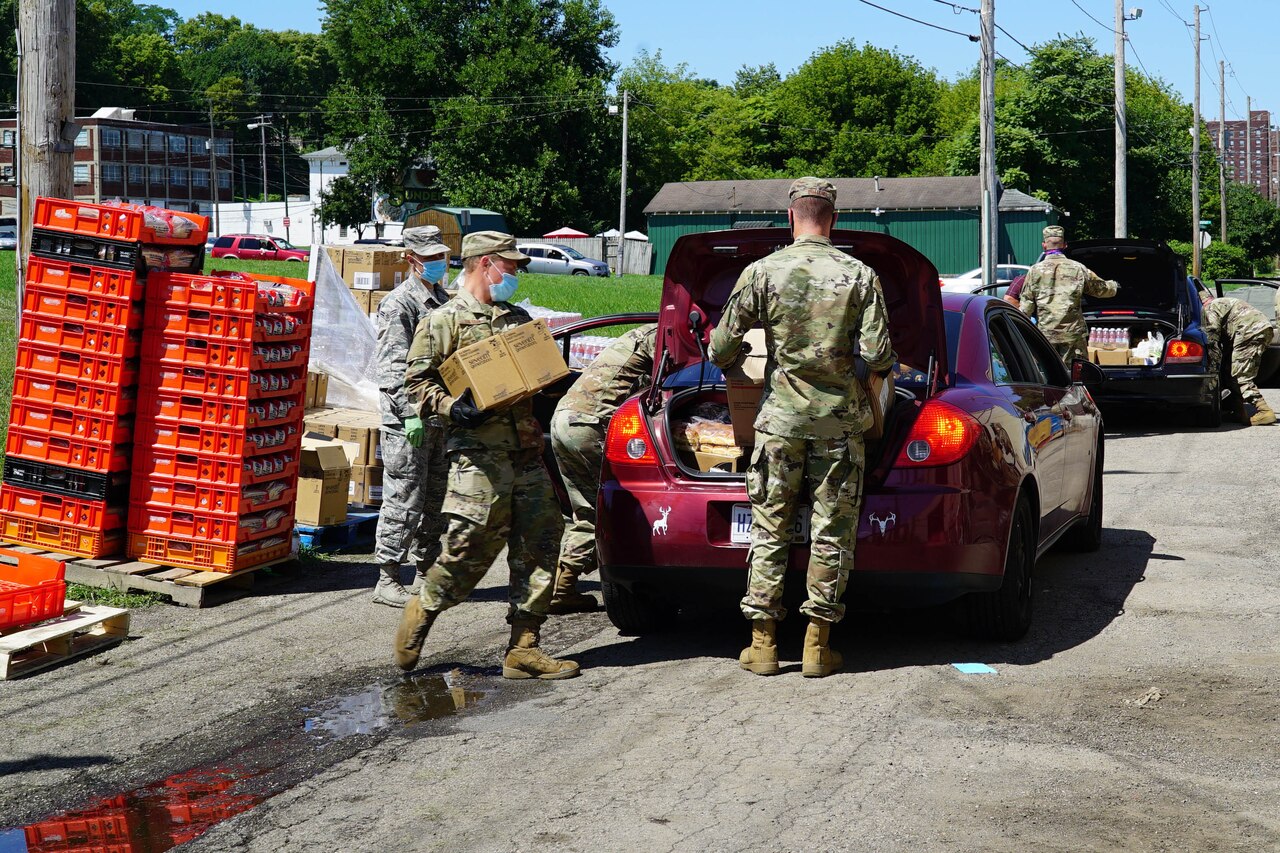
Soldiers wearing face masks load food into waiting vehicles.

"Right now, we are serving hundreds of families a day," Army Spc. Levi Brown of the Ohio Army National Guard's 37th Infantry Brigade Combat Team, said. "My favorite thing here is the kids' lunch program. I really enjoy getting to meet the kids and serve them lunch."

As the food bank mission continues, Ohio Guard leaders are constantly analyzing where, when and how the Guard's assets are critically needed to mitigate the spread of COVID-19.

(Army Sgt. 1st Class Thomas Vega is assigned to the 371st Sustainment Brigade.)

Close Contact Tracing Team Fights on Front Lines of COVID-19 Care

 Aug. 19, 2020 | BY Riley Eversull

For more than six months, Naval Medical Center Camp Lejeune has been battling the COVID-19 pandemic. While epidemiologists work around the clock to better understand the coronavirus, the medical center's laboratory technicians, pharmacists, nurses and paramedics must translate information quickly for their patients and the public.

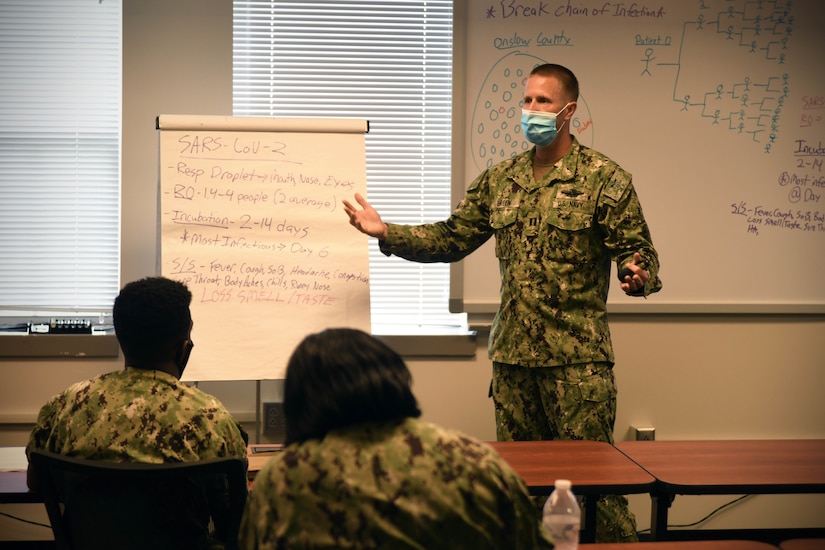
A sailor wearing a face mask teaches a course.

"We pay close attention to lessons learned and best practices outlined by the Centers for Disease Control and Prevention and Department of Defense health experts," Navy Lt. Eric Green said, addressing a recent contact tracing course at Camp Lejeune. "Our contact tracing has revealed some local trends that we immediately act upon to educate our forces and beneficiaries, as well as develop our own local best practices."

Green serves as the medical center's preventive medicine department head and as assistant public health emergency officer for Marine Corps Installations East. As COVID-19 took just a matter of weeks to permeate eastern North Carolina, Green and the preventive medicine department quickly determined the undeniable need for a team dedicated to tracing close contacts of COVID-19-positive patients.

"Our team of close contact tracers are working shifts seven-days a week, 12 or more hours a day, to track down possible close contacts of confirmed COVID-19 patients," Green said. "Because of the contact tracing team's hard work, there is an impressive synergy between Marine Corps operational units [ in Marine Corps Installations East] and local and state health department officials to thoroughly investigate each case."

Preventive medicine has hosted a series of contact tracing courses over the past five months. The most recent course, held on Aug. 5, brought together medical professionals from Navy and Marine Corps units, Marine Corps Community Services, child development centers and Department of Defense Education Activity schools. The class breaks down what preventive medicine has learned about COVID-19 and the novel, yet effective, process for tracking close contacts. Class participants can then take these methods back to their units or organizations to apply to their daily COVID-19 prevention routines.

"What we are learning is that if you have COVID-19, you could potentially infect an average of two people, then those two people could infect four people, and so on," Green said. "People assume because they aren't showing symptoms right away, they don't have it. However, we are seeing that the incubation period for COVID is two to 14 days, and by Day 6 or 7 after exposure – boom. That's often when those symptoms are hitting, or the symptoms are so mild the person may believe it is just allergies or the common cold."

To keep close contact tracing operational each week, a team of Marines from the 2nd Marine Expeditionary Force and Marine Corps Base Camp Lejeune was trained to aid the contact tracing team. Each morning, shifts begin in the same manner: dozens upon dozens of phone calls.

"We have six or seven sailors and Marines working each shift, and these are the guidelines and questions we use when calling possible close contacts," explains Navy Seaman Demetria Garvin, a hospital corpsman, as she pulled up a collage of colorful charts and lists on her computer screen. "We speak directly with the patient, and then we start contacting individuals that the patient tells us about. We inform them that they have been identified as a close contact and to self-quarantine and monitor for symptoms."

Garvin explained that identified close contacts are then called every 24 to 48 hours for symptom checks. When asked what defines a close contact, Garvin immediately pulled up the most current information on COVID-19 epidemiology.

"Were you within 6 feet for at least 15 minutes or longer of someone who has COVID-19?" Garvin said, communicating a couple of the questions asked of potential close contacts. "Have you had direct physical contact with someone who has COVID-19?"

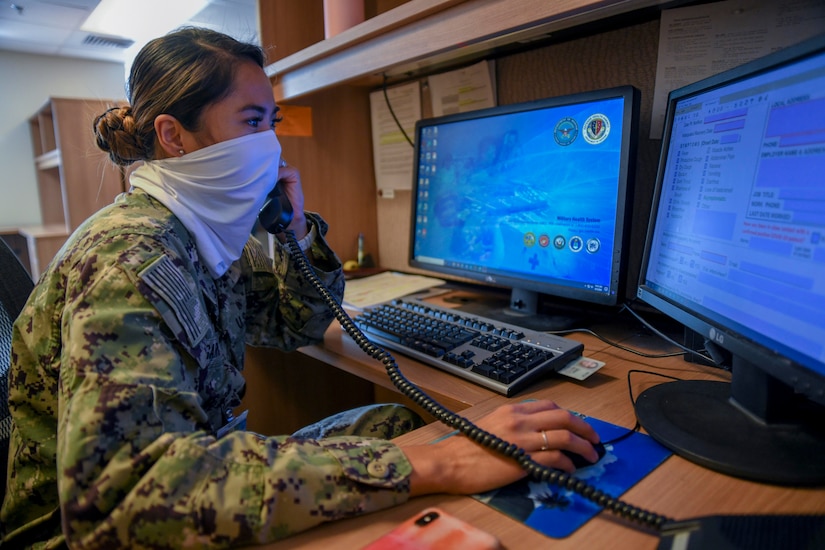
A sailor wearing a face mask talks on a phone.

If a person is identified as a close contact, contact tracers then convey the symptoms to monitor. The individual will be advised to remain home for 14 days to watch for current or possible development of symptoms. Close contacts are given information on the medical center's COVID-19 phone help line, the active-duty COVID-19 screening site and the medical center’s acute respiratory clinic. Contact who notice symptoms can confer with a medical professional about further testing, if necessary.

"We want to surround positive cases, isolate them and quarantine their close contacts," Green said. "The quicker we can do this, the more effective we can be in stopping an outbreak. What we are seeing is that we can't necessarily control cases from happening, but we can control the cluster that comes from cases."

Green described contact tracing as a sort of "box it in" process. In four steps, personnel are surrounding a COVID-19 case by testing a patient, isolating the sick, finding close contacts and having patients quarantine 14 days from the date of exposure.

"So far, we have been effective at controlling the explosive spread of the virus that we have seen occur throughout other parts of the world and nation," Green said. "We attribute part of that success to early and effective contact tracing and getting close contacts into quarantine quickly before they themselves become infected and subsequently infect others. It is a tedious and often an imperfect process, but we have undoubtedly seen these efforts slow the spread of the virus locally."

After more than 100 days spent contact tracing and refining methods, the contact tracing team has identified what they call avoidable traits, or the "Big Four," in not contracting COVID-19:

  • If you are sick, stay home.
  • Avoid large gatherings, especially with people you know to have or possibly have COVID-19.
  • If you were a known close contact of someone with COVID-19, self-quarantine for 14 days from the last exposure date.
  • If you have a COVID-19 test taken and are waiting for results, isolate at home until you get the results.

Each day, the team reports numbers of positive cases and other pertinent information to local health departments. While COVID-19 will not likely disappear soon, Green said, the contact tracing team is not only helping to "box in" cases, but also is expanding knowledge of how to prevent falling ill with COVID-19.

"By having this contact tracing process that works, this rapid response is mitigating further propagation of the disease," he said. "By doing well at contact tracing, we can flatten our local curve and keep more people from becoming sick."

What counts as a close contact? Check out these points from the medical center's contact tracing team:

  • You were within 6 feet of someone who has COVID-19 for at least 15 minutes.
  • You provided care at home to someone who is sick with COVID-19.
  • You had direct physical contact with that person (touched, kissed or hugged).
  • You shared eating or drinking utensils.
  • The person sneezed, coughed or somehow got respiratory droplets on you.

(Riley Eversull is assigned to Naval Medical Center Camp Lejeune.)

Defense Personnel Among First to Deliver Aid to Lebanon

 Aug. 19, 2020 | BY Jim Garamone , DOD News

When almost 3,000 tons of ammonium nitrate exploded in Beirut, it caused a humanitarian catastrophe that killed more than 200 people and wounded tens of thousands. 

In less than two days, American airmen were on the ground in Lebanon, delivering critical supplies. The swift reaction undoubtedly saved lives, said Stephanie Hammond, acting deputy assistant secretary of defense for stability and humanitarian affairs.Stability and humanitarian affairs personnel began working on the situation as the smoke from the explosion in Beirut was dissipating.

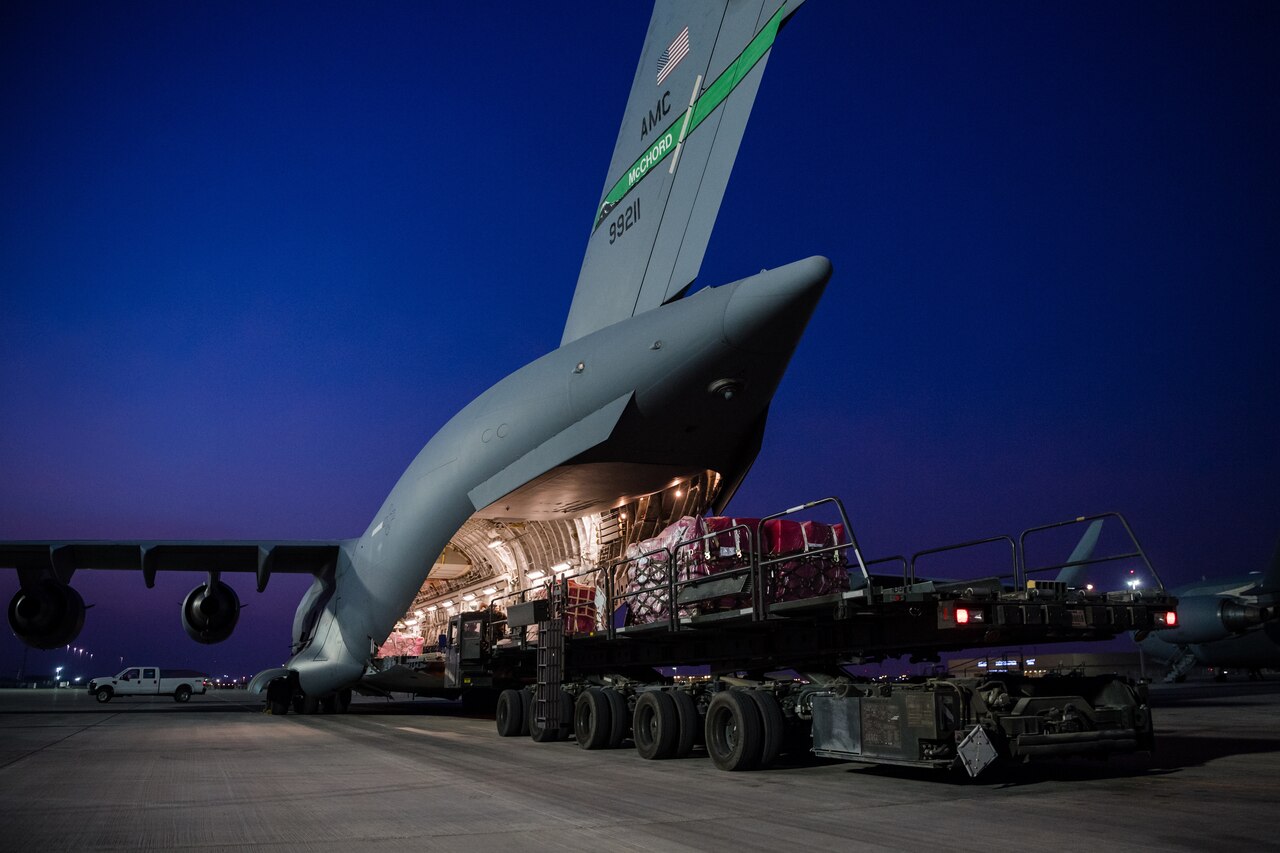
Supplies loading onto back of giant aircraft.

"Minutes after the explosion happened, actually, we swung into action, working really closely with [U.S. Central Command and U.S. European Command]," Hammond said during an interview in her Pentagon office.

Defense Secretary Dr. Mark T. Esper followed developments in the stricken Mediterranean city and "really reiterated to the department that we needed to support the Lebanese people in this desperate time of need," she said.

The American airmen were among the first to arrive. They brought food, water and critically needed medical supplies. The medical supplies were especially important, as many medical centers and providers were affected by the blast, which leveled Beirut's port. Tens of thousands of people were wounded, and Lebanese health care providers were running out of supplies.

Airmen unload C-17 at Beirut International Airport.

The supplies went immediately to the hospitals. "We've heard extremely positive feedback from the U.S. Embassy in Beirut, the Lebanese government, from the Lebanese armed forces, about how significant the medical supplies have been," Hammond said.

"The Department of Defense is home to the greatest fighting force in the world, but there is another side to what we do," said James Anderson, the acting undersecretary of defense for policy. "Our dedicated group of civilian and military experts in the Office of Stability and Humanitarian Affairs ensures the department's ability to respond to crises caused by natural disasters, pandemics and conflicts overseas."

The DOD effort is part of the larger U.S. mission to aid Beirut led by the U.S. Agency for International Development, she said, noting that the stability and humanitarian affairs office has an excellent relationship with USAID and the State Department. 

In a disaster of this type, speed is critical. The Defense Department can move quickly, and DOD shouldered the mission to get the first critical U.S. aid into Beirut. Now, USAID disaster assistance response teams are in place and working with local officials and nongovernmental organizations to funnel in aid and supplies.

DOD stands ready to assist if called upon, Hammond said.

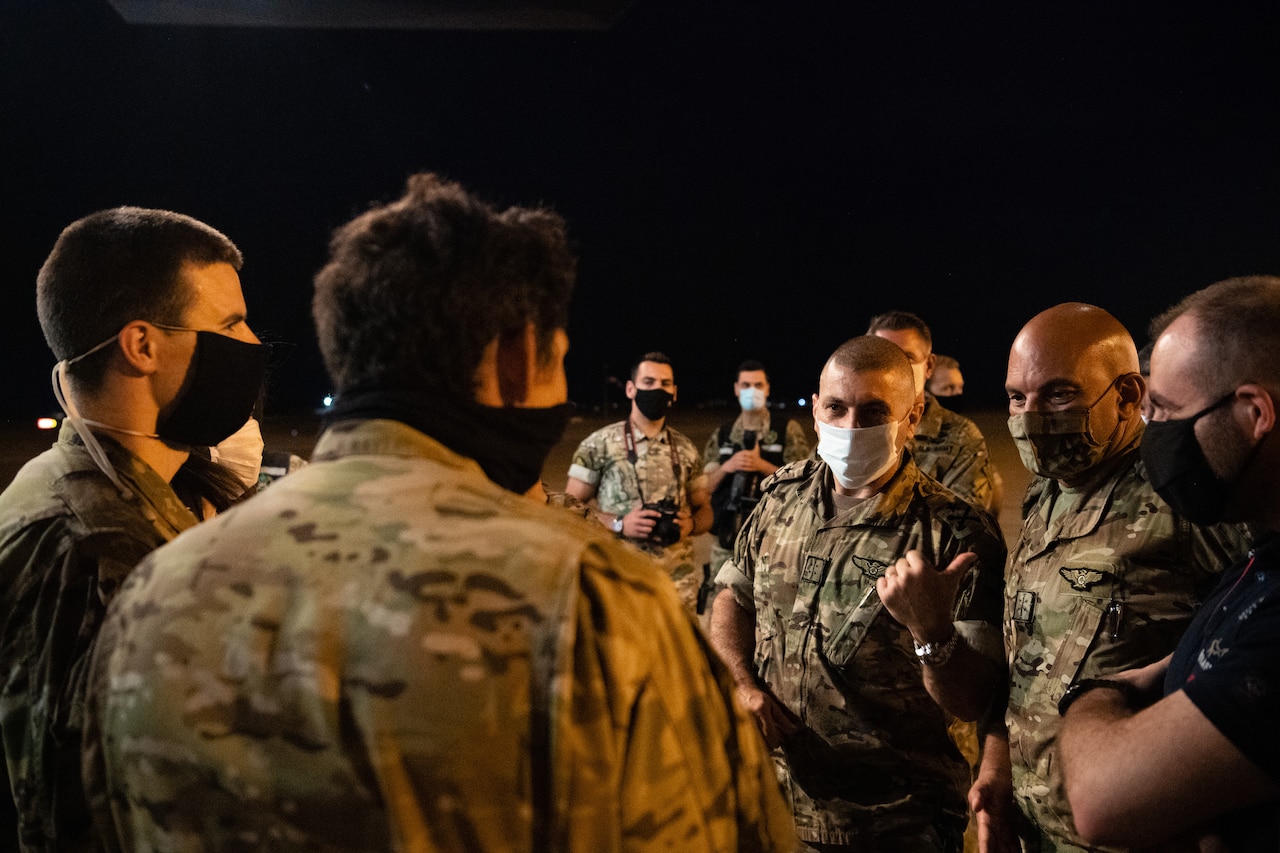
U.S., Lebanese officers speak.

The aid effort is further complicated by the COVID-19 pandemic. News reports out of Lebanon point to a higher infection rate there since the explosion. The blast leveled the country's main port. The docks, the equipment to load and unload cargo, and the channels were destroyed by the powerful blast, said Joe Catalino, a senior advisor in DOD’s policy office. "Now we will see the second- and third-order effects of this over time," he said. 

Normally, distributing the supplies or capabilities would end active U.S. efforts in a foreign country, but this is not a normal situation. "Once there is some form of stability, we would step back, normally," Catalino said. "But here, you still have a few hundred thousand displaced. The transportation infrastructure is destroyed and the health system impacted." 

Also, he noted, the Lebanese government has resigned, the Syrian civil war is going on next door, and there are a lot of concerns for the United States in the region. The DOD humanitarian assistance mission will shift to a transitional phase of U.S. government effort to support the people of Lebanon.

Keeping Watch


Seaman Daniel Campos stands optical sighting system watch in the combat information center as the guided missile destroyer USS Mustin conducts routine operations in the Taiwan Strait, Aug. 18, 2020.

Aerial Training


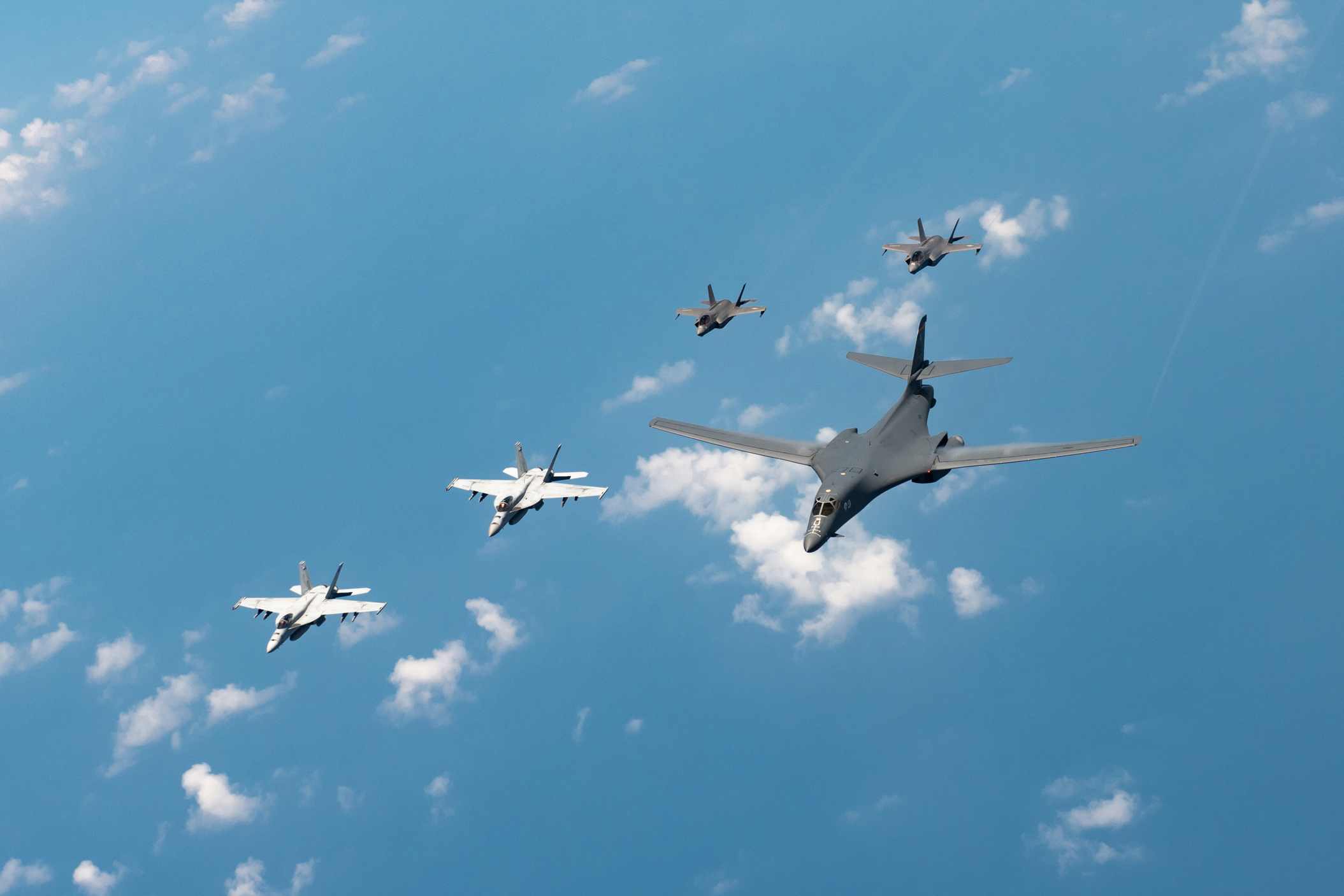
F/A-18 Super Hornets, F-35 Lightning IIs, and a B-1B Lancer conduct a large-scale joint and bilateral integration training exercise above the Indo-Pacific, Aug.18. 2020.

Flag Tradition


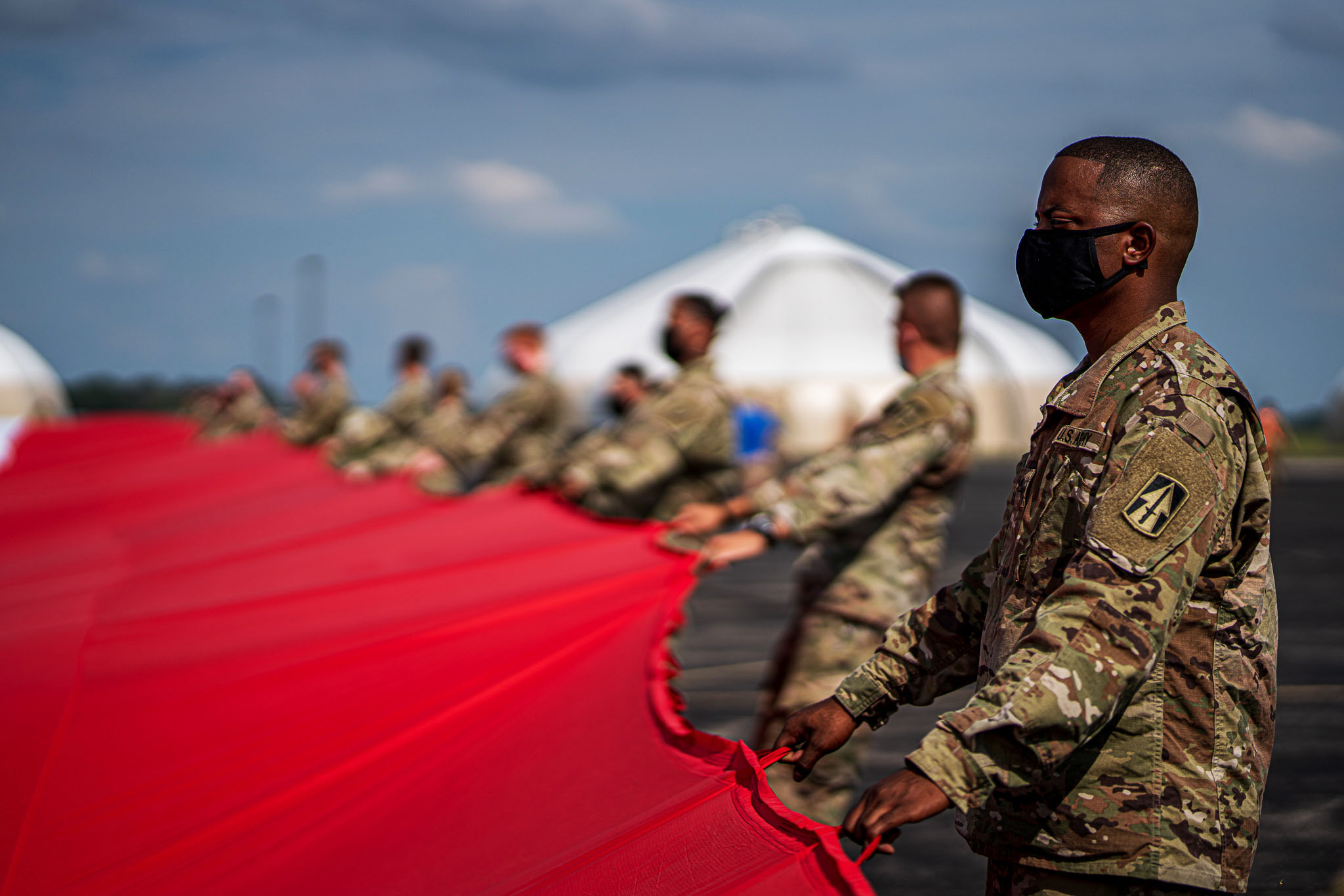
Indiana Guardsmen, donned in masks, came together to hold up a football field sized flag at the Shelbyville Aviation Flight Facility, Ind., Aug. 13, 2020. In the past, this tradition is performed live for the national anthem during Indianapolis Colts pregame ceremonies. However this year, guardsmen participated in a prerecorded version to keep the tradition alive but in a safe, responsible manner.

K-9 Class


Air Force Staff Sgt. Jason Taylor and military working dog, Ben, train at Aviano Air Base, Italy, Aug. 18, 2020.

Marine Makeup


Marine Corps Lance Cpl. Matthew D. Tyler applies camouflage paint during training at Camp Lejeune, N.C., Aug. 18, 2020.

Seahawk Sailors


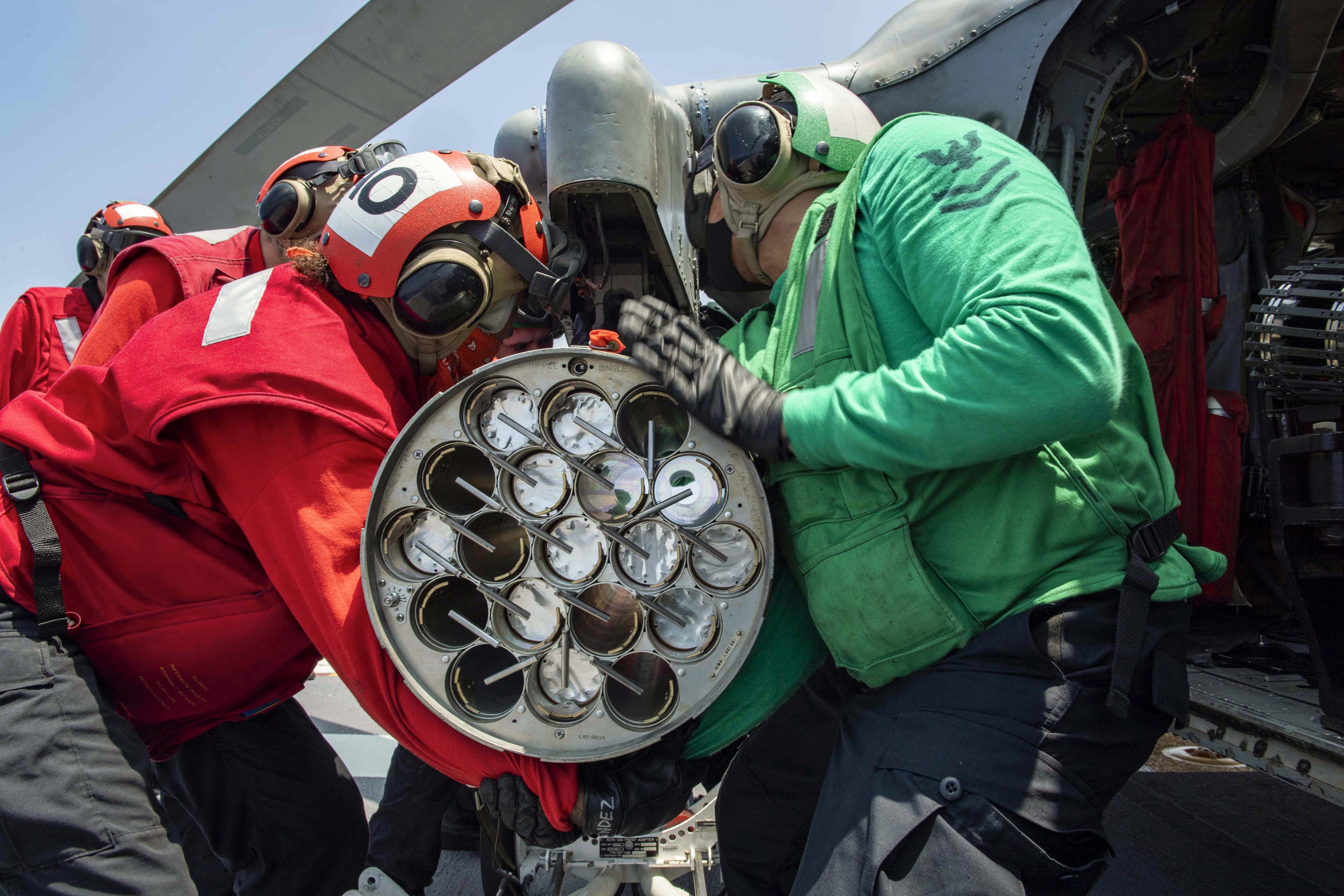
Sailors load missiles onto a Navy MH-60S Seahawk helicopter on the flight deck of the USS America in preparation for a live-fire exercise in the Phillipine Sea, Aug. 16, 2020.

DOD Continues Sexual Assault Support Services Amid COVID-19 Pandemic

 Aug. 19, 2020


The Department of Defense (DOD) announced that help for sexual assault survivors has not diminished during the National Emergency declared due to the COVID-19 pandemic.

Once DOD put Force Health Protection measures in place, victim assistance professionals quickly shifted to telephone support, ensuring survivors received uninterrupted timely, professional, and quality assistance.

“The COVID-19 pandemic has changed all of our lives. However, one thing that hasn’t changed is our commitment to helping our warriors and their families who may be seeking assistance with an experience of sexual assault,” said Dr. Nate Galbreath, acting director of the Sexual Assault Prevention and Response Office (SAPRO). “We want to assure everyone in the DOD community that we are still here to support them on their healing journey.” 

Continued Support
First Responders
Service members and adult dependents who have been victims of sexual assault still have access to the services of a sexual assault response coordinator (SARC) or sexual assault prevention and response (SAPR) victim advocates who can help them report the assault, and hold their alleged offenders appropriately accountable. 

When any Service member or adult dependent reports a sexual assault, the SARC addresses the victim’s immediate safety needs, connects the victim to recovery-oriented resources, and assigns a SAPR victim advocate.

The SAPR victim advocate provides advocacy and assistance throughout the medical, investigative, and legal processes, as appropriate. Upon determining eligibility, SAPR victim advocates will inform the victim of his or her option to make a Restricted or Unrestricted report.  Those making a Restricted Report may also consider providing information to the Catch a Serial Offender (CATCH) program.

Special Victims Counsel (Army and Air Force) and Victims Legal Counsel (Navy and Marine Corps), chaplains, and healthcare providers also continue to be available. To find out how to connect with these providers, contact your local SARC and SAPR victim advocates through the DOD Safe Helpline at https://www.safehelpline.org/nearme or 877-995-5247. 

DOD Safe Helpline
The DOD Safe Helpline is a hotline dedicated to members of the DOD community affected by sexual assault. Safe Helpline offers completely anonymous, confidential, 24/7 support available online at www.safehelpline.org or by calling 877-995-5247. In addition, the Safe Helpline Mobile App provides access to one-on-one support, peer-to-peer support, information, resources and access to self-care exercises 24/7, worldwide, on a mobile device. Safe Helpline personnel can provide crisis intervention support and – with their robust and verified database of resources across the nation -- refer members to care resources within their local community or to the closest SARC or SAPR victim advocate.

What is New
Electronic Forms
If SAPR personnel are unable to meet with a Service member in person due to COVID-19 restrictions, the SARC of SAPR victim advocate can explain the DD Form 2910, or “Victim Preference Statement,” and get the member’s verbal approval over the phone, as well as accept electronic signatures. 

Up-to-Date Knowledge of SAFE Possibilities
In an effort to mitigate to any impacts the pandemic has had on the administration of  Sexual Assault Forensic Examinations (SAFEs), SARC and SAPR victim advocates worked with their SAFE providers to update response procedures. Individuals seeking a SAFE should telephone their installation SARC/SAPR victim advocate in advance for instructions on where and how to present for medical care. Service members experiencing injury, requiring immediate medical attention, should not delay in seeking assistance at an emergency room.

More Frequent Check-Ins
Travel Restrictions and Stay at Home Orders necessary to limit the spread of the pandemic may exacerbate stress for some, including Service members who now may be unable to move to their new duty stations. SARCs and SAPR victim advocates can check in with members more frequently (particularly if the member requests) or reinitiate contact with them (as circumstances indicate) to identify any safety issues or concerns. 

Up-to-Date Info on Resource Access Amid COVID
As travel restrictions and Stay at Home orders begin to ease, installation commanders will have the authority to adjust restrictions based on local Health Protection Condition Levels. It is important to contact a local SARC/SAPR victim advocate to obtain the most current information. To find out how to connect with your local SARC and SAPR victim advocates, please contact the DOD Safe Helpline at https://www.safehelpline.org/nearme or 877-995-5247. 
Target Training


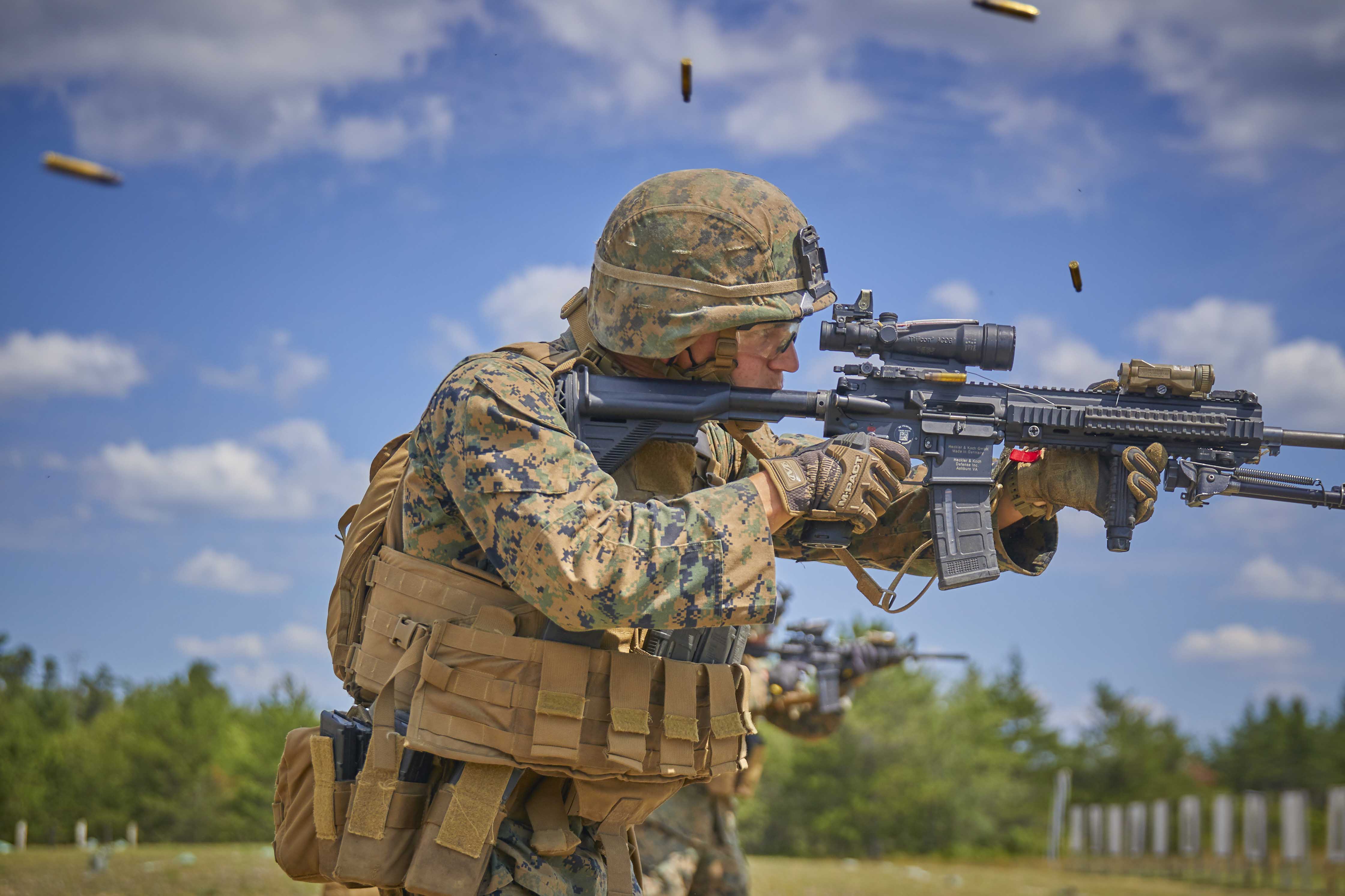
Marine Corps Lance Cpl. Logan Andre fires an M27 infantry automatic rifle at a target during training at Camp Grayling, Mich., Aug. 14, 2020.

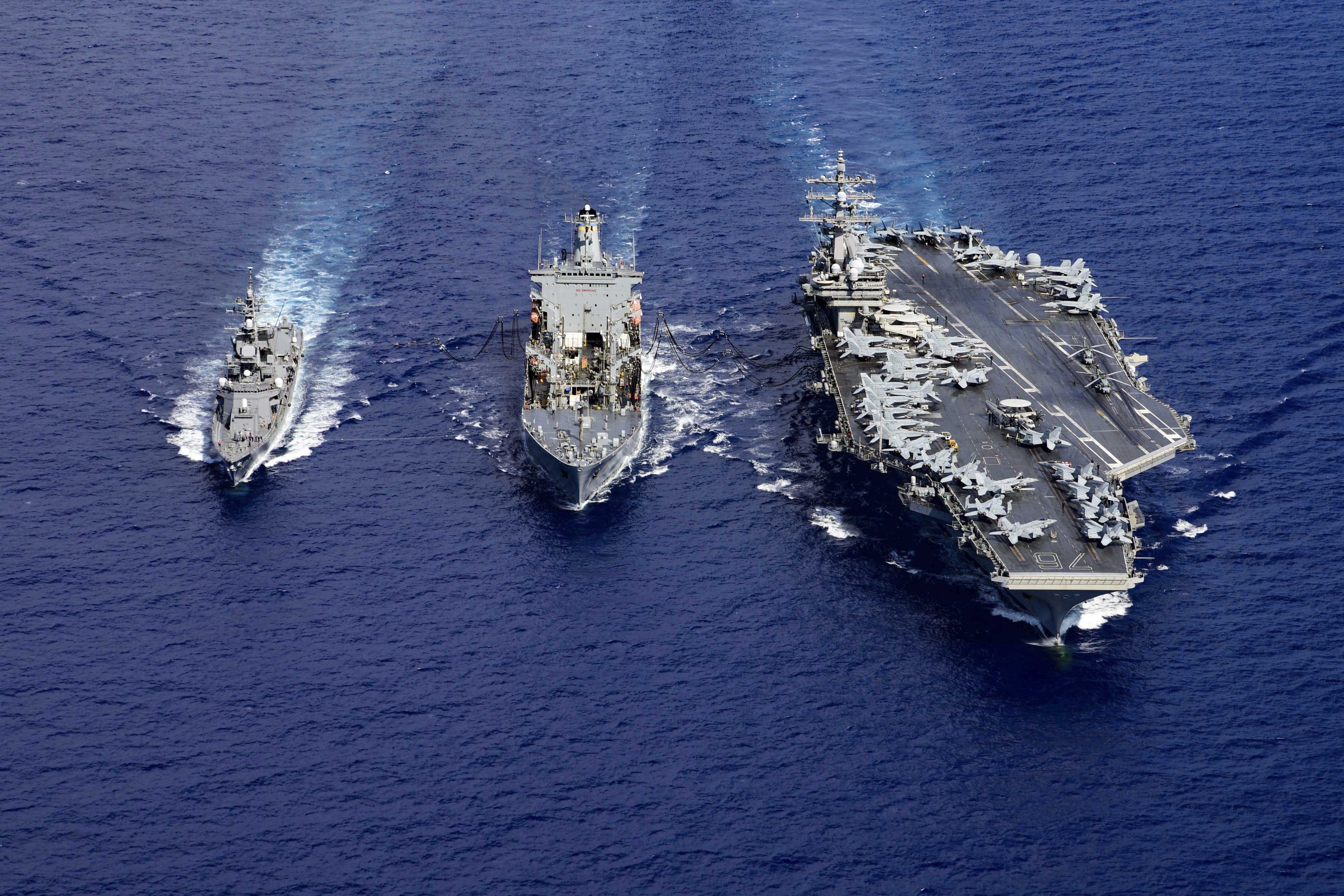
Replenishment Trio


The USNS John Ericsson and the USS Ronald Reagan sail in formation with the Japanese destroyer JS Ikazuchi during a replenishment in the Philippine Sea, Aug. 16, 2020.

Florida Formation

The Blue Angels, the Navy’s flight demonstration squadron, fly with the team’s new C-130J Super Hercules over Naval Air Station Pensacola, Fla., Aug. 17, 2020. The Blue Angels’ previous C-130 “T” model served the team fo

Fierce Fire


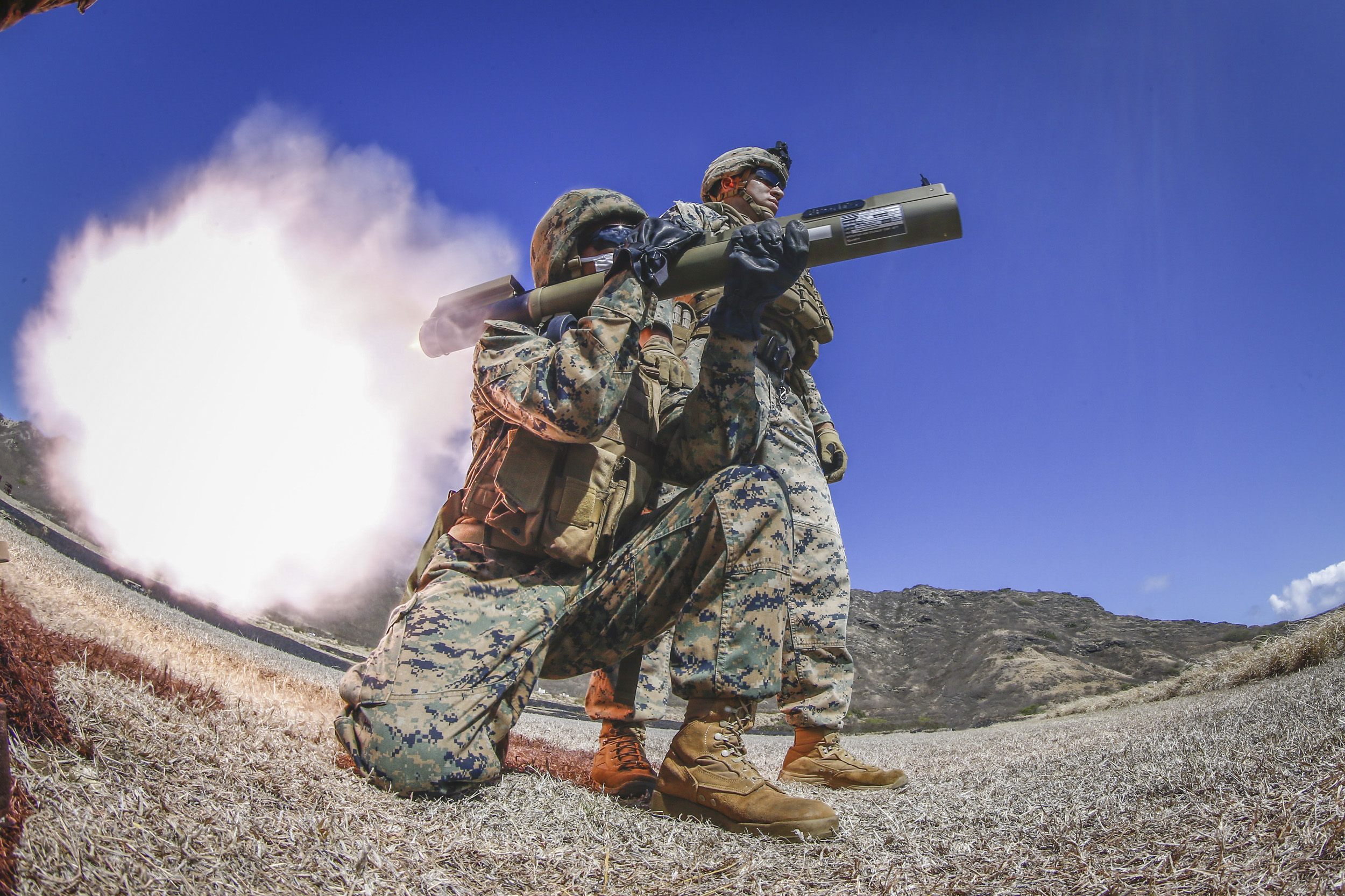
A Marine fires an M72 light anti-tank weapon during training at Marine Corps Base Hawaii, Aug. 13, 2020.

Strip Explosive


Marines use an interior training strip explosive during training at Camp Hansen in Okinawa, Japan, Aug. 12, 2020.

Readout of Secretary of Defense Dr. Mark T. Esper's Meeting with Minister of Defense of the Republic of Iraq Jumaah Saadoon

 Aug. 19, 2020


Chief Pentagon Spokesperson Jonathan Hoffman provided the following readout: 

Secretary of Defense Dr. Mark T. Esper hosted an enhanced Honor Cordon and Bilateral Meeting in Honor of His Excellency Jumaah Saadoon, the Minister of Defense of the Republic of Iraq, today.  The two leaders discussed the bilateral security partnership and the importance of continuing to build the capabilities of the Iraqi Security Forces, such that they are able to prevent the Islamic State of Iraq and Syria (ISIS) from ever re-emerging and threatening Iraq, the region or the broader international community.  Both leaders reaffirmed the continued cooperation between the Iraqi Security Forces and the US-led Global Coalition to Defeat ISIS and their commitment to the ultimate objective of a secure, stable and prosperous Iraq.

Secretary Esper Travels to Colorado Springs, Nevada and the Indo-Pacific Region

 Aug. 19, 2020


Tomorrow, Secretary of Defense Dr. Mark T. Esper will travel to Colorado Springs, Colorado, where he will attend the change of command ceremonies for United States Northern Command and United States Space Command. The next day, he will travel to Nevada to visit the Nellis Air Force Base test and training range and meet with U.S. Air Force personnel.

The following week, Secretary Esper will travel to the Indo-Pacific region, visiting Hawaii, Palau and Guam. On this trip he will conduct meetings with military leaders, local officials and foreign partners; visit with our forces deployed through the region; and participate in commemorative events marking the 75th Anniversary of the end of World War II. During this trip he will reinforce the United States’ vision for a free and open Indo-Pacific comprised of nations that adhere to the international rules-based order that was established 75 years ago in the wake of the allied victory in World War II.

Former Fort Riley Soldier Sentenced For Distributing Info on Napalm, IEDs

 TOPEKA, KAN. – A former Army soldier stationed at Fort Riley was sentenced today to 30 months in federal prison for distributing instructions for making explosives, U.S. Attorney Stephen McAllister said. After his prison time, the defendant will serve three years on supervised release.

Jarrett William Smith, 24, formerly of Ft. Riley, Kan., pleaded guilty to two counts of distributing information related to explosives, destructive devices and weapons of mass destruction.

Smith joined the Army June 12, 2017. He served as an infantry soldier and was trained in combat and tactical operations. He was transferred to Fort Riley in Kansas July 8, 2019.

The FBI received information that Smith used social media to give out guidance to others on how to construct improvised explosive devices. He spoke to others on social media about wanting to travel to Ukraine to fight with a violent, far-right military group.

On September 20, 2019, from Fort Riley Smith sent a person working undercover for the FBI specific instructions for making an explosive device. Smith also provided a recipe for creating improvised napalm.

McAllister commended the FBI and Assistant U.S. Attorney Tony Mattivi for their work on the case.