Friday, December 09, 2011

New Brace Salvages Limbs, Mobility, Morale

By Elaine Sanchez
American Forces Press Service

SAN ANTONIO  – A wounded warrior limped into Ryan Blanck’s office at the Center for the Intrepid here one day with a plea for help.

The doctors at San Antonio Military Medical Center had saved the service member’s leg after a combat injury, but due to the pain, he couldn’t walk comfortably, let alone run.

Blanck, a leading prosthetist at the state-of-the-art rehab center, found himself in an unfamiliar position: at a loss. “There wasn’t a go-to option,” he said, referring to devices for wounded warriors with lower leg injuries.

So Blanck created one. He designed the Intrepid Dynamic Exoskeletal Orthosis, or IDEO, a streamlined, energy-storing brace that delivers nearly instantaneous results. Now, most troops with salvaged limbs who wheel or limp into his office walk out a short time later, pain and limp-free.

The injured warriors are impressed by the results. When they strap on the brace for the first time and start walking, Blanck said, some stumble midway across the room, but not due to discomfort.

“They’re uncontrollably weeping,” he said. “It’s the first time they’ve walked without pain in two or three, or seven years in one guy’s case.”

Brace Proves to be ‘Game-Changer’

Blanck’s creation is a lightweight, streamlined carbon-fiber device that can be tucked under a pant leg and into a boot or sneaker. It comprises a cuff that wraps around the leg just under the knee connected to a footplate by carbon-fiber rods.

The brace works by offloading the limb and allowing the patient to operate the lower limb in a way that avoids pain, he explained. When a service member’s heel strikes, the device stores energy through the gait cycle, then delivers it back to propel the foot forward.

“That’s the concept behind it all; energy storage and power,” he said.

Prior to IDEO, Blanck noted, “there wasn’t a combination device that would allow offloading, adequate range restriction and then power generation.”

The device is proving a “game-changer” for service members with salvaged limbs, said Johnny Owens, a CFI physical therapist who is working hand-in-hand with Blanck in treating IDEO-fitted warriors. “We’re seeing immediate changes we don’t usually see,” he said.

Owens said the device also is singlehandedly helping to turn the tide on a trend of wounded warriors opting for delayed amputations -- amputations several months after injury. He attributes the trend to the slow, and sometimes frustrating, recovery for troops with lower leg injuries.

“Prior to all this, limb salvage was a little bit of an unknown,” Blanck explained. “You couldn’t tell a patient, ‘you’re going to run.’”

But amputees -- depending on the situation and barring other injuries -- can regain significant functions about six months after amputation, he noted. Meanwhile, limb salvage patients sit on the sidelines watching their amputee battle buddies walking or running as their own progress proceeds painfully slow.

Frustrated by their limitations, some troops with salvaged limbs opted for late amputations.

“It’s enticing,” Owens said. “You’re in pain, but if you cut your leg off, you can run. Many invested a year or two in recovery and then decided to cut [a limb] off. It was psychologically frustrating to see these guys work so hard and then just cut it off.”

Thanks to IDEO, these troops now have another option, he said, that enables them to not only walk, but run, sprint and jump.

Returning to Service

Word is spreading of IDEO and its astounding results, and Blanck now is fitting troops from around the country with his device. After hearing of Blanck’s and Owens’ success, Army 1st Lt. Matthew Anderson traveled here from his unit at Fort Carson, Colo., hoping for similar results.

Anderson, an infantry platoon leader, was injured in October 2010 while on a dismounted combat patrol in Kandahar, Afghanistan. As his unit cleared a building, he stepped on a landmine. “It felt like a jackhammer hitting my ankle,” he recalled. The explosive shattered his heel into a dozen pieces.

The doctors salvaged his limb, but the injury left Anderson in pain and with a pronounced limp. While he was able to start walking again after about six months, this strapping, lifelong athlete figured his running days were over.

It took Blanck just a few minutes to prove him wrong. With the IDEO, Anderson was walking comfortably within minutes and running within days.

“It put the biggest smile on my face,” the infantry platoon leader said. He had stopped by the CFI early one morning so Blanck could make adjustments to his device and fit him for another.

“I went from walking with a severe gait issue and a limp to walking normally,” Anderson said.

Blanck finished his adjustments, and Anderson pulled a sneaker over the foot plate and walked across the office with a smooth stride.

Once he got the brace, “I could run on it, jump vertically, laterally shuffle,” Anderson said. “Things that there’s no way I’d be doing with that much speed, efficiency or lack of pain.

“For a guy that’s in his late 20s that’s always been a jock athlete, being hampered by these injuries is pretty tough mentally,” he continued. “When you’re given the option to get back into it, it’s huge; it means a lot to me.”

Anderson soon will return to duty at Fort Carson. Of the nearly 200 cases they’ve seen, Owens noted, more than 30 have returned to service and 11 have combat deployed.

As they test and improve the current design, Blanck and Owens also are looking into what they call a “widespread potential” for people with issues such as ankle arthritis, strokes and head, back and other injuries.

The program’s success has one limitation: space. Between amputees and warriors with salvaged limbs, the CFI can get crowded at times. The pair would like to see a rehab center like the CFI, but devoted to wounded warriors with salvaged limbs. There would be no shortage of demand, Owens said, noting that for every one amputee, there are about 10 limb salvage patients.

Meanwhile, they have no plans to cut back, no matter how great the demand. Just seeing the joy in a wounded warrior’s face at walking again pain-free, they said, makes every extra hour at work worthwhile.

“I never thought I’d come to work and get hugged by a 220-pound, 6-foot-4, Special Forces guy,” said Blanck with a smile, “but I’ve had a few hugs.

“I loved my job before this, but this is a whole new level.”

Dempsey Accepts USO Award on Behalf of Military Members

By Donna Miles
American Forces Press Service

NEW YORK  – Last night turned out to be a family affair for Army Gen. Martin E. Dempsey as he accepted the USO’s Distinguished Service award on behalf of 2.2 million men and women in uniform, along with his wife, Deanie, who he said has served alongside him for the past 35 years.

The chairman of the Joint Chiefs of Staff was honored here at the 50th USO Armed Forces Gala, where he and Albert P. Carey, CEO of PepsiCo American Beverages, received the USO’s award for service in support of the armed forces.

Lance B. Boxer, chairman of the board for the USO of Metropolitan New York, saluted Dempsey and Carey for earning the prestigious award. “Their outstanding service to our country epitomizes the standard of selfless commitment to others we seek to live by each day,” he said.

Introduced by his son, Army Capt. Christopher Dempsey, a history instructor at the U.S. Military Academy, the chairman expressed pride in his family’s military tradition. All three Dempsey children followed their father into Army service. Dempsey also praised his wife for the key role she has played in helping military families deal with challenging times and become stronger as a result.

Last night’s USO gala proved to be a special treat for Dempsey, who got his first opportunity to meet his month-old granddaughter. “I can’t think of a better place to meet her,” he told the group. Pausing, he added with a laugh, “I hope it makes it into the baby book.”

Turning serious, Dempsey recognized the USO’s establishment 70 years ago and its continued support to the military through many milestones, including the Pearl Harbor attack 70 years ago, Operation Desert Shield and Desert Storm 20 years ago, and the 9/11 attacks 10 years ago.

He noted the USO support he and his family have experienced during his career and thanked the organization and its legion of volunteers for their work that benefits all military members and their families. “Keep it up, and thanks for doing it, because it does make a difference,” he said.

Dempsey noted the demands U.S. service members are facing around the world, many of them far from their loved ones and in harm’s way, working to protect the United States and its interests.

Looking to the future, he said he doesn’t expect that requirement to go away.

“We should probably expect to be challenged because of what we stand for, because of who we are,” he said. “We stand for what’s right. And as we stand for what’s right, those that don’t stand for the same things as us will often challenge us. And when we are challenged, we will respond.”

With that response, Dempsey said Americans will strive, in the words of Will Rogers, “to leave the woodpile a little higher than we found it.”

Dempsey said he’s proud of the entire military team -- troops on the ground, carrier battle groups at sea with their embarked Marine expeditionary units, tactical air squadrons, logisticians maintaining and sustaining the force -- who exemplify Will Rogers’ standard.

“It’s a remarkable enterprise, and I couldn’t be more proud to be a part of it, and I couldn’t be more proud of all the services for what they do,” he said. “So I am honored to accept this award on their behalf.”

While acknowledging that he doesn’t know what the future holds, Dempsey said he’s confident that America’s military members will be up to anything that’s asked of them.

“Whatever is next, that group of young men and women … they are out there, and we’ll be OK,” he said.

Transition Benefits: OCHR Launches Civilian Careers Campaign

By Mass Communication Specialist 3rd Class (SW) Mikelle D. Smith, Defense Media Activity - Navy

WASHINGTON (NNS) -- The Department of the Navy's (DoN) Office of Civilian Human Resources (OCHR) held a leadership conference at the Admiral Gooding Center on board Washington Navy Yard, Dec. 8.

Assistant Secretary of the Navy (Manpower and Reserve Affairs) Juan M. Garcia III., a speaker at the event, announced DoN's official launch of the new Civilian Careers campaign.

The campaign, developed as a response after OCHR recognized the changing environments that currently exist in the DoN, will address and modernize tools and processes in recruiting non-military personnel and veterans to the civilian component of the Navy.

"The Department of the Navy is one of the largest most complex organizations in the world," said Garcia. "We need the best talent we can get, so we go from corner to corner in the country searching for the best of the best ... if they have the desire to serve we can use their talents."

During the event, Garcia touched on a variety of discussion topics, including Enlisted Retention Boards (ERB), Perform-to-Serve (PTS), and Selective Early Retirement Boards (SERB).

"With an unprecedented level of retention [in the Navy] we had to make some very tough decisions," said Garcia. "We had to ask a lot of great Americans and exceptional Sailors to leave the active component. But, it is important to know that over 50 percent of our civilian teammates are veterans, and we need more of those folks to go from shipmates to workmates."

Former Sailor and Civilian Careers spokesperson Connie Vitiello, said she decided to rejoin the ranks of the military when she applied for a position with the Marine Corps.

"The sense of urgency and pride that I felt while I was in the Navy was my motivation for pursuing a civilian career with the military," said Vitiello. "In the Navy I valued the camaraderie and the work ethic that I found while I served ... I found what I was looking for when I realized I could still feel that and support the active duty military while continuing to be with my family."

A web site has been setup to help encourage Sailors who may be affected by ERB, PTS and SERB to consider continuing their service to country in the civilian sector of the DoN. Visit the site at http://www.public.navy.mil/donhr/Employment/Vets/Pages/Default.aspx.

"We hope the Sailors we had to ask to leave active duty will consider bringing those talents and training they received in the Navy over to the civilian side," said Garcia. "If we [the Navy] are going to ask the private sector to hire our Sailors it only makes sense that we lead from the front and transition those individuals that want to stay Navy to our civilian services."

George H.W. Bush CSG Homecoming Goes Social: Streamed Live on Internet

From U.S. Fleet Forces Public Affairs

NORFOLK (NNS) -- When the nearly 6,000 Sailors of the George H.W. Bush Carrier Strike Group (GHWB CSG) return from a seven month deployment to their homeport of Norfolk Dec. 10, Navy friends and families will be able to see it live on the internet.

To enhance the homecoming experience, the Navy is using social media to allow individuals to participate virtually, while encouraging those present to share their experience from the pier.

Navy family, friends and fans may view the homecoming of USS George H.W. Bush live via the U.S. Navy Facebook page (www.facebook.com/usnavy) or on the Navy Livestream channel directly at http://www.livestream.com/usnavy on Saturday beginning at 10 am EST.

Livestream is a web based platform that the Navy and other government agencies use for real time audience engagement by streaming live video and chat over their social media properties. The Navy has found this type of technology useful in sharing events and experiences predominantly located near the coast with interested viewers who are unable to attend in person.

A Foursquare event entitled "George H.W. Bush Carrier Strike Group Homecoming" has also been created for in-person attendees to "check-in" to. Foursquare, is a location-based social networking site for mobile devices where users "check-in" at events or venues by selecting from a list the program locates nearby. The Navy intends to use this type of engagement platform for fleet events like deployments and homecomings as well as community outreach events like Navy and Fleet Weeks during its upcoming bicentennial commemoration of the War of 1812.

The homecoming, as well as the seven-month deployment supporting operations with the U.S. Navy's 5th and 6th Fleets, will be highlighted and discussed on Navy and command specific Facebook and Twitter accounts as well. The Twitter hashtag for this event will be #GHWBCSG.

Thursday, December 08, 2011

Face of Defense: Grandson Carries on Grandfather’s Service

By Stefan Bocchino
377th Air Base Wing

KIRTLAND AIR FORCE BASE, N.M.  – Air Force Col. Paul W. Tibbets IV, the Air Force Inspection Agency’s commander, is the grandson of retired Brig. Gen. Paul W. Tibbets Jr., the pilot in command of the "Enola Gay" when it dropped the atomic bomb on Hiroshima, Japan, on Aug. 6, 1945.

Tibbets said that while growing up he was aware of his grandfather’s World War II accomplishments. His father spent a 30-year career in the Army reserve as a pharmacist and hospital administrator, he said, retiring as a colonel.

"My father had the biggest influence on me joining the Air Force," Tibbets said. "When I was in 9th grade, I became involved in youth service projects. It was a passion of mine to serve. My father said ‘You seem to be very interested in serving -- what do you want to do with your life?' I told him I was interested in serving, and he told me to look into something like the ROTC or service academies."

Tibbets applied to the service academies and was accepted to the Air Force Academy, where he spent four years.

"The time that I spent with my grandfather was very limited growing up," Tibbets said. "It was an honor being a Tibbets, and I will always consider him a hero. The last time I saw him before leaving for the Air Force Academy, he told me, 'Paul, just remember, people are going to know you because of who I am. You be who you are and don't worry about who I was.' What I found out later was that he was really concerned his service would somehow have a negative effect on my career. I took his advice to heart the best I could."

Tibbets said he was interested in flying at the academy. Following graduation, he was selected to attend pilot training.

"There was no favoritism when I was chosen for bombers," Tibbets said, who has been in the Air Force for 22 years. "The Air Force can't afford to put someone in a job for which they're not qualified. I was told that it wasn't because of who I was, but because it was the best fit."

During World War II, General Tibbets flew B-17s in Europe. Later in the war, he returned to the United States to test-fly the B-29 Superfortress. He was selected to command the 509th Composite Group that was connected to the Manhattan Project. On Aug. 6, 1945, he flew a B-29, which he dubbed “Enola Gay” after his mother's name, during the bombing of Hiroshima.

"Even though there was controversy over the bombings of Hiroshima and Nagasaki, my grandfather said he never lost one minute of sleep," Tibbets said. "He emphasized that, 'My country asked me to do something, and I set forth with the men in the 509th Composite Group to accomplish it to the best of our ability, and it helped bring the war to an end.' It is interesting being a senior officer now and thinking about the challenges those men went through. They never lost focus on the mission they were to carry out, and they did it beautifully."

Tibbets was previously assigned to the 509th Bomb Wing at Whiteman Air Force Base, Mo. That was the same unit his grandfather commanded during the bombing of Hiroshima.
 
"I competed to go to the 509th and was selected," the colonel said. "It was quite an honor to be in that organization. It's a highly skilled, highly capable organization with a very unique mission. Later, I was selected to command."
 
He commanded the 393rd Bomb Squadron, an operational squadron of B-2 “Spirit” aircraft at Whiteman, within the same wing his grandfather commanded.
 
"The wing commander made the decision that commanding the unit was where my skills were needed," Tibbets said. "It was one of those opportunities that the Air Force has given me, to command an operational squadron, and I'm obviously honored and thrilled to be a part of something like that. You add on that it was my grandfather's squadron and it meant just the world to me. Just as my grandfather did, I was focused on serving those entrusted to my command to the best of my ability. I thought, 'I won't let them down, I can't let my grandfather down, and I don't want to let my Air Force down.'"
 
General Tibbets died in Columbus, Ohio, on Nov. 1, 2007, at 92.
 
"It is a real privilege to serve our great nation, being part of something bigger than ourselves," said Colonel Tibbets, who took command of AFIA in July. "I am so proud of all our airmen and joint partners, who are a very small percentage of all Americans who are wearing the uniform and defending freedom. I love it."
 
(EDITOR’S NOTE: This feature is part of the "Through Airmen's Eyes" series on AF.mil. These stories and commentaries focus on a single airman, highlighting their Air Force story.)

Canadian Army

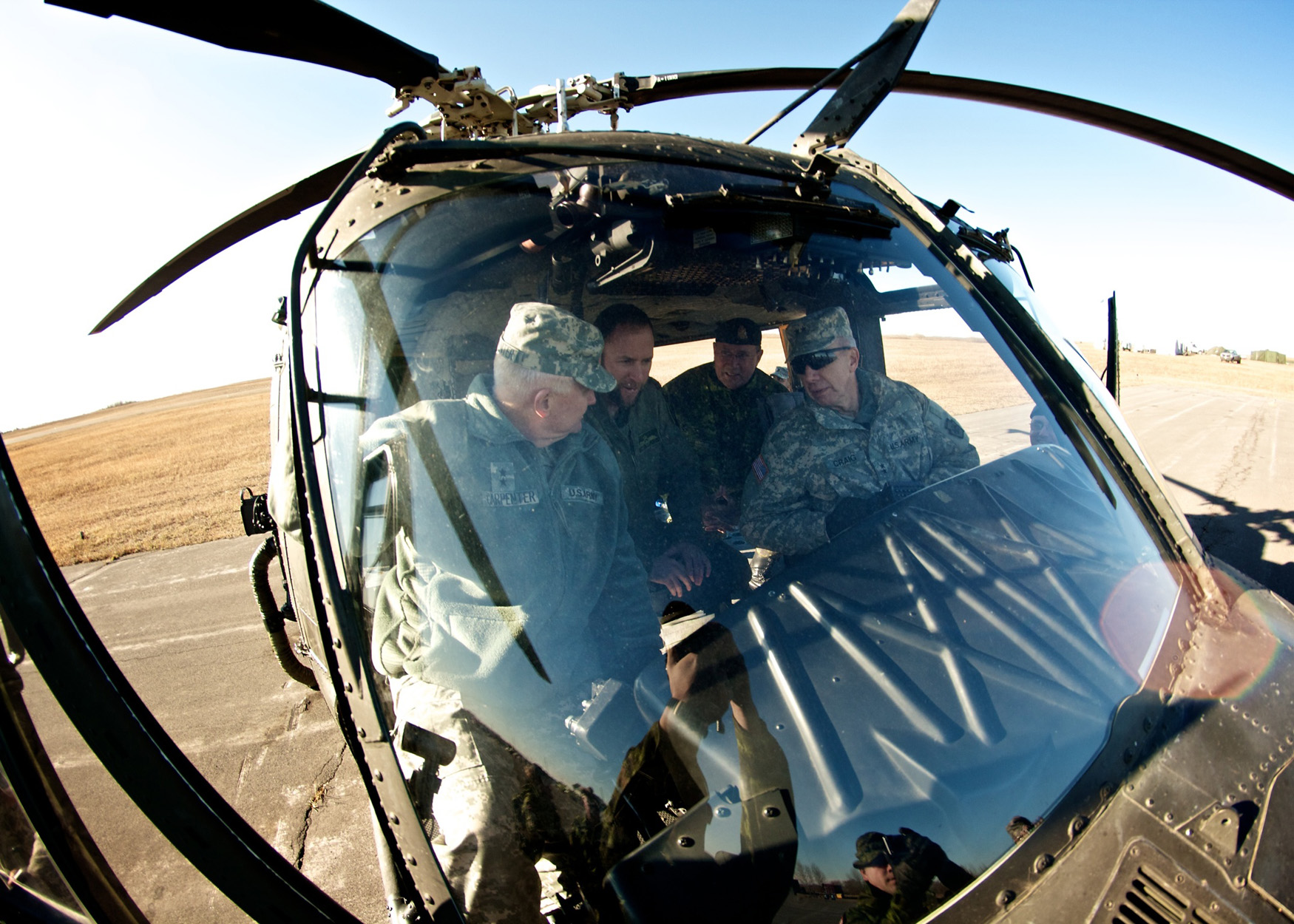
Canadian army pilot gives tour of helicopter
The pilot of a Canadian CH-146 “Griffon” orients Army Maj. Gen. Raymond Carpenter, acting director of the Army National Guard, and Maj. Gen. Wesley Craig Jr., the adjutant general of the Pennsylvania National Guard during Exercise Maple Resolve in October 2011. (Canadian army photo by 2nd Lt. Javin Lau)

CH-47F Chinook crew prepare for night operations
A CH-47F Chinook helicopter crew with the Pennsylvania Army National Guard’s B Company, 2nd of the 104th General Support Aviation Battalion prepares for night operations during Exercise Maple Reserve in October 2011. The Pennsylvania National Guard, due to its assets and proximity to the Canadian border, were called on to help the Canadian army with pre-deployment training requirements. (Canadian army photo by 2nd Lt. Javin Lau)

Wreath Laying at Lone Sailor Held in Remembrance of Pearl Harbor

By Mass Communication Specialist 3rd Class Shannon Burns, Defense Media Activity

WASHINGTON (NNS) -- Naval District Washington hosted a wreath laying ceremony at the U.S. Navy Memorial in Washington, D.C., Dec. 7, to commemorate the 70th anniversary of the attack on Pearl Harbor.

Among those in attendance were Pearl Harbor survivors and their family members as well as retired Rear Admiral Edward K. Walker Jr. At the time of the attacks Walker was just nine years old and stationed with his family at Pearl Harbor. At the time Walkers' father was a Lt. Cmdr. as the operations officer of a staff command. Walker said he remembers watching the smoke rise.

"I climbed up on the roof of our house and from there I could see the smoke. I was close enough that I could feel the concussions from the bombs, that went on for about an hour," said Walker. "Then the second wave came in. The planes flew over the mountain behind our house and on into Pearl Harbor."

Walker said he was honored to be a part of the wreath laying and that it was very personal to him.

"I'm very emotionally involved in the wreath laying," Walker said. "I served 38 years in the Navy and my father served 33.

Walker also said that remembering Pearl Harbor is important for several reasons.

"Most important is remembering the sacrifices, dedication and courage of the nearly 2,400 people who lost their lives that day," said Walker. "Pearl Harbor teaches us that we as military people must always be prepared to meet an enemy capability."

Walker invited retirees to come and enjoy the Navy Memorial.

"I want to ask all of the Navy, Marine Corps, and Coast Guard veterans to please visit your Navy Memorial," said Walker. "You helped build it, you help keep it running. This memorial represents you, your dedication, your sacrifices, and your courage."

Following the wreath laying a panel discussion was held in the Navy Memorial Historical Society with Pearl Harbor survivors sharing their memories of that day.

Wednesday, December 07, 2011

Message to Pearl Harbor Survivors

As Delivered by Secretary of Defense Leon E. Panetta

Seventy years ago on a December morning, our nation sustained a cruel and destructive attack at Pearl Harbor.  Our enemies thought that by this sudden and deliberate raid, they could weaken America.  Instead, they only strengthened it.  That day truly awoke a sleeping giant.

As we join you in remembering the events of December 7, 1941, we honor you and your fallen comrades for your indomitable will – and we remember the sacrifice and shared purpose of the American people, as well as the strength of our elected and military leaders during the war.

December 7, 1941 was indeed a day that will live in infamy.  But in the memories of that day we continue to draw determination and conviction to protect our freedoms, to sacrifice for our fellow citizens, and to serve a purpose larger than self.  You, the survivors of Pearl Harbor and of the war that followed, embody this conviction, this determination to raise high the torch of freedom and sacrifice.  From your stories, posterity records for all subsequent generations the emotion, the heroism, and the tragedy of a harrowing attack and the titanic struggle that would later unfold.

As a young boy, I remember seeing troops move through Fort Ord during the war years in Monterey, California.  My parents would invite soldiers into our home for Christmas dinner, and I remember seeing young men from all over the country about to go to war.  And I remember thinking in that uncertain time: “This is going to be the last opportunity these young men have to enjoy the comforts of home for a long time.”

You are the veterans of that greatest generation.  You have lived full lives and witnessed years of great prosperity because of the freedom you helped to secure for America and her allies.  I know you take great pride, as I do, that your legacy lives on in today’s men and women in uniform, who have borne the burden of a decade of war, and who are truly this nation’s next greatest generation.  The 9/11 generation, like you, has stepped forward in your image of service and sacrifice, volunteering for military duty after another sudden and terrible attack on our shores.

We treasure you.  You have brought everlasting credit to your fallen comrades.  The men and women in today’s military stand on the shoulders of your individual and combined sacrifice and service to our nation.  Your example inspires those in uniform today, strengthens our nation’s moral fiber, and proves that with united resolve our country can surmount any challenge.  Thank you for your service, for your sacrifice, and for your endless zeal to see to it that our children and grandchildren can pass along a better life to the next generation.  This has always been the American dream, a dream we can realize because of the determination of our citizens to defend it.

God bless you, God bless our troops, and God bless the United States of America.

Officials Announce Absentee Voting Guidelines

Federal Voting Assistance Program News Release
 
WASHINGTON, Dec. 7, 2011 – The Federal Voting Assistance Program and the Military Postal Service Agency yesterday announced absentee ballot mailing date guidelines that apply to various overseas locations.
 
Military members serving overseas and other U.S. citizens living abroad must consider mail transit times when submitting their absentee ballots to vote in upcoming presidential, Senate, House, gubernatorial, state legislature, local and other elections.
 
The 2012 U.S. presidential election, for example, will be held Nov. 6, 2012.
 
Officials recommend that absentee voters sending ballots from the following countries mail them out no later than:
 
-- Iraq: 22 days before the election;
 
-- Afghanistan (excluding air stop locations), Egypt, Kyrgyzstan, Oman and Turkmenistan: 17 days before the election;
 
-- Germany: 11 days before the election;
 
-- Afghanistan air stop locations, Bahrain, Cuba, Kuwait, Qatar, Saudi Arabia, United Arab Emirates: 10 days before the election; and
 
-- Japan, Korea and the Philippines: seven days before the election.
 
For a full list of absentee ballot mailing dates for overseas locations, visit www.FVAP.gov.
 
Military members serving overseas may express mail their absentee ballots free of charge from any APO/FPO/DPO or American embassy and consulate -- ask to use the Express Mail Label 11-DoD. This label allows voters to track their ballots at www.usps.com.
 
The federal write-in absentee ballot is used as a backup ballot. Thirty days prior to an election, if voters believe they’ll not receive their state ballot in time to vote and return it, they can vote using the FWAB. This ballot is accepted by all states from any overseas or military voter who has registered and requested a ballot for 2012.

Face of Defense: Airman Saves Musical Treasure

By Air Force Capt. Amy Hansen
Air Force News Service

WAKE ISLAND AIRFIELD, Wake Island, Dec. 6, 2011 – In a tale straight from an adventure book, contractors on this tiny Pacific island recently stumbled upon a vinyl record collection with an estimated value between $90,000 and $250,000.

The 611th Air Support Group's Detachment 1 is making a comprehensive effort to preserve the nearly 9,000 vintage vinyl records and ship them to their rightful owner, the American Forces Radio and Television Service in Alexandria, Va., according to Master Sgt. Jean-Guy Fleury, the detachment's infrastructure superintendent, who took over the project from the former Detachment 1 commander, Maj. Aaron Wilt.

No digging was required to access this treasure, as the records were cataloged and neatly organized on shelves in a small room on the second floor of the airfield’s base operations building. The door was conspicuously stenciled with the name of a radio station, KEAD, and a "Restricted Area Warning" sign, which kept most people out.

"That's a locked room, normally, but people in my department have known the records were there for years," said Colin Bradley, the communications superintendent with Chugach Federal Solutions Inc. CFSI is the contractor that manages operations on Wake Island with the oversight of Air Force quality assurance personnel.

"Because of the completeness of the collection, I assumed it was quite valuable," Bradley said. "I have not run across a collection that well preserved or that intact in my career. It's a little time capsule."

The collection includes a variety of vinyl albums and records specially made for military audiences, as well as some commercially available records.

"In 1942, the American Forces Radio Service was starting to get American music out to the troops overseas," said Larry Sichter, the American Forces Network Broadcast Center’s affiliate relations division chief. "Some of the radio productions were original, like GI Jill and Command Performance, and have significant value."

The exact operational dates of the low-powered AM station on Wake Island remain unclear, but Bradley shared his estimate.

"I would guess that [KEAD] started in the ’60s, due to the dates on the records," he said.

According to a 2007 Internet entry by Patrick Minoughan, who was stationed on Wake Island from 1963 to 1964, KEAD was operating in 1963.

"On the second floor of the then-new terminal building was a very small AFRTS radio station," Minoughan wrote. "AFRTS had no personnel there, but sent in monthly shipments of music. While I was there, one of the communications guys named Steve Navarro would do a daily show for a couple of hours. When it was unattended, anyone could go in and play the records, which were broadcast on the island."

AFRTS was able to get permission to use the work of many artists, and later actors, for free, Sichter said. Therefore, the records were copyrighted and only to be used for their official purpose of entertaining the troops overseas, and then returned to AFRTS.

Since Wake Island Airfield is on a 1,821-acre atoll located about 2,000 miles west of Hawaii and 2,000 miles east of Japan, it is possible that the cost and logistics of returning the records to the mainland were prohibitive when the radio station was shut down, officials said.

So now, about 30 years after the last record was spun on KEAD, Fleury is spearheading the operation to ship the records back to AFRTS. He has estimated that it will take about 75 16-inch-by-16-inch boxes, and about $10,000 worth of specialized material to properly pack up the records. AFRTS is providing the materials and Detachment 1 will do the packing, he said.

The records will be used to fill any gaps in the American Forces Network’s local museum, Sichter said, and the rest of the collection will be entered into either the Library of Congress or the National Archives to become a permanent piece of U.S. history, accessible to all.

Country Music Group 'Emerson Drive' Entertains Guantanamo Bay

By Mass Communication Specialist 2nd Class (SW/AW) Justin Ailes Naval Station Guantanamo Bay, Cuba Public Affairs

GUANTANAMO BAY, Cuba (NNS) -- Morale, Welfare and Recreation (MWR) at Naval Station (NS) Guantanamo Bay, Cuba, presented celebrity country music group Emerson Drive, Dec. 3.

The Grammy-nominated act performed at the Downtown Lyceum as part of the installation's annual holiday parade and Christmas celebration.

"What a great way to kick off the holiday season," said MWR Community Activities Director Amiee MacDonnell. "Events like these are important to give the community a way to start the holidays in an enjoyable way for everyone."

Emerson Drive entertained the community with their recent singles, "Moments" and "Fall Into Me," before inviting children in the audience on-stage to sing along with classic Christmas songs.

"We chose a country act for the holiday performance based on customer feedback from our last entertainment survey," said MacDonnell. "Emerson Drive appealed to all audiences and this was a truly special holiday performance."

Family Matters Blog: ‘Budget Fatigue’ Can Lead to Holiday Debt

By Elaine Sanchez
American Forces Press Service

WASHINGTON  – Last night I hopped on the Internet with the intention of buying a few gifts. Money, as always, is tight, so I figured I could go bargain hunting without wasting time or gas.

As colorful, enticing images of gift possibilities danced across the screen, I swiftly shot from site to site, half a dozen windows open at a time, comparing prices and swooping in to buy more and more.

I felt exhilarated. I was spending guilt-free for the first time in years. I was clicking buttons rather than forking out cash, and that’s OK, right?

My bank account told another story when I accessed it later that night.

Today I learned I had fallen victim to a phenomenon known in some financial circles as “budget fatigue.”

It’s easy to get frustrated and tired of tight purse strings, particularly after years of economical setbacks, and decide to let loose over the holidays. But today’s spending excess is tomorrow’s debt hangover.

In a recent article, Dan Radovsky of USAA offers some tips to combat this trend:

-- Know your budget. Be realistic about what you have to spend, make a gift-giving list and stick to it, whether shopping in a store or online. If you’ve been on a strict budget all year, don’t veer off course now.

-- Paper or plastic? The payment method you use can have a big impact on the final cost of the gift. If you decide to charge now and pay later, high interest rates and late fees can take an expensive toll. You may end up spending a lot more than you intended. Plus, what’s the point of bargain hunting if you end up with fees tacked on? An expert suggests people who want to use plastic stick to a debit card, but even then be wary of piling up teller machine fees.

-- Try layaway. Layaway plans encourage early shopping and enable people to spread out the financial burden over a period of time rather than have it hit all at once. These plans may involve a small fee, but that won’t come close to a credit card’s interest rates and late fees.

Bottom line, Radovsky said, is to avoid letting budget fatigue nudge common sense aside. Have fun, but within limits.

Now that I’m a smarter shopper, I’m off to reduce the damage of my Internet shopping spree so I can get back on my budget track.

Service members and their families can learn more about smart spending on Military OneSource or through the Consumer Financial Protection Bureau’s Office of Servicemember Affairs, a government office dedicated to protecting service members and their families from financial predators and pitfalls.

If you have some tried-and-true holiday smart spending tips, don’t hesitate to share.

For more posts like this one, visit AFPS' Family Matters Blog.

Naval Air Station Whidbey Island Honors Tuskegee Airmen

By Mass Communication Specialist 2nd Class Nardel Gervacio, Navy Public Affairs Support Element West, Det. Whidbey Island

OAK HARBOR, Wash. (NNS) -- Naval Air Station Whidbey Island (NASWI) hosted a visit from World War II Tuskegee Airmen and an exclusive showing of "Red Tails," a Lucas Film about the Tuskegee Airmen, at the Skywarrior Theater, Dec. 6.

In "Red Tails," a film scheduled for release in 2012 about the Tuskegee Airmen, the all-African American group of pilots that fought in World War II, are called into duty under the guidance of Col. A.J. Bullard.

During World War II, the U.S. military was racially segregated. Reflecting American society and law at the time, most black soldiers and Sailors were restricted to labor battalions and other support positions.

An experiment in the U.S. Army Air Forces, however, showed that given opportunity and training, African-Americans could pilot, command and support combat units as well as anyone.

The event included Tuskegee Airmen, Capt. George Hickman and Lt. Col. Edward Drummond, members of the Tuskegee Airmen Youth Camp, Youth in Aviation and Sam Bruce Tuskegee Airman Chapter.

On hand to promote the movie was producer Rick McCallum and actors Elijah Kelly and Marcus Paulk.

"I think it's great that Lucas Film has spent so much time and effort and that George (Lucas) really wanted to tell the story of the Tuskegee Airman," said Billy Hebert, a systems test technician at Boeing and a member of the Sam Bruce Chapter in Seattle. "It's just great that the film is finally getting out and that so many of the young people are seeing these men and their accomplishments."

Divided in four groups, the morning included tours of NASWI Search and Rescue, Electronic Attack Squadron (VAQ) 140, Fleet Air Reconnaissance Squadron (VQ) 2 and the Aviation Survival Training Center at Naval Air Station Whidbey Island,and lunch at the Admiral Nimitz Hall Dining Facility, followed by flight operation demonstrations.

After the base tour, the tour group gathered at the Skywarrior Theater for a special prescreening of Red Tails.

"I'm looking forward to seeing the movie. As an African-American, this is a great part of my history...the Tuskegee Airmen have paved the way for me as a minority to be in the military and do great things," said Chief Hospital Corpsman Psyleth D. Gilroy of Cunningham, Tenn., assigned to Navy Operational Support Center (NOSC) at Naval Air Station Whidbey Island.

The Tuskegee Airmen, a pioneering and highly decorated World War II African-American aviator unit gained its name during training at the US Army airfield near Tuskegee, Ala., and at the Tuskegee Institute.

The unit was activated as the 99th Pursuit Squadron and later formed the 332nd Fighter Group (with the 100th, 301st and the 302nd squadrons). Nearly 1,000 black pilots emerged from training to fly P-39, P-40, P-47 and P-51 aircraft in more than 15,000 sorties in North Africa, Sicily and Europe.

On escort missions, it was the only unit that never lost a U.S. bomber. It shot down 11 enemy planes and destroyed 273 planes on the ground.

In a prepared speech, Capt. Jay Johnston, commanding officer of Naval Air Station Whidbey Island thanked everyone in attendance and acknowledged the heroic actions made by Tuskegee Airmen. There was also a question and answer session with the actors and producers before the start of the movie.

"I first heard of the Tuskegee Airmen 23 years (ago) when George (Lucas) told me that he wanted to make this film, believe it or not the Tuskegee Airmen are not in any single historical book in school or anywhere in the United States," said producer Rick McCallum. "The basic story of these incredible men, overcoming these extraordinary odds, and all they wanted to do was to have a chance to fight for their country. This story was so powerful as a story and as a film; it was a natural reason for us to do this."

The Tuskegee Airmen flew their first mission in the Mediterranean in 1943, later that year the Army activated three more squadrons. ,Joined with the 99th in 1944, they constituted the 332nd Fighter Group. The latter was the USAAF's only escort group that did not lose a bomber to enemy planes.

"After watching the film, I hope these kids take out exactly what these brave men went through despite any obstacle that is put in front of you," said Hebert. "You can achieve and go over and above the obstacle that was put there, and hopefully after seeing the movie, they'll respond to that and move forward."

A second black flying group, the 477th Bombardment Group was established near the end of the war, in all, the Tuskegee Airmen flew 1,578 missions, destroyed 261 enemy aircraft, and won more than 850 medals.

Wisconsin Guard members part of unique holiday tribute to troops

By Sgt. Tiffany Addair
Mobile Public Affairs Detachment

The holiday season took a memorable turn for approximately 300 service members and their families Saturday (Dec. 3) - including Wisconsin National Guard members - thanks to the Burlington Northern Santa Fe Railroad's Holiday Express, a vintage passenger train.

For the past four years, BNSF has invited military members and their families as guests on board the Holiday Express, as a gesture of thanks for their service and sacrifice.

"This program is specifically designed to honor military families," said Andrew K. Johnsen, assistant vice president of state government affairs for BNSF. "[BNSF] recognizes that men and women in uniform make tremendous sacrifices for our nation and we also know service is recognized and praised, but all too often the sacrifices of family members gets lost in the shuffle. This is our way of saying thanks."

BNSF selects four or five states every year for the Holiday Express. This year the train - consisting of 13 cars and the locomotives - visited Minnesota, Wisconsin, Illinois, North Dakota, South Dakota and Kansas.

In addition to the military member and family passengers, Gov. Scott Walker, commander-in-chief of the Wisconsin National Guard, Maj. Gen. Donald Dunbar, adjutant general of Wisconsin, and Matt Rose, BNSF chief executive officer, were on the 90-minute train ride.

"It was an exciting moment watching the reactions of the children as the Holiday Express pulled into the makeshift station decorated with a red carpet and holiday scene," said Lisa Kluetz, family program director and event coordinator. "Once we boarded the train, it was especially nice that Gov. Walker took time out of his day to say thank you to each military family for their service and sacrifices and, along with BNSF Railroad, create a special and memorable family event."

Rose said the Holiday Express allows families to put their concerns aside for a moment and enjoy an experience many have not had before - riding a train.

"We have done it for several years over several cities and it is always the same result - a lot of kids and parents with smiles on their faces," Rose said. "It's a great way to kick off the holiday period."

The service members and their families enjoyed refreshments, holiday décor and a surprise visit from Santa, who gave all children on board a commemorative ornament to remember their ride on the Holiday Express.

"Each of the vintage train cars had been refurbished to create the wonderful excursion along the scenic Mississippi River," Kluetz said. "Each train had its own theme, complete with holiday decorations and refreshments. I am sure that the families will be talking about what a special moment that BNSF Railroad created to honor their service."

Tech Sgt. Brian Benzing, a jet engine mechanic with the Madison-based 115th Fighter Wing, brought his wife, Fawn, and their four children to start off the holiday season.

"It's a great opportunity to bring our kids," Fawn said. "[Brian and I] planned on coming, but it was a last-minute surprise for the kids, so they were excited when they found out we were doing this today."
Sixteen percent of the BNSF workforce includes currently service members or veterans. The company donated $10,000 each to PROUD and Operation Home Front of Wisconsin, two organizations that support military families. Over the course of the route, BNSF donated $110,000 in support of military organizations.

Pearl Harbor Survivor Finds Final Resting Place at Pearl Harbor

By Mass Communication Specialist 2nd Class (SW) Mark Logico, Commander Navy Region Hawaii Public Affairs

PEARL HARBOR (NNS) -- On Dec. 5, two days before the 70th Anniversary Pearl Harbor Day, a memorial ceremony was held for 81-year-old Pearl Harbor survivor, Boatswain's Mate 1st Class Jack Gordon Franklin, at the USS Utah Memorial on Ford Island.

The ceremony included a short religious service, the scattering of ashes, and a three-volley rifle salute provided by the Joint Base Pearl Harbor-Hickam Navy Detachment Honor Guard. A bugler from U.S. Pacific Fleet Band was also on hand to sound "Taps," and at the end of the ceremony a Sailor presented an American flag to Franklin's eldest daughter Joey Elaine Duncan.

"It was really beautiful," said Duncan. "I haven't stopped crying yet. It was a beautiful day too and I appreciate the military doing this for us. It just means so much. It's closure for us."

Franklin, who died July 12, 2005, was a 17-year-old Sailor aboard USS West Virginia (BB 48) during the Dec. 7, 1941 Pearl Harbor attacks.

Retired Command Master Chief James Taylor, a volunteer at Commander, Navy Region Hawaii Public Affairs, hosted the ceremony and said Franklin expressed desire to his children to have his remains returned to Pearl Harbor so he could be with his friends and shipmates who were lost during the attack.

"Thanks to his three children- Joey, Tim and Pat- his wish has come true," said Taylor.

Born, on Jan. 31, 1924, Franklin joined the Navy a few days after his 17th birthday in January 1941. Franklin was a mess cook on West Virginia when the attack started. Duncan said when Franklin went topside he was wandering around the ship looking for people.

"A chief was the one who signaled him to get to the gun," said Duncan. "I haven't been able to find out but they used to call him Chief Smithy."

Franklin reached an anti-aircraft battery and fired the only shots from the battery during the raid. The West Virginia was hit by numerous torpedoes and two bombs. More than 100 crew members including the ship's commanding officer were killed that day.

Franklin continued to serve throughout the war effort, participating in major battles such as the Battle of Midway and the Battle of Coral Sea. He saw his last action at Buckner Bay in Okinawa, Japan, ducking Japanese Kamikaze planes.

Franklin was such a devout Christian that his shipmates called him "Holy Joe" because he preached to anyone who would listen. After serving, he dove into several ventures including ministry, operating a café, doing public relations work for the Southern Pacific Railroad, and managing an art gallery until his death in 2005. He is survived by Joey, Timothy and Patrice.

Panetta to Honor Pearl Harbor Dead, Salutes Attack Survivors

By Jim Garamone
American Forces Press Service

WASHINGTON  – Pearl Harbor survivors represent the best of America and serve as role models for the current generation that responded to another deadly surprise attack, Defense Secretary Leon E. Panetta said in a message issued today to Pearl Harbor veterans.

Tomorrow, Panetta will place a wreath at the Navy Memorial here to remember the more than 3,500 Americans killed or wounded in the Japanese attack 70 years ago.

President Barack Obama signed a proclamation today naming tomorrow National Pearl Harbor Remembrance Day and urged all Americans to fly their flags at half staff in memory of those killed that day.

The Japanese attack on Pearl Harbor galvanized an American public that had been leaning toward isolationism. “Our enemies thought that by this sudden and deliberate raid, they could weaken America,” Panetta said in his message. “Instead, they only strengthened it. That day truly awoke a sleeping giant.”

President Franklin D. Roosevelt said Dec. 7, 1941 was “a date which will live in infamy” in asking Congress to declare war on the Empire of Japan. On Dec. 11, 1941, Nazi Germany and Fascist Italy declared war on the United States. The United States mobilized for the global conflict.

“In the memories of that day, we continue to draw determination and conviction to protect our freedoms, to sacrifice for our fellow citizens, and to serve a purpose larger than self,” Panetta said. “You, the survivors of Pearl Harbor and of the war that followed, embody this conviction, this determination to raise high the torch of freedom and sacrifice.”

The stories and records of the World War II generation are entering legend, and with around 3,000 living Pearl Harbor survivors, this anniversary is poignant.

“You have lived full lives and witnessed years of great prosperity because of the freedom you helped to secure for America and her allies,” the secretary continued. “I know you take great pride, as I do, that your legacy lives on in today’s men and women in uniform, who have borne the burden of a decade of war, and who are truly this nation’s next greatest generation.”

Like the Pearl Harbor survivors, the young men and women of the 9/11 generation stepped forward for military duty after another sudden and terrible attack on American shores. Today’s service members emulate the spirit of the generation that placed the American flag at the Elbe River in Germany, and raised it atop Mount Suribachi on the island of Iwo Jima in the Pacific.

“We treasure you,” Panetta said in his message to Pearl Harbor veterans. “You have brought everlasting credit to your fallen comrades. Your example inspires those in uniform today, strengthens our nation's moral fiber, and proves that with united resolve our country can surmount any challenge.”

Panetta thanked the veterans -- most now in their late 80s and 90s -- for their sacrifices “and for your endless zeal to see to it that our children and grandchildren can pass along a better life to the next generation.

“This has always been the American dream, a dream we can realize because of the determination of our citizens to defend it,” Panetta said.