Thursday, April 22, 2021

Vaccination Cards


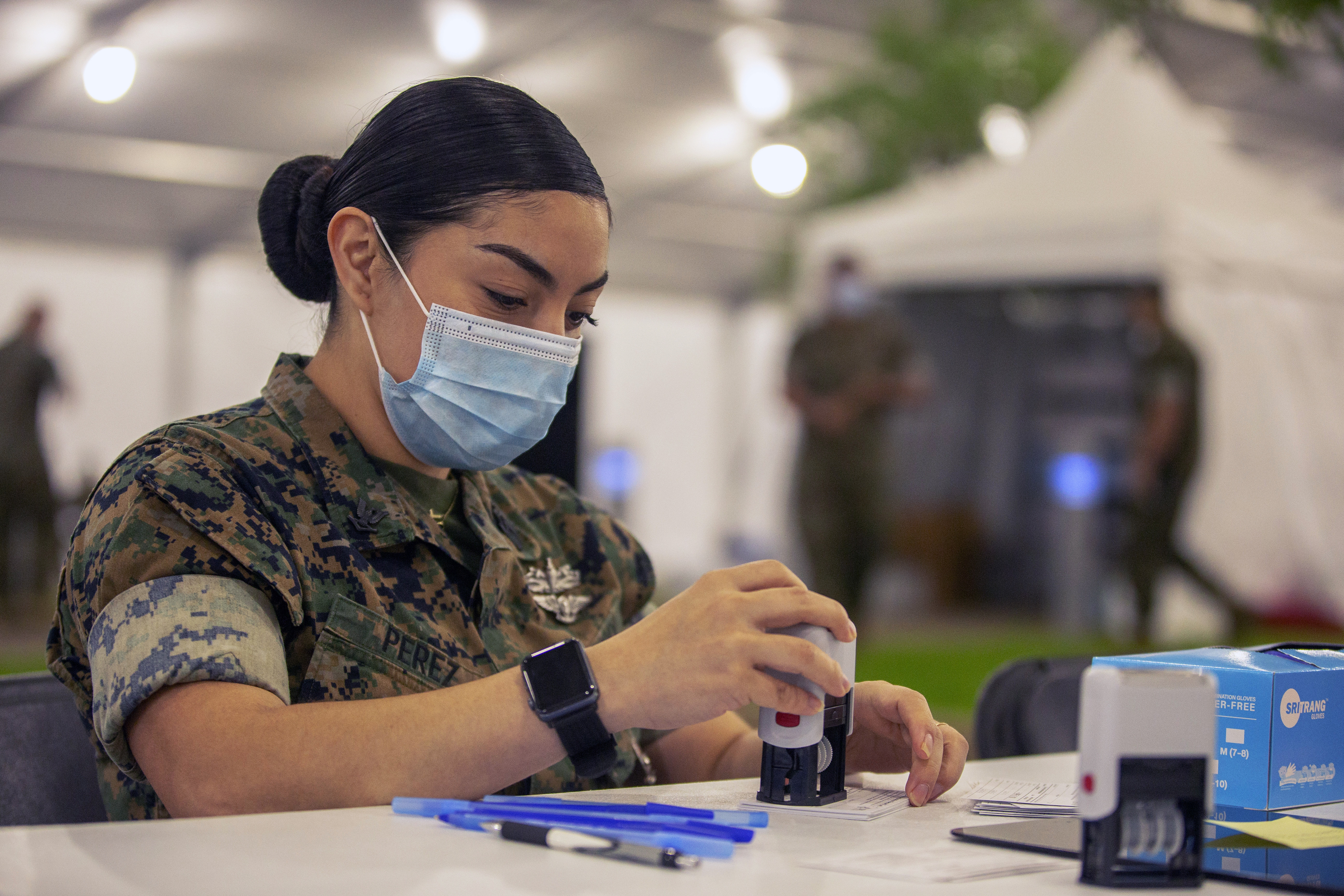
Navy Petty Officer 3rd Class Dora Perez, who's assigned to the 2nd Marine Division based at Camp Lejeune, N.C., prepares vaccination cards at the Memphis Community Vaccination Center in Memphis, Tenn., April 16, 2021. U.S. Northern Command, through Army North, remains committed to supporting the Federal Emergency Management Agency as part of the government's response to the COVID-19 pandemic.


Army Spc. Rashad Kelley, a unit supply specialist with the Georgia Army National Guard, receives a visitor at a mass vaccination site in Savannah, Ga., April 13, 2021. The Georgia National Guard provides logistics and operational support to the Georgia Emergency Management and Homeland Security Agency, which is administering COVID-19 vaccinations at mass vaccination locations across the state.

Registering Residents


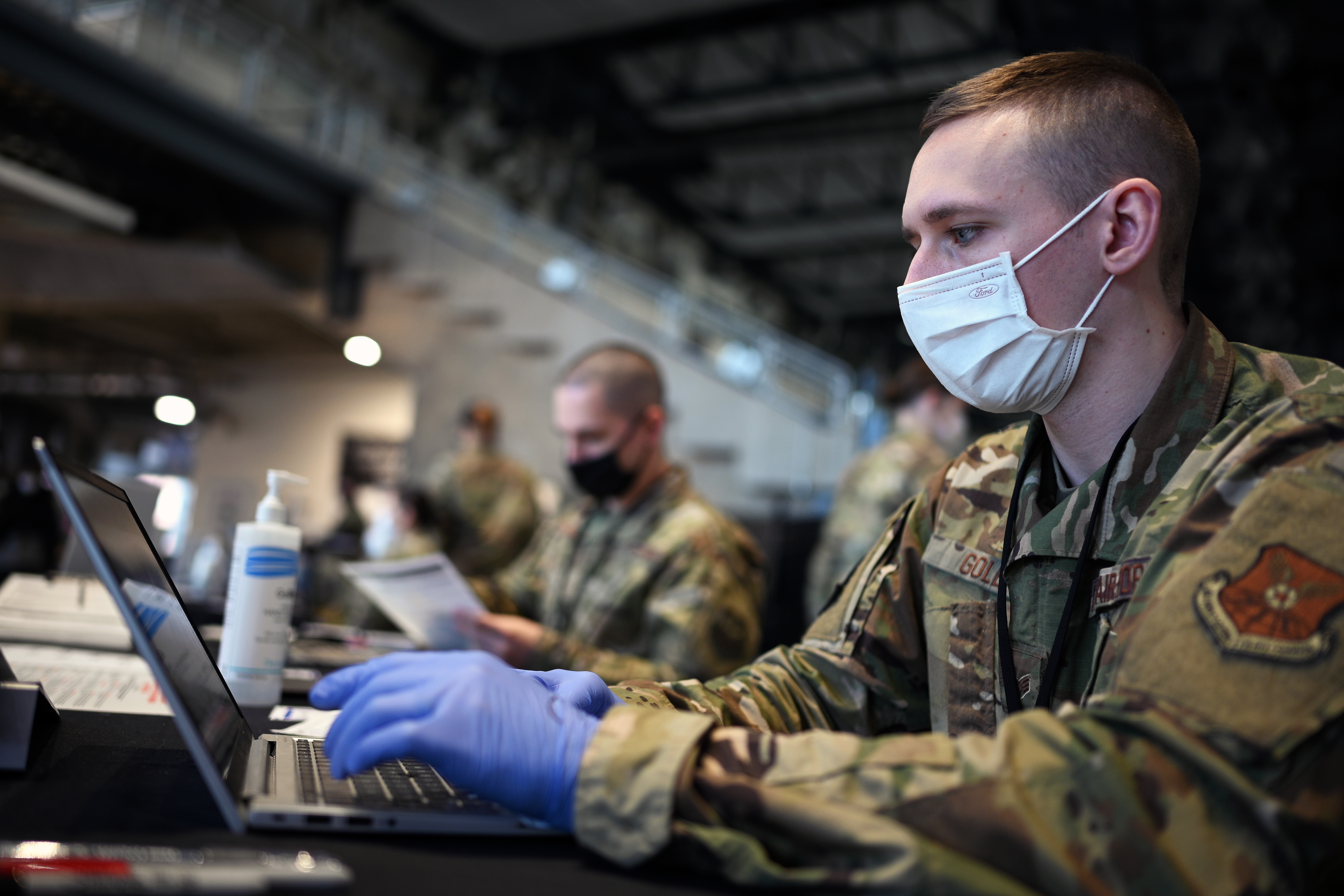
Air Force Senior Airman Joshua Goley, who's assigned to the 2nd Maintenance Squadron of the 2nd Bomb Wing at Barksdale Air Force Base, registers people for vaccinations at the state-led, federally-supported Ford Field Community Vaccination Center in Detroit, Mich., April 15, 2021. Goley, an aircraft maintainer, is part of a group assigned to the 1st Detachment of the 64th Air Expeditionary Group. His job is to ensure community members are healthy enough to receive a vaccination.

Fighting Flames


Sailors train in basic and advanced firefighting with the Japanese navy in Sasebo, Japan, April 9, 2021.

Admiral Charles A. Richard, Commander, U.S. Strategic Command, Holds a Press Briefing

 April 22, 2021

Admiral Charles A. Richard (USN), commander, U.S. Strategic Command

STAFF:  Good morning, ladies and gentlemen.  Thanks for being here.  I want to go ahead and welcome you to today's morning -- morning press conference and introduce to you the commander of the U.S. Strategic Command, Admiral Chas Richard.

And sir, we'll just turn this right over to you.

We'll do Q&A after his opening remarks.

ADMIRAL CHARLES A. RICHARD:  Well, all right.

Good morning, everyone.  And as Brook just said, I'm Admiral Chas Richard, commander of U.S. Strategic Command; have the privilege of leading 150,000 soldiers, sailors, airmen, Marines, Guardians and civilians.  I appreciate y'all taking some time, have a conversation, answer a few questions.

I do understand that this afternoon General McKenzie from Central Command will also be doing one of these, and perhaps it's -- y'all probably see him, and -- and I don't think I'm going to get the opportunity.  If y'all could pass him a "Roll tide" on my behalf, right, I'd appreciate that.

The -- I do want to report that STRATCOM remains ready to accomplish all of our assigned missions.  That has not been easy, given the COVID environment and other things, but we're fully mission-capable.

So as you know, I just spent a couple of days, along with another combatant commander testifying to the House and Senate about my responsibilities, my command's responsibilities, how well we're doing those.  And I -- I feel very privileged to have had that opportunity.  The -- as you know, we're responsible for maintaining strategic deterrence and in doing so, enabling the rest of the Joint Force to accomplish their missions.

I testified in some detail to the threats that we currently face.  I want you to know that we're fully ready for that challenge, including the challenge of deterring two peer competitors at the same time.  And I did want to start off by saying I applaud the secretary's leadership in all areas, but in particular, in our efforts to do a series of reviews, to include a strategic deterrence review, and the way we're approaching that because I think it's important to remember that nuclear deterrence is not separate from strategic deterrence, is not separate from conventional deterrence or space or cyber.  Those must be all looked at together in order to accomplish a strategic deterrence mission, and so I applaud where we're going and the way we are approaching that.

So with that, I'll stop, and I'm happy to take your questions.

STAFF:  Thank you, sir.

First, we'll start with Bob Burns, AP

Q:  Thank you, Admiral Richard.

I wanted to ask you about a couple comments you made yesterday during your -- your testimony. When you were talking about the issues with the Minuteman III, and the question about possibly life extending it.  You said that there's a long list of parts that are in very short supply, and you give an example of lock switches that you said there's only two at the moment.  And then you went on to say, "I'm afraid there's a point where they won't -- they won't be able to pull a rabbit out of the hat and the system won't work."  I'm wondering if you could elaborate on what sounds to me like an unreliable aspect of the system.

ADM. RICHARD:  Okay, so the -- the Minuteman III system is -- is fully reliable today; right.  The question is both in terms of the future, in terms of the system performance, as well as its ability to pace the threat.  You know, in the end, I defer to the U.S. Air Force in terms of their ability to do that.  They have assured me they can do that.  But it is getting increasingly harder, and I do want to have an understanding of just what it's taking to keep that weapon system up to the standards that we expect of it.

Q:  But you said the system -- you're afraid the system won't work on any given day.  It doesn't sound like -- that sounds like a definition of unreliable to me.

ADM. RICHARD:  Again, today it works fine.  Air Force -- I'm confident in their ability to get it to the points where GBSD [Ground Based Strategic Deterrent] is expected to come in.  But this is another example of no more margin; right.  So can you keep going with that?  I want us to recognize that you can't indefinitely life-extend anything.  That's the point, right?  You can't take stuff that you got back at the end of the Cold War and to think somehow forever you can continue to make it work, right?  There's a point where it becomes not cost-effective to do that, and there's another point out there, where it's not possible at all.  And I want to make sure that as we think through these decisions, we recognize that those points exist and look for them.  I wanted to give a specific example of the detail that is necessary to make sure we know where those points are.

STAFF:  Very good.

Okay.  I'll still go here in the room.  We'll to go Meghann Myers.

Q:  So, the other day in front of Congress you testified that you are confident that there is zero extremists within Strategic Command, and one of the reasons you offered that is because security clearances are required for the entire organization.  Do you want to clarify or expand upon those comments?

ADM. RICHARD:  I do, actually.  I welcome the opportunity to do that.

Look, the standard is really clear:  We don't tolerate extremism. My forces live up to an even higher standard based on their responsibility.  This is not new; right.  The Department of Defense has never tolerated extremism.  I think the secretary's leadership is on point for us to remember, this is a continuing effort, right?  The stand-down, which my command has completed, was a great opportunity to remind ourselves what is the standard, and to make sure that we're upholding that standard.

So we're not done.  And I'm not naive, and I don't think I'm immune to this.  So this is just the -- the -- a step in a longer process; right.  We are making sure that those procedures, security clearance being one of them, are being rigorously executed, rigorous execution of the Personnel Reliability Program.  And I'll go back to what I said -- also said, which is if you're there, then you're hiding it very well, and it is just a matter of time before I get to you.  You are either on Team Constitution or you are not, and if you are not, you have no place in my forces.

Q:  So just to clarify, you're confident that it's zero, but that's not based on any data or surveying or --

ADM. RICHARD:  I know of none, right, and I'm looking really hard.  So that was one of the outcomes of the stand down, right, is we didn't find anything. So yes, I know of none and I'm doing my best to make sure that I haven't missed anybody.

STAFF:  Okay.

Let's go to the phone.  We're going to go to Sangmin Lee, Radio Free Asia.

Q:  Yes, I have two questions.

It is known that deterrence and escalation came in the exercise had it been made last week.  So can you tell me, North Korea nuclear threat is also included as a target to deter for this exercise?

And second question is, North Korea continues to develop and deploy a more capable ICBM [Intercontinental Ballistic Missile] and sea-based launch ballistic missile, so how do assess North Korea this capability?  And do you think that currently your strategic capability is capable to deter North Korea nuclear threat?

ADM. RICHARD:  Missed the -- the second half of the first question.  I think you were referring to what we call the DEGRE [Deterrence and Escalation Game and Review] war game that was recently conducted.  But what was your question about that?

Q:  So what is for this exercise?  The North Korean nuclear threat is targeted for this exercise?

ADM. RICHARD:  So the actual work specifics inside of DEGRE are classified.  And so I -- I'm not -- not really able to answer that question.  I will tell you that I am very confident in my ability to deter -- we're very familiar with North Korea's capabilities and I'm very confident in our ability to deter that.

STAFF:  Okay.

And back in the room, Jenny?

Q:  Thank you.

I ask about North Korea again.  As you know that North Korea continues to develop in nuclear weapon and WMD, weapons of mass destruction, and recently North Korea has joined forces with China and Russia.

It's, kind of, very dangerous to Korean Peninsula (inaudible).  And what are the strategic goals of the United States to protect the alliance -- you know, from North Korea's for anything, you know, biological weapons -- you know, weapons.

ADM. RICHARD:  And so -- so the short answer is, first, I think that situation is ripe for a diplomatic resolution.  That that is the best path to resolve issues with North Korea is using diplomacy first; right.  I will say that the United States -- and certainly my command -- are fully ready to honor our security commitments and alliance promises that we have made to South Korea.

Q:  And you are Strategic Commander, so do you have any -- you know, best (inaudible) in strategic goals for the -- this North Korean --

ADM. RICHARD:  Look, my goal is to fundamentally uphold my piece of the responsibility in the assurances and commitments that we have made to South Korea.  And I'm fully ready to do that.

STAFF:  Okay.

And now to -- let's go to here in the room.  Mike Glenn?

Q:  Yes, sir, can you tell me how well do you think Congress appreciated your concerns during your testimony?  Are you -- are you optimistic about it or pessimistic, I mean, after spending the last couple of days up there on the Hill?

ADM. RICHARD:  Look, to be honest, I think you would have to ask them how well I did.  What I appreciate was the fact that I had the opportunity to do it and to lay out the mission, both in an open and closed hearing, the way I see it in a very frank manner.  I think I upheld my obligations to Congress to do that.

STAFF:  Very good.

Also here in the room, Barb?

Q:  Admiral, to follow up on some of Bob's questions, can you -- starting with the Minuteman III.  Can you put some framework around it?  Are we talking months, years before it becomes unreliable and unable to sustain?  Is there any kind of framework on that?

ADM. RICHARD:  Well, the framework is the Air Force has made a commitment that they will be able to present me a Minuteman III operating system to the IOC [Initial Operational Capability] and FOC [Full Operational Capability] dates on GBSD, and I am fully confident that they are able to go do that.

What I'm trying to point is that if you want to push that further, right, you are going into uncharted territory.  We may be able to chart that territory, but there is an enormous amount of detail that has to go into that, and the only organization that I know who is capable of working through all of that detail is the United States Air Force.

That's my point.  I'm trying to point out it is not simply a matter of saying, "Well, the rocket'll work," and a couple of other things.  It's -- it's a weapon system --

Q:  What year is that in your mind?

ADM. RICHARD:  The IOC of GBSD is 2029.

Q:  And Senator Warren yesterday, obviously, expressed a lot of concern that, while you were giving your best military advice, she raised the prospect that you were ahead of the reviews that are being done about strategic policies, strategic reviews, nuclear reviews.  Do you worry that this candid advice you're giving is boxing in the president before their reviews are done or even the budget is done?

ADM. RICHARD:  Barbara, I tell you, I tried very -- I felt like yesterday putting a sign beside my name that said "This is best military advice."

I am a military officer, a military commander.  I will do exactly what the president tells me to do or not do.  The advice I was giving was not new; right.  I have said that many times in the past, and in fact, you could probably trace the lineage back to other Strategic Command commanders.

So, I absolutely understand my place inside the chain of command.  And so, I'm absolutely ready to do whatever the nation asks me to do.

STAFF:  Okay, let's go to the phones.  We're going to go to Brian Everstine from the Air Force Magazine.

Q:  Admiral, thank you for taking the time.

I was hoping to go back to your statement from a couple days ago on the -- if somehow the ICBM leg of the triad is cut, you recommend returning bombers to alert.

If -- looking at the current state of the Air Force's bomber fleet and the bomber roadmap, is this something that could be hostile beyond just a few days it has been exercised?  And would that in turn cause the recommendation to increase the B-21 buy?

ADM. RICHARD:  Hey, so, one, thank you for the question.

And two, I was using that as specific example of the challenges the nation would fact, right?

Remember, I -- I am unique among the combatant commands that I don't get to decide or offer to the secretary what my objectives are; right.  Most other combatant commands execute their missions that way.  Mine are directed by the president as interpreted by the secretary of defense and the chairman of the Joint Chiefs of Staff.  And so, I take those and then look at the threat and then ask for the forces to accomplish it.

It's a very analytic process.  And that results in -- and the nation has repeatedly validated that given -- and those objectives that I'm talking about are very consistent.  I can trace their lineage back to the Kennedy administration.  And we've repeatedly decided the triad is the best way to do that.

Doesn't mean that that's the decision that we'll come to in the future, right?  That's what these reviews are going to go show, and we'll be ready to execute whatever decisions that the nation makes.

My point was given what I'm responsible for now, given the standards that we have historically held this mission set to, which is specifically, if any piece of it fails, right -- we assume we can fail an entire people – for whatever reason, we can still do what we were assigned to do with what remains.  That -- I gave you the day-to-day example of what I would ask for.  That's only a subset.  I'd still have to figure out some other pieces.

And so that was only one subset of a larger class of stuff that I'd be responsible for figuring out an answer to.

STAFF:  Okay, and also on the phone, we'll go to Frank Wolfe with Defense Daily.

Q:  Yeah, good morning, Admiral.

I just had a question.  I wondered if I could get your insights on the 2018 Nuclear Posture Review, which stated that the SSBN force, presumably, the existing Ohio-class SSBNs and the future Columbia class will -- are virtually undetectable, and there's no near-term threat to their survivability.  So when we talk about the ground-based leg of the triad being necessary, could you just explain that?  If -- if, in fact, you modernize the NC3 [Nuclear Command, Control and Communications] command and control system so that the command authority could still get in touch with the SSBNs, what -- what -- why is the triad -- why is the ground leg necessary?  Why is -- why is GBSD data or -- or the service life extension of the Minuteman III necessary?

ADM. RICHARD:  Hey, so first, there is a total amount of capability and capacity that's required to execute the responsibilities that I have been given.  I need the -- the forces that we have, to include the intercontinental ballistic missiles, to be able to accomplish all of that.  We don't have capacity in any to -- to start to change that unless we change the guidance, right?  And we can always do that.

Then the second piece is there -- there are things that we all take as givens nowadays.  One of them is bolt out of blue, right?  I'm referring to an unwarned large attack, right?  I think we would all agree that that is highly unlikely.  We'd be the first to tell you that it's highly unlikely because we look at it every day.

But we forget how we got here, in some cases.  We made bolt out of the blue unlikely.  Ballistic missile submarines, the -- the responsiveness of the intercontinental leg, our postures, our policies, the way we execute.  The reason bolt out of the blue is unlikely is because it's probably not going to work; right.  And so we have to be careful when we make future decisions that we don't forget how we got here, lest we return ourselves to a world we don't want to be in.

STAFF:  And do we have any other questions here in the room?  Kris Anderson?

Q:  Thank you for taking my question.

I'm wondering if -- if you could talk a little bit about the capabilities that Space Command has brought, having the Guardians under your command.

ADM. RICHARD:  One, I -- I applaud the decision to establish Space Command.  I think it has been a -- a great benefit to my mission sets.  As you know, we still think of ourselves as the proud parents of Space Command because the responsibilities were transferred out of STRATCOM to Space Command.  And the -- of many things that I could point to in terms of how General Dickinson helps me accomplish my mission better, the one I'd point to is his role and responsibility as the sensor manager. So now, we are looking across three different mission sets.  I'm specifically referring to them: missile warning missile defense and space situational awareness, and we are able to take the nation's total collection of capability and sensors, in this case, and use them much more effectively such that all three missions actually benefited from that.  This is a good specific example of some of the ways we need to think about command and control moving into the future.

STAFF:  Very good.  And one final?

Q:  Yeah.  Do you have any information about the North Korea -- prepared for the SLBM [Submarine-Launched Ballistic Missile] launch or ICBM pretty soon?

ADM. RICHARD:  So ma'am, look, we are ready for just about anything North Korea can do. So I am fully confident that we're prepared for whatever they might decide to do.  All right.

Q:  Thank you.

STAFF:  Very good, very good.

Okay, and with that -- oh, actually, one final question from Lucas.

Q:  Admiral, Lucas Tomlinson, Fox News.

Can you talk about the growing Chinese ballistic missile threat?  And why is China putting ICBMs into the ground?

ADM. RICHARD:  So one, as I testified, they have hit some kind of inflection point.  They're rapidly expanding.  I think I covered that in some detail in testimony, right?  As to why they are doing that, remember, they're very opaque.  In -- in fact, Lucas, I -- I'd almost ask you to ask them.  And I was just -- I was getting ready for this.  I was, like, trying to think of other countries' admirals and generals who are willing to get up in front of their press or are willing to go testify in front of their congress or other legislative body, and -- and I think it's something as Americans we should be proud of, that -- that your military is willing to come and answer your questions.  And I can't ask them that question, right?  But you can. And I would love for some of these questions y'all asked me, if you would ask them the same things.  I -- I would like to know the answer myself.

Q:  And then, talk about their growing stockpile.

ADM. RICHARD:  Look, again, I covered that in a lot of detail, and -- and I would offer just one point, maybe, to -- to reemphasize.  Measuring a stockpile is -- is a very crude way to describe what a nation can and can't do.  There's much more to it.  It's delivery systems, command-and-control, readiness training.  And I don't have the luxury of deterring one country at a time, right?  I have to deter all countries, all the time, in order to accomplish my mission sets.

And so I'd ask just to -- to consider that, right, as we think through the security challenges that we have.

STAFF:  Okay, sir, thank you very much.

ADM. RICHARD:  All right.

STAFF:  Do you have any final comments?

ADM. RICHARD:  No.  It's just a -- a privilege to -- to talk to y'all, and again, remember:  McKenzie, "Roll tide," right?

(Laughter.)

Thanks.

STAFF:  Thank y'all very much.
Dusty Duty


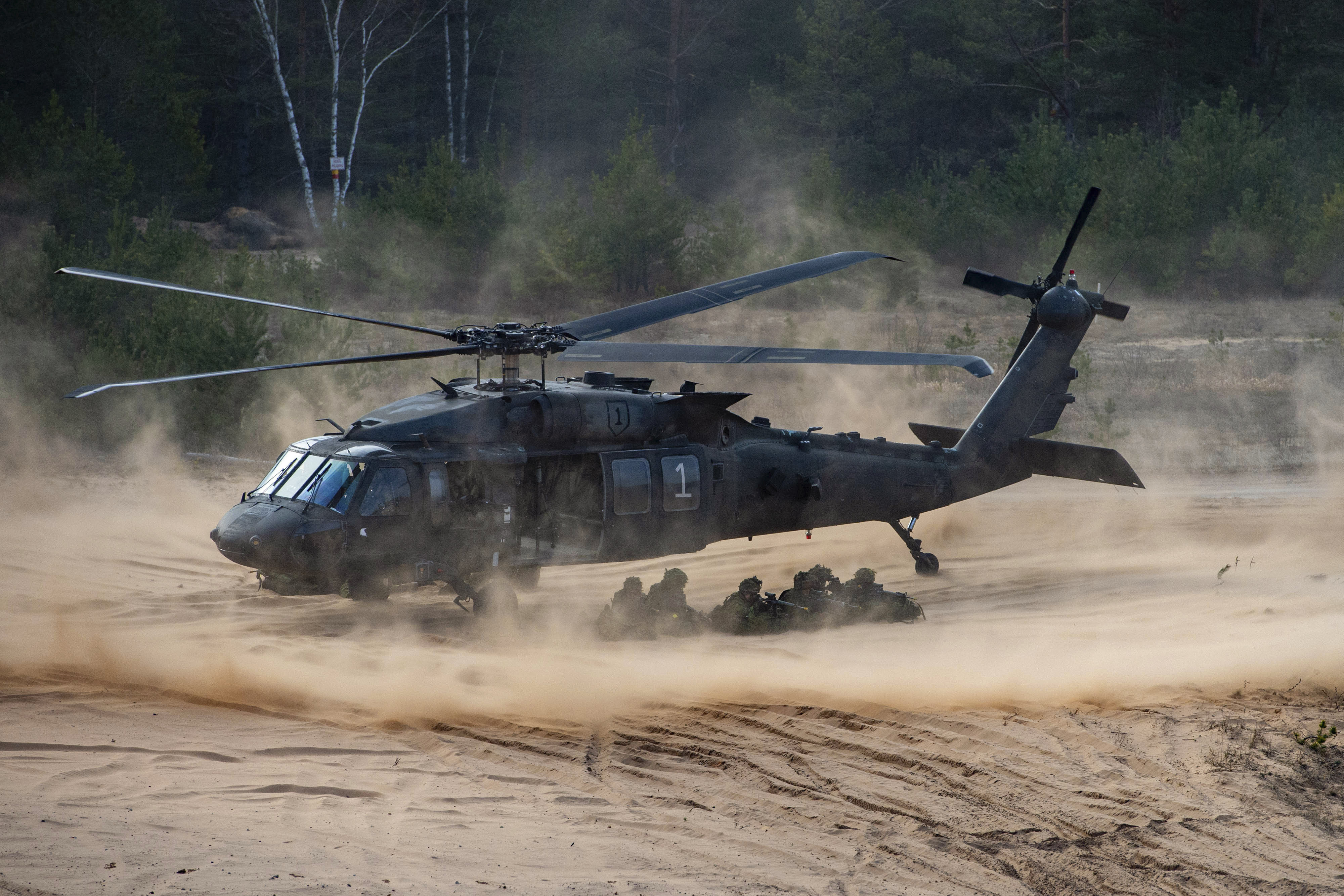
Canadian soldiers participating in an exercise with U.S troops, dismount from a U.S. Army Black Hawk helicopter during a mission to clear the area of enemy in the mountainous wooded border region near Lielvarde, Latvia, April 16, 2021.

Construction Partners


Sailors assist Habitat for Humanity workers construct a house in Santa Cruz, Calif., April 10, 2021.

Munitions Monitor


An airman conducts training with munitions at the Duluth Air National Guard Base, Minn., April 16, 2021.

Readout of Deputy Secretary of Defense Dr. Kathleen Hicks Phone Call With U.K. Permanent Secretary for the Ministry of Defence David Williams

 April 20, 2021


Deputy Secretary of Defense Dr. Kathleen Hicks held an introductory phone call with recently appointed U.K. Permanent Secretary for Defence David Williams to reaffirm the special U.S.-UK relationship and discuss security issues of mutual interest.

The two leaders discussed Afghanistan, Russian destabilizing actions, and support to Ukraine. Mr. Williams also shared his views on the Ministry of Defence’s approach to implementing the UK’s Integrated Review. The leaders look forward to convening the U.S.-UK Defense Dialogue later this year to discuss issues such as technology cooperation and innovation.

Both leaders expressed their commitment to deepening the U.S.-U.K. defense relationship and contributing to each other’s defense strategy development and implementation. 

Six Language Recruiters Indicted for Recruiting Unqualified Linguists for Deployment with U.S. Armed Forces in Afghanistan

 A federal rand jury in the Eastern District of Virginia returned an indictment Wednesday charging six former employees of a government contractor for their role in a conspiracy to commit wire fraud in connection with a U.S. government contract to recruit and deploy qualified linguists to Afghanistan where they would provide language services in Dari and Pashto to the U.S. military, including interacting with Afghan civilians and military forces.

According to court documents, Mezghan N. Anwari, 41, of Centerville, Virginia, Abdul Q. Latifi, 45, of Irvine, California, Mahjoba Raofi, 47, of San Diego, California, Laila Anwari, 54, of Fredericksburg, Virginia, Rafi M. Anwari, 54, of Centerville, Virginia, and Zarghona Alizai, 48, of Annandale, Virginia, were employed as linguist recruiters for the Arlington, Virginia-based government contractor, which performed subcontract services such as recruiting linguists to serve in support of U.S. military operations, pursuant to a U.S. government prime contract valued in excess of $700 million.

The indictment alleges, among other things, that the defendants knowingly recruited linguists who lacked the minimum language proficiency in Dari or Pashto. The defendants arranged for other individuals with stronger language skills to fraudulently impersonate the unqualified linguist candidates during oral proficiency interviews, which were tests independently conducted by another government contractor to ensure that candidates identified by the defendants met minimum proficiency standards. In so doing, the defendants sought to make it appear that the linguist candidates possessed stronger language skills than was the case and to ensure that their unqualified linguist candidates would receive passing scores. At times, the defendants themselves fraudulently impersonated candidates during interviews. During the scheme, the defendants received a base salary plus a series of incentive-based bonuses determined by how far through a multi-step vetting process a recruited candidate progressed.

“The defendants in this case allegedly engaged in an expansive conspiracy to enrich themselves at the expense of American soldiers and military operations in Afghanistan,” said Acting Assistant Attorney General Nicholas L. McQuaid of the Justice Department’s Criminal Division. “Fraud and abuse of U.S. government contracts paid for by the American taxpayer, and designed to support our men and women uniform, will not be tolerated.”

“As alleged in the indictment, the defendants exploited the trust placed in them by the U.S. military and recruited unqualified linguists to be deployed to Afghanistan,” said Acting U.S. Attorney Raj Parekh for the Eastern District of Virginia. “We are committed to holding accountable those who undermine the integrity of the procurement process and potentially jeopardize the United States’ mission overseas.”

“This indictment alleges serious crimes that threatened to put American troops at greater risk in a combat zone,” said John F. Sopko, the Special Inspector General for Afghanistan Reconstruction (SIGAR). “I’m proud that SIGAR special agents and their investigative partners got to the bottom of this alleged scheme. We remain committed to protecting our country’s investment in Afghanistan reconstruction, and to pursuing justice anytime that investment is put at risk.”

“The Defense Criminal Investigative Service (DCIS) is committed to ensuring the integrity of the Department of Defense's procurement system” said Special Agent in Charge Stanley A. Newell of the Transnational Operations Field Office for DCIS. “The special agents of DCIS along with our investigative partners will vigorously investigate contractors who attempt to rig the system for their own ill-gotten gain.  Illicit conduct of this sort deprives our military forces of crucial services and cheats the American taxpayer. We remain steadfast in our mission to root out fraud against U.S. Department of Defense and bring those responsible to justice.”

Mezghan Anwari is charged with conspiracy to commit wire fraud and six counts of wire fraud.  Latifi is charged with conspiracy to commit wire fraud and five counts of wire fraud. Raofi is charged with conspiracy to commit wire fraud and two counts of wire fraud. Laila Anwari is charged with conspiracy to commit wire fraud and two counts of wire fraud. Rafi Anwari is charged with conspiracy to commit wire fraud and three counts of wire fraud. Alizai is charged with conspiracy to commit wire fraud and two counts of wire fraud. The defendants are scheduled for initial court appearances on May 5, before U.S. Magistrate Judge Anthony J. Trenga of the U.S. District Court for the Eastern District of Virginia. If convicted, each of the defendants face a maximum of 20 years in prison per count. A federal district court judge will determine any sentence after considering the U.S. Sentencing Guidelines and other statutory factors.

 SIGAR, the U.S. Army Criminal Investigation Command, and DCIS are investigating the case.

The Criminal Division’s Fraud Section is the nation’s leading prosecuting authority for complex procurement fraud and corruption cases.

Trial Attorneys Michael McCarthy and Matthew Kahn of the Criminal Division’s Fraud Section and Assistant U.S. Attorney Matthew Burke of the Eastern District of Virginia are prosecuting the case. Trial Attorney Daniel Butler of the Fraud Section contributed significantly to the investigation of this case.

An indictment is merely an allegation and all defendants are presumed innocent until proven guilty beyond a reasonable doubt in a court of law.

Desert Torch


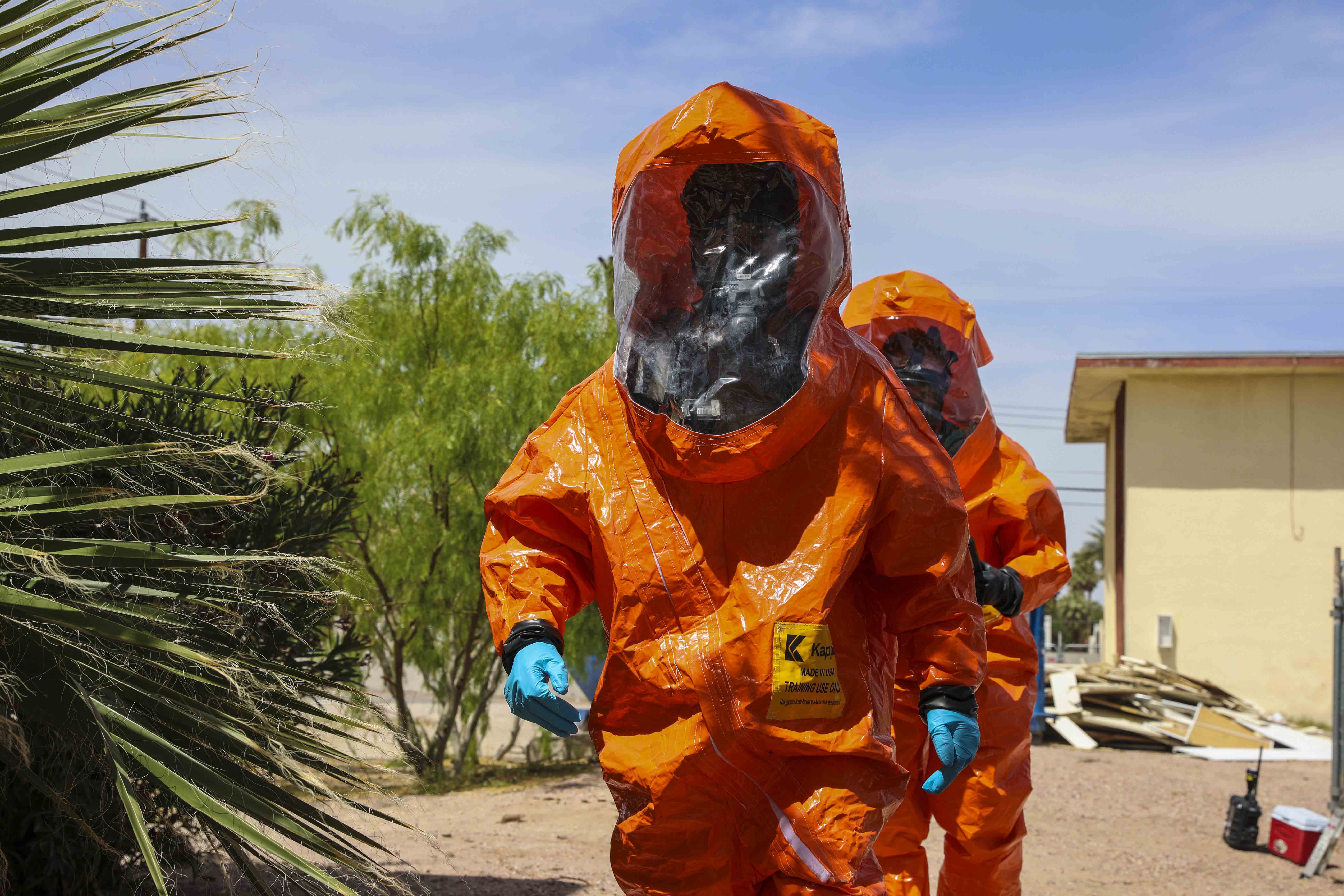
Army Sgts. Chaz Rapp and Rjhun Rimon search for simulated hazardous materials during Desert Torch in Las Vegas, April 20, 2021. The exercise is designed to test soldiers’ ability to react to the simulated chemical, biological, radiological, nuclear and high yield explosive threats.

Wednesday, April 21, 2021

Statement by Secretary of Defense Lloyd J. Austin III on the President's Nomination of Dr. Ely Ratner as the Assistant Secretary of Defense for Indo-Pacific Security Affairs

 April 21, 2021


"I welcome the President's nomination today of Dr. Ely Ratner as Assistant Secretary of Defense for Indo-Pacific Security Affairs. Ely has already proven an invaluable member of our team as Director of the China Task Force, and his deep knowledge of the Indo-Pacific region will prove invaluable as we begin to shape our operational concepts and strategy for dealing with threats and challenges in that part of the world. There is simply no better person for the job. I am grateful to Ely for his commitment and willingness to serve, and I look forward to working with him. I urge the Senate to confirm Ely as soon as possible so he can take up this important work for our nation."

Official Says Women's Contributions Are Vital to DOD, Allies and Partners

 April 21, 2021 | BY David Vergun , DOD News

Representatives from ally and partner nations in southeast Europe today spoke at a conference about the important role women play in their armed forces.

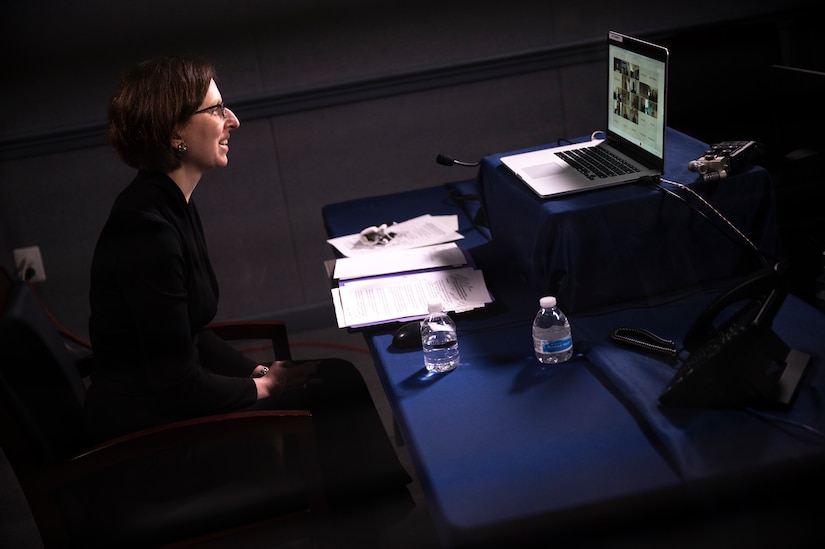
Laura K. Cooper, deputy assistant secretary of defense for Russia, Ukraine and Eurasia, represented the Defense Department at the virtual Conference of the U.S.-Adriatic Charter on Women's Contribution to Peace and Security: Lessons Learned and Challenges Ahead.

Cooper said the DOD has been making significant strides in working to integrate gender considerations into policies, plans, operations and training to ensure women participate across all ranks within our force since implementing its Women, Peace and Security, or WPS, in 2020.

A woman sits at a desk and looks at a computer screen.

"We view our own WPS initiative, which is aimed at achieving a more stable world and safety, equality and opportunity for women and girls, as absolutely critical to U.S. national security," she said, adding that there is still more work to be done.

One WPS priority is to establish gender advisors across the entire department, she said, noting that there are now full-time gender advisors at every geographic combatant command. 

The advisors will work to implement the DOD's 2020 WPS strategic framework within their components, advising their commanders or senior staff on how to better integrate gender into a wide swath of defense activities, Cooper said.

Another priority is developing and conducting training on WPS principles across the department, she said. 

In addition to U.S.-based training, personnel have been sent to leading partner-country WPS initiatives, such as the Nordic Center for Gender in Military Operations in Sweden, she said.

Also, the Defense Security Cooperation University in the U.S. is working to build partner-country capabilities in support of WPS goals, she said.

"Our security cooperation activities seek to increase gender diversity across all ranks of partner security sectors and to consider the security needs of women and girls, particularly when faced with conflict or crises," she said.

A woman sits at a desk and looks at a computer screen.

Cooper said allies and partners in Europe — including the five U.S.- Adriatic Charter nations of Bosnia and Herzegovina, Croatia, Montenegro, North Macedonia and Albania — have made critical contributions to the collective WPS effort. She also mentioned noteworthy progress in Serbia and Slovenia, the latter of which appointed its first woman as chief of its armed forces in 2018. 

Croatia is currently advancing through a partnership with the U.S. government-funded project to strengthen gender equality within the Croatian army's peacekeeping missions, she said.

Part of that effort is the first-ever analysis on the status of women in the Croatian armed forces and peacekeeping missions. As a result, Croatian leaders will be equipped with recommendations and measures to improve the status of women in the military and promote a culture of zero tolerance to violence, Cooper said, mentioning that the U.S.'s WPS efforts will be informed by what is achieved in Croatia.

The U.S. is also working through NATO channels to support WPS efforts, including through the NATO Committee on Gender Perspectives and the integration of gender considerations into joint exercises, she said.

"[WPS] initiatives do not only benefit women, they also benefit the entire population and contribute to the security of our partnerships and, in the case of NATO, to the strength of the NATO alliance. History shows clearly that the inclusion of women is critical to establishing lasting peace and prosperous futures," she said.

History of WPS

On Oct. 31, 2000, the United Nations Security Council adopted Resolution 1325, the Women, Peace and Security initiatives.

The resolution calls for the participation of women in: the prevention, management, and resolution of conflicts; peace negotiations; peace-building; peacekeeping; humanitarian response; and post-conflict reconstruction. It also stresses the importance of their equal participation and full involvement in all efforts to maintain and promote peace and security. 

In addition, the resolution urges an increase in the participation of women and the incorporation of gender perspectives in all United Nations peace and security efforts. It also calls on the parties involved in armed conflicts to take special measures to protect women and girls from gender-based violence, particularly rape and other forms of sexual abuse.

Band-Aid Prep


Air Force Senior Airman Benedict Barnett, a medic assigned to the 193d Special Operations Wing, Pennsylvania Air National Guard, prepares band-aids at the Esperanza Community Vaccination Center in Philadelphia, April 8, 2021. The Pennsylvania National Guard is supporting local and federal agencies in the whole-of-government response to COVID-19.

Mass Vaccination


Army Spc. Nyvasia Parks, a unit supply specialist assigned to the Marietta-based Headquarters and Headquarters Company, 1st General Support Aviation Battalion, 171st Aviation Regiment, Georgia Army National Guard, receives a visitor at a mass vaccination site in Savannah, Ga., Apr. 13, 2021. The Georgia National Guard provided on-site logistics and operation support to the Georgia Emergency Management and Homeland Security Agency as they administered COVID-19 vaccinations at mass vaccination locations across Georgia.

COVID-19 Vaccine


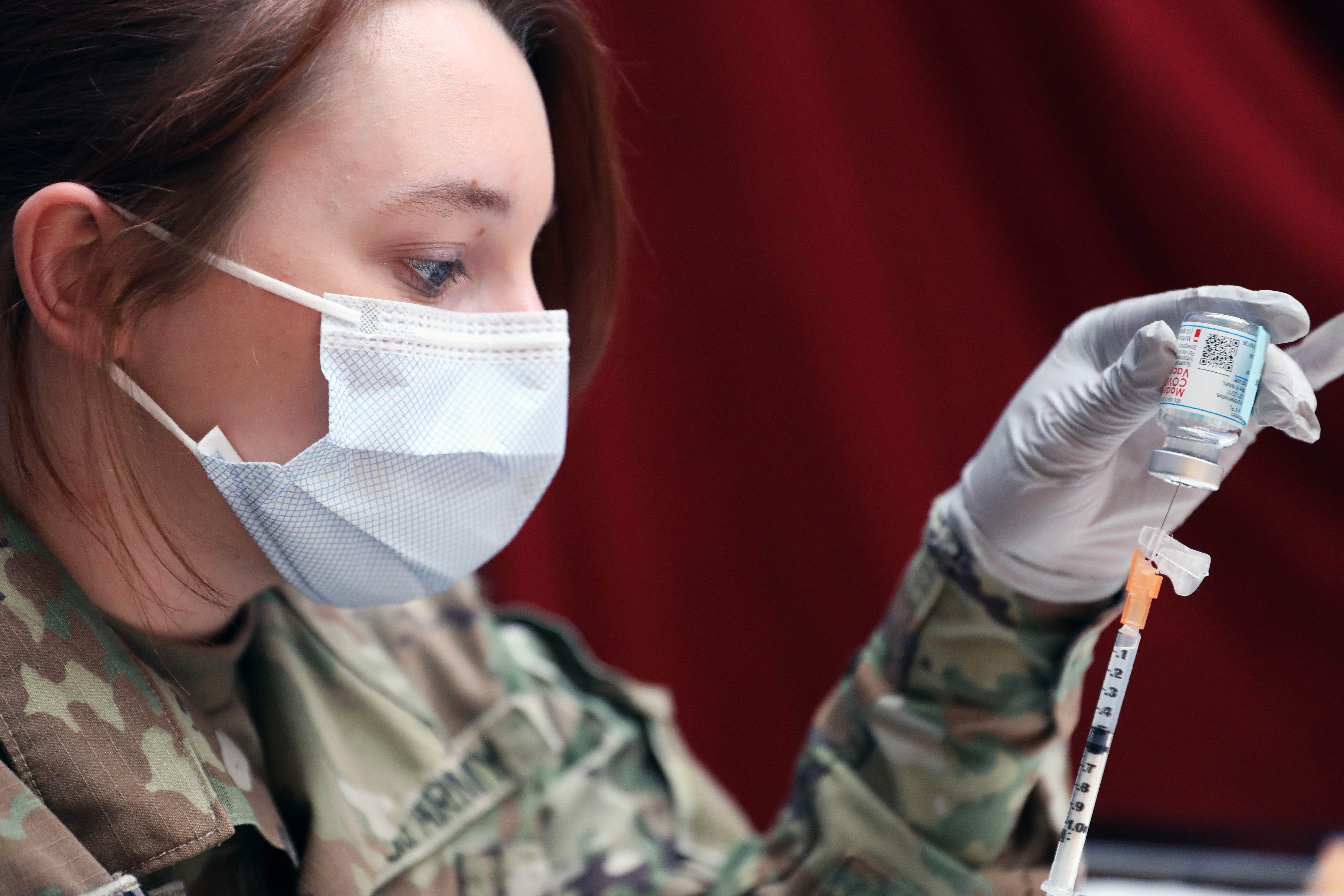
Army Pfc. Sara Jennings, a combat medic specialist assigned to Landstuhl Regional Medical Center, prepares doses of the Moderna COVID-19 vaccine in Landstuhl, Germany, April 19, 2021.

Administering Vaccines


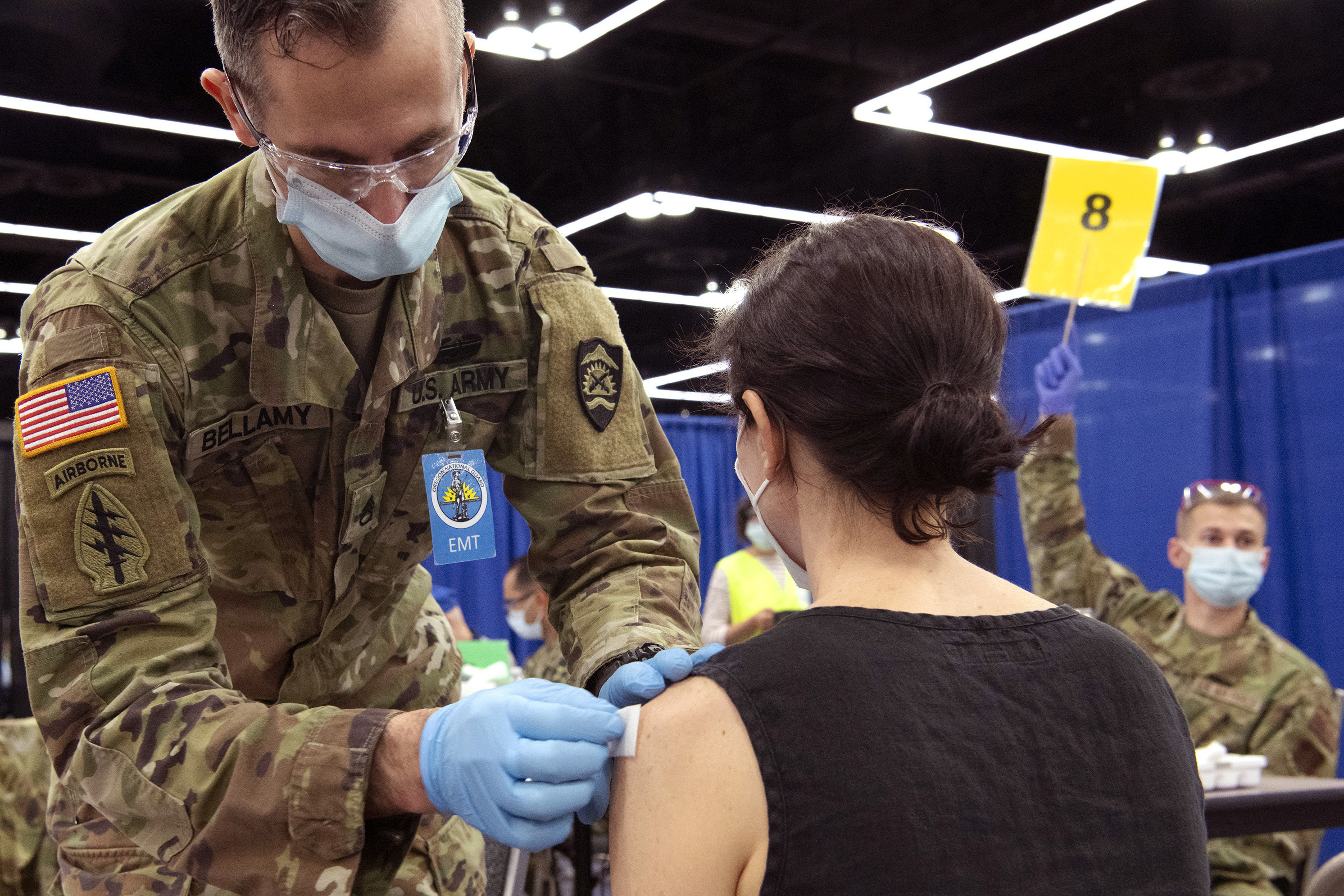
An Oregon Army National Guard medic administers the COVID-19 vaccine during a mass vaccination clinic at the Oregon Convention Center, Portland, Ore., Apr. 19, 2021. On April 6, President Joe Biden announced that all American adults would be eligible for a COVID-19 vaccine by mid-April., as Oregon Guardsmen have now administered over 300,000 vaccinations since being activated.

DOD's Military OneSource Provides Access to Military Funeral Honors Directory

 April 21, 2021


The Department of Defense provides members of the military community access to a Military Funeral Honors Directory on the Military OneSource website. The interactive online directory allows funeral planners, veterans, family members, or anyone arranging for military funeral honors to locate the appropriate service representative.

Anyone can use the online directory to look up a military funeral honors representative by service and state. This resource also includes information on how to arrange for military funeral honors in overseas locations.

“The rendering of military funeral honors is an important way we show our deep gratitude to those who have faithfully served our country,” said Deborah Skillman, director of DOD’s Casualty and Mortuary Affairs office. “We are pleased to provide this online directory and valuable content, so families can easily arrange for this final tribute and ceremonial paying of respect for their loved ones.”

Military OneSource also features helpful information about the military funeral honors process, as well as an eTutorial that allows users to better understand the program and eligibility.

The department’s Casualty Assistance Program makes sure that military families have support in their time of need, including understanding all benefits and other forms of assistance. Although the term “casualty” is usually associated with death, casualty support to eligible family members also means support after injury and illness, and when a service member is missing.

For more information, visit the Military OneSource website at https://www.militaryonesource.mil/ or call 800-342-9647 to speak with a consultant.

About Military Community and Family Policy 

Military Community and Family Policy is directly responsible for establishing and overseeing quality-of-life policies and programs that help our guardians of country, their families and survivors be well and mission-ready. Military OneSource is the gateway to programs and services that support the everyday needs of the 5.2 million service members and immediate family members of the military community. These Department of Defense services can be accessed 24/7/365 around the world.

About Casualty and Mortuary Affairs

The Casualty Assistance, Mortuary Affairs and Military Funeral Honors Office provides policy oversight of programs pertaining to casualty notification, casualty assistance, mortuary affairs and military funeral honors to deceased, missing, ill or injured personnel. 

Military Child Larissa Heslop Stands Out as a Student-Athlete, Volunteer

 April 21, 2021 | BY Barbara Gersna

Most children of those serving in the military move around a lot and sometimes attend several different schools. They learn to adapt to new environments as they move, leaving behind friends with hopes of making new ones. Many learn how to use these challenges to enhance their lives at a very young age.

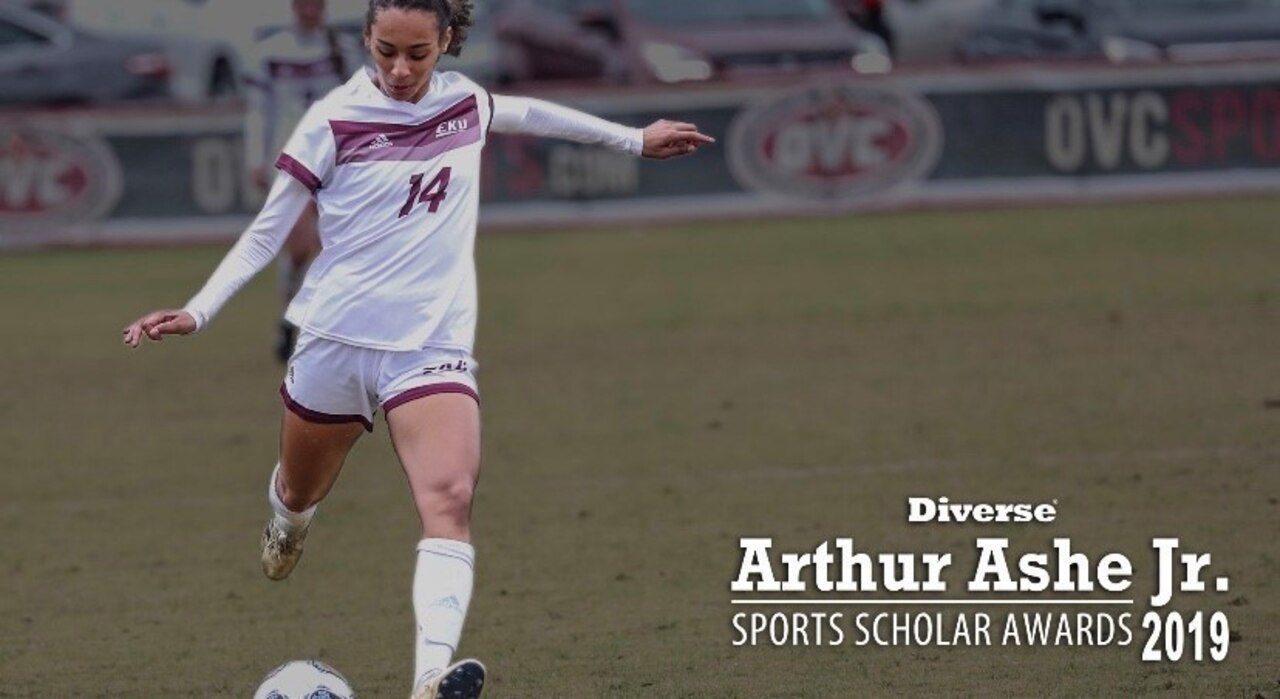
Larissa Heslop, daughter of Army Lt. Col. Larry W. Heslop, G33 chief of operations, 1st Theater Sustainment Command, achieved much success as a student-athlete playing soccer while attending Eastern Kentucky University. In addition to these successes, she also volunteers to help others.

A woman poses with a cap and gown during her graduation.

Heslop said that she was exposed to diverse groups of people and different ways of thinking due to moving around a lot as a child. Her aspirations for international public service are driven in part by her upbringing as a military child. 

She attended seven different schools by the 12th grade.

"When I moved to different schools, I did not try to change myself to fit in; I remained true to myself," she said. "Staying true to myself contributes to my confidence in my ability to achieve my goals and follow my own path. The advice I would give to other military children is to stay true to yourself and what you love. From the military lifestyle, you will be exposed to many different cultures and people. While it is important to learn from every person and situation, it is also important to stay grounded in your own values."

Military children learn from an early age how to adapt to change since it is more constant and frequent in our lives."
Larissa Heslop

Heslop graduated from EKU as summa cum laude with a 4.0 grade point average in May 2020. She is now pursuing a master of public administration at the University of Kansas School of Public Affairs and Administration in Lawrence, Kansas. She is preparing for a career in public service and hopes to lead humanitarian aid and relief efforts abroad with an international nonprofit organization or government agency.  

During high school she visited her father in Saudi Arabia and Bahrain. She traveled internationally within the U.S. Central Command area of responsibility as part of her undergraduate studies in Egypt and also studied in England, Israel and Brazil.

A woman kicks a soccer ball during a game.

The COVID-19 pandemic didn't stop Heslop from volunteering during her summer break. She delivered meals to the elderly with Warm Blessings Inc. and also read books virtually to hospitalized children with the Happy Hope Factory. 

An active leader both on and off the field, Heslop has received numerous awards recognizing her leadership, outstanding academic performance and community service. 

We are very proud of Larissa's hard work and accomplishments and hope that she may be an encouragement for other military children to make the most of the unique opportunities within our community."
Lt. Col. Larry W. Heslop

Heslop was named the 2019 Arthur Ashe Jr. Sports Scholar of the Year for women's soccer by the publication Diverse: Issues in Higher Education. She also received the Athletics Director Leadership Award - 2020 Colonels’ Choice Awards. She was named an academic All-American in 2019 and was a speaker at the 2018 Annual Eastern Kentucky University Championing Women's Athletics Luncheon. 

Heslop was also recognized with Play of the Year in the 2017 Colonels' Choice Awards for her game winning penalty shootout goal in the Ohio Valley Conference tournament semifinals. 

As one of the winningest athletes in EKU soccer history, Heslop was nominated for the National Collegiate Athletic Association Woman of the Year award for 2020, representing Eastern Kentucky University and the Ohio Valley Conference. She was one of only two athletes selected in the initial Division 1 cut from the Ohio Valley Conference.

Heslop continues to be recognized at the University of Kansas where she was recently awarded the Harry S. Truman Good Neighbor Award.

A family of three walks after a soccer game

"My advisor nominated me for the award for graduate students at UK who demonstrate promise for a potential career in international service," she said.

"Separate from the Truman Award, I will be interning this summer with the U.S. Agency for International Development in the Middle East Bureau," she said. "USAID is an organization I have been wanting to intern with, because I could see myself working there in the future as a foreign service officer," she said. 

Her father said, "We are very proud of Larissa's hard work and accomplishments and hope that she may be an encouragement for other military children to make the most of the unique opportunities within our community."

Larissa shared a famous quote from the Greek philosopher, Heraclitus of Ephesus, "The only thing constant in life is change." She said, "Military children learn from an early age how to adapt to change since it is more constant and frequent in our lives. Many people do not learn to deal with big changes until later in life. I would encourage other military children to embrace this skillset. Life is easier when you learn to trust that change can work for your benefit and that each season of life can bring new growth."

Commander Says Africa Is Too Important for Americans to Ignore

 April 21, 2021 | BY Jim Garamone , DOD News

Africa is a fascinating continent of tremendous possibilities but also tremendous dangers, and the U.S. ignores the nations of Africa at its own peril, the commander of the U.S. Africa Command said during an interview.

Four men in military uniforms walk into a building.

"China and Russia don't ignore Africa, and that alone should say something," Army Gen. Stephen J. Townsend said.

Africa has 13 of the 25 fastest growing economies in the world, Townsend said. In a time of climate change, Africa has 60% of the arable land on the globe. "This fact alone should show how important Africa is for the world," he added.

The continent also has a plethora of strategic materials, such as cobalt, chromium, tantalum and more. African resources are critical to 21st century progress. 

Africa has a growing population, and demographers estimate that by 2050 one in four people on Earth will be African. 

The country is also a crossroads of the world. The Bab el-Mandeb Strait between Djibouti and Yemen is a choke point at the southern end of the Red Sea. There is another choke point between Sicily and Libya. The Strait of Gibraltar is between Europe and Africa. The recent blockage of the Suez Canal threw light onto two more choke points: the Mozambique Channel and the Cape of Good Hope in South Africa, Townsend said. These sea lines of communication are vital around the globe and are ever in Townsend's mind as he engages the nations of the continent.

A number of Africa countries are among the "most fragile" in the world, Townsend said. These countries have ungoverned or little governed areas that attract violent extremist organizations, which capitalize on economic and political dysfunction to extend their reach. 

An aircraft flies over foreign military vehicles and service members in the desert.

He said governments in these areas need help. "An African leader once said to me 'A drowning man will reach for any hand,'" Townsend said. "They are drowning in poverty and will take help from whomever it comes from."

This offers a perfect opening for Russia and particularly China, Townsend said. "The Chinese sometimes refer to Africa as their 'second continent,' and some Chinese military leaders refer to the east coast of Africa as China's 'fifth island chain,'" the general said. 

China has its first overseas military base in Djibouti and has invested heavily in ports around the continent, he said. The Chinese are playing a long game on the continent. The Chinese Communist Party wants to change the international rules-based architecture to favor China.

Economic pressure on African nations could gather votes in the United Nations and in other world bodies to do just that. Maybe not tomorrow, but some day.

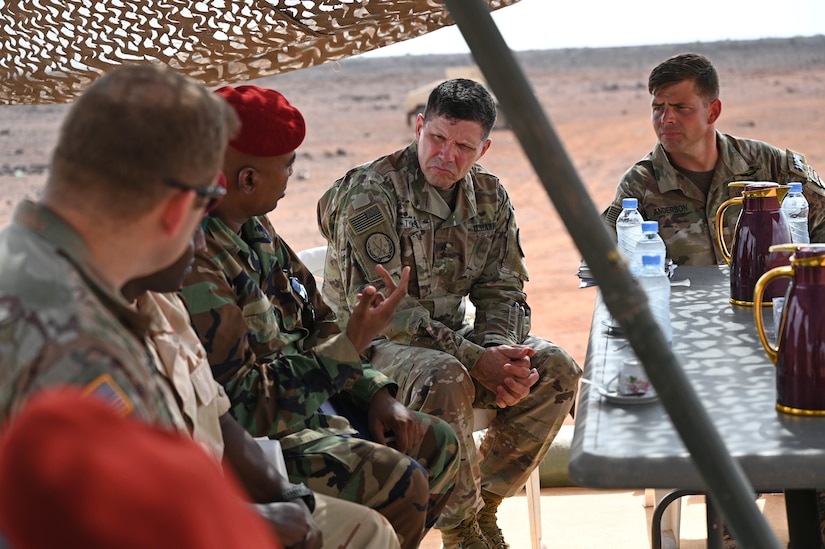
Shaded by an umbrella, five men in military uniforms sit at a table outside and talk; a desert landscape is in the background.

The United States, actually, is the preferred partner on the continent, Townsend said. "We were never a colonizing power in Africa, and we are regarded as an honest broker by many nations," he said. "In addition, our values are their values."

Townsend said the U.S. could use this to gain access and influence with the nations of Africa without "debt-trap diplomacy" — a term that refers to China's lending practices. 

A number of violent extremist organizations operate in Africa, including al-Qaida affiliate al-Shabab in Somalia and ISIS allies. Al-Shabab has stated it wants to attack the U.S. homeland, and it is a major contributor to global al-Qaida. 

Townsend said the U.S. can help Africans confront these groups. "We say we work 'by, with, and through' our African partners, so much it is almost a cliche, but it is true," he said. "It's the only way to get a handle on this problem: African solutions for African problems is the way we work at Africom."

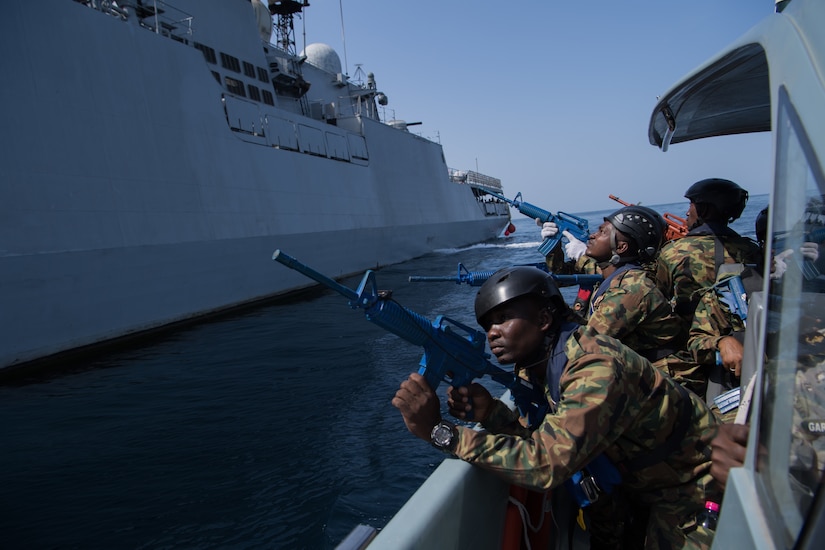
From the deck of a ship, service members point guns upward at a large ship.

More engagement is needed, the general said. Exercise African Lion and the Express series of naval exercises are important to develop the personal contacts needed to operate on the continent. In addition, having more African military officers and noncommissioned officers going to American professional military education would also benefit U.S. relations with the nations of the continent. 

The Ebola outbreak of 2014 is an example of what U.S. aid can achieve in Africa. When the disease first appeared, U.S. military epidemiologists worked closely with African medical professionals to contain the disease. They worked to educate populations on ways to stop transmission and developed procedures to care for those infected. U.S. Army units deployed to the region to build care facilities, laboratories and more.

The epidemic ended without becoming a global pandemic. "Ebola is still present in some countries in Africa, but they learned how to contain it," Townsend said. "Sure, we helped them develop their capabilities, but they have [the] capacity to manage Ebola on their own now."