
From left: the USNS William McLean, the USS Bataan and the USS Oak Hill travel through the Suez Canal, June 15, 2020.
From left: the USNS William McLean, the USS Bataan and the USS Oak Hill travel through the Suez Canal, June 15, 2020.
Now that Pennsylvania has begun a phased reopening from the COVID-19 crisis, Fort Indiantown Gap has begun gradually increasing operations.
Several facilities and recreation areas had closed, some training and events were cancelled, and some employees worked from home, but the installation still remained open.
"Although operations were reduced and some things were canceled, Fort Indiantown Gap never closed," said Army Col. Lane Marshall, the garrison commander. "The primary focus shifted from training to supporting our soldiers and airmen who were serving the citizens of the commonwealth in the fight against the spread of COVID-19."
The 17,000-plus-acre installation, which is home to the headquarters of both the Pennsylvania National Guard and the Pennsylvania Department of Military and Veterans Affairs, is one of the busiest National Guard training sites in the country, with more than 120,000 service members training there annually. The fort also hosts training for law enforcement and other state and federal agencies.
While some training was canceled, training didn't completely cease. For example, the 28th Expeditionary Combat Aviation Brigade completed predeployment training at the fort for a previously scheduled rotation to the U.S. Central Command area of operations.
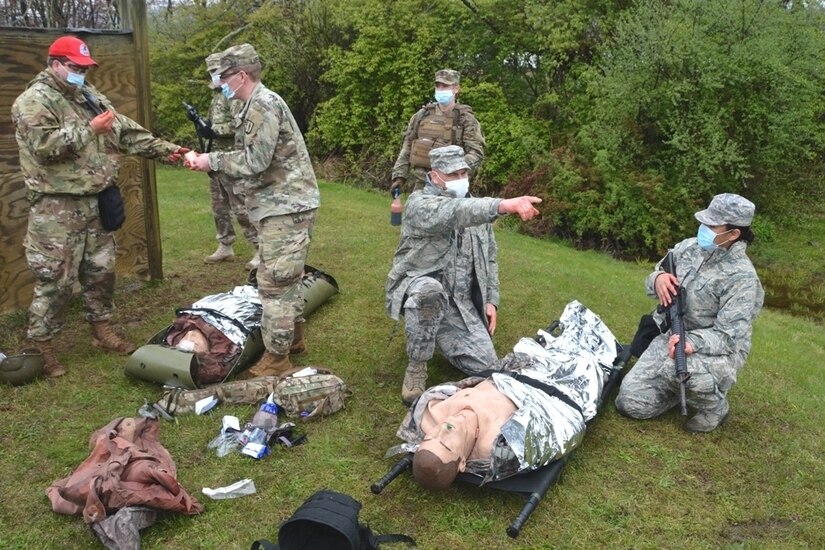
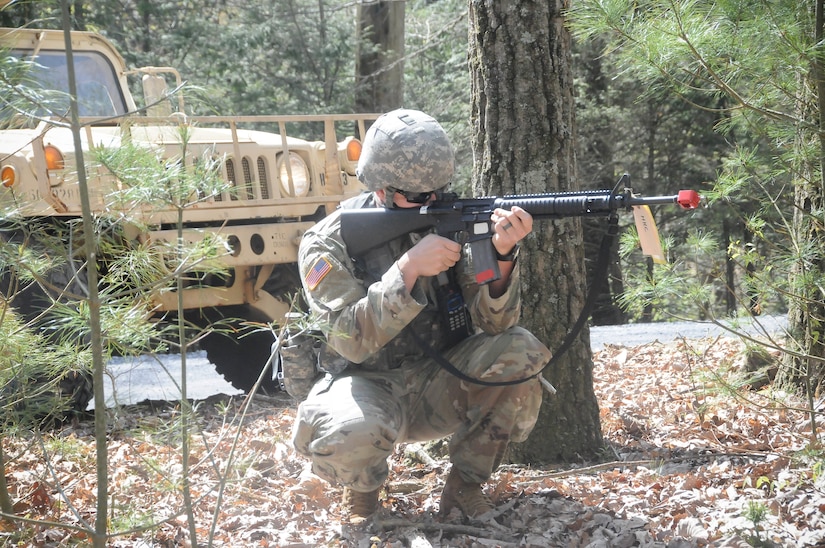
Training in weapons qualifications, grenade training and land-navigation training was done while taking measures to prevent the spread of COVID-19, such as social distancing and wearing facemasks, to the extent practical.
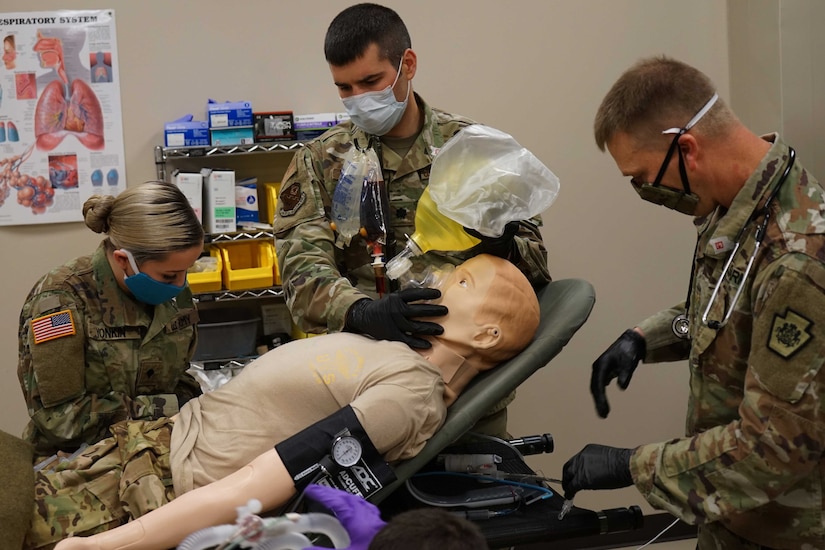
Additionally, Pennsylvania National Guardsmen who were activated for COVID-19 support missions received various types of medical training at the installation's Medical Battalion Training Site and Medical Simulation Training Center.
Now that operations are beginning to ramp up, the training center is anticipating an influx of training requests from units attempting to salvage their training year, and the range scheduling section has already started receiving training requests.
The directorate of plans, training, mobilization and security, under the guidance of the garrison commander, has been developing courses of action aimed at maximizing use of the fort's training assets while incorporating measures to mitigate the potential spread of COVID-19 among the training population and the installation's permanent party service members and employees.
"We are doing everything we can to ensure units can train in a safe manner so they can maintain readiness and they are able to complete their missions when called upon," Marshall said.
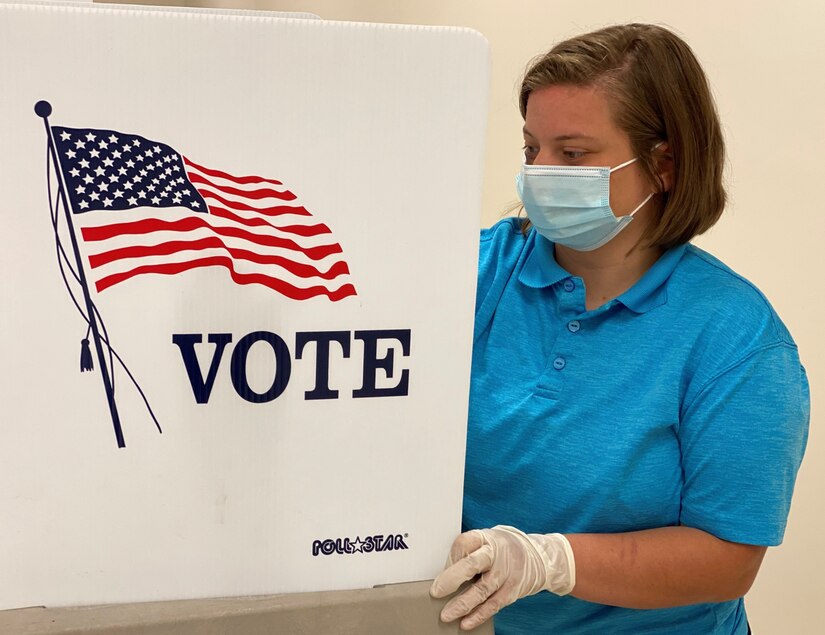
Guardsmen — who will serve out of uniform — will perform nonelection officer duties, such as setting up and cleaning poll locations and assisting with traffic, parking and crowd control in a non-law-enforcement capacity under the direction of election officers, officials said. The guard will not perform duties reserved for trained election officials, such as handling ballots or screening voters to determine who can vote.
Many of Kentucky's poll workers are older and have to self-quarantine because of high risk factors for COVID-19, creating a need for extra help at the polls, said Army Col. Andrew Bates, the deputy chief of staff for the Kentucky National Guard. This partnership will help protect those who are most vulnerable and allow them to remain healthy at home, he added.
''The National Guard has been asked to help in many different ways around the commonwealth, as we stand together against the COVID pandemic,'' Bates said. ''This is just another way the Kentucky Guard is making a difference in their neighbor's lives in times of crisis.''
Army Lt. Col. Andrew Caldwell, the director of military support for the Kentucky National Guard, said this is the first time, to his knowledge, that the Kentucky Guard has been asked to assist in an election. He said the guardsmen who are assisting volunteered to do so.
''We are here to support the commonwealth,'' Caldwell said. ''At a time when most of the volunteers at the polling stations are in the high-risk category for the coronavirus, we are here to step into that role and protect our state and our citizens.''
In addition, Caldwell said, guardsmen will serve only at locations in the 44 counties for which election officials requested the guard's assistance. Richard Vowels, director of the Jefferson County election center, said guardsmen were invaluable in assisting with setting up poll stations in his county ahead of the election. Vowels said because of social distancing requirements, his center has never had to set up polling locations this large.
''Our office does not have many employees in it,'' Vowels said. ''We could not have made this happen without [the guard],'' he continued. ''The help has really been tremendous.''
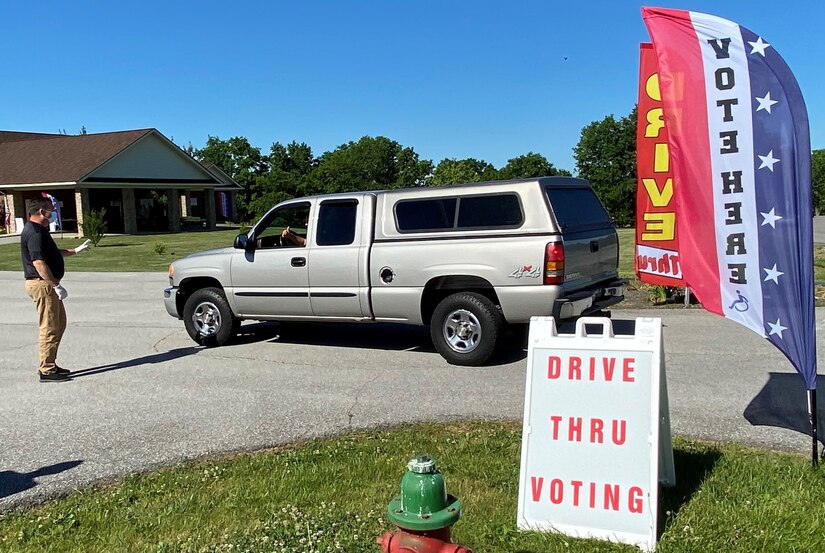
In Anderson County, where residents can vote early using drive-thru or walk-in stations, County Clerk Jason Denny said the guard's assistance has been a great benefit.
''The soldiers have been helping us with traffic control and doing things like sanitizing voting stations to help prevent the spread of the virus,'' he said. ''It's been very beneficial. We appreciate the guard being able to do this for us.''
On June 12, Army Chief Warrant Officer 2 David Cureton, with the Kentucky National Guard, received a thumbs-up from a voter as he directed traffic through a drive-thru voting station at the Anthony Stratton Building in Lawrenceburg.
''I'm just doing my part to help provide support during COVID-19,'' Cureton said.
The Kentucky National Guard has found itself serving in multiple capacities during the pandemic, such as assisting with food banks and turning an exhibit hall at the state fairgrounds into a field hospital. This year has presented several missions that require skill sets that are not often required to be used outside of the training environment, said Army Maj. John Kwiek, the special project officer with the Kentucky National Guard.
''Our Kentucky National Guard soldiers have excelled at every task placed in front of them,'' Kwiek said. ''Our soldiers have shown the commonwealth and their communities that we have been trained to provide assistance in many capacities, both home and abroad.''
With this most recent assignment, Kentucky joins other states who have also recently used guardsmen in elections, including Nebraska and Wisconsin. While preparing to assist at polls, Kentucky National Guard leaders said they studied best practices from the Wisconsin National Guard, which reported a successful election-support mission.
(Army Capt. Cassandra Mullins is assigned to the 133rd Mobile Public Affairs Detachment.)
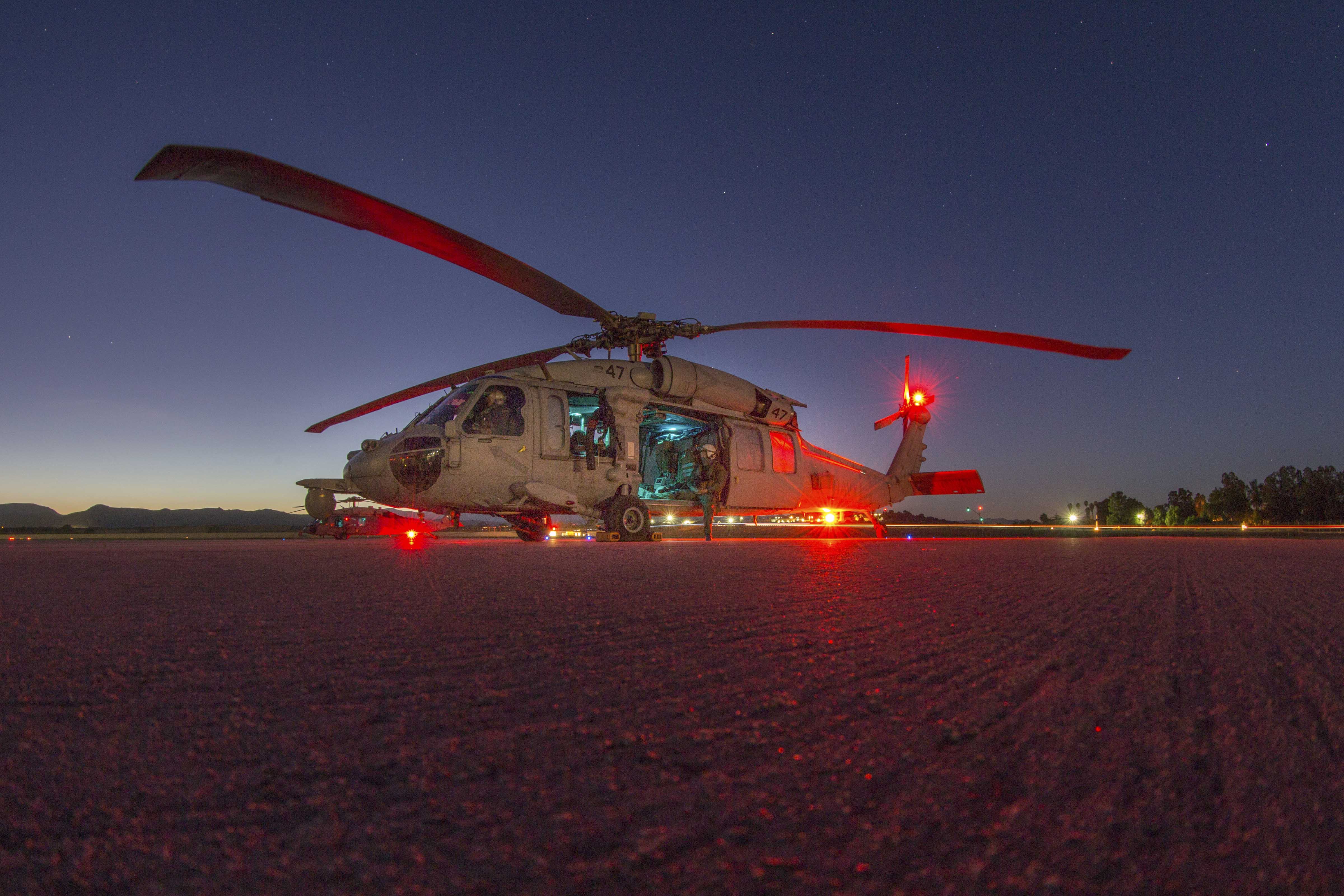
A Navy MH-60 Seahawk helicopter sits on the flightline before a simulated casualty evacuation exercise at Marine Corps Air Station Camp Pendleton, Calif., June 13, 2020.
Statement attributed to Lt. Col. Mike Andrews, Department of Defense spokesman:
Today the Department is announcing five Defense Production Act Title III actions to help sustain and strengthen essential domestic industrial base capabilities and defense-critical workforce in shipbuilding, aircraft manufacturing, and clothing and textiles. These actions will help to retain critical workforce capabilities throughout the disruption caused by COVID-19 and to restore some jobs lost because of the pandemic. The Department remains closely partnered with FEMA and HHS, providing almost $2.9 billion in life-saving medical services, supplies and equipment to service members and federal agencies in the nation's whole-of-government approach to the coronavirus pandemic.
As part of the national response to COVID-19, the Department of Defense entered into a $50 million agreement with Austal USA to maintain, protect, and expand critical domestic shipbuilding and maintenance capacity. These investments will have long-term benefits for U.S. Navy shipbuilding while accelerating pandemic recovery efforts in the Gulf Coast region.
Using funds authorized and appropriated under the CARES Act, this DPA Title III investment will protect jobs and bolster the local economy in a region hit hard by the COVID-19 pandemic and ensure critical capabilities are retained in support of U.S. Navy operational readiness.
Austal USA is based in Mobile, Alabama, which is the principal place of performance.
As part of the national response to COVID-19, the Department of Defense entered into a $55 million agreement with W International to maintain, protect, and expand critical domestic industrial base capability for the U.S. Navy nuclear shipbuilding industry. These investments will have long-term benefits for Navy shipbuilding while accelerating pandemic recovery efforts in the South East region of the United States.
Using funds authorized and appropriated under the CARES Act, this DPA Title III investment will support capital projects to maintain and support capacity, workflow improvements, and workforce development. These investments will protect jobs in a region hit hard by the COVID-19 pandemic and ensure critical capabilities are retained in support of U.S. Navy operational readiness.
W International is located in Goose Creek, South Carolina, which is the principal place of performance.
As part of the national response to COVID-19, the Department of Defense (DoD) entered into a $25 million agreement with Weber Metals Inc. to sustain critical domestic industrial base capability and capacity for making of large, open and closed die forgings used in many DoD weapons systems.
Using funds authorized and appropriated under the CARES Act, this DPA Title III investment will expand production capability and capacity to meet vitally important DoD demand and improve associated processes including conversion and core processing in their supply chain. These investments will enable Weber Metals Inc to retain critical workforce capabilities throughout the disruption caused by COVID-19 and to restore jobs lost due to the pandemic.
Weber Inc. is headquartered in Paramount, CA, which is the principal place of performance.
As part of the national response to COVID-19, the Department of Defense entered a $55 million agreement with GE Aviation to sustain essential aircraft engine component manufacturing capabilities. The purpose of this investment is for the remanufacture of selected critical engine components used on the F110-100/-129 turbofan jet engine and the F118-101 turbofan jet engine. These engines power the F-16 and the U-2 aircraft respectfully.
Using funds authorized and appropriated under the CARES Act, this DPA Title III investment will enable GE and their sub-tier suppliers, including small business, minority owned, women owned and veteran owned businesses to retain/reinstate more than 225 American jobs. It is critical to national defense that GE and their affiliated companies remain viable and working.
Additionally, both the F-16 and the U-2 propulsion systems have future forecasted readiness challenges and the injection of these Title III funds will enable the USAF to avoid that projected shortfall.
GE is a world-leading provider of jet and turboprop engines, components, and integrated systems for commercial, military, business and general aviation aircraft. GE Aviation has a global service network to support the aviation industry with extensive repair capabilities and experienced technicians, which provides the highest level of customer service and world-class performance.
Besides GE some of the affected sub-tier companies and vendors are located in: Grand Prairie, TX; East Granby, CT; Rochester, NY; Cincinnati OH; Bloomfield, CT; Brazil, IN; Asheville, NC; and Ithaca, MI, to name a few locations.
The Department is confident that this effort not only sustains the viability and readiness of current propulsion systems but will also continue to advance leading edge propulsion technologies.
As part of the national response to COVID-19, the Department of Defense entered a $2 million agreement with American Woolen Company to sustain domestic production of poly/wool blend fabric for U.S. Army dress uniforms.
Using funds authorized and appropriated under the CARES Act, this DPA Title III investment will sustain the domestic production capability and capacity of poly/wool blend fabric for Army dress uniforms. The sustainment of this production capability will ensure the U.S. Government gets dedicated long term industrial capacity to meet the needs of the nation.
This investment will leverage American Woolen Company’s manufacturing capabilities to commercialize the Army Green Service Uniform (AGSU) fabrics, enabling the government to diversify the supply chain and add a second source of innovation to the market.
American Woolen Company is a small, women-owned manufacturer of wool and wool/blend fabrics based in Stafford Springs, Connecticut, which is the principal place of performance.
Website resources:
DoD Coronavirus update: https://www.defense.gov/Explore/Spotlight/Coronavirus/
DoD Industrial Policy: https://www.businessdefense.gov/coronavirus/
Joint Acquisition Task Force: https://www.acq.osd.mil/jatf.html
Defense Production Act Title III: https://www.businessdefense.gov/Programs/DPA-Title-III/

U.S. airmen and Canadian soldiers prepare to board a C-17 Globemaster III during aerial medical evacuation training at Ali Al Salem Air Base, Kuwait, June 17, 2020.

An Air Force C-130J Super Hercules waits for passengers to board during loading and unloading operations in Kenya, June 15, 2020.
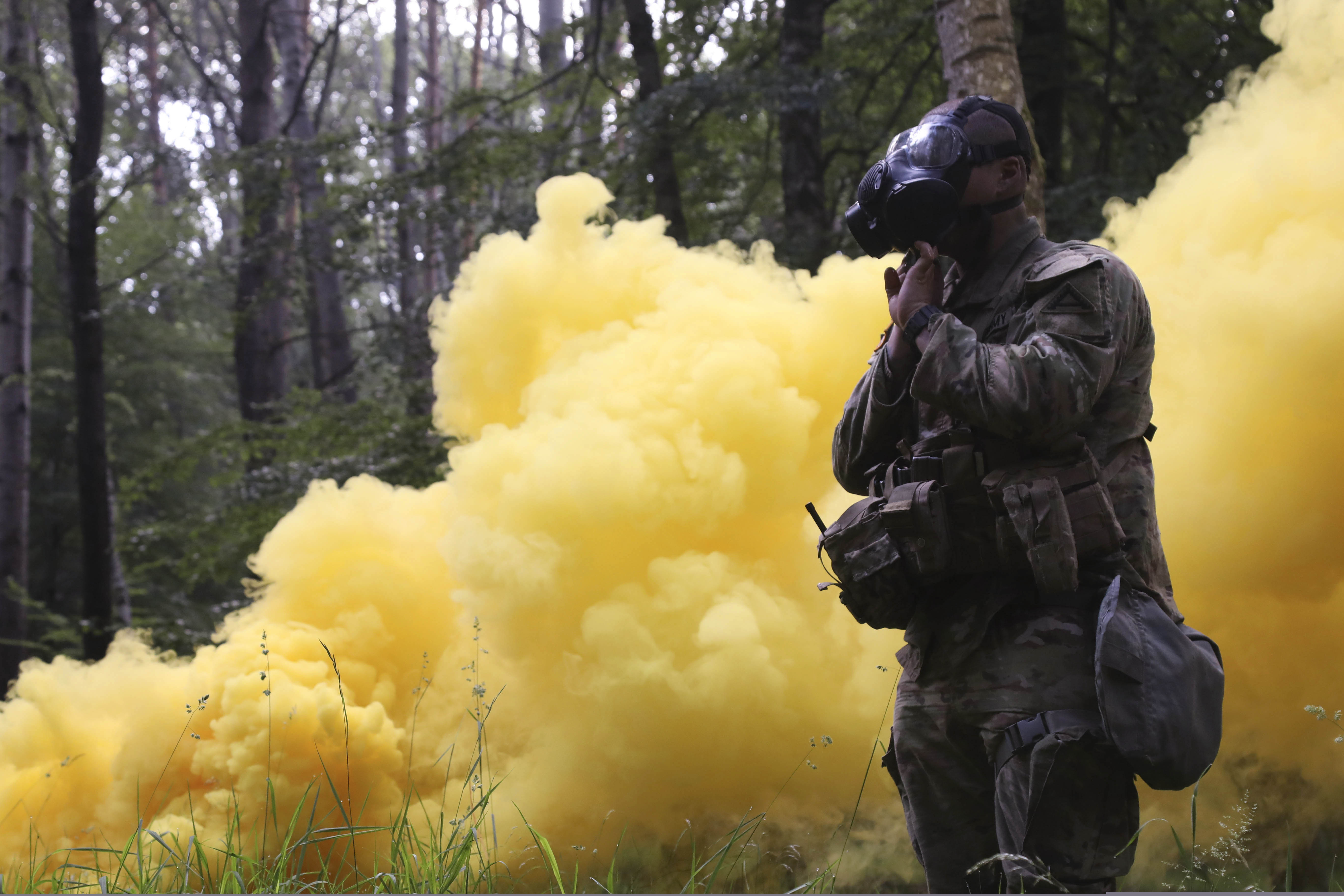
A soldier participates in the Noncommissioned Officer of the Year and Soldier of the Year Competition at the Joint Multinational Readiness Center in Hohenfels, Germany, June 17, 2020.
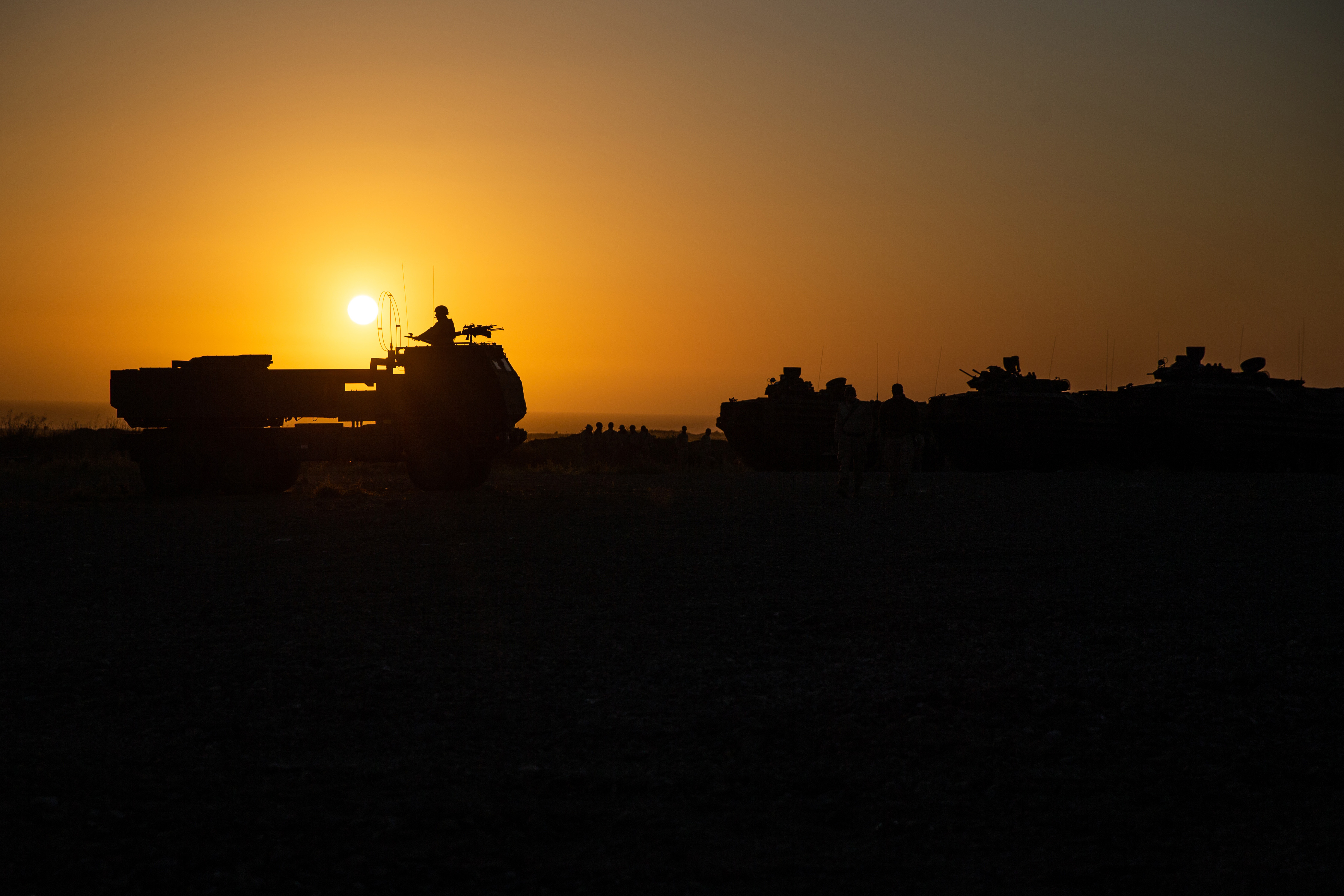
Marines conduct simulated fire missions with an M142 High Mobility Artillery Rocket System during an exercise at San Clemente Island, Calif., May 2, 2020. The rocket system, which is intended to engage and destroy artillery, air defense concentrations, light armor and fortified stationary targets, is capable of firing GPS-guided munitions.
''We've placed complex dynamic missions overseas and here at home,'' Army Lt. Gen. Daniel R. Hokanson said at today's confirmation hearing. ''The next chief of the National Guard Bureau must continue to effectively navigate this unprecedented landscape and work closely with stakeholders at the international, federal, state and local levels.''
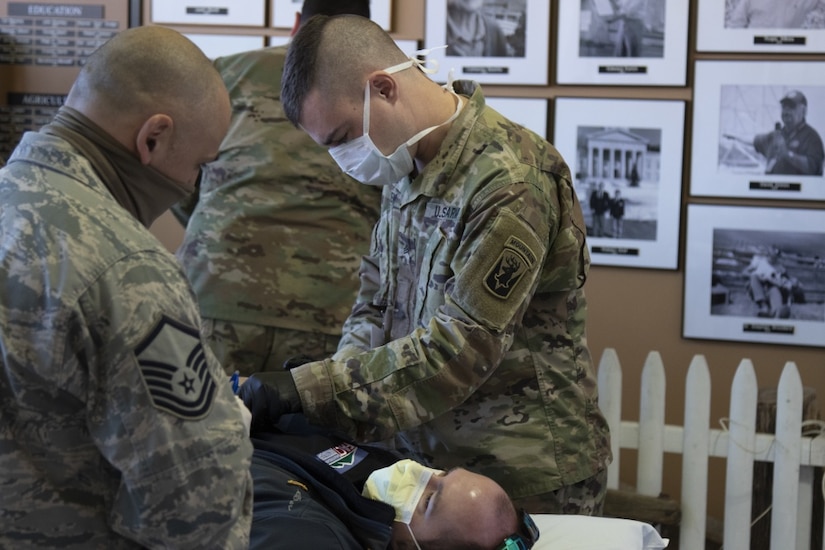
If confirmed by the Senate, Hokanson will be promoted to the rank of general to head up the bureau, where he is now vice chief.
If he is confirmed, he told the Senate panel, he will work with the committee to ensure the National Guard is manned, trained, equipped and ready, whenever and wherever it's needed.
In recent months, the National Guard has been on the front lines of the COVID-19 pandemic response in every state, territory and the District of Columbia, where guard members are helping communities fight the invisible enemy.
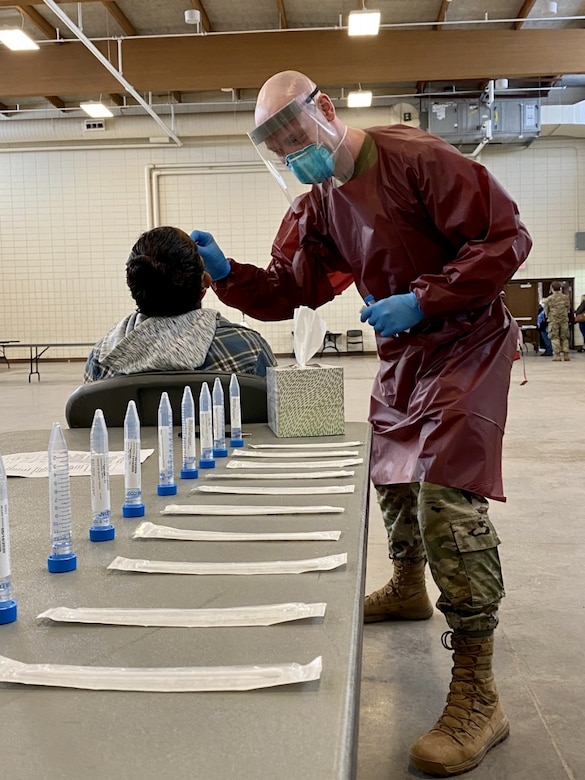
''[Guard members] are supporting key functions in their communities [for] testing sites, long-term care facilities, hospitals and food banks. We have delivered personal protective equipment, sewn face masks, turned convention centers into alternate-care facilities and so much more,'' Hokanson said.
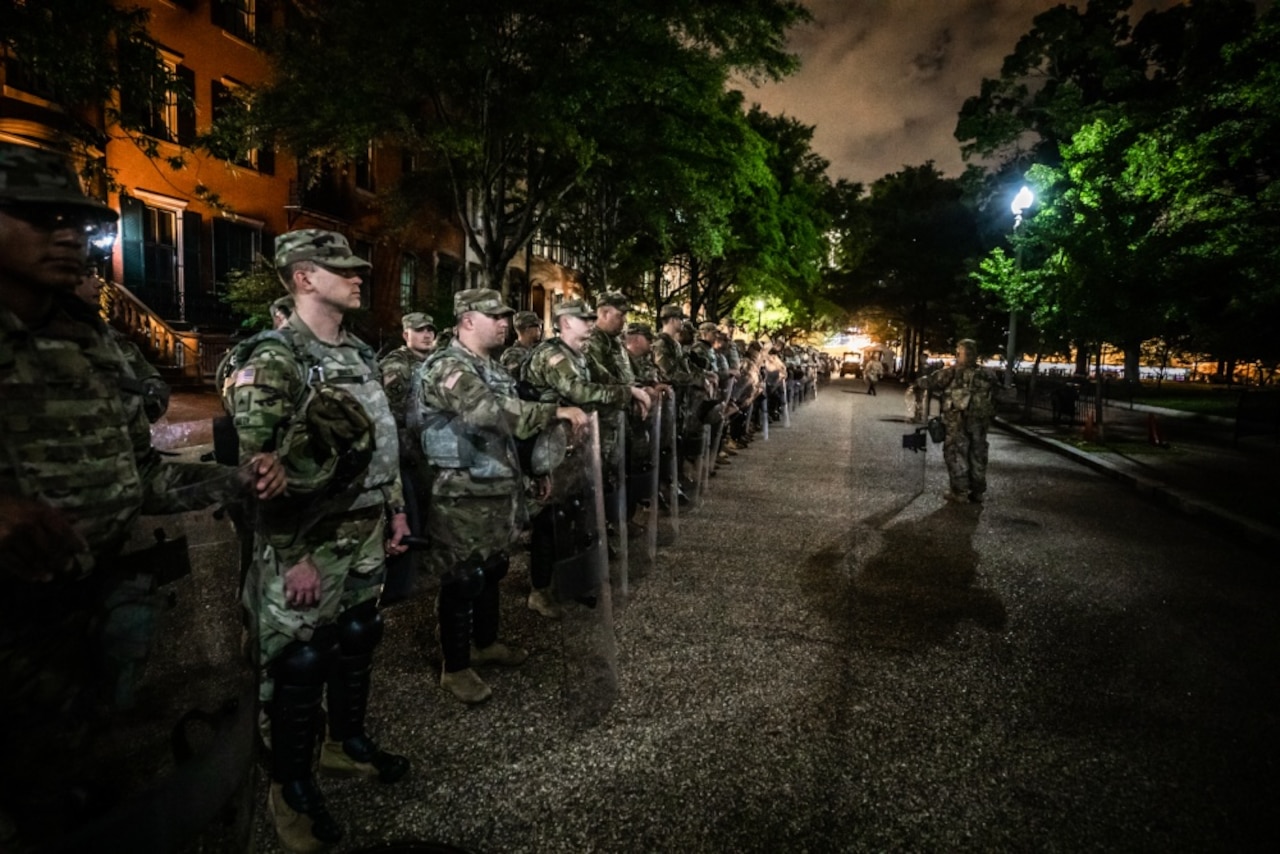
The National Guard also has responded to civil unrest in several states and Washington, D.C., as part of a national call for justice and racial equality, he said. ''Our soldiers and airmen were there to protect our First Amendment rights and preserve public safety in the communities where we live,'' the general added.
The citizen-soldiers and -airmen responded to those events and others in the homeland while simultaneously meeting all overseas deployment requirements to support combatant commands and the National Defense Strategy, Hokanson noted.
''As a result, we reached a new peak earlier this month of over 120,000 citizen-soldiers and -airmen mobilized worldwide. What makes this possible has not changed since the founding of our National Guard in 1636,'' he told committee members.
Hokanson called National Guardsmen and women ''incredible.''
''They have [been] and will always be my highest priority,'' he said. ''They balance their military careers, civilian careers, their families and all the sacrifices they must make so we can live true to our motto, 'Always Ready, Always There.'''
Whether in the face of the enemy or a deadly global pandemic, the Marine Corps not only stays ahead of the curve, but also flattens it.
World War I showed the world the destruction and devastation that a man could do to another man, but the deaths caused by man paled in comparison to the destructive force that a simple virus can bring to the table. The 1918 Spanish Influenza pandemic, which is known as one of the world's deadliest pandemics, affected about a third of the world's population at the time, and it resulted in the deaths of millions due, in part, to countries not following proper health protocols.
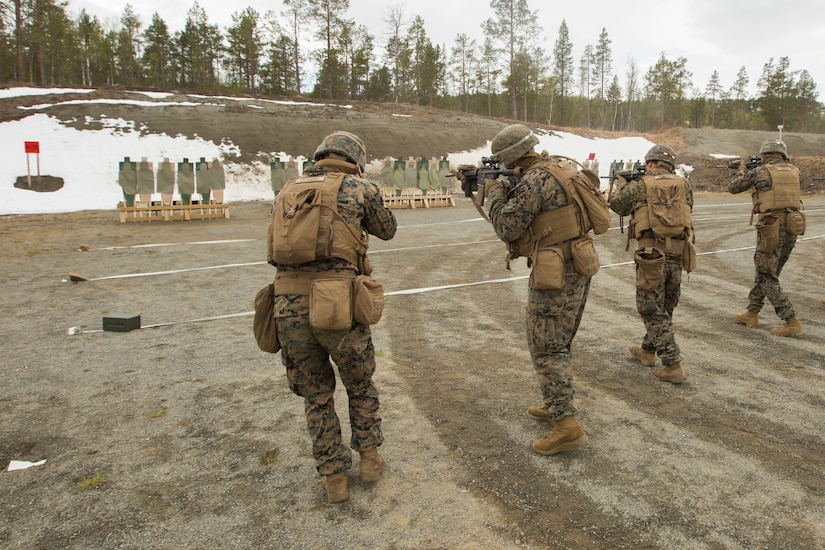
A century later, the Marine Corps has learned from the past, and the Marines and sailors with 3rd Battalion, 2nd Marine Regiment, 2nd Marine Division, 2nd Marine Expeditionary Force deployed to Norway in May as part of Marine Rotational Force Europe 20.2, Marine Forces Europe and Africa, which focuses on cold-weather and mountain-warfare training and military-to military engagements to enhance interoperability with allies and partners.
"COVID-19 was certainly a challenge to readiness," said Marine Corps Lt. Col. Brian Donlon, the battalion commander of MRF-E. "It imposed conditions on the battalion's ability to train that were new and challenging, but COVID did not erase the requirement to be ready to deploy, to be expeditionary, and be prepared to execute our mission-essential tasks."
During the deployment process, the battalion mandated strict social distancing, hygiene protocol and mask donning, and Navy corpsmen continuously screened Marines and sailors for any symptoms of the virus. Once in Norway, a 14-day quarantine was executed.
"We treated quarantine a lot like being on ship, and when we were in quarantine, we did our prep for combat in the limited spaces available to us, and we created a battle rhythm that was essentially shipboard living," Donlon added.
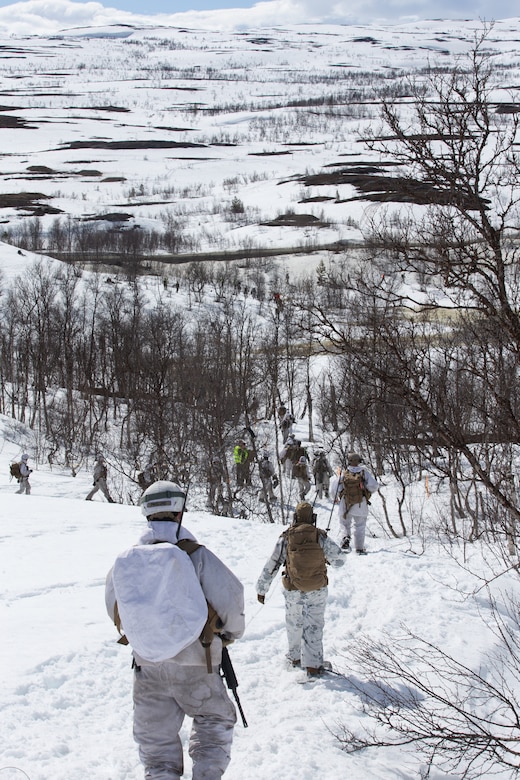
After a successful 14-day quarantine where the battalion saw zero COVID-19 cases, the Marines and sailors immediately transitioned into the annual interoperability exercise, Thunder Reindeer, located inside the Arctic Circle. The exercise included opportunities to practice live-fire and combined arms training, as well as air integration.
On the ground, the Marines found themselves setting up camp in snowy, rocky terrain, much different from the humid, swampland they were used to at their home station in North Carolina. In the morning, the Marines tactically integrated with the Norwegians to provide support by fire.
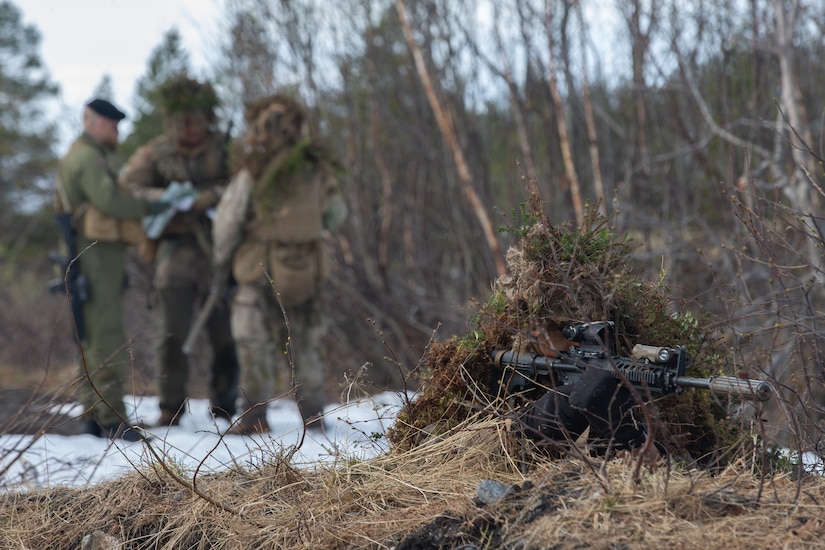
Marine scout snipers maneuvered through forests across mountainous terrain to practice stealthy link up procedures with their Norwegian counterparts without giving away their position.
"This shows the flexibility of each country and our ability to quickly integrate after coming out of quarantine," said Marine Corps Sgt. Stephen Michaels, a scout sniper.
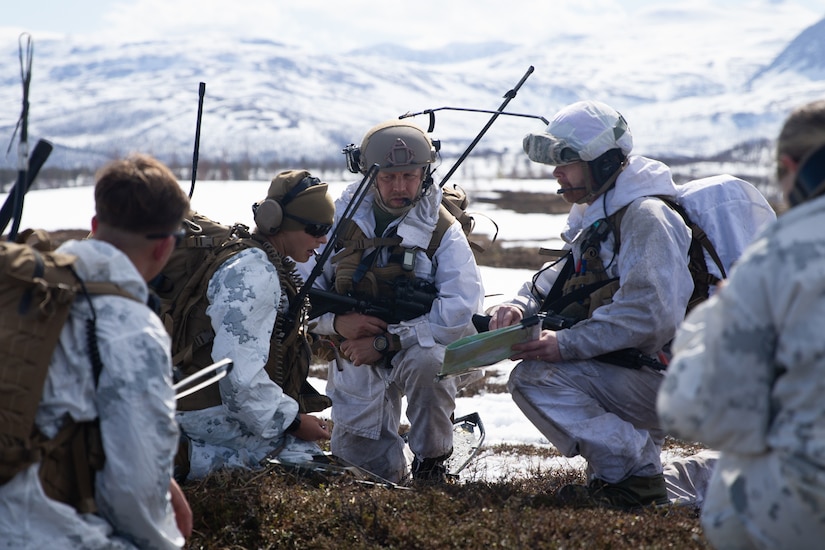
Marines also integrated with a Norwegian artillery battalion and learned how their NATO counterpart conducts a call for fire. The Norwegians were able to integrate air, land, and naval assets, including F-35 fighter jets, in a joint setting at the battalion level for the first time.
The Norwegian government announced its support for purchasing F-35s in 2008, and the first round of jets became operational in late 2019. According to Norway's chief of defense, bringing the capability to communicate with the jets is still a work in progress for the different Norwegian army, navy and air force units.
During Thunder Reindeer, the Marines stepped in to assist with the progress by simulating air support in conjunction with Norway's 2nd Army Battalion and Marine forward air controllers.
While out in northern Norway's arctic climate and mountainous terrain, contact with participating F-35 jets was reached, a milestone previously unattained by the 2nd Battalion. As a result, troops on the ground received the simulated support needed.
"It's a personal feat for the Norwegians as they continue to progress with that sort of technology and being able to use them not only as air assets, but air-to-ground," said Marine Corps Capt. Sage Santangelo, a Marine forward air controller.
Lt. Col. Erling Nervik, the commander of Norway's 2nd Battalion, said making contact and having air support was an important asset to bring into the training and that he was very satisfied with his experience with the Marines.
"We are in many ways like-minded, and we have been good allies for many years and working together with the USMC is always a pleasure," Nervik said. "After being at Quantico in America for a year at the Command and Staff College, I know the Marines — know the attitude, the mentality. I'm looking forward to the cooperation between two good allies."
The Marines are expected to operate in Norway until the fall, and they and the Norwegians plan to hold various exercises during that time for continued interoperability and arctic training.
(Marine Corps Lance Cpl. Chase Drayer is assigned to Marine Corps Forces Europe and Africa.)
As COVID-19 continued to affect deployments around the world, airmen downrange found hope in their wingmen and showed true resilience when challenges were thrown their way.
Due to the unforeseen mission impacts due to COVID-19, the 729th Air Control Squadron at Hill Air Force Base, Utah, was unable to replace members of the 726th Air Control Squadron on time. This pushed back the 726th ACS airmen's redeployment to their home station at Mountain Home Air Force Base, Idaho, by almost a month.
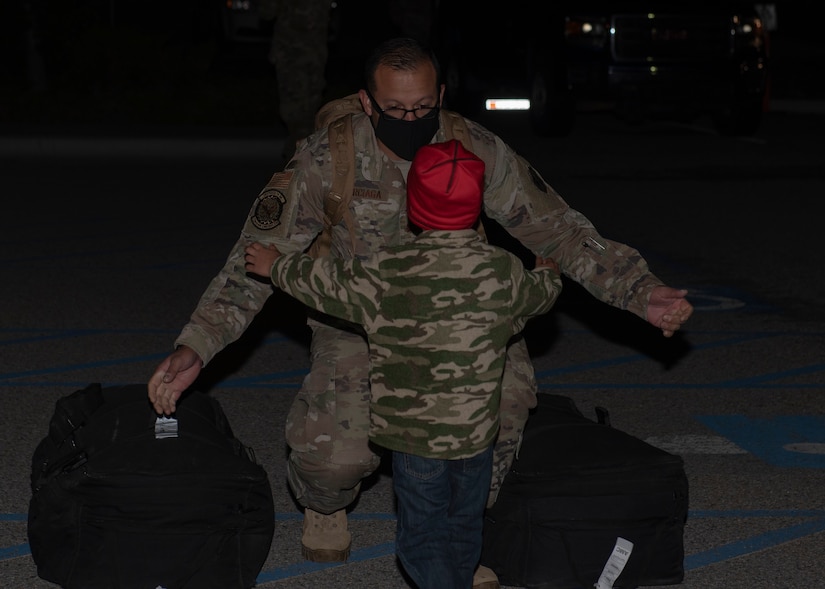
As COVID-19 began to ramp up, Air Force Airman 1st Class Barbara Miller, a surveillance technician with the 726th ACS, knew her homecoming would not be the same.
''During month seven, we still didn't know when we were coming home,'' said Miller, a first-time deployer. ''Our leadership was transparent, and they were doing what they could to get us back.''
Despite their best efforts, the delay was still disheartening to many. But Miller said she found ways to stay positive and keep pushing forward.
''We got to work with our coalition partners and the Marines,'' she said. ''I couldn't have asked for a better support system; they make the job easier. We knew there would be a light at the end of the tunnel somewhere.''
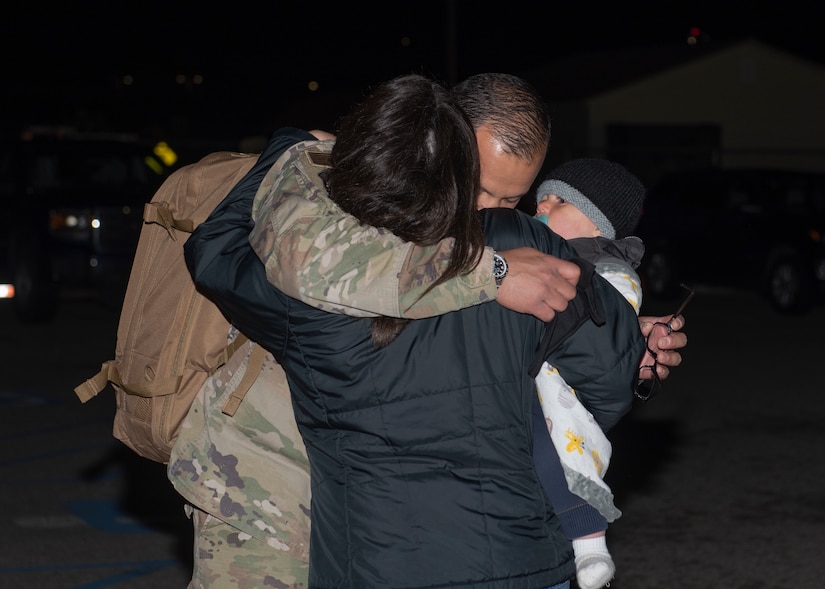
Positivity in the midst of hardship can be difficult, but as it took root in the squadron, people began to notice, including Air Force Lt. Col. Richard Barber, 726th ACS commander.
''There were many mental and physical challenges that they had to go through with this deployment,'' Barber said. ''These airmen adapted so well with the changes that were thrown their way.''
The airmen came together during their time of uncertainty, and so did their families back home.
''We definitely saw a mutually beneficial camaraderie with families and spouses of the deployed airmen,'' Barber said. ''They were hosting virtual coffee hours or virtual trivia nights to break away from the monotony and maintain a social life while physically distancing.''
Airmen and their families proved to be prioritizing their mental health during trying times, Barber said. ''Thankfully, that keeps their minds sharp so they can take care of each other and the mission,'' he added.
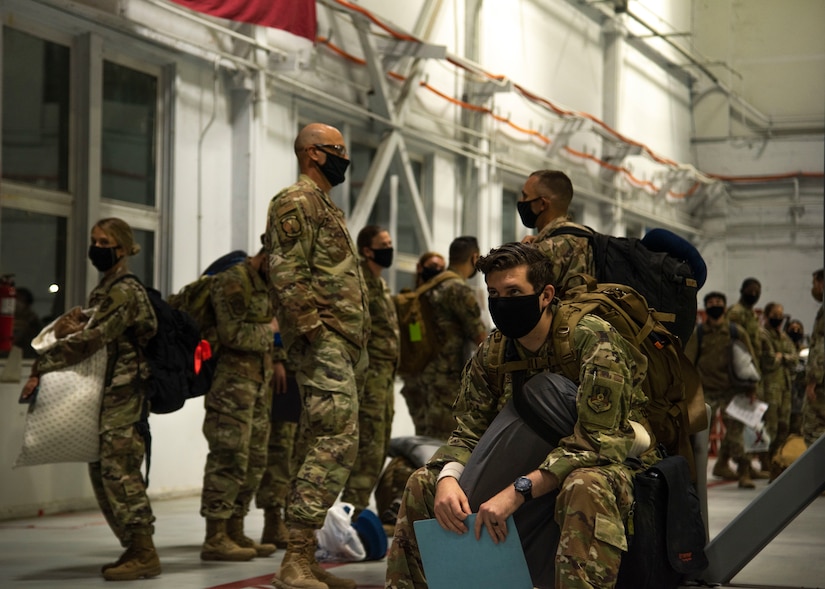
''The airmen that deploy from the 726th ACS and all the ACSs from across the Air Force are the theater air control for the entire theater,'' Barber said. ''They have a large weight of responsibility, and their ability to be resilient with the changes and the daily missions was incredible.''
The airmen of the 726th Air Control Squadron were faced with the uncertainty of the current times and met it with resilience and camaraderie. ''It was a crazy, eye-opening and exciting seven months,'' Miller said. ''I learned a lot about myself and my job, and I would do it all over again.''
(Air Force Airman Natalie Rubenak is assigned to the 366th Fighter Wing.)
Indiana National Guardsmen have been serving Hoosier citizens throughout the COVID-19 response. Despite rigorous missions across the state, these guardsmen continued to maintain combat readiness by practicing combat-related medical care.
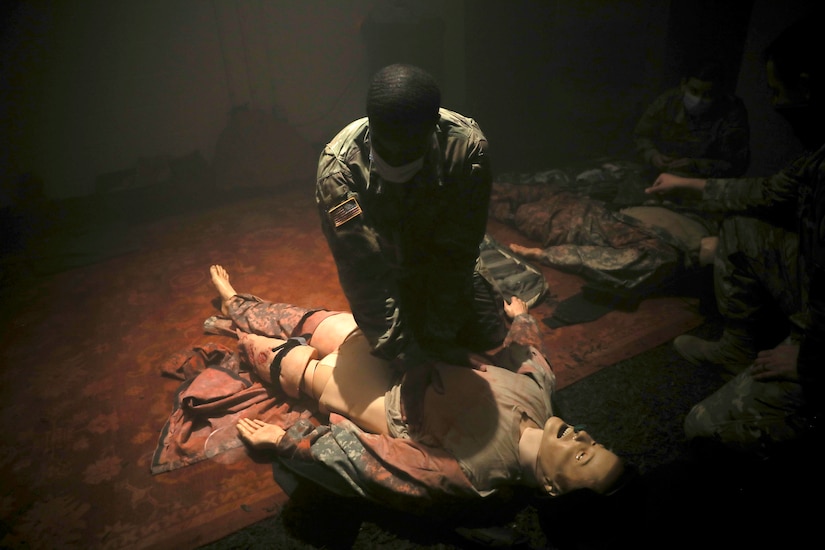
"Training and rehearsals facilitate an efficient, robust and reproducible delivery of services," said Army 1st Sgt. Ryan A. Richmond, the medical branch noncommissioned officer in charge of the Indiana Medical Detachment. "Empowered health care professionals are force multipliers, and they have consistently shown how they are able to turn theory into practice with tailored training over accelerated timelines without losing quality of instruction and patient care."
Between tasks in assisting the community through various missions, the guardsmen completed training on combat-related care at the Medical Simulation Training Center at Camp Atterbury, Indiana. The advanced training facility is one of 22 MSTC sites in the world.
Training began in a lecture format, followed by IV practice. Finally, medics ran through a realistic, hands-on medical training in a combat scenario using cutting-edge patient simulators. Instructors remotely controlled the simulators to display symptoms that included blinking, breathing, increasing or decreasing heart rate, bleeding and more.
The patient simulators were placed in a low-lit room filled with smoke, flashing lights and loud noises to simulate a combat environment. This tested the medics' knowledge and ability to administer care in the battlefield while learning and developing muscle memory.
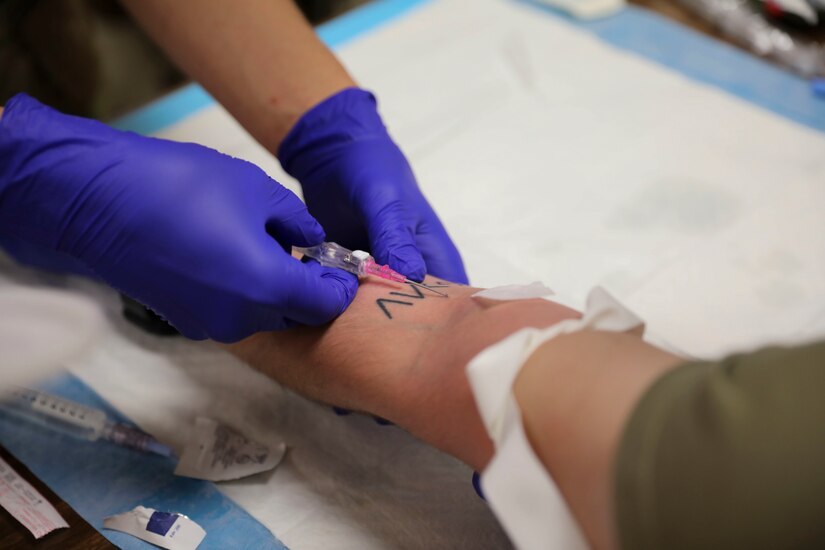
Having high-quality equipment and experienced trainers provided guardsmen the opportunity to increase combat readiness through intensive, realistic training that many leaders hope to continue for guardsmen serving in a traditional status.
The guardsmen also participated in other training, such as running through a litter course, loading and unloading patients on military vehicles, search and rescue training in a rubble pile, suturing practice on pig skin and learning how to provide medical care while in a helicopter.
When the guardsmen weren't training, they served to accomplish their designated COVID-19 response missions. These guardsmen helped thousands of Hoosiers at mobile testing centers across the state while providing relief to multiple civilian agencies and organizations.
"Serving during this pandemic has changed the way people look at how we are serving and has forced us to be flexible and tactical in everything we do," said Army Capt. Jessica Philbin, the medical operations officer for the 219th Engineer Brigade. "It is critical as citizen-soldiers and citizen-airmen to be able to come together in an unfortunate situation to help Hoosiers. We are here fighting the pandemic all together, but we are also able to get some training experience out of it as well."
The training also provided an outlet to relieve stress from working on the frontlines of the COVID-19 pandemic and an opportunity to build relationships across branches. While the operational tempo was rigorous during the statewide response, these guardsmen were proud to be serving their communities while developing themselves as medics, soldiers and airmen.
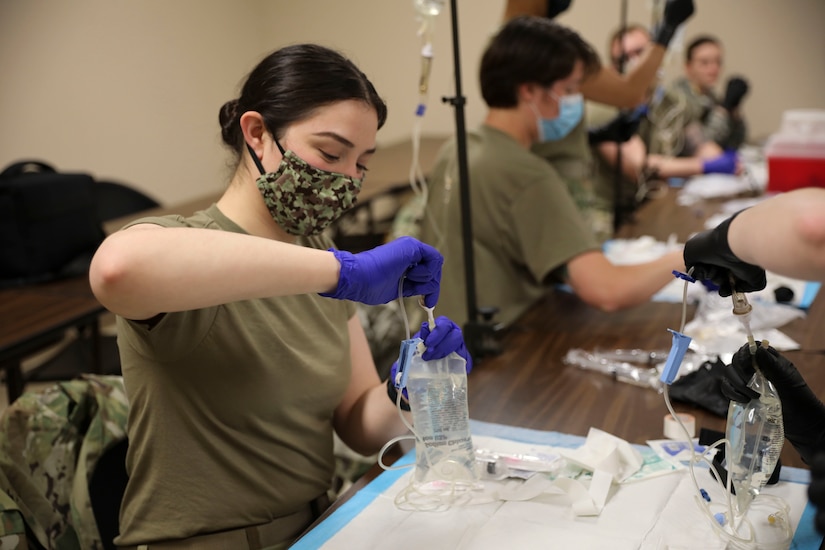
"These are two different types of scenarios," said Army Cpl. Kaley Beckham, a medic with the 738th Area Medical Support Company. "Working with this pandemic is definitely not the same as this training, but they are equally as important. I hope that I have the opportunity to do this training again."
Their effectiveness in accomplishing missions while simultaneously honing their combat-care skills, speaks to the Indiana National Guard's overall commitment to the readiness to fight any enemy — foreign or domestic — that may threaten the state or nation.
"Our health care professionals within the Indiana National Guard are catalysts in the delivery of care while assigned to missions during the state response," Richmond said. "Ensuring each and every one of them have the fundamental knowledge, skills and most up-to-date information facilitates mission readiness, their safety and their success."
(Army Cpl. Hannah Clifton is assigned to the Indiana National Guard.)
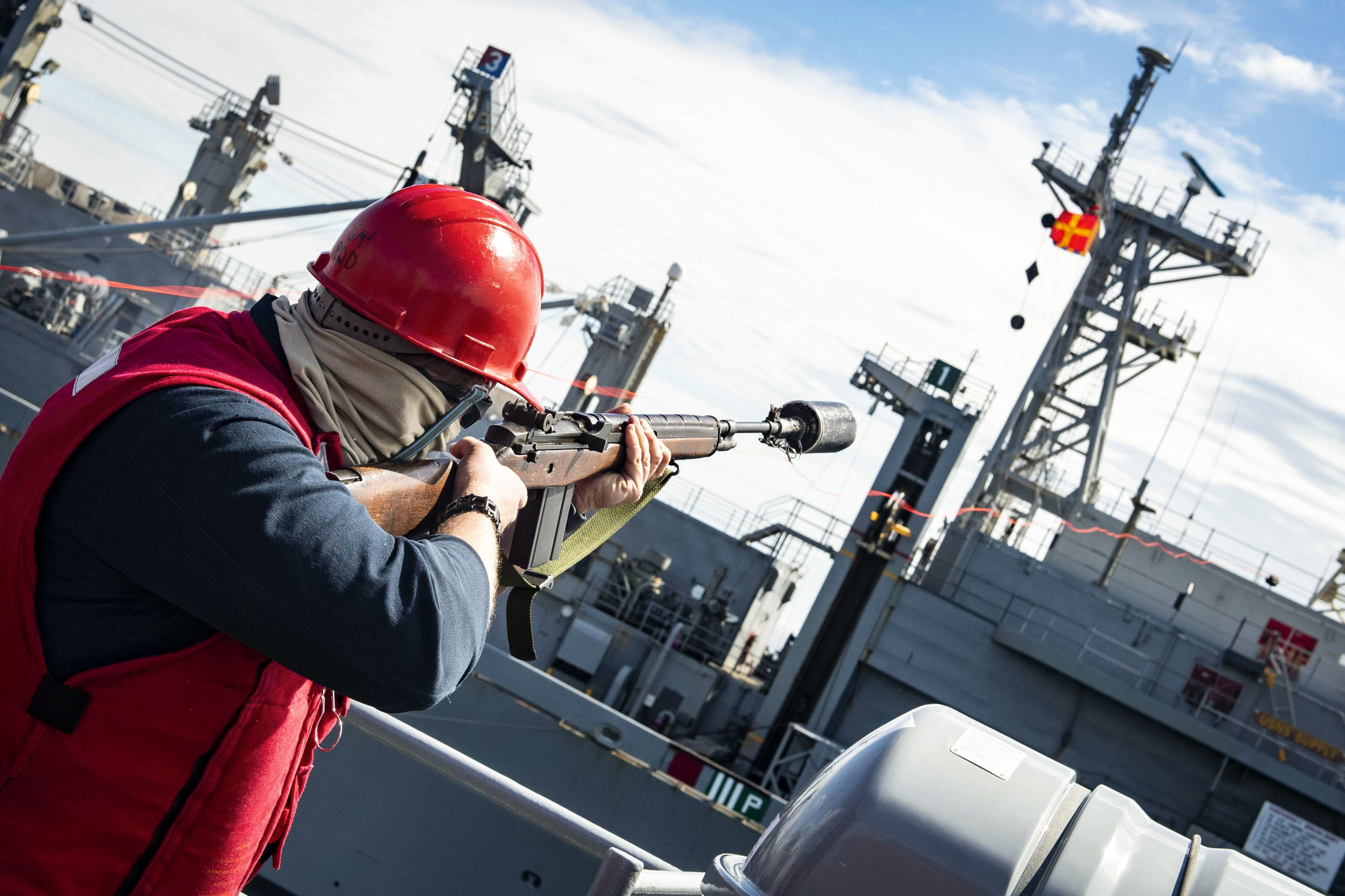
Navy Petty Officer 1st Class Adrian Rodziewicz fires a line to the USNS Supply in the Baltic Sea, June 16, 2020, during Baltic Operations, an annual maritime exercise in the region.
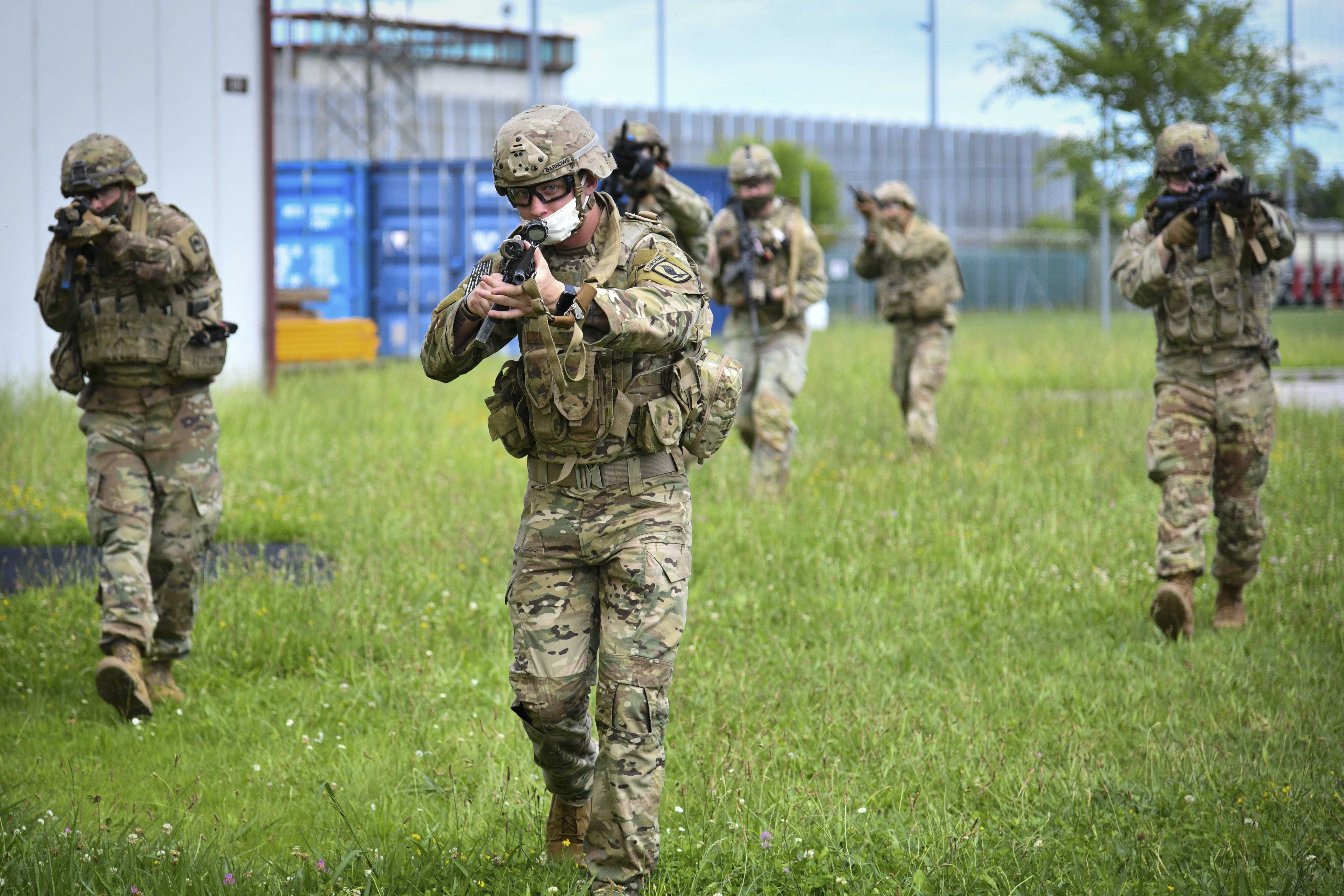
Army paratroopers participate in urban operations training under COVID-19 prevention conditions at Caserma Ederle Range in Vicenza, Italy, June 16, 2020.
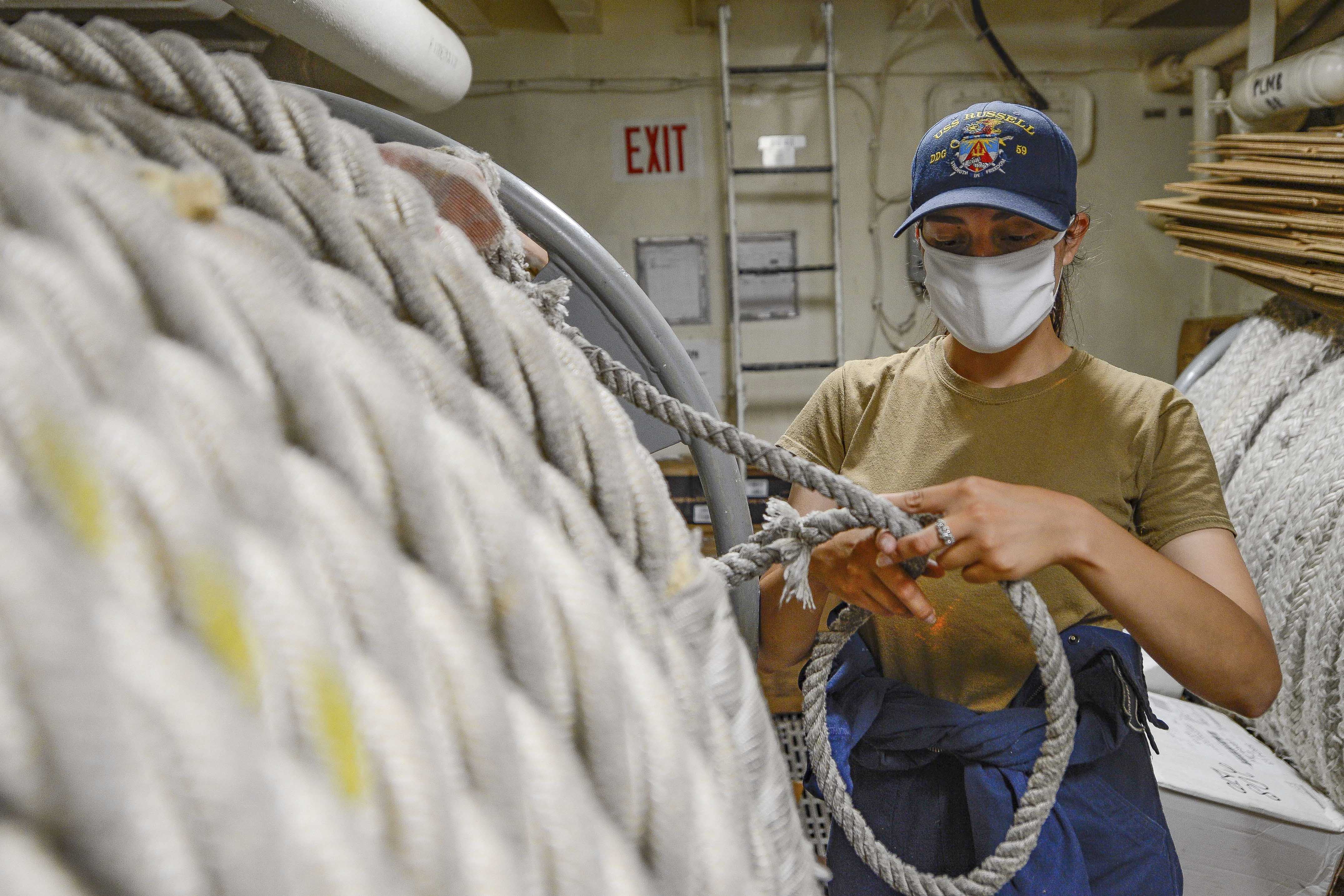
Navy Seaman Rose Ramirez ties a bowline knot aboard the USS Russell in the Philippine Sea, June 15, 2020.
"COVID started when we got here. We've been dealing with it every day for the past few months," said Army Chaplain (Lt. Col.) Douglas Brock, the chaplain for the New York Army National Guard's 42nd Infantry Division.
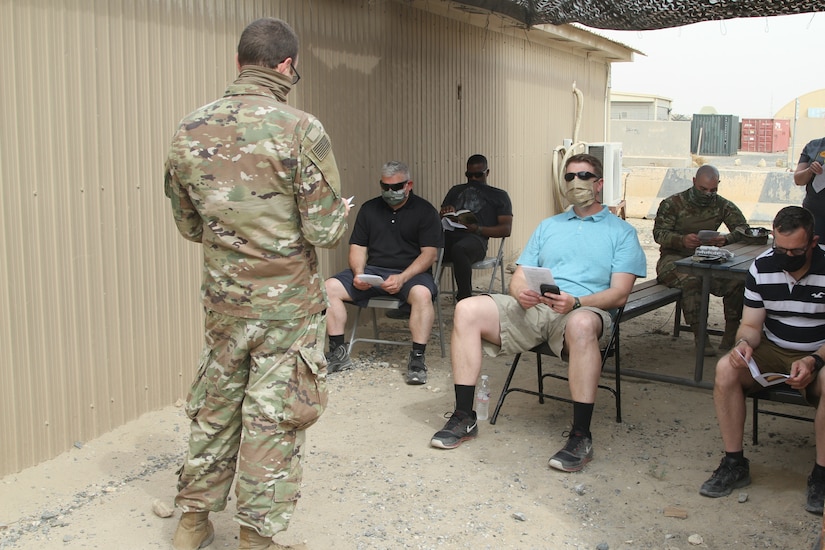
One of the largest impacts COVID-19 had on the task force's installation was the suspension of church services, Brock said.
"So we moved the chapel part of Sunday services to virtual," he said. "For example, my chapel has a Facebook page/group in which some of my chaplain team are posting Sunday messages, or daily messages and engaging with people."
The Facebook group Brock runs is called "AJ Contemporary Family." The Spartan chaplains believe the group makes it easier for soldiers to fulfill their spiritual needs, even if they cannot physically attend services.
"I don't know how well that's impacting our soldiers here on the camp, but we see that people are looking at it," Brock said. "They’re liking it. You have visibility on how many people have looked and how many people have liked and shared, and we’ve seen some action there, so it’s doing its mission."
Brock's social media group isn’t the only service in town. Others have followed suit.
"There are others; in fact, every chaplain program on post has a Facebook group." Brock said.
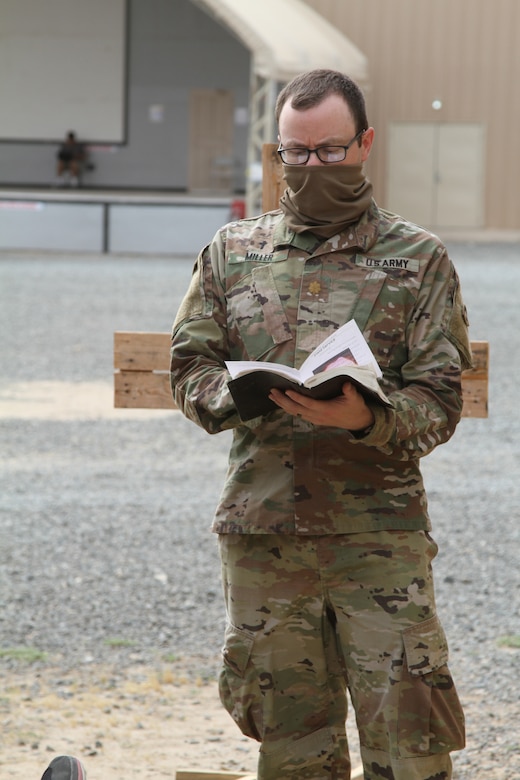
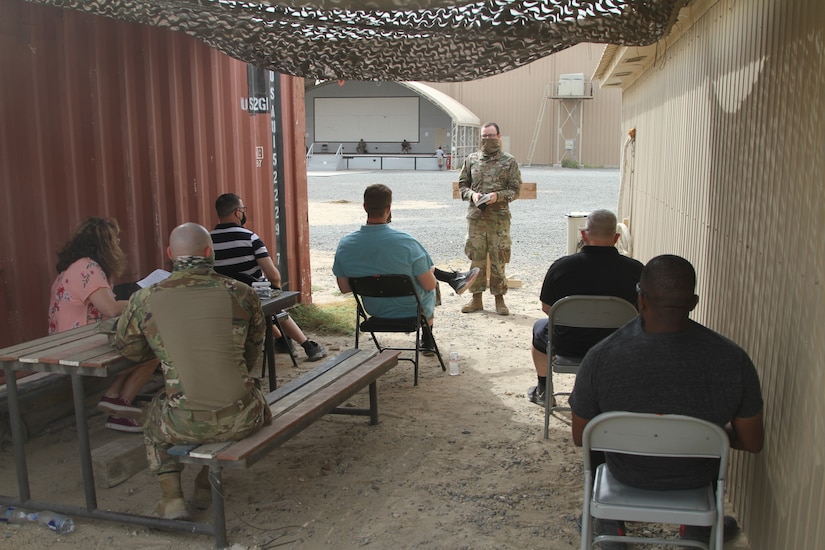
Army Chaplain (Capt.) Matthew Granahan, the chaplain for Task Force Hellhound, 3rd Ordnance Battalion, also has an online group. While keeping up to date with his own social media group, Granahan also works to provide support to soldiers who reside in quarantine or isolation.
"I will stand outside the wire, and soldiers will come up to me on the other side to gather together for a small service," Granahan said. "Sometimes, only one or two will show up, but I'll be there for whoever needs to hear the message."
Virtual services are not the only method for tending to the faithful. Some small-scale services take place outdoors to maintain some semblance of normalcy.
"'When is service?' is one of the questions that I've been asked my whole career. Being able to answer that question reinforces that sense of normalcy, at least for National Guard soldiers that are used to field services."Brock said.
The services appear to have a positive effect on the soldiers who attend, Brock said, but the real struggle concerns current events on the home front. "In talking to my soldiers and talking to my chaplains," he said. "I'm finding that the biggest impact on morale is what's going on at home."
While Spartan soldiers deal with COVID-19, their families at home deal with multiple issues, including quarantine, potential loss of jobs and the increasing civil unrest related to recent events that have taken place in the United States. Without being able to be there for their families, soldiers are turning to their faith to cope.
"According to one soldier, what's hurting morale is the general feeling of ‘My wife and children are going through so many crises at home, and I'm not there to be a part of that,'" Brock said.
With all that going on in the world, Brock still sees this as a chance for soldiers to grow, and he looks at the situation with optimism, which he tries to share in his message.
"We talk a lot now about finding joy in trials and hardships," Brock said. "It's about recognizing God is in control, he can be trusted, he is good, there is hope and justice. We're recognizing that trials and hardship build us; it builds character and makes us stronger."
Brock and his three chaplains from the 42nd are all Christians, but they have made sure to provide opportunities to soldiers of other faiths to practice their beliefs.
"Since COVID, services have largely been virtual. Usually, Ramadan would include celebrating in gathering, and even surrounding nations cut that off," Brock said. "Like the Christians, they are not able to gather in large numbers, but we made provisions for that and provisions for Passover."
Brock wanted to give a message of hope to all the soldiers of Task Force Spartan.
"Rejoice in trial," he said, "Rejoice in trial because we recognize that hardship in trial is how we grow. Think of a gem. Think of basic training. Whatever it is you think of, it's in the hardship that you grow. I encourage you to reconnect with your faith and look for hope outside of your circumstances. Connect with someone, and if you need chaplain help, please reach out to us. So Amen, and Rainbow, never forget."
(Army Sgt. Andrew Valenza is assigned to Task Force Spartan.)
Naval Medical Research Unit San Antonio is giving recent graduates of the Medical Education and Training Campus Biomedical Equipment Technician School practical experience by attacking maintenance backlogs caused by the COVID-19 pandemic.
''Because of the COVID-19 closure, we got behind on our preventive maintenance inspections,'' said Navy Chief Petty Officer David Snow, the senior enlisted leader of the research unit.
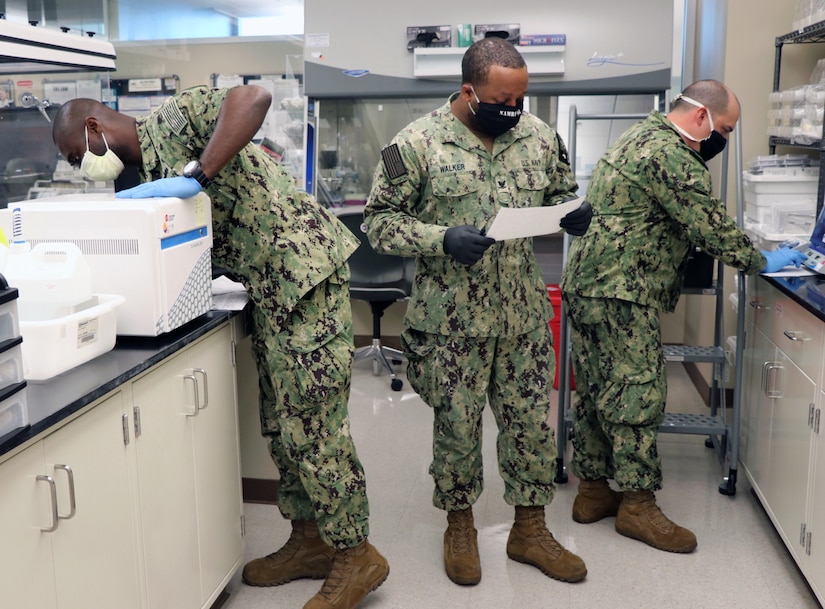
More than 1,300 pieces of medical and dental research equipment are in worksites at the Tri Service Research Laboratory and at the Battlefield Health Trauma Building, both located at Joint Base San Antonio-Fort Sam Houston, Texas.
Snow and two defense contractors, all former Navy BMET instructors at the school, are maintaining NAMRU-SA's biomedical equipment.
''It's a daunting task for three individuals,'' Snow said. ''One of the three of us is there supervising and doing quality control to ensure everything was done to the manufacturer's specifications.''
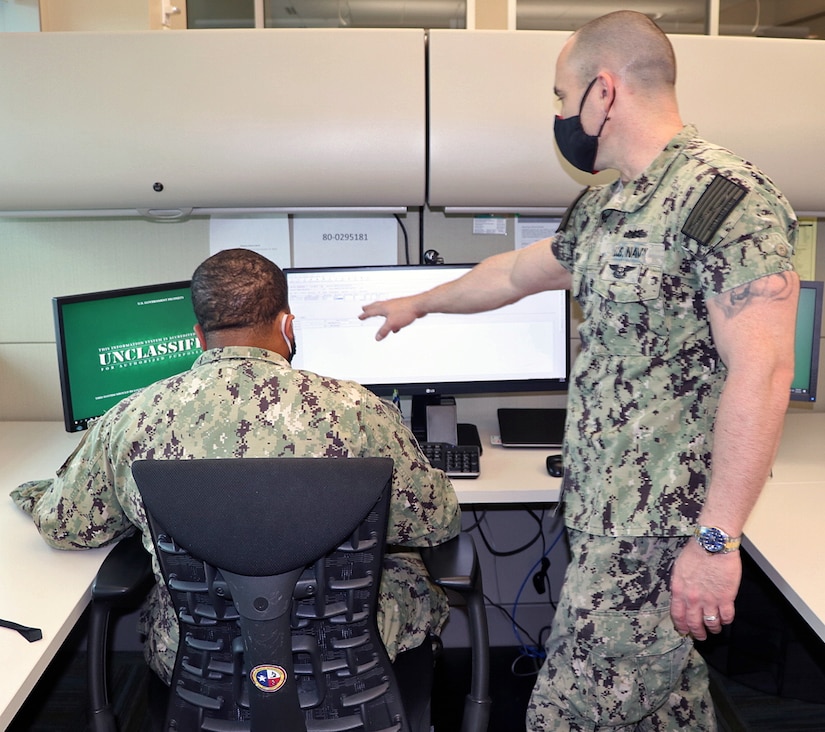
Snow said he knew that if the backlog got worse, it might jeopardize battlefield health research. With a recent memorandum of understanding between NAMRU-SA and NMTSC, which allowed for mutual assistance whenever possible, Snow was able to gain support from the executive officers of both commands, and eight recent BMET graduates reported for work at NAMRU-SA on May 18.
The new BMET graduates work with NAMRU-SA for three eight-hour days each week to aid in reducing the maintenance backlog.
The new graduates document their work in the Defense Medical Logistics Standard Support, where their efforts are reviewed for accuracy. It's a confidence-builder and exactly what the BMETs will be doing when they get to their shops.
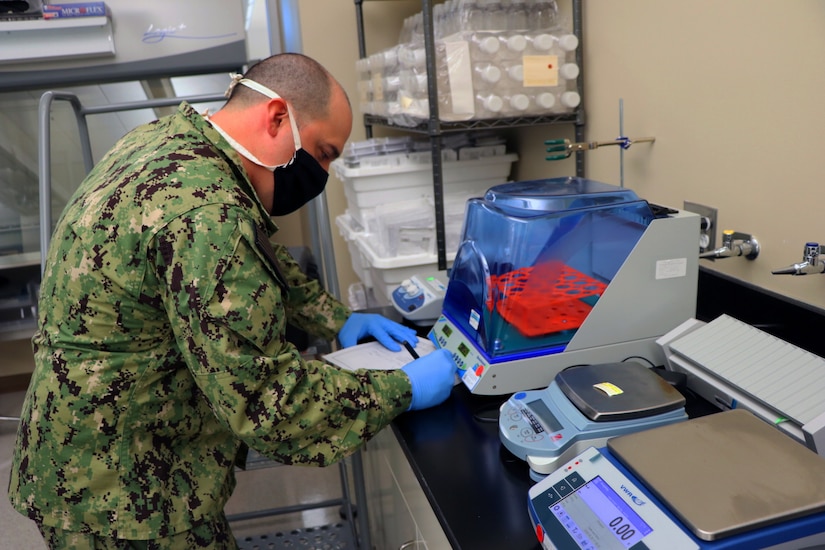
''I was a little bit nervous about leaving here because I have never been a BMET before,'' Navy Petty Officer 3rd Class Benjamin Walker said. Prior to attending the BMET course, Walker was a Navy dental technician. His next assignment is at Naval Medical Center Portsmouth, Virginia.
''Having this experience is going to help me slide into my next assignment pretty smoothly,'' he said.
(Randy Martin is assigned to Naval Medical Research Unit San Antonio.)

An Air Force F-16 Fighting Falcon assigned to the Ohio National Guard takes off in Swanton, Ohio, June 16, 2020, for a nighttime training mission.
Defense Secretary Dr. Mark T. Esper visited Air Force basic military training cadre and recruits, as well as members of the Air Force Recruiting Service, for a firsthand look at how the service transforms citizens into airmen.

Esper, accompanied on yesterday's visit by Senior Enlisted Advisor to the Chairman Ramón "CZ" Colón-López, observed how the 37th Training Wing, with the support of a tri-wing partnership with the 502nd Air Base Wing and 59th Medical Wing, has protected airmen during the COVID-19 pandemic. The traveling party adhered to all Centers for Disease Control and Prevention and Defense Department social distancing guidelines to ensure protection of their health and those around them.
"The basic military training mission remains absolutely vital to renew our air and space forces and underwrites our ability to defend the nation and deliver air and space power any time, any place," Esper said. "The entire team here has demonstrated what fighting through COVID-19 looks like with flexibility and tenacity, ensuring the safety of the recruiting, training and education pipeline."
The first stop was at Basic Military Training's Pfingston Reception Center for an overview of Gateway Wing operations and an in-depth look at how officials have adjusted operations amid the pandemic to continue developing the airmen needed to ensure readiness, including restriction of movement implementation, person-under-investigation and isolation operations.
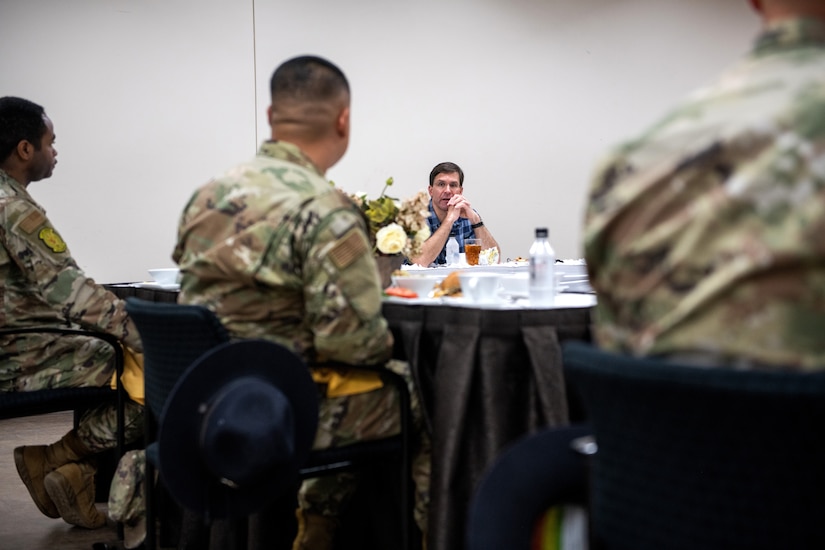
More than 34,500 airmen will graduate from Air Force basic training in fiscal year 2020, and the wing has graduated more than 8,500 airmen since March 16, when the service first implemented a 14-day restriction of movement protocol for new accessions arriving to training. Since May 19, 100% of new recruits have been tested, and the training campus has been realigned to prevent interaction of airmen in different weeks of training.
"Two of our top priorities during COVID-19 have been the safety of our people and ensuring the mission of national security continues," Esper said. "The rapid implementation of safety protocols here has been extremely successful on both of these fronts, thanks to the partnership of health experts and the BMT team."
Military training instructors and cadre had the opportunity to discuss BMT's tempo, successes and ways forward with Esper before taking him on a walkthrough of new trainee in-processing, daily operations at an airman training complex, as well as the Reid Clinic, where the 59th Medical Wing conducts BMT medical support operations.
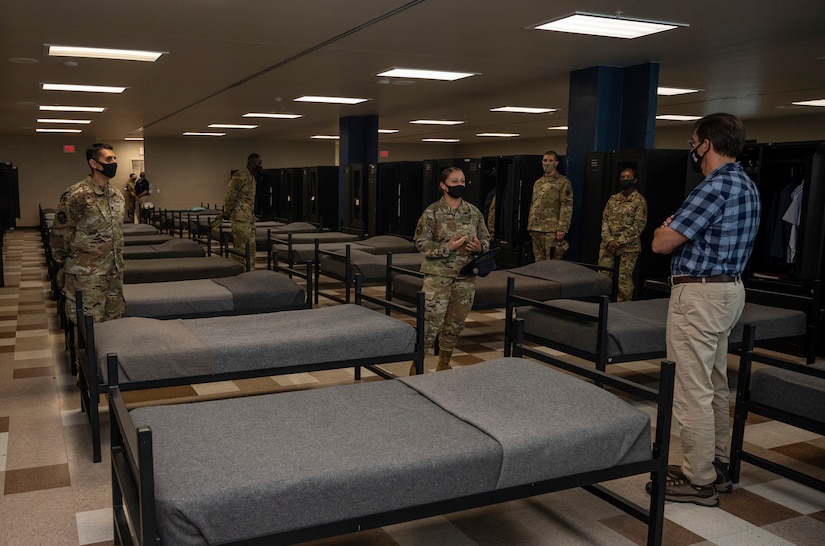
BEAR base, also called tent city, was another stop on the visit. This area was established by the 49th Wing at Holloman Air Force Base, New Mexico, to support potential BMT contingency operations for the Gateway Wing should swing space be required in the COVID-19 environment.
How the service recruits more than 31,000 new accessions every year into the total force was also highlighted for the Defense Department's senior leader, including the use of agile shipping methods to adjust the numbers of airmen reporting to basic military training each week.
"What the U.S. Air Force Recruiting Service has done in response to COVID-19 by being ready to pivot, prioritize, and match applicants to an optimal job and enter-active-duty date on a weekly, and sometimes hourly, basis has been incredible," Esper said.
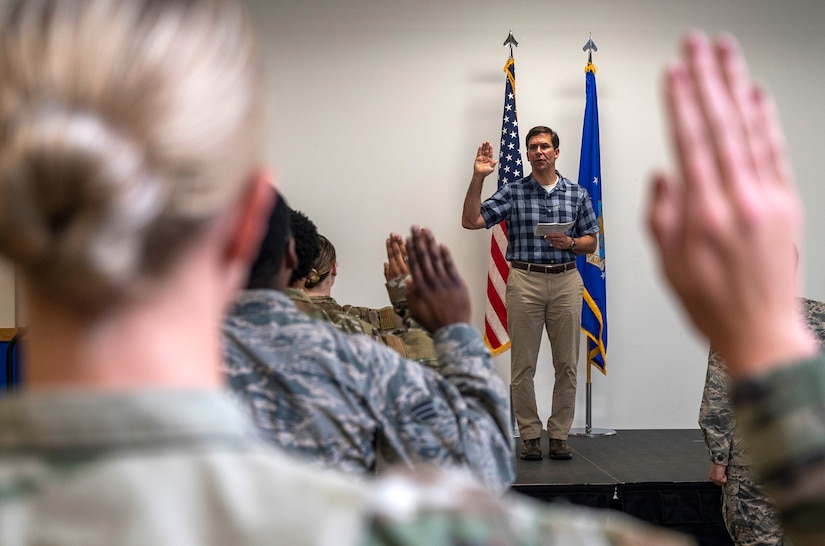
The secretary also learned about the recent integration of the Air Force Reserve and Air National Guard into total force recruiting and the recent rollout of the new "Aim High" phone application by Air Force Recruiting Service, which is aimed at providing better communication to inform and inspire new recruits with embedded tools to guide them into the right Total Force career path as they transition from citizens to service members.
"It's evident BMT's success in the COVID-19 environment can be largely credited to the [military training instructor] corps creating a culture of safety," said Esper. "The work they do year-round laid the foundation for them to adapt swiftly with health recommendations and develop a mentality of early symptom reporting."
(Air Force 1st Lt. Kayshel Trudell is assigned to the 37th Training Wing.)


 Posts
All Comments
Posts
All Comments
Posts
All Comments
Posts
All Comments


