Thursday, April 16, 2020

Northcom Issues Smartphones to Health Care Providers Helping in New York


April 16, 2020 | BY NAVY CHIEF PETTY OFFICER BARRY RILEY

Upon their arrival in New York City to support the U.S. Northern Command response to the COVID-19 pandemic, military medical professionals augmenting civilian hospitals are issued phones as part of their in-processing.

The phones provide personal health updates, location tracking, and messaging and alerts for the more than 300 medical providers augmenting 11 hospitals around the city.

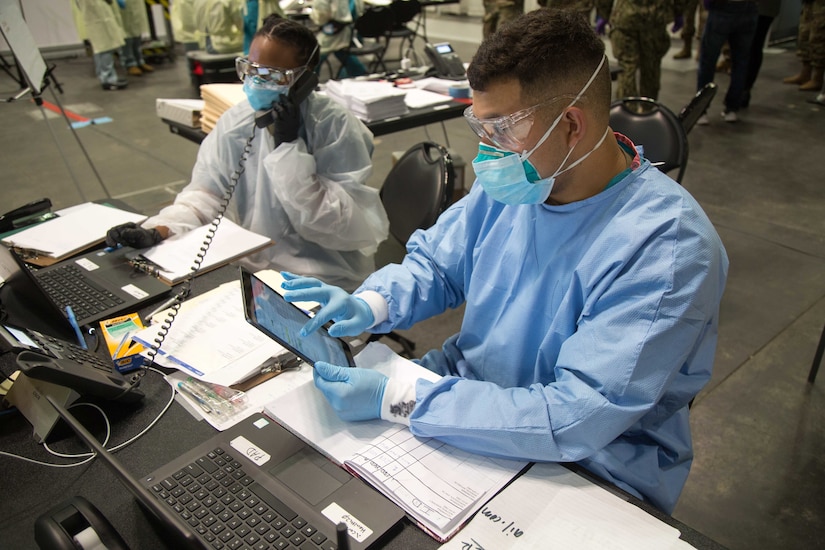
One soldier speaks on a telephone and another uses a hand-held tablet. Both are wearing face masks and other protective gear and are seated at laptop computers.

Army Maj. James Watson, a communications officer assigned to 531st Hospital Center, said the devices are meant to improve COVID-19 pandemic domain awareness with real-time data for decision-making using advanced computing mobile format and collaboration capabilities.

These capabilities enable opportunities in health and medical supply management and tracking through the personnel statistics and medical statistics applications.

''These are great tools to flatten the battlefield and offer a clear sight picture for all the senior leaders to know what's happening on ground in the moment,'' said Watson, who is working at the Javits New York Medical Station, the name given to the alternate care facility established at New York’s Jacob K. Javits Convention Center.

Providers can also use the Microsoft Teams software to collaborate, share lessons learned and help to build a bond of communication.

''It shows a great level of concern, from the most senior commander on down to the individual that is going into the hospitals to support the COVID-19 response,'' Watson said.

Northcom is providing military support to the Federal Emergency Management Agency to assist the New York hospital system and others across the nation's hardest-hit areas.

Javits New York Medical Station has been operational and caring for non-COVID-19 patients since March 30. It began providing medical care for patients with COVID-19 on April 3. Also initially tasked with providing care to non-COVID patients, the Navy hospital ship USNS Comfort, deployed to New York City, began taking COVID-positive patients April 6.

(Navy Chief Petty Officer Barry Riley is assigned to Joint Task Force Civil Support.)

Truth, Accuracy Part of Democratic Value System, Eucom Commander Says


April 16, 2020 | BY C. Todd Lopez , DOD News

Two harmful things are spreading across the globe now: the coronavirus and disinformation. The commander of U.S. and NATO forces in Europe says they're working to conquer both.

"As military forces, we have an obligation to be truthful, timely and accurate in what we say and what we do," Air Force Gen. Tod D. Wolters, commander of U.S. European Command and NATO's supreme allied commander for Europe, said during a telephone news conference today.

"That's exactly what we continue to do here from a U.S. perspective, and certainly from a European perspective," he added. "It's part of our democratic value system. Transparency is vital right now. Neutralizing misinformation and delivering accurate and truthful facts is paramount. Our partnership and trust with one another is steadfast."

As medical goods have been moved among NATO nations, Wolters said, Russia has inserted itself into the conversation, downplaying the value of those transactions. "That in itself is a form of disinformation," the general said.

At the same time, he said, the news media have also reported that goods Russia has delivered to European nations have been "flawed."

This is proof that the alliance remains ready and capable to support one another in these tough, tough times of need."

Wolters said part of countering disinformation is recognizing when it’s happening — to have a "sensing system" in place that recognizes those falsehoods and is prepared to counter them. Another part, he said, is deterring that disinformation. And that, he said, starts with leadership and military personnel.

"That has to do with your field commanders and your operators and your maintainers and your mission supporters and your medical specialists understanding what it is their forces are effectively doing to improve health and to improve our ability to deter and defend," he said.

Wolters said he's asked uniformed military members to be knowledgeable and equipped to speak honestly about their accomplishments.

"That in itself is telling the truth, and it's part of more effective deterrence and defense," he said.

When it comes to helping to defeat COVID-19 in Europe, Wolters said, Eucom has provided for more than $500,000 in essential equipment and medical supplies from Defense Department stocks in Italy alone.

"We've leveraged long-standing bilateral relationships to coordinate access to supplies in Luxembourg," he said. "Under NATO's lead, we've joined with allies to lift much-needed medical supplies from the Pacific to Romania."

Last week, he said, President Donald J. Trump authorized contributions of $4.7 million to fund locally procured personal protective equipment.

The general also said Eucom is executing 10 "quick reaction" projects that are delivering $150,000 in personnel protective equipment to eight different locations on the continent, with eight more projects in the works.

"None of these events would have been possible without the trust and confidence and coordination between allies and partners," he said. "This is proof that the alliance remains ready and capable to support one another in these tough, tough times of need."

Wednesday, April 15, 2020

Guard Assists Illinois Residents in COVID-19 Response


April 15, 2020 | BY David Vergun , DOD News

About 31,000 Army and Air National Guard troops nationwide have been activated to support the COVID-19 pandemic response, and about 650 have been activated in Illinois, the chief of operations for the Illinois National Guard's joint task force said.

Army Lt. Col. Michael Eastridge spoke with reporters at the Pentagon by telephone today from Springfield, Illinois.

All missions the Guard takes on are initiated by civilian agencies and in close collaboration with the governor, Eastridge explained. ''The civil-military relationship has been absolutely outstanding,'' he said. ''The flow of information has been continuous throughout the day.''

Illinois Guard liaison officers are embedded in emergency operations centers to keep tabs on the status of hospitals and determine if Guard support is needed, Eastridge said.

Operations are centrally located for warehouse activities in Springfield, the state capital. This helps consolidate supplies and transportation throughout the state, he noted.

Service members are receiving training on personal protective equipment before conducting operations Eastridge said, and COVID-19 testing kits are available for service members if required. Religious support teams are available throughout the state to provide spiritual and mental support, he added.

Eastridge listed a few of the activities the National Guard is engaged in throughout Illinois:

    Supporting the buildout of the McCormick Place Convention Center in Chicago as an alternate care facility, in collaboration with the Army Corps of Engineers.
    Providing support to Cook County medical centers in respectful removal of the deceased. Service members are not physically removing the deceased from homes, he said, but rather are assisting the Cook County medical examiner's office with dignified transport of the deceased.
    Providing medical screenings at Stateville and Sheridan correctional facilities.
    Supporting logistics for alternate housing facilities in Schaumburg, Springfield and Mount Vernon. These facilities allow family members to isolate themselves if they don't already have the ability to do that to help prevent COVID-19 spread within families, he explained.
    Operating drive-thru testing sites, including in Harwood Heights, Markham and Bloomington. More sites will be established  upon request of state health officials, he said.

Eastridge noted that at one drive-thru, a civilian vehicle broke down, and service members were able to get the vehicle running again. The children of the family in the vehicle later returned to present pictures they had colored as a gesture of thanks to the service members who helped them.