Wednesday, September 27, 2017

DoD Officials Provide Update on Hurricane Relief Efforts


WASHINGTON, Sept. 27, 2017 — In Puerto Rico, enhanced communications and completed assessments are providing a clearer picture of the extent of the storm damage and the magnitude of the response challenge, Defense Department spokesman Army Lt. Col. Jamie Davis said today.

“Given the changing scope and conditions, DoD will adjust its concept of operations in Puerto Rico and transition from a short term, sea-based response to a predominantly land-based effort designed to provide robust, longer term support to [the Federal Emergency Management Agency] and [to Puerto Rico],” Davis said. The situation in the U.S. Virgin Islands continues to improve, he said, noting that the governor is shifting from response to recovery.

In Puerto Rico, response operations continue as synchronization of efforts between the Title 10 forces, Puerto Rico National Guard and FEMA improve. Fuel distribution remains the top FEMA priority. Multiple DoD elements delivered fuel and continue route clearance operations. Fifty nine of 69 hospitals are operational with unknown status. Roughly 44 percent of the population remains without drinking water. The San Juan Airport and nine other airports are open. Three seaports are open and five are open with restrictions.

In the U.S. Virgin Islands, the J.F. Luis Hospital in St. Croix has been found to be structurally sound. Power has been restored to the Schneider Hospital on St. Thomas. Airports are closed except for military and relief operations. Eight seaports are open with restrictions.

DoD Response in Puerto Rico, U.S. Virgin Islands

-- U.S. Northern Command is developing an enhanced logistical capability designed around a sustainment brigade and able to provide logistical command and control, transportation, supply distribution, movement control and engineering capabilities.

-- The U.S. Army North deputy commanding general, Brig. Gen. Rich Kim, will deploy to Puerto Rico today and establish a joint forces land component command forward headquarters to manage the Title 10 support to the response.

-- Northcom will deploy medical capability and ambulances and has requested the hospital ship USNS Comfort prepare to get underway. The ship has a 72-96 hour prep time.

-- U.S. Transportation Command coordinated 14 flights to the U.S. Virgin Islands and Puerto Rico yesterday, delivering food, water, FEMA communications, FEMA logistics, security teams and critical DoD enablers -- communications, logistics, and command and control -- and has 16 flights scheduled today to deliver food, water, communications and DoD rotary-wing aviation.

--  A joint Army National Guard and Marine expeditionary unit team is providing first responder movement, commodities and fuel distribution, and route clearance in Puerto Rico. The team established Roosevelt Roads Airfield as an Installation Staging Base; available for 24/7 hurricane relief and commercial operations. The MEU is also moving Department of Health and Human Services assessment teams, via helicopter, to hospitals across Puerto Rico to determine medical requirements.

-- The Defense Logistics Agency is transporting 15,000 gallons of propane to Puerto Rico and 10,000 to the U.S. Virgin Islands and has coordinated the shipment of trucks and support vehicles, including 175,000 gallons of diesel and 75,000 gallons of gasoline, by barge to Puerto Rico by Sept. 29. DLA is also shipping 90 fuel trucks to Puerto Rico.

Foreign Disaster Assistance

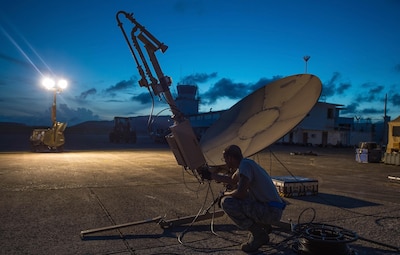
Caribbean Region: U.S. Southern Command’s Joint Task Force Leeward Islands continues to support State Department humanitarian assistance and disaster relief operations in the Leeward and Windward Islands, conducting search and rescue operations and evacuating U.S. citizens. Helicopters from the amphibious assault ship USS Wasp continue to support evacuations of U.S. citizens and to respond to requests for reconnaissance, transportation and logistics support.

Former Tactical Air Controller Earns Invictus Games Medals in Honor of Father


By Shannon Collins DoD News, Defense Media Activity

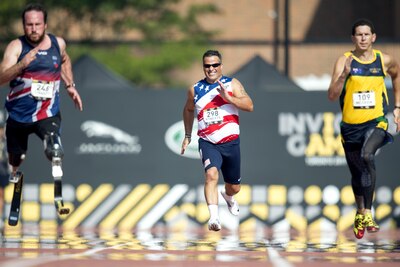
TORONTO, Sept. 27, 2017 — Though Patrick Roberts has earned more than 40 medals over the years while competing at the Department of Defense Warrior Games, the medals he earns at this year’s Invictus Games here will mean more, he said, because they are dedicated to his twin brother, Tim Roberts, and his late father, Jim Roberts.

Around the time Roberts was medically retired from the Air Force as a technical sergeant in 2008, his brother drowned. Roberts had served 16 years as a tactical air controller, calling in close air support missions for the Army on Special Forces missions in Haiti, Bosnia, Kosovo and Afghanistan. While in Afghanistan, he sustained multiple injuries during combat operations. After 18 surgeries, he medically retired. He also has post-traumatic stress disorder and a traumatic brain injury.

Roberts’ father, who was a major influence in his life, passed away a little over a month ago. “My dad, I love him. He definitely inspired me and my twin brother. He pushed us since we were five years old. He was very big into sports, mostly wrestling,” Roberts said with emotion. “You’re going to win no matter what. I’m trying my hardest. You always push as hard as you can but it’s a special effort for him.”

He said his father was a four-time state wrestling champion and a national champion. His grandfather wrestled in the Olympics.

Roberts earned a bronze medal in his disability category in the men’s 100-meter and 200-meter at track and field Sept. 24 at the York-Lions Stadium. He competes this week in track and field, swimming and seated volleyball.

“This is my first Invictus ever, and I’m excited,” he said. “I’m going to be 45 [years old] this year but it’s still fun to come out and beat some of these young kids. I’m going to go back home, work harder, lose some weight and try out for Team Socom for the Warrior Games and for the next Invictus Games.”

More than 550 wounded, ill and injured service members from 17 nations compete in 12 sporting events including archery, track and field, cycling, golf, sitting volleyball, swimming, wheelchair rugby and wheelchair basketball Sept. 23-30 as they are cheered on by thousands of family members, friends and spectators in the Distillery District here.

Road to Recovery

The road to Invictus was a journey, he said. “Even though I never wanted to join, I loved the military. Once you’re in a career field like that, it’s like a brotherhood; it’s your life,” he said. Roberts said as he transitioning out of the military and dealing with the loss of his brother and his fellow comrades, he was also dealing with the pain of his injuries.

“They gave me a lot of pain meds. It was horrible, and I was in a bad place,” he said. “They were like, you’re not going to walk again. I was in a wheelchair. I told them, ‘No, I’m going to walk again. I’m going to run. I’m going to quit the meds.’”

He checked himself into a rehab facility and worked his way off of the pain medication. “If I hadn’t gone to the rehab facility, I probably wouldn’t be here today,” he said.

Adaptive Sports

Roberts said getting out and meeting up with other veterans who had similar backgrounds helps, as well as finding adaptive sports in local areas. “Life can suck but you can manage it better by getting with other vets who have been through what you’ve been through or who you can relate to,” he said. “I try to get out there and help people.”

Roberts speaks to police departments and has been a speaker at the FBI Academy. “I tell them, we all need help. We don’t want to talk about it, especially the guys in Special Ops. We never need help but you have to get help because you don’t want to be like some of my friends who have committed suicide. They never got help. They never got the proper treatment. I know it’s hard. These programs here motivate me. I’m in pain but I’m out there living it. Just take one day at a time,” he said.

Roberts said the key is to get out of the house and get involved. “Do it once, and you’re going to see that you enjoy it. You’ll continuously start coming back and that right there should inspire you and start changing your life,” he said. “People get out of the military and feel depressed or left out. It only takes time to change your life. Don’t worry about making a team. Just get involved. Get engaged, have a good time, and you’re going to find out that life does get easier.”

Ohio Army National Guardsman’s School Project Helps Combat Suicide


By Stephanie Beougher, Ohio National Guard

COLUMBUS, Ohio, Sept. 27, 2017 — During his career with the Ohio Army National Guard, Capt. Michael Barnes has had many opportunities to lead fellow soldiers through a deployment as well as numerous training exercises. He’s also taken to heart the leadership philosophy of taking care of his soldiers’ mental health and well-being.

“I helped my first suicidal soldier in basic training back in 1993,” Barnes said. “When I was in my company command, I counseled at least a dozen soldiers expressing suicidal ideations. It is then that I truly began to realize how bad the issue was and also how suited I was to help.”

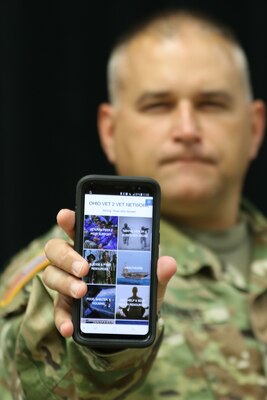
Barnes is channeling his passion for helping veterans into a master’s degree in nursing, which will allow him to specialize as a psychiatric mental health nurse practitioner. As part of his coursework, Barnes created a website and mobile app to, as his website states, “bring together a wealth of information and resources to combat the risk factors of suicide.”

“I’ve known veterans who have committed suicide and I’ve heard my military brothers and sisters say, ‘I wish that I could have done more.’ I have even said it myself. The problem is that we say it in the moment and then move on with our lives. I decided I was no longer going to move on with my life without doing something,” Barnes said.

With his Ohio Vet 2 Vet Network, Barnes’ goal is to create a nonprofit, build a network of peer-to-peer support groups and, eventually, establish transitional housing and a counseling center. For now, he’s gathered resource links related to topics that can be risk factors for suicide, such as post-traumatic stress disorder, homelessness and access to health care.

Project With Meaning

Barnes estimates he’s put in more than 150 hours of work into the project. His professor for the course at Ohio State University, Judy Donegan, calls the project “remarkable” and plans to have him present it to health professionals during national conferences.

“He’s done a remarkable job of bringing his own passion for his fellow veterans to life for those of us who are not military,” she said. “I want my students to do projects that have meaning, not just projects for a class that will go in a cupboard and sit there. My mantra is you can change the world one person at a time, and that is what Mike’s doing.”

According to a U.S. Department of Veterans Affairs study, an average of 20 U.S. military veterans take their own lives every day. Barnes will be marketing his app to military groups, social workers, and shelters and charities that assist veterans.
“In the military, you’re taught to be strong,” he said. “Veterans are hesitant to reach out and ask for help. I want to provide them with easy access to help when they’re ready to ask.”