by 1 Lt. Justin Phillips
125th Fighter Wing
10/23/2015 - ST. AUGUSTINE, Fla. -- Col.
Brian Simpler, 125th Fighter Wing commander, announced Oct. 20, to a
room full of Airmen, the Wing had earned a "Highly Effective" rating
from the Air Combat Command Inspector General team.
The 125th FW received the IG rating after completing its last
self-inspection Oct. 16-19, utilizing the new Air Force Inspection
System.
"AFIS eliminates the last-minute rush to make things look good," said
1st Lt. Justin Elliott, 125th Fighter Wing, inspection planner. "We have
made inspecting a continual process, ensuring our ability to complete
the mission is unwavering."
The new system is broken down into four graded components: managing
resources, leading people, improving the unit and executing the mission.
AFIS has allowed units to eliminate "inspection prep," which wasted
valuable time and resources, allowing those efforts to be focused on
commander priorities.
The 125th Inspector General Inspections team has been in place for the
last two years managing internal inspections statewide. This team, led
by Maj. Jackson Whiting, has worked countless hours planning and
implementing inspections and exercises in an effort to self-identify
areas that need work and report them to leadership.
The IGI team along and the Wing Inspection Team are a group or wing of
subject matter experts. The teams ensure the wing is inspected across
all areas based on the commander's priorities. The inspection results
are reported to the commander and ultimately to the major command's
inspector general.
"The work that was done over the last two years is nothing less that
exceptional," said Simpler. "Under Maj. Whiting's leadership, our
Commanders Inspection Program has set the standard for the rest of the
Air Force to follow."
The days of spending countless resources before inspections, or what
many referred to as "painting rocks," are over. Today's Air Force is
focused on empowering commanders to ensure their Wings are 'Always on
Mission.'
More than 40 Airmen were called forward to accept certificates and
recognition from leadership for exceptional performance and highlighting
the total team effort required to achieve the rating. This rating is
nearly unprecedented in both Active and Reserve components of the United
States Air Force.
"These results validate what we knew all along--our Airmen are well
trained and execute their mission with a great deal of proficiency,"
said Simpler. "Our leaders at all levels are engaged, focused on their
Airmen and dedicated to improving their units. These results place us in
the very top tier of all Air Force units."
Sunday, November 01, 2015


U.S. Strategic Command to Conduct Command and Control Exercise
by U.S. Strategic Command Public Affairs
10/30/2015 - OFFUTT AIR FORCE BASE, Neb. -- U.S. Strategic Command (USSTRATCOM), one of nine U.S. unified commands under the Department of Defense, will conduct Exercise GLOBAL THUNDER 2016 with components and tasks forces beginning Nov. 2, 2015.
GLOBAL THUNDER 2016 is being held in conjunction with North American Aerospace Defense Command and U.S. Northern Command's Exercise VIGILANT SHIELD 2016, which aims to train participants in homeland defense.
In coordination with other combatant commands, services and appropriate U.S. government agencies, USSTRATCOM conducts global operations to deter and detect strategic attacks against the U.S. and its allies, and is prepared to defend the nation as directed.
Exercise GLOBAL THUNDER is an annual command and control exercise designed to train Department of Defense forces, assess joint operational readiness, and validate the ability to identify and mitigate attacks across all of USSTRATCOM's mission areas, with a specific focus on cyber, space, missile defense and nuclear readiness. The exercise provides training opportunities for USSTRATCOM to validate the ability to posture components, task forces, units, and command posts to deter, and if necessary, defeat a military attack against the United States and to employ forces as directed by the President. To ensure resilience, redundancy and survivability of our nation's strategic deterrent forces, the scenario for GLOBAL THUNDER integrates nearly every conceivable strategic threat to our nation and calls upon all the USSTRATCOM capabilities that would be provided to geographic combatant commanders in a real-world crisis: space, cyber, intelligence, surveillance and reconnaissance, global strike, and ballistic missile defense capabilities. The exercise has been planned for more than a year and is based on a notional scenario.
"The United States' ability to maintain a safe, secure, effective and credible nuclear deterrent is foundational to our national security and contributes to the security of our allies and partners," said Adm. Cecil D. Haney, U.S. Strategic Command commander. "This exercise, and our continued focus on maintaining key capabilities and skills, ensures USSTRATCOM's strategic forces remain ready, 24/7, providing flexible and credible options for the President and the Department of Defense."
10/30/2015 - OFFUTT AIR FORCE BASE, Neb. -- U.S. Strategic Command (USSTRATCOM), one of nine U.S. unified commands under the Department of Defense, will conduct Exercise GLOBAL THUNDER 2016 with components and tasks forces beginning Nov. 2, 2015.
GLOBAL THUNDER 2016 is being held in conjunction with North American Aerospace Defense Command and U.S. Northern Command's Exercise VIGILANT SHIELD 2016, which aims to train participants in homeland defense.
In coordination with other combatant commands, services and appropriate U.S. government agencies, USSTRATCOM conducts global operations to deter and detect strategic attacks against the U.S. and its allies, and is prepared to defend the nation as directed.
Exercise GLOBAL THUNDER is an annual command and control exercise designed to train Department of Defense forces, assess joint operational readiness, and validate the ability to identify and mitigate attacks across all of USSTRATCOM's mission areas, with a specific focus on cyber, space, missile defense and nuclear readiness. The exercise provides training opportunities for USSTRATCOM to validate the ability to posture components, task forces, units, and command posts to deter, and if necessary, defeat a military attack against the United States and to employ forces as directed by the President. To ensure resilience, redundancy and survivability of our nation's strategic deterrent forces, the scenario for GLOBAL THUNDER integrates nearly every conceivable strategic threat to our nation and calls upon all the USSTRATCOM capabilities that would be provided to geographic combatant commanders in a real-world crisis: space, cyber, intelligence, surveillance and reconnaissance, global strike, and ballistic missile defense capabilities. The exercise has been planned for more than a year and is based on a notional scenario.
"The United States' ability to maintain a safe, secure, effective and credible nuclear deterrent is foundational to our national security and contributes to the security of our allies and partners," said Adm. Cecil D. Haney, U.S. Strategic Command commander. "This exercise, and our continued focus on maintaining key capabilities and skills, ensures USSTRATCOM's strategic forces remain ready, 24/7, providing flexible and credible options for the President and the Department of Defense."
The Warrior Wall

355th Fighter Wing Public Affairs
10/30/2015 - Davis-Monthan Air Force Base, Ariz. -- In August of 2006, a patient lounge in the 332nd Expeditionary Medical Group Contingency Aeromedical Staging Flight Facility at Joint Base Balad, Iraq, turned into a place where wounded Soldiers, Sailors, Marines and Airmen could relax and write messages on the walls, forming what became known as the Walls of Balad.
Wounded warriors would go through the CASF to be airlifted to Landstuhl Regional Medical Center in Germany where they would receive further treatment. These service members would spend a couple hours up to a few days at the facility waiting for their airlift. Retired Air Force Reserve Senior Master Sgt. Karen Loalbo, CASF mission manager, came up with an idea to make the patient lounge more comfortable for the service members.
"It was a simple idea," said Loalbo. "I talked with some troops while I was at the clinic in Balad and I thought if they ever came through the CASF I would make it a welcoming facility."
With the approval of U.S. Air Force Reserve Lt. Col. Michael Fellows, the CASF executive officer at the time, Loalbo and her team of three planned the layout of the lounge, obtained furniture, cut out and painted wooden letters to spell Warrior Wall, the original title. They also painted the walls and provided pens for patients to write on the walls.
"My vision was to have a blank canvas for them to graffiti and have fun with it," Loalbo said. "It really took on a life of its own after that."
It wasn't until a year later that Loalbo and Fellows learned about the success of the Warrior Wall. A member from her team was sent on a second rotation to CASF where she took pictures of the walls and sent them to Loalbo.
"Back then, each deployment rotation was four months and each group wants to make their mark," said Fellows. "It was a huge surprise when the rotation the following year sent us back the pictures. "We weren't sure if the next rotations would paint over the walls and do something else or not."
For the next five years, patients along with visitors signed the walls, covering them with signatures, farewell messages, thank you notes and memories of their fallen comrades on the lounges walls.
"I love history and when I look at events such as the Civil War, a lot of what we know is from the Soldiers' diaries, Fellows said. "So that's what I see in these walls is the diaries from one perspective, the wounded Soldiers."
One wounded service member quoted John F. Kennedy on the wall: "In the long history of the world only a few generations have been granted the role of defending freedom in its hour of maximum danger. I do not shrink from this responsibility, I welcome it!"
Maj. Gloria Scott from Camp Victory in Baghdad wrote a message to her sister on Dec. 12, 2006:
"To my big sister, I've spent my whole life following you. Now that you are gone and have given your life for us all, I must find my way without you. I will NEVER forget you. We all miss you and love you Alexis! SSG A.R Scott COB Speicher 2009-2010."
In December of 2011, the Walls of Balad were saved and sent to the National Museum of the United States Air Force at Wright-Patterson Air Force Base, Ohio, and then shipped to 309th Aerospace and Regeneration Group at Davis-Monthan AFB, Ariz.
"It didn't strike us about the permanence of these until 2012, when we had heard that they were being cut out and saved," Fellows said. "I was stunned and excited to learn that the walls would be saved."
On Oct. 20, 2015, Fellows, Loalbo and their spouses traveled to D-M to visit the walls nine years after they were created. Both became emotional upon seeing the success of the walls.
"We understood that it would grow and people would continue to write on them, we didn't think it would go around the whole facility," Fellows said.
Both Fellows and Loalbo hope that word of the Walls of Balad reach anyone who has signed them.
"It was our honor to serve in Balad and we got some phenomenal stories from the Soldiers, Sailors, Marines and Airmen coming through," Fellows said. "They are all real heroes, but we only got little snippets of their stories and that's something we would love is to learn about the folks that signed the walls and how they got there and what they have been doing since then."
The walls are now safely stored in a warehouse at the 309th AMARG and have only been displayed during Base Open House events.
Saturday, October 31, 2015
Face of Defense: Soldier Develops Apps to Help His Comrades
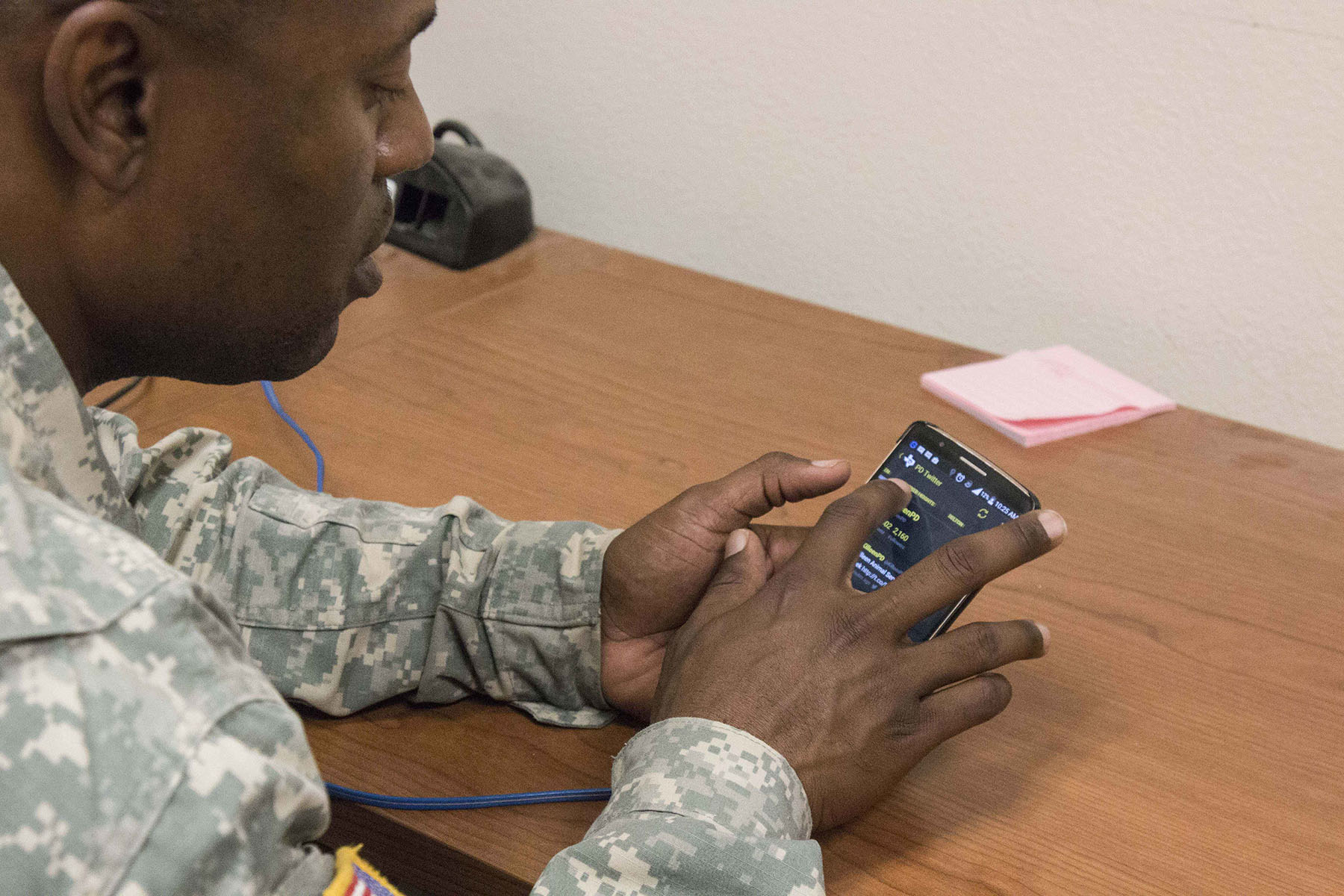
By Army Staff Sgt. Leah Kilpatrick 3rd Brigade Combat Team,
1st Cavalry Division
FORT HOOD, Texas, October 29, 2015 — Today, almost
everything is on the Internet, and mobile devices place that immense collection
of knowledge in the palms of our hands.
But not everything is online -- or at least much of it isn’t
readily accessible -- so one noncommissioned officer is using the power of the
Internet to help soldiers.
Army Sgt. 1st Class Ronnie Russell, mortar platoon sergeant
with Headquarters and Headquarters Company, 1st Battalion, 12th Cavalry
Regiment, develops mobile applications to provide troops and their families
with tools to help them navigate their duty stations and surrounding
communities.
About 15 years ago, while stationed in South Korea, Russell
struggled to get from one place to another in the foreign country. It was an
irritating reality that Russell said he just became accustomed to over time.
Russell recalled that experience when he returned to South Korea last year with
the Charger Battalion for a rotational deployment. He was shocked, he said,
that there were still very few resources to help soldiers navigate the local
area.
“There was nothing being done about it, except through each
area’s publication, so I didn’t like that,” said Russell, a Fayetteville, North
Carolina, native. “So I said, ‘Let me try making an app.’ The app was really
for my soldiers, because they were new. Korea was not new to me.”
After getting the runaround from a couple of mobile
application developers, Russell said, he took matters into his own hands.
“I was like, ‘Well, I’ll teach myself,’ so I went on
Google,” he said. “I tell people now, ‘I went to Google University, and my
professor’s name was YouTube.’ That is who taught me.”
One-Stop Shop
The app, called Penn Around, serves as a mobile one-stop
shop stocked with all the resources a soldier assigned to South Korea might
need. Penn Around consolidates a variety of information under one umbrella,
Russell said.
“When the app first started, it started small,” said Army
Sgt. Melvin Dizon, fire direction computer check assigned to Headquarters and
Headquarters Company, 1-12 Cav. “It was basically the bus schedules of all the
camps. That helped, since being 1-12, we weren’t from Korea. It was the best
thing that was out at the time to help soldiers who were transitioning figure
out where to go.”
Inside the roughly 13-megabyte file are resources ranging
from bus schedules and military lodging information to MyPay, taxis and
exchange vendors.
And the response has been positive.
The app has more than 5,000 downloads and an average rating
of 4.4 stars out of 5. “Very convenient app,” one reviewer wrote. “It provides
access to all the bus schedules as well as keeps me up to date with what’s
going on.”
Dizon said that Russell put care, thought and the concerns
of his soldiers into the development of this resource.
“Sergeant Russell approached each member of our platoon,
because he said he was going to start an app to help soldiers transition and
get around Korea,” Dizon said. “He took ideas from every soldier in our
platoon, so whatever ideas we first pitched to him, he added that to the
initial app when it first came out. Ever since then, it actually evolved. Now
it has the SHARP program on it. It has the movie times. Whatever you needed as
a soldier out there, it eventually ended up on the app.”
Off-Duty Time
Russell spent a lot of his off-duty time ensuring he was
going through all the right channels and getting permission from all the right
people at every step of the way -- a lot of work for a noncommissioned officer
who simply wanted to help his soldiers learn how to traverse the Korean
Peninsula.
Russell’s concern for the welfare of others didn’t stop
there.
The single father sought information about safe
neighborhoods in which to rear his son. This quest for knowledge grew into “Tx
Corral,” another mobile app that serves as a tool to keep citizens informed of
what’s going on in their neighborhood and in neighboring towns.
It taps into the social media feeds of various law
enforcement agencies and provides access to services that contact nearby cab
companies and tow trucks using the GPS location from the user’s phone.
Russell dedicated a lot of time to traveling throughout
Central Texas to obtain permission from the various agencies involved to use
their information.
Having tackled Central Texas and the Land of the Morning
Calm, Russell is currently working on prototype apps for U.S. Pacific Command
and U.S. Army Japan.
In all of the programs he is working on, Russell said, he
considers what is important and relevant to the soldiers at that specific assignment.
What is a priority for soldiers in Hawaii isn’t necessarily what’s important to
soldiers in South Korea, and vice versa, he explained.
As the apps are all free to download, there is no monetary
gain for Russell. But he does get the satisfaction of knowing he may have
helped a soldier answer the same questions he once had.
633rd SFS Airmen, Hampton police train to enhance JBLE

by Senior Airman Kayla Newman
633rd Air Base Wing Public Affairs
10/28/2015 - JOINT BASE LANGLEY-EUSTIS, Va. -- Driving on a military installation isn't a privilege many receive, and until recently, if a civilian or military motorist waspulled over for a driving infraction, the ticket was taken to the violator's first sergeant for repercussions. Now, civilian ticketed motorists will have to answer to a federal magistrate.
U.S. Air Force Airmen assigned to the 633rd Security Forces Squadron recently spent a week working side-by-side with the Hampton Police Division to obtain their Virginia state radar certification.
"This is significant for [SFS] because it's one of the duties of law enforcement," said Sgt. Pelham Felder, Hampton PD Homeland Security unit supervisor. "It gives them the training and experience so they can go out and be more efficient as far as traffic safety and enforcement."
During the 16-hour classroom portion of the certification, SFS personnel spent time learning Doppler Theory and principles before practical testing, where they became proficient at setting up and testing the radars. Once it was time to apply what was taught, the Airmen could visually estimate the speed of a vehicle.
According to Senior Airman Sean Lennon, 633rd SFS Base Defense Operations Center controller, while SFS personnel have used radars in the past, they didn't have the Virginia State certification required to issue speeding tickets to civilian motorist.
"Now we have the authority to write speeding tickets to civilian personnel and actually have that individual appear in federal magistrate court, along with the ticketing officer," said Lennon. "For uniformed members, it's more of a base charge. Once they have a certain amount of points they can be denied base driving privileges."
With the radar certifications, SFS personnel and Hampton PD hope this will encourage drivers on the installation to slow down and abide by the traffic laws.
"Hopefully this causes people to slow down. I'm sure people see a lot of people speeding, especially when they are leaving base after work," said Lennon. "Hopefully they realize it's not the most important thing to get off base two minutes early."
Carter to Visit Asia-Pacific Region, Discuss Rebalance With Partner-Nations’ Leaders
By Terri Moon Cronk DoD News, Defense Media Activity
WASHINGTON, October 29, 2015 — Defense Secretary Ash Carter
begins an eight-day trip to the Asia-Pacific region tomorrow, Pentagon
spokesman Navy Capt. Jeff Davis told reporters today.
During his third visit to the Asia-Pacific in eight months,
the secretary will meet with leaders from more than a dozen nations across East
Asia and South Asia to help advance the next phase of the U.S. military’s
rebalance in the region by modernizing longtime alliances and building new
partnerships, DoD officials said.
Among numerous meetings, Carter will attend the 47th annual
U.S-Republic of Korea Security Consultative Meeting in Seoul, and the
Association of Southeast Asian Nations Defense Ministers Plus meeting in Kuala
Lumpur, Malaysia, Davis said.
The secretary also will deliver the keynote address at the
3rd annual Reagan National Defense Forum at the Ronald Reagan Presidential
Library in Simi Valley, California, before returning to Washington.
The forum brings together leaders and key stakeholders in
the defense community, including members of Congress and civilian and military
leaders from the Defense Department and industry to address national defense
health and encourage discussions that promote policies to strengthen the U.S.
military, according to the forum’s web site.
Commentary: AFRL people: A national asset

Commander, Air Force Research Laboratory
10/28/2015 - WRIGHT-PATTERSON AIR FORCE BASE, Ohio -- We recognized Air Force Research Laboratory's top scientists and engineers on Oct. 22 during the AFRL Fellows and Early Career Awards banquet. It was a spectacular event.
We inducted seven senior researchers as AFRL Fellows, our most prestigious honor, representing the top 0.2 percent of our professional technical workforce. Another five S&Es were presented awards for truly exceptional leadership potential and research contributions early in their careers.
They were spotlighted from among a small, diverse and highly talented workforce of 3,511 engineers and scientists, who are charged with providing our nation's Air Force with revolutionary, relevant and responsive capabilities. It's an awesome responsibility and our efforts focus on all three domains of air, space and cyber.
The fact that both Gen. Ellen Pawlikowski, Air Force Materiel Command commander, and Dr. Greg Zacharias, Chief Scientist of the Air Force, joined in honoring these men and women underscores senior Air Force leaders appreciate what AFRL brings to the table. AFRL is the global technology integrator that brings agile, innovative and trusted value to the U.S. Air Force.
In September, I attended the Air Force Association Air and Space Conference, where the theme was "Reinvent the Aerospace Nation." Leaders clearly emphasized we cannot do that without great people. Our senior leaders understand that the people are the platform for which innovative ideas, strategies, and technologies are delivered to the fight. The people, along with innovation and technology will remain the pillars of the American strength and its determination.
AFRL people are at the foundation of every Air Force weapon system currently fielded and on the horizon. They absolutely are a national asset. Collectively, AFRL people are the lens that focuses the national technical base on Air Force needs, to provide tomorrow's warfighters with an unfair advantage.
Working closely with our industry, academic, international and other government agency partners, AFRL people fulfill the critical leadership role of turning science into warfighting capabilities.
I frequently get asked what's the next big thing ... What's on the horizon? My answer is always the revolutionary game-changers which AFRL and others are focusing on: hypersonics; directed energy; autonomy; nanotechnology; and unmanned Systems. But, we are also charged with thinking about the next game-changers, technologies like: quantum technologies, additive manufacturing and synthetic biology. This mix of game-changing research will continue to evolve and revolutionize how we fight in the future.
However our contributions to leverage science and technology to enhance the capabilities of today's warfighters and to rapidly respond with solutions to the urgent "We need this now" problems are equally important. Our research supports all service core functions and major commands by addressing prioritized capability gaps.
It's true that focused science and technology investment has given the U.S. a qualitative military advantage. Our peers and adversaries had decades to study the American way of war. So it should come as no surprise they're investing heavily in their own technology, and they are catching up fast. Our technical dominance is no longer assured. The work by AFRL people to prevent technological surprise and to deliver agile capabilities is more important now than ever.
From advanced turbine engines, to human performance augmentation, to advanced space situational awareness, AFRL people are at the cutting edge, focused on providing America's Airmen the best technology at the right time. We owe them a debt of gratitude. I could not be more proud to serve as their commander.
Team 5-0 members support children at Good Grief Camp

50th Space Wing Public Affairs
10/28/2015 - SCHRIEVER AIR FORCE BASE, Colo. -- Service members from Schriever Air Force Base and other military installations around Colorado Springs volunteered as mentors at a National Suicide Survivor Seminar and Good Grief Camp Oct. 10 - 11, 2015, at the Cheyenne Mountain Resort in Colorado Springs, Colorado.
The camp was hosted and sponsored by Tragedy Assistance Program for Survivors, a not-for-profit organization that has held grief counseling camps across the nation for more than a decade.
According to their website, http://www.taps.org/about, "The Tragedy Assistance Program for Survivors offers compassionate care to all those grieving the death of a loved one serving in our Armed Forces. Since 1994, TAPS has provided comfort and hope 24 hours a day, seven days a week through a national peer support network and connection to grief resources, all at no cost to surviving families and loved ones."
TAPS is a national organization that was started to help family members in the grieving process. Bonnie Carroll, TAPS president and founder, was the wife of Brig. Gen. Tom Carroll, who passed away in an Army C-12 plane crash in 1992. Following his death, she was unsatisfied with the resources available to assist those in her same situation.
TAPS became a way for families to get together for counseling and support through the loss of a loved one in the armed forces. Master Sgt. Steven Grant, 50th Space Communications Squadron section chief of network infrastructure, attended the event for the second year in a row.
Grant explained why supporting children at the Good Grief Camps is so important.
"The kids experience not only a loss in their family, but they also experience a kind of identity crisis, because they're no longer military affiliated," explained Grant. "What TAPS gives them is an opportunity to get with other kids in their same position, open up to some of the grieving process and by tying in military members, it kind of gives them [back] that connection to their loved one."
At the beginning of the weekend-long camp, parents and adult family members dropped off their children with the mentors before heading to their own peer counseling activities. The early portions of the activities were in a very relaxed social environment. Kids in attendance were not forced to interact, but instead given freedom to talk/play with their mentors as they felt comfortable.
"We went over each child's information sheet prior to the actual event and mine said she was very shy," said Staff Sgt. Taylor Koch, 50th Space Wing administrative assistant and Good Grief Camp mentor. "I was thankful to know what to anticipate. She took about 10 minutes to warm up but once she did she didn't leave my side."
Throughout the weekend, kids attending the camp participated in activities and games ranging from sports, to crafts, to music.
"They actually had an excellent musician come in, we made a drum and he talked about the language of music," said Grant. "The kids were able to beat the drum and have an outlet to express their frustrations and their feelings through music so it was an excellent program."
Koch explained that volunteering for the program is not for everyone, but is a rewarding opportunity.
"We heard four and five-year-olds talk about some pretty heavy things," she said. "But just knowing you've made an impact like we did is so overwhelming and rewarding. I would highly recommend anyone who is interested to get involved."
Grant explained there was a diverse group of youth in attendance, some who were comfortable and some who needed more time to open up. For most of the children however, he said he could definitely see a positive change in their demeanors by the end of the camp.
The impact of volunteering is even more powerful as a parent, Grant shared.
"Being a father of three, it really got me to think about what would happen if I were to pass away, you know, I would want someone to be there for my children," said Grant.
Subscribe to:
Posts (Atom)


 Posts
Posts

