Tuesday, September 05, 2017

Face of Defense: Officer Returns to Port Hueneme to Engineer New Future


By Brian Melanephy, Naval Surface Warfare Center, Port Hueneme Division

PORT HUENEME, Calif., Sept. 5, 2017 — In the early 1980s, a young, smart and motivated teen from New England was looking down the road to his future. College was his next step.

Michael Ladner was looking for the best. At first, he had the Massachusetts Institute of Technology in his sights. However, he quickly realized that the cost of an education at the prestigious university was out of his reach.

Summers in Massachusetts as a child often involved going to the coast, and the ocean had an allure. Looking close to home and close to the water, Ladner found the perfect match: the U.S. Naval Academy in Annapolis, Maryland.

He was selected and entered the academy, becoming part of a group of young patriots who would become the Class of 1989. Their unofficial motto quickly became "Out the door in '94" -- give five years of service to Uncle Sam upon graduation, and then move on to other things.

An Offer

The early years of his career went quickly, and suddenly it was 1993. Ladner was thinking about getting out until he received an offer he couldn't refuse. He remembers the phone call vividly.

"[I] called the detailer and they said, 'We can send you to Monterey, California, to go get a master's degree from the Navy," Ladner, who’s now a Navy captain, recalled. "I said, 'Wow, how do I turn that down?'"

And off he went.

Toward the end of his two-plus years in Monterey, a Master of Science in Physics degree in hand, Ladner received a lateral transfer to the engineering duty officer community and found himself at Naval Surface Warfare Center, Port Hueneme Division here. It was his first shore assignment where he served as the combat systems ship qualifications trials officer.

Ironically, Ladner would spend more time underway during this shore tour than he did aboard his first three ships. For the three years he was here, he estimates he was at sea for close to 2.5 years.

From here, Ladner moved on to become the first standard missile program manager's representative at the Raytheon Missile Systems plant in Tucson, Arizona. Moving from the sea to the sand, he served what he didn't yet know would not be his last assignment in the desert. From there, he moved on to Program Executive Office Integrated Warfare Systems 3.0, where he served as the Standard Missile 6 project engineer.

Service in Iraq

After his next assignment as executive assistant to the Navy's director of surface warfare, he volunteered to go to Iraq for nine months as an individual augmentee at Joint Crew Composite Squadron 1. There, he touched all facets of the fielding and testing of countermeasures to disrupt and disable remote-controlled improvised explosive devices. His efforts were highly successful, resulting in safer travels for service members outside the wire.

His deployment did not go unnoticed. At the end of his tour, Ladner was hand-picked by the commander of Naval Sea Systems Command to be his executive assistant. After this eye-opening experience, he moved on to become the major program manager for Program Executive Office Integrated Warfare Systems 10.0, which evolved into the Ship Self-Defense System, Integrated Combat Systems Program Office.

Major Program Manager Assignments

Ladner then served in consecutive major program manager assignments at Program Executive Office Integrated Warfare Systems 3.0 (Surface Ship Weapons). At the end of these back-to-back tours, he got word he was returning here as the department officer for the chief engineer and land and sea test department.

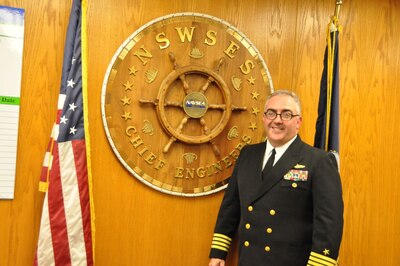
Happy to be back at the division, Ladner beams with pride when he looks at the wheel-shaped plaque hanging in his office.

"I am looking at the wheel on the wall, which has all of the chief engineers that have been here at Port Hueneme," Ladner said. "It's inspiring for me to think that I am sitting in the same room where I did my engineering duty qualification board."

Ladner cut his teeth here 20 years ago, and now has an opportunity to shape and mold its future from a place at the top.
"It is now my time to give back to the community, the station [and Naval Sea Systems Command] for all of the great things they have done for me," he said.

Monday, September 04, 2017

Marine Reservists Answer Nation's Call in Texas


By Marine Corps Pfc. Samantha Schwoch U.S. Marine Corps Forces Reserve

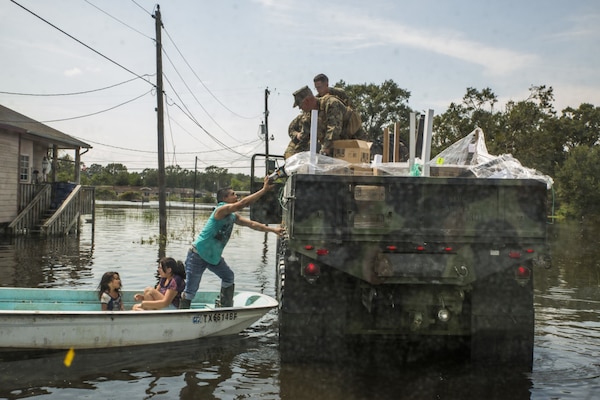
HEMPSTEAD, Texas, Sept. 4, 2017 — Marines with 4th Reconnaissance Battalion, 4th Assault Amphibian Battalion and 14th Marine Regiment, 4th Marine Division, Marine Forces Reserve, have come together since Aug. 28 in the wake of Hurricane Harvey to conduct search and rescue missions and provide disaster relief to affected areas of Texas and Louisiana.

Hurricane Harvey, a storm of record-breaking proportions, dropped an estimated 27 trillion gallons of water or 51 inches of rain in the two states. Marines supported lead federal agencies and worked closely with state and local officials to conduct search and rescue missions. As flood waters rose, the Marines' amphibious capabilities, which make them unique among the services, allowed them to swiftly rescue residents in distress.

The U.S. Marine Corps Reserve is exceptional in its ability to respond quickly to any call and to flexibly conduct operations through air, logistics and ground elements. For example, the Marines rapidly mobilized and used their amphibious assault vehicles designed to transport Marines from ship to shore to rescue residents from flood affected areas.

Humanitarian Assistance

"We were called up to come out and provide humanitarian assistance to the local population," said Marine Corps Gunnery Sgt. Alan Daigle, a platoon sergeant with 4th Assault Amphibian Battalion, 4th Marine Division, Marine Forces Reserve. "We got the call to come over to east Texas into [the] Beaumont, Lumberton and Port Arthur areas. So we've been doing humanitarian missions, going out with the swift-water rescue survival team and finding areas that traditional military vehicles cannot get in and out of. The amphibious assault vehicles help us get to those areas."

Marines from 4th Reconnaissance Battalion, 4th Assault Amphibian Battalion and Marine Light Attack Helicopter Squadron 773 rescued almost 1,300 residents and countless animals from the affected areas.

"We got our first mission to Clearview, Texas, to help the local authorities there to go to these neighborhoods that were unreached," said Marine Corps Sgt. Brad L. Coats, a reconnaissance Marine with 4th Reconnaissance Battalion, 4th Marine Division, Marine Forces Reserve. "They had us going house to house via Zodiac, which is our combat rubber rafts, checking on the individuals that were in these houses to see if they wanted to be rescued or if they needed supplies."

Lifesaving Efforts

The units from Marine Forces Reserve focused on lifesaving efforts throughout south east Texas, where many of the Marines are from. Charlie Company, 4th Assault Amphibian Battalion is located in Galveston, and 4th Reconnaissance Battalion is based in San Antonio. The Texas-based Marines have long-standing relationships in the surrounding communities where they live and work.
"We have a personal responsibility to pull together because it's like our home is being invaded in a way," said Marine Corps Staff Sgt. Travis Hough, a reconnaissance Marine with 4th Reconnaissance Battalion, 4th Marine Division, Marine Corps Forces Reserve. "Since all of us are from San Antonio and the surrounding areas, essentially it's more than just a duty but more of a personal responsibility to help out our fellow communities. It's the best part about having that special bond together, especially in Texas."

Army Reserve Aviators Deliver Water to Hurricane Harvey Victims


By Army Capt. Loyal Auterson U.S. Army Reserve Command

CONROE, Texas, Sept. 4, 2017 — Once the skies cleared after Hurricane Harvey moved off, the work of cleaning up was hampered by flooding across various counties. This didn't slow down the tight-knit aviation community here.

As donors began to send semitrailers of water and supplies into the area, the Conroe North Houston Regional Airport became the natural staging point for relief operations.

Two local aviators, Chad Herdrich and Mike Barksdale, began to negotiate hangar space to store the supplies and called for local pilots to carry them to flooded communities north of Beaumont. As they began to carry the cargo, two problems faced the aviators. Their personal aircraft could carry only a few hundred pounds at a time, and the airspace became congested with military helicopters trying to locate trapped survivors.

As a solution, the two men reached out to local U.S. Army Reserve aviators with the 1st Battalion (Assault Helicopter Battalion), 158th Aviation Regiment. One day later, four CH-47 Chinooks from the 7th Battalion (General Support Aviation Battalion), 158th Aviation Regiment, each capable of moving 15,000 pounds of water, took on the mission.

"We kept having semiloads show up, and we just weren't cutting a dent into it. …The Army Reserve comes in and tackles the issue with these big CH-47 Chinooks, and God bless them that they came in and helped us out," Hendrich said.

Critical Capabilities

"We do have the capability to move a massive amount of cargo to affected areas with four Chinook and three UH-60 Black Hawks," said Army Capt. Chris Fishel, an assistant operations officer for 1st Battalion (Assault Helicopter Battalion), 158th Aviation Regiment.. "Yesterday, we moved just shy of 100,000 pounds. Safety is always paramount, and airspace deconfliction is a huge aspect of it."

The Army Reserve provides capabilities critical to Defense Security Cooperation Agency's response to the hurricane, including search and rescue, aviation, engineer, transportation, medical and communications support. The Army Reserve owns a stake in domestic welfare with soldiers and equipment in more than 1,100 communities across the nation, allowing immediate response to local emergencies.
"Here's the bottom line for the Army Reserve and for this unit in particular, the 1st of the 158th Assault Helicopter Battalion: this community has supported us through the good times, through the bad times for a lot of years. Having the opportunity to support the community that has supported us for all those years, is an honor, it's a privilege, and it's a responsibility that we take very seriously," Fishel said.