by Andrea Jenkins
23d Wing Public Affairs
11/16/2015 - Amari Air Base, Estonia -- From
the combat-communications technicians who keep the communication lines
open to the Security Forces Airmen who stand guard at the edge of the
flight line --much of the work they do is behind the scenes.
Known to everyone as BOS-I -- fifty-three Airmen from 18 different Air
Force specialty codes make up the Base Operations Support-integrating
and their functions are essential to the 74th Expeditionary Fighter
Squadron's mission.
"Every detail of the mission accomplished every day is made possible by
our BOS-I team," said U.S. Air Force Lt. Col. Bryan France, 74th EFS
commander. "From infrastructure to logistics to force protection, our
mission moves forward daily because of them. It's difficult not to
over-simplify the intricate detail in which they are involved."
The BOS-I team is made up of Airmen whose functions would normally fall
under the umbrella of a mission support group at their home station.
"BOS-I is essentially a deployed version of the mission support group,"
said U.S. Air Force Capt. David Martin, BOS-I officer-in-charge. "It
includes Airmen from squadrons like security forces, combat
communications, force support, logistics readiness, contracting and
civil engineering. Every element is needed to make the base operate,
keep the mission functioning and make the expeditionary mission happen."
"We're responsible for everything from refueling the jets, to guarding
them, to securing lodging for the pilots and Airmen who fly and maintain
those aircraft," added Martin, a logistics readiness officer deployed
from RAF Lakenheath, UK. "I would say we are the lifeblood that supports
the ability for maintainers and operators to function out here.
Everything that is not directly fixing the aircraft or flying the
aircraft--it's us. And I think that's pretty cool."
The 74th EFS is deployed as part of a theater security package in
support of Operation Atlantic Resolve and since arriving in Estonia, the
BOS-I team have organized and arranged movement of over 112 tons of
cargo and 240 pilots and maintenance Airmen to three separate locations
throughout Europe.
The support personnel needed to execute the BOS-I mission were sourced
from a pool of USAFE Airmen stationed at five different bases around
Europe.
"We put a lot of responsibility on each individual in BOS-I," said
Martin. "Some of these career fields are one deep so they are
responsible for everything that has to do with that function. For
example, the CE individual who was here by himself for the first few
weeks built a wall while he worked on surveys and figuring out the fire
department and EOD needs. So each individual within our team has a lot
of pressure on them to be the experts in their field."
The players of the BOS-I team cannot take all the credit for their
success as the team chief recognizes some of the work wouldn't be
possible without their Estonian counterparts.
"We work very closely with the Estonians and they are an absolutely
fundamental part of what we do here," said U.S. Air Force Tech. Sgt.
Denise Beirman, BOS-I team chief. "Each one of our BOS-I offices has an
Estonian contact that we meet with almost daily. They are an integral
part to our mission and we have not run into one issue that they haven't
worked hand-in-hand with us to make a success. They have been
phenomenal in helping us make this mission happen."
Everyone on the team agrees that teamwork is essential to the mission
and working with the Estonians is only adding to the legacy of the
Flying Tigers.
"Being a part of a unit that has such a rich history like the 74th EFS
and knowing that we are enabling that unit to continue being an
important assurance for our NATO allies is rewarding," said Martin.
"It's just great to be here working alongside the Estonians making sure
we support them the best way we can while continuing the legacy of the
world famous Flying Tigers."
Although the BOS-I Airmen make up less than 15 percent of the 74th EFS
team, the commander welcomes them to the team and recognizes they are
vital to mission success.
"We couldn't have this deployed theater security package operation
without the experts of our BOS-I team," said France. "These Airmen are
the nervous system of our expeditionary fighter squadron and I am
honored to have them on the Flying Tiger team."
Wednesday, November 18, 2015
Face of Defense: Boxer Fights for Country, Friends
By Army Staff Sgt. Dee Jackson, 108th Training Command DoD
News Features, Defense Media Activity
CHARLOTTE, N.C., November 17, 2015 — In 2015, Army Capt.
Boyd “The Rainmaker” Melson became the World Boxing Council’s U.S. junior
middleweight champion.
Melson, an Army reservist assigned to the 1st Mobilization
Support Group in Fort Totten, New York, also is a U.S. Military Academy
graduate, a four-time U.S. Army champion and a three-time National Collegiate
Boxing Association all-American boxer who strives to live the Army values every
day.
The captain said he started his boxing career at West Point,
and that in 2002, he became friends with someone who went on to inspire him to
help raise awareness about chronic spinal cord injuries.
“We formed an extraordinary bond, and her dream to walk
again became my ultimate dream in this world,” Melson said. “Although it started
with her, and she remains the bedrock for my inspiration, ending [her]
suffering is a large part of my inspiration.” Melson’s efforts are focused on
fundraising for research and trial experiments.
‘This is True Service’
Determined to make a difference, Melson elevated his boxing
hobby to a more competitive level, earning more money for his fights, and he
donates 100 percent of his winnings to spinal cord injury research and
awareness.
“Boyd has given of himself, in a way no one else has,” said
Dr. Wise Young, director of the W.M. Keck Center for Collaborative Neuroscience
in New Jersey. “This is true service, service to human kind and he’s doing it
because he really cares.”
Melson gives to a charity called Justadollarplease.org, a
nonprofit organization that raises money for the first U.S. spinal cord injury
umbilical cord stem cell trials. Headed by Young, this trial aims to help
people with spinal cord injuries regain some movement in their extremities.
Melson said he will continue boxing in hopes of one day
helping his longtime friend to walk again. “I need my friend to walk,” he said.
“She still can’t, and when she does, that’s when I’ll have my moment. That’s
all that matters.”
Team Fight to Walk
Melson and his longtime friend have also started Team Fight
to Walk, in hopes of increasing awareness of the need for clinical trials in
the United States with the purpose of curing spinal cord injuries.
“The impact that he’s having on lives, to have the vision to
say I’m going to donate 100 percent of my purses to charity is unbelievable”
said Army Col. Chris Hart, the U.S. Military Academy’s boxing coach. “What a
leader of character for our nation, and he’s a young captain in the U.S. Army
Reserve.”
With each step in the ring, each punch he receives and each
round he goes, Melson said, he knows that he is one step closer to getting a
treatment for spinal injuries.
“We all share this planet, so hold on to a vision in your
head that you want for yourself with a grip that a mother would hold on to her
baby if someone were trying to take [it],” he said. “Hold on to it until you
die, because although a storm is gigantic, there was that first raindrop that
began that storm of change.”
Maj. Gen. Cotton takes command of 20th Air Force
by Lan Kim
90th Missile Wing Public Affairs
11/17/2015 - F.E. WARREN AIR FORCE BASE, Wyo. -- Maj. Gen. Anthony J. Cotton took command of 20th Air Force and Task Force 214 during a ceremony here, Nov. 16, 2015.
Continuing the legacy and leadership put forth by his predecessor, Cotton will lead the men and women of the 20th AF and U.S. Strategic Command's TF 214. Twentieth Air Force is responsible for maintaining and operating the Air Force's three intercontinental ballistic missile wings and nuclear operations support wing at Kirtland AFB, New Mexico.
As a task force, these units provide the President of the United States with a quick-reacting and highly reliable strategic missile force. These forces are dispersed in hardened silos across the nation's central tier and are based at F.E. Warren AFB, Wyoming; Malmstrom AFB, Montana; and Minot AFB, North Dakota.
Prior to his current assignment, Cotton served as the National Reconnaissance Office deputy director. He began his military career as a missileer at Minot AFB's 91st Missile Wing, and later went on to serve in joint assignments and leadership positions within space operations. He also served as vice commander and commander of the 341st Missile Wing at Malmstrom AFB.
A formation of more than 150 Airmen witnessed the symbolic gesture of passing the command flag that recognizes the age-old military tradition signifying the continuity of command and authority to all those present -- the flag further represents the loyalty and trust of the Airmen in their commander.
"I am truly humbled by the opportunity to lead the Airmen charged with providing one-third of our nation's nuclear deterrent capability to U.S. Strategic Command," Cotton said.
Gen. Robin Rand, commander of Air Force Global Strike Command and presiding officer of the 20th Air Force change of command, praised the Airmen who comprise America's ICBM force.
"Twentieth Air Force has an amazing legacy and has enjoyed the leadership of renowned historical figures, now joined by Maj. Gen. Anthony Cotton," Rand said. "As part of the Global Strike family, General Cotton is taking the lead of an amazing group of Airmen charged with the tremendous responsibility of maintaining a vital leg of our nation's nuclear triad. These Airmen are innovative; they are hard-charging; and they are devoted to bringing our nuclear deterrence capabilities into the future as an unmatched, long-range strategic force. I know he will continue to uphold this amazing legacy and lead the Airmen of the 20th into an even greater future."
U.S. Navy Adm. Cecil Haney, U.S. Strategic Command commander and presiding officer for the TF 214 change of command, focused on the capability Cotton will provide to USSTRATCOM and the nation.
"Our nation is blessed to have Anthony Cotton take the helm of 20th Air Force and Task Force 214. He comes with an impressive resume, packed with extensive leadership and operational experience. Tony is known for being clear in expectations, fair in decisions and always giving accurate and calm feedback," Haney said.
"There should be no doubt as to the credibility and reliability of our nuclear triad, with our ICBMs being the most responsive leg," said Haney. "I am pleased to have Lt. Gen. Cotton leading the world's best ICBM force and I am positive that you will continue the momentum Jack Weinstein has set in motion."
Cotton thanked Haney and Rand with entrusting him with the confidence and leadership to take command of TF-214 and 20th AF. As he viewed the formation he spoke to how proud and humbled he was to be part of the AFGSC family.
"Global strike and deterrence represents the core of America's defense posture since the end of World War II," said Cotton. "Our responsibilities to that continuing mission represent the greatest trust our nation can place in any of its citizens. I am humbled for the opportunity to help support that mission."
Cotton reiterated his priorities and galvanized his newly appointed command to stay true to the dedication necessary to keep a safe, secure, and effective nuclear force.
"I am very proud of my ICBM heritage and look forward to working with our Nation's finest" stated Cotton. "I'm glad to be home! Marsha and I also look forward to working with the incredible communities in Cheyenne, Albuquerque, Minot and Great Falls."
Weinstein took time to thank the Airmen of 20th AF and TF 214 for the commitment to excellence he had seen from them during his tenure, "The positive changes across the ICBM force over the past two years are proof-positive of our Airmen's dedication to the mission and their steadfast commitment to improve our combat capability."
Weinstein will be promoted to lieutenant general and serve as the Air Force's Assistant Chief of Staff for Strategic Deterrence and Nuclear Integration.
90th Missile Wing Public Affairs
11/17/2015 - F.E. WARREN AIR FORCE BASE, Wyo. -- Maj. Gen. Anthony J. Cotton took command of 20th Air Force and Task Force 214 during a ceremony here, Nov. 16, 2015.
Continuing the legacy and leadership put forth by his predecessor, Cotton will lead the men and women of the 20th AF and U.S. Strategic Command's TF 214. Twentieth Air Force is responsible for maintaining and operating the Air Force's three intercontinental ballistic missile wings and nuclear operations support wing at Kirtland AFB, New Mexico.
As a task force, these units provide the President of the United States with a quick-reacting and highly reliable strategic missile force. These forces are dispersed in hardened silos across the nation's central tier and are based at F.E. Warren AFB, Wyoming; Malmstrom AFB, Montana; and Minot AFB, North Dakota.
Prior to his current assignment, Cotton served as the National Reconnaissance Office deputy director. He began his military career as a missileer at Minot AFB's 91st Missile Wing, and later went on to serve in joint assignments and leadership positions within space operations. He also served as vice commander and commander of the 341st Missile Wing at Malmstrom AFB.
A formation of more than 150 Airmen witnessed the symbolic gesture of passing the command flag that recognizes the age-old military tradition signifying the continuity of command and authority to all those present -- the flag further represents the loyalty and trust of the Airmen in their commander.
"I am truly humbled by the opportunity to lead the Airmen charged with providing one-third of our nation's nuclear deterrent capability to U.S. Strategic Command," Cotton said.
Gen. Robin Rand, commander of Air Force Global Strike Command and presiding officer of the 20th Air Force change of command, praised the Airmen who comprise America's ICBM force.
"Twentieth Air Force has an amazing legacy and has enjoyed the leadership of renowned historical figures, now joined by Maj. Gen. Anthony Cotton," Rand said. "As part of the Global Strike family, General Cotton is taking the lead of an amazing group of Airmen charged with the tremendous responsibility of maintaining a vital leg of our nation's nuclear triad. These Airmen are innovative; they are hard-charging; and they are devoted to bringing our nuclear deterrence capabilities into the future as an unmatched, long-range strategic force. I know he will continue to uphold this amazing legacy and lead the Airmen of the 20th into an even greater future."
U.S. Navy Adm. Cecil Haney, U.S. Strategic Command commander and presiding officer for the TF 214 change of command, focused on the capability Cotton will provide to USSTRATCOM and the nation.
"Our nation is blessed to have Anthony Cotton take the helm of 20th Air Force and Task Force 214. He comes with an impressive resume, packed with extensive leadership and operational experience. Tony is known for being clear in expectations, fair in decisions and always giving accurate and calm feedback," Haney said.
"There should be no doubt as to the credibility and reliability of our nuclear triad, with our ICBMs being the most responsive leg," said Haney. "I am pleased to have Lt. Gen. Cotton leading the world's best ICBM force and I am positive that you will continue the momentum Jack Weinstein has set in motion."
Cotton thanked Haney and Rand with entrusting him with the confidence and leadership to take command of TF-214 and 20th AF. As he viewed the formation he spoke to how proud and humbled he was to be part of the AFGSC family.
"Global strike and deterrence represents the core of America's defense posture since the end of World War II," said Cotton. "Our responsibilities to that continuing mission represent the greatest trust our nation can place in any of its citizens. I am humbled for the opportunity to help support that mission."
Cotton reiterated his priorities and galvanized his newly appointed command to stay true to the dedication necessary to keep a safe, secure, and effective nuclear force.
"I am very proud of my ICBM heritage and look forward to working with our Nation's finest" stated Cotton. "I'm glad to be home! Marsha and I also look forward to working with the incredible communities in Cheyenne, Albuquerque, Minot and Great Falls."
Weinstein took time to thank the Airmen of 20th AF and TF 214 for the commitment to excellence he had seen from them during his tenure, "The positive changes across the ICBM force over the past two years are proof-positive of our Airmen's dedication to the mission and their steadfast commitment to improve our combat capability."
Weinstein will be promoted to lieutenant general and serve as the Air Force's Assistant Chief of Staff for Strategic Deterrence and Nuclear Integration.
Tuesday, November 17, 2015
820th BDG teams with RAF, French for exercise GLOBAL EAGLE
by Senior Airman Ryan Callaghan
23d Wing Public Affairs
11/17/2015 - AVON PARK AIR FORCE RANGE, Fla. -- The 822d Base Defense Squadron, the No. 15 Squadron Royal Air Force Regiment and the French air force wrapped up exercise GLOBAL EAGLE after three weeks of training, here Oct. 16 to Nov. 6.
GLOBAL EAGLE is an annual joint exercise that brings one of the three squadrons from the 820th Base Defense Group and the Royal Air Force Regiment together to exchange tactics, techniques and procedures. Every even year it is held in the United Kingdom and the odd years it is held in the United States. This year, it also included the French air force.
U.S. Air Force Tech. Sgt. Carl Hook, 822d BDS squad leader, is one of more than 100 people participating in GLOBAL EAGLE this year.
"We're showcasing the different capabilities that we have," said Hook. "The French showcased some of their special operations personnel along with their (Tactical Air Control Party,) the Royal Air Force showcased a live-fire scenario and we just finished showcasing our capabilities.
After a few hours in the sun on Avon Park's north tactical range, Hook and the rest of his fireteam finished demonstrating how they would clear an airstrip of enemy combatants, utilizing dismounted tactics, a military working dog team and a small unmanned aircraft system for reconnaissance.
"We share tools, tactics and procedures and build camaraderie," Hook added. "There's a good chance for future missions downrange where we could be working with them, so it's a great opportunity to talk about all that. I feel very fortunate to be out here and I know a lot of our guys do too."
One of those guys is Airman 1st Class Jordan Cummings, a member of Hook's fireteam from the 822nd BDS.
"We're down here to put together all of our different training so that we can integrate it into our own operations," Cummings said, dripping with sweat and rainwater courtesy of the temperamental Florida weather.
In addition to dismounted operations, GLOBAL EAGLE also included land navigation, counter-improvised explosive device training, combatives, tactical combat casualty care, a sniper team competition and emergency close air support (ECAS) procedures.
Senior Aircraftsman Ben Wood, 15 Squadron RAF Regiment, explained the value of learning how to communicate with pilots to coordinate close air support.
"It's good because we don't get to do anything like that back in the UK," Wood said. "It's more for the forward air controllers and the TACPs. (This training) is good for us (in case) we do ever need it. The day before we were on close quarters battle training, clearing out these buildings here. I've done it before but it's good to come out here mixed in with the Americans and French, it's nice to see new faces when you're doing that.
"It's good to get used to the other nations because obviously we'll be working together on operations," Wood added. "It's nice to get a feel with how other nations train and things like that. It's just honing our own skills and drills so the more training we get, the better we get ... so any training is welcome."
23d Wing Public Affairs
11/17/2015 - AVON PARK AIR FORCE RANGE, Fla. -- The 822d Base Defense Squadron, the No. 15 Squadron Royal Air Force Regiment and the French air force wrapped up exercise GLOBAL EAGLE after three weeks of training, here Oct. 16 to Nov. 6.
GLOBAL EAGLE is an annual joint exercise that brings one of the three squadrons from the 820th Base Defense Group and the Royal Air Force Regiment together to exchange tactics, techniques and procedures. Every even year it is held in the United Kingdom and the odd years it is held in the United States. This year, it also included the French air force.
U.S. Air Force Tech. Sgt. Carl Hook, 822d BDS squad leader, is one of more than 100 people participating in GLOBAL EAGLE this year.
"We're showcasing the different capabilities that we have," said Hook. "The French showcased some of their special operations personnel along with their (Tactical Air Control Party,) the Royal Air Force showcased a live-fire scenario and we just finished showcasing our capabilities.
After a few hours in the sun on Avon Park's north tactical range, Hook and the rest of his fireteam finished demonstrating how they would clear an airstrip of enemy combatants, utilizing dismounted tactics, a military working dog team and a small unmanned aircraft system for reconnaissance.
"We share tools, tactics and procedures and build camaraderie," Hook added. "There's a good chance for future missions downrange where we could be working with them, so it's a great opportunity to talk about all that. I feel very fortunate to be out here and I know a lot of our guys do too."
One of those guys is Airman 1st Class Jordan Cummings, a member of Hook's fireteam from the 822nd BDS.
"We're down here to put together all of our different training so that we can integrate it into our own operations," Cummings said, dripping with sweat and rainwater courtesy of the temperamental Florida weather.
In addition to dismounted operations, GLOBAL EAGLE also included land navigation, counter-improvised explosive device training, combatives, tactical combat casualty care, a sniper team competition and emergency close air support (ECAS) procedures.
Senior Aircraftsman Ben Wood, 15 Squadron RAF Regiment, explained the value of learning how to communicate with pilots to coordinate close air support.
"It's good because we don't get to do anything like that back in the UK," Wood said. "It's more for the forward air controllers and the TACPs. (This training) is good for us (in case) we do ever need it. The day before we were on close quarters battle training, clearing out these buildings here. I've done it before but it's good to come out here mixed in with the Americans and French, it's nice to see new faces when you're doing that.
"It's good to get used to the other nations because obviously we'll be working together on operations," Wood added. "It's nice to get a feel with how other nations train and things like that. It's just honing our own skills and drills so the more training we get, the better we get ... so any training is welcome."
AF welcomes newest 3-star general to lead manpower, personnel, services
By Tech. Sgt. Bryan Franks, Secretary of the Air Force
Public Affairs Command Information / Published November 17, 2015
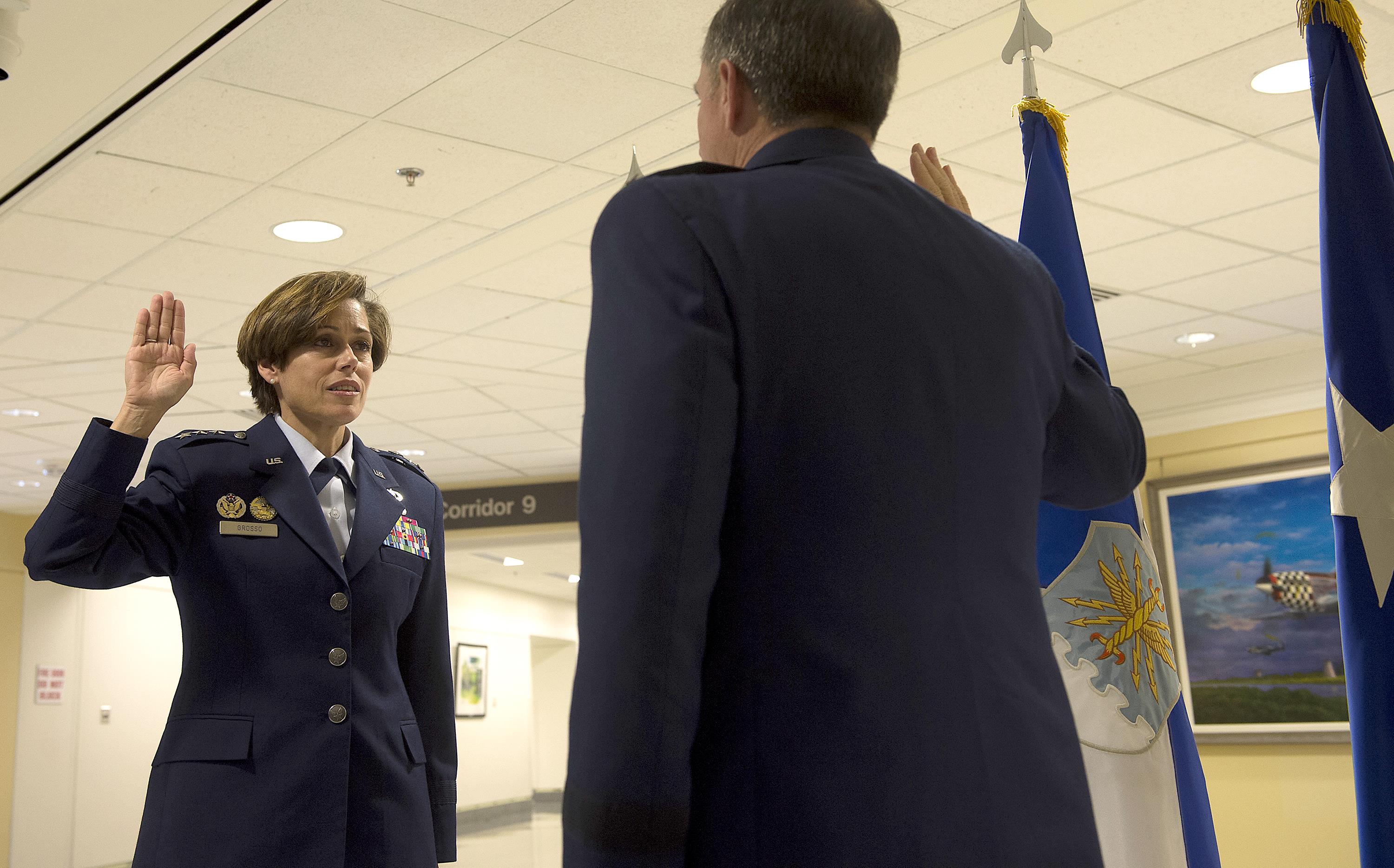
WASHINGTON (AFNS) -- Air Force Vice Chief of Staff Gen.
David L. Goldfein welcomed the newest lieutenant general to the Air Force, who
will serve as the 31st Air Force deputy chief of staff for manpower, personnel
and services, during a Nov. 16 ceremony at the Pentagon.
With her new title, Lt. Gen. Gina Grosso is responsible for
comprehensive plans and policies covering all life cycles of military and
civilian personnel management, which includes military and civilian end
strength management, education and training, compensation, resource allocation,
and the worldwide Air Force services program. She is the first female to hold the
position.
Grosso said that the Air Force has given her opportunities
of increasing responsibility and authority in the manpower, personnel and
services arena, including command opportunity positions to prepare her for her
new role.
“I never aspired to be a three star,” Grosso said. “I always
aspired to be a good Airman and do the best I could in the job the Air Force
asked me to do.”
Grosso marked the occasion in front of a host of co-workers,
friends and family, who she said were part of the inspiration that kept her
moving forward.
“I grew up with an amazing group of role models that were
all of my mom’s friends,” Grosso said. “I saw these amazing women and the
things they were doing in their lives -- I believed I could do whatever I
wanted to do in this world. It never occurred to me to limit myself based on my
gender.”
As the new deputy, Grosso said that developing the plans to
expand on the Human Capital Annex of the Air Force’s Strategic Master Plan is
going to be a huge part of her job to make sure the Air Force is not only
capable today, but in the midterm and far-term, and she is excited about the
opportunity.
“I have served in positions that didn’t even exist when I
was a second lieutenant and you don’t know what this world looks like far into
the future,” Grosso said. “The Air Force has such tremendous opportunities for
men and women, of all ages and colors, military and civilian.”
Over the span of 29 years, Grosso has held several command
and staff positions most recently serving as the Air Force’s Sexual Assault
Prevention and Response program director.
“To me, the sky is the limit and so my advice is to never
hesitate to go through a door, especially if it’s really scary to go through,
because the less you know about something the more you grow and I will
guarantee you will probably look back on that as your best assignment ever,”
she said.
National Guard Airmen partner with local law enforcement, perform life-saving SWAT training
by Senior Airman Kasey Phipps
137th Air Refueling Wing Public Affairs
11/17/2015 - BETHANY, Okla. -- Six members of the Oklahoma Air National Guard trained alongside almost 30 members of the Oklahoma County Sheriff's Office and other state agencies during a Special Weapons and Tactics school held by the Oklahoma County Sheriff's Office at a variety of training locations throughout Oklahoma, Oct. 26 to Nov. 6, 2015.
The school allowed four Security Forces and two Tactical Air Control Party Airmen from Will Rogers Air National Guard Base in Oklahoma City and state law enforcement to learn precise joint operations and procedures that could be used to save lives in real-world situations.
"Collaborating with the Oklahoma County Sheriff's Office provides great joint training and helps us prepare for local state support and tactical missions," said Staff Sgt. Ryan Delarber, 137th Security Forces flight chief.
The techniques taught in the school can be used directly by SF Airmen, who are charged with ensuring base defense both here and abroad, and TACP Airmen, who perform tactical operations while deployed.
Students worked through a wide range of in-depth scenarios and tasks, including trauma care, building and vehicle entry, shield and gas mask use, search and clearance, assessing threats, low light operations, and hostage situations held at the Southern Nazarene University campus in Bethany and at a firefighting training center in Edmond.
"A lot of the scenarios are from situations we've encountered real world, either our team or other teams," said Lt. Jason Ruegge, Oklahoma County Sheriff's Office tactical unit team leader. "We work in reverse order a lot of times and put in place what we want the officers to learn from the scenario. Then we build the scenario backwards."
The rigorous training scenarios, which include live-fire simulation ammunition and explosives, are designed to mimic the stress that can complicate decision-making in rapidly changing environments.
"We try to make the training as real as possible and get their stress levels as high as possible, so that these things come back to them when they are in a stressful situation," said Sgt. Jimmy Lilly, Oklahoma County Sheriff's Office tactical unit senior team leader.
The participants of this joint school left with an appreciation for collaborative learning that captures the expertise shared by both law enforcement and military operators.
"Now, we all speak the same language. We understand the tactics. We understand the mission. We can push forward and get it done," said Ruegge.
This is at least the 10th year for the SWAT school, and the program continues to develop, said Ruegge. The scenario locations vary each year, allowing Airmen and officers to adapt to their environment and their team members.
137th Air Refueling Wing Public Affairs
11/17/2015 - BETHANY, Okla. -- Six members of the Oklahoma Air National Guard trained alongside almost 30 members of the Oklahoma County Sheriff's Office and other state agencies during a Special Weapons and Tactics school held by the Oklahoma County Sheriff's Office at a variety of training locations throughout Oklahoma, Oct. 26 to Nov. 6, 2015.
The school allowed four Security Forces and two Tactical Air Control Party Airmen from Will Rogers Air National Guard Base in Oklahoma City and state law enforcement to learn precise joint operations and procedures that could be used to save lives in real-world situations.
"Collaborating with the Oklahoma County Sheriff's Office provides great joint training and helps us prepare for local state support and tactical missions," said Staff Sgt. Ryan Delarber, 137th Security Forces flight chief.
The techniques taught in the school can be used directly by SF Airmen, who are charged with ensuring base defense both here and abroad, and TACP Airmen, who perform tactical operations while deployed.
Students worked through a wide range of in-depth scenarios and tasks, including trauma care, building and vehicle entry, shield and gas mask use, search and clearance, assessing threats, low light operations, and hostage situations held at the Southern Nazarene University campus in Bethany and at a firefighting training center in Edmond.
"A lot of the scenarios are from situations we've encountered real world, either our team or other teams," said Lt. Jason Ruegge, Oklahoma County Sheriff's Office tactical unit team leader. "We work in reverse order a lot of times and put in place what we want the officers to learn from the scenario. Then we build the scenario backwards."
The rigorous training scenarios, which include live-fire simulation ammunition and explosives, are designed to mimic the stress that can complicate decision-making in rapidly changing environments.
"We try to make the training as real as possible and get their stress levels as high as possible, so that these things come back to them when they are in a stressful situation," said Sgt. Jimmy Lilly, Oklahoma County Sheriff's Office tactical unit senior team leader.
The participants of this joint school left with an appreciation for collaborative learning that captures the expertise shared by both law enforcement and military operators.
"Now, we all speak the same language. We understand the tactics. We understand the mission. We can push forward and get it done," said Ruegge.
This is at least the 10th year for the SWAT school, and the program continues to develop, said Ruegge. The scenario locations vary each year, allowing Airmen and officers to adapt to their environment and their team members.
Inspiring next generation: Secret Squirrel Raiders honored at Parkway High School
by Senior Airman Amanda Morris
2nd Bomb Wing Public Affairs
11/16/2015 - BARKSDALE AIR FORCE BASE, La. -- Students from Parkway High School honored veterans during their annual Veterans Day Tattoo Ceremony Nov. 11. Three members from Barksdale Air Force Base attended as guests of honor to be recognized for their roles in Operation Senior Surprise, a previous classified mission that helped kick-off Operation Desert Storm.
Operation Senior Surprise was a mission cooked up by Strategic Air Command during Operation Desert Shield. The term Senior Surprise was the official name of the mission, but aircrew and maintainers creatively came up with the name Secret Squirrel so they could track schedules and discuss the mission in unclassified areas.
At the start of Desert Shield, a select group of aircrew and maintainers from the 596th Bomb Squadron were briefed about the conventional air launch cruise missiles.
"I was first informed of the mission in August 1990 and then had six months to train on the new weapon. We couldn't tell anybody anything," said Warren Ward, Air Force Global Strike Command deputy chief of programming division and 596th Bomb Squadron B-52G Stratofortress co-pilot, during Operation Senior Surprise. "The 62nd BS and part of the 596th BS were largely deploying forward yet a large portion of the 596th stayed at Barksdale. We were watching our brothers in arms going forward, yet we were staying back. We had to work under a veil of secrecy."
Once briefed, the groups began extensive training to ensure that the aircraft could fly long range missions safely and flawlessly.
"When we launched the weapons, the sun was barely coming up," said Ward.
The morning of Jan. 16, 1991, seven B-52G Stratofortresses from Barksdale took off heading toward Iraqi targets, launched 35 conventional air launch cruise missiles, and returned in secret.
These buffs were the first combat sorties launched for the liberation of Kuwait in support of Operation Desert Storm, and it marked the longest combat sortie flight totaling 14,000 miles in 35 hours and 24 minutes. The clandestine mission set the standard for long range strike.
The mission remained classified until Jan. 16, 1992, when the crewmembers and maintainers who made the mission possible were presented with air, achievement and commendation medals for their efforts.
Three of these raiders shared their Veterans Day with the school to honor other veterans and to be recognized.
"It was a great honor to be recognized by Parkway. Here we are 25 years later, and the fact that they chose this particular event in history as the theme for their annual event is humbling," said Col. Trey Morriss, 307th Bomb Wing vice commander and 596th BS electronic warfare officer, during Operation Senior Surprise. "This event was a learning moment. This generation was born in a time of constant global warfare, fighting terrorism, so it is easy to forget and become complacent. Veterans Day and Memorial Day are great opportunities to remind, refresh and teach."
"It was very humbling to be part of this event, and I'm grateful because the torch is being passed to a new generation," Ward said. "We must educate people and pave the way for new generations. We need to continue to inspire patriotism to guarantee that we have a nation to hold onto in the future. I hope the ceremony has shed a light on these students to think about joining the military. I was absolutely overwhelmed by the Parkway tattoo."
2nd Bomb Wing Public Affairs
11/16/2015 - BARKSDALE AIR FORCE BASE, La. -- Students from Parkway High School honored veterans during their annual Veterans Day Tattoo Ceremony Nov. 11. Three members from Barksdale Air Force Base attended as guests of honor to be recognized for their roles in Operation Senior Surprise, a previous classified mission that helped kick-off Operation Desert Storm.
Operation Senior Surprise was a mission cooked up by Strategic Air Command during Operation Desert Shield. The term Senior Surprise was the official name of the mission, but aircrew and maintainers creatively came up with the name Secret Squirrel so they could track schedules and discuss the mission in unclassified areas.
At the start of Desert Shield, a select group of aircrew and maintainers from the 596th Bomb Squadron were briefed about the conventional air launch cruise missiles.
"I was first informed of the mission in August 1990 and then had six months to train on the new weapon. We couldn't tell anybody anything," said Warren Ward, Air Force Global Strike Command deputy chief of programming division and 596th Bomb Squadron B-52G Stratofortress co-pilot, during Operation Senior Surprise. "The 62nd BS and part of the 596th BS were largely deploying forward yet a large portion of the 596th stayed at Barksdale. We were watching our brothers in arms going forward, yet we were staying back. We had to work under a veil of secrecy."
Once briefed, the groups began extensive training to ensure that the aircraft could fly long range missions safely and flawlessly.
"When we launched the weapons, the sun was barely coming up," said Ward.
The morning of Jan. 16, 1991, seven B-52G Stratofortresses from Barksdale took off heading toward Iraqi targets, launched 35 conventional air launch cruise missiles, and returned in secret.
These buffs were the first combat sorties launched for the liberation of Kuwait in support of Operation Desert Storm, and it marked the longest combat sortie flight totaling 14,000 miles in 35 hours and 24 minutes. The clandestine mission set the standard for long range strike.
The mission remained classified until Jan. 16, 1992, when the crewmembers and maintainers who made the mission possible were presented with air, achievement and commendation medals for their efforts.
Three of these raiders shared their Veterans Day with the school to honor other veterans and to be recognized.
"It was a great honor to be recognized by Parkway. Here we are 25 years later, and the fact that they chose this particular event in history as the theme for their annual event is humbling," said Col. Trey Morriss, 307th Bomb Wing vice commander and 596th BS electronic warfare officer, during Operation Senior Surprise. "This event was a learning moment. This generation was born in a time of constant global warfare, fighting terrorism, so it is easy to forget and become complacent. Veterans Day and Memorial Day are great opportunities to remind, refresh and teach."
"It was very humbling to be part of this event, and I'm grateful because the torch is being passed to a new generation," Ward said. "We must educate people and pave the way for new generations. We need to continue to inspire patriotism to guarantee that we have a nation to hold onto in the future. I hope the ceremony has shed a light on these students to think about joining the military. I was absolutely overwhelmed by the Parkway tattoo."
Subscribe to:
Posts (Atom)