by an anonymous Airman
Air Force Materiel Command
11/4/2015 - AFMC -- I have
worked for the federal government for 13 years. In each and every one of
those years, I have been through suicide awareness and prevention
training. I have completed the Resiliency Training Assistant course, and
I have even taught resiliency at Wingman Days. I know the toolsets to
help and have a set of personal coping skills. However, there is nothing
more excruciatingly painful than emotional pain.
Now the dark truth: I have attempted suicide twice and have battled
suicidal ideation for years. I have a long history of depression and
anxiety. Feelings of hopelessness, sadness and being alone, along with
overwhelming stress and the desire to be "normal," piled up until I was
in a very dark place. I found myself overcome with inner turmoil: do I
choose to live or end it all?
Struggles, stressors, depression, sadness, anxiety, hopelessness and
feelings of being alone are very real and very personal. They are not
things I felt I could talk openly about to people at work, or even my
family. I felt ashamed, embarrassed and scared, and I didn't know who I
could trust with these very personal feelings and thoughts. Who would
care? I didn't want to be a burden on anyone. These were my problems,
not theirs. I felt at work that I was nothing more than a statistic. I
felt as if no one would understand and I would just be told to "suck it
up and move on." What would my boss think? How would it reflect on me
and my work performance?
I understand that everyone has ups and downs in life; that's the way
life is. But despite my history, I knew I was in the darkest place I had
ever been. I knew the feelings I had were deeper and hurt more than
they did when I had previously attempted suicide. The internal battle of
part of me wanting to live and part of me wanting to die was becoming
unbearable. Still, I went to work day after day, fighting a fight that
no one knew about. It was easy to put on a happy face and act like
everything was okay while I was around people. I even kept up the act at
home around my spouse and children. No one knew.
For months I wrestled with my feelings, trying desperately to get the
fighting within myself to stop. I was grasping at everything I could
think of as a reason to live. When my spouse and I got into a fight one
evening after a rough day at work, I blurted out without thinking, "All
of our problems would be solved and life would be much better if I were
dead!" After the fight I told him I was just upset, that I didn't really
mean it.
I started to think more about death. I developed a plan on how I would
do it. I was very methodical in the way I handled work things one day --
under the guise of 'situational awareness,' I made sure my co-workers
knew where things were located for some events that were coming up; I
left a few select papers and folders on my desk; I left my desk
unlocked. No one noticed, though I would never do those things normally.
I said my usual goodbyes and left for the evening with no intention of
being alive to "see them in the morning." As I drove home, I looked at
telephone poles and large trees and wondered how fast I would have to go
to wrap my car around one of them to make it a fatal accident. I fought
myself to keep on the road. I had one more thing to take care of before
I left.
As I walked into my home, one of my children, who is young and doesn't
say very many words, ran up to me yelling, "MOM, MOM, MOM!" with his
arms wide open and gave me the biggest hug I have ever received in my
life. When my child looked up at me and motioned for a kiss, that was
it. That was the turning point for me.
In an instant I felt desperate; I needed help and I needed it now. I
confessed to my spouse how I was truly feeling and that it had been
going on for quite some time. The realization that there was a definite
possibility of me not being here anymore was suddenly very real and
extremely terrifying. I called the National Suicide Prevention Lifeline
and talked to a very nice, soft-spoken woman. She asked me a lot of
questions about how I was feeling, if I had a plan and what my life
situation was. As nice as she was, it wasn't providing the help I
needed. I called my primary care physician and explained my need for
help. She told me to go to the emergency room right away. Fearing that
driving myself wouldn't go very well, I packed up my family and headed
out to the ER, trying to keep myself together.
I was taken to a room immediately. I was very ashamed as I explained to
the nurses and doctor what was going on. I knew how to be resilient; I
taught it. The thoughts of, "I don't really need help" and, "I just had a
bad day, I will get over it" started rushing through my mind. I fought
the urge to just leave. I was there for several hours and released with a
follow-up appointment at the mental health clinic early the next
morning. My spouse called my supervisor to let her know what was going
on and that I would not be in to work the next day. She was supportive
and offered to help in any way she could.
I arrived at my appointment after a long night of thinking. I had a long
talk with a counselor. She wrote me a safety plan and suggested I have
my medications adjusted. I was once again sent home. I called my doctor
and set up an appointment for the following day. I went to that
appointment and told her what had happened. She made some adjustments to
my medications and suggested inpatient care.
The next day I went back to the clinic with my spouse and explained that
I needed more intensive help and wanted to be admitted. After sharing
more details with the ER nurses and telling them that I really felt this
was the best thing for me, I was taken to an inpatient facility.
I went to every group therapy meeting they offered. I learned that I am
truly not alone. I have been told for years and by every mental health
professional I have seen that "I am not alone." Until I experienced it
first hand, I never believed them. I was not and am not alone. Through
the group meetings, I found that a lot of people are suffering and
battling the same dark, overwhelming sadness I was and still am to an
extent. Their life situations weren't the same as mine, but it didn't
matter. We were all there for the same reason: to get help.
I was in the inpatient facility for five days. When I returned home, the
darkness had lifted some. I was by no means "cured," but I felt a lot
better. I knew that I had done the right thing. I found hope when I
thought I had none. I found reasons to live when I felt they were all
gone. I found support from my supervisor, which lessened my work-related
stress. For the first time in years, I felt some level of happiness. I
was proud of myself for choosing to live. I was proud I took that step
to accept I needed help and to get the help I needed -- even though it
was probably the hardest thing I have ever done.
I still battle depression and anxiety and probably always will. But I
have found through all of this that no matter what is going on in life,
there is always a reason to live.
EDITOR'S NOTE: Air Force Materiel Command is currently conducting
its Mental Fitness Campaign, to inform the workforce about the signs and
symptoms of depression, offer anonymous behavioral health screenings,
and promote mental fitness assistance programs and services. Click here to read more.
Professional counseling services are available for the AFMC workforce
and their families. Active-duty personnel can contact their local mental
health clinic for services, or they can contact Military OneSource by
calling (800) 342-9647 or visiting militaryonesource.mil. Civilian
employees can contact the Employee Assistance Program for free,
confidential counseling services by calling (800) 222-0364 or by
visiting FOH4You.com.
Friday, November 06, 2015


Thursday, November 05, 2015
AFGSC Airmen support largest NATO exercise in 20 years

by Charles Ramey
Air Force Global Strike Command Public Affairs
11/5/2015 - BARKSDALE AIR FORCE BASE, La. -- Two B-52 Stratofortresses and aircrews assigned to Air Force Global Strike Command conducted a long-range bomber mission to the U.S. European Command area of operations Nov. 3-4, where they participated in Trident Juncture 2015 - the largest NATO Exercise to be conducted in the past 20 years.
During the non-stop sortie, which lasted approximately 26 hours, the B-52 aircrews from the 2nd Bomb Wing flew from Barksdale Air Force Base, Louisiana, to the multinational exercise area of operations where they executed a show-of-force in Spain, participated in a naval maritime strike scenario, and conducted a large force integration scenario in Portugal.
With approximately 36,000 participants from more than 30 Allied and partner nations, Trident Juncture uses a fictitious training scenario to assess NATO's agility and ability to meet operational challenges while responding to global threats to peace and security.
"[Trident Juncture] demonstrates that we can deploy high-readiness forces from across the alliance in a matter of days," said Gen. Philip M. Breedlove, Supreme Commander Allied Powers Europe (SACEUR) during the exercise's opening ceremonies at Trapani Air Base, Italy, Oct. 19. "These multinational forces from Air, Land, Sea and Special Operations are highly interoperable and have proven capable of conducting complex military maneuvers across the spectrum of operations."
Participation of a strategic bomber in Trident Juncture highlights the United States' commitment to NATO Allies and partners and enhancement of regional security. This most-recent B-52 mission follows a series of similar partnership activities in the EUCOM AOR. In September, a 2nd Bomb Wing B-52 Stratofortress aircrew flew from Barksdale Air Force Base to Postojna, Slovenia, where they worked with Slovenian and U.S. Joint Terminal Attack Controllers (JTAC) at a range near the Slovenian town of Pivka to provide close air support to allied forces during Exercise Immediate Response.
In June, three Stratofortresses from Minot Air Force Base, North Dakota, deployed to Royal Air Force Fairford, England, where the bombers trained and integrated with U.S. and allied military forces in the region during exercises Baltops and Saber Strike. The deployment followed an April nonstop roundtrip sortie by two Barksdale B-52s from their home station to the North Sea where aircrews participated in dissimilar air intercept maneuvers with fighters from the Royal Canadian Air Force, the United Kingdom's Royal Air Force and the Royal Netherlands Air Force.
According to Maj. Gen. Richard Clark, Eighth Air Force commander and the U.S. Strategic Command's Joint Functional Component Command commander for Global Strike, the participation of B-52 forces in Trident Juncture demonstrates the ability of America's long-range strike force to quickly support multinational forces anywhere on the globe.
"Trident Juncture gives us an invaluable opportunity to hone our warfighting skills. It allows us to integrate with our NATO allies and to train like we will fight," Clark said. "These missions enhance our interoperability and teamwork, demonstrate global reach capability of our bomber force and allow our aircrews to train on the unique demands of long duration sorties."
The B-52 Stratofortress is a long-range, multirole bomber that can perform a variety of missions. Through the use of aerial refueling, the range of a B-52 is limited only by crew endurance. It has an unrefueled combat range in excess of 8,800 miles.
"Our participation in Trident Juncture allows B-52 aircrew to enhance their readiness by flying a global strike profile and conducting operations in unfamiliar airspace," said Capt. Kevin Crawford, 2nd Operations Support Squadron flight commander for nuclear plans and operations. "The opportunity to integrate with both U.S. and NATO forces allows B-52 aircrew to 'practice like we fight' in an international exercise."
28th BW participates in ORE

28th Bomb Wing Public Affairs
11/5/2015 - ELLSWORTH AIR FORCE BASE S.D. -- The 28th Bomb Wing recently participated in a base operational readiness exercise Oct. 20 through 22.
Exercises evaluate the wing's ability to meet wartime and contingency tasks of employing and sustaining forces, and maintaining the ability to survive and operate in a deployed location.
"The intent of this readiness exercise was to evaluate the 28th BW's ability to execute and sustain combat power from a forward operating environment," said Tech. Sgt. Danielle Kahler, 28th Bomb Wing Inspector General Inspections wing inspection team manager. "A variety of base-wide support was evaluated to employ and sustain operations in a contested combat environment, including Chemical, Biological, Radiological, Nuclear and High Yield Explosives (CBRNE) reconnaissance, SABC response and post-attack recovery."
Airmen were also tested on unexploded ordnance identification, marking and evacuation procedures, and contamination avoidance.
"The Air Force defines the most probable threat as tactical ballistic missiles," Kahler said. "Through readiness exercises, we develop tactics and procedures to continue mission operations after conventional and irregular biological warfare attacks."
Conducting exercises would not be possible without Wing Inspection Team members and 28th Civil Engineer Squadron emergency management flight personnel.
"Their dedication to getting the job done correctly and efficiently allowed us to put this exercise together in a timely manner and meet all objectives," Kahler added.
One of the objectives met during the exercise was satisfying pre-deployment requirements.
"The IGI office worked with [28th] CES emergency management and put together a mass CBRNE training class in the Pride Hangar Oct. 19," Kahler said. "This met requirements for more than 180 military members."
In supporting the B1- bomber mission at home and abroad, OREs allow Ellsworth to bridge the gap between training and real world so Airmen can continue to win the fight.
Carter Visits USS Roosevelt in South China Sea
By Lisa Ferdinando DoD News Features, Defense Media Activity
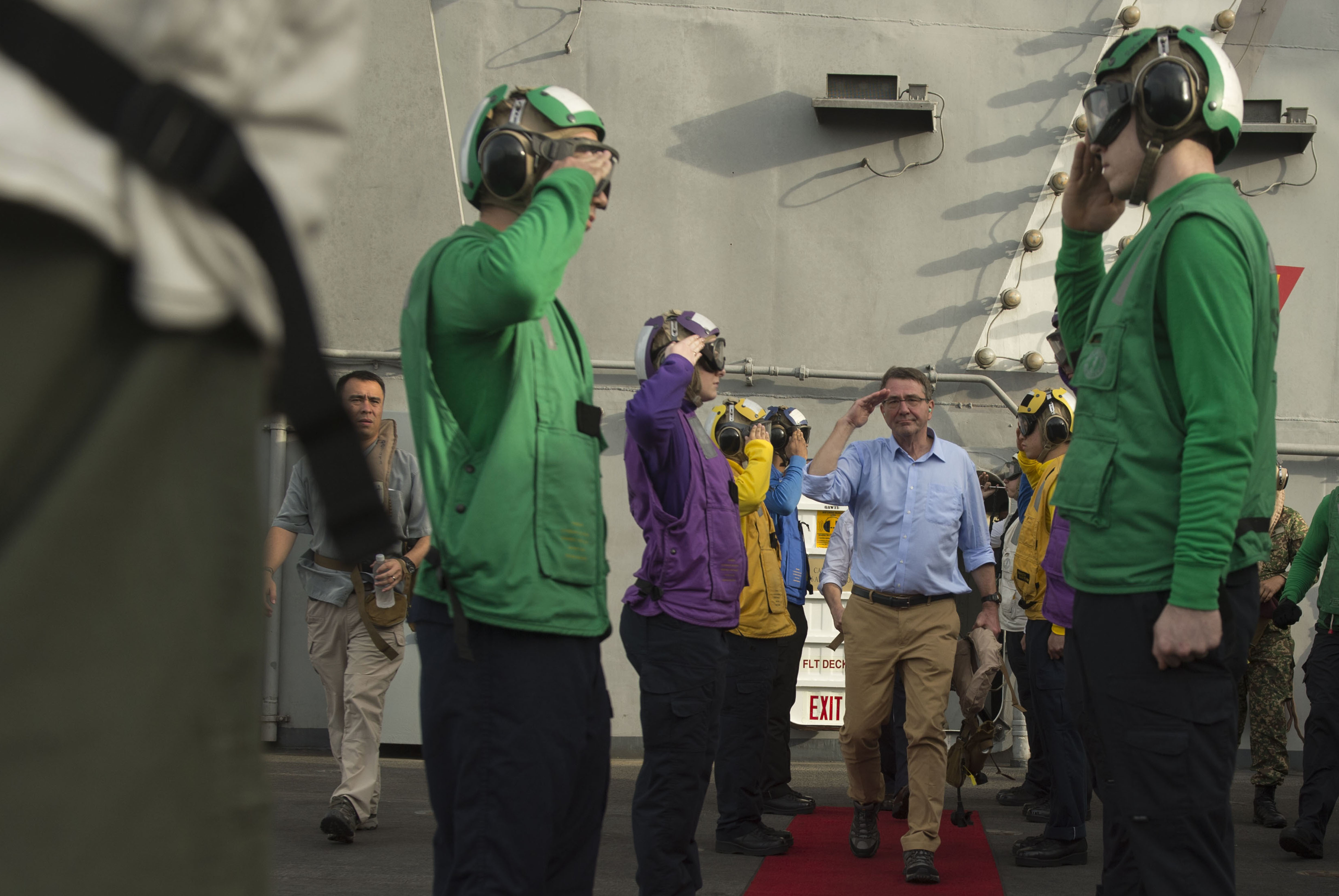
WASHINGTON, November 5, 2015 — Defense Secretary Ash Carter
today toured the USS Theodore Roosevelt in the South China Sea and expressed
concern about China's activities in those waters.
Carter said the Nimitz-class aircraft carrier’s presence is
a "symbol and a sign of the critical role the United States' military
power plays in what is a very consequential region for the American
future."
The defense secretary also commented on regional tensions
resulting from disputes over land features in the South China Sea. Several
Asia-Pacific countries, including China, are involved in those disputes.
"There is a lot of concern about Chinese behavior out
here," he said.
Those concerns, Carter said, were discussed yesterday at the
Association of Southeast Asian Nations Defense Ministers’ Meeting - Plus in
Malaysia’s capital city, Kuala Lumpur.
"Many countries in the region are coming to the United
States and asking us to do more with them so that we can keep the peace out
here," he said.
Asia-Pacific Partners
Carter toured the aircraft carrier with Malaysian Defense
Minister Hishammuddin Hussein. Visiting the ship with his Malaysian
counterpart, Carter said, indicates the demand for American presence in the
Asia-Pacific region.
Stability in the Asia-Pacific region is important to the
United States economically, Carter said, noting that half of the world's
commerce comes from or passes through that part of the world.
The U.S. military's rebalance to the Asia-Pacific region is
intended to maintain and further promote peace and prosperity in the region,
according to Carter.
The USS Roosevelt, with about 3,000 crew members, is
operating in the U.S. 7th Fleet area of operations as part of a worldwide
deployment en route to its new homeport in San Diego. The move is part of a
three-carrier homeport shift.
Carter, who is on an eight-day trip focusing on the
Asia-Pacific rebalance, will travel on to Hawaii, then California, before
returning to the Pentagon.
Vandenberg Airmen help rescue family

30th Space Wing Public Affairs
11/5/2015 - VANDENBERG AIR FORCE BASE, Calif. -- Two Vandenberg Airmen recently helped rescue a family in Goleta, Calif.
While driving along Highway 101 on Oct. 25, Staff Sgt. Bryan Karason, 30th Force Support Squadron NCOIC of assignments, and Senior Airman Sarah Cabrera, 614th Air and Space Operations Center administrator, noticed what looked like flames on the side of the road.
"As we drove a little closer we noticed there was an enormous dust cloud that was generated from a car that had swerved off the road and onto a hill off the expressway, causing it to flip over," said Karason.
Karason immediately pulled his car to the side of the highway, and swiftly approached the scene with Cabrera.
"Initially approaching the car I assumed that everyone was out of the car but then I saw a gentleman kicking open the rear passenger door," said Karason. "Cabrera yelled for one of the members at the scene to call 911. Arriving to the car, the gentleman was in shock and was expressing that there were more individuals located inside the vehicle. He didn't speak English so Cabrera helped with the language barrier and started to communicate in Spanish."
After quickly assessing the situation, the Airmen sprung to action using Self-Aid and Buddy Care techniques.
"I saw a young girl in the backseat, and also heard the screaming of a woman coming from the front passenger seat," said Karason. "Another individual on the scene assisted me with getting the young girl out, and while he tended to her, I responded to the woman and got her out of the passenger seat. Once cleared from the wrecked car, we laid her flat on a blanket, treated her for shock and made sure she didn't move any part of her body to prevent more bodily injury."
When the first responders and paramedics arrived on scene, Cabrera was the only person on site who was able to overcome the language barrier and translate for the victims.
"The cops took me to the side to tell me questions to ask the victims," said Cabrera. "What were their names, dates of birth, current address and other important information they needed."
Cabrera is thankful for her military experience, helping her triumph in a difficult situation.
"We practice situational awareness on and off base, and in this case it happened to be off-base," said Cabrera. "We put our training to the test, and were able to quickly assess the situation and pull a family out of the car to safety."
Cabrera hopes this situation will help shine light on the importance of Air Force training and expand knowledge about different languages and cultures.
"Not only does it open up a new world of opportunities for your career and for yourself, but you never know when you will actually use it," said Cabrera. "In this situation, I was the only one communicating between the crash victims and first responders - because I knew a second language, I was able to help."
The two Airmen remain humble, attributing their quick thinking to military training and experience.
"I would have to say the training the Air Force has provided just took over," said Karason. "I just felt like I knew what to do and what had to be done, and with the help of Cabrera and a couple other individuals we were able to assist the best we could."
Providing fast and effective care, while assisting and supporting to the family, Karason and Cabrera proved the quality of today's American Airmen.
"I am a firm advocate that in our training, you practice how you play," said Karason. "When we are called on, there is no confusion, we just act."
Perfectly wounded

55th Wing Public Affairs
11/3/2015 - OFFUTT AIR FORCE BASE, Neb. -- The Offutt Diversity Team hosted a National Disability Employment Awareness Month Lunch and Learn Oct. 28 at the Patriot Club with several guest speakers including two wounded warriors.
The first of the four guest speakers was John Weinberg, a wounded warrior, who was medically retired in 2008 after serving 12 years in the Army infantry. Before his unit deployed to Afghanistan, he was severely injured during a field exercise, leaving him a quadriplegic.
"We were out doing a live-fire exercise and the last thing I remember was talking on the radio to the platoon leader and telling him we saw the objective and we were going to start the assault," said Weinburg. "The driver must have thought I was talking to him and starting making the turn and clipped a tree, causing the tree to fall on top of the vehicle."
He spent more than six months in the hospital and had metal plates placed in his neck and eight screws into his vertebrae. Weinburg went on to talk about the challenges of being wheelchair-bound.
"When I first got out of the hospital, my kids were 5, 3 and 2. They had no idea what I was going through," he said. "They would come to me and ask, 'Dad, can you open my juice box? Dad, can you button my shirt? Dad, can you tie my shoes?' It made me feel like a bad dad."
Weinburg continued to struggle and in 2010 attempted suicide.
"Thank God I failed," he said. "Pride. That was my problem."
Weinburg finally got the help he needed.
"They sent me to a lock-down PTSD program," he said. "It helped me out drastically. Now I just live day-to-day and don't let anything stop me. My mom always said, 'God doesn't give you anything you can't handle.'"
He said the most important thing he learned was suicide was a permanent fix to a temporary problem.
Weinberg still has days he feels sorry for himself, but he reminds himself that there are always other who have it worse. In the deployment following his injury, his unit lost nine soldiers who were also his close friends.
"One of them just had a brand new baby, she wasn't even 3 or 4 months old. His daughter will never have the opportunity to grow up with him," said Weinberg. "In the infantry we had a saying, 'take a knee, face out, drink water and get back up and keep going.'"
Following his speech Todd Dawson, 55th Medical Support Squadron recovery care coordinator, spoke about the services he offers members transitioning out of the military.
"I want to take care of all non-medical needs," said Dawson. "We want to make sure as members are transitioning out of the military, they are getting out on solid ground. We want to talk about things such as jobs, education, goals and finances. We want to start looking at these things way early on."
Next, the audience heard from John Galbarith, 55th Force Support Squadron Airman and Family Readiness community readiness technician, who also does work with wounded warriors.
He spoke of an Army sergeant he had worked with in the past who lost everything, because he wasn't willing to reach out and get help with his PTSD.
"At the end of the day he did what his country asked him to do and sacrificed a part of himself in doing it," said Galbarith. "Most wounded warriors are no different. They didn't find their disabilities, their disabilities found them. These airmen, soldiers, sailors and Marines have to rediscover who they are and where they fit in."
Finally, Staff Sgt. Troy Green, 139th Security Forces Squadron, Missouri Air National Guard, and Purple Heart recipient, spoke on his struggles with PTSD. After serving several years in the Air Force, he made the decision to join the Army and found himself at a forward operating base in Afghanistan.
It wasn't long before the base came under attack. During the initial explosion, Green suffered a concussion, traumatic brain injury and shattered two discs, but still continued to fight and assist the wounded until the forward operating base was secured.
"I checked a lot off of my combat bucket list that day," Green said. "I got to see a helicopter fly over and launch a bunch of rockets. I got to see a sniper in action. I got to see a guy self-detonate. It was a weird bucket list. But all that happened in about a span of an hour."
After his unit returned home, they were given five days of leave and then were expected to return to work. There wasn't much in the way of helping them deal with their new issues.
Luckily, Green said he had his wife. He said she was his biggest savior.
But, Green recognizes that not everyone has someone and has become an activist for veteran's needs.
He just finished a 203-mile rucksack march across the state of Missouri and raised more than $7,000 for a veteran's home. He and his wife are also starting a non-profit organization called "Perfectly Wounded" with all proceeds going to support wounded warriors.
Since his deployment, Green switched back to the Air Force and is due to deploy again shortly.
"I am glad to know if something were to happen to one of my [troops], I know where to go know," said Green. "That was one of the problems we had, we didn't know where to go or what to do."
Dunford: U.S. Engagement in Pacific ‘Unprecedented’
By Jim Garamone DoD News, Defense Media Activity
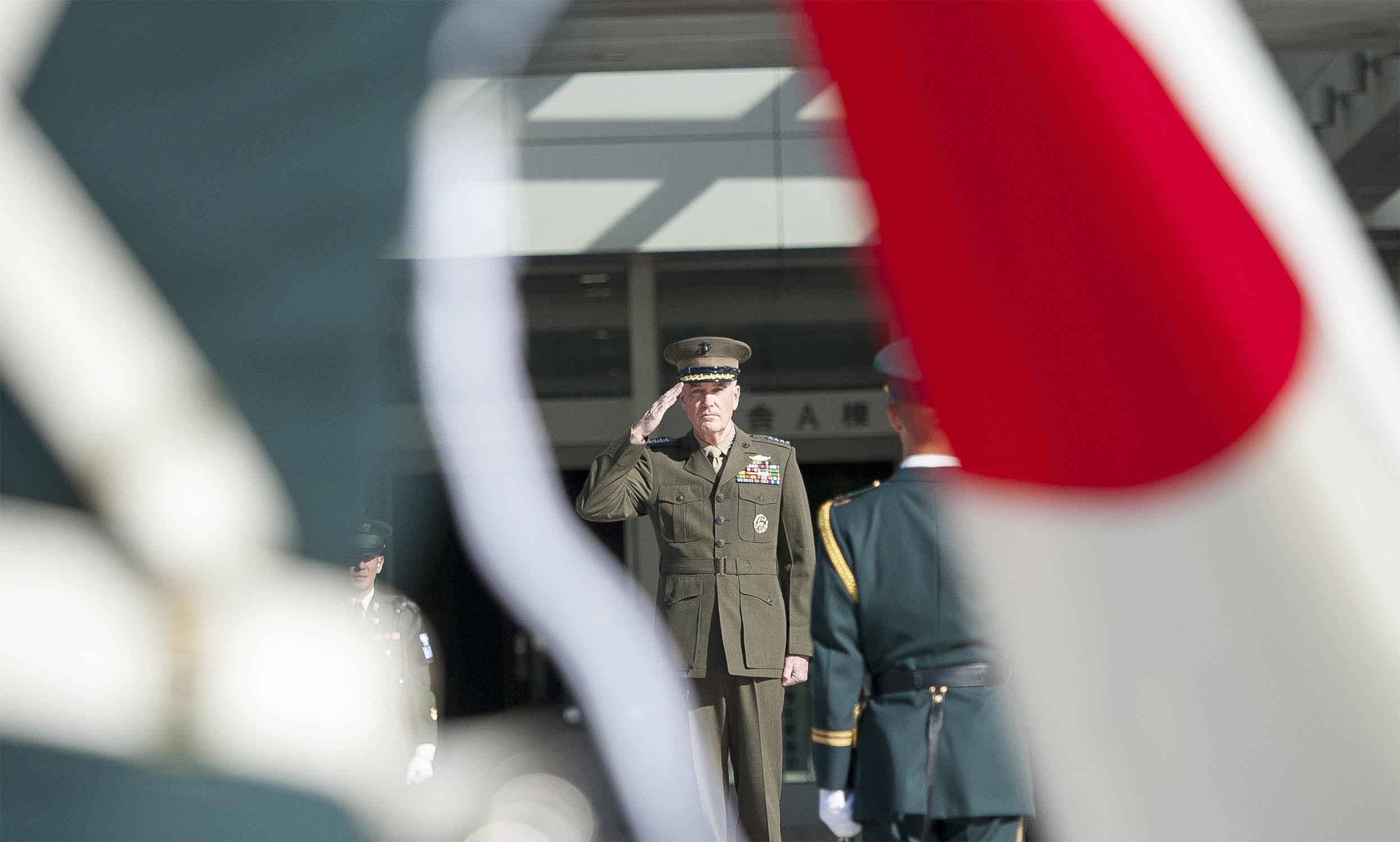
TOKYO, November 4, 2015 — Marine Corps Gen. Joseph F.
Dunford Jr. met with Japanese leaders here today to discuss freedom of
navigation, changes to the U.S.-Japan alliance and threats and opportunities in
the region.
Dunford met with Japanese Prime Minister Shinzo Abe, State
Minister of Defense Kenjo Wakamiya and Maritime Self-Defense Force Adm.
Katsutoshi Kawano, the chief of defense, during a round of visits.
“We talked about the Pacific, we talked about their
assessment of the challenges in Asia,” the chairman of the Joint Chiefs of
Staff said in an interview following the meetings. “Frankly, they line up
pretty well with how we see it.”
Freedom of Navigation
Dunford said he discussed the issue of freedom of navigation
with Prime Minister Abe. The general referred to last week’s passage of the USS
Lassen within 12 miles of Subi Reef -- an artificial island China has built in
the Spratly archipelago.
The passage, the chairman said, “was not provocative. We
made it very clear that the Global Commons is accessible to everybody in
accordance to international laws.”
Dunford added, “The Japanese support what we did and they
believe what we did is important. They believe we ought to continue to do
that.”
The chairman said he and the Japanese leaders also discussed
the challenges posed by China, Russia and North Korea.
The threats are pushing Japan to more closely cooperate with
others in the region, Dunford said, adding that he dug deep in discussing
Japan’s trilateral relationships. These are the United States, Japan and
Australia; the U.S., Japan and the Philippines and the U.S., Japan and South
Korea.
His meeting with Japanese leaders was the first since Japan
passed legislation in September that will allow the country to play a greater
role in global security affairs.
“Clearly everyone recognizes that we had a very good
relationship with the Japanese before this,” Dunford said. “But this will open
up possibilities for more integration in areas that we were proscribed from
actually dealing with them in the past.”
The legislation will take effect in the spring and the
chairman believes it will allow U.S. and Japanese troops to take their
cooperation to new levels.
Alliance’s Importance on the Rise
Kawano hosted a full-honors arrival ceremony at the defense
ministry for Dunford. The Japanese admiral told the chairman he wanted to
deepen the military-to-military relationship between the two countries.
“The situation in the Asia-Pacific region is severe and that
is why the importance of the U.S.-Japan alliance is increasing,” Kawano said
through an interpreter at the start of the meeting with the general.
“I believe this alliance will contribute to maintaining
peace and stability through the region,” he said. “So we would like to make the
effort to contribute to the peace and stability not only in this region, but
throughout the world.”
Also at the meeting, Dunford said this visit, just a month
into his term as chairman, reflects of the importance the United States places
on the alliance.
“We have had a relationship with the Japanese Self-Defense
Forces for many years, but I don’t think it has ever been more important than
it is today,” the chairman said.
There are many challenges in the region, he said, and Japan
and the United States must work together to overcome them. But, Dunford added,
“there are also opportunities, and those are based on the strength of our
alliance.”
Dunford said he was pleased with the overall state of U.S.
relations in Northwest Asia. Before coming to Japan, he visited South Korea for
the annual Military Committee Meeting.
“My perspective on the trip … is that the relationships at
every level were really in pretty good shape,” he said. “The amount of
engagement that we have in the Pacific … is unprecedented.”
Subscribe to:
Posts (Atom)


 Posts
Posts

