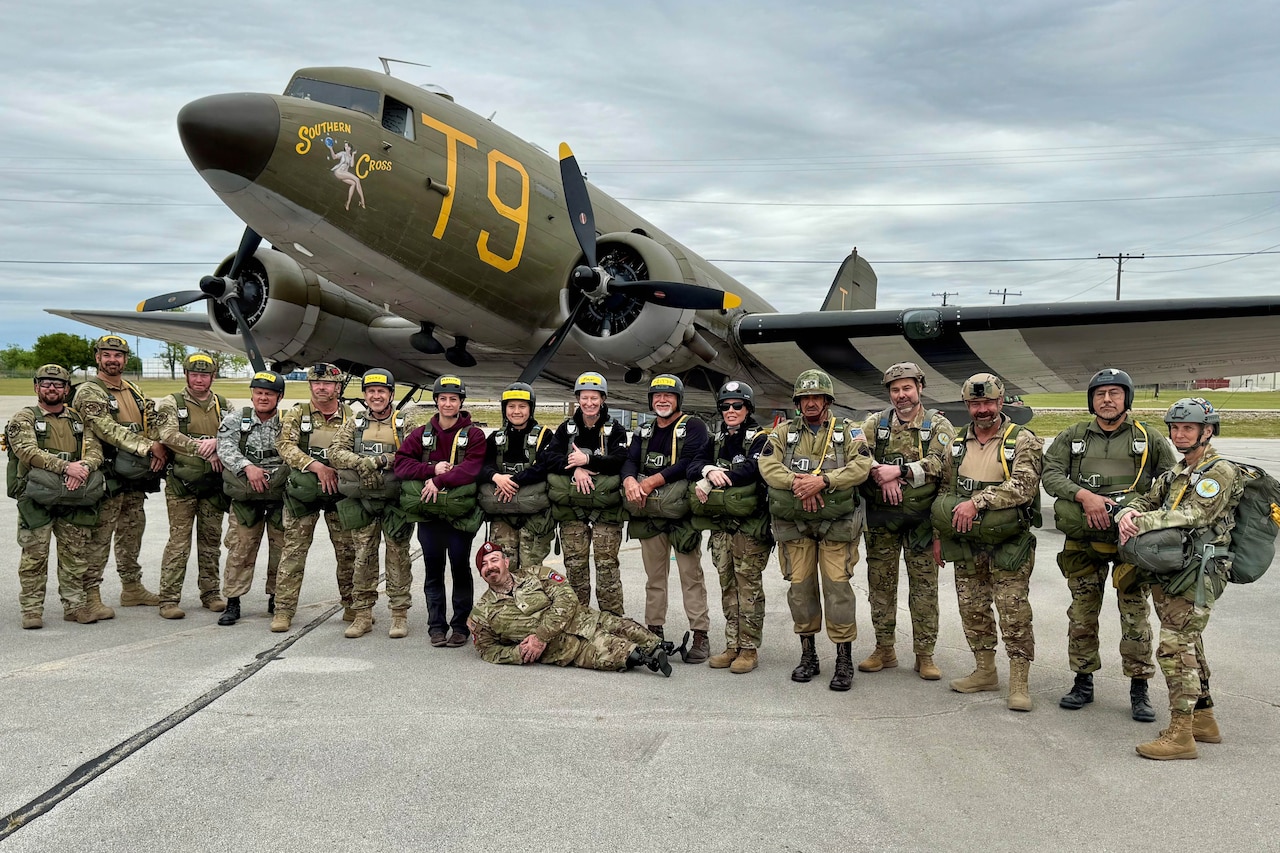
Fourteen years after an explosion in an Afghan village took both of his legs and nearly his life, former 82nd Airborne Division paratrooper Jon Harmon is preparing to step into the door of a World War II‑era C‑47 over Normandy, France, and jump again.
For Harmon, 32, the moment will mark more than a return to the sky. It will mark a return to himself.
"Normandy's everything," Harmon said. "That's where our guys made their history, and to be able to jump in those drop zones, in front of the men who actually dropped there, is the greatest honor of my life."
Joining the Ranks
Harmon grew up in Cedarville, California, raised on stories of his grandfather's service and inspired by the paratroopers of World War II.
"'Band of Brothers' came out, and then I learned who [Army Maj. Gen. Jim] Gavin was," he said. "I started reading books and researching. I thought, 'This is incredible.'"
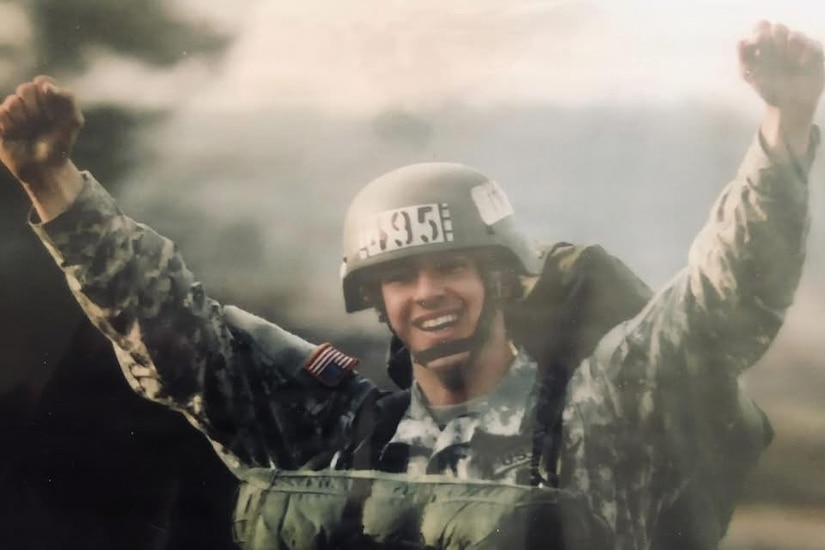
Harmon enlisted in 2011 — a couple of months out of high school — as an airborne infantryman. He arrived at Fort Bragg, North Carolina, as a teenager with a beret still in the post exchange bag.
"I got immediately destroyed by one of the airborne females who picked me up because I didn't have a beret yet," he said with a laugh. "The next day, we were doing a 20K. It was everything I expected, and more."
A year later, he deployed to Kandahar Province, Afghanistan, with the 4th Brigade Combat Team, 82nd Airborne Division.
Harmon was a 19‑year‑old private first class on his first deployment as part of Task Force Fury, when his life changed in an instant, June 7, 2012.
He said the mission that day began as a routine patrol and key leader engagement with village elders, about a mile and a half from their strongpoint. Harmon was serving as a machine gun ammo bearer at the time. The platoon had been in a firefight in that exact location on a previous mission.
It was midafternoon when the maneuver element began moving into the village. Harmon and his gunner set up the support‑by‑fire position. He gave his gunner sectors of fire, checked his angles and stepped to the side of a low wall and berm, where the machine gun was positioned.
"And that's when I stepped on it," Harmon said.
"It" was an improvised explosive device; the blast threw Harmon into a cloud of dust and debris.
"It was a total brownout," he said. "I kept trying to stand up. I didn't understand why I couldn't, until I looked down and saw my [tibia and fibula] sticking out."
Army Pfc. Brandon Goodine, who was positioned near Harmon, stepped on a second device moments later.
As medics fought to save Harmon, Goodine and multiple other casualties, a stretcher team carrying Goodine triggered a third IED.
"They carried him right over me," Harmon said. "And then, the stretcher team stepped on another plate. It was … it was bad. It killed Brandon instantly."
Harmon remained conscious throughout the evacuation, giving himself aid and applying his own tourniquets. His unit suffered nearly a dozen casualties during the mission.
"It was like something out of 'Apocalypse Now' — just a pile of guys in the Blackhawk. The last thing I remember was the American flag on the ceiling as they pushed me into the surgical unit," he said.
Everything has Changed
Harmon woke up days later in Germany. He had undergone surgeries in Afghanistan, Germany and finally, Walter Reed National Military Medical Center in Bethesda, Maryland, where doctors amputated his left leg above the knee.
His right leg was already gone.
At Walter Reed, Harmon found himself surrounded by soldiers who had survived similar wounds, including his former squad leader, Army Staff Sgt. Travis Mills, a quadruple amputee.
"He came bopping into my [intensive care unit] room on his little shorty prosthetics," Harmon said. "Seeing him made it impossible to lose yourself."
Another noncommissioned officer, a double below‑knee amputee, showed Harmon what was possible.
"He lifted his pant leg and said, 'It doesn't end here.' From that moment on, I wanted to be like him," Harmon said.
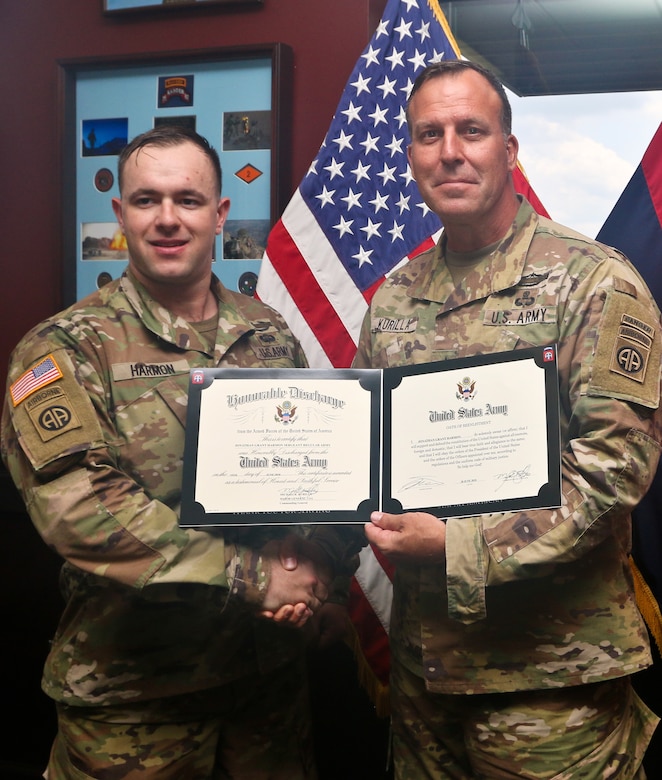
Harmon not only recovered. He became the 82nd Airborne Division's first double above‑knee amputee soldier to return to active-duty service through the Army's Continuation on Active Duty program.
"They actually gave me for that when I retired," he said. "I was the first person to ever do it."
He spent years at Walter Reed as the XVIII Airborne Corps liaison, helping wounded soldiers and their families navigate the hardest days of their lives.
"It was the greatest job I ever had," he said. "I got to inspire and motivate my paratroopers every day."
Harmon eventually left the Army to continue his education after nearly eight years of service.
Answering the Call
He thought his static-line parachuting days were over. However, that changed when Dominic Mancuso, a fellow combat infantryman from his time in service, called with an unexpected question: "Would you want to jump into Normandy?"
Mancuso told Harmon that Army 1st Sgt. Ramon Alvarez was recruiting veteran paratroopers to take part in a commemorative event.
Alvarez and Mancuso had been deployed to Afghanistan together. Now stationed at Fort Benning, Georgia, Alvarez is the cofounder and executive director of a nonprofit organization that provides resources, support programs and life-improving opportunities for veterans and their families.
"Eight months ago, if someone said that was possible, I would've laughed them out of the building," Harmon said. "But once it became a possibility, it was mission mode — how do we do this? What prosthetics? What padding? And then it was off to the races."
Harmon trained with the Liberty Jump Team, a veteran-led, all‑volunteer commemorative parachute organization based in Corsicana, Texas. The team preserves airborne history by performing World War II‑style, static‑line jumps at historic sites and memorial events. Harmon tested short prosthetic legs, specialized feet and relearned the mechanics of parachuting.
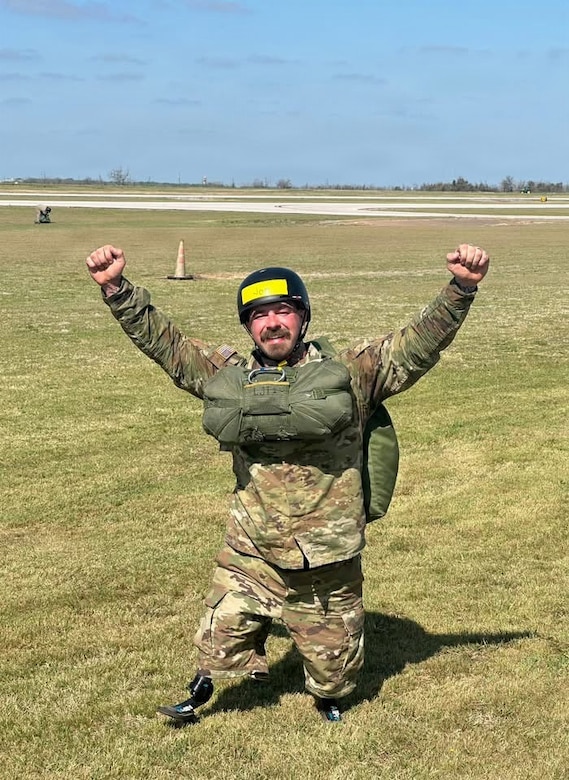
He is believed to be the first double above‑knee amputee to complete a static‑line parachute jump. He has completed three jumps, bringing his total to 10, and said he has no plans to stop.
When Harmon stepped into the door of a C‑47 Skytrain aircraft in March, for the first time since 2012, he said something clicked.
"I grabbed the door and thought, 'This is so cool,'" he said. "When I landed and stood up, I just broke down crying. I couldn't believe I walked away unscathed."
His wife, Carmen, encouraged him to jump again.
He said, "As soon as my wife saw how insanely happy it made me, she said, 'Yeah, you need to do this.' And after I came back from [basic airborne refresher], she told me, 'You need to keep doing this. I haven't seen you this happy in years.'"
Reminding Others
For Harmon, returning to jumping isn't about proving something to himself; it's about reminding other amputees who they are.
"If I can use what I'm doing to help my guys, so they're not hurting themselves, I'll do that for the rest of my life," he said. "I want young paratroopers to know you can go into battle [and] get hurt, and life is not over; you can keep doing incredible things."
On June 7 — 14 years after the day that changed his life — Harmon will jump into Sainte‑Mère‑Église, the same drop zone where the 508th Parachute Infantry Regiment and the 82nd Airborne fought on D‑Day.
"The fates always have an odd sense of irony in my life," he said. "Jumping on my 14th alive day — into the drop zone [that] my 508 guys jumped — it's surreal."
During the jump, Harmon will carry Goodine's necklace, lent to him by Goodine's daughter and his original Army ID card. The grandfather who served in the Korean War and told him stories about this time as an infantryman died recently. Harmon will also carry some of his ashes.
"I'll be jumping with all my guys," Harmon said. "Every paratrooper who came before me."
Harmon hopes his story reaches two distinct audiences: young paratroopers and fellow wounded warriors. To those currently serving, his message is a call to appreciate the unique nature of their mission.
"Stay airborne," Harmon said. "It's the greatest place on Earth."
To his fellow wounded warriors, he offers a reminder of the identity that remains, regardless of injury. "Life isn't over; you can still do insane things," he said. "You just need someone to remind you who you are."
Harmon is a paratrooper who refused to let the worst day of his life define the rest of it. As he looks back on his journey to the drop zone in Normandy, his thoughts return to the legacy of the 82nd Airborne Division and the predecessors who paved the way.
"I hope I'm making them proud," he said. "General Gavin, the World War II guys — all of them."
Stay tuned for a follow-up story following Jon Harmon's historic jump into Normandy, France, next month.


 Posts
Posts


No comments:
Post a Comment