Monday, December 21, 2015

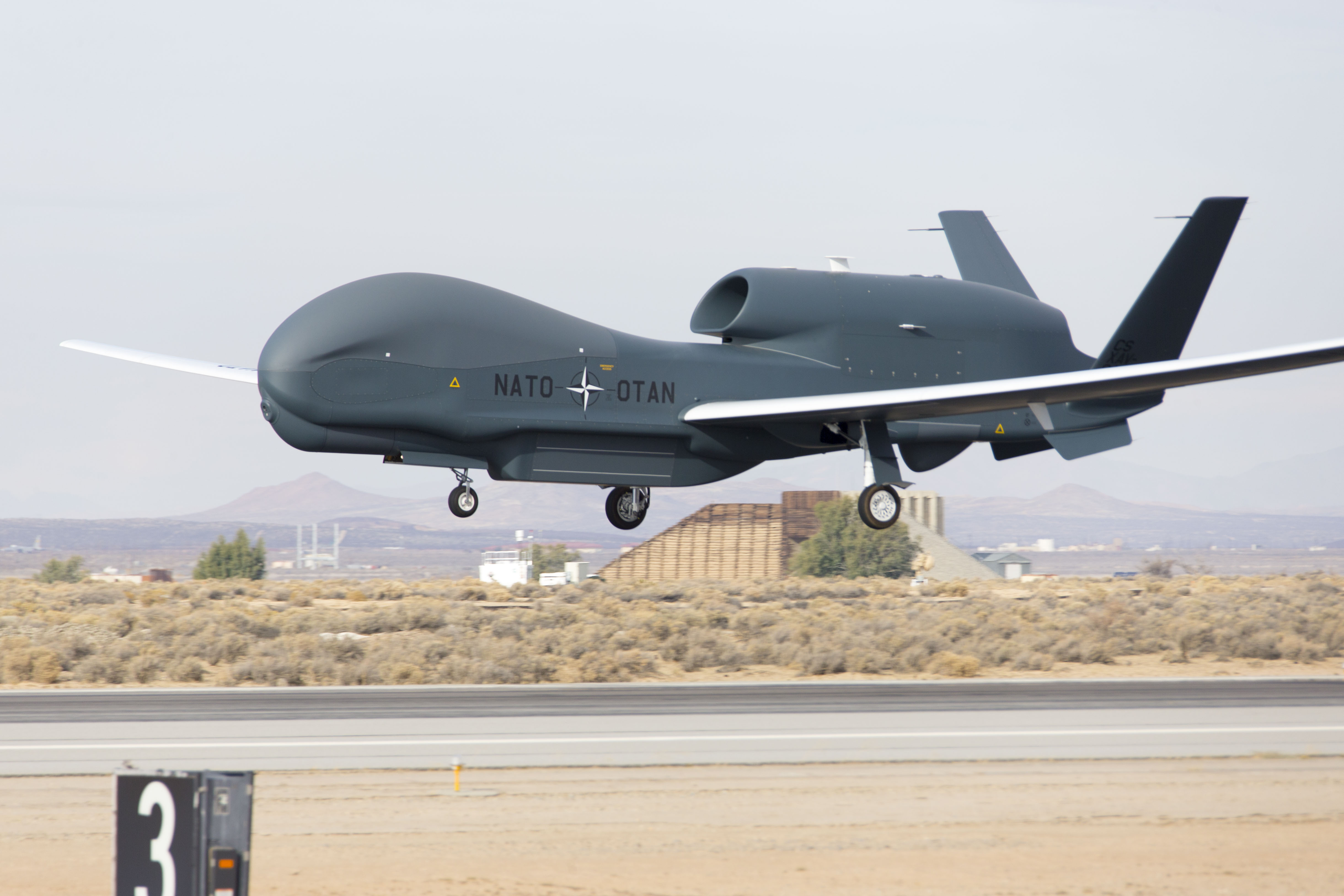
NATO Alliance Ground Surveillance aircraft arrives at Edwards


By Rebecca Amber, Edwards Air Force Base Public Affairs / Published December 21, 2015

EDWARDS AIR FORCE BASE, Calif. (AFNS) -- NATO's first Alliance Ground Surveillance aircraft arrived at Edwards Air Force Base Dec. 19 completing its first flight.

The test flight marked the start of six months of ground and airborne testing at Edwards AFB before the aircraft is sent to its new home in Sigonella, Italy.

NATO AGS is a derivative of the wide-area surveillance RQ-4 Global Hawk, with a few small changes in the communications software to meet certain criteria for operation in Europe.

"They've got a (few) differences, but it's very similar to a U.S. Air Force Global Hawk," said Roberto Garnica, from the Global Vigilance Combined Test Force and the NATO AGS project manager.

The first flight allowed the test team to observe the flying characteristics of the aircraft during a variety of flight performances and at varying altitudes.

According to Garnica, this test varies from other Global Hawk testing because the Global Vigilance CTF is not the executing test organization. While Edwards Range Control and safety officers will be present, responsibility for the test and aircraft falls on Northrop Grumman's team including the pilots, test conductors and directors.

"Because it is a Direct Commercial Sale to NATO, the Air Force is never going to own or possess it. So we are a participating test organization," Garnica said.

The first flight was an important milestone for Northrop Grumman Corp. and NATO Alliance Ground Surveillance Management Organization members of NATO's Alliance Ground Surveillance Management Agency.

Northrop Grumman is scheduled to begin ferrying the first NATO AGS aircraft to Italy in 2016. The NATO AGS system will include five aircraft and European-sourced mobile and transportable ground stations that will provide data link connectivity, data processing and exploitation capabilities to multiple deployed and non-deployed operational users.

All 28 alliance nations will take part in the long-term support of the program, but it is initially being procured by 15 NATO nations: Bulgaria, Czech Republic, Denmark, Estonia, Germany, Italy, Latvia, Lithuania, Luxembourg, Norway, Poland, Romania, Slovakia, Slovenia and the U.S.

The final product will be used for collective defense, crisis management and cooperative security.

Like the Block 40 RQ-4 Global Hawk, the unmanned aircraft has the ability to fly for up to 30 hours at a time. The high-altitude, long-endurance system will perform all-weather, persistent wide-area terrestrial and maritime surveillance in near real-time. The NATO-owned and operated system will provide intelligence, surveillance and reconnaissance capabilities to support a range of NATO missions such as protection of ground troops and civilian populations, border control, maritime safety and humanitarian assistance.

The aircraft is equipped with leading-edge technology, including the Multi-Platform Radar Technology Insertion Program sensor. The MP-RTIP sensor will provide critical data to commanders during operations, in any weather, day or night. Utilizing the MP-RTIP sensor, the NATO AGS system will be able to fuse sensor data, continuously detect and track moving objects and provide imagery of selected objects.

A Honduran experience


By Senior Airman Westin Warburton, Joint Task Force-Bravo Public Affairs / Published December 21, 2015

SOTO CANO AIR BASE, Honduras (AFNS) -- On my flight to Honduras, I didn't have the slightest idea of what to expect. Sure, I knew my job, I knew the types of missions I'd be part of, but I was not prepared for the culture shock I received after landing in Honduras.

For the most part, Tegucigalpa, the nation's capital, isn't that different from an average U.S. city. Malls, movie theaters, fast food joints, you name it and they have it. As soon as you start driving down the road, however, life is quite different. Cars zoom by and dash over into your lane without notice. Motorcycle drivers squeeze through cars on small lanes. These are but a few sights that immediately welcome new members to Honduras.

It wasn't until my first chapel hike that I realized how well off we have it back in the States. I saw huts put together from found material and with no running water or electricity.

To me, I had jumped back in time.

Though these villagers live tough lives, they all held big smiles and were gracious for the food and supplies we hiked up to their village. At that moment, I was very humbled, but it was at my first medical readiness training exercise, that my entire perspective on life changed.

The MEDRETE I went on was deep into the Olancho Department of Honduras. The medical staff set up shop in a school in the middle of a village. When I walked onto the school grounds, it appeared as if it was abandoned but in fact it was still in use.

With trash everywhere and walls and ceilings falling apart, I couldn't believe how different life was for these Hondurans. Some walked miles upon miles just to receive basic medical attention, because of no other available way.

Standing there, watching the people receiving medications, tooth extractions and basic treatment, a wall broke down in my mind. It was then that I felt the most humbled I had ever felt in my life. Most of us take everything for granted in the States; I know I did prior to this experience.

Not once back home did I wash my hands and think about how thankful I am for running water. I never got in my car and drove to a supermarket thinking about how easy it is to get food. To be completely honest, I don't think I was thankful for any of the luxuries we have in the States, because I never experienced anything else.

Now though, I am so thankful that I had the opportunity to come to Honduras and meet so many great people. People who have shown me that happiness doesn't come from materialistic things or luxuries like running water and electricity. To them, their families, friends, and life are what bring them true happiness.

Face of Defense: Navy Corpsman Earns Fleet Marine Force Pin


By Marine Corps Sgt. Owen Kimbrel, 5th Marine Expeditionary Brigade DoD News, Defense Media Activity

SOUTHWEST ASIA, December 21, 2015 — U.S. Navy Petty Officer 2nd Class Ambrose McGill, a hospital corpsman assigned to Special Purpose Marine Air-Ground Task Force Crisis Response-Central Command, earned his Fleet Marine Force Warfare insignia, Dec. 12, 2015, after completing demanding hours of dedicated study, practical applications and evaluations.

The rigorous course, designed to help sailors better understand their partner service, includes lessons about the Marine Corps ranging from Corps knowledge to infantry tactics. The FMF pin is awarded to sailors who show an ability and willingness to learn the next level of warfighting to more effectively support the mission of the Marine Corps.

From the day he arrived at his unit, McGill said he worked hard to earn his pin because it not only allows him to become more tactically proficient at his job, but it also gives him deeper insight into his unit.

 “It’s quite an honor, I’ve been with the Marine Corps for almost five years now and this has been something I’ve wanted to achieve since the first day I became a hospital corpsman,” he said. “This is the biggest achievement in my entire career.”

The arduous curriculum involves mastering approximately 400 pages of knowledge ranging from land navigation to the significance of distinguished Marines, such as Dan Daly. To qualify, a sailor must serve one year with an active-duty Marine Corps unit -- or two years for reserves -- pass a written test and the Marine Physical Fitness Test, and demonstrate skills used in service with the Marines such as weapon breakdown and familiarization, land navigation, combat communications. The final hurdle is an oral examination by senior enlisted sailors who are FMF qualified.

“This qualification says that you are qualified to serve with the fleet Marines and take care of the ‘Devil Dogs,’” Chief Petty Officer Casey Wheeler, the Navy senior enlisted leader with SPMAGTF CR-CC,said. “There is a vast amount of pride that comes with earning this pin.”

McGill said he spent months dedicated to earning the FMF pin.

“It’s good to be a great sailor, but it’s better to go above and beyond,” he said. “To sacrifice the additional hours to learn the extra knowledge and do everything you can to be proficient and an expert -- not only in your job, but also in the Marine Corps traditions and various tactical areas -- is something people should strive to achieve.”
McGill said he is happy to be part of a community of sailors who have earned the right to wear the FMF pin.

Wreaths Across America honor fallen service members

by Senior Airman James Richardson
JBER Public Afffairs


12/21/2015 - JOINT BASE ELMENDORF-RICHARDSON, Alaksa  -- The Fort Richardson National Cemetery, at Joint Base Elmendorf-Richardson hosted the annual Wreaths Across America Day, Dec. 12, 2015.

Wreaths Across America is a nonprofit organization founded to continue and expand the annual wreath laying ceremony at Arlington National Cemetery. More than 1,000 cemeteries across the nation participated, with volunteers laying an estimated 700,000 wreaths on veterans' graves.

U.S. Army Alaska commander Maj. Gen. Bryan Owens spoke on behalf of JBER at the cemetery to honor veterans who have made the ultimate sacrifice.

"We do this to remember the fallen, honor those who serve and their families, while teaching our children the value of freedom," Owens said.

The cemetery was established during World War II to bury those who died in the Aleutian Islands Campaign and other Pacific Theater campaigns. Today, the cemetery has 4,527 interments and it continues its tradition of honoring service members from Alaska who have served in every conflict since.

"I've never experienced a community as connected to its service members as Alaska," Owens said. "The relationship shared between Alaskans and [the] military is truly one of a kind."

Since the start of the conflicts in Iraq and Afghanistan, 22 service members from Alaska have been killed in action. Owens went on to share the stories of two fallen Soldiers, Sgt. Daniel Woodcock and Spc. Shane Woods.

Woodcock, who served under Owens, was killed by an improvised explosive device in Iraq in 2007.

"I will always remember Sergeant Woodcock not only because he was one of my Soldiers, but because he was an outstanding young noncommissioned officer, husband and father of two beautiful young children," Owens recalled.

Woods, from Palmer, Alaska, and two fellow Soldiers were killed when an improvised explosive device detonated under their Humvee in Iraq in 2006.

Owens referenced what the Woods family wrote of their son.

"His follow Soldiers knew him to be a real warrior, putting duty and honor above self. His strong belief in his mission to protect what we have at home; and faith in our Lord Jesus Christ is a continued inspiration to those who knew him."

The conclusion of General Owens speech was highlighted by a poem Woods wrote

"To serve as a Soldier, there is nothing more noble or more true,
To defend your home and ones you love, until your life is through,
To live and die for your brothers, could not be more right,
To honor those who marched before, to carry on their fight,
To protect the innocent and the fair, that they may know no strife,
To keep them safe at any cost, even if the price be thy own life,
Some to return without their limbs, others their lives, some their very soul,
Of all the men to march to war, nobody, not one to come back whole,
To lie in bed late at night, and wonder why not me,
To weep for a brother who didn't make it, his home never again to see,
To wonder if anyone really understands, or even cares at all,
That they live because others died, that good men had to fall,
To wonder if the banner brave men saluted every day,
Is treated with rightful honor, in memory of those who marched away."

National cemeteries host Wreaths Across America annually on the second Saturday in December.

Seven miles

by Staff Sgt. Jarad A. Denton
501st Combat Support Wing


12/18/2015 - RAF ALCONBURY, United Kingdom -- The tinny, melodic pings of my phone's alarm pulled me from a half-remembered dream and into the darkened reality that was 5 a.m.

For a moment I debated pressing the "dismiss" button and curling back into my blanket - letting the "man-cold," which I'm certain was a combination of Pneumonia, Influenza and the Bubonic plague, lull me back into a comfortable snooze.

"Get up, Jarad," I sighed aloud, swinging my feet onto the floor in one fluid motion, as not to disturb my wife, Jennifer - who was still enjoying an extra few minutes of peace before our youngest daughter, Evie, decided to rouse herself.

"'The sky's awake, so I'm awake,'" Evie often tells her mother, quoting her favorite movie of the past two years.

It's hard to believe at four-years-old, Evie hasn't known a life outside the U.S. Air Force. This transitory, sometimes nomadic, life is her normal. My mind began to wander to the road not taken, as I swallowed a daily multivitamin - a sign of my inevitable descent toward middle age.

Splashing cold water on my face, I brushed those thoughts aside and focused on my morning routine, which consisted simply of going to the gym. Today was cardio day, I thought as I tossed my backpack into my car and started the drive to RAF Alconbury, United Kingdom.

It was still dark when I parked at the fitness center - naturally. This is England, we have roughly seven hours of light on any given, cloud-covered, often rainy, winter day.

"Seven," I thought as my eyes adjusted to the light inside the gym. "I can do that - seven miles in one hour."

Resolved to my goal I stepped onto the treadmill, rationalizing - as I do every cardio day, that it was too cold and wet to run outside, especially with a fatal man-cold. This wasn't the first time I had run seven miles in one hour, but lately my cardio routine had taken a backseat to weight lifting.

"It's my gaining phase," I tell people, trying hard not to sound like the 175-pounds of bacon grease and pizza who left for Basic Military Training nearly seven years ago.

It's always within the first mile when my mind wanders to Jan. 13, 2009 - the day I left my home and family for a world I knew virtually nothing about. As I held my firstborn, nearly-3-month-old, daughter, Ari, for what seemed like the last time, I looked up at my mother and father - who had come to see me off.

Both had taken this road before, decades ago when the country was plunged into a war in Vietnam. Now, their only son was following in their footsteps.

"The Air Force can change you for the better," my dad said, shaking my hand and pulling me into an embrace. "If you let it."

I pulled away and looked back at Ari, her wide, brown eyes scanning me as I stared intently at her. This is for you, I thought as I handed her to Jen. I remember being scared at that moment. I was 27, older than most who enlisted, slower and decidedly out of shape. But, I had a family. I had responsibilities. I had a daughter who I hoped would understand, but deep down knew all she would recognize is her daddy was gone.

"Was this right," I asked myself as I boarded the bus to the airport. "Was I right?"

It's hard to push past that memory during the first mile, when I question my sanity for running anywhere without being chased. Then again, maybe I was chased - by the memory of everything I was leaving behind: the multiple jobs, colleges and poor decisions that amounted to a directionless life. I couldn't afford that - not anymore, not with a family. The day I became a parent was the day I stopped being the star in my own life story. I just took leaving them for more than five months to realize that.

After the second mile, I began to feel renewed - my confidence returning. I remembered my first supervisor, now-retired, Master Sgt. Steven Wilson, who encouraged me, with a southern accent both welcoming and stern at the same time, to "find my 'ism."

Despite my numerous failed attempts at school, which resulted in my father disappointingly telling me, "college may not be for everyone," Wilson pushed me to take my education seriously - even passionately. He taught me my future lay between balancing what I learned with what I could do - and he set the bar high, earning his Master's degree while he was still a technical sergeant.

Firm, but always fair, Wilson never ceased to humble me through his humanity - going so far as to share his own personal hell as a child who lived with an abusive mother.

"I got punched in the face or hit with whatever she could find," he said, candidly. "Wooden spoons, electrical cords, clothes hangers, a hairbrush across the head - she developed an imagination for turning anything into an instrument to clobber me with."

A little more than a year from the date I enlisted and I was writing a story about my supervisor, my mentor, my friend, who grew up as "the house whipping boy." How this man found the strength to overcome a life of cruelty and go on to honorably serve his country while still being a devoted husband and father still baffles me - and makes me feel small for assuming the pain I felt when I left my family to make a better life could ever measure up.

As hard and as vivid as that memory with Wilson was, it taught me the solemn virtue of my role in the Air Force. They always tell you in technical school, Public Affairs has a responsibility to tell the military story. What they don't tell you is we also have a responsibility to remember it and let it affect our lives - for better or worse. I remember them. I remember every interview, every conversation and every story - because they all showed me the struggles and humanity of people far better than I could ever hope to be. Their stories showed me that our greatness comes from the ability we have to pick ourselves up, carry on and continue fighting.

Twenty-five minutes into my run and this is the hardest part. Not quite halfway done, my mind and body start to argue about whether or not to continue. Quitting would be so easy - just hit the stop button. My rhythmic stride breaks as my fingers reach for the button that will let me rest - so easy.

"Too easy," I whisper to myself, as I pull my hand away and remembered John Coons.

He was a 90-year-old World War II veteran when I sat down to interview him in 2012, his face still haunted by the demons of his past.

"I was underground for 47 days in Algiers, Africa," Coons said, softly. "They beat me with a stick and hit me with switches across my legs. All they wanted was information."

He was only 21-years-old, a U.S. Army Soldier with the 3rd Army, 4th Armored Division, 22nd Infantry, serving as a rifleman when he was captured and tortured by the Nazis in a dark cave. The only thing they left him were his shoes, and a 1921 silver dollar hidden inside - a gift from his mother.

"You've just got to do it," he said. "Think about living to the next day. I kept telling myself 'I have to make it, I have to make it.'"

With sexual assault, suicide awareness and overall resiliency continuing to affect Service members, remembering what Coons went through in that cave, only to be rescued and sent to fight in the Battle of the Bulge after only 10 days of rest, reinforces my belief that everything is relative, and everyone has a story.

"Old blood and guts was there," Coons said, referring to the time he met Gen. George S. Patton. "We had come back from the front, from the Battle of the Bulge, and had to stand for a full field inspection. He walked up and down, looking us over. When he got to me he stopped and said, 'good work, Soldier, you all did a hell of a job, anything I can do for you?'"

As a brash, young private first class who had just survived torture, starvation and the bloodiest battle of World War II, Coons said he swallowed hard, and thought carefully before answering Patton.

"Yes, Sir," Coons said. "Before I leave this man's Army, I would like a star from your uniform."

Coons said that Patton paused, and looked him up and down before walking away. However, something made Patton stop a few paces past Coons. He looked back at the young private, turned around and ripped a silver star from his uniform. Patton walked back to Coons and thrust the star into his hand.

"Boy, you guys got a lot of balls," Patton said before turning around and walking away again.

Pushing past my fourth mile, the words of Coons echoed in my mind, reminding me military life is not for the faint of heart. It can be demanding, tiring, grueling and sometimes even demoralizing - but it can also be fulfilling and enriching, for those bold enough to seize every opportunity.

After five miles, I'm convinced tiny gnomes have lit torches inside my calves. The pain is sharp, dull and confusing as to how it can be both at the same time. The only thing keeping my on the treadmill at this point is the realization that I only have two miles left - even though I feel like I could collapse at any second.

I should have lifted weights today.

"I have to get up. I have to get up."

The voice of Tech. Sgt. Angela Biggs echoed in my head, drowning out my internal whining. We spoke for an hour one day, right before she was wheeled into surgery at Langley Air Force Base, Va. Biggs was going under the knife for a procedure that would hopefully alleviate the pain she felt in her right elbow, which began during a yearlong deployment to Afghanistan, as a medical technician with Provincial Reconstruction Team Zabul.

It was a beautiful Sunday, Aug. 28, 2011, as she walked through the forward operating, which rested in the shadow of Alexander the Great's Castle. Biggs said Sundays were the most relaxing days. There were no missions and the team could wear physical training gear, instead of a uniform laden with 70-pounds of body armor.

"What a great day," she remembered thinking. It was the last thought she had before her entire life changed.

"I saw the ground lift up in slow-motion, coming toward me like a tidal wave," Biggs said. "Then, everything around me started shattering and blowing up."

A 400-pound vehicle borne improvised explosive device had detonated against the wall of the FOB, less than 60-meters from where Biggs had been standing. Disoriented, nauseous and suffering from shock, Biggs forced herself to her feet - her medic training taking over.  She grabbed her medical bag and weapon before rushing to the aid of two Army guards, who had been blown off the tower during the initial attack.

"Even though it all happened so fast, it felt like an eternity went by," she said. "I kept telling myself: 'you've got to work, you've got to do what you've been practicing.'"

Through the pain and the chaos, Biggs managed to save more than a dozen lives - all after suffering what would later be diagnosed as a traumatic brain injury.

"It's such a hard thing to know you have because you don't see it," she said. "To this day I still have memory loss from it. You know what's normal for you. It's not normal to forget conversations that just happened."

Earning the Purple Heart for her combat injuries, Biggs taught me heroism can be born in a single moment, but recovering and moving beyond trauma can be a long, winding road.

"The way I see life now is to keep things simple," she said. "Love your life. Afghanistan taught me to appreciate everything in my life, because you never know when it might be taken away."

With renewed vigor I pushed into my last mile - working through the pain and the fatigue. Knowing that for me, this was temporary - but for some, like Paul Blais, it was permanent.

Working as a commissary grocery bagger, Blais limped from register to register - seen, but rarely remembered, by the people passing through the checkout lines. It is almost impossible to fathom this soft-spoken man as a 26-year-old senior airman, celebrating his birthday inside a laundy room in Dhahran, Saudi Arabia, June 24, 1996.

"It was a squadron tradition to have your birthday off," the former airborne communications systems operator said, his speech slow and strained by a heavy slur. "I stayed in the dorm and did laundry."

As Blais and I spoke, he told me about the closeness he felt with the members of his aircrew. They were scheduled to fly a routine mission to Aviano Air Base, Italy - taking 50 Airmen home to their families. The pre-flight check stated the plane was in perfect condition, with the exception of an engine due for inspection. The crew agreed to ground the plane and stay in the Khobar Towers until the following morning - a morning they would never see.

"They were my second family," Blais said, his cheerful voice suddenly turning somber. "I am the only survivor of my second family."

On the third floor of the tower, Blais was in the bathroom at 10:09 p.m., June 25, 1996, when an explosion equal to the force of nearly 30,000 pounds of dynamite tore through the building like a hot knife through butter. It left a crater 85-feet wide and 35-feet deep.

"If I had been in my room, asleep in my bed, I wouldn't have survived," Blais said. "Being in the bathroom put an extra wall between me and the explosion. Ten feet saved my life."

The floor beneath Blais gave way and he plummeted three stories, entering a coma as soon as he hit the ground. As he lay unconscious, the five stories above him buried him alive and left him bleeding profusely from the head. For two-and-a-half hours, the blood flowed from Blais' head, inching him closer to death.

After nearly two months in a coma, Blais opened his eyes to the unfamiliar walls of the Walter Reed Army Medical Center in Washington, D.C. He still possessed all his mental faculties, but couldn't eat, drink, walk or talk. Even nearly 20 years later, Blais still shows signs of the injuries, both mental and physical, that earned him a Purple Heart and a medical retirement from the Air Force.

"I would try to remember the attack and all that would come to mind would be feelings of sorrow and guilt," he said. "I was the one to survive when they all died. I was the 'lucky one.'"

Wrestling with survivor's guilt, Blais said his responsibility is to carry the legacy of his second family to future generations of Airmen.

"Freedom really is not free," he said. "My aircrew paid the price with their lives. I paid the price by having to survive and carry on with the knowledge of what they might have accomplished, had they lived."

With a familiar tone, the treadmill slowed - indicating my run was over, but the memories I recalled lingered on. Paul, Angela, John, Steven and so many others have made a profound and lasting impression on me - throughout my Air Force career. Seven years over seven miles seemed like hardly a drop in the bucket when compared to the insurmountable weight of the stories they carry with them, every day.

They lived through those times. They carried on - and I, for my part, will carry them with me and remember.