May 20, 2020 | BY ARMY CAPT. JASON SWEENEY
As the COVID-19 crisis continues, so does the threat from
wildfires that can flare up across California. Over the past few years, the
state has been hit by a series of devastating fires that have destroyed
communities and taken dozens of lives. In 2018, the Camp Fire in Butte County
was the deadliest in California history, killing 86 people.
Several hundred California National Guardsmen are activated
for humanitarian missions in response to COVID-19. They've been assisting food
banks, providing health screenings and medical support, setting up shelters and
serving as linguists. Meanwhile, preparations for wildfire season are also
underway.
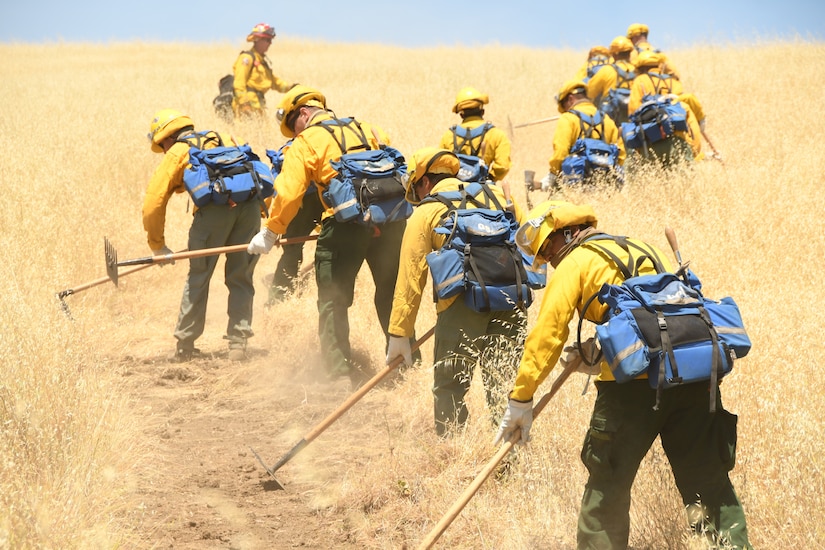
More than 100 California guardsmen were on Camp Roberts, San
Miguel, California, for hand crew training May 11-15 with military crew
advisors from the California Department of Forestry and Fire Protection, known
as CAL FIRE. The advisors instructed the guardsmen on several wildland
firefighting subjects such as team organization, safety skills, driver's
training, using fire shelters, chopping logs and digging trenches.
The guardsmen who participated in the training were
organized into five hand crews that will augment Task Force Rattlesnake teams
in Fresno, Monterey, Auburn and Redding, where they will clear potential
wildfire fuels and be on call to serve as hand crews in support of CAL FIRE
operations.
''We're doing proactive prevention,'' said Army Maj. Robert
Langston, the commander of Task Force Rattlesnake. ''We're doing wildfire fuels
reduction to protect vital infrastructure and augmenting first responders.''
On May 14, Army Spc. Jonathan Botting from the 235th
Engineer Company used a Pulaski hand tool to cut a fire break with fellow crew
members on Camp Roberts as part of the hand crew training. He said he was proud
to be serving on a hand crew and looking forward to helping out during fire
season.
''I think it's going to be a great experience, both
physically and for the camaraderie,'' Botting said. ''It's a good group. We
already have a good bond.''
Hand crews are critical to helping CAL FIRE contain
wildfires. The work is arduous, often requiring hikes into remote areas wearing
personal protective equipment and carrying gear. The crews mop up fires, put
out hotspots, cut trenches and fire breaks and remove brush and other wildfire
fuels.
''My soldiers are up for the challenge,'' said Army 1st Lt.
Michael Lyons, a platoon leader in the 235th Engineer Company, and a civilian
firefighter in Sacramento. ''They're built to perform.''
Army Sgt. 1st Class Alben Camaya, from the 235th Engineers,
is the noncommissioned officer in charge of one of the hand crews. He said the
first two days of classroom training were a little stressful, but his troops
were happy once they were out in the field.
''We, as combat engineers, we love to train in the field,''
Camaya said. ''We love hard work.''
This year's training was a little different because of the
extra health and safety measures due to the ongoing COVID-19 pandemic. The
guardsmen wore masks when in close proximity to each other and maintained
social distancing.
''COVID has proposed challenges to us to adhere to the
guidelines set by the [Centers for Disease Control and Prevention],'' said
Damon Godden, the CAL FIRE division chief. ''The Guard has stepped up to
collaborate with CAL FIRE to adhere to the guidelines through frequent washing
of hands, social distancing, wearing masks and separating crews.''
Eighty of the California guardsmen participating in the
training at Camp Roberts were soldiers from the 79th Infantry Brigade Combat
Team and the 49th Military Police Brigade. Twenty-one Airmen from all five
California Air National Guard wings participated in the training. In addition,
six California State Guard members were on the hand crews — a first for the
organization.
On May 14, Army Col. Richard Mifsud, the commander of the
79th Infantry Brigade Combat Team, visited Camp Roberts to check on 35 of his
soldiers assigned to the hand crews.
Mifsud's brigade will supply six force packages of 80
soldiers each over the course of this fire season.
''In California, we've got experience with fires, floods and
earthquakes,'' he said. ''With COVID-19, it's a different type of disaster in a
disaster-rich state. It's delayed our training a bit, but we’ll be ready for
fire season.''
Army Lt. Col. Leslie Palmer, the commander of the 40th
Brigade Support Battalion, was with
Mifsud visiting the troops.
''As the BSB, we've done hand crew training before,'' Palmer
said. ''Our soldiers have been wanting to get involved. We had more volunteers
than positions. The fact that they're out here, I'm immensely proud of them.
They're hard chargers.''
Mifsud said that the California National Guard and CAL FIRE
have developed a great relationship.
''In emergency management, it's all about relationships,''
he said. ''By maintaining a great relationship with CAL FIRE, we're able to
supply them with personnel to meet their needs and they supply us with
firefighting equipment, and together we're able to protect our communities in
the state in which we serve.''
(Army Capt. Jason Sweeney is assigned to the California
National Guard.)




 Posts
Posts

