Monday, April 13, 2020

Guardsmen Conduct COVID-19 Testing at Massachusetts Nursing Homes


April 13, 2020 | BY AIR FORCE CAPT. BONNIE BLAKELY

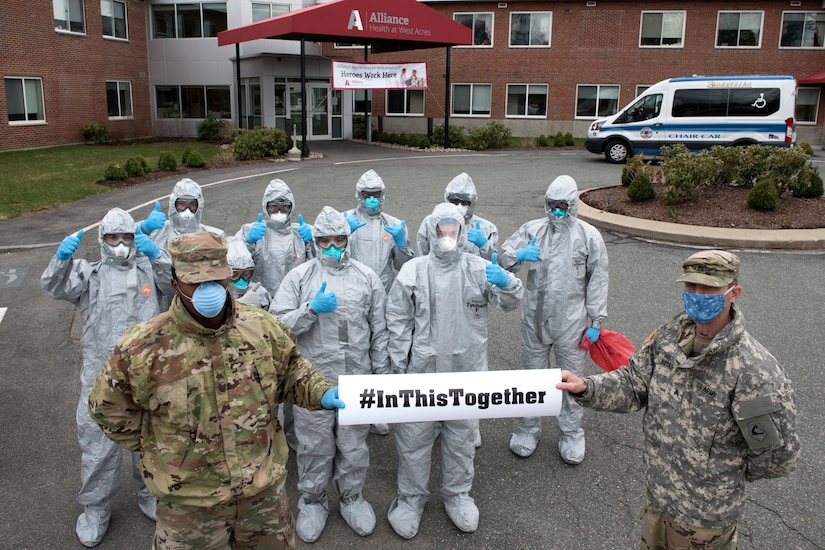
Soldiers and airmen from the Massachusetts National Guard have been working together to complete mobile COVID-19 testing on patients at nursing homes throughout the commonwealth.

As of April 11, more than 3,000 swab tests had been completed. The testing began March 31, and the mission is still ongoing.

''Our personnel are highly trained in the areas of patient care and sample collection, which has been pivotal to the success of this mission,'' said Air Force 1st Lt. Derek May, medical plans and operations officer for Region I Chemical, Biological, Radiological, and Nuclear Task Force.

Twelve medical teams are activated throughout the state underneath Task Force CBRN Medical Support Element and have been assisting medical facilities and nursing homes with high-risk populations.

The residents at these facilities are unable to do drive-through testing or go to local urgent care centers. Bringing this capability directly to the residents helps facilities identify positive COVID-19 patients, which allows them to then apply increased safety procedures to help slow and stop the spread of the coronavirus, May said.

''When the patients see military personnel, it gives them comfort,'' said Air Force Tech. Sgt. Joseph Startup, 102nd Medical Group clinical supervisor. ''They know we are out here to keep our community and our citizens safe during this time.''

Two service members wearing personal protective equipment talk as they stand by a cart bearing a blue cooler and medical equipment.


Nursing homes and providers are identified by the Department of Public Health and Human Services for testing each morning and given to the medical teams. Each team typically visits three or four locations a day, resulting in an average of more than 300 total tests per day. The swabs are packaged in a cooler and delivered to DPH at the end of each day, Startup said.

Testing teams have six to nine guard members composed of medics, CBRN decontamination personnel and a noncommissioned officer in charge who oversees the team. Airmen and soldiers are spread throughout each team and are conducting missions jointly.

''Integrating with our sister service partners in the Army has been seamless,'' May said. ''From Day One, all of the soldiers and airmen have banded together to provide the same level of service to the commonwealth's citizens.''

Some of the soldiers supporting this mission are from infantry and artillery units. They received extensive training on how to wear the required protective equipment and properly conduct a swab test. All testing team members are monitored by a medical team leader who ensures the tests are done accurately and that everyone is staying safe.

''It's really a huge, successful display of teamwork,'' said Army Maj. Ryan Lee, a dental officer providing medical supervision and quality control. ''It’s an incredible sight to see infantry and field artillery soldiers who are trained [to administer COVID-19 tests] step outside of their military occupational specialty to answer the call.''

After the testing is completed inside each facility, everyone on the team goes through a detailed decontamination process, which includes safely removing the personal protective equipment and being sprayed with chemicals to remove any possible contaminants that they may have come in contact with.

''Being able to come out here as a medic as we're all helping the community is one of the most rewarding things I've ever done,'' said Army Spc. Albert Richards, medical team leader. ''Seeing the general impact and the sighs of relief from the nurses when we’re in and out of their facilities and helping them, … it’s amazing.''

This mission is one of several National Guard operations across the commonwealth in support of coronavirus response efforts.

(Air Force Capt. Bonnie Blakely is assigned to the Massachusetts Air National Guard.)

DOD Transporting Vital COVID-19 Medical Supplies to Points of Need


April 13, 2020 | BY David Vergun , DOD News

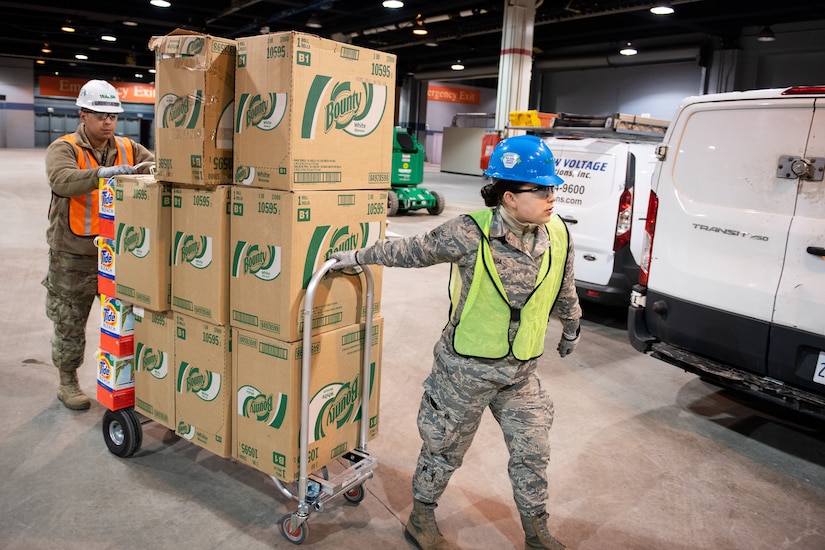
Transportation is a key part of the Defense Department's contributions to the whole-of-government effort in response to the COVID-19 pandemic.

U.S. Transportation Command has moved people and supplies around the world in support of the whole-of-government effort to combat COVID-19, Transcom's commander said.

Transcom has moved COVID-19 testing supplies to the United States from overseas and has delivered field hospitals in places such as New York and Washington state, Army Gen. Stephen R. Lyons said, coordinating movements with U.S. Northern Command, the Department of Transportation and the Federal Emergency Management Agency.

The command's mission is to conduct globally integrated mobility operations, lead the broader joint deployment and distribution enterprise, and provide enabling capabilities to project and sustain the joint force.

Lyons noted his command is also working with the State Department to contract with commercial airlines to repatriate U.S. citizens stranded abroad. To date, Transcom has contracted four flights and coordinated other missions resulting in almost 800 travelers being repatriated in support of State Department efforts.

The National Guard in every state and territory is responding to the COVID-19 pandemic. About 29,000 guardsmen have been called up by their governors, according to today's Defense Department media fact sheet.

Besides supporting communities with testing sites and creating additional medical capability, the Army National Guard and Air National Guard are providing transportation for distribution of food and medical supplies. For example, airmen from the California Air National Guard are transporting 500 state-owned ventilators and medical supplies from California to states in need, including New York.

The Massachusetts National Guard is delivering personal protective equipment to first responders and hospitals throughout the state and providing staff augmentation and meal delivery to the Holyoke Soldiers Home.

The Iowa National Guard transported 280 pallets of medical supplies to 90 of the state's 100 counties.

The Arizona National Guard recently flew 300 sets of masks and gowns to a medical facility in the Navajo Nation town of Kayenta. The shipment also included some 2,000 gloves for health care workers. Additionally, several dozen guardsmen are working on building an alternate care facility in that area. Additionally, the Arizona Air National Guard delivered 40,000 yards of fabric from North Carolina to Arizona to be made into medical gowns.

Logistic teams from the West Virginia National Guard transported critical personal protective equipment to 55 counties throughout the state. They also delivered 5,500 meals using refrigerated trucks and packed an additional 2,000 meals for distribution.

The Louisiana National Guard, as of April 2, transported more than 360,000 N95 masks, 1.2 million gloves, 300 ventilators and about 50,000 protective suits to testing sites throughout the state.

The Nevada National Guard is organizing and transporting PPE for distribution to hospitals across the state. At the direction of medical professionals, they are also distributing 50 ventilators received from the state of California.

The Defense Logistics Agency manages the global supply chain for the U.S. military and federal agencies.

In West Mifflin, Pennsylvania, getting free school lunches to students who are now at home indefinitely, was a problem. DLA helped arrange the transfer of two former Massachusetts National Guard field ambulance trucks to the city's school district. The trucks were excess military property, but ran well. The trucks are helping in the  meal distribution effort.

Mobility Airmen Conduct First Transport Isolation System Medevac Mission


April 13, 2020

Air Mobility Command aircrew and medical personnel conducted the first operational use of the Transport Isolation System to perform an aeromedical evacuation of three U.S. government contractors who tested positive for the coronavirus from Afghanistan to Ramstein Air Base, Germany.

Upon arrival April 10 at Ramstein, the patients were transferred to Landstuhl Regional Medical Center for treatment.

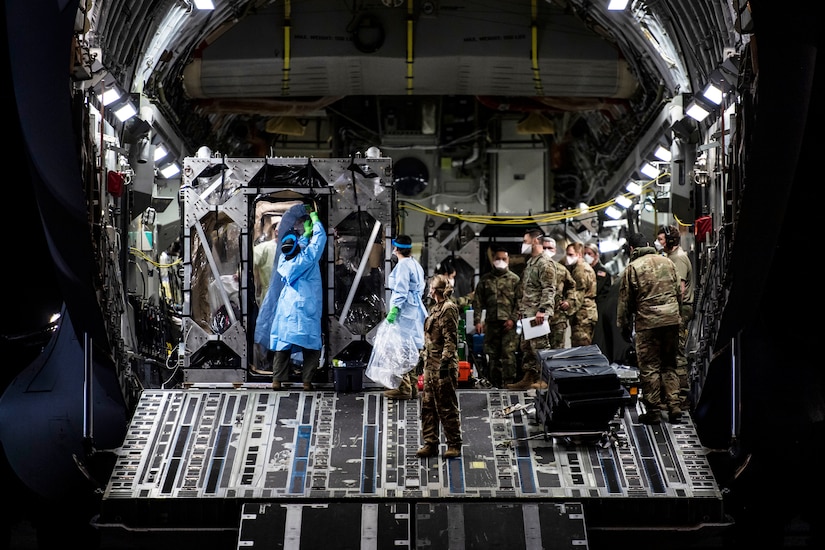
The mission, REACH 725, marked the first operational use of the TIS since its development during the 2014 Ebola outbreak in West Africa, and the first movement of COVID-19 positive patients aboard U.S. Air Force aircraft. The TIS is an infectious disease containment unit designed to minimize risk to aircrew, medical attendants, and the airframe, while allowing medical care to be provided to patients in-flight.

REACH 725 featured a full TIS force package, which includes one C-17 and aircrew carrying two TIS modules and medical support personnel, consisting of aeromedical evacuation specialists, critical care air transport team members, infectious diseases doctors and technicians, and TIS operators.

Upon receipt of a warning order from U.S. Transportation Command on April 8, the 618th Air Operations Center tasked a TIS-trained AMC aircrew and medical team at Ramstein to prepare to execute the mission within 24 hours. Drawn from multiple specialties and units from across the Air Force, these airmen were pre-staged with a C-17 from Joint Base Charleston, South Carolina, and TIS at Ramstein's 86th Airlift Wing in late March in anticipation of joint force, allied and partner requirements in Europe, Africa and the Middle East. Since arriving, these airmen have trained to increase proficiency on the movement of infectious patients via the TIS.

Airmen wearing personal protective gear wait for patient documentation in the cargo bay of a large transport jet.


"Our unique capabilities, paired with our strategic locations across the globe, enable us to rapidly help those in need," said Gen. Jeff Harrigian, commander of U.S. Air Forces in Europe-Air Forces Africa and NATO Allied Air Command. "Along with our allies and partners, we stand united against a shared threat and stand ready to help when called."

Hours before the crew stepped to the C-17, Air Force Brig Gen Jimmy Canlas, 618th Air Operations Center commander, led a teleconference call in which he provided guidance in line with the recently released AMC COVID-19 Patient Movement Plan.

"Through the meticulous effort of AMC's planners over the past few weeks, in coordination with U.S. Transportation Command, we've produced a detailed plan that guides our crews on how to safely and effectively move ill patients to a location where they can receive greater care, all while providing protection for our aircrew, medical personnel and aircraft," Canlas said. "Within hours of completing and releasing this plan to the force, the crew of REACH 725 validated the hard work of these planners by safely transporting three COVID-19 patients nearly 4,000 miles from Afghanistan to Landstuhl."

Developed by AMC planners over the past few weeks, the Patient Movement Plan provides aircrew and support personnel a comprehensive and detailed process by which to transport patients aboard pressurized, military aircraft, including patients afflicted with highly contagious diseases such as COVID-19.


"I'm exceptionally proud of our airmen who executed this historic [aeromedical evacuation] mission," said Air Force Gen. Maryanne Miller, AMC commander. "REACH 725 is a great demonstration of AMC's transition to a warfighting component command, with increased flexibility and speed enabling our mobility airmen to quickly answer any call for help during this global campaign to defeat COVID-19. Delivering hope runs deep in the blood of mobility airmen, and I'm in awe of what they are doing for those in need."

(Courtesy of Air Mobility Command.)