Tuesday, December 22, 2015

Many U.S. Troops Serving Overseas During the Holidays


By Jim Garamone DoD News, Defense Media Activity

WASHINGTON, December 22, 2015 — Thousands of U.S. service members and Defense Department civilians are serving around the world during the holidays to protect America, its interests and its allies.

Around 9,800 Americans are deployed to Afghanistan. And roughly 3,500 Americans are deployed to Iraq and Syria to assist in the fight against the Islamic State of Iraq and the Levant. The Army's 82nd Airborne Division forms the nucleus of the deployment there.

All told, there will be roughly 220,000 American service members serving overseas this holiday season. They operate in more than 100 countries, on every continent.

"I want you to know that you are what I wake up to every morning," Defense Secretary Ash Carter told troops Dec. 19 aboard the USS Kearsarge. "You're what I think about all day. I'm so proud of you and 100 percent, 1,000 percent behind you."

Snapshot of Troops Around the World

The U.S. Navy has 36 ships deployed around the world. The largest is the aircraft carrier USS Harry S. Truman, which has transited the Suez Canal and is headed for operations in the Arabian Gulf. There are more than 5,000 personnel aboard the ship. The Truman will be accompanied by destroyers, each with about 300 crew members. Submarines and resupply ships are also usually part of the equation.

The amphibious ready group centered around the USS Kearsarge is operating in the Arabian Gulf. There are 5,000 sailors and Marines aboard.

Navy ballistic missile submarines operate 24/7 around the world. The submarines are part of America’s nuclear triad, and there are around 150 crew members.

In the Pacific, there are roughly 50,000 American service members based in Japan. Another 28,500 troops are based on the Korean Peninsula.

About 500 service members will be celebrating the holiday season in Australia and more celebrating in Singapore.

Africa has one large base -- Camp Lemonnier in Djibouti -- and there are around 4,000 service members assigned there. Roughly another 1,000 service members are deployed elsewhere on the continent.

More than 64,000 U.S. service members are stationed across Europe -- from Rota, Spain, to the Baltic Republics. The highest number is in Germany, followed by Italy, the United Kingdom and Spain. There are another 3,000 based in Turkey, which is a NATO ally with most of its territory in Asia.

In Central and South America, there are roughly 5,500 service members deployed. U.S. airmen may also be operating to resupply scientists in Antarctica during the holidays.

'The Noblest Thing'

But it is not just overseas that U.S. service members are serving. Some Air Force missileers man the ICBM silos across the American heartland, while other airmen vigilantly defend the space, airspace and cyberspace. Coast Guardsmen must stay ready for incidents at sea.

And while many bases try to limit operations during the holidays, units still have to have on-call duty members prepared to be called to work at a moment's notice. Military police still have to guard the gates, and thousands of military and civilian specialists still have to care for those in hospitals.

America's military members are away from their families "doing the noblest thing you can possibly do with your life, which is protect our people and make a better world for our children," Carter said.

NATO AGS arrives at Edwards

by Rebecca Amber
412th Test Wing Public Affairs


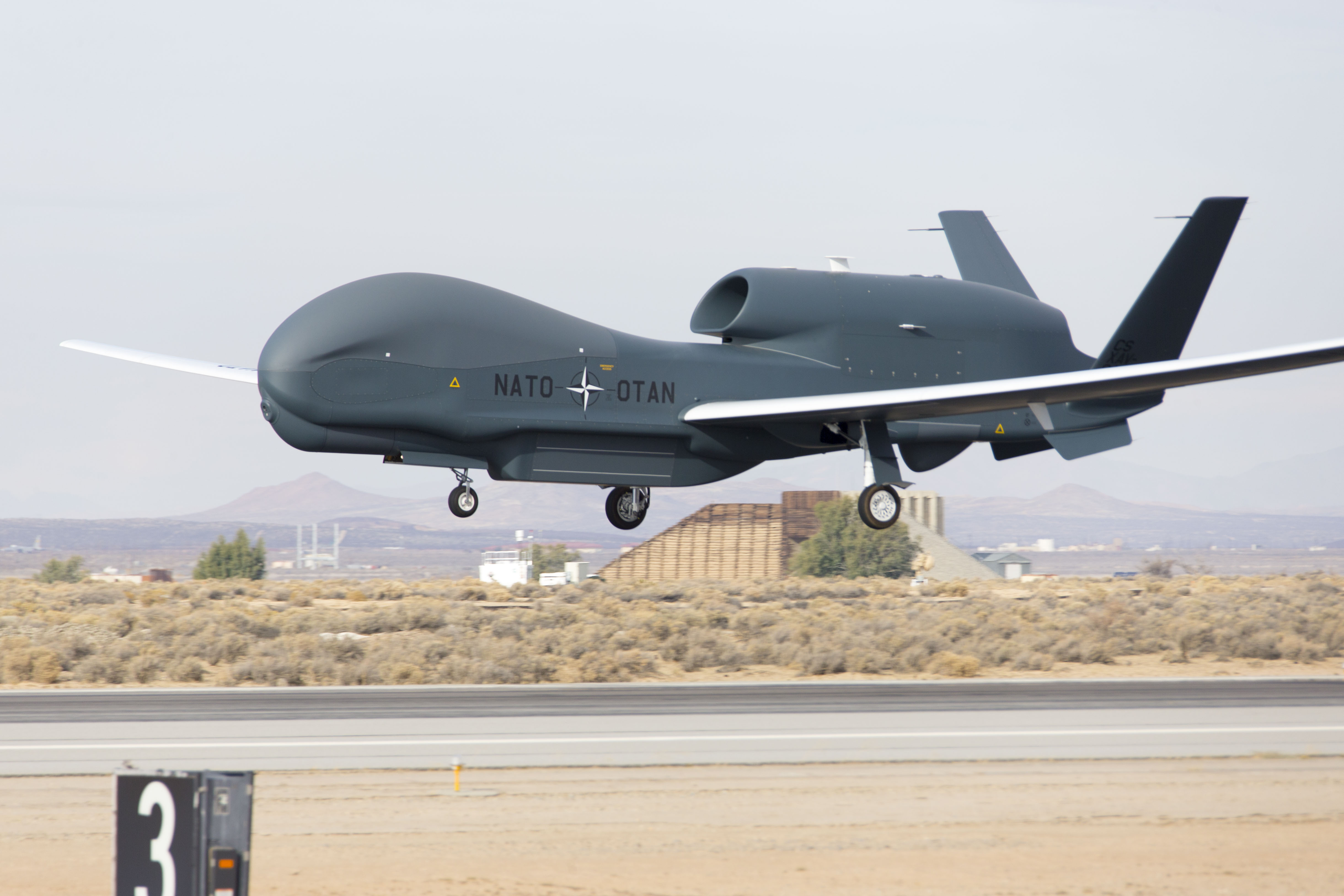
12/19/2015 - EDWARDS AIR FORCE BASE, Calif. -- NATO's first Alliance Ground Surveillance aircraft arrived here Dec. 19, completing its first flight. The test flight marks the start of six months of ground and airborne testing at Edwards before the aircraft is sent to its new home in Sigonella, Italy.

NATO AGS is a derivative of the wide-area surveillance Global Hawk, with a few small changes in the communications software to meet certain criteria for operation in Europe.

"They've got a [few] differences, but it's very similar to a USAF Global Hawk," said Roberto Garnica, Global Vigilance Combined Test Force, NATO AGS project manager.

The first flight allowed the test team to observe the flying characteristics of the aircraft during a variety of flight performances and at varying altitudes.

According to Garnica, this test varies from other Global Hawk testing because the Global Vigilance CTF is not the executing test organization. While Edwards Range Control and safety officers will be present, responsibility for the test and aircraft falls on Northrop Grumman's team including the pilots, test conductors and directors.

"Because it is a Direct Commercial Sale to NATO, the Air Force is never going to own or possess it. So we are a participating test organization," said Garnica.

The first flight was an important milestone for Northrop Grumman Corporation and NATO Alliance Ground Surveillance Management Organization members of NATO's Alliance Ground Surveillance Management Agency.

Northrop Grumman is scheduled to begin ferrying the first NATO AGS aircraft to Italy in 2016. The NATO AGS system will include five aircraft and European-sourced mobile and transportable ground stations that will provide data link connectivity, data processing and exploitation capabilities to multiple deployed and non-deployed operational users.

All 28 Alliance nations will take part in the long-term support of the program, but it is initially being procured by 15 NATO nations: Bulgaria, Czech Republic, Denmark, Estonia, Germany, Italy, Latvia, Lithuania, Luxembourg, Norway, Poland, Romania, Slovakia, Slovenia and the United States.

The final product will be used for collective defense, crisis management and cooperative security.

Like the Block 40 RQ-4 Global Hawk, the unmanned aircraft has the ability to fly for up to 30 hours at a time. The high-altitude long-endurance system will perform all-weather, persistent wide-area terrestrial and maritime surveillance in near real-time. The NATO-owned and operated system will provide intelligence, surveillance and reconnaissance capabilities to support a range of NATO missions such as protection of ground troops and civilian populations, border control, maritime safety and humanitarian assistance.

The aircraft is equipped with leading-edge technology, including the Multi-Platform Radar Technology Insertion Program sensor. The MP-RTIP sensor will provide critical data to commanders during operations, in any weather, day or night. Utilizing the MP-RTIP sensor, the NATO AGS system will be able to fuse sensor data, continuously detect and track moving objects and provide imagery of selected objects.

DOD CIOs visit area to discuss innovation and collaboration

by Patty Welsh
66th Air Base Group Public Affairs


12/22/2015 - HANSCOM AIR FORCE BASE, Mass. -- The Chief Information Officer for the Department of Defense and the Chief Information Officers for the Joint Staff, Air Force, Army, Navy and Coast Guard, along with more than 20 senior representatives from DOD, Cyber Command and the intelligence community, visited the local area Dec. 10 and 11 to see how Massachusetts and its local tech companies and military bases pursue technology innovation.

This visit was a part of a regular series of engagements to ensure DOD senior leadership is informed by and connected to the cutting edge of cyber and information technology activities.

Senior DOD officials who visited Massachusetts included Dave DeVries, DOD principal deputy CIO; Army Lt. Gen. Mark Bowman, Joint Staff CIO; Army  Lt. Gen. Bob Ferrell, Army CIO; Air Force Lt. Gen. Bill Bender, Air Force CIO; Rob Foster, Department of the Navy CIO; and Vice Adm. Ted Branch, Navy deputy CIO.

"Partnerships across government and industry are vital to DOD's success," said DeVries. "Visits like this help DOD CIO and other Department senior leaders engage on important issues, like innovation, technology transfer and collaborative acquisition strategies."

Numerous high-level Air Force officials from Hanscom participated in many aspects of the visit, including Maj. Gen. Craig Olson, Command, Control, Communications, Intelligence and Networks program executive officer; Steve Wert, Battle Management PEO; Maj. Gen. L. Scott Rice, Massachusetts adjutant general; and Dr. Tim Rudolph, Life Cycle Management Center chief technology officer.

Topics ranged from information technology of the future and cybersecurity to public-private partnerships and best practices, as well as innovation opportunities and challenges. The visitors expressed specific interest about the state's Military Asset and Security Strategy Task Force, which Hanscom has partnered with on workforce development, infrastructure and energy efficiency projects. Highlighted throughout the presentations were the benefits of the area -- from world-class educational institutions and high-tech corporations to the critical work done for warfighters at Hanscom AFB and the U.S. Army Natick Soldier Systems Center.

During the two-day event, the visitors heard from myriad organizations about how they address innovation. A meeting at the State House in Boston with Massachusetts Governor Charlie Baker, Rice, state economic development officials and staff from U.S. Rep. Niki Tsongas' office focused on economic development and strengths. The Massachusetts National Guard provided a briefing on their cyber initiatives. The delegation also learned about Hanscom's Collaboration and Innovation Center, described as a "hub" that integrates efforts between various parties.

During the event, Rudolph offered his take on partnerships and encouraged the DOD CIO delegation to continue making these types of visits.

"Massachusetts and the leading companies in emerging sectors housed near Hanscom Air Force Base bring expertise and a history of innovation to our efforts," he said.

And according to Hanscom personnel, collaboration is crucial.

"Collaboration among the DOD, the services, academia, labs and industry represents a force multiplier for transformational change that individual institutions cannot achieve on their own," said Adam Freudberg, support contractor and senior advisor to the CTO for innovation and collaboration. "Much of what we are trying to achieve at Hanscom is being made easier and more effective by the partnerships we have established."

Also during the visit, the representatives participated on a panel discussion with industry, academic and government personnel about leveraging existing partnerships. Panel participants were from the University of Massachusetts, Northeastern University, Massachusetts Open Cloud, and the Advanced Cyber Security Center.

Companies in the local area known for innovation were also on the agenda. Personnel from IBM, State Street, Allied Minds, 406 Ventures and EMC all shared their experience and expertise with the visitors.

The executive director of the ACSC said he believes the opportunity to highlight the state's support for military missions along with government-industry-university partnerships will provide benefits.

"Meeting in the Commonwealth was a valuable opportunity for the DOD CIO delegation and our state thought leaders to share best practices on critical cybersecurity issues," said Charlie Benway. "The Pentagon was able to learn first-hand how our global companies and world-class universities transform IT, institutionalize innovation, reduce costs and develop talent. We hope that this engagement will lead to expanded partnerships with the Pentagon to more broadly leverage the unique intellectual capital that defines this region."

Rudolph said the visit went well, but he wished it could have been longer.

"My only disappointment is that the DOD CIO delegation's visit was too short. We look forward to the opportunities this trip created to give us the chance to continue to connect DOD to the breadth and depth of the New England region's innovation economy and the mechanisms we at Hanscom Air Force Base are working on, like Cyber PlugTest, in our pursuit to get rapid capabilities and agile tools to the warfighter."

Marilyn Thomas selected as Presidential Distinguished Rank Award winner


By Secretary of the Air Force Public Affairs Command Information, / Published December 21, 2015

WASHINGTON (AFNS) -- The deputy chief management officer, Office of the Under Secretary of the Air Force, was named the Air Force’s top Presidential Rank Award winner and recognized at the “Unlocking the Full Potential of America’s Federal Workforce” event hosted by the Office of Management and Budget Dec. 15.

Marilyn Thomas, who was selected as a Presidential Distinguished Rank Award winner, is responsible for improving effectiveness and efficiency of business operations and serves as the Director of Business Transformation, overseeing implementation of continuous process improvement initiatives.

The Presidential Distinguished Rank Award is limited each year to only 1 percent of the Air Force's senior executives and only 5 percent of SES employees may receive the Presidential Meritorious Rank Award.

“This award is really the pinnacle award for an SES career,” Thomas said. “To be recognized by the President with the distinguished award is unlike any other recognition that a civilian can get.”

Thomas said she was humbled to receive the award.

“The only reason I was able to receive this award is because all of the other SES employees, the general officers, and of course all of the workforce and people I’ve served with over the years,” Thomas said. “They taught me and helped with any success I’ve managed to have. “

She also had some advice for civilians seeking mentorship.

“Every day is a job interview,” Thomas said. “You can have a great resume, you can put together a great reference letter, a great package to submit for a position, but what people are really impressed with is your day-to-day performance”

Monday, December 21, 2015

NATO Alliance Ground Surveillance aircraft arrives at Edwards


By Rebecca Amber, Edwards Air Force Base Public Affairs / Published December 21, 2015

EDWARDS AIR FORCE BASE, Calif. (AFNS) -- NATO's first Alliance Ground Surveillance aircraft arrived at Edwards Air Force Base Dec. 19 completing its first flight.

The test flight marked the start of six months of ground and airborne testing at Edwards AFB before the aircraft is sent to its new home in Sigonella, Italy.

NATO AGS is a derivative of the wide-area surveillance RQ-4 Global Hawk, with a few small changes in the communications software to meet certain criteria for operation in Europe.

"They've got a (few) differences, but it's very similar to a U.S. Air Force Global Hawk," said Roberto Garnica, from the Global Vigilance Combined Test Force and the NATO AGS project manager.

The first flight allowed the test team to observe the flying characteristics of the aircraft during a variety of flight performances and at varying altitudes.

According to Garnica, this test varies from other Global Hawk testing because the Global Vigilance CTF is not the executing test organization. While Edwards Range Control and safety officers will be present, responsibility for the test and aircraft falls on Northrop Grumman's team including the pilots, test conductors and directors.

"Because it is a Direct Commercial Sale to NATO, the Air Force is never going to own or possess it. So we are a participating test organization," Garnica said.

The first flight was an important milestone for Northrop Grumman Corp. and NATO Alliance Ground Surveillance Management Organization members of NATO's Alliance Ground Surveillance Management Agency.

Northrop Grumman is scheduled to begin ferrying the first NATO AGS aircraft to Italy in 2016. The NATO AGS system will include five aircraft and European-sourced mobile and transportable ground stations that will provide data link connectivity, data processing and exploitation capabilities to multiple deployed and non-deployed operational users.

All 28 alliance nations will take part in the long-term support of the program, but it is initially being procured by 15 NATO nations: Bulgaria, Czech Republic, Denmark, Estonia, Germany, Italy, Latvia, Lithuania, Luxembourg, Norway, Poland, Romania, Slovakia, Slovenia and the U.S.

The final product will be used for collective defense, crisis management and cooperative security.

Like the Block 40 RQ-4 Global Hawk, the unmanned aircraft has the ability to fly for up to 30 hours at a time. The high-altitude, long-endurance system will perform all-weather, persistent wide-area terrestrial and maritime surveillance in near real-time. The NATO-owned and operated system will provide intelligence, surveillance and reconnaissance capabilities to support a range of NATO missions such as protection of ground troops and civilian populations, border control, maritime safety and humanitarian assistance.

The aircraft is equipped with leading-edge technology, including the Multi-Platform Radar Technology Insertion Program sensor. The MP-RTIP sensor will provide critical data to commanders during operations, in any weather, day or night. Utilizing the MP-RTIP sensor, the NATO AGS system will be able to fuse sensor data, continuously detect and track moving objects and provide imagery of selected objects.