Monday, December 07, 2015

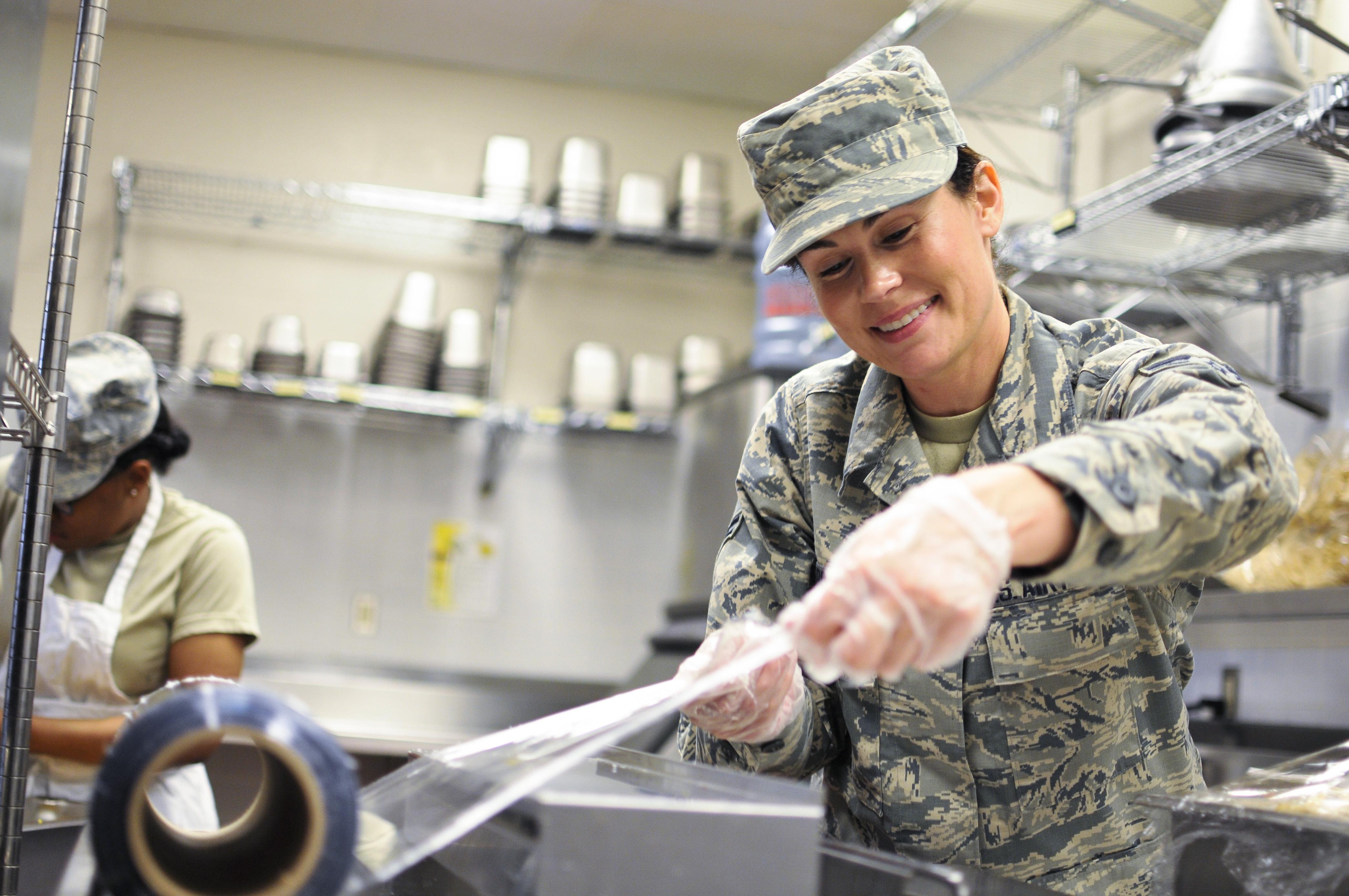
Face of Defense: Air Guardsman Enlists at 35, Excels


By Air Force Staff Sgt. Lealan Buehrer 182nd Airlift Wing

PEORIA, Ill., December 7, 2015 — Illinois Air National Guard Airman 1st Class Tanya Brown was a full-time everything three years ago -- beautician, livestock farmer, college student, wife, and mother to four children. Then, not being one to shy away from a challenge, the 35-year-old decided to join the Air National Guard.

Along the way, she earned a 94 percent technical school class average, the Thunderbolt Certificate for Fitness Excellence, the Small Arms Expert Marksmanship Ribbon, and a 98.5 percent physical fitness score.

What motivated the 182nd Force Support Squadron airman to add military service to her hectic life, and how did she excel at it? It all started with a haircut.

Brown was working as a cosmologist and esthetician when an Army sergeant needed a last-minute haircut before reporting for duty. Brown assisted him. Recruiters had recently visited her oldest daughter's high school, so Brown started asking questions about the armed forces. The sergeant asked her if she had ever considered enlisting.

Brown said she was too old for that. The sergeant disagreed, and it made her begin to wonder.

She continued her questioning during his monthly haircuts until he finally offered to connect her with recruiters. One of them was Illinois Air National Guard Tech. Sgt. Stephen Graves from the 182nd Airlift Wing.

‘Unusual’ Recruit

Graves said the average age of recruits coming through his office was 17 to 23, so Brown was not his typical customer. The cutoff age for new enlistees is 39.

"It was unusual," Graves said, "so we try to let [older enlistees] know that 'OK, this is what you're going to get into. You're going to be held to the same requirements,' and she was all for it.”

Brown said that one thing led to another and she ended up enlisting.

"I didn't even tell my family and friends for a while,” she said. “My husband knew when I went and bought the running shoes. [He] looked at me and goes, 'You're serious about this, aren't you?’”

Brown had not run in 15 years, so she started training for Air Force basic military training in San Antonio. However, that was not the only obstacle she anticipated.

"I was nervous about going to basic and tech school at such an age difference," she said.

Blending In, Helping Out

She knew that she needed to blend in with girls nearly half her age.

"I just kind of sat back and just let people be who they are and just try to become part of the group," Brown said, adding that she did have to administer some wisdom when attitude problems flared up in the dormitory.

"I wasn't being mean or anything, but I would take them aside and I'd say, 'Hey, there's a better way to deal with something like this,'" Brown said. "And then, after a while, they'd start coming to me if they were sick. It was funny. They'd start coming to me like I was a nurse or something, or their mom."

Brown called her smile her biggest challenge in basic military training.

"You know, it was hard for me because I've been in the public, working all the time around people and learning how to smile and customer service, and all that," Brown said. "Well, when I went down to basic, you can't smile … And that was my biggest thing -- getting yelled at for that."

Brown passed her two-week physical fitness evaluation and kept pushing herself to see how far she could go. At age 36, she earned the second-highest award for fitness with 57 sit-ups, 43 pushups, two pullups and a 1.5-mile run time of 11 minutes, 28 seconds.

After a short visit home, Brown attended the Services Apprentice Course in Fort Lee, Virginia. She said that she chose the career field because she already had a background in customer service and food preparation, having held a food sanitation license for more than 10 years. She also saw the career's mortuary affairs training as good knowledge to apply to her nursing studies.

Happy to Have Enlisted

Brown returned home after graduating technical training school in 2014 and began work with the force support squadron. She said that she is still happy she enlisted.

"I love it. I think everybody around here's pretty cool," Brown said.

Illinois Air National Guard Master Sgt. Sarah Markham, the services superintendent at the 182nd FSS, said that the feeling is mutual.

"Tanya Brown is one of the hardest-working, [most] self-motivated, energetic airmen I've ever encountered throughout my career," Markham said. "She has proved to be an asset to the force support squadron and is always on point with the mission at hand."

Recently, she completed a mandatory career development course and has also resumed studies at Richland Community College. She said she is pursuing an Associate of Science using the GI Bill and the 100 percent paid tuition grant offered by the Illinois National Guard.

Brown said that no one excuse could keep a person from serving if they wanted to.
"I say, if you want to do it, do it," Brown said. "Doesn't matter what age you are. If you're determined to do it, you set your mind to it, you can do it. No matter what."

Sunday, December 06, 2015

125th Fighter Wing Airmen sing for Salute to Service

by Master Sgt. Jaclyn Lyons
125th Fighter Wing Public Affairs


12/1/2015 - JACKSONVILLE, Fla. --
On a sunny, breezy afternoon this past Sunday, Senior Airmen Asia Bryant and Kaleigh Kozdras, and Staff Sgt. Carlynne Devine from the 125th Fighter Wing gathered in a tight semi-circle in front of the microphone and began to sing the Star Spangled Banner.

The crowd of 60,000 rose for the presentation of the National Anthem by the 125th FW trio and the unfurling of the American flag by military members across Everbank Field stadium. As the Airmen hit the last note, three jets flew overhead and the crowd erupted in thunderous applause as the Jacksonville Jaguars took the field to kick off their Military Salute to Service game.

Each of the airmen is known at the 125th Fighter Wing for their great voice and has sang many times for ceremonies around base themselves, they all have a background in singing ranging from school and church choirs, karaoke, to even cutting a record in Nashville.

A commander on base asked if they had ever thought about singing together and the three Airmen decided to practice and try it out. Their three-part harmony has now been heard around the 125th Fighter Wing at special ceremonies and family events.

When the Jaguars contacted the Florida National Guard to inquire if the if there was anyone that could sing in the Salute to Service, 1st Lt. Justin Phillips, deputy communications director, Florida Department of Military Affairs, immediately thought of the trio.

"For us to provide singers at the Jags game, in a town where there are more than 20,000 Navy personnel, is a strong testament for our relationship with this great city," Phillips said.

The women were all flattered and excited about the opportunity to represent the Air Force in the place they call home.

"Singing for a Jags game was actually on my bucket list," said Staff Sgt. Carlynne Devine. "But I never dreamed I'd get to do it in uniform, representing the 125th for the NFL team in my own back yard. It doesn't get much better than that!"

When the time came, the song went just as practiced and left the three Airmen with a sense of accomplishment and fulfillment. Senior Airman Asia Bryant explained,

"Standing there on the field with my fellow airmen in uniform I was filled with pride and excitement, it's truly an honor to represent our unit, the Air National Guard, and the Air Force as a whole."

WRANGB participate in first Air National Guard distance simulation demonstration

by Senior Airman Kasey Phipps
137th Air Refueling Wing Public Affairs


12/4/2015 - WILL ROGERS AIR NATIONAL GUARD BASE, Okla. -- Airmen from the 146th Air Support Operations Squadron here, remotely took part in the world's largest modeling, simulation and training conference Dec. 1-3, which was hosted more than 1,000 miles away in Orlando, Florida.

For the first time Airmen and retired service members from Oklahoma, Iowa and Florida, remotely demonstrated the use of the Air National Guard Advanced Joint Tactical Air Control Training Simulator as part of the Distributed Training Operations Center's participation in the Interservice/Industry Training, Simulation and Education Conference.

"This is the first time that an Air National Guard unit has shown the ability to do distributive training," said Master Sgt. Chris Johnson, the contracted operator and maintainer for the simulator.

The squadron's participation with the DTOC is just the beginning of a national trend, said Johnson. Joint Tactical Air Control units around the nation are getting these simulators and will have the opportunity to connect with other simulators for collaborative and interactive training.

The simulator and DTOC allow members - from different locations, military branches and subject matters from around the world - to coordinate operations in a single simulated location while never leaving their respective bases and at the fraction of the cost of organizing a national exercise.

"It gives local units the ability to bring outside players in to create a more robust and realistic training," said Johnson, who, without the DTOC, is tasked with creating scenarios and acting as the remote parties that interact with Joint Tactical Air Controllers. "You're bringing in a greater depth of knowledge and people's real life experiences versus just one guy."

For Airmen, the demonstration of the simulator provided a look into the real-life cooperation and organization behind operations abroad.

"It's really important to do this because we get different perspectives," said one of two Tactical Air Control Party students who participated over the three days. "We're actually talking to a pilot who's flying a simulated A-10 [aircraft]. We're actually doing our job controlling and being an air liaison to the Army. Everyone's doing their part."

As JTACs, the Airmen are responsible for calling in fire and artillery, battle tracking to orient commanders to progressing situations, and coordinating aircrews and ground teams to carry out operations. During the demonstration, the students communicated with A-10 pilots in Iowa and a ground commander in Florida, among others.

Though the simulator is different from real battle, it helps to overcome space and time restrictions that could otherwise limit the experience Airmen take with them overseas.

"It's putting you in the best place you can be, without actually being there," said the other participating TACP student.

Saturday, December 05, 2015

Dunford Launches 2015 USO Holiday Troop Tour


By Jim Garamone DoD News, Defense Media Activity

JOINT BASE ANDREWS, Md., December 5, 2015 — Marine Corps Gen. Joseph F. Dunford Jr. launched the 2015 USO Holiday Tour from here today with stops planned on three continents.

The chairman of the Joint Chiefs of Staff is bringing the USO troupe to entertain service members in Europe, Africa and Asia.

“The chairman, along with members of the 2015 USO Entertainment Troupe, will be visiting service members and their families to express the country's gratitude for their service while deployed during the holidays in defense our nation,” said Navy Capt. Greg Hicks, the chairman’s spokesman.

Singer/songwriters Kyle Jacobs, Chris Daughtry, Billy Montana and Brett James will bring a bit of home to service members on the seven-day tour.

Rounding out the traveling group of celebrities are actor/director Elizabeth Banks of “Pitch Perfect” and “Hunger Games” fame, writer/director/actor David Wain of “Wet Hot American Summer,” comedian Sydney Castillo, and Boston Red Sox relief pitchers Heath Hembree and Steven Wright.

USO President J.D. Couch is also accompanying the tour.

Dunford is continuing a tradition started by Air Force Gen. Richard B. Myers, who brought USO troupes to Iraq and Afghanistan during his tenure as chairman.

Face of Defense: F-15 Pilot Passes 2,000-Hour Milestone


By Air Force Airman 1st Class Corey M. Pettis 18th Wing

KADENA AIR BASE, Japan, December 4, 2015 — A maintenance airman stands in front of a fighter jet, arms stretched out as he marshals the jet into place. The engine’s roar begins to fade and its canopy opens, projecting a robotic sound reminiscent of a 1980s science-fiction flick. As the pilot climbs down, friends and family congratulate him in the traditional manner -- by spraying him with a stream of ice-cold water.

This is what happens when an F-15 Eagle pilot reaches the milestone of 2,000 flying hours.

Air Force Lt. Col Alexander Haddad, 44th Fighter Squadron pilot, reached this milestone Nov. 19, after a routine training mission in his F-15.

Members of the crowd congratulated him one by one, including Lt. Col. Kevin Jamieson, 44th FS commander, who presented Haddad with the 2,000-hour patch.

Rare Air

Reaching that many hours doesn’t happen often in the fighter jet world. Unlike cargo and tanker aircraft, which fly for hours on end, F-15 flights are much shorter in duration.

“It’s difficult to achieve that milestone,” Jamieson said. “Typically on a training [flight] you average anywhere from 44 minutes to an hour and 15 minutes."

Accumulating 2,000 in-flight hours can take an entire career to achieve, if it happens at all. For Haddad it took a little over 19 years, and he's the first Kadena F-15 pilot to accomplish the feat since 2009.

“In today’s Air Force, we’re fairly limited on flight time and resources," Haddad said. "So we’re trying to do more with less, and we’re trying to make every single flight hour count.”

As recently as a decade ago, Haddad explained, it was more common for fighter pilots to reach 2,000 hours. In recent years, though, the focus has been "on making sure they’re doing the right thing with the few precious hours we do get."

Unforeseen Achievement

Haddad graduated from the United States Air Force Academy in Colorado Springs, Colorado, in 1996, to become a pilot. He finally took off on his first F-15 flight in April 1998.

He said he didn’t think he would ever make it to this moment. Jamieson said he thinks it’s a big deal because it shows that the pilot has been able to do his job well over a long period of time.
“I had always aspired to get to 2,000 hours, and four or five years ago I wasn’t sure if I was going to make it,” Haddad said. “It feels pretty amazing; I’m very privileged that I got the chance to do that here with the 44th and the 18th Wing.”