Friday, December 04, 2015

All Air Force occupations open to women


By Secretary of the Air Force Public Affairs Command Information, / Published December 03, 2015

WASHINGTON (AFNS) -- Defense Secretary Ash Carter announced all occupations in the U.S. military will be open to men and women alike during a press conference Dec. 3.

The announcement came after a thorough review of findings from the last three years of studies, and the subsequent recommendation of service secretaries and the chairman of the Joint Chiefs of Staff.

"This decision means that we will be able to maximize our military effectiveness because we'll be able to draw from a larger pool of skilled and qualified individuals,” said Air Force Secretary Deborah Lee James. “The bottom line is to ensure the force’s future success based on validated, gender neutral standards."

According to Carter, within 30 days all currently closed occupations will be open and available for the assignment of women or men. The services will begin implementing their current plans for recruiting, accessing and initial training of women in these occupations.

"Our Air Force is more effective when success is based on ability, qualifications, and mission performance,” said Air Force Chief of Staff Gen. Mark A. Welsh III. “While not everyone aspires to be a Battlefield Airman, those who have the desire and are qualified will be afforded an opportunity to serve in those specialties in our Air Force. As with any new policy, implementation will take time and will be done in a deliberate and responsible manner. "

Carter said Deputy Defense Secretary Bob Work and Gen. Paul Selva, the vice chairman of the Joint Chiefs of Staff, will oversee the decision’s short-term implementation, ensure there are no unintended consequences to the joint force, and periodically update Carter and Marine Gen. Joseph Dunford, the chairman of the Joint Chiefs of Staff.

Women will be fully integrated into combat roles deliberately and methodically, Carter said, using seven guidelines.

Seven guidelines

1. Implementation will be pursued with the objective of improved force effectiveness.

2. Leaders must assign tasks and jobs throughout the force based on ability, not gender.

3. Equal opportunity likely will not mean equal participation by men and women in all specialties, and there will be no quotas.

4. Studies conducted by the services and U.S. Special Operations Command indicate that on average there are physical and other differences between men and women, and implementation will take this into account.

5. The department will address the fact that some surveys suggest that some service members, men and women, will perceive that integration could damage combat effectiveness.

6. Particularly in the specialties that are newly open to women, survey data and the judgment of service leaders indicate that the performance of small teams is important.

7. The United States and some of its closest friends and allies are committed to having militaries that include men and women, but not all nations share this perspective.

Integrating women in all military jobs

Implementation won't happen overnight, Carter said.

“Fully integrating women into all military positions will make the U.S. armed forces better and stronger but there will be problems to fix and challenges to overcome,” he said. “We shouldn't diminish that.”

The military has long prided itself on being a meritocracy, where those who serve are judged only on what they have to offer to help defend the country, Carter said.

“That’s why we have the finest fighting force the world has ever known,” he said, “and it’s one other way we will strive to ensure that the force of the future remains so, long into the future.”

Scott, Pope Field team up for C-17 aeromedical training

by Airman 1st Class Melissa Estevez
375th Air Mobility Wing Public Affairs


12/3/2015 - SCOTT AIR FORCE BASE, Il. -- Aeromedical evacuation experts from Scott AFB recently teamed up with AE crews from Pope Field, North Carolina, for a collaborative Air Mobility Command training initiative Nov. 16-20.

For the weeklong exercise, both teams were flown to Pope Field in a C-17 Globemaster III by the 6th Airlift Squadron, Joint Base McGuire-Dix-Lakehurst, New Jersey.

There were 41 medical personnel who flew between Scott and Pope, which gave each AES team the opportunity to maximize training on that aircraft without having to navigate around cargo.

"The 6th AS has not only allowed us a week of training on their C-17, but also negated any travel costs for the 43rd and 375th AES crews by flying between each location. The 6th AS is acquiring training time as well, so it's a win for all three of us," said Maj. John Hein, 375th AES Operations Flight commander.

Scott's AE crew trains, mobilizes, and deploys nearly 150 members each year to support aeromedical evacuation missions aboard C-21A, C-17A, C-130E/H/J, and KC-135R aircraft.

Capt. Nicole Ward, 375th AES flight nurse, said, "First, we set up the litter configuration, oxygen and electrical lines, and then verified we had adequate emergency oxygen systems for our patients in the event we had an in-flight aircraft emergency."

Once all the equipment and personnel were set up, multiple challenging scenarios were presented to the crews to include patient problems both with mannequins and co-workers acting as patients, as well as dealing with simulated in-flight aircraft emergencies.

Hein said, "Combined training provided both squadrons invaluable experience on the C-17, a plane that's not organic to Pope Field or Scott AFB. The ability to get in-garrison aeromedical evacuation training on the C-17 is invaluable because it's one of the primary aircraft we conduct patient movement on while deployed."

McGuire's Capt. Stephen Ching, C-17 pilot, explained that the size and versatility of the aircraft allows plenty of room for people and equipment which makes it an exceptional aircraft for aeromedical training.

All rise: NCO recounts experiences serving military justice system

Commentary by Air Force Staff Sgt. Sheila deVera
JBER Public Affairs


12/3/2015 - JOINT BASE ELMENDORF-RICHARDSON, Alaska -- When we hear about a court-martial, curiosity often gets the best of us. What did this person do? What evidence is there to find this person guilty or not guilty?

All sort of thoughts go through my mind when I hear about it. Often, when I think of the military justice system, I feel uneasy.

Recently I had an opportunity to serve as a bailiff and was able to see how the whole military justice system works.

The week before the trial, I received quick guidelines about the responsibilities of a bailiff.

I remembered I was nervous on the first day. It's the same feeling you get when you are the new kid on the block and people are watching your every move.

I remembered the quick training I'd gotten from a paralegal outlining my duties.

"When the judge arrives, you say 'all rise,'" he said.

"When the jury panel members arrive, you tell the room to 'all rise.'"

See the judge, call the room. Got it.

See the jury panel members, call the room. Check.

Before the trial started, I assumed all parties would be present and that the counsel members would start their arguments like I normally see on screen. But there is more to a trial than what we see on TV.

There were other steps before the attorneys could present their arguments. The first order of the day was a pretrial hearing when both lawyers prepare evidence and witnesses, and file pretrial motions.

This is also an opportunity for the judge to settle any issues.

Once this was complete, the accused listened to the charges against him during the arraignment process. This also gives him a chance to enter a plea.

As the case slowly makes its way to trial, the attorneys went through a very long voir dire and challenges.

This was new to me. Not knowing much about the process, I asked the court reporter during a recess why they question each jury member. She explained voir dire is an opportunity for the attorneys to find out if the panel members can be fair and objective, and ensure they understand the accused is innocent until proven guilty.

The defense attorney and the prosecutors asked each one a series of questions.

When all parties agreed on jury selection, the judge instructed me, as bailiff, to dismiss four of the potential jurors.

I passed the news to the jury members and thanked them for their patience in the whole selection process.

When everything was set, the defense and the prosecutor stated their cases.

After a full day of calling witnesses to the stand, watching, and listening to both attorneys argue and provide closing arguments - I was intrigued. I felt both provided strong evidence and was thankful that I was not one of the jury members who would decide this Airman's fate.

Before the jury members were dismissed to begin deliberation, the judge reminded them the accused is presumed to be innocent, and the panel must be satisfied beyond a reasonable doubt. A two-thirds majority of the panel is needed to find the accused guilty.

As I sat outside, guarding the door of the deliberation room for a few hours, I remember looking out the window, watching the world go by as darkness loomed. It seemed to parallel how an Airman's life and career hung in the balance. I reflected it might be his last night with his family, and the military chapter of his life coming to a close.

The judge instructed the panel members to get some rest; and they would resume deliberation the next day.

Early that morning, I did my normal routine: checked in with the judge, refilled the water container, and informed the judge that all parties were present.

After a few more hours of deliberations and voting: they had a verdict.

The accused was found not guilty, and I saw him hug his mom as she tried to hold her composure.

As the family of three walked away from the courtroom, I was glad to witness the general court-martial procedures.

The bailiff duty was long, but also very rewarding - because I saw someone put their faith in the military justice. It gave me a better appreciation of how the military justice works and to trust its system.

If there is another opportunity as a bailiff, I would not hesitate to volunteer again.

Thursday, December 03, 2015

Schriever spreads holiday cheer

by Staff Sgt. Debbie Lockhart
50th Space Wing Public Affairs


12/2/2015 - SCHRIEVER AIR FORCE BASE, Colo. -- Team Schriever gathered to light the base Christmas tree and ring in the holiday season Dec. 1, outside of Building 210 at Schriever Air Force Base, Colorado.

Col. DeAnna M. Burt, 50th Space Wing commander; Lt. Col. Casey Beard, 1st Space Operations Squadron commander; Lucy Paffett, wife of Capt. Tyler Paffett 1 SOPS, and their sons Tyler and Lucas had the honor of lighting the Christmas tree.

"It feels great to be part of the tree lighting ceremony," said Lucy. "We feel really included and it is nice to be part of Schriever and the holiday festivities--we feel really honored."

As the tree was lit, Chaplain (Capt.) Jennifer Ray, 50 SW, explained the meaning behind the lights.

"The lights on the Christmas tree represent hope in the world," said Ray. "May the bright lights fill our hearts with warmth this season. The lights on the tree may have different meanings to the diversity of our military, but celebrating today brings us all together to enjoy the spirit of giving, caring and sharing."

The event fostered a sense of community and brought a small piece of home and holiday tradition to each person in attendance.

"The holidays are a great time to be with your family and celebrate the season, but for some of us especially in the military, we don't always get to be with each other for the holidays," said Burt. "Thank you all for your service, I know it can be tough when you're away from your family."

The Chapel staff hopes this event helped Team 5-O see we are all part of a military family.

"We want to make sure we incorporate traditions into our Schriever community so others feel a family presence, especially through the holidays," said Staff Sgt. Jacqulyn Rider, 50 SW chaplain's assistant.

To further enhance the holiday spirit, Ellicott Elementary School choir students, led by James Christian, sang "Jingle Bells," "Feliz Navidad," "Jingle Bell Rock" and "Winter Wonderland."

"The choir sang beautifully," said Burt. "I want to thank our Ellicott family for being out here today with us."

The event also featured visits from Scruff McGruff, Frosty the Snowman and Santa Claus.

"The ride down from the North Pole was a little rough, but the weather is cooperating," said Santa. "It's a nice day to welcome the holiday season with this tree lighting and say 'Merry Christmas' to all the kids. I'm so glad the Ellicott kids were able to participate."

This was Santa's second visit to Schriever for the Christmas tree lighting ceremony.

"I came last year and it was a wonderful ceremony," said Santa. "I'm glad I could make it down again to take part in such a great event."

Rider explained the event wouldn't have been possible without the help of the force support squadron, the Schriever AFB Fire Department, the Satellite Dish Dining Facility, the civil engineering squadron's electrical shop, Thea Wasche, Bill Arimborgo, Billy Ray and the Chapel Staff.

"[The tree lighting ceremony committee] are all on the nice list this year," said Santa. "They've been very kind and generous and they've given me a very warm welcome."

Santa offered advice to all the boys and girls on how to stay on the nice list this year.

"Remember to listen to your parents. Christmas isn't here yet, so there is still time to make that naughty list-- although, I hope all the kids end up on the nice list."

U.S., British, French forces partner for inaugural Trilateral Exercise at JBLE

by Staff Sgt. J.D. Strong II
633rd Air Base Wing Public Affairs


12/1/2015 - JOINT BASE LANGLEY-EUSTIS, Va.  -- U.S. Service members will partner with members of the United Kingdom's Royal Air Force (RAF) and the French Air Force (FrAF) for the inaugural Trilateral anti-access/area denial exercise scheduled for Dec. 2-18, 2015, at Langley Air Force Base, Virginia.

The exercise, hosted by the 1st Fighter Wing (FW), will focus on operations in a highly-contested operational environment through a variety of simulated adversary scenarios. According to U.S. Air Force Col. Pete Fesler, the commander of the 1st FW, the intent of the exercise is to gain an understanding of the logistics, support requirements, capabilities, tactics, techniques and procedures associated with the integrated operation of coalition front-line fighters.

"The RAF and FrAF are our vital strategic partners and allies in the current fight against extremism, and will be in any foreseeable future conflict," said Fesler. "The trilateral exercise gives us an opportunity to train together in realistic counter-air and strike scenarios. This training is critical to ensure that we have day-one interoperability for future contingency operations."

According to Fesler, international exercises like the Trilateral Exercise have helped the 1st FW learn to work with coalition partners in the past, such as during the Western Zephyr exercise in 2015, where the 1st FW worked with the RAF to enhance joint capabilities.

More than 500 people will be involved in the exercise, consisting of approximately 225 personnel from the U.S. Air Force, 175 from the RAF and 150 from the FrAF.

According to Fesler, partnering with coalition forces for training is critical to ensuring the 1st FW and its allies are ready to execute their mission when called upon.

The exercise will not only feature the U.S.'s Raptor, but also the RAF's Typhoon and the FrAF's Rafale as primary aircraft. The Trilateral Exercise will be the first time these coalition aircraft have flown together. Adversary aircraft will be replicated by the U.S.'s F-15E Strike Eagles and T-38 Talons. The U.S.'s Airborne Warning and Control System, as well as U.S. and FrAF tankers will also provide support during the exercise.

While there will be more aircraft flying out of Langley, the level of noise in the surrounding area should be no different than normal.

ADAPT helps members achieve a substance-free life

by Senior Airman Areca T. Bell
31st Fighter Wing Public Affairs


12/3/2015 - AVIANO AIR BASE, Italy -- Team Aviano members sometimes turn to drugs and alcohol for a release or escape from everyday life.

For these Airmen, the Alcohol and Drug Abuse Prevention and Treatment Program is available to help them regain control of their lives.

"ADAPT's job is to educate, treat and get Airmen back on the right track," said Staff Sgt. Juan Padua, 31st Medical Operations Squadron mental health technician. "We educate members about substance use, the short- and long-term effects, build responsible [use] and abstinence plans, and help members assess their situation."

ADAPT aims to promote readiness, health and wellness through prevention and treatment, to help ensure each member can perform their mission duties.

"Our goal is to minimize the negative consequences of substance misuse and abuse to the member, their family and the Air Force and to restore function and return them to [a healthy lifestyle.]" Padua explained."

The program offers treatment and prevention outreach services to all units and members in need of help.

"We offer counseling for members who don't necessarily meet medical diagnosis, but need education on substance abuse, in order to minimize possible negative consequences," said Padua. "For members who have met a medical diagnosis, we offer individual and group treatment services. We also [host education] activities to advertise safe and responsible drinking."

With these available resources, Airmen should remain alert of risk factors and warning signs exhibited by their wingmen. These can include mood changes, becoming more withdrawn, focusing on activities that revolve around alcohol, personal life challenges and poor work performance.

"Have a conversation with the person and express your concern," said Padua. "This may motivate the person to seek help on their own before they have more problems. If speaking with the member doesn't work and you still have significant concerns, seek guidance from supervision or a first sergeant."

Padua also encourages those who think they may have a problem to seek the help needed.

"The vast majority of people who seek ADAPT treatment have zero career impact," said Padua. "Being proactive and identifying a problem on your own tends to be seen as a sign of strength by leaders. The only time people may have a negative career impact is if they are not compliant with program requirements."

To receive help, members can visit ADAPT in Bldg. 108 on Area 1, or call the office at 632-5321 to make an appointment. The clinic is open from 7:30 a.m. to 4:30 p.m., Monday through Friday.

"It's difficult to make major life changes without some assistance," said Padua. "ADAPT provides support and teaches skills so substance abuse doesn't become a social or workplace problem."

AF presents Fisher House award to TAPS


By Secretary of the Air Force Public Affairs Command Information, / Published December 02, 2015

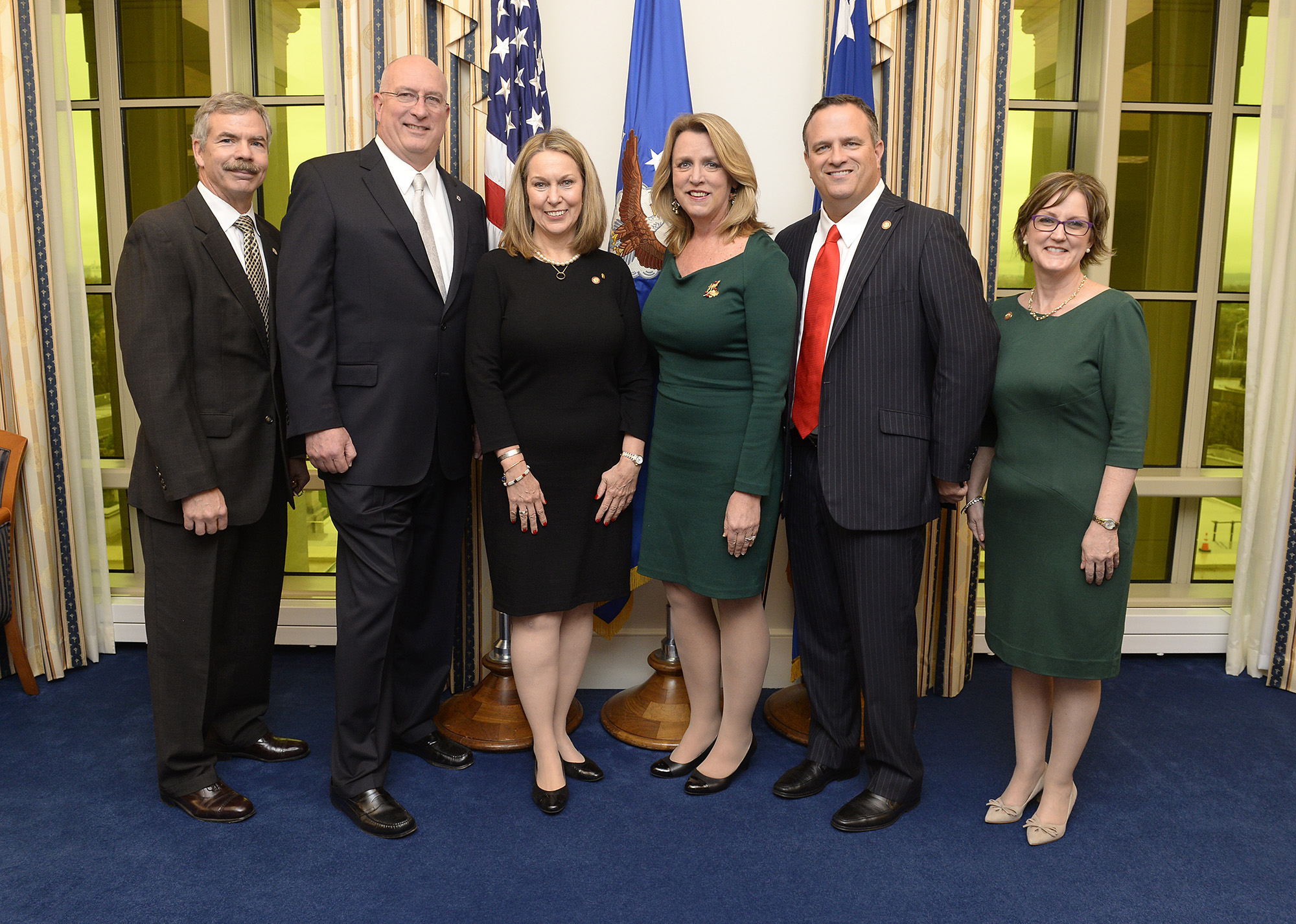
WASHINGTON (AFNS) -- Secretary of the Air Force Deborah Lee James presented the 2014 Zachary and Elizabeth Fisher Distinguished Civilian Humanitarian Award to the founder and president of the Tragedy Assistance Program for Survivors in a ceremony at the Pentagon Dec. 1.

Bonnie Carroll established TAPS in 1994 as a nonprofit, charitable organization that provides ongoing peer-based emotional support to those grieving the death of someone who died while serving in the armed forces. The organization brings survivors together with others who have experienced a similar loss for comfort, healing and hope. The program offers a 24/7 helpline, a network of volunteers and resources, quarterly publications, children and adult retreats, and more -- all of which are free to the survivor.

“For the past 11 years, TAPS has extended their arms to embrace our survivors, their children, family and friends with support, compassion and love, regardless of where or how their loved one died,” James said. “TAPS’s mission to provide ongoing peer-based emotional support to those grieving the loss of a fallen service member underwrites the sacred trust placed in the Department of Defense and the commitment to take care of our troops and their families.”

The award, established in 1996, was named in honor of Zachary and Elizabeth Fisher, both of whom contributed extensively to the support and welfare of members of the U.S. armed forces and their families. The award is presented to an organization or individual who has demonstrated exceptional patriotism and humanitarian concern for members of the armed forces or their families.

“Bonnie has comforted the hearts and lifted the lives of thousands of families across the country,” James said. “Her strength and generosity are testament to the enduring human spirit. I am so fortunate, so lucky it was my turn to preside over this ceremony today and present this award to such a deserving organization and to a woman who’s very near and dear to my heart.”

Carroll said she was honored and humbled to be recognized with the award.

“This is the organization none of us wanted to be a part of, that we wish didn’t exist, but it is a family where those loved ones of our nation’s fallen heroes can find hope, comfort, support and care,” Carroll said.

“I accept this honor very humbly on behalf of what is today a magnificent organization,” she continued. “We’re so proud that you as the military have allowed us to be your shipmates, to be your teammates, to be your battle buddies. It is a beautiful partnership; it is a family affair and I am so deeply honored to accept this tremendously prestigious award on behalf of all of our families.”

Measureable maintenance

by Airman Shawna L. Keyes
4th Fighter Wing Public Affairs


12/3/2015 - SEYMOUR JOHNSON AIR FORCE BASE, N.C. -- With thousands of working parts, the F-15E Strike Eagle relies on Airmen from several maintenance squadrons to keep the jet in the air. While some of these Airmen work directly on the flightline, others work quietly behind the scenes to ensure Strike Eagles are ready-to-go.

One of those silent warriors is the 4th Component Maintenance Squadron test, measurement and diagnostic equipment shop, also known as the Precision Measurement Equipment Lab, or PMEL.

The 4th CMS PMEL shop calibrates, troubleshoots and repairs more than 8,500 pieces of equipment on Seymour Johnson Air Force Base, North Carolina, Pope Army Airfield, N.C. and the U.S. Coast Guard Cutter Diligence, out of Wilmington, N.C.

The flight is broken down into three different sections: scheduling, quality assurance and PMEL.

The scheduling section is responsible for the entire inventory from various squadrons on base and at other installations. This includes every piece of equipment that has measurement capabilities.

The PMEL section is responsible for the proper functioning of all equipment in the inventory. Ranging from gauges and maintenance tools for the F-15E, to the drug scales used by the 4th Security Forces Squadron and Air Force Office of Special Investigations detachment, these Airmen calibrate and repair everything to specific standards, which are inspected and signed off by the quality assurance section.

"Everything we do here is directly related to how the jet is able to function," said Staff Sgt. John Loving, 4th CMS NCO in-charge of PMEL quality assurance program. "While we may not be exactly on the jet itself, everything they're using out there on the flightline to service that jet is calibrated in our lab."

PMEL handles more than 637 pieces of equipment on a monthly basis coming from various squadrons on base. They also support an inventory of more than 1,280 items from outside the installation.

"If PMEL didn't come out and test our diagnostic equipment, which gives us all of our readings and parameters for the engine, we couldn't guarantee it was actually serviceable," said Staff Sgt. Spencer McGraw, 4th CMS aerospace propulsion flight technician. "If we placed (an unserviceable) engine in a jet, it could result in an in-flight emergency or even loss of an aircraft.  It's really important that PMEL comes out and calibrates our equipment or we can't do our job correctly."

According to Loving, there is a constant flow of equipment coming in and out of the shop. Even when jets aren't flying, PMEL still works around the clock to service the equipment needed to keep the flying mission going.

"If we're not here to service that equipment for a day, a week, things are not going back to the customer and all of sudden those weekly checks, monthly checks, before flight checks, they can't get accomplished because they don't have certified equipment to do it," Loving said.

With anywhere from 20 to 60 items coming into the shop on a daily basis, the more than 20 PMEL technicians have to prioritize the work while still getting items back to the customer in a timely manner.

In addition, the flight maintains a rapid assistance calibration lab, or RASCAL, that operates as a mobile PMEL module. This component, manned by eight technicians, can be sent out in support of overseas contingency operations at a moments notice.

"We have one of only two [RASCALs] in the entire Air Force," said Airman 1st Class Alexis Kogel, 4th CMS TMDE technician. "The RASCAL has to be ready 24/7, so that way if there is a need overseas for it, we can have it ready to deploy within 24 to 48 hours."

According to Loving, all the equipment in PMEL is calibrated to an accuracy four times better than the test equipment's minimum standards. These calibrations can take anywhere from a few hours to several days depending on specifications needed.

"We're kind of the unsung hero, where you don't really know we're here until something bad goes down," Loving said. "In that respect, the more that you don't know about us the better we're doing our job."