Saturday, September 07, 2013

Reserve intel squadron brings Total Force Integration concept to Hickam

by Capt. Joe Simms
940th Wing


9/5/2013 - JOINT BASE PEARL HARBOR-HICKAM, Hawaii -- Ten communications specialists from the 50th Intelligence Squadron, Beale Air Force Base, Calif., completed two weeks of annual training at Distributed Ground Station 5, Joint Base Pearl Harbor-Hickam, Hawaii, Aug. 17-31.

The arrival of the reserve DGS to work alongside an active duty squadron marked the culmination of several months of coordination between the 50 IS and the 792nd Intelligence Support Squadron, JB Pearl Harbor-Hickam.

"The 792nd ISS currently has no reserve or Guard associations, so the opportunity to see the Air Force's Total Force Integration concept in action is a first for many of our airmen," said Capt. Brandon Kalski, 792nd ISS Operations Flight commander. " It has been a great opportunity to leverage the experience our reserve brethren bring to the table."

The 50th IS and 792nd ISS support two of the five distributed ground stations throughout the world that make up the Distributed Common Ground System weapons system. DGSs are also located at Osan Air Base, Republic of Korea, Joint Base Langley-Eustis, Va., and Ramstein Air Base, Germany.

Each DGS is comprised of intel analysts and communications specialists who process multiple forms of intelligence gathered from manned and unmanned reconnaissance platforms such as the U-2 Dragonlady and the RQ-4 Global Hawk remotely piloted aircraft.

The task of providing the infrastructure needed to process the vast amount of intelligence gathered by these platforms falls on Airmen with different backgrounds and fields of expertise.

"At DGS-2 (Beale AFB), we have full-time reservists embedded with the active duty. There are also civilian contractors at the DGS who are able to bring another perspective that the military members may not have," said Tech. Sgt. Robert Bower, 50th IS Mission Systems supervisor.

"Finally, our traditional reservists are also able to draw upon their experience from their civilian jobs in the communications industry," he continued. "As the model for Total Force Integration, we're able to bring all three of those domains to the table when we travel to another DGS."

The priorities for the 50th on this trip were to augment their regular Air Force counterparts and prepare the 792nd for their consolidated unit inspection later this year.

Air Force releases results of on-duty fatality Ground Accident Investigation

by Air Force Global Strike Command
Public Affairs


9/6/2013 - BARKSDALE AIR FORCE BASE, La. -- The Air Force has completed its investigation into an incident in which an Airman died at Whiteman AFB, Mo. The report discusses factors which may have played a role in the incident.

Staff Sgt. Roderick Davenport, a 23-year-old Airman assigned to the 509th Security Forces Squadron at Whiteman AFB, Mo., collapsed during the run portion of his Air Force fitness assessment April 9, 2012, and subsequently died after being transported to a local hospital. There were no other injuries resulting from this incident.

Sgt. Davenport joined the Air Force Aug. 1, 2007, as a Security Forces Specialist. He attended Air Force Basic Training at Lackland AFB, Texas, prior to his assignment at Whiteman as the police services desk sergeant.

The 509th Security Forces Squadron is part of the 509th Bomb Wing (BW) located at Whiteman AFB, Mo. Its mission is to serve as a global strategic force capable of delivering traditional and precision guided munitions; as well as acting as a key nuclear deterrent. The Bomb Wing includes approximately 5,500 military members as well as 2,800 civilian employees who operate, maintain, and manage the wing's fleet of B-2 Spirit stealth bombers.

Air Force Global Strike Command, parent unit for the 509th Bomb Wing, conducted the ground accident investigation.

AFGSC's report said the toxicology report for the Airman was negative, and the cause of death is listed as undetermined. However, the pathologist did note the presence of sickle cell trait, and stated that this was likely a contributing factor in the Airman's death.

"Our thoughts and sincerest sympathies are with Sgt. Davenport's family," said Brig. Gen. Thomas Bussiere, 509th Bomb Wing Commander. "This was a tragic situation for everyone, and Sgt. Davenport's loss continues to be felt by the Air Force family. We held him in the greatest affection and respect."

Prodigy Trades Music Career for Army Service


By Army Staff Sgt. Ray Kokel
15th Sustainment Brigade

KANDAHAR AIRFIELD, Afghanistan, Sept. 6, 2013 – A soldier serving here on her first deployment was a musical prodigy as a child, and walked away from her job as a music director at Pepperdine University to serve in the Army.


Click photo for screen-resolution image
Army Spc. Pyungan Cho practices with her church choir on Kandahar Airfield, Afghanistan, Aug. 31, 2013. U.S. Army photo by Staff Sgt. Raymond Kokel
  

(Click photo for screen-resolution image);high-resolution image available.
Army Spc. Pyungan Cho, a logistics specialist assigned to Headquarters and Headquarters Company, 15th Sustainment Brigade from Fort Bliss, Texas, was born in Seoul, South Korea, and started playing the piano when she was 5 years old.

“I was first taught at church,” Cho said. “It was a gift I had the opportunity to learn.” When she was 18, her family moved to Los Angeles, and her music career took off.

“I had a great instructor who wanted to take me to Juilliard, but my family insisted that I stay,” she said. “My grandmother had breast cancer, and my family needed my help to take her to medical appointments.”

As it turned out, Cho said, taking care of her grandmother helped her music career. “I would play for her, and she would pray for me,” she explained. “It was her prayers that made everything possible.”

At her parents’ request, Cho auditioned for music professors at Pepperdine University in Malibu, Calif.
“I was so nervous,” she said. “Here were all these men and women, masters in their craft, judging whether I get a full ride to a higher education or not. I played two pieces of music that I had practiced. When I was done, a professor told me they would call me in two weeks.”

But before she could walk out, a professor handed her a thin music book and asked her to play it for the rest of the group. Cho said she did not know that it was a complicated piece and would be the true test of her abilities. What the professors did not know, she added, was that she had a talent her previous instructor identified as perfect pitch.

“When someone has perfect pitch they can hear a note and recognize it by name,” Cho said. “As I read the book, I could hear the notes playing in my head.”

Although it was the first time she had played that particular work, Cho played every note perfectly. One after another, Cho recalled, the professors gave her more books to play, and their moods changed right before her eyes.

“Suddenly they went from ‘We’ll call you in two weeks’ to ‘You have to come to our school,’” she said.

After the audition, Cho said, she walked outside to where her father was parked.

“When I got inside the car, he told me my grandmother had a vision of me in a cap and gown holding a diploma,” she said. “I told my father how it went, then we got out of the car and prayed on the steps of the school.”

Cho later graduated from Pepperdine with a bachelor’s degree in music. She has played at Carnegie Hall, and she performed in front of thousands of people around the world during her time at Pepperdine. She even earned a job as the youngest music director ever at the university.

But despite her successful career in music, Cho said, she joined the Army because she wanted to give something back to the United States.

“The United States, through the help of its military, built schools and hospitals in South Korea,” she said. “That is why Korea has been able to grow so much more as a nation.”

Cho spends much of her off-duty time here practicing with her church choir and performing for religious services on the base.

“Music is a powerful thing. It can make you happy, and even cry,” she said. “I’ve been so blessed in my life, and it feels great to be a blessing for others through my music.”

Cho said she plans to go to Officer Candidate School and play for the Army Band as she continues her military career.

Former DJ finds pulse in the Air Force

by Staff Sgt. Amber Corcoran
2nd Bomb Wing Public Affairs


9/6/2013 - BARKSDALE AIR FORCE BASE, La. -- When he was 8 years old, he would sit in his bedroom and act like Casey Kasem, radio personality and host of the American Top 40, using a tape recorder with a condenser microphone as an 8-track cassette tape or record played in the background.

His aforementioned disc jockey career didn't get its start however, until after being the seventh caller in to a radio station and going to pick up his prize.

"I asked the DJ if I could see the room where they make their announcements and play the music," said Maj. Steve Katsaris. "I then asked to announce a song, but he didn't want to get fired for putting a kid on the radio. I told him I could do it, so he asked if I announced one, what it would sound like. I blurted it out, and he ended up letting me on because he thought it was cute."

Fortunately for both the DJ and Katsaris, the program director who happened to be monitoring the station, heard the song announcement and was intrigued. The director contacted Katsaris' parents and offered to let him come back to the station, work with the DJ's one Saturday afternoon and learn more about the business.

Katsaris, Chief of Helicopter Training at Air Force Global Strike Command, started a path down the broadcasting lane by purchasing his own equipment and DJing at roller rinks, high school and middle school dances or any event he had a chance to hone his skill. As soon as he turned 18, he began working in night clubs and evolved into a very prominent talent in the industry.

Building his experience, Katsaris was on track to continue further into the broadcast world by obtaining an undergraduate degree in radio, television communications.

"There was no surprise as to what I wanted to achieve," said Katsaris. "I was making my transition from radio to television and heading to CNN in Atlanta for an internship. Typically, if you do well during an internship, you obtain ground floor entry into that network."

But Katsaris had another dream that had always lingered in the back of his mind.

While attending the University of Central Florida, Katsaris lived next door to an Air Force Reserve Officer Training Corps cadet and shared with him his other dream.

"I told him my real dream was to fly," said Katsaris. "He looked at me funny and said, 'if that's what you really wanted, then why didn't you?' I told him I didn't think I had the mathematical aptitude to be a pilot. I was under the assumption that you had to be able to do calculus in your head and master arithmetic without a calculator."

The ROTC cadet convinced Katsaris to speak with the professor of aerospace science at their school. The professor set him up with appointments to test his hand/eye coordination, aptitude and physical fitness. His transcripts were pulled to make sure he had the grades; after being told he could most certainly obtain a pilot slot for his graduation year, Katsaris finally arrived at the fork in the road.

"I was within four months of being too old to enter pilot training, based off when I would graduate," he said. "So it was a now or never type of decision, especially since I didn't have resources to pay for the training on my own."

Katsaris decided to enroll in an accelerated ROTC program immediately. As the professor predicted, Katsaris picked up a pilot training slot.

Katsaris' new path was paved quickly thereafter. He flew 20-25 hours in the T3-A Firefly during flight screening and moved on to Columbus Air Force Base, Miss., for undergraduate training in the Cessna T-37. He then selected the helicopter track and went to Fort Rucker, Ala., to learn to fly the UH-1H Iroqouis. Katsaris was next ordered to Kirtland Air Force Base, N.M., where he learned to fly the UH-1N Huey and he finally settled at Andrews Air Force Base, Md., for his first official Air Force assignment as a second lieutenant.

Throughout his Air Force career, Katsaris continued to blend the worlds he knew by DJing and lending his broadcaster skills.

"I've always volunteered to emcee various functions and would lend a hand when needed," said Katsaris. "I was the emcee for Guardian Challenge in Air Force Space Command and assisted with the Global Strike Challenge here, providing the voice for the trophy return ceremony and events at the convention center."

While stationed at Vandenberg Air Force Base, Cali., Katsaris was given the title of "The Voice of Vandenberg" by Maj. Gen. Jack Weinstein, AFGSC vice commander, who at the time was Col. Weinstein, 30th Space Wing commander.

As his schedule allowed, he would travel to clubs in San Francisco or Los Angeles and was highlighted as a special guest DJ for one-night engagements. Though, the further he progressed in his Air Force career, the less time he had to DJ.

"When you do something for so long, it's hard to walk away from it; the energy, the pulse of the club dance floor," he said. "I loved the challenge of finding the pulse. Once I found it, I took it in and elevated it to the next level."

Katsaris discovered a different pulse during his Air Force career; one that had started out as a childhood dream - flying.

"As my schedule demands continued to rise, I decided to back away from DJing entirely," said Katsaris. "I couldn't keep up with the music industry and also be the best officer I could at that point. I know where my priorities are and that's to the Air Force."

After more than 25 years of service, including the eight years as an enlisted member of the Florida Army National Guard before his fork in the road decision, AF retirement is right around the corner for Katsaris. At this point, he's confident he'll still fly after his military career has come to a close.

"I may go the commercial route and fly for an airline or continue in rotary aviation as a helicopter pilot," he said. "Who knows, maybe I'll combine the two paths and fly a news chopper and broadcast at the same time; it'd be an interesting mix. I don't know the exact path yet, but whatever I do, it's going to be what makes me happy - flying. The Air Force allowed me to make that dream a reality and made that happiness possible."

Doolittle Raiders' Final Toast Ceremony to take place at National Museum of the U.S. Air Force

By Rob Bardua, National Museum of the U.S. Air Force

 DAYTON, Ohio (AFNS) --
The Air Force will host the famed Doolittle Tokyo Raiders' final toast to their fallen comrades during an invitation-only ceremony on Nov. 9 at the National Museum of the U.S. Air Force.

Eighty men achieved the unimaginable April 18, 1942, when they took off from an aircraft carrier on a top secret mission to bomb Japan. Led by Lt. Col. James H. "Jimmy" Doolittle, these men came to be known as the Doolittle Tokyo Raiders. Today, just four of the men survive: Lt. Col. Richard E. Cole, co-pilot of crew No. 1; Lt. Col. Robert L. Hite, co-pilot of crew No. 16; Lt. Col. Edward J. Saylor, engineer-gunner of crew No. 15; and Staff Sgt. David J. Thatcher, engineer-gunner of crew No. 7.
At this time, all four Raiders are planning to attend the event.

According to museum director Lt. Gen. (retired) Jack Hudson, the Doolittle Raid was an extremely important event in the development of American air power because it marked the first combat use of strategic bombardment by the Army Air Forces in World War II.

"While the attack itself caused little actual damage to Japanese war industry, the psychological impact on the Japanese military and the American public proved to be immense," Hudson said . "The U.S. Air Force has drawn upon the Doolittle Raiders for inspiration ever since, and we are deeply honored that they have chosen to have this final ceremony at our national museum."

In 1959 the city of Tucson, Ariz., presented the Doolittle Raiders with a set of silver goblets, each bearing the name of one of the 80 men who flew on the mission. At each of their past reunions, the surviving Raiders would conduct their solemn "Goblet Ceremony." After toasting the Raiders who died since their last meeting, they would then turn the deceased men's goblets upside down. The Nov. 9 event will mark their final toast.

Among those scheduled to attend the ceremony to pay tribute to the Raiders are Air Force Acting Secretary Eric Fanning and Chief of Staff Gen. Mark Welsh III.

The public will also have an opportunity to celebrate these World War II aviation heroes that day through events that include a wreath-laying ceremony at the Doolittle Raiders memorial and a flyover of B-25 Mitchell aircraft. In addition, the Air Force Museum Theatre is planning to show Doolittle Raider and World War II-themed films. More details will be announced as the event nears at www.nationalmuseum.af.mil/doolittle.asp.

The National Museum of the United States Air Force, located at Wright-Patterson Air Force Base near Dayton, Ohio, is the service's national institution for preserving and presenting the Air Force story. Each year, more than one million visitors come to the museum to learn about the mission, history and evolving capabilities of America's Air Force. For more information about the museum, visit www.nationalmuseum.af.mil.

President Explains Syria Decision in Weekly Address

American Forces Press Service

WASHINGTON, Sept. 7, 2013 – President Barack Obama today used his weekly address to explain his decisions to take military action against Bashar Assad’s regime in Syria for using chemical weapons against its own people and to seek congressional approval for that action.

More than 1,000 innocent people – including hundreds of children – were murdered Aug. 21 in the worst chemical weapons attack of the 21st century, the president said, and the United States has presented a powerful case to the world that the Syrian government was responsible.

“This was not only a direct attack on human dignity; it is a serious threat to our national security,” Obama said. “There’s a reason governments representing 98 percent of the world’s people have agreed to ban the use of chemical weapons. Not only because they cause death and destruction in the most indiscriminate and inhumane way possible – but because they can also fall into the hands of terrorist groups who wish to do us harm.”

Last weekend, he said, he announced that as commander in chief he had decided the United States should take military action against the Syrian regime. “This is not a decision I made lightly,” the president added. “Deciding to use military force is the most solemn decision we can make as a nation.”
Obama also explained why he sought authorization from Congress for military action.

“As the leader of the world’s oldest constitutional democracy, I also know that our country will be stronger if we act together, and our actions will be more effective,” he said. “That’s why I asked members of Congress to debate this issue and vote on authorizing the use of force.”

The president emphasized that the pending military action is not an open-ended intervention. “This would not be another Iraq or Afghanistan,” he said. “There would be no American boots on the ground. Any action we take would be limited, both in time and scope – designed to deter the Syrian government from gassing its own people again and degrade its ability to do so.”

Obama acknowledged that the American people are weary after a decade of war. “That’s why we’re not putting our troops in the middle of somebody else’s war,” he said.

“But we are the United States of America,” he added. “We cannot turn a blind eye to images like the ones we’ve seen out of Syria. Failing to respond to this outrageous attack would increase the risk that chemical weapons could be used again [and] that they would fall into the hands of terrorists who might use them against us, and it would send a horrible signal to other nations that there would be no consequences for their use of these weapons -- all of which would pose a serious threat to our national security.

“That’s why we can’t ignore chemical weapons attacks like this one – even if they happen halfway around the world,” he continued. “And that’s why I call on members of Congress from both parties to come together and stand up for the kind of world we want to live in -- the kind of world we want to leave our children and future generations.”

Friday, September 06, 2013

Airmen perform first F-35A weapons load verification

By Lt. j.g. Lisa Lill, 33rd Fighter Wing Public Affairs

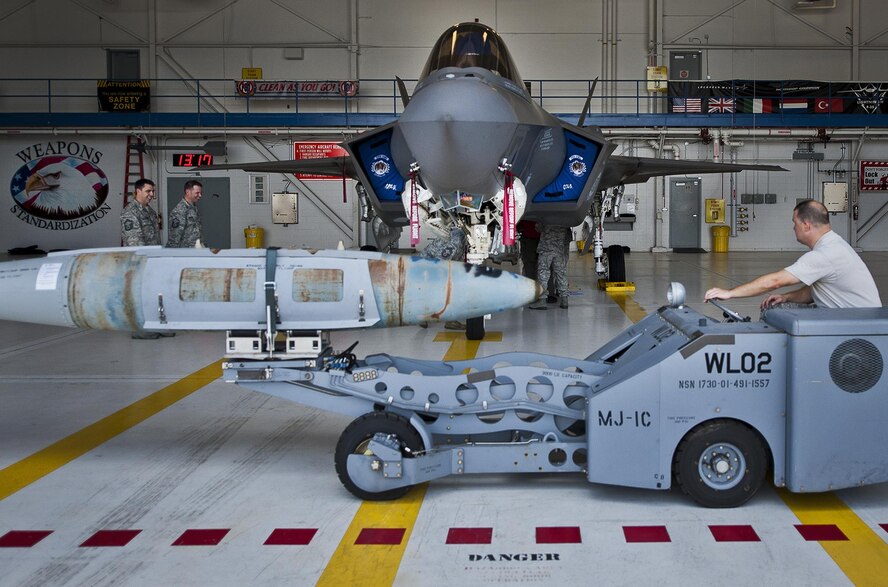
EGLIN AIR FORCE BASE, Fla. (AFNS) -- After months of preparation the weapons troop standardization load crew, or SLC, from the 33rd Maintenance Group performed the first munitions load verification on the F-35A Lightning II here Aug. 27.

"Over the next couple of days, our 33d Fighter Wing maintenance professionals, alongside representatives from the F-35 Program Office and Air Combat Command, will validate weapons loading procedures. This involves loading and unloading laser-guided and GPS-guided bombs, and air-to-air missiles into the weapons bays of the aircraft and ensuring the instructions we provide our load crews are accurate and effective - one more step towards F-35 initial war fighting capability," explained Lt. Col. Ron Huzzard, the deputy commander of the 33rd MXG.

The SLC has been practicing this load verification using a series of tabletop exercises for several months. This marked the first hands-on load verification for the crew.

"Watching our weapons troops verify loading procedures was like getting a glimpse into the future. Ultimately, this will be the work that is performed down range when it counts, and we are laying that foundation here at Eglin," said Navy Capt. Lance Massey II, the commander of the 33rd MXG. "The stealth capability on the F-35 is beyond incredible, but the weapons capability rounds out the whole purpose of the joint strike fighter."

The procedure was overseen by Chief Master Sgt. Christopher Wilbur, the wing weapons manager at the 33rd MXG.

"The Airmen walked through the technical instructions to verify the data is accurate and make adjustments as necessary," Wilbur said about the verification load exercise.

The three-person SLC included Master Sgt. Karen Griffin, Tech. Sgt. Russell Fontaine and Staff Sgt. Steven Dash. Working as a cohesive team, the trio carefully performed several iterations of loading and unloading four different munitions. Once the procedures are verified SLC members will train the weapon troops.

"Getting this step verified in ALIS (the automated logistics information system) for the F-35A is important, so we can move forward and get our 60-plus maintainers trained and working," Griffin said.

Airman helps deliver daughter, deploys same day

by Senior Airman Benjamin Gonsier
2nd Bomb Wing Public Affairs


9/6/2013 - BARKSDALE AIR FORCE BASE, La. -- Airman 1st Class Timothy Pledger was scheduled to depart for his six month deployment Aug. 30 in the early hours of the morning, but an aircraft malfunction pushed back his departure.

Pledger returned home until the new departure time to be with his pregnant wife, who was expecting any day. Around 9 a.m. his wife's water broke. With no time to spare, Pledger took action.

"I called emergency services when her water broke," Pledger said. "However, the baby was already coming out. I called them back so they could give me step-by-step instructions on how to deliver the baby."

The emergency personnel told him to ensure his wife was fine and to tell her to continue to push while also checking on the baby's condition. When the baby got stuck, Pledger had no idea what to do, but he kept his composure and listened to the emergency personnel's directions. After applying what the emergency personnel told him, a few minutes later his daughter was completely out and breathing normally.

"The moment was magical," Pledger said. "I was all choked up and could barely talk."

After the fire department and ambulance arrived, his wife and daughter were taken to a local hospital where they were stabilized and in good condition.

His daughter, Zoey, weighed in at six pounds, nine ounces, and measured 19 inches long.

"This is definitely a once in a lifetime situation," he added. "With the delayed jet in the beginning, it seems like this was meant to happen."

Later that day, the electronic warfare journeyman was on the plane to Anderson Air Force Base, Guam, to support the Continuous Bomber Presence mission.

"This is a testament to Airmen we have at Barksdale and the Air Force in general," said Master Sgt. Anthony Grubb, 2nd Aircraft Maintenance Squadron first sergeant. "To deliver his own daughter early in the morning, when he was supposed to deploy, and not even 12 hours later, go through the processing line and get on a jet to support the mission says a lot about the great Airmen we have here. Family is important and so is the mission, and Pledger was able to successfully support both."

LRS Airman Receives Bronze Star

by Airman 1st Class Malissa Lott
366th Fighter Wing Public Affairs


9/6/2013 - MOUNTAIN HOME AIR FORCE BASE, Idaho -- Tech. Sgt. Makeba Liebert, 366th Logistics Readiness Squadron NCO in charge of individual protection equipment, earned a Bronze Star while facilitating the transfer of responsibilities for supply chains to Afghans.

Liebert was presented the fourth highest combat medal in the U.S. by Lt. Col. Todd Jensen, 366th LRS commander, for her actions while deployed to Kabul, Afghanistan.

Working as the NCO in charge, Liebert played a main role in the logistics analysis and fortification of 25 districts in Afghanistan, helping transition them to full control for local Afghans. She also directly supported the readiness of 62 districts fighting for security.

"We worked 14-hours a day with no days off for the entire deployment," said Liebert. "I never had a day that was the same."

Liebert conducted 60 missions traveling over 1,000 miles outside the wire including key leader engagements in which she cleared supply chain log jams fixing province-wide shortages.

"She has done great things for us," said Master Sgt. John Tristan, 366th LRS Materiel Management superintendent. "It shows younger Airmen we do things that we are not normally tasked to do, and we step outside of our comfort zone to accomplish the mission."

Liebert proved she was willing to go above and beyond to accomplish the mission while deployed.

"I feel very proud to be awarded this medal," she said. "I am glad to be back on American soil and to be with my husband and children."

Obama: Syrian Chemical Attacks Threaten Region, Globe

By Jim Garamone
American Forces Press Service

WASHINGTON, Sept. 6, 2013 – Chemical weapons attacks in Syria are not just a tragedy in that country, but also pose a threat to regional and global peace and stability, President Barack Obama said in St. Petersburg, Russia, today.

At a news conference following the G-20 summit, Obama said the Syrian regime’s chemical attack on its own people threatens to unravel the almost century-old ban against using such weapons.

The president said the Syrian government’s attack killed civilians, making this more than an esoteric subject. “Over 1,400 people were gassed. Over 400 of them were children,” Obama said. “This is not something we've fabricated. This is not something that we are … using as an excuse for military action.”

The Syrian attack threatens Turkey, Jordan, Lebanon, Iraq and Israel, and threatens to further destabilize the Middle East, the president said. The actions also increase the likelihood that these weapons of mass destruction could fall into the hands of terror groups, he added.

“Failing to respond to this breach of this international norm would send a signal to rogue nations, authoritarian regimes and terrorist organizations, that they can develop and use weapons of mass destruction and not pay a consequence,” Obama said. “That’s not the world that we want to live in.”

G-20 leaders were unanimous that there was a chemical weapons attack in Syria on Aug. 21, Obama said, and also were unanimous that the chemical weapons ban is important. Where there is a division in the G-20 has to do with the United Nations, he added.

“You know, there are number of countries that just as a matter of principle believe that if military action is to be taken, it needs to go through the U.N. Security Council,” he said. “It is my view … that given Security Council paralysis on this issue, if we are serious about upholding a ban on chemical weapons use, then an international response is required, and that will not come through Security Council action.”

In a joint statement released today, the leaders of Australia, Canada, France, Italy, Japan, South Korea, Saudi Arabia, Spain, Turkey and the United Kingdom joined with the United States in calling for “a strong international response to this grave violation of the world’s rules and conscience that will send a clear message that this kind of atrocity can never be repeated. Those who perpetrated these crimes must be held accountable.”

Obama said he was elected to end wars, not to start them. “I’ve spent the last four and a half years doing everything I can to reduce our reliance on military power as a means of meeting our international obligations and protecting the American people,” he said. “But what I also know is that there are times where we have to make hard choices if we’re going to stand up for the things that we care about. And I believe that this is one of those times.”

The president announced he will address the American people from the White House about Syria on Sept. 10

Vice Chairman Joins in Opening Wounded Warrior Retreat

By Amaani Lyle
American Forces Press Service

BLUEMONT, Va., Sept. 6, 2013 – On a sprawling, tree-framed landscape, the vice chairman of the Joint Chiefs of Staff joined about 400 guests today for the official grand opening of Boulder Crest Retreat for seriously wounded service members, veterans and their families.

Navy Adm. James A. Winnefeld Jr. commended retired Navy Master Chief Petty Officer Ken Falke and his wife, Julia, who donated the land and realized their vision of providing free use of a lodge, cabins, activities and programs that provide respite and aid in reconnection, recovery and rehabilitation.

“As more than 12 years of war come to a close for the magnificent men and women who have been fighting it, our collective obligation to take care of them will not end,” Winnefeld said. “The majority of the seen and unseen injuries our warriors have endured from Iraq, … Afghanistan and other places are scars they’ll bear for life.”

With medical facilities such as the Walter Reed National Military Medical Center and others just a road trip away, Boulder Crest Retreat, Winnefeld said, goes the extra mile to not only be a home away from home, but a home away from clinics and hospitals.

“The severity of many veterans’ physical and emotional trauma suggests long-term care needs that will surpass our publicly available medical capacity well into the future,” the admiral said.

The 37-acre, Americans With Disabilities Act-accessible retreat already has proven popular, with bookings in each of its four private cabins through 2013 and projected recreation and resources for 250 to 500 families each year.

Each cabin accommodates up to six people and is available for two- to 14-day stays, and guests also can gather in the 6,000-square-foot, two-story lodge to connect with other families and participate in programs.

Visitors also can enjoy outdoor amenities such as an archery range, nature trails, a playground, an organic garden, a bird sanctuary and a fishing pond, while recreational activities include nature walks, Shenandoah River kayaking and swimming, and golf and tennis.

In addition to the retreat’s healing offerings of yoga, meditation, massage therapy, journaling, art and music therapy, Winnefeld also noted featured assistance therapy with dogs and horses, which resonates well with wounded warriors who may be weary of sudden noises and movements.

Winnefeld directly addressed wounded warriors, lauding them for their courage and buoyancy. “I’m continually amazed by your grit and resilience [and] your commitment to ability over disability.”
Julia Falke, too, admired the courage not only of her husband, an explosive ordnance disposal technician, but also of fellow military families, which she said ultimately inspired her journey to Boulder Crest Retreat.

The Falkes lived in military family housing in both Scotland and her native England. “We’d always invite the young families stationed there to come and have dinner and feel the comforts of home,” she said. “You could really see the difference it made.”

Thirty years later, the Falkes bought 200 acres of land in rural Virginia, where they took residence in a large, stone farmhouse atop the hilly grass and briar. The couple began visiting wounded warriors and their families at nearby military hospitals, and soon resumed the tradition of inviting guests over for home-cooked meals and relaxation.

But sending the troops back, Julia said, became less and less practical. So when a friend suggested a writer’s retreat for the Falkes’ countryside, Julia thought of something more meaningful.


“The more we started talking about [Boulder Crest Retreat], the more other people would come to us and say, ‘If you start it, we will help you,’” Julia said.

The Falkes soon secured a 501c3 charitable foundation status, and in less than a year, various donors poured more than $5 million into the organization.

Julia said contributors ranged from the Boy Scouts of America to multi-billion-dollar corporations. “There has been every kind of involvement, the outcome has been unbelievable,” she said.

But the nascent project will continue to grow with the ideas and donations of those who support it, Julia said. “I’ve been crying all day long,” she added. “To see it in reality is so amazing.”

Perhaps the most interesting style of arrival to the grand opening was that of wounded warrior Dana Bowman, who parachuted in by way of tandem jump with an American flag in tow.

In 1994, Bowman, a former special operations troop who once served with Falke, lost both of his legs after being injured while serving on the Army’s Golden Knights parachute team.

Standing tall on legs of steel, Bowman didn’t lose his courage, and he became the first double amputee to re-enlist in the U.S. military. So when Ken Falke asked him to attend the Boulder Crest Retreat grand opening, Bowman said, the decision to help his former comrade was easy.

“Absolutely, I said I’d be there to bring the American flag in … and to land on target, and that’s exactly what we did,” Bowman said. “We’re able to come back, bring the whole team and tandem jump a warrior in for this special event and day.”

Bowman said the retreat, at is essence, is about giving back.

“At the end of the day,” he added, “we all bleed the same way, so we have to rally our troops from the different services to come out and make a difference.”

Elected and public officials, corporate and private organization representatives as well as Vietnam veteran and former Pittsburgh Steelers running back Rocky Bleier all attended the grand opening.

U.N. Rep: Inaction Would Be More Risky Than Action in Syria

By Cheryl Pellerin
American Forces Press Service

WASHINGTON, Sept. 6, 2013 – The risks of inaction in response to the Syrian regime’s use of chemical weapons against its own people would be greater than the risks of military action, the U.S. permanent representative to the United Nations said here today.

Speaking to an audience at the Center for American Progress, Ambassador Samantha Power characterized Syria as lying at the heart of a region critical to U.S. security -- a region that is home to friends and partners and one of the closest U.S. allies.

The Bashar Assad regime, Power said, has stores of chemical weapons that it recently used on a large scale and that the United States can’t allow to fall into terrorists' hands. The regime also collaborates with Iran and works with thousands of extremist fighters from the militant group Hezbollah.

The ambassador acknowledged that questions are being raised about why the United States should be the world’s police in such brutal situations and how the nation can afford another war in the Middle East.

“Notwithstanding these complexities, notwithstanding the various concerns that we all share,” Power said, “I'm here today to explain why the costs of not taking targeted, limited military action are far greater than the risks of going forward in the manner that President [Barack] Obama has outlined.”

The chemical weapons attack in Damascus on Aug. 21 killed more than 1,400 Syrian men, women and children, she said, and the U.N. assessed that although Assad used more chemical weapons on Aug. 21 than he had before, he’s barely put a dent in his large stockpile.

“Obama, Secretary of State John F. Kerry and many members of Congress have spelled out the consequences of failing to meet this threat, Power said. “If there are more chemical attacks,” she added, “we will see an inevitable spike in the flow of refugees on top of the already 2 million in the region, possibly pushing Lebanon, Jordan, Turkey or Iraq past their breaking points.”

The Zaatari refugee camp is now the fourth-largest city in Jordan, she said, adding that half of Syria’s refugees are children and that such camps are known to become fertile recruiting grounds for violent extremists.

Beyond Syria, the ambassador said, if violating a universal agreement to ban chemical weapons is not met with a meaningful response, other regimes will try to acquire or use them to protect or extend their power, increasing risks to American troops in the future.

“We cannot afford to signal to North Korea and Iran that the international community is unwilling to act to prevent proliferation or willing to tolerate the use of weapons of mass destruction,” Power told the audience.

“People will draw lessons,” she added, “if the world proves unwilling to enforce the norms against chemical weapons use that we have worked so diligently to construct.”

Moving from discussing the risks of inaction to the risks of taking action, Power said the reason nonmilitary tools can’t be used to achieve the same end in Syria is that the alternatives are exhausted.
“For more than a year,” Power said, “we have pursued countless policy tools short of military force to try to dissuade Assad from using chemical weapons.”

The ambassador explained how she and others engaged the Syrians directly and asked the Russians, the U.N. and the Iranians to send similar messages, but when Scud missiles and other weapons didn’t stop the Syrian rebels, Assad used chemical weapons on a small scale several times, as the United States reported in June.

Her group then redoubled its efforts, backing the U.N. diplomatic process and trying to get the parties back to the negotiating table, she said. They provided more humanitarian assistance and on chemical weapons they went public with evidence of the regime's use.

“We worked with the U.N. to create a group of inspectors and then worked for more than 6 months to get them access to the country on the logic that perhaps the presence of an investigative team in the country might deter future attacks. … We expanded and accelerated our assistance to the Syrian opposition. We supported the U.N. Commission of Inquiry,” the ambassador said.

She noted that Russia, often backed by China, blocked every relevant action in the U.N. Security Council, even mild condemnations of the use of chemical weapons that ascribed blame to no particular party. “And on Aug. 21, [Assad] staged the largest chemical weapons attack in a quarter-century while U.N. inspectors were sitting on the other side of town,” Power said.

It was only after the United States pursued such nonmilitary options without deterring chemical weapons use in Syria that Obama concluded that a limited military strike is the only way to prevent Assad from using chemical weapons as if they are a conventional weapon of war, the ambassador added.

“From the start of the Syrian conflict, the president has consistently demonstrated that he will not put American boots on the ground to fight another war in the Middle East,” Power said. “The draft resolution before Congress makes this clear.”

The president is seeking public support to use limited military means to degrade Assad's capacity to use these weapons again and deter others in the world who might seek to use them, the ambassador said. “And the United States has the discipline as a country to maintain these limits,” she added.
Limited military action will not solve the entire Syria problem, Power noted, but the action should reinforce the larger strategy for addressing the crisis in Syria.

“This operation, combined with ongoing efforts to upgrade the military capabilities of the moderate opposition, should reduce the regime's faith that they can kill their way to victory,” the ambassador said.

“We should agree that there are lines in this world that cannot be crossed and limits on murderous behavior -- especially with weapons of mass destruction -- that must be enforced,” Power said. “If we cannot summon the courage to act when the evidence is clear and when the action being contemplated is limited, then our ability to lead in the world is compromised.”

Minnesota Commissioning Carried Live Saturday Morning at 10 (EDT)

NORFOLK (NNS) -- Check out live online coverage of the commissioning of the Navy's newest Virginia-class attack submarine Minnesota (SSN 783) Sept. 7, 2013 at 10 a.m. Eastern Time on the Navy Live Blog.

The broadcast, orginating from Naval Station Norfolk in Norfolk, Va. can be found online at http://navylive.dodlive.mil/ and will feature a hosted, interactive live chat.

Secretary of the Navy Ray Mabus will deliver the ceremony's principal address. Ellen Roughead, wife of former Chief of Naval Operations Adm. Gary Roughead and a Minnesota native, will serve as ship's sponsor. In the time-honored Navy tradition she will give the first order to "man our ship and bring her to life!"

Minnesota, the 10th ship of the Virginia class is named in honor of the state's citizens and their continued support to our nation's military. Minnesota has a long tradition of honoring its veterans of wars past and present. The state is proud to be home to 46 Medal of Honor recipients that span from the Civil War to the Vietnam War.

"Minnesota and the success of our Virginia-class submarine program prove that acquisition excellence is a key element of building the future fleet," said Secretary of the Navy Ray Mabus. "The work of the more than a thousand shipyard craftsmen and engineers who built this boat have helped make the Fleet stronger and our nation safer. Their dedication and expertise led to the delivery of the world's most advanced submarine almost a year ahead of schedule and on budget."

This will be the third ship to bear the state name. The first USS Minnesota, a sailing steam frigate, was commissioned in 1857 and served during the Civil War, remaining in service until her decommissioning in 1898. The second Minnesota was commissioned in 1907. On Dec. 16, 1907 she departed Hampton Roads as one of the 16 battleships of the Great White Fleet sent by then-President Theodore Roosevelt on a voyage around the world. She continued her service through World War I and was decommissioned in 1921.

Minnesota will provide the Navy with the capabilities required to maintain the nation's undersea supremacy well into the 21st century. She will have improved stealth, sophisticated surveillance capabilities and special warfare enhancements that will enable her to meet the Navy's multi-mission requirements.

Designated SSN 783, Minnesota is built to excel in anti-submarine warfare; anti-ship warfare; strike warfare; special operations; intelligence, surveillance, and reconnaissance; irregular warfare; and mine warfare missions. Capable of operating in both the world's shallow littoral regions and deep waters, Minnesota will directly enable five of the six Navy maritime strategy core capabilities - sea control, power projection, forward presence, maritime security, and deterrence.

The 7,800-ton Minnesota is built under a teaming arrangement between General Dynamics Electric Boat and Huntington Ingalls Industries. A crew of approximately 134 officers and enlisted personnel will operate the 377-feet long, 34-foot beam vessel, which will be able to dive to depths of greater than 800 feet and operate at speeds in excess of 25 knots submerged. Minnesota is designed with a nuclear reactor plant that will not require refueling during the planned life of the ship - reducing lifecycle costs while increasing underway time.


Thursday, September 05, 2013

KC-46 critical design review officially closed

from Secretary of the Air Force Public Affairs

9/5/2013 - WASHINGTON (AFNS) -- The Air Force officially closed the KC-46 Weapon System Critical Design Review (CDR) on August 21, one month ahead of the Sept. 24 contractual date.

This formal closure of the July Weapon System Design Review represents the culmination of more than 10 months of component and sub-system design reviews, resolution of all resulting action items and completion of all CDR criteria established in the Air Force's contract with Boeing.

Closure of CDR formally establishes the KC-46 design and now allows the program to progress into its manufacturing and development test phases.

The KC-46 is based on the Boeing 767-200ER commercial aircraft. Design review activities blended best practices of commercial and Department of Defense frameworks, leading to overall improvements.

Boeing will now proceed with integration, verification, and production of four engineering and manufacturing development aircraft to support flight testing, scheduled to begin in mid-2014. The first fully equipped KC-46 tanker is projected to fly in early 2015.

"This build and test phase is another critical step toward meeting the KC-46 contractual Required Assets Available date -- a milestone requiring 18 KC-46 aircraft and all necessary support to be on the ramp, ready to support warfighter needs by the August 2017 timeframe," said Maj. Gen. John Thompson, Air Force program executive officer for tankers. "To succeed will require the focused efforts from all members of the team."

The Air Force contracted with Boeing in February 2011 to acquire 179 KC-46 refueling tankers to begin recapitalizing the more than 50-year old KC-135 fleet. Production will ramp up to deliver 179 tankers by 2028.

U.S., Russia Can Make Bilateral Progress, DOD Official Says

By Jim Garamone
American Forces Press Service

WASHINGTON, Sept. 5, 2013 – The United States and Russia disagree on some aspects of their bilateral relations, but there are many areas where the countries can and do cooperate, the deputy assistant secretary of defense for Russia, Ukraine and Eurasia told the Heritage Foundation yesterday.
The relationship has been marked by ups and downs, Evelyn N. Farkas said, and that is normal. The idea, she added, is to work through these disagreements.

“We will continue to work with Russia to find mutually acceptable solutions,” Farkas said in her prepared remarks. “We’ve been managing a significant disagreement with the Russians over Syria.”
Still, Farkas said, American officials want to bolster defense cooperation. The United States wants to work on counterproliferation issues with Iran, North Korea, and on counterterrorism and counternarcotics in regions adjacent to Russia.

“Our level of interaction with Russia has increased substantially with the establishment of the Defense Relations Working Group in September 2010,” she said. “The working group is intended to create mechanisms for discussion and exchange at the policy level between defense professionals on a range of issues, including defense reform and modernization, missile defense cooperation, defense technology cooperation, and global and regional security issues of mutual interest.”

Increased cooperation on Afghanistan tops the U.S. wish list, Farkas said. “Working to bring improved stability to Afghanistan is clearly in U.S. and Russian interests, and Russia continues to be supportive by expanding the Northern Distribution Network and allowing for diversification in the types of cargo that can pass through its territory,” she explained. “The U.S. and Russia continue working together to disrupt al-Qaida’s and other terrorist groups’ operational networks and undermine their access to financial resources.”

Continued cooperation to combat piracy off the Horn of Africa also is a U.S. goal, Farkas said.
Even in areas of disagreement there must be conversations, Farkas said. Both Russia and the United States agree that the civil war in Syria should end, she noted, but Russia supports the regime of Bashar Assad. “Both of our countries have been adamant that we remain committed to working with each other to bring the parties together to negotiate a political settlement,” she said.

Russia continues to express concern that U.S. and NATO missile defenses could pose a threat to Russia’s strategic deterrent, Farkas said, and Russian leaders also question whether Iran really poses a threat.

“We continue to assure Russia that our missile defense efforts are not directed against Russia, nor do they pose a threat to its strategic nuclear deterrent,” she said. “And we continue to make the case that the transparency and cooperation we are offering are the best way for Russia to gain the confidence it seeks that our missile defenses do not threaten Russia’s strategic deterrent.”

Continuing talks on nuclear arms reductions also is important, Farkas said. “We have made clear our willingness to discuss the full range of strategic stability issues of concern to both our countries, and we will continue to seek opportunities to make progress on this agenda,” she added.

Farkas echoed a statement President Barack Obama made yesterday in Stockholm on U.S.-Russian relations, citing areas in which U.S. and Russian interests overlap.

The president pointed to progress the two nations have made in the Strategic Arms Reduction Treaty, in Russia joining the World Trade Organization, and in close cooperation on counterterrorism issues. Russia has also provided logistical support to U.S. and NATO forces based in Afghanistan.

Still, the president acknowledged, relations have cooled recently over Syria and over Russia granting asylum to National Security Agency leaker Edward Snowden. “But I have not written off the idea that the United States and Russia are going to continue to have common interests even as we have some very profound differences on some other issues,” Obama said. “And where our interests overlap, we should pursue common action. Where we’ve got differences, we should be candid about them --try to manage those differences, but not sugarcoat them.”

Forest Service Ends Military Firefighting Aircraft Activation

From a U.S. Northern Command News Release

BOISE, Idaho, Sept. 5, 2013 – The U.S. Forest Service, through the National Interagency Fire Center here, has decided to end current military C-130 Modular Airborne Fire Fighting System operations as of the end of the day today.

MAFFS aircraft and crews remain available for recall if the wildland fire situation dictates, U.S. Northern Command officials said.

In a notice to the Defense Department of Defense issued Sept. 3, the Forest Service said wildland fire activity had begun to moderate. That, along with the increased availability of civilian air tankers, has allowed the release of the military aircraft, their crews and ground support personnel.

Two MAFFS C-130s, both from the North Carolina Air National Guard’s 145th Airlift Wing, had remained on duty at McClellan Air Tanker Base outside of Sacramento, Calif., following the release of three others by the Forest Service. Those aircraft -- one from the Wyoming Air National Guard’s 153rd Airlift Wing based in Cheyenne, Wyo., was slated to fly home yesterday. The other two, from the California Air National Guard’s 146th Airlift Wing, will stand down at their home airfield at Channel Islands Air National Guard Station, Port Hueneme, Calif., where they had operated in recent days.
Since the year’s initial activation June 11, MAFFS crews have flown 572 missions and made 535 drops using 1,375,981 gallons of fire retardant. This summer, they have fought fires in Idaho, Oregon, Wyoming, Colorado, Utah, Arizona, California and Nevada.

MAFFS is a self-contained aerial firefighting system owned by the Forest Service. MAFFS modules are loaded into the cargo bays of military C-130 aircraft. Following Forest Service lead planes, military aircrews can discharge 3,000 gallons of water or fire retardant from the MAFFS modules along the leading edge of a forest fire in less than five seconds and cover an area a quarter of a mile long by 100 feet wide. Once the load is discharged, ground crews at a MAFFS tanker base can refill the modules in less than 12 minutes.

An interagency Defense Department and Forest Service program, MAFFS provides aerial firefighting resources when commercial and private air tankers are no longer able to meet the needs of the Forest Service. A military air expeditionary group exercises control over MAFFS resources at the Forest Service’s direction.

Libraries Remain Centerpieces of Morale, Welfare Programs

By Donna Miles
American Forces Press Service

WASHINGTON, Sept. 5, 2013 – During World War I, troops deployed to Europe found they wanted more than just the beans and bullets the military logistics effort provided. The American Library Association stepped in, delivering books and magazines paid for through the war bond program to entertain and give them a slice of home.


Click photo for screen-resolution image
A service member passes the time reading during a long flight to a military deployment. Courtesy photo
  

(Click photo for screen-resolution image);high-resolution image available.
The association’s war service committee raised a whopping $5 million in public donations, distributing more than 7 million books and magazines, erecting 36 camp libraries and providing library collections to over 500 sites, including military hospitals.

In the process, it laid the foundation for the Defense Department’s first and longest-running morale, welfare and recreation program.

The Navy established the first official military library program in 1919, Nellie Moffitt, the Navy’s general library program manager, told American Forces Press Service. The Army followed with its own program in 1920, and the Air Force quickly stood up its own library program when it was established as a separate service in 1947.

By World War II, the service library programs had developed “an incredible operation,” Moffitt said. The Navy alone had 275 permanent libraries ashore and 961 afloat, as well as 281 extension services in remote sites.

“Historically, reading has been an integral part of the morale effort across DOD,” she said. “That remains as true today as at any time in history.”

Most major military installation house a library, and the Navy outfits every new ship with a library while providing library services aboard every ship in the fleet.

And just as troops have enjoyed library services while deployed to every conflict since World War I, MWR officials take pains to provide those same services in Afghanistan, even at the most remote forward operating bases. The Army set up formalized library programs at the largest bases in Afghanistan and Iraq, and the Air Force maintains seven learning resource centers across the U.S. Central Command region, Moffitt said.

While books and magazines remain popular, military libraries have stayed current with evolving technology. Through the years, military libraries have offered cassette tapes, phonograph records, compact disks and DVDs. Downloadable audio books were introduced in 2005, and e-books in 2007.
“We are no different than any other industry. If we don’t keep up with the times and what our customers want, we won’t be around very long,” Moffitt said.

Stop by any installation library, and it’s clear that hasn’t happened. Statistics show usage at the brick-and-mortar libraries has remained strong, and even experienced a slight increase, Moffitt said. Meanwhile, use of downloadable audio books, e-books and online databases has skyrocketed.

Last year alone, the services spent $12 million for digital library materials, Moffitt reported. Based on usage statics, those funds provided $725 million in materials and services.

“That’s a huge return on investment, $60 in value for every dollar spent,” Moffitt said.

That savings, and the fact that many military members who live on base aren’t entitled to use most local public libraries, makes installation libraries magnets for many service members and their families.

“A lot of different people use libraries for a lot of different reasons,” Moffitt said. “Some people may be coming into the libraries to enjoy the actual books and programs offered,” including storytelling sessions for military children and popular summer reading programs.

Others seek out references on everything from weight loss or auto repairs to recorded music and audio books, all provided to users at no cost.

“But an awful lot of military members are using our materials for professional reading and their professional military education,” Moffitt said.

Military members and their families tap their libraries to get transitional assistance, bone up on details about spouse employment and tuition assistance, and prepare for standardized tests, she said.

Online test preparation services are among the most popular offerings at many military libraries. Some use these programs to increase their Armed Services Vocational Aptitude Battery scores so they can change their military career fields, Moffitt said. Others use them to prepare for the GRE, SAT and other standardized college boards.

Based on the appetite, DOD invested more than a half-million dollars in digital test preparation services in 2012, Moffitt reported. This educational portal collectively saved library users more than $10 million in out-of-pocket costs, including $19 or $20 they would have paid for every practice test, she noted. But the true value of the library programs, officials agree, is their link to troops’ mental and emotional fitness and resilience.

“People get their energy and bounce back from problems in many different ways,” Moffitt said. “Some kayak or run triathlons. But others prefer to read a mystery novel and absolutely fade away, or listen to music they can get through the library by borrowing a CD. I believe the library program is an integral part of wellness and overall wellbeing, and that contributes to readiness.”

Air Force Col. Thomas Joyce, services director at the Air Force Personnel Center, agrees. When Air Force officials evaluated their MWR programs to identify the core activities that most directly impact readiness, libraries ranked among the top six.

“This is one of the hidden gems that don’t get talked about much, but that are a huge contributor to life-long learning and overall resilience,” he said.

“Libraries have long been one of our most forward thinking, professionally oriented programs,” noted Ed Miles, DOD’s morale, welfare and recreation policy director. “From installation level to headquarters staff, taking care of library customers has always been at the forefront of everything they do.

“That is evidenced in the high usage and outstanding customer satisfaction ratings we see in MWR customer service surveys year in and year out,” Miles said. “They always get high marks.”

Yet with budget cuts striking across the board and taking a big chunk out of many MWR programs, officials recognize that libraries aren’t immune.

“Like everybody else, we are going to have to take cuts, whether that is in hours, staffing or our materials budgets,” Moffitt said. “We know we are going to be taking cuts, but we will try to minimize the impact on the customer and if at all possible, try to maintain the services we provide.”

The service libraries have pooled their resources for decades to maximize what they can provide.

“We are a very cooperative program,” Moffitt said. A joint MWR library forum established in 1996 sets standards for all military libraries and policies to improve efficiencies. Five years ago, the services stood up a joint purchasing program so they could purchase digital databases together and share them among all their users.

“We try to do things jointly so we can be more efficient and more effective,” Moffitt said. “If somebody has a great idea, we will borrow it.”

Marine Corps Base Camp Pendleton, Calif., for example, runs DOD’s only bookmobile, purchased with profits from the base recycling center to better serve Marines and their families. Marine Corps Air Station Cherry Point, N.C., plans to roll out an experimental library that does away with the Dewey decimal classification system and is organized like a retail bookstore.

Meanwhile, the military library programs continue to operate as they always have – quietly rolling out incremental improvements to better serve their customers, Moffitt said.

Those are services she said she’s confident will continue, regardless of what new budget challenges libraries face. “Just because you don’t have a lot of money doesn’t mean you can’t do a stellar job,” she said. “Military libraries stand as a testament to that.”

Breedlove Urges NATO to Tap NCO Corps Capabilities

By Donna Miles
American Forces Press Service

WASHINGTON, Sept. 5, 2013 – As new challenges and budget realities loom, the officer who serves as NATO’s supreme allied commander for Europe and commander of U.S. European Command has challenged those in his charge to tap the “vast reservoir of untapped potential” within the noncommissioned officer corps.

“NATO and our partner nations are standing atop a gold mine of capability,” Air Force Gen. Philip M. Breedlove wrote today in his command blog. “We need to get better at mining it and refining it.”

Breedlove shared his own experience as NCOs shared their tactical and technical skills and leadership abilities with him throughout his Air Force career. “As I’ve risen through the ranks as a leader and commander, I’ve benefitted from the support, trust and wise counsel of my NCOs,” he said.

Now, he said, he continues to rely on the knowledge and insights of his command senior enlisted leaders at NATO and Eucom: Air Force Command Chief Master Sgt. Todd Small and Air Force Command Chief Master Sgt. Craig Adams.

“I believe our alliance abounds in NCOs like these two leaders,” he said. “And I believe we must fully engage our NCOs’ unique capabilities to strengthen NATO’s collective defense and assist its transformation.”

NATO has been made progress in better developing and engaging its NCOs, Breedlove noted. The alliance established command senior enlisted leader position across the NATO structure and published the alliance’s first NCO strategy and guidelines.

In addition, the NATO School and Swiss Armed Forces Professional NCO School joined forces to design and teach NCO education courses, he said. Allied Command Operations and Eucom command senior enlisted leaders also partnered with the George C. Marshall European Center for Security Studies to organize the annual International Senior Enlisted Seminar.

Meanwhile, Belgium, Hungary, Romania, Ukraine, Turkey and other allies established senior enlisted leadership positions, Breedlove reported. Other nations such as Slovenia and Croatia developed their own multinational NCO education and outreach programs.

“These efforts have proven beneficial by creating an NCO corps that is increasingly empowered and responsible for individual training, discipline and the health and welfare of their service members,” Breedlove said.

“In this era of fiscal belt-tightening, we must look for opportunities to better develop and employ the assets we already have, in particularly our NCOs,” he said. “When we sharpen our NCOs’ capability through exercises, training, experience and professional education, we sharpen our nations’ combat edge.”

Asian Leaders Welcome U.S. Rebalance, Official Says

By Jim Garamone
American Forces Press Service

WASHINGTON, Sept. 5, 2013 – As leaders across Asia welcomed Defense Secretary Chuck Hagel during his recent trip there, they also welcomed the U.S. rebalance to Asia, the acting assistant secretary of defense for Asian and Pacific security affairs told reporters here today.

In a meeting with reporters to discuss the trip, Peter R. Lavoy noted that the secretary visited Malaysia, Indonesia, Brunei and the Philippines during his nine-day trip. He also participated in the Association of Southeast Asian Nations defense ministers conference in Brunei. Joining the ASEAN ministers for a “plus” session were defense ministers from China, Russia, Japan, South Korea, India, New Zealand, Australia and the United States.

“Each of his interlocutors was extremely positive about the rebalance,” Lavoy said.

All of the nations appreciated the fact that the rebalance is a whole-of-government approach to the Asia-Pacific region that is not limited to the military sphere, Lavoy said, but focuses on trade, investment, diplomacy, political engagement and defense. “It’s important that we have balance within the rebalance as well,” he added.

Asian leaders also showed satisfaction in the way the United States is resourcing and operating the rebalance, Lavoy said.

President Barack Obama, Hagel and Secretary of State John F. Kerry all have spent significant time in the region. Hagel is returning to Asia next month, as is the president.

Hagel’s trip also demonstrated U.S. global reach to the defense ministers, Lavoy said. As the secretary was in Asia, the Syria situation was heating up, he noted. The secretary held a full schedule of activities during the day with Asian leaders and also spent the nights dealing with interagency partners on Syria.

“He was doing Syria by night and Asia by day,” Lavoy said. “It really impressed upon his interlocutors that the U.S. really brings incredible capacity wherever it goes. We’re able to walk and chew gum at the same time.”

In Malaysia, the secretary discussed the deepening defense relationship, including possible sales of F-18s to the nation. They also discussed competing claims over the South China Sea. Malaysia is leading an effort to create a code of conduct for the region that would include China. Lavoy said the United States strongly supports the effort.

In Indonesia, the secretary discussed the close military-to-military relationship between the two nations. The United States is selling AH-64 Apache helicopters to Indonesia, and one example of the closeness of the relationship is the creation of an alumni association for Indonesian and U.S. military personnel who attended each country’s military schools, Lavoy told reporters. This includes the president, who graduated from the Army Command and General Staff College at Fort Leavenworth, Kan.

In the Philippines, Lavoy said, Hagel discussed progress in the framework agreement to provide U.S. forces the opportunity to operate on a rotational basis on Philippine territory. This, he explained, will allow U.S. and Philippine forces to train together.

“There have been two rounds of negotiations on the framework agreement, and we have two more rounds,” he said. “Our expectation … is we would try to get this done in the next few weeks.”

Military working dogs wag their tails and sharpen their skills at JBER

by Air Force 2nd Lt. Michael Trent Harrington
JBER Public Affairs


9/5/2013 - JOINT BASE ELMENDORF-RICHARDSON, Alaska  -- The sun hung low over the morning horizon. The rumble of traffic melted into a muffled rustle of grass, damp and short, then of footfalls rushing closer and faster, faster, faster. The jangle of brass clinked in the chill air, punctuation marks for panted breaths. A single bark echoed, then another, pushed before the quickening paces like a sound wave of compressed air as it leaves a muzzle--here not a rifle but the slobbery, snarling muzzle of a dog.

A third bark was swallowed in a growl, the unmistakable, guttural vibration of a dog nearing its prey. The animal leapt and, ferocious and inescapable, closed the final yards in the air.

The target toppled to the ground in a flurry of sharp white canine teeth and sleek brown canine fur. He kicked. He flailed and struggled. The dog remained clamped, jaw shaking, eyes widened, as loyal to the task at hand as to his keeper. He ripped and pulled until a shouted "OUT" rang out. The dog obeyed on cue and instantly released its grip. The animal sat on its back haunches and waited patiently, tail wagging, tongue hanging to one side.

Dog handlers with the 673d Security Forces Squadron volunteer for a particularly ruff--rough, even--line of work. The road to becoming a military working dog handler is lengthy. Airmen must possess three years of experience in security forces and must be accepted for work with canines. Yet the road for the dogs themselves is nothing to wag a tail at, either.

A military working dog starts its Air Force life just like any other basic recruit, as a bouncy, helpless puppy at sunny Lackland Air Force Base, Texas. There, the 341st Training Squadron administers the Department of Defense Military Working Dog Program, raising German Shepherds and Belgian Malinois breeds. Before being paired with a handler, the puppies are given to foster families who help the animal adjust to various social settings. Then they are monitored through various stages of readiness and training.

The initial period for a dog-and-handler team on base, known as the rapport phase, essentially involves military working dogs re-learning their most fundamental talent, and the one oftentimes most critical downrange--serving as (air-) man's best friend.

"The first phase involves taking the dogs around, playing with them, then working up towards mission-oriented tasks like explosives detection and building searches," said Senior Airman Shawn Witcher, 673d SFS MWD handler. "Everything we do starts--has to start, really--with mutual trust."

All the repetition and shared time helps mesh the two personalities. A well-trained dog can smell, hear and see better than any human under most circumstances. Teaching the dog to detect specific stimuli and communicate that information to a handler is equal parts art and psychology.

The threats facing them are as varied as the dogs themselves. Some are playful and loud, others more reserved. Witcher's military working dog, Ajax, is a curious seven-year-old German Shepherd, and has been on station at Joint Base Elmendorf-Richardson for five years. But even dogs as social as Ajax share an uncommonly large responsibility for the safety of their teams. Early every morning, a handler runs his or her dog through a series of obedience tasks, obstacles and scenarios.

"One of the most rewarding things is to take a brand-new dog and watch them develop and improve," said Staff Sgt. Stacy Glass, 673d SFS MWD handler.

In a combat or crisis scenario, a handler must be able to trust his or her dog from the very first moment. Indeed, dogs tend to deploy frequently precisely because they can do what even the most sophisticated technology often cannot in terms of explosive detection, tracking and threat mitigation. The dogs do it all with an acute awareness of their surroundings and an anxious desire to protect their handlers that computerized equipment has not yet been able to replicate. Recently, a Belgian Malinois dog became the first military working dog to be awarded a medal for valor after she subdued a would-be ambusher in Afghanistan, despite receiving several bullet wounds at close range.

"The dogs themselves serve as a psychological deterrent, at the gate, around base, and while out on missions," Witcher said.

Thus, the dogs are oftentimes better at detecting potential hazards than, say, an electronic explosives "sniffer" and more likely to deter an incident from occurring in the first place.

Military working dogs and their handlers play hard and train harder. The four-legged guardians of the base community embody the best in all service members--loyalty, dedication, determination--and do it all without a paycheck.

Few would say no, however, to the occasional tennis ball.

Army Soldier Pleads Guilty in Denver to Bribery Charges for Facilitating Thefts of Fuel in Afghanistan

Former U.S. Army Specialist Stephanie Charboneau pleaded guilty today to bribery charges for her role in the theft of fuel at Forward Operating Base (FOB) Fenty, near Jalalabad, Afghanistan, announced Acting Assistant Attorney General Mythili Raman of the Justice Department’s Criminal Division.

Charboneau, 34, of Fountain, Colo., pleaded guilty before U.S. District Judge Phillip A. Brimmer in the District of Colorado to one count of conspiracy to commit bribery and one substantive count of bribery.
According to court documents, from approximately February through May 2010, Charboneau was involved in overseeing the delivery of fuel from FOB Fenty to other military bases.  As part of this process, documents generally described as transportation movement requests (TMRs) were created to authorize the movement of fuel.

Court documents state that Charboneau created fraudulent TMRs that purported to authorize the transport of fuel from FOB Fenty to other military bases, even though no legitimate fuel transportation was required.  After the trucks were filled with fuel, the fraudulent TMRs were used by the drivers of the fuel trucks at FOB Fenty’s departure checkpoint in order to justify the trucks’ departures from FOB Fenty.  In truth, the fuel was simply stolen.

Charboneau pleaded guilty to receiving payments from a representative of the trucking company in exchange for facilitating the theft of approximately 90 fuel trucks.  According to court documents, the loss to the United States as a result of the theft was in excess of $1.5 million.

At sentencing, scheduled for Dec. 12, 2013, Charboneau faces a maximum penalty of five years in prison for conspiracy and 15 years in prison for bribery.

Charboneau’s plea is the fourth guilty plea arising from this investigation of fuel thefts at FOB Fenty.  On Aug. 3, 2012, Jonathan Hightower, a civilian employee of a military contractor who had conspired with Charboneau, pleaded guilty to similar charges.  On Oct.10, 2012, Christopher Weaver, who also conspired with Charboneau, pleaded guilty to fuel theft charges.  Both Weaver and Hightower pleaded guilty in the District Court of Colorado.   On Aug. 29, 2013, Sergeant Bilal Kevin Abduallah, who succeeded Charboneau at FOB Fenty, pleaded guilty in the Western District of Kentucky to fuel theft related charges.

This case was investigated by the Special Inspector General for Afghanistan Reconstruction; Department of the Army, Criminal Investigations Division; Defense Criminal Investigative Service; and FBI. This case is being prosecuted by Fraud Section Trial Attorney Mark H. Dubester of the Justice Department’s Criminal Division.      

33rd RQS Airmen awarded Distinguished Flying Cross with valor

by Tech. Sgt. Amanda Savannah
18th Wing Public Affairs


9/5/2013 - KADENA AIR BASE, Japan -- Five 33rd Rescue Squadron Airmen were recently awarded the Distinguished Flying Cross with valor for their heroic actions during a deployment mission in 2012.

Air Force Chief of Staff Gen. Mark A. Welsh III presented Capts. Michael Kingry, Gavin Johnson and Matthew Pfarr, Tech. Sgt. Scott Lagerveld and Staff Sgt. Robert Wells with the award Aug. 20 during his visit to Kadena.

Capts. Matthew Carlisle and John Larson, former Kadena members, were also awarded the DFC with valor for the mission before permanently changing stations.

According to their citations, the members of PEDRO 83 and 84 distinguished themselves by heroism while participating in a two-ship HH-60G Pave Hawk combat rescue mission in Afghanistan on Aug. 4, 2012. On that day, the team demonstrated heroic actions during a seven hour, 320-mile rescue mission under direct enemy gunfire.

According to Pfarr, it wasn't just the mission that was different.

"The whole day started differently," he said. "There's a set time when we'd go preposition all of our gear (each day). We actually got the scramble call during that time. It was a little bit of a strange day."

On a typical day during their deployment to Bagram Air Base, Kingry said the team would show up, put their gear on their helicopters, receive update and mission briefs on the current status, and would then be on standby, waiting for the call.

"As I put my gear on the aircraft, I was halfway getting all my stuff situated when the call came in," Kingry said. "The call we listen for comes across the radio as 'Attention on the net, attention on the net, scramble, scramble, scramble.' As soon as you hear that scramble call, you know there's somebody out there who's basically in a life or death situation, and we've got to get off the ground as quickly as possible."

Two New Zealand coalition forces members had sustained gunshot wounds.

Again the day would prove "strange," as the pickup location was farther than usual and was nestled within a steep mountain range, which the HH-60s could not climb because of the weight of the aircraft. Kingry had to first plot a course through valley passes, making the trip longer.

The lead officer, in PEDRO 83, contacted the operations center and requested an HC-130 for refueling support, realizing the team would need fuel during the extended mission.

"About halfway there we got an update from our operations center that was saying it's now five total patients," Kingry said. "Our understanding was, 'Ok, the area is probably still hot, still sustaining casualties. There's an ongoing firefight.' So that definitely led us to step up our game."

The operations center also advised there was a B-1 providing close air support overhead and gave Kingry the frequencies to contact the aircraft.

"We were about 30 minutes out, and I was able to coordinate with him for what the picture looked like on the ground," Kingry said. "He was in contact with the JTAC (joint terminal air controller) on the ground. The story we got from him was they had five casualties all located in the same spot that had sustained gunshot wounds and were in an ongoing firefight from multiple points of origin."

Kingry developed a game plan with the B-1 and JTAC for the team to get in and get the casualties out. As they got closer, they got another update -- the casualty number was now seven.

As the team arrived, they located the patients within a valley flanked by very steep cliffs. Kingry and Pfarr remained overhead to provide watch while PEDRO 84 landed and picked up three patients. Kingry then landed PEDRO 83 in the same spot to pick up the other four before the team left the location.

They were too low on fuel and the patients were too critical for the team to return to Bagram. They had to fly to the nearest forward operating base.

The operations center notified the FOB to be ready with facilities and gas. Kingry said he landed PEDRO 83 with about 300 pounds of gas, the lowest he'd ever seen. The team had a few moments to reflect on what had happened, when another call came in.

There were three more casualties at the same site and the site's observation post. The team gassed up and returned to the location.

Now covered overhead by an F-16, the team returned to the site.

"It was taking a while to package this patient just due to the fact that it was very difficult terrain. They were under fire, and basically the slope of that terrain made it difficult," Kingry said. "It was starting to take more and more time, and we were burning more and more gas. So at that point I instructed my wingman to land at the other site and pick up the remaining patient."

As PEDRO 83 and 84 were picking up their patients, they came under fire.

"As we came to a hover over the incident site and started the hoist down, the copilot came on the radio and said, 'Muzzle flashes at 10 o'clock.' I was holding the aircraft in a hover and looked out to my 10 o'clock and basically I saw five or six just bright, flashes of light all aimed at our aircraft," Kingry said. "I immediately started pulling the power in to go around and my first call to the gunner ... was '10 o'clock, 300 meters burst.' I said it again, '10 o'clock, 300 meters burst.' Finally I said 'Shoot 'em, shoot 'em, shoot 'em,' so that he ... just started pouring 50-cal back into their position.

"At that point PEDRO 84 was still on the ground ... so I immediately called to them the weapons pattern, that we needed weapons support, and probably the best thing I heard the whole time as we came into the weapons pattern was 'PEDRO 84 calling in hot.'"

Kingry said the two aircraft spent about 500 rounds combined covering the area, with Lagerveld and Wells delivering most of the rounds.

Though the enemy threat was suppressed, the aircraft were then facing the threat of "bingo" fuel, meaning they had the lowest amount of gas possible to complete the mission, and the pararescue men were still on the ground with the casualties. Kingry maneuvered PEDRO 83 to pick up the PJs and the casualties, while PEDRO 84 called for the tanker to move as close as possible.

Soon the tanker met up with the team. The next mission would be to perform helicopter air-to-air refueling, which is done by the tanker aircraft dragging a hose with a small basket behind it, which the receiving pilot then directs his or her probe into, Kingry said.

"It was high altitude so it (the basket) was bouncing around quite a bit," Kingry said. "I remember taking the controls and looking at the fuel gauge and seeing that we had about 300 pounds of fuel. Previously we had landed with 300 pounds, and we were still about 20 to 30 minutes out. We had to get gas or we weren't going to make it back. Luckily for me ... it kind of got calm, the basket just kind of sat there in front of me, (and) I was able to make a run in on the first try and get gas."

PEDRO 84 wasn't so lucky. The turbulence returned, and the aircraft failed at a few attempts to connect to the hose.

"I could see how much gas they had; I knew that they weren't going to be able to make it back unless they were able to plug," Kingry said. He began discussing a plan to land PEDRO 84, move some of the crew to PEDRO 83 and return to the FOB, but finally Johnson was able to pilot the aircraft and connect to the tanker.

"The time that I was most afraid was ... waiting for our wingman to take fuel," Pfarr said. "We were thinking about how to PL -- precautionary land -- that aircraft in the middle of Afghanistan, and then PEDRO 83 would have to ferry crew members and patients out of there. That was a very real possibility that we had begun to look at, and fortunately right before we had to make that decision they were able to get the fuel they needed. That was the scaredest I felt during that day."

The team returned to the FOB, unloaded their patients and waited for more news before returning to Bagram.

Reflecting on the day, Pfarr said it was the type of day he expected when joining the Air Force.

DOD Focuses on Ending Assad Regime’s Chemical Weapons Use

By Cheryl Pellerin
American Forces Press Service

WASHINGTON, Sept. 5, 2013 – The Defense Department leadership is focused on what President Barack Obama has defined as the objective of a proposed military operation in Syria: ending Bashar Assad’s use of chemical weapons, Pentagon Press Secretary George Little said here today.


Click photo for screen-resolution image
Pentagon Press Secretary George Little answers reporters' questions regarding possible U.S. military intervention in Syria at the Pentagon, Sept. 5, 2013. DOD photo by Erin A. Kirk-Cuomo
  

(Click photo for screen-resolution image);high-resolution image available.
Little spoke with reporters after two days of Senate and House foreign affairs committee hearings and testimony before both panels by Secretary of State John F. Kerry, Defense Secretary Chuck Hagel and Chairman of the Joint Chiefs of Staff Army Gen. Martin E Dempsey.

Obama favors limited military action against Syria, but wants Congress to decide if the nation will stand behind it. That process is underway.

“We're focused right now on what the president and others have said about what this military operation -- if it takes place -- would try to achieve,” Little told the reporters. “And that is a clear objective of stopping the Assad regime using chemical weapons [and] deterring and degrading the ability of this regime to murder innocent Syrian men, women and children.”

The operation would be of limited scope and duration, and there would be no boots -- of American or allied troops -- on the ground, he added, describing the scope of the proposed operation.

But more broadly in Syria, others have been working on a track beyond the military part of the equation, Little said.

“The State Department, in particular, has been heavily involved in diplomatic efforts with the Syrian opposition to try to move toward an ultimate political solution in Syria that's driven by the Syrians,” he explained. “That's what we want at the end of the day. That's what the Syrians want.”

In terms of getting help with Syria from the international community, Little said the department believes some countries will provide support if the United States takes military action.

“But international participation does not need to be vast in order for us to succeed,” he added.

Little was unable to offer details on the cost of an incomplete and so far unapproved Syrian military operation, but he did respond to questions about continuing budget constraints in the upcoming fiscal year.

“We have said that this is in the national security interests of the United States. And if this operation goes forward, if we're asked by the president to conduct a military mission, we will conduct it,” the press secretary said.

“When it comes to sequestration and budget uncertainty,” he added, “when this country decides to come together and take military action for a just cause that's rooted in the legitimacy of a very strong international norm, then we'll find a way to fund it.”

During Hagel’s recent four-country trip to Asia, during which he engaged in bilateral meetings with several counterparts from the region, including South Korea, Little said the defense secretary learned about North Korean stockpiles of chemical weapons, underscoring this week’s discussions about Syria’s use of chemical weapons on its own citizens.

“If we sit idly by and allow the Syrian regime to perpetrate atrocities the likes of which we've seen recently, then what signal does that send to countries like North Korea?” Little said.

If the Syrians are allowed to get away with it, then perhaps that sends a signal that others might be able to get away with it, the press secretary added -- not just North Korea, but Iran, Hezbollah and other rogue actors in the international community.

“This is very serious business,” Little said. “And it is very important not just for the United States, but for other countries, to step up and say this international norm is worth defending.”

In response to a question about whether the long U.S. discussion about such a military strike would give the Syrian army an advantage during such an attack, Little said the United States is the strongest military power in the world and one of the most flexible and adaptable, with access to information that will enable it to take effective action at the appropriate time, if called upon.

“No one in the Syrian regime should take solace from the deliberative process that we're undertaking right now with the United States Congress,” he observed.

Little said there will be time to adjust, given conditions on the ground and given what the Syrian regime may or may not do in terms of moving equipment.

“So the Syrian regime does not get a strategic or a tactical advantage from the time we, if called upon, will carry out a military mission effectively,” he added, “and we will meet our objective of deterring and degrading their chemical weapons use.”