Showing posts with label aberdeen proving ground. Show all posts

Saturday, September 06, 2025

Premier Army CBRNE Command Supports Ulchi Freedom Shield in South Korea

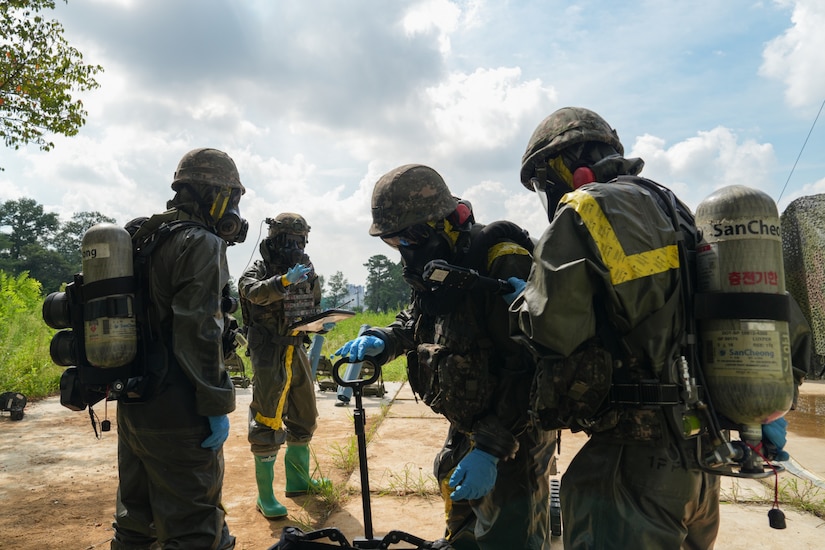
The U.S. military's premier joint task force-capable chemical, biological, radiological, nuclear, explosives formation participated in exercise Ulchi Freedom Shield 25 in South Korea, Aug. 18–28.

Soldiers and Army civilians assigned to the 20th CBRNE Command's early entry command post exercised with 8th Army and Combined Forces Command units on the Korean Peninsula and employed capabilities from their home station located at Aberdeen Proving Ground, Maryland. 

"It is always an honor to train together with our South Korean partners," said Army Brig. Gen. W Bochat, commanding general of the 20th CBRNE Command. "For more than seven decades, American soldiers have proudly defended liberty with our South Korean allies on freedom's frontier. This exercise is another chance to make one of the world's strongest alliances even stronger." 
 
Ulchi Freedom Shield 25 is a defense-oriented exercise, featuring live-fire, constructive and field training exercises that engage allied forces and governmental agencies. The training is focused on conducting all-domain operations. 
 
The annual exercise enhances the combined, joint, all-domain and interagency operating environment and the South Korea-U.S. alliance's response capabilities. 
 
Soldiers and Army civilians assigned to the 20th CBRNE Command deploy from 19 bases in 16 states to confront and defeat the world's most dangerous hazards in support of joint, interagency and multinational operations.

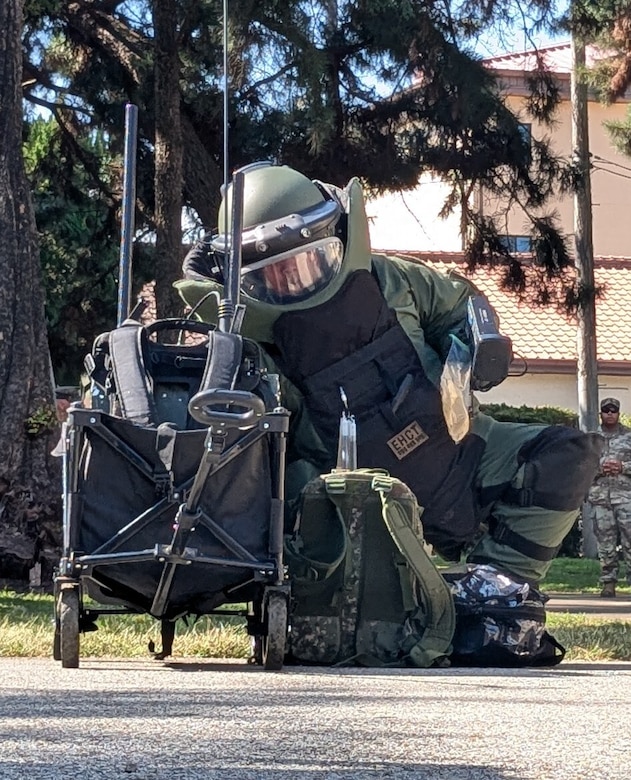
A soldier in a protective bomb suit crouches on the ground next to a backpack and roller cart. There are trees and a building in the background.
Headquartered at Aberdeen Proving Ground in northeast Maryland's science, technology and security corridor, the 20th CBRNE Command is home to the majority of the active-duty Army's CBRN specialists and explosive ordnance disposal technicians, as well as the 1st Global Field Medical Laboratory, CBRNE Analytical and Remediation Activity, weapons of mass destruction coordination teams and nuclear disablement teams. 
 
Members routinely deploy to South Korea for exercises, and the command also deploys a chemical company to support rotational forces during deployments to the Korean Peninsula.
 
The Fort Hood, Texas-based 181st Chemical Company is serving in South Korea on a rotational deployment in support of the 23rd CBRN Battalion, 210th Fires Brigade, 2nd Infantry Division/ROK-U.S. Combined Division and 8th Army. 
 
During their second deployment to South Korea in three years, the 181st Chemical Company is serving near the Korean Demilitarized Zone, the world's most heavily guarded border. 
 
The 181st Chemical Company is part of the 2nd CBRN Battalion, 48th Chemical Brigade and 20th CBRNE Command.

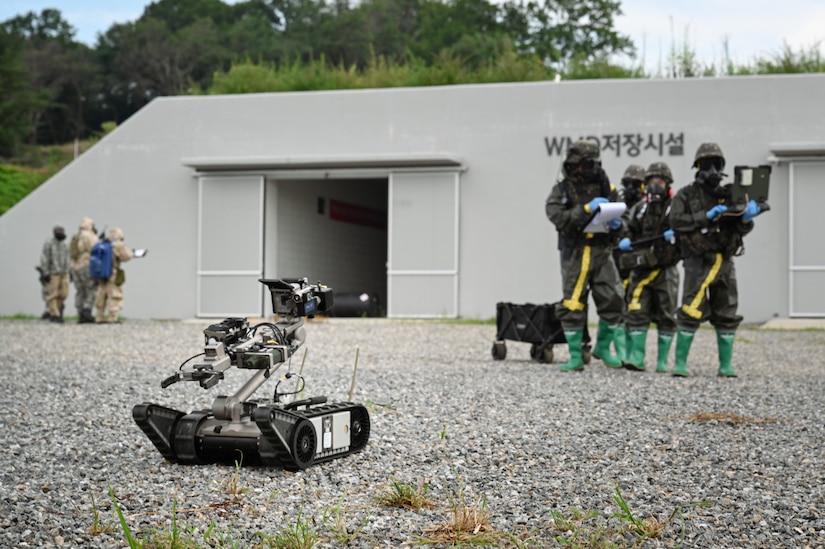
A bomb robot is rolling on the ground as four soldiers wearing camouflage military uniforms and personal protective equipment stand in the background holding laptops and other equipment. There is a large gray facility behind the soldiers.

 
Army hazardous response companies conduct CBRN reconnaissance, surveillance and decontamination operations in support of conventional and special operations forces around the world and provide support to civil authorities across the nation.

Friday, June 22, 2012

Life-saving training results in state award


By Yvonne Johnson, APG News

ABERDEEN PROVING GROUND, Md. -- The value of a life-saving program at Aberdeen Proving Ground has resulted in it being honored with a prestigious state award during National Emergency Medical Services Week in May.

The Directorate of Emergency Services' Fire and Emergency Services Division received the Outstanding EMS Program Award from the Maryland Institute for Emergency Medical Services Systems, or MIEMSS, during a ceremony at the Miller Senate Office Building in Annapolis, Md., May 22, 2012.

AWARD
During the annual Maryland Stars of Life ceremony, Dr. Robert R. Bass, MIEMSS executive director and a Fellow of the American College of Emergency Physicians, or FACEP, presented the award to APG Fire Chief Edward C. Budnick who was accompanied by Michael P. Slayman, assistant chief of EMS. They were accompanied by paramedics Michael Davis, Scott Kauffman, and John Williamson who represented the entire Fire and Emergency Services Division.

The award was for the public education initiative involving the Public Access Defibrillator Program in which military and civilian employees receive instruction in first aid, CPR, and proper use of the automated external defibrillator, known as an AED.

In 2011, APG paramedics and firefighters taught more than 2,400 students, comprising nearly 11,000 student hours, in 168 public classes and increased public access to defibrillators on post, resulting in at least two lives saved.

Slayman, who runs the program, said its success is due to the amount of responders and AEDs in place on APG -- 498 AEDs in buildings and facilities throughout APG North (Aberdeen) and South (Edgewood).

He said the public access program that started in 1996 in post gyms has evolved and grown so much in numbers that it also was nominated for the EMS Program of the Year in 2008. Two CPR/AED classes -- as they are commonly called -- are held the third Wednesday of each month. Slayman said the award speaks volumes about the students' actions as well as the instructors' commitment.

"It emphasizes the importance [of the program] to our working population on post and ensures they know how to respond appropriately during an emergency," he said, "and, it keeps my instructors motivated in a valuable program that requires a lot of additional time and work."

In addition, emergency responders record each time an AED is used and maintain statistics on the medical outcome. Slayman said the award also recognizes the statistics on patients who were previously in cardiac arrest and obtained a "return of spontaneous circulation, or ROSC.

"The national average of patients who suffer a cardiac arrest and are resuscitated in the field is only 5 to 7 percent," he said. "Due to our outstanding public education initiative, in every cardiac arrest we responded to last year, out of three cardiac arrests, ROSC was obtained on all three and two returned to work within two weeks of the incident with little to no neurological deficit."

He said all credit goes to the paramedics and firefighters who teach the programs. So far this year, 1,265 students have been trained.

"The educated public and availability of nearly 500 AEDs on post is what drives our success numbers," Slayman said, adding that the program "bends over backwards" to support APG organizations.

"We've been doing a lot with MWR and Child, Youth and School Services as well as with large organizations like ATC," he said.

More than 60 AEDs are located on the C4ISR complex, and the program even offers night classes.

"We train everybody," Slayman said. "We really understand the importance of keeping people happy and what we see in return is public support."

MIEMSS AND EMS WEEK
Each year the Maryland Institute for Emergency Medical Services Systems celebrates EMS Week by honoring men and women across Maryland who have contributed to the EMS System. The term "Stars of Life" is used because it combines the symbol, the star of life, with the shared vision, "the elimination of preventable death and disability from injury or sudden illness."

Awardees are selected by a statewide committee of career, volunteer and commercial EMS providers. The Outstanding EMS Program Award is awarded to a program that offers an innovative approach to reducing death and disability.

From Army.mil

Thursday, June 21, 2012

Face of Defense: Soldier Helps Save Virginia Trooper’s Life


By Jessica Maxwell
20th Support Command

ABERDEEN PROVING GROUND, Md., June 21, 2012 – “I knew something wasn’t right when I saw his hat on the ground.”

That was the moment late last year, Army Sgt. 1st Class Michael Kinzie recalled, when his instincts kicked into action to help save the life of Virginia State Police Senior Trooper Mike Hamer.

Kinzie, a 20th Support Command soldier here, was driving on Interstate 95 with his mother and brother on Dec. 8, 2011, heading to his wife’s graduation in Savannah, Ga., when he noticed flashing lights on an unmarked police car off to the side of the road. At the same time, his mother and brother heard a “pop, pop, pop,” and were unsure of the cause the sound.

At first glance, Kinzie believed the trooper was tugging on his seatbelt and then he noticed the trooper’s hat was on the ground.

“It seemed odd because it reminded me of a drill sergeant’s hat -- drill sergeants never put their hats on the ground,” he said.

As Kinzie looked again, it became clear that Hamer was struggling to get out of his car.

Hamer gave his version of the incident, which started out, in his words, seemingly fine. Hamer, who was working in the Fredericksburg, Va., area at the time, said he was responding to a call regarding a pedestrian on Interstate 95. Hamer found the suspect on the interstate and as they talked in Hamer’s patrol car, the man appeared to be coherent.

Suddenly, Hamer said, the suspect lunged over the patrol car’s front seat and attempted to grab his gun.

“While I was fighting back, he succeeded in getting the safety measure off the gun,” Hamer said. “That’s when the gun discharged into my leg.”

Hamer was able to reach his backup weapon and shot the suspect, who later died. He then got out of his car and managed to call for help before feeling lightheaded from the blood loss. It was then that Kinzie passed by the scene. Unable to stop due to traffic, Kinzie placed an emergency call, continued driving to the next exit, got off and turned around. During that time, two other people stopped to administer first aid to Hamer.

Because of the incident, traffic was already stopped on Interstate 95 but Kinzie said he was able to get through in order to give his statement to the officers on scene. Hamer credits Kinzie, as well as the other two Good Samaritans with saving his life.

“Because of his actions, Emergency Medical Services was able to get to the scene quickly,” said Hamer, who has fully recovered from his injuries.

For his actions, Kinzie was later awarded the Certificate of Merit from the Virginia State Troopers. In a letter written to Kinzie, the president of the Virginia State Police Association, E.J. Kelly, commended Kinzie’s unselfish actions and expressed gratitude for his service. During the award ceremony, James De Ford, the northern Virginia field lieutenant, told Kinzie the troopers were glad he happened to be driving by at that time.

“Because of you and the two other people, Trooper Hamer is alive,” De Ford said.

After accepting the certificate, Kinzie attributed his actions to his upbringing and thanked his parents for teaching him the value of helping others.

“I’m thankful I was able to do something,” Kinzie said. “I always try to put myself in the position to help others.”

Thursday, September 22, 2011

Face of Defense: NCO Heads to All-Army Golf Trials

By Yvonne Johnson
U.S. Army Test and Evaluation Command

ABERDEEN PROVING GROUND, Md., Sept. 22, 2011 – Though Army Master Sgt. Sheila Sango has golfed just eight years, she has hopes of becoming one of the Army’s elite golfers.

Sango, a career counselor with the U.S. Army Test and Evaluation Command here, was selected to compete in the All-Army Golf Trials held tomorrow through Sept. 26 at Fort Jackson, S.C.

Upwards of 30 of the Army's top golfers will compete in the trials. The top finishers from the 72-hole event will form the 2011 All Army Team, which will compete against teams from the Air Force, Navy and Marines in the Armed Forces Championship held Sept. 28 to Oct. 1, also at the Fort Jackson Golf Club.

This is Sango's second trip to the trials. She competed last year and hopes to do better.

"I didn't do as well as I can; it was a very humbling experience," Sango said. "Through the grace of God, I will do well this year."

A native of California, Sango is a 21-year Army veteran who came to Aberdeen in March from Hawaii. Sango has two combat tours in Iraq and Afghanistan and said she started playing golf while stationed at Fort Hood, Texas, after years of playing softball.

"I used to love softball, but for some reason I always enjoyed watching golf," she said.

Sango credits various coworkers who shared their knowledge of the game as she honed her skills. She said a Maryland-based nonprofit golfing organization, along with local golf club manager Rick Bond and golf pro Dave Correll, took her under their wings.

"Dave has been very valuable; he's given me great tips," Sango said. "There is no perfect swing. He takes your swing and works with that.”

Bond called Sango a great player who is driven to succeed.

"She's not just a wonderful player -- she's even a nicer person," he said. "She's a joy to be around and she has a tireless work ethic. Even if it's raining, she's out here working on her game. We're all pulling for her."

Sango said she feels her first assignment on the East Coast is not by chance.

"I just know I'm here for a reason," she said. "I've found a nice church here and a beautiful place to perfect my [golf] game.”

Sango said she loves the quiet of early-morning golf.

"There's nothing here but you and nature,” she said. “I see geese and deer, and I even saw a little fox out here. It's inspiring. So I just keep trying and trying. I know God will still love me whether I fail or succeed as long as I just don't quit."

Tuesday, August 30, 2011

Face of Defense: Vietnam Vet Regains Long-lost Bronze Star


Don't forget the sacrifices of American heroes; discover these Vietnam Veteran books where our heroes tell you their story.

By Jane Gervasoni
U.S. Army Public Health Command

ABERDEEN PROVING GROUND, Md., Aug. 30, 2011 – More than 40 years ago, Army 1st Lt. Robert C. Berkshire earned a Bronze Star Medal for valor during his service in Vietnam.

On his way stateside following his Vietnam tour of duty, Berkshire's duffel bag was stolen -- in the duffel bag was his Bronze Star. He never saw his medal again.

After his honorable discharge from the Army in 1971, Berkshire never said anything to his family or friends about the loss of his award. However, about a year ago, the subject of his military career came up while he was talking with David Kurk, a friend and fellow civilian employee in the laboratory at the U.S. Army Public Health Command here.

Berkshire told his friend about the loss of his Bronze Star and showed him the award certificate.

Berkshire explained that in June 1970 he and his platoon had flanked and destroyed an enemy position. Under heavy enemy fire, he’d also directed a medical evacuation of two wounded platoon members. Kurk was determined to see if he could help his friend be recognized for his heroic actions during the operation in Vietnam and replace his stolen medal.

Working with Berkshire's daughter, Alyson Berkshire, Kurk took action to have his friend recognized.

"No one in the family had heard about Dad's Bronze Star," Alyson said. "My parents have always been my heroes, and I wanted to make sure Dad could be honored as one."

Working with Command Sgt. Maj. Gerald C. Ecker, the Public Health Command’s command sergeant major, Alyson and Kurk provided the paperwork necessary to secure a replacement Bronze Star. Lovetta Britton, the command’s protocol officer, arranged a surprise award ceremony.

On Aug. 17, Army Brig. Gen. Timothy K. Adams, commander of the Public Health command, hosted the award ceremony to honor Berkshire's heroism. Berkshire was told his daughter was receiving an award, and that he was invited to participate in the ceremony.

During the ceremony, Adams turned to the Army veteran. "I understand you were in the Army and served in Vietnam,” he said, “and I heard that you also lost something."

Berkshire, still unaware of the surprise presentation, thought Adams was referring to his recent hip surgery and replied, "Yes, I lost a piece of my hip." Adams then told Berkshire he’d receive a new Bronze Star Medal to replace the one stolen from him more than 40 years before.

"Your service to our country should be remembered and celebrated," Adams said. "It is my privilege to give you this award for your service."

Berkshire said he was stunned by the commander's words and the standing ovation from friends, family and co-workers at the award presentation.

"For you and everyone else to work so hard in replacing the medal that was so precious to me and that I thought I would never see again, I was basically speechless," Berkshire said to the general. "Please accept my deepest gratitude for your gracious act."

Ecker summed up the event’s purpose.

"When an act of selfless service to our nation has been fulfilled, it is never too late to render honors and gratitude for the service," he said.
<><>
<>
<><>
Don't forget the history and sacrifices of American heroes; discover these Vietnam War books where our heroes tell you their story.

Wednesday, March 09, 2011

Platform Provides Collaboration Behind Firewall

By Claire Heininger
Program Executive Office Command, Control and Communications – Tactical

ABERDEEN PROVING GROUND, Md., March 9, 2011 – The Defense Department’s secure collaborative platform has expanded beyond the Army to include more members of the Navy, Marine Corps, Air Force and Coast Guard, providing behind-the-firewall access to a collection of secure knowledge management tools mirroring popular social media platforms.

DOD common access card holders can access the milSuite enterprise edition release at https://www.milsuite.mil.

The milSuite community consists of more than 140,000 individuals from the active services and DOD’s civilian and contractor work forces dedicated to a more connected military, officials said, and the change is expected to broaden the user base and facilitate joint knowledge sharing.

“People across the Department of Defense are collaborating on programs and efforts in ways that were impossible prior to milSuite’s secure, professional networking capabilities,” said Army Brig. Gen. N. Lee S. Price, program executive officer for Army tactical command, control and communications in an office known as PEO C3T. “MilSuite provides a valuable opportunity to synchronize efforts across separate services, so we can work as one.”

The secure capabilities include milWiki, a living military encyclopedia editable by subject matter experts; milBook, a professional networking tool providing communities of practice; milBlog, a place to share and comment on internal news and events; and milTube, a video-sharing capability for the military work force. The technology is similar to what users are familiar with at home: wikis, blogs, social networking sites such as Facebook, and media-sharing sites such as YouTube and Flickr.

U.S. Army Training and Doctrine Command has used milWiki to promote online collaboration of Army field manuals, allowing the knowledge and experiences of soldiers conducting operations to be rapidly incorporated into doctrine.

Users have leveraged milBook to share lessons learned and best practices on enterprisewide technologies and to bring hundreds of people into communities of practice centered on chaplaincy, medicine, tactical communications and more.

Army Maj. Jerome Scott Loring, who leads a milBook group for people who provide educational services to the Army National Guard, said the forum has connected officers across the 54 U.S. states and territories supported by the National Guard Bureau on topics such as the Post-9/11 GI Bill.

“We can post an issue, [and] people can comment, discuss [or] raise issues in a secure environment,” Loring said. “You can reach everyone in a way that doesn’t clog up e-mail in-boxes.”

MilSuite builds on the Web 2.0 model of community content and participation to streamline business processes while tapping a broader knowledge base, officials said. The tools are integrated with one another and linked by a Google search appliance so users can locate the specific resources they need.

With network firewall protection, users from all branches and organizations can share official unclassified internal information and engage in dialogue.

MilSuite is assigned to the MilTech Solutions Office, a government organization of PEO C3T.

“This is a significant development for the way we communicate across the Department of Defense,” said Emerson Keslar, director of MilTech Solutions and one of the architects of the milSuite project. “At a time when we are all focused on efficiencies, milSuite is one way we can overcome the geographic and organizational divisions of the military community to share information instantly.”

(Emily Gee, a Symbolic Systems intern who supports MilTech Solutions, contributed to this article.)

Team Focus Brings Synergy to Warfighter Support

By Donna Miles
American Forces Press Service

ABERDEEN PROVING GROUND, Md., March 8, 2011 – Not everyone at Fort Monmouth, N.J., was happy in 2005 when the announcement came down that the post would close and that most of its mission would move here as part of the Base Realignment and Closure Commission plan.

But fast-forward six years, and the new arrivals at Aberdeen Proving Ground say they’re already seeing the wisdom of the plan and its benefit to warfighters on the battlefield.

BRAC is bringing major changes to this historic post, with the exodus of the Army Ordnance Center and School and the influx of thousands of high-tech organizations that are making it a technological hub.

The largest group of new tenants hails from Fort Monmouth, former home of Army Communications and Electronics Command and Communications-Electronic Research, Development and Engineering Center. It’s made up largely of senior-level scientists, engineers, researchers, acquisition professionals and logisticians focused on developing, testing and fielding cutting-edge communications and electronics systems and equipment for the fighting force.

Before BRAC, they had been shoe-horned into more than 90 buildings scattered across Fort Monmouth. Often, they were miles away from their colleagues and relegated to substandard workspaces made available to support the expanding mission.

“There was a lot of retrofitting,” said Joe Cocco, deputy principal engineer for the project. “You squeezed into a building and made that building fit the mission, or maybe you spread the mission over three or four different buildings. Each organization was in their own building or own area of a building.”

BRAC promised to change all that, bringing together these functions at Aberdeen Proving Ground and organizing them in a way that threw traditional organizational charts out the window.

In addition to the Fort Monmouth activities, the state-of-the-art campus built to support their activities also would bring together other key partners in their mission that previously had been based at Redstone Arsenal, Ala., Fort Huachuca, Ariz., and Fort Belvoir, Va.

Collectively, they would be called the “C4ISR Materiel Enterprise” -- for Command, Control, Communications, Computers, Intelligence, Surveillance and Reconnaissance. And as they began moving into their new “C4ISR Center of Excellence” here, they were organized more like a private-sector corporation than a military organization.

Team C4ISR is built around “business domains,” each focused on a different project or program, Cocco said. “Within each of those domains are several of the organizations, all mixed in each of the buildings and working together as an enterprise.”

“A domain is built around a single product development line,” such as a new radar system, explained Army Col. Andrew Nelson, deputy garrison commander for transformation. “Components of all those elements that support the mission are in there, all now clustered around their common laboratory.

“They work for three different bosses, but they are all working on the same domain – the same product – with the same objective to produce the next version of that radar or radio system,” he added.

That’s a whole different way of doing business than what the staff had at their previous posts. “In the old scenario, they were all separated,” said Army Col. Bill Montgomery, CECOM’s chief of staff. “The engineers were in one building. The safety people were in another. The project managers were in another building. That worked OK. But imagine if you got those entities together in a room. Think of the difference that could make.”

Nelson agreed. “That’s the beauty of what’s happening here using the domain concept,” he said. “You get the synergy of various team members, all working together with a common objective. It’s a big improvement over how they did business before.”

It also speeds up the process that gets new systems and equipment to the field, Montgomery said. “When you bring the different people involved [in a program] around the table, with all of them contributing their own experiences and expertise, it helps us get things done quicker, because you are not going through four or five different offices in different buildings,” he said.

With more than half of the C4ISR team’s 7,200 employees already settled into their new campus here and the rest to follow before the congressionally mandated Sept. 15 deadline, Montgomery said he’s already seeing clear indications the new organization is working.

Employees are enjoying the bright, open spaces of the new C4ISR campus that rivals the most modern corporate technology parks, he said. The environmentally friendly buildings are built around courtyards and green space that even includes a grass-covered auditorium.

And no longer are C4ISR staffers relegated to cramped workspaces. When the second phase of the project is completed in the next month or so, the full complex will include 2.5 million square feet of new space spread across 13 buildings.

But selling the new facility -- and the move to Aberdeen -- wasn’t necessarily an easy task. Shortly after the BRAC decision, Cocco traveled to Aberdeen to walk the grounds that would become the new C4ISR campus. He was part of a team that worked tirelessly with planners at both Fort Monmouth and Aberdeen Proving Ground to sort through the thousands of tiny details involved in building a first-class new facility, and moving an entire operation without disrupting its immediate wartime support role.

As construction continued on the new complex, Cocco hosted numerous bus trips so Fort Monmouth employees could see Aberdeen Proving Ground and its surrounding communities. Most of all, Cocco said, he wanted them to see the buildings being readied for them and entice them to make the move to Aberdeen.

Ultimately, about half of the Fort Monmouth work force opted to do so – far more than the 20 percent typical of previous BRAC moves, Nelson said.

While many of the C4ISR employees have relocated to Maryland, some have retained their New Jersey residences and commute between the two states. Among them is Richard Wittstruck in the office for intelligence, electronic warfare and sensors, who commutes four and a half hours, roundtrip, between his home and Aberdeen Proving Ground.

Living through his second BRAC – the first took him from Maryland to Fort Monmouth -- Wittstruck said he’s worked hard to ensure his people understand that closing Fort Monmouth was strictly a business decision.

“BRAC is a very personal thing,” he said. “The first thing you have to do is convince the work force that it’s not a reflection of their performance. It’s not as if they failed at their mission and were closed.”

Wittstruck credited the efforts planners made to retain employees, recruit new ones to replace those who opted not to move to Aberdeen, and provide the infrastructure to support them at their new post.

Already, he said he sees the payoff in being able to coordinate activities across functions, with people able to step outside their offices rather than running across an installation to collaborate with their colleagues.

“There is going to be an intangible difference in the type of synergy and interaction that you are going to see,” he said. “But to be practical, it is going to take time. It is going to take time to synthesize and synergize that.”

As that evolution takes place, with C4ISR employees sharing spaces at their new desks and laboratory facilities, or gathering at food courts expected to open in the coming months, Montgomery said, they’ll help to transform the way the Army does business.

“This is huge,” he said. “We’re getting back to the way things used to be done, which is just talk to each other” rather than relying on telephones and e-mail.

“This new facility and organization really gives us the capability to get together and talk around the table and discuss the work we’re doing,” he said. “And ultimately, that’s going to have a huge impact on how we support the warfighter.”

Monday, March 07, 2011

BRAC Transforms Aberdeen Proving Ground Mission

By Donna Miles
American Forces Press Service

ABERDEEN PROVING GROUND, Md., March 7, 2011 – With just over six months left to implement the Base Closure and Realignment Commission plan, the sweeping transformation it has sparked here is well under way and slated to be completed on time and under budget, officials reported.

The BRAC plan took effect in November 2005, and impacts more than 800 military installations. It involves closing some, consolidating or realigning others, and ultimately relocating some 123,000 military members and civilian employees. By law, all these actions must be completed by Sept. 15, 2011.

The plan is bringing major growth to Aberdeen Proving Ground -- more than 6,500 people and more than $1 billion in new construction to accommodate the new workers, Army Col. Orlando W. Ortiz, the garrison commander, told American Forces Press Service.

But it’s also bringing a fundamental change to the post’s historic mission, and how the Army ensures its warfighters have the most advanced equipment and systems possible to succeed on the battlefield.

The U.S. Army Ordnance Center and School, the major tenant that defined Aberdeen Proving Ground’s very identity for nearly a century, already has moved to Fort Lee, Va. There, it is part of the new Sustainment Center of Excellence, another BRAC initiative.

As officials here closed a page on their post’s legacy, they were busy preparing to open an exciting new one that would transform the installation into a hub of cutting-edge communications and electronics technology.

Aberdeen Proving Ground has long been heavily involved in the Army’s research, development, testing and evaluation mission, explained Army Col. Andrew Nelson, deputy garrison commander for transformation. But by consolidating many disparate and geographically separated organizations that supported those processes here at one post, BRAC is “bringing it to the next level,” he said.

“Aberdeen Proving Ground has been, but will be to a greater extent, one of the Army’s major hubs of research and development of new technologies, and the testing and evaluation of those new technologies that lead to fielding new systems to support the warfighter,” Nelson said.

“This is the center of all of that -- the technology development that is leading to soldiers being better equipped and better supported in the operational environment where they are,” he said. “It’s the clothes they wear, the radios they speak through, the computer system that tracks where individual vehicles and soldiers are on the battlefield, to having [unmanned aerial vehicles] that give them the best intelligence of what the enemy is doing.

“That is what Aberdeen Proving Ground already is, and what it will be about,” Nelson said. “Everything we do here is all about ensuring that the individual soldier and the combat leader have the best possible equipment and systems and technology that is giving them the advantage on the battlefield.”

The biggest group of new arrivals to support this expanded mission is a collection of activities referred to as “the C4ISR materiel enterprise” that focuses on command, control, communications, computers, intelligence, surveillance and reconnaissance.

The lion’s share of its 7,200 people are coming from Fort Monmouth, N.J., which is closing under BRAC and transferring most of its functions to Aberdeen. The new arrivals hail from Fort Monmouth’s Communications and Electronics Command and Communications-Electronic Research, Development and Engineering Center and several of their program executive offices. Others are arriving from related activities at Redstone Arsenal, Ala.; Fort Huachuca, Ariz.; and Fort Belvoir, Va.

CECOM established a forward presence at Aberdeen in 2007, and officially uncased its colors here in October 2010. A steady stream of its workforce began arriving this past summer, some directly from Fort Monmouth, some from temporary swing space at Aberdeen and others, new hires replacing workers who chose not to relocate.

Today, about 60 percent of the new C4ISR team already has made the move to Aberdeen Proving Ground, settling into the state-of-the-art research and development campus known as the “C4ISR Center of Excellence.”

Meanwhile, construction crews are putting the finishing touches on the second phase of the C4ISR project, which Nelson said is expected to be completed this month or next. The entire C4ISR complex, once complete, will include 13 buildings and more than 2.5 million square feet of new space.

The next-largest group of newcomers to Aberdeen, numbering just over 600, hails from the Army Test and Evaluation Command headquarters and Army Evaluation Center, both in Alexandria, Va. While construction was wrapping up on its new headquarters, Army Maj. Gen. Genaro Dellarocco opted to move directly to Aberdeen, rather than temporarily to Alexandria, when he assumed command in October. Working in swing space at Aberdeen, he’s paving the way for the rest of the headquarters elements to follow, while supervising subordinate commands that were already based at Aberdeen when the BRAC recommendations were announced.

In addition, BRAC is consolidating a variety of other organizations at Aberdeen. These include the Joint Program Executive Office for Chemical and Biological Defense from Falls Church, Va.; Air Force Non-Medical Chemical-Biological Defense Development and Acquisition, from Brooks City Base, Texas; the Walter Reed Army Institute of Research from Forest Glen, Md., the Army Research Institute from Fort Knox, Ky., and the Army Research Laboratory’s Vehicle Technology Directorate from Langley, Va., and Glenn, Ohio.

The BRAC initiative also has brought a broad range of defense contractors to Aberdeen Proving Ground, where many are operating in a new 416-acre complex just outside the gate.

Ortiz credited detailed planning that started before the ink had even dried on the BRAC 2005 recommendations with ensuring the post is ready to receive the new arrivals.

The planners worked closely with inbound organizations to identify their exact requirements, and with state and local officials to ensure surrounding communities were prepared for the influx.

And, able to take advantage of an economic slump that made bidding on the 17 major construction projects required at Aberdeen Proving Ground highly competitive, they realized huge cost-savings in implementing BRAC.

“In our fiscal year 2010 program, we were awarding contracts at 60 to 70 percent of what the government estimate was [in 2005],” Nelson said. “That’s a big savings, money the Army didn’t have to invest here.”

The first major construction project, a new gate with five vehicle inspection lanes, was completed in May 2009. As the other projects took shape around the installation, less obvious to casual observers were the tremendous infrastructure improvements required to support them. These included multiple-lane gate accesses, roadways, water, sewer and electrical line and miles and miles of fiber optic cabling.

Exciting as these new developments are, Ortiz said he’s made a concerted effort to ensure Aberdeen’s 70-plus previous tenants don’t get short shrift.

“We don’t want haves and have-nots,” he said.

So the post has undertaken a massive plan to upgrade existing facilities and demolish many of its old World War I- and II-era buildings. Ultimately, plans call for demolishing 188 facilities and 775 housing units over the next five years. As these efforts continue, Nelson said he expects lots of activity at Aberdeen during the spring and summer months as workers move into new or renovated facilities. July is expected to be particularly busy.

With the clock ticking down, Ortiz said he’s confident Aberdeen Proving Ground is on track to fully comply with the Sept. 15 BRAC deadline.

“We’ve already integrated a sizeable number of the new workers and the buildings that aren’t already completed are very far along,” he said. “The conditions are pretty well set.”

The plan is going so well, in fact, that Ortiz expects Sept. 16, the first workday after the BRAC deadline, to be “just another day at work” at Aberdeen Proving Ground.

“I honestly do not believe that on Sept. 16, folks are going to notice anything different,” he said. “As the locals will tell you, for us, BRAC has already happened. The magic of that Sept. 15 date has long come and gone.”

So instead of fixating on the BRAC deadline, Aberdeen Proving Ground is focusing on its new, expanded mission, Ortiz said.

“What we’re focusing on is the future,” he said.”That’s where we really need to go.”