Friday, September 08, 2017

Northcom Supporting Hurricane Irma Response


PETERSON AIR FORCE BASE, Colo., Sept. 8, 2017 — U.S. Northern Command is fully engaged with federal, state, territorial and international mission partners as the command continues its planning, pre-positioning and initial Defense Department response efforts for Hurricane Irma.

The amphibious assault ship USS Wasp, located near the U.S. Virgin Islands, is conducting medical evacuations for critical care patients from St. Thomas to St. Croix and performing damage assessments in support of the local government. They also are transporting people and supplies to the affected areas with medium and heavy lift helicopters.

Crews have so far conducted six search and rescue missions and evacuated about 21 patients, with another 23 patients planned for evacuation today.

The amphibious assault ships USS Kearsarge and USS Oak Hill, carrying Marines assigned to the 26th Marine Expeditionary Unit, are approaching the disaster area and will be postured north of St. Croix, ready to provide assistance to the Federal Emergency Management Agency. The ships have rotary-wing assets to provide search and rescue support and personnel transportation.

The Air Mobility Command has dispatched C-17 Globemaster III aircraft carrying all-terrain vehicles, forklifts, Humvees, pallets of supplies and crew -- including contingency response and medical personnel -- are supporting ongoing relief efforts in St. Croix and St. Thomas.

Northcom is providing urban search and rescue capabilities to the U.S. Virgin Islands and Puerto Rico to assist with lifesaving and life-sustaining efforts.

DoD is also leaning forward to support states that may be impacted by Hurricane Irma. The Defense Logistics Agency is providing about 50,000 gallons of unleaded gasoline and 50,000 gallons of diesel to Robins Air Force Base, Georgia, in support of potential requirements.

Northcom strongly recommends for those who may be affected by Hurricane Irma to listen and adhere to the guidance given by local authorities.

Conference Attendees Discuss Indo-Asia-Pacific Regional Security


By Navy Petty Officer 2nd Class Robin Peak U.S. Pacific Command

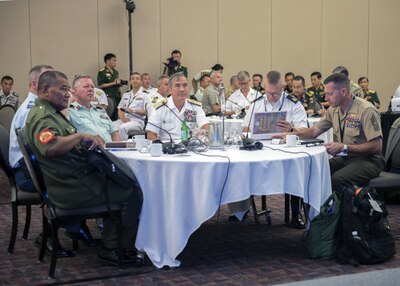
VICTORIA, British Columbia, Sept. 8, 2017 — The recently concluded annual U.S. Pacific Command Chiefs of Defense Conference, this year co-hosted by Canada and the United States, provided a forum for 26 senior Indo-Asia-Pacific military leaders to strengthen military-to-military relationships, discuss common defense issues and foster regional cooperation.
Senior military leaders, including Navy Adm. Harry B. Harris, commander of U.S. Pacific

The conference was held here from September 4-6. Topics of discussion included the threat from North Korea, trends in the Indo-Asia-Pacific area, combating and preventing violent extremism and peace support operations.

"We share many challenges in the Indo-Asia Pacific, but through bilateral and multilateral engagements like these and cooperation with other nations in the region, I am confident that when we face these challenges together, we will prevail together,” said Navy Adm. Harry B. Harris, Pacom’s commander.

Canadian Army Gen. Jonathan H. Vance, chief of the defense staff, said he was honored to co-host this year’s conference with Harris.

Defense, Security Issues

“This was the first time the event was held in Canada, and I want to sincerely thank the organizers for their hard work in making it a success,” Vance said. “This was an excellent opportunity to discuss a wide range of defense and security issues with our Asia-Pacific partners, which only serves to enhance security and confidence in the region."

Senior enlisted leaders also came to the conference to discuss ways to bolster and promote leadership in the enlisted ranks.

“A vested enlisted force, developed through programs of merit, can more precisely understand, translate and transmit the commander’s intent, which allows the commander more strategic bandwidth during operations,” Marine Corps Sgt. Maj. Anthony A. Spadaro, Pacom’s senior enlisted leader, said during one meeting.

Topics discussed by the senior enlisted leaders’ portion of the conference included the importance of noncommissioned officer development and multilateral training opportunities between partner nations.

Senior Enlisted Leaders

The group consisted of sixteen senior enlisted leader representatives from throughout the Indo-Asia-Pacific region. Spadaro said he hopes to increase that number to twenty members for the 2018 CHODS conference.

With allies and partners, Pacom is committed to enhancing stability in the Indo-Asia-Pacific region by promoting security cooperation, encouraging peaceful development, responding to contingencies, deterring aggression, and when necessary, fighting to win. This approach is based on partnership, presence, and military readiness.

“I was extremely pleased to talk with so many of our allies and partners in the region this week to enhance our military relationships, regional collaboration and discuss our shared security concerns,” Harris said.

Military Logisticians Prepare for Hurricane Irma


By Army Sgt. Debra Cook 107th Mobile Public Affairs Detachment

ST. AUGUSTINE, Fla., Sept. 8, 2017 — Florida Gov. Rick Scott declared a state of emergency on Labor Day in anticipation of Hurricane Irma's pending arrival, and while communities began stocking up on food and water, Florida’s Army and Air National Guard were already activating military personnel.

Assembling Troops, Equipment

Soldiers belonging to a variety of Florida National Guard units began to report to their unit armories. It is during these early moments, when the National Guard G4, which functions as the logistics department of the Florida National Guard, implements its contingency planning and is a key department in supporting contingencies -- including natural disasters brought on by hurricanes.

"The primary mission of logistics is all-encompassing,” said Lt. Col. Blake Heidelberg, the Florida Army National Guard's G4 Defense Support of Civil Authority coordinator. “We have to be positioned and prepared to support the entire Florida National Guard, to include the Air National Guard, in order to sustain long term in austere environments.”

After the storm passes, the Florida National Guard will work with the state’s civilian authorities to work rescue and recovery operations. Logistical staging areas and points of distribution will be set up, military personnel put in place, and supplies delivered.

Many Unknowns

“In a hurricane, there are so many unknowns. Where will it impact? What will the short- and long-term damage be? The mission is to plan and support every potential outcome," Heidelberg said. "Much of the coordination can't take place until the storm has passed."

Water, food, diapers, and tarps are just a few of the items that are coordinated and provided to displaced families. Military personnel also assist local law enforcement to provide security and assist local communities by clearing downed trees from routes so that first responders can travel unhindered and families can safely return home without concern of additional damage to homes and property.

"A natural disaster or catastrophic event usually results in significant impacts over an extended period of time. It overwhelms state and local communities while almost immediately exceeding resources,” said Deputy Chief of Logistics, G4, Army Col. Frank A. Zenko. “As logisticians, it is imperative to anticipate needs and then pre-position equipment and supplies in order to rapidly respond to areas impacted by the storm."