Monday, December 14, 2015

Chairman’s USO Tour Puts Overseas Bases in Spotlight


By Jim Garamone DoD News, Defense Media Activity

WASHINGTON, December 14, 2015 — The spotlight shone on entertainment and sports celebrities last week as Marine Corps Gen. Joseph F. Dunford Jr., chairman of the Joint Chiefs of Staff, hosted a USO tour to various overseas bases.

But the tour also provided an opportunity to shine the spotlight on the service members who do the day-to-day work for the U.S. military mission at Sigonella Naval Air Station, Italy; Camp Lemonnier, Djibouti; Bahrain Naval Support Activity; and Ramstein Air Base, Germany.

Naval Air Station Sigonella

Mount Etna overlooks this base on the eastern side of Sicily. Americans call the base “the Hub of the Med,” given its strategic location. The base was an important part of the Cold War infrastructure, with its P-3 Orion maritime surveillance aircraft keeping watch from the skies for Soviet submarines. Sigonella’s strategic importance declined after the fall of the Soviet Union, and many people in Italy and the United States believed the U.S. presence would dwindle.

And then came the Arab Spring, said Navy Capt. Christopher Dennis, the U.S. commander of the base.

“Sigonella is perfectly positioned for actions in North Africa and the Eastern Mediterranean,” he said. “It is central to so many crucial areas.”

Sigonella played a part in the NATO operation over Libya, and its anti-sub mission continues as the base will soon begin operating P-8 Poseidon aircraft. In addition, there is a growing intelligence, surveillance and reconnaissance effort at the base with Global Hawk and Predators. The base also hosts a portion of the special purpose Marine air-ground task force that responds to crises in Africa.

There are now more than 4,000 sailors, airmen and Marines at the base, and they are busy, Dennis said.

Camp Lemonnier

When U.S. Army engineers first arrived at Camp Lemonnier in 2002, it had been out of use for years, and goats roamed the site. Originally a French base, the area had been stripped of anything useful. But geography is destiny, and Djibouti occupies key terrain on the Strait of Bab al Mandab at the mouth of the Red Sea. Camp Lemonnier is the only U.S. base on the African continent and comes under the command of U.S. Africa Command, while supporting elements operating in U.S. Central Command’s area of operations.

“We’re in Africa, but the Arabian Peninsula is right across the Bab al-Mandeb Strait, [and] we’re on a religious fault line between Christianity and the Islamic community,” said Army Maj. Gen. Mark Stammer, the commander of Combined Joint Task Force Horn of Africa.

While there is some spillover from the conflict in Yemen, the biggest terrorist threat comes over land from Somalia in the form of al-Shabab, the general said. “While al-Shabab’s strength and ability to project are waning, they still have intent and capability to harm us,” he said. “I don’t believe they have the ability to wage a long campaign, but they can definitely hurt people, as they have demonstrated in Somalia.”

About 4,000 U.S. service members are based at Camp Lemonnier at any one time. Most are involved with building partner nation capabilities and capacities. Other units provide intelligence, surveillance and reconnaissance capabilities and special operations support.

Naval Support Activity Bahrain

The U.S. Navy has had a presence in Bahrain since World War II. The Persian Gulf kingdom is home to the headquarters of the U.S. 5h Fleet, U.S. Naval Forces Central Command and the Combined Maritime Forces multinational naval partnership. The base is a logistics and command and control hub for naval forces operating in the U.S. Central Command area of operations, Centcom officials said.

Vessels ranging from patrol craft and mine countermeasure craft to Nimitz-class aircraft carriers dock in Bahrain. The U.S. Coast Guard maintains a cutter in the area. It is a base dedicated to maintaining freedom of navigation in a sea through which flows a large percentage of the world’s oil.

And across the Persian Gulf lies Iran. The grey-hulled U.S. Navy ships share the sea lanes with dhows, supertankers, Iranian navy vessels and Iranian Revolutionary Guard Corps vessels.

It would be extremely difficult for U.S. naval forces to operate in the Persian Gulf without a base like NSA Bahrain, officials said.

Ramstein Air Base

Located in Rheinland-Pfaltz, Ramstein lies at the center of a concentration of about 56,000 American service members, Defense Department civilians and their families. Anyone assigned to operations in U.S. European Command, U.S. Africa Command or U.S. Central Command is affected by what happens at the base, said Air Force Brig. Gen. Ty Thomas, the commander of the 86th Airlift Wing at the base.

At the height of the Cold War, with almost 400,000 Americans based in Europe, Ramstein was a fighter base housing F-4 Phantom II fighter aircraft. Remnants of the hardened hangars still dot the base. Now, Thomas says, the base is the hub for aircraft supporting European Command, Africa Command and throughput to Central Command. It is also the headquarters for U.S. Air Forces in Europe and U.S. Air Forces Africa. The base is also a communications center for the American military.

Nearby is the Army’s Landstuhl Regional Medical Center. As a base, Ramstein proved its worth during the Cold War. It is doing so again in the face of Russian actions in Crimea and Ukraine. At the height of operations in Iraq and Afghanistan, the apron at the base was loaded with C-5 Galaxy and C-17 Globemaster III transport aircraft coming from and going to the battlefield.

“It’s an irreplaceable bit of infrastructure,” Thomas said.

Dunford led the 2015 USO Holiday Show, which included actor/director/producers Elizabeth Banks and David Wain, singer Chris Daughtry, singer/songwriters Kyle Jacobs, Brett James and Billy Montana; comedian Sydney Castillo and Red Sox baseball players Steve Wright and Heath Hembree.

Dunford Discusses Implications of Current Security Environment


By Jim Garamone DoD News, Defense Media Activity

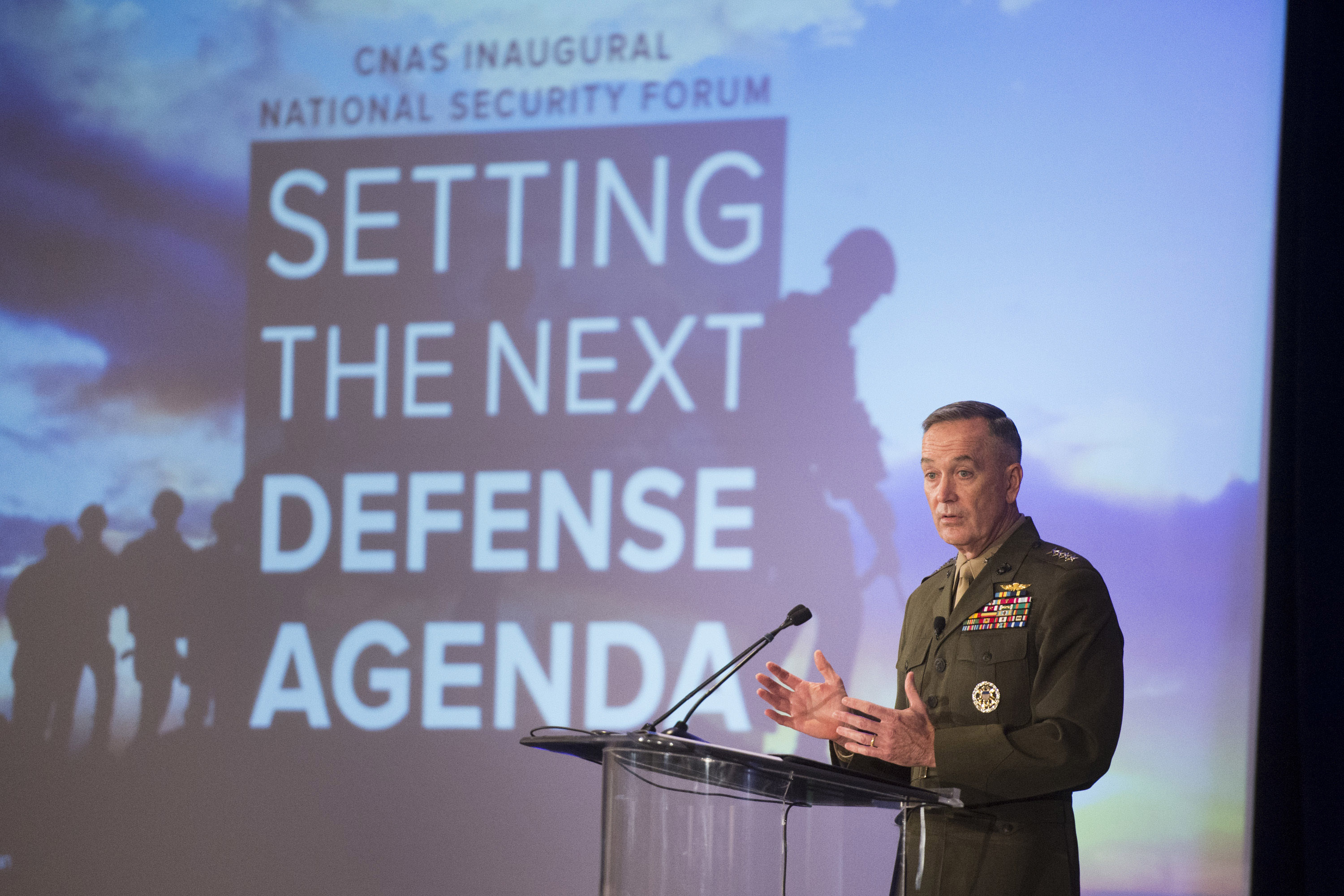
WASHINGTON, December 14, 2015 — The chairman of the Joint Chiefs of Staff discussed his short-term priority – defeating the Islamic State of Iraq and the Levant – and provided insight into his long-term goals during a talk at the Center for a New American Security here today.

Marine Corps Gen. Joseph F. Dunford Jr. spoke about the security environment and its implications on the force of the future and also spoke about joint force organization.

Current trends indicate any conflict in the future will be transregional, multidomain and multifunctional, the chairman said.

“When I look at information operations, cyber capabilities, space and counter-space capabilities, ballistic missile technology – they have all affected the character of the modern battlefield,” the general said. “And we see such capabilities fielded by both state and nonstate actors.”

The North Korean Challenge

An example of the changes these technologies have wrought is North Korea, Dunford said, noting that in the past, military planners believed any conflict would be confined to the Korean Peninsula. “But as North Korea developed ballistic missile technology, that obviously affected other regional actors, such as Japan,” he said.

Today, with ICBMs, cyber, information operations and more, “it’s pretty hard to see how even a conflict on the peninsula would be anything but transregional, multidomain and multifunctional,” the chairman said.

Current planning, organizational constructs and command and control set-ups “is not optimized for that fight,” he added.

U.S. military planning is done regionally and commanders rely on cooperation and collaboration, the chairman said. “It may surprise you to know this, but the lowest level of integration in the Department of Defense really is the secretary of defense,” he said. “That’s an issue that’s on the top of my inbox. That’s an issue that I am taking a look at hard.”

No Slowing Down

Underlying everything are the people of the U.S. military, the chairman said, noting that he returned from a trip last week in which he visited with service members in U.S. European Command, U.S. Africa Command and U.S. Central Command. “I saw a large number of soldiers, sailors, airmen and Marines, and they are in great spirits. … The closer I got to the fight, the more spirited they were. They are focused and proud about what they are doing,” he said. “I don’t take that for granted. The one thing I am mindful of as I come into the job is that we have been running pretty hard for a long period of time.”

The challenges of the world mean they won’t get a rest soon, Dunford said.

“I told them I can’t see a time where that dynamic is going to change,” he explained. “If our requirements continue to be what I believe they will be, and the force structure stays about what it is today, … we are going to be running hard for some time to come.”

Measuring Joint Readiness

The general said he is looking at new ways to measure joint readiness, and that people should expect a new way of looking at the concept after the first of the year.

“It isn’t just the readiness of our individual units and the parts and pieces,” he said. “It’s making sure we have the right inventory, and also making sure on a day-to-day basis we are postured to respond in a timely manner.”

The fight against violent extremism is a transregional conflict, the chairman said. Still, he added, the Defense Department’s portion of the nine lines of effort are focused on destroying core ISIL in Syria and Iraq, and the U.S. military does this by striking ISIL leaders and fighters. “The second critical element is to develop and support effective partners on the ground to seize and secure ISIL-held terrain,” he said.

Dunford came to the venue straight from a meeting with President Barack Obama and the rest of the National Security Council at the Pentagon. “I want to make it clear that within the framework of international and domestic law, our policies and our end state, I don’t personally feel at all inhibited in terms of making recommendations to the president,” he said. “And we will continue to do that.”

Syria, he said, is the bigger challenge, because there is no partner on the ground. The Iraqi security forces and Kurdish peshmerga provide allies to take and control terrain inside Iraq. Dunford did say he understands how much more needs to be done, but that he is encouraged by operations against ISIL.

Concerns Over State Actors

However, the chairman said, the threat from extremists, while pressing, is not the only security challenge. The capabilities and behaviors of four state actors– Russia, China, Iran and North Korea – must inform U.S. contingency plans, he said.

“Despite its declining population and shrinking economy, Russia has made a significant investment in its military capabilities,” the chairman said. Russia has fielded new ICBMs, aircraft, new submarines, tanks and air defense systems. The nation is also expanding capabilities in space and cyberspace. As you look at Russian capability, you have to look at it in the context of what they have done in Crimea, Ukraine and Syria.”

Dunford then turned to China, saying the emphasis is to cooperate with the rising giant. “We also – and we get paid to do that – watch closely the developments in their military capabilities and their behavior in the South China Sea,” he said.

Iran and North Korea are exporters of instability who continue to look for new ways to threaten neighbors, the chairman said.

All of these challenges have implications for the future joint force, he said, and the first is foundational.

“We need a balanced inventory of joint capabilities that’s going to allow us to deter and defeat potential adversaries across the range of military operations,” he said. “We don’t have the luxury to have a choice between a force that can fight the current fight against violent extremism and one that can deal with the full range of challenges.”

The second implication is to define how to use the military instrument of power in the “gray zone” of cyberspace, he said.

“I believe we need to develop more effective methods to deal with challenges like Russia’s ‘little green men’ or Iranian malign influence,” he said. “Our traditional approach – where we view things either as at peace or at war – may not be the case for our adversaries.”

On cyber, Dunford called for more offensive cyber capabilities and cyber deterrence.

Chinese Navy Ships to Visit Hawaii Sunday


By Naval Surface Group Middle Pacific Public Affairs

PEARL HARBOR-HICKAM (NNS) -- Three People's Liberation Army-Navy [PLA(N)] ships are expected to visit Joint Base Pearl Harbor-Hickam Dec. 13-17.

CNS Jinan (DDG 152), CNS Yiyan (FFG 548), and CNS Qiandaohu (AOE 886) are expected to arrive in the morning Dec. 13. This routine port visit will give Chinese sailors an opportunity to interact with their U.S. counterparts and demonstrate parity and reciprocity between two maritime nations.

Foreign Navy ships come to Pearl Harbor-Hickam regularly for scheduled port visits. In recent months Pearl Harbor-Hickam was visited by the PLA(N) ship Zheng He, by a ship from Bangladesh, and several times by Japan Maritime Self-Defense Force vessels.

As part of a planned series of military-to-military exchanges between the two nations, the ships will be hosted by USS Preble (DDG 88), USS Chosin (CG 65), and USS Chung-Hoon (DDG 93). Chinese and U.S. naval officers will conduct dialogues to build confidence and mutual understanding.

The Chinese ships will be met by Rear Adm. John Fuller, commander of Navy Region Hawaii, Capt. Stanley Keeve, commander of Joint Base Pearl Harbor-Hickam, and Capt. Kevin Brand, commanding officer of USS Chosin.

American and Chinese sailors plan to engage in deckplate level events including touring each other's ships and participating in sporting activities. Receptions aboard the PLA(N) vessels and USS Preble are also planned.

The last port visit by PLA(N) ships to Pearl Harbor-Hickam was in October 2015.

The U.S. Navy is committed to continued engagement to improve mutual understanding, build trust, enhance transparency, and reduce the risk of misperceptions and miscalculations.