Monday, December 14, 2015

BEMR: A New Reality for the Future Force


By David Smalley, Office of Naval Research

ARLINGTON, Va. (NNS) -- New virtual-reality capabilities emerging at the Battlespace Exploitation of Mixed Reality-or BEMR-Lab, in San Diego, California, will make dramatic impacts across the Navy and Marine Corps, officials announced Dec. 10.

Advancements included affordable virtual training, data assessment, firing of weapons and even basic concepts of operations.

The program is sponsored by the Office of Naval Research (ONR) and developed at the Space and Naval Warfare Systems Center, Pacific (SSC Pacific).

Viewers can get an inside look at some of the technology in a new video from ONR at https://youtu.be/rLDqcNAyVm8.

"The BEMR Lab is a constellation of technologies in augmented and virtual reality," said Karl Van Orden, senior technologist at the BEMR Lab. "It's a place where we can explore how to exploit those technologies in our warfighting systems."

When people think of virtual reality, many imagine Tony Stark from the "Iron Man" movies, hands raised and moving virtual displays projected in front of him. While that might be fanciful now, Navy engineers are working hard to develop such capabilities.

Virtual reality (VR) describes a scenario where a participant is completely immersed in a simulated/virtual world. Augmented reality (AR), by contrast, is used to describe a state where virtual objects are imposed onto real-world vision, like the yellow lines superimposed on televised sports.

When these technologies are merged, and one can easily jump between states of virtuality, it's called Mixed Reality, or MxR.

As the video shows, the BEMR Lab team believes this technology is ready now. Their vision: The future force will soon train and operate in very different ways.

"What mixed reality is all about is immersion-you want to get the warfighter feeling like he's really in the space," said BEMR Lab lead Heidi Buck.

Importantly, advanced VR and AR capabilities will utilize the skills of young Sailors and Marines.

"The modern naval force has grown up with computers at home, video games, arcades and head-mounted displays in their personal life," noted Dr. Lawrence Schuette, director of research at ONR. "Coming to float and seeing it onboard ship is just a logical extension."

Senior naval leadership has called for increased use of technological advances. In a recent address at the Reagan National Defense Forum, Chief of Naval Operations Adm. John Richardson said, "It's about the team that can bring the people, the technology and the processes together to learn the fastest-that's the team that has the advantage."

Virtual technologies could result in significant cost savings-for example:

-Training: Where the warfighter might currently need to fly to a specific spot for training, he or she could don the MxR gear and "be there" virtually, completing training at a fraction of the cost.

-Maintenance: MxR technologies can have a subject matter expert "standing" next to Sailors or Marines as they troubleshoot a difficult problem-even if the expert is on the other side of the world.

-Operations: MxR technologies will give operators views never before seen, with striking fidelity, to execute missions to exacting standards.

And the BEMR Lab team is utilizing low-cost, commercial-off-the-shelf technologies, like Oculus Rift VR goggles.

The effort ties in to the Naval S&T Strategy, which calls for leveraging advancements in a "rapidly changing landscape of new technologies."

Strike Eagles vs. Typhoons: exercise brings aircraft together

by Staff Sgt. Emerson Nuñez
48th Fighter Wing Public Affairs


12/9/2015 - ROYAL AIR FORCE LAKENHEATH, England  -- Iron sharpens iron; the same could be said for fighter jet pilots seeking new ways to improve their skills to deliver decisive combat air power.

Fighter pilots from Royal Air Force Coningsby and the 494th Fighter Squadron partnered up for dissimilar air combat training, here, Dec. 7-8, 2015.

The training session consisted of mock air to air combat fights where in this case, both aircrafts went up against each other to test each other's and their own capabilities. The aircrafts had a certain amount of mock ammunition per separate engagement and each pilot would call out on the radio whenever they were "hit".

"It's great practice for both parties to go against a different aircraft," said a Typhoon evaluator pilot from the 41 Typhoon Test and Evaluation Squadron. "The F-15 gets an opportunity to fight a superior performing threat, and we get to fight against a very capable weapons system and highly maneuverable missile."

Training with RAF jet fighters not only sharpens combat skills, but strengthens host nation partnerships for future integration.

"They reached out to us for some dissimilar flights and it's something we definitely wanted to do," said Capt. Joseph DiCocco, 494th FS weapon systems officer. "We want to integrate more with our host nation partners, so when we saw the offer, we snatched it up."

Exercises like these accomplish multiple goals for both parties involved.

"It's a lot of fun and a lot of learning at the same time," DiCocco said. "Definitely beneficial for both sides seeing a different side of how to fight in the air. We would definitely be happy to do this again. "

Liberty Wing remains Forward, Ready, Now with Expeditionary Active Shooter training

by Senior Airman Dawn M. Weber
48th Fighter Wing Public Affairs


12/9/2015 - ROYAL AIR FORCE LAKENHEATH, England  -- The hallways echoed with the sounds of gunfire. Airmen scrambled for shelter as opposing forces scurried about amidst the confusion.

In light of events such as the Charlie Hebdo and the Chattanooga Recruiting station active shooter incidents, beginning Oct. 1, 2015, the Air Force Chief of Staff implemented expeditionary active shooter training as a requirement for all deploying Airmen.

Since then, Staff Sgt. Joseph Betancourt, 48th Security Forces Squadron training supervisor, and the Defender University team has led approximately 10 deploying classes through the real world active shooter scenarios.

According to Betancourt, realistically, Airmen aren't always going to be armed and their three basic responses will be to either freeze, fight or flee. The training is designed to prepare the person to respond properly.

"We, as Security Forces, are training the base populace how to react, where to move, how to escape safely, how to properly barricade, or if need be, to fight," Betancourt said.

Acting as a bystander, SSgt. Daren Daniels, Detachment 4 unit training manager, recalled that the training had an element of fun, but remembered having the sense he was being hunted. The use of simulated munitions increased the urgency and importance of the training.

"You never know your neighbor's mental readiness; you never know how they will react to day-to-day situations," Daniels said. "As Airmen, we need to be ready for anything, especially in the event we have to engage with the adversary."

With the recent trend of violence against members of the military and law enforcement, it's not a matter of if these incidents will occur, but when, which explains the urgency in implementing these courses.
For Daniels, the most valuable portion of the training was to learn how to think aggressively in high-stake situations, to remain vigilant and always have a plan. The tactics learned in the expeditionary active shooter training keep Airmen Forward, Ready, Now, in deployed environments or at home station.

Alaskan NORAD Region prepares to track Santa for 60th year

by Capt. Anastasia Wasem and Tech. Sgt. John Gordinier
Alaskan NORAD Region Public Affairs


12/14/2015 - JOINT BASE ELMENDORF-RICHARDSON, Alaska -- The list has been made and checked twice...no, we're not talking about Jolly Old Saint Nicholas and his list of who's been naughty or nice.

It's the dedicated men and women of Alaskan NORAD Region that have made the vital preparations necessary to help keep Santa safe on his journey around the world this Christmas.

The devoted men and women of ANR have ensured that Santa has received his intelligence briefing, the current weather reports, as well as safety guidance. His sleigh has been inspected by our best mechanics and the route has been reviewed for potential logistical issues.

"As Christmas Eve approaches the anticipation builds as we await Santa's arrival. Everyone in ANR and the 176th Air Defense Squadron gets excited to be a part of such a special event that brings so much joy to children," explained Tech. Sgt. Michael Wachel, 176th ADS surveillance non-commissioned officer in-charge.

All day, every day, dedicated Americans and Canadians watch the Arctic skies of North America from here in Alaska. On the rare occasion when an unidentified or suspicious aircraft nears North American airspace, F-22 jets are launched to find out who they are and better understand why they are approaching. At Christmas, ANR eagerly awaits the moment when Santa leaves the North Pole and appears on our radar screens. In some cases, our fighter pilots may even be lucky enough to see Santa during his journey. Our mission is to ensure he travels safely around Canada and the United States.

"My job is to watch all of the airspace over Alaska," said Wachel. I help make sure that every airplane or other flying object is being tracked so we know who they are and where they are going. When Santa passes through we give him special attention to help him get to all of his stops as quickly as possible. Alaska is one of his last stops on his worldwide journey and we ensure his continued safety as he heads home after a long night!"

This annual mission is known as NORAD Tracks Santa. The North American Aerospace Defense Command, including Alaskan NORAD Region, Continental  U.S. NORAD Region, and Canadian NORAD Region will play a major part in that mission - tracking Santa across the globe to ensure safe travels.

The tradition of NORAD tracking Santa dates back to Christmas of 1955.

The program began December 24, 1955, when an incorrect phone number encouraging children to call Santa on Christmas was printed in a local Sears Roebuck and Co. newspaper advertisement.

Instead of Santa, the number actually dialed the Air Operations Center at Continental Air Defense Command, NORAD's predecessor organization, in Colorado Springs, Colorado.

The phone that rang that night was the top-secret crisis phone - and a call on that line meant serious trouble.

Air Force Col. Harry Shoup, the commander on duty that night, was not amused, he said in a 2005 interview.

He answered with a crisp "Yes, sir?" expecting to hear Air Force Gen. Earle Partridge, the NORAD commander, giving an order.

Instead, a little boy told him what he wanted for Christmas.

Shoup was suddenly even less amused, and started looking around the AOC for whichever Airman was on the phone and trying to stifle a grin.

"I thought, 'Someone's playing a joke, and I don't stand for that,'" Shoup said in the interview. "If I see who's laughing out there, I'm going to nail him good."

But no one was laughing. The little boy on the other end of the line sensed something was amiss.

"You're not Santa," Shoup recalled him saying.

"Oh-ho-ho, yes I am," Shoup responded.

Soon, the phone was ringing constantly - and Shoup pulled some Airmen aside and told them to answer the calls and "just pretend you're Santa."

Instead of having Sears pull the ad, Shoup offered the kids something else -Airmen would check the radar for Santa's official location as he made his journey across the globe.

Every Christmas since, ANR service members have worked to identify and track Santa and report it to NORAD.

Volunteers manning the telephone lines take the calls, and answer the urgent questions of children across the globe.

Starting at 10:01 p.m. locally on Dec. 24, website visitors can watch Santa make preparations for his flight.

NORAD's "Santa Cams" will stream video on the site as Santa makes his way over various locations.

Then, at 2 a.m. locally, trackers worldwide can speak with a live phone operator to inquire as to Santa's whereabouts by dialing the toll-free number (877) Hi-NORAD ((877) 446-6723) or by sending an e-mail to noradtrackssanta@outlook.com.

Children of all ages can follow along at www.noradsanta.org, the Facebook page at www.facebook.com/noradsanta, or on Twitter using the handle @NoradSanta.

Ice safety story: "Who do I call when I slip and fall?"

by Airman 1st Class Javier Alvarez
JBER Public Affairs


12/14/2015 - JOINT BASE ELMENDORF-RICHARDSON, Alaska -- Water can change physical state depending on its surrounding temperature. Gas, liquid and solid; these are the three physical states water can occupy. Of these states, solid water has proven to be one of the most destructive and befuddling for military members at Joint Base Elmendorf-Richardson this winter season.

The 673d Safety Office has recorded an increase in reported slips and falls this year, and has presented a series of measures to prevent future injuries.

"[Safety] has had 15 falls documented this year compared to nine documented last year throughout the same time frame," said Lt. Col. Randy Green, 673d Medical Operations Squadron, Physical Therapy Flight commander. "The severity has been greater this year. They have had three concussions. One involved a hospitalization and an elbow fracture. Last year, there were more sprains, strains and bruises."

A new program, which began last month and is known Air Force wide as direct access to physical therapy, offers individuals a streamlined path to reach a physical therapist, occupational therapist or musculoskeletal professional within 24 hours, Green said.

"If they suspect they have a fracture, they need to go to the emergency room," Green said. "However, if they are just embarrassed, have a bruise, or feel like something is not right because they have limited motion or swelling, we have direct access to physical therapy. They can go to their primary care manager, but if they want to get treatment right away, they can go directly and call central appointments."

If individuals seek medical attention, they should contact their supervisor and fill out a Supervisor's Mishap Report, Air Force Form 978, said Tech. Sgt. Jennifer Tuepker, 673d Air Base Wing Safety Office occupational safety technician.

"There are duty days lost because of injury," said Maj. Nathan Shepard, 673d Medical Group physical therapy element leader. "That is why we have this direct access, so we can get them in quicker to get them back to work quicker."

Certain medicines have side effects like dizziness and fatigue which can increase fall risk, Green said. Understanding personal limitations and knowing which medicines are being consumed goes a long way when preventing a slip or fall.

In battling these safety hazards, there are precautionary measures that can be taken to minimize falls on the ice, Tuepker said.

Tuepker said JBER Safety encourages people to walk like a penguin. Take short strides and walk flat footed. This technique, as silly as it may sound, is effective in preventing slips on the ice.

Wearing ice cleats can help establish a firm foot-hold when walking on icy walkways, Tuepker said.

Individuals are encouraged to have three points of contact whenever possible, Tuepker said. When entering and exiting a vehicle, one can sustain positive control by holding on to the door. Furthermore, holding on to a handrail can help prevent a slip or fall when ascending and descending steps.

U.S. Military Academy to Host 2016 DoD Warrior Games


DoD News, Defense Media Activity

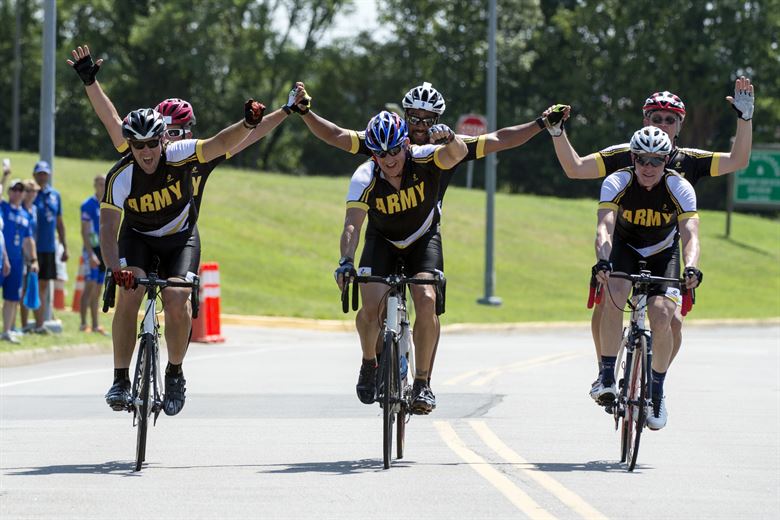
WASHINGTON, December 14, 2015 — The 2016 Department of Defense Warrior Games will take place at the U.S. Military Academy in West Point, New York, June 14-22, Pentagon officials announced today.

This is the first year the Army is hosting the Warrior Games, an annual sporting competition bringing together wounded, ill and injured service members and veterans from across the country.

"The United States Military Academy and the entire West Point community are honored to host the 2016 DoD Warrior Games," said Army Lt. Gen. Robert L. Caslen Jr., U.S. Military Academy superintendent. "These warrior-athletes competing in the games, who at one time answered their nation's call to service, exemplify the very best of America. They embody the resiliency, discipline, mental and physical toughness to overcome adversity and achieve their goals -- all traits we aspire to instill in our graduates, who will lead America's sons and daughters as Army officers."

DoD Warrior Games 2016 will feature eight sporting events: archery, cycling, shooting, sitting volleyball, swimming, track and field, and wheelchair basketball in a paralympic-style competition. About 200 athletes representing teams from the Army, Marine Corps, Navy, Air Force and U.S. Special Operations Command will compete. Each military service hosts trials in the months leading up to the games to determine their teams.

Enduring Strength

"The 2016 DoD Warrior Games will showcase the enduring strength of our service men and women who have overcome adversity and are using adapted reconditioning to become resilient warrior athletes. They represent the strength and resiliency of this great country," said Army Col. Chris Toner, commander of U.S. Army Warrior Transition Command and assistant surgeon general for warrior care and transition.

"Warrior Games is an opportunity for the services to communicate their sacred obligation and enduring commitment to their wounded, ill and injured service members, their families and caregivers," Toner added.

Adaptive sports and athletic reconditioning activities play a fundamental role in recovery, rehabilitation and reintegration of service members back to their units or as they transition into the civilian sector, officials said.

Face of Defense: Surface Warfare Officer Recalls Path to Success


By Navy Petty Officer 1st Class Mathew Diendorf, USS Makin Island DoD News Features, Defense Media Activity

SAN DIEGO, December 14, 2015 — When Navy Lt. Cmdr. Ty Wiese decided he was going to enlist, it didn't take too much to convince his father, a retired senior chief missile technician, and his grandfather, a former Navy pilot, of his decision to follow in their footsteps.

"Both my parents were supportive but initially wanted me to wait," he said. "I was only 17, but my father, a 21-year submarine veteran, was able to convince my mother that I would be okay, and the Navy would take care of me."

Wiese, a Satellite, Fla., native, began his career by attending missile technician school, where he was one of only four sailors to graduate in a class of 16.

He then reported to the ballistic missile submarine USS Henry M. Jackson, where he realized early on that he could do more with his career.

"In the submarine community, you work side by side with enlisted and officers in small groups," Wiese said. "Knowledge is power. It doesn't really matter what rank you are. The officers would come up all the time to learn the different systems, and I just realized they really aren't that much different than me."

After completing nine submarine deterrent patrols with the Jackson, Wiese became an instructor at the Trident Training Facility in Bangor, Washington.

Becoming an Officer

During his time on shore duty, he began taking night and weekend classes at Southern Illinois University, earning his four-year degree in only two years.

"After I graduated, I wanted to keep challenging myself," Wiese said. "I applied for Officer Candidate School, and three days after submitting my package, they called me at home to tell me I was selected," Wiese said. "Being selected for OCS felt amazing, but with all the excitement of telling my family and friends that I was going to be an officer, reality hit that OCS in itself was going to be a whole new set of challenges."

In November 2000, Wiese met those challenges and was commissioned as a Navy surface warfare officer.

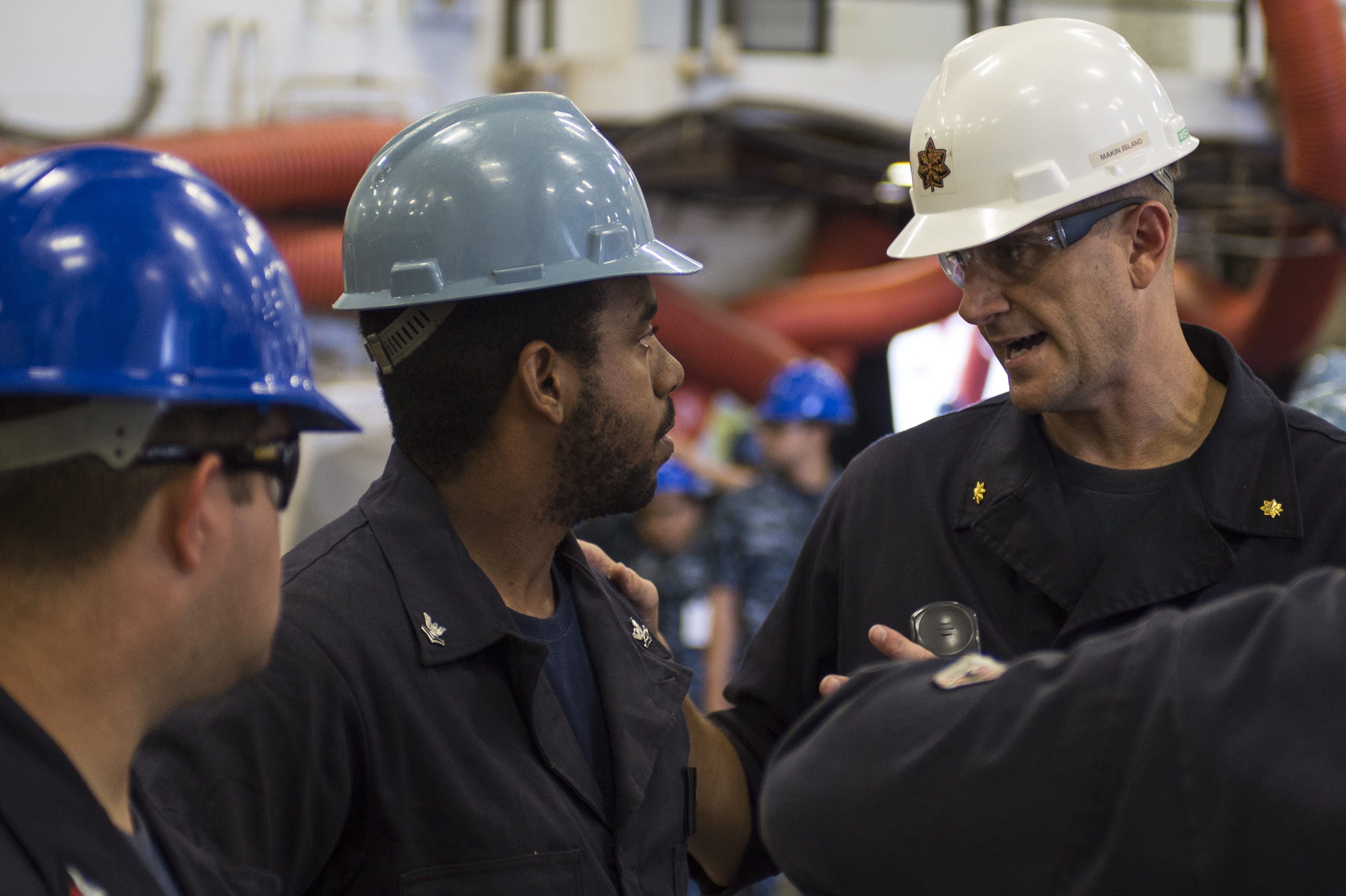
During his career as a SWO, he served aboard the fast combat support ship USS Bridge, the guided missile destroyers USS O'Kane and USS Shoup, and also the USS Makin Island, an amphibious assault ship, where he was named Commander, Amphibious Squadron 5 Surface Warfare Officer of the Year in both 2010 and 2011.

Wiese attended the Naval War College in Newport, Rhode Island, following his tour on the Makin Island.

"The Naval War College was a fantastic tour," he said. "From day one we were treated very well. The classes were filled with officers from many communities, including international students. The assigned reading was intense, but all worth it. I learned a ton about history, critical thinking, and the importance of strategic communication."

Return to the Gator Navy

After graduating in June 2013 with a graduate degree in national security and strategy, he served two years at Carrier, Strike Group Nine. But he wasn't done in the “gator navy” -- the Navy’s nickname for the amphibious fleet.

In May of 2015 he once again reported to the Makin Island and serves as the ship's damage control assistant.

Wiese was recently selected for promotion to commander, and as he looks back on his career he said he sees how far he's come.

"Coming in the Navy as an E-1, I never would have thought I'd be where I am today," he said. "Being selected for commander is just so humbling, and I'm so excited to be given the opportunity."

"It's been an interesting ride, and I'm just getting started," Wiese said.

As a 25-year Navy veteran, he has been able to balance a career and his 21-year marriage to his wife, Stephanie.

"I wouldn't be able to do what I do without my wife," Wiese added. "We've always backed each other up. When I was going to school, she was taking care of the house. You can't be successful in this community unless you have the support at home."