Tuesday, June 19, 2018

Vice Chairman Discusses Building DoD Partnership With Humanitarian Agencies


By Jim Garamone, DoD News, Defense Media Activity

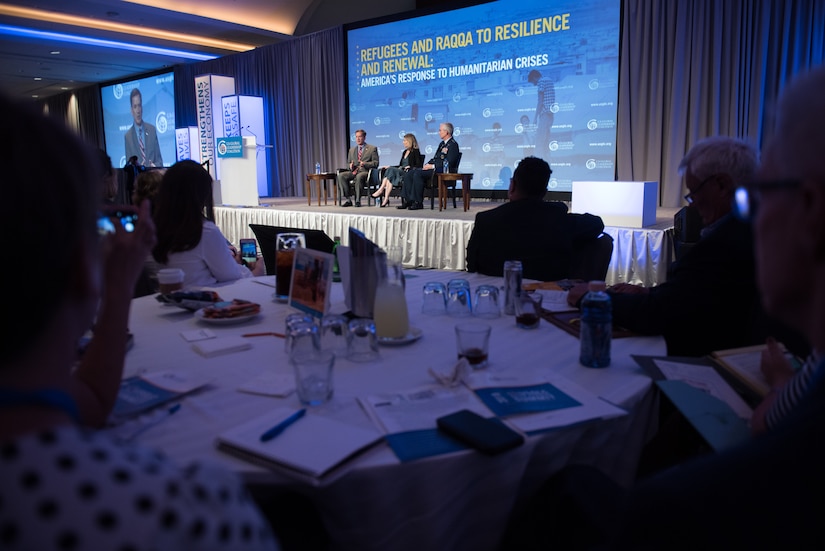
WASHINGTON -- The Defense Department is a resource unlike any other in the world for aiding civilian agencies as they confront natural or man-made disasters, and DoD continues to look for better ways to work alongside civilian agencies, the vice chairman of the Joint Chiefs of Staff said here yesterday.

Air Force Gen. Paul J. Selva told the U.S. Global Leadership Coalition that DoD has learned lessons from past disasters such as the earthquake in Pakistan, the tsunami in South Asia, the Haitian earthquake, the Ebola outbreak in West Africa and the earthquake/tsunami that hit Japan.

Selva spoke alongside Mark Green, the administrator of the U.S. Agency for International Development.

In humanitarian crises occurring today, with most caused by war, 66 million people are displaced in the Middle East, Asia, South and Central America and the Arabian Peninsula.

DoD has a national security stake in aiding other nations, Selva said, noting that 71 years ago, Gen. George Marshall announced the Marshall Plan, which was instrumental in rebuilding Europe in the aftermath of World War II.

“He said if we don’t do something to stabilize Europe and help them help themselves, that would be counter to our interests,” Selva said. “So over a period of about four years, about $14 billion was dispersed to governments around Europe – that’s $123 billion in today’s dollars – to stabilize the countries that had been ravaged by war. That puts an exclamation point on the importance of the partnership among diplomacy, development and defense.”

Green underlined the importance of close cooperation between USAID and DoD, noting that his agency has 23 people assigned with the military’s combatant commands. “So many of the crises we are facing, so much of the humanitarian work that we are doing and the need that’s out there is either conflict driven or man-made,” he said. “In order for us to get our arms around that, if we are not partnering closely with the military, we aren’t going to be able to achieve our goals and mission.”

Stabilization Assistance Review

Both men said they want the partnership to become closer. The administration released a Stabilization Assistance Review this spring that spelled out how DoD, USAID and the State Department could work together more effectively. It drew heavily from lessons learned in Iraq and Syria and other areas.

“The basis of the document is to define the relationships – particularly in a crisis battlespace like Syria, like the city of Raqqa, where the devastation is significant,” Selva said.

In those areas, it is not enough to just bring aid into the region, Selva said. The Islamic State of Iraq and Syria left explosives and bombs throughout Raqqa, and DoD expertise is needed before humanitarian missions can proceed. But even in this, there is outreach, he said, because DoD works with organizations that specialize in demining, and the department can train local technicians to accomplish the mission. “That becomes a livelihood for a short period of time and gives them a foundation to build on,” Selva said.

This move does not require a formal arrangement between USAID and DoD as a consequence of the stabilization review, so it can be accomplished at the tactical level with little time wasted, the general said. The U.S. military can provide security, he added, and USAID and nongovernmental agencies can operate under that umbrella.

“They certainly give us better authorities to work in the environment we find ourselves in today,” the vice chairman said.

Selva would like to see more sharing among the American agencies. “There are several ways we can work better together,” he said. “One is our relatively small footprint in many of these countries is a good set of sensors. So there are soldiers, sailors, airmen, Marines … who are deployed with indigenous forces in these countries, and we ought to be a feedback mechanism … into the understanding of what is going on in those countries to give our diplomats a bird-eye view of what is happening within those societies.”

Monday, June 18, 2018

World War II Veterans Hold Reunion at Camp Blanding Joint Training Center


By Army Staff Sgt. Carmen Fleischmann, Florida National Guard

STARKE, Fla. -- For years, veterans of the Army’s 66th Infantry Division have reunited to reminisce about their time together fighting in World War II, to share stories of how their lives have changed since then, and to recall fond memories of those brothers they lost along the way.

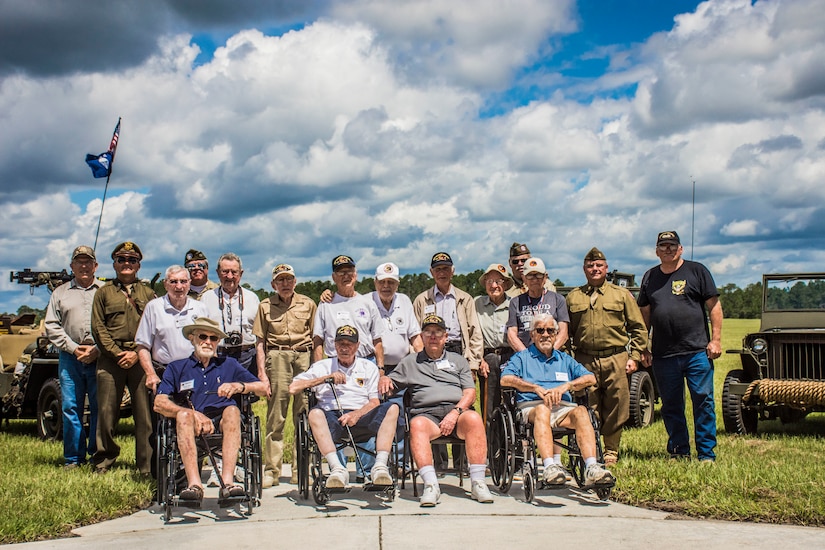
They have taken many journeys together, but none as impactful as their June 15 return here to the Camp Blanding Joint Training Center for their final reunion.

The 15 veterans of the 66th “Black Panther” Division and their families were welcomed to the Camp Blanding Museum by post commander, Army Col. Matt Johnson, who shared how he was personally impacted by their stories.

Upon taking command of Camp Blanding in 2015, Johnson said he would enjoy a morning run past the troop billeting areas on Quincy Avenue which just happened to be located behind what used to be the headquarters for the 66th Infantry Division.

“I remember vividly on those first mornings as I ran through the area, how I observed the concrete foundations and the red brick chimneys that still remain there today,” Johnson said. “It stirred within me the desire to learn more about the history of this post and the soldiers and civilians who once trained and served here.”

Johnson ran his usual route again on the morning of the reunion to prepare for his meeting with veterans that trained at his post all those years ago.

“I could still imagine the voices and the sounds of men rising early, preparing for another day of training at Camp Blanding. I thought of what you experienced then and what we experience today,” he said.

Veteran’s Story

Johnson said he was also touched by the story of one of the veterans in attendance, Cyril Reshetiloff, who served in Headquarters Company, 2nd Battalion, 262nd Infantry Regiment. Reshetiloff was onboard the S.S. Leopoldville, a Belgian passenger ship that was torpedoed and sunk by a German submarine as it was crossing the English Channel to deliver members of the 66th to fight at the Battle of the Bulge.

While Reshetiloff was able to climb his way out of the wreckage and swim to safety, the 66th Infantry Division lost 14 officers, including two battalion commanders, and 784 enlisted men in that attack.

Instead of continuing to the original battle, the Black Panther Division was assigned to fight 60,000 Germans along the French Atlantic coast. They later relocated to Koblenz, Germany, following the German surrender in May 1945, where they conducted occupation duty and provided security at German prisoner-of-war camps. The men who left to continue the fight after

Jerry Roetigers, President of the Panther Veterans Organization, and one of the young men who trained at CBJTC and went on to fight with the 66th Infantry Division, said the PVO has boasted as many as 2,500 members since it was created in the 1960s. He recalls emotional moments when the PVO went to Europe and placed a wreath at the location where the Leopoldville was sunk, and later when they placed one at the Tomb of the Unknown Soldier.

The members of the 66th Infantry Division have been honored for their sacrifice and praised for their legacy. Their final reunion at Camp Blanding was no different. Dozens of soldiers, airmen and civilians turned out in the hot summer sun to pay their respects to the brave men of the Black Panther Division. Several World War II-era vehicles led the convoy of buses around post, bringing back memories of the unit’s time here, but also providing a reminder of how much time has gone by.

Choking back tears, Roetigers said, “None of this would have ever happened if our buddies on the Leopoldville didn’t give their lives. They gave their lives for us. It kept us out of the Battle of the Bulge, and who knows … we all might have been buried in Belgium.”

Honoring World War II Veterans

Roetigers had his grandson, also named Jerry and a veteran who served in Iraq, read an article written by his friend and previous PVO President Frank Bartino, and the current CEO of the Panther organization, Lenore Angelo, titled, “Roses in December.” The heartwarming words remembers comrades that fell during the war and have passed away since.

Just before laying a wreath on the monument, each of the 12 Black Panther Division veterans in attendance received a 66th Infantry plaque and a CBJTC challenge coin.

The veterans noticed on their tour of Camp Blanding that while the post has changed tremendously over the years, the spirit of sacrifice and service remains.

During the ceremony, currently serving Florida National Guard soldiers and airmen stood proudly as they donned the same style “Black Panther” Division patches as the heroes who have gone before them wore when the 66th Infantry Division was activated on April 15, 1943.

“We are very proud of the 66th Infantry Division’s record in World War II, and we are extremely pleased that you have come home in 2018,” said the president of the CBJTC Museum Association, George Cressman.

Face of Defense: Former Monk Trades Robes for Air Force Uniform


By Air Force Airman 1st Class Erick Requadt, Moody Air Force Base

MOODY AIR FORCE BASE, Ga. -- For most people, spending a day without their cell phone is an impossible feat. To spend 30 days without a phone, writing, reading, talking or even eye contact would seem unfathomable, but for Thailand Buddhist monks, this is their world.

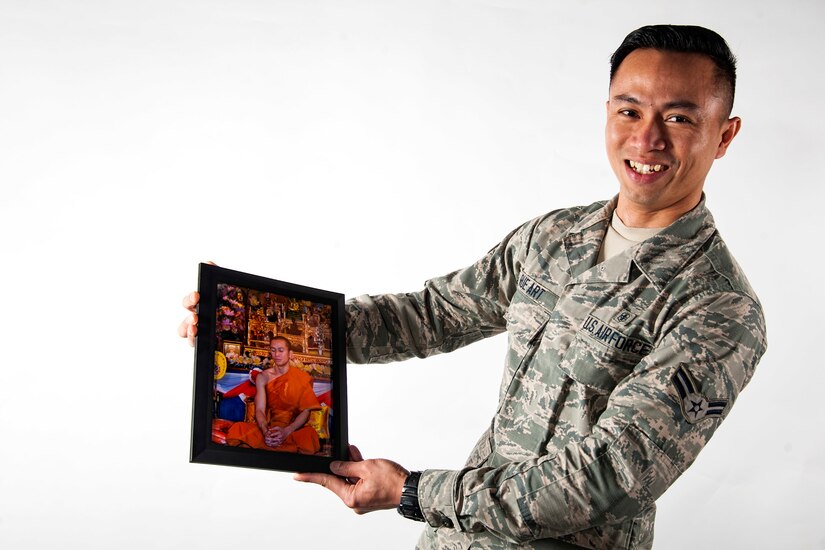
After spending 18 years in that world as a monk, Airman 1st Class Kornkawee Rue Art, a pharmacy technician with the 23rd Medical Support Squadron here, traded his robes for a uniform in his continual pursuit of a life bigger than himself; one of meaning and purpose.

“When I first became a monk, I didn’t think it would open any professional doors,” Rue Art said. “But the first time I heard I could join the military, I saw the opportunities. I would be able to meet more people, see the world and be a part of the world’s greatest military. Even when I was a kid, I saw ads for the Air Force in Thailand.

"And then,” he continued, “I saw my chance to join. I wanted to feel that experience of being a part something larger than myself, to be with the best Air Force.”

In Thailand, a monk is one who studies Buddhism and practices its ways, follows the rules and lives at the temple. Monks practice and teach meditation, along with being spiritual consultants and leaders of ceremonies. Monks also perform missionary work, traveling across the world.

During his first missionary journey to the U.S., Rue Art reacquainted with an old friend who was soon to enlist in the U.S. military. Inspired by this friend, who became the first Thai Buddhist monk serving in the Air Force, Rue Art blazed his own trail by becoming the second.

‘I Used to Dream About Joining the Military’

“Even when I was young I wanted to join the military,” Rue Art said. “Being a monk, though, it closed my dream. I just wanted a chance, because talking with my friend it reminded me of how I used to dream about joining the military.”

Having grown up on a farm in the countryside of Thailand, growing up dreaming of joining the Air Force, along with successfully following over 200 rules as a monk, Rue Art developed a foundation that would carry his dedication to the honor, respect and duty he would bring to the Air Force.

“This was something I felt I could do if I prepared myself,” he said. “I wanted to challenge myself and always keep growing.”

Rue Art, wanting to experience the full range of life, and exemplifying the Buddhist principle of releasing expectations, joined the Air Force with an open mind of genuine service before self.

“I think being a monk made me more flexible,” Rue Art said. “I believed in myself. Whatever job I would get, it’s something people have done and are still doing, so it’s possible that I could do it, too. Whatever the Air Force needed me to do, I could do that.”

Rue Art said experiencing everyday life in the outside world has provided him with a stronger conviction in his beliefs.

“You learn how to deal with conflict as a monk, but you never experience it,” Rue Art said. “Being at the pharmacy, I saw the realness of it all. So, when something would make me feel mad or upset, I would wonder how I’m going refresh myself every day and be ready to go to work tomorrow. But with my Buddhist beliefs I was actually able to put it into practice and see how it really does work.”

Rue Art maintains his Buddhist ways daily through meditation and keeping a calm mind in his Air Force life, serving as a cornerstone in his spiritual pillar of resiliency.

Respecting Others

“You have to have a calm, cool, collected self to be able to get far not just in the Air Force, but in life,” said Air Force Airman 1st Class Makatelyn Maynard, 23rd MDSS pharmacy technician.

Rue Art “knows how to treat other people and respect them, because he’s been respecting people the whole time he was a monk,” Maynard said.

“I know that for myself, I get worked up over a lot of things that’ll fluster me. But with Rue Art, if he does get aggravated he doesn’t let it show,” she continued. “He’ll just stop. He’ll take a breath and breathe, and then he reiterates what he’s doing and just goes right back into it. It always amazes me how he does it.”

From monk to airman, Rue Art’s world has changed, but his way of life is still able to bring honor, not just to himself, but his friends and family back in Thailand, the Land of Smiles.

“I’m happy to be here,” Rue Art said. “When my friends in Thailand hear about me being in the Air Force, to them that’s a big deal. And, it fills me with a sense of honor knowing I’m making them proud.”