Thursday, April 26, 2018

Air Guard, Reserve Wings Conduct Firefighting Training With Forest Service


By Air Force 2nd Lt. Emerson Marcus, 152nd Airlift Wing

SACRAMENTO, Calif. -- As temperatures heated up in northern California, aerial firefighters from four C-130 airlift wings operating the U.S. Forest Service‘s Modular Airborne Fire Fighting System began a weeklong training exercise here April 23.

The training, sponsored by the Forest Service at McClellan Reload Base in Sacramento, includes four military airlift wings that make up the air expeditionary group: three Air National Guard units from California, Nevada and Wyoming, and one Air Force Reserve unit from Colorado.

“Training with all four MAFFS wings alongside the U.S. Forest Service, [the California Department of Forestry and Fire Protection] and other wildland firefighting agencies here in Sacramento provides a significant opportunity as we prepare for wildland fire season,” said Air Force Col. James DeVere, commander of the MAFFS Air Expeditionary Group and the Air Force Reserve’s 302nd Airlift Wing.

Protecting Citizens, Property

“Training collectively ensures overall standardization of operations while continuing to build working relationships with the key players in the wildland firefighting community,” DeVere said. “It is rewarding as Guardsmen and reservists to stand alongside our agency partners, knowing that we help make a difference protecting our citizens and their property.”

The Forest Service’s MAFFS equipment -- rolled into the back of a C-130 aircraft -- can drop up to 3,000 gallons of water or fire retardant in six seconds through a nozzle on the rear left side of the plane.

The certification training includes classroom sessions and flight operations for military flight crews, lead plane pilots and other support personnel from the U.S. Forest Service and other wildland firefighting agencies.

“Wildland fire management agencies have relied on MAFFS for more than 40 years to provide surge capacity when commercial air tankers are fully committed or not readily available, as they frequently are during periods of high wildfire activity,” said Kim Christensen, deputy assistant director for operations for the U.S. Forest Service. “Training that includes all of the military and civilian personnel that work together when MAFFS are mobilized is critical to ensure that military aircraft fly safely and effectively and that they can be seamlessly integrated into wildfire suppression operations.”

Participating airlift wings include three Air National Guard units -- the 146th Airlift Wing from Port Hueneme, California; the 152nd Airlift Wing from Reno, Nevada; the 153rd Airlift Wing from Cheyenne, Wyoming -- and the Air Force Reserve Command’s 302nd Airlift Wing from Peterson Air Force Base, Colorado.

Training water drops will be executed on lands within the Tahoe and Shasta-Trinity national forests. California residents in these areas may see low-flying Forest Service lead planes and C-130s dropping water this week.

In the past decade, military C-130s equipped with MAFFS delivered more than 8 million gallons of fire retardant to aid in the suppression of wildfires around the United States.
MAFFS aircraft are activated to supplement commercial air tankers contracted by the Forest Service during periods of high wildfire activity throughout the nation. They are also activated by governors to assist with wildfire suppression in states where the Air National Guard units that provide the C-130s are located, including California.

Wednesday, April 25, 2018

DoD Seeks to Make Civilian Agencies More Productive, Efficient


By Jim Garamone, DoD News, Defense Media Activity

WASHINGTON -- The Defense Department is already looking at ways to make its agencies more productive and efficient, the deputy defense secretary told the Defense Writers Group here today.

Patrick M. Shanahan welcomed House Armed Services Committee Chairman Rep. Mac Thornberry’s interest in the so-called Fourth Estate. The Texas representative has issued “discussion drafts” of legislation that calls for elimination of some organizations and reforms of others.

Thornberry defines the Fourth Estate as civilian-dominated military agencies such as the Defense Contract Audit Agency, the Defense Information Systems Agency or the Defense Logistics Agency.

“The Fourth estate is an area I have been spending an awful lot of time in,” Shanahan said. He believes there is tremendous opportunity for reform in DoD, he told the defense writers, adding that those reforms would tremendously boost productivity and modernization in the department.

The National Defense Authorization Act called for the creation of a department chief management officer position, and that person – John H. Gibson II – has been leading the effort that gets after reform in the Fourth Estate.

Shanahan said he looks at the Fourth Estate in three different segments: intelligence, acquisition, and business operations such as health care, information technology and so on. “The way I tend to think about it is, ‘How do we restructure ourselves so we can be much more productive and much more responsive?’” he said.

That question has different answers, depending on the segment he said. On the intelligence side, he explained, it boils down to leveraging artificial intelligence to make better decisions with the volumes of information that comes to DoD.

Another organization in the Fourth Estate is the Defense Health Agency, which has hundreds of clinics. “How do we combine them in a way that drives cost down because there is a common procurement system?” he asked.

Six Major Areas

The DoD chief management officer is going after six major areas that need to be re-engineered and consolidated, Shanahan said, noting that the biggest leverage there is real synergy at the DoD level. “Today, we are parsed by service and we are leaving a lot of productivity on the floor,” he said. “We have 10 different ways to do the same thing. These are issues that every large organization runs into.”

In the world of Ellen Lord, the undersecretary of defense for acquisition and sustainment, Shanahan said, reform and re-engineering are different, so she needs to understand how to make it easier to do business with the government. It also entails how the department picks the right industrial partners for modernization, he added.

The fact that the chairman of the House Armed Services Committee is also approaching this issue gives support to DoD’s efforts, Shanahan said.

Not a ‘People Problem’

The deputy secretary said he doesn’t want this effort to be viewed as a “people problem” or as a way to reduce the workforce. “There is this assumption that there are all these people standing around with their hands in their pockets and not working hard,” he said. “What we find is we have processes and management systems and [information technology] systems that have evolved over years and years that were never designed to scale to the size that we are, and so people are stuck in processes that … aren’t as productive as they could be.”

The Defense Information Systems Agency has a number of data centers, he noted, and if those are consolidated there will be a reduction in the number of people needed to run them.

“The art form here is, ‘Then what do you do with the benefits?’” he said. “The reason I hesitate to talk about it as a people issue is it is not a people issue. People are the solution, not the problem. From a management standpoint, the easiest thing to do is redraw the lines and boxes on an org chart, but it is actually the hardest thing to implement.”

The department must look at processes, Shanahan said. There needs to be enough people to perform the mission, he added, and then an examination of back-office inefficiencies.

“It’s our processes, not our people,” he said.

Tuesday, April 24, 2018

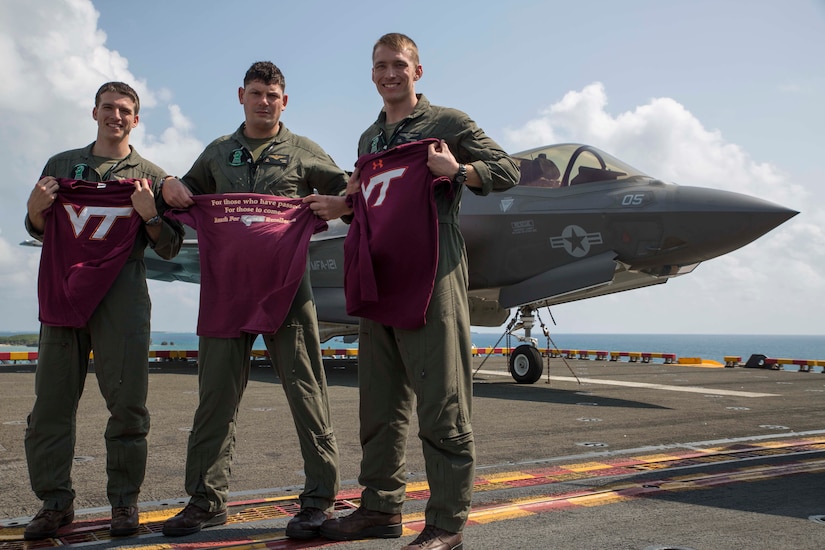
Face of Defense: Virginia Tech Grads Serve Together as F-35 Pilots


By Marine Corps Cpl. Bernadette Wildes, 31st Marine Expeditionary Unit

PACIFIC OCEAN -- Three Virginia Tech alumni are now serving as Marine Corps aviators.

Marine Corps Maj. John Stuart, Capt. Evan Slusser and Capt. Andrew Thornberg fly the F-35B Lightning II out of Iwakuni, Japan, with Marine Fighter Attack Squadron 121.

Flying with the 31st Marine Expeditionary Unit aboard the amphibious assault ship USS Wasp during Spring Patrol 2018, all three participated in this year’s historic first operational deployment of the F-35B with a MEU.

The 31st MEU, based out of Okinawa, Japan, is a forward-deployed, flexible air-ground-logistics team capable of accomplishing a wide range of military operations in support of U.S. Pacific Command.

“The fact that three of us end up being pilots in the Marine Corps who end up flying the F-35 [and] end up in the same squadron in Japan -- the chances are pretty wild,” said Slusser, from Prince George, Virginia.

Virginia Polytechnic Institute and State University, also known as Virginia Tech, is located in Blacksburg, Virginia. The school’s maroon and orange are proudly worn and never forgotten by the Hokies of Virginia Tech.

Remembering Virginia Tech

“It’s just beautiful out there,” Slusser said. “It’s in the southwest corner of Virginia in the mountains. You get all four seasons. You get snow, you get summer. You get the best fall of anywhere on the planet, and the springtime’s not bad either. The school and scenery are beautiful.”

Slusser played soccer and majored in international studies with a concentration in global politics.

Thornberg said it’s unique to have the Virginia Tech community all the way on the other side of the world in Japan. They even get together to watch the games on TV.

“When I think of Virginia Tech and Blacksburg, I think of home,” said Thornberg, from Fairfax, Virginia. “I’m very grateful to the Virginia Tech community. It has shaped my life and made me who I am today. I will always be a Hokie at heart.”

Thornberg, who graduated with a degree in international studies, played lacrosse and was a part of the Virginia Tech Rescue Squad, an all-volunteer, student-run organization that provides emergency medical services to the university community. As a member of the VTRS, Thornberg was a first-responder during the tragic April 16, 2007, school shooting that claimed the lives of 32 Virginia Tech students.

Stuart was a member of the Student Engineer’s Council and the Virginia Tech Motocross Club. He has a degree in industrial systems engineering.

“Virginia Tech didn’t just feel like home; Virginia Tech was home to me,” said Stuart, from Marshall, Virginia. “My best friends in life, even to this day, went to Virginia Tech.”

Slusser agreed.
“From my first day to the last [at Virginia Tech], it was one of the best times of my life,” Slusser said. “The people there are amazing, the place itself is amazing. I would love to retire and end up living somewhere near that school.”