Friday, April 13, 2018

U.S., Japan Commemorate World War II Battle of Peleliu


PELELIU, Palau, April 13, 2018 — The U.S. Navy and Marine Corps and the Japan Self-Defense Force participated in a wreath-laying ceremony at the Peleliu Peace Memorial Park here yesterday to remember the service members who lost their lives during the World War II Battle of Peleliu.

Members of the British Royal Navy and Royal Australian Navy also attended the ceremony.

Considered the bitterest battle of the war for the U.S. Marines, the first U.S. invasion force landed in Peleliu on Sept. 15, 1944. Expected to last only four days, the battle stretched more than two months, with a casualty rate exceeding that of all other amphibious operations during the Pacific War.

The ceremony included remarks from Marine Corps Gunnery Sgt. Walter Greber, the staff noncommissioned officer in charge for security, and Lt. Cmdr. Satoshi Hirokami, a member of the Japan Maritime Self-Defense Force and the Joint Staff.

Solemn Ceremony

The two service laid a wreath at the concrete cenotaph erected to memorialize those who perished during the Peleliu battle. The ceremony concluded with the playing of “Taps” by two buglers to honor the sacrifice made by those who fought in the battle.

“While the Battle of Peleliu gave us insight into emerging Japanese defense tactics, these lessons could not have been learned without the sacrifice and service of our U.S. troops,” Greber said. “The battle underscores our warfighting history, determination and will, as well as the resolve of the Japanese.”

U.S. Marines of the 1st Marine Division, and later, soldiers of the U.S. Army’s 81st Infantry Division fought to capture an airstrip, encountering a well-armed Japanese force defending 500 caves that honey-combed the small coral island, a maze the Marines soon nicknamed “Bloody Nose Ridge.”

U.S., Japan Relations ‘Stronger Than Ever’

“Today, times have changed and the relationship between Japan and the United States has become stronger than ever as can be seen in this event,” Hirokami said. “We together mourn the soldiers who lost their lives here.”

Following the ceremony, U.S. and Japanese participants visited the Peleliu Elementary School and played sports and listened to a performance by the U.S. Navy Pacific Fleet band with more than 50 students, while the medical staff conducted health screenings at the Peleliu clinic, providing blood-glucose, vital signs and height/weight measurements, as well as prescription eye glasses.

“We have witnesses today who came from … the Republic of Palau and the United Kingdom. [This] shows the special relationship among us,” Hirokami said. “It is my sincere hope that our visit here contributes to the further development of our cooperative relations.”

The U.S. sailors and Marines and Japan Self-Defense Force staff members came to t Palau aboard USNS Brunswick as part of Pacific Partnership 2018, the largest annual multilateral humanitarian assistance and disaster relief preparedness mission.
“Our history is important to us. It keeps the memory of the sacrifices of our former brothers and sisters made remembered,” Greber said. “It also allows us to learn from past mistakes and continue to evolve.”

U.S. Military Must Develop All-Domain Defenses, Mattis, Dunford Say


By Jim Garamone DoD News, Defense Media Activity

WASHINGTON, April 13, 2018 — If a nation wants to challenge the United States conventionally, that nation will lose.

So, nations won’t challenge America conventionally, but look for asymmetric ways to do so, DoD’s most-senior civilian and military leaders said to the House Armed Services Committee yesterday.

Defense Secretary James N. Mattis and Marine Corps Gen. Joe Dunford, the chairman of the Joint Chiefs of Staff, also spoke about the problems caused by “gray zone” warfare.

Right now, the U.S. military is practiced in counterinsurgency operations. The defeat-Islamic State of Iraq and Syria campaign has honed the skills needed to train local troops and provide troops with enablers like close air support and logistics.

If groups like al-Qaida and ISIS were the only threats, then counterinsurgency forces would be fine. But Russia and China will be long-term competitors, and both countries are developing capabilities to challenge U.S. dominance. These areas include the cyber world, space and information operations.

It also includes anti-access strategies like building islands in the South China Sea.

Develop, Maintain Overmatch, Reassure Allies

The United States must develop and maintain overmatch in all domains of combat, and continue to reassure allies. “What we will do is make certain our allies know that we’re reliable and we can break through to them,” Mattis said. “We can get to them and stand with them at the time of need.”

This asymmetric challenge is sometimes described at the “gray zone” or the Gerasimov doctrine -- after the Russian chief of General Staff Gen. Valery Gerasimov -- or even as “little green men.”

Dunford described the strategy as the use of “political influence, economic coercion, use of cyber, use of information operations and then military posture,” during his testimony.

“So there's a military dimension to it, but it's clearly a broader problem than just a military dimension,” the general added.

The bottom line is that the competition taking place inside the gray zone “is really the competition for our allies and partners,” he said.

What the Russians are trying to do in the gray zone is undermine the credibility of U.S. alliances and partnerships, the general said. “So what’s critical for us to do is overcome in the information space, overcome in cyber capabilities, and then our military posture, the erosion of that relationship that we have with our allies,” Dunford said.

Interagency Participation

This requires broader government participation. The State Department, Treasury, the intelligence agencies, U.S. Agency for International Development and more need to be involved to bring some resolution to the gray zone.

Dealing within the gray zone is even more complicated because of the way the United States military thinks about conflict. The gray zone is predicated on a continuum between peace and war. The United States military sees an on/off switch between the two.

“The activities and the authorities that we have in place on a day-to-day basis reflect the fact that we’re at peace, and our adversaries don’t actually have the same restraints,” the chairman said. “So what they’re doing on a day-to-day basis looks more like moving towards war than being in peace.”

DoD is reviewing the issue. “We do believe that we are limited in the activities that we can perform on a day-to-day basis and the authorities that we have to allow us to be competitive,” Dunford said.

Officials Detail Combat Aviation Priorities at House Hearing


By Marine Corps Sgt. David Staten DoD News, Defense Media Activity

WASHINGTON, April 13, 2018 — Senior Navy, Marine Corps and Air Force leaders outlined priorities for combat aviation during a House Armed Services Committee hearing here yesterday.

Speaking for Navy and Marine Corps aviation, Navy Vice Admiral Paul A. Grosklags, commander of Naval Air Systems Command, told committee members he believes the DoD budget agreement covering fiscal years 2018 and 2019 is aligned with and supports the National Defense Strategy in rebuilding military readiness while providing a more lethal force.

“The lethality which naval aviation brings to bear in support of our nation's interest will be greatly enhanced by the increase procurement numbers for aircraft and weapons, increased investment in the development of new and advanced capabilities and increased funding of our critical readiness and sustainment accounts,” Grosklags said.

Marine Corps, Navy Aviation Priorities

Grosklags provided aviation priorities for the Marine Corps and Navy.

For the Marine Corps:

-- F-35 Lightning II aircraft procurement and sustainment;

-- CH-53K King Stallion helicopter development and continuation of low rate initial production;

-- Marine air-ground task force unmanned expeditionary capability, also known as MUX;

-- Completion of the H-1 upgrades procurement program featuring UH-1Y “Venom” and AH-1Z “Viper” helicopters, the next generation of Marine Corps utility and attack aircraft;

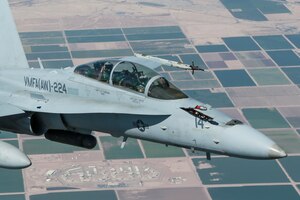
-- Maintaining lethality of legacy F/A-18 Hornet aircraft.

For the Navy:

-- F/A-18 super Hornet service life modernization;

-- Procurement of F-18 Block III upgrades, F-35’s, E-2 early warning aircraft, P-8 Poseidon aircraft, CMV-22 Osprey aircraft and MQ-4C Triton unmanned aerial vehicles; and

-- Development of the MQ-25 unmanned air system and the next generation jammer.

A critical priority for the Navy and Marine Corps is full funding for aviation readiness accounts, including spares, officials said.

Naval and Marine Corps leaders also told committee members their services are committed to flight safety and are dedicated to reducing the likelihood of accidents.

Marine Corps Lt. General Steven R. Rudder, deputy commandant of the Marine Corps for aviation, told the committee his service is maximizing efforts to prevent aerial mishaps, and taking corrective actions if they occur. More money, Rudder said, is being spent on aircraft maintenance to keep older airframes in good shape.

“We’re giving maximum amounts to our [maintenance and parts] depots; maximum amounts to buy spares, giving max amounts to program managers so they can fix the airplanes,” Rudder said.

The general also said the Marines are stepping up efforts to buy new aircraft to replace older, more maintenance-prone aircraft.

Demand for Air Force Capabilities Grows

The demand for Air Force capabilities continues to grow, as the United States experiences a more competitive and dangerous international security environment, Air Force Lt. General Arnold W. Bunch Jr., military deputy for the Office of the Assistant Secretary of the Air Force for Acquisition, told the committee.

The Air Force is supporting combatant commander requirements in response to growing challenges from Russia, China, North Korea and Iran, in addition to the counterterrorism mission in the Middle East and around the world, Bunch said.

Air Force spending priorities include F-35 aircraft procurement, sustainment and modernization, KC-46 aerial refueler aircraft for their power-projection role, and the B-21 Raider bomber development program, Bunch said. According to the general, these efforts are key to the Air Force so it can answer the nation's call when needed.

“The Air Force must build a more lethal and ready force, strengthen alliances and partnerships and deliver greater, more affordable performance,” Bunch said. “Future wars will be won by those who observe, orient, decide and act faster than adversaries in an integrated way across all domains.”

Bunch said his plan for the Air Force is to drive innovation, reinforce budget discipline and deliver capabilities with greater affordability at the speed of relevance.

“Today's modernization is tomorrow's readiness -- readiness is not static,” the general told the committee. The Air Force, he said, will continue its efforts to bolster readiness, increase lethality and modernize in a cost-effective manner.