Wednesday, January 24, 2018

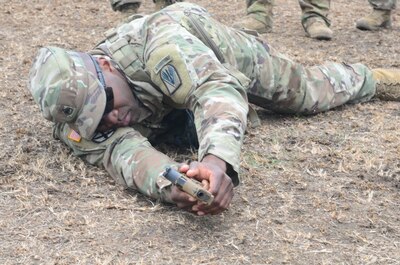
Soldiers Test New Modular Handgun System at Fort Polk


By Sgt. Ryan Tatum, 1st Security Force Assistance Brigade

FORT POLK, La., Jan. 23, 2018 — Soldiers from 1st Battalion, 1st Security Forces Assistance Brigade familiarized themselves and qualified with the XM17 handgun at the Joint Readiness Training Center here, Jan. 19-20.

According to the Army, the XM17 and XM18 handgun systems are replacing the M9 pistol. The “X” in “XM” stands for experimental and will be used until February 2018 when the weapons complete Type Classification. Afterwards, the weapons will be referred to as the M17 and M18. The XM18 is the compact version of the XM17. Both weapons are capable of firing 9 mm rounds.

Army Maj. Lucas Leinberger, the chief range office from 3rd Battalion, 353th Armor Regiment, provided insight on the range and some of the fundamentals in basic marksmanship.

Familiarizing Training

“We are working with members of the 1st SFAB to get some familiarization with the M17 pistol,” Leinberger said. “Part of that training is going through fundamentals such as sight picture, proper grip and trigger squeeze.”

The Army currently has plans to buy approximately 238,000 units of the new pistol system.

“Personally, I noticed a better balance in the overall weapon -- how it feels in your hand compared to the M9 and the M11 [service pistol] both unloaded and loaded with a full magazine,” Leinberger said. “I believe it is much easier to use; it is more ergonomically correct. I believe it will make anyone who is firing the weapon more combat effective.”

The main reason for the change in weapon systems is to make the soldier and units more lethal. The XM17 and XM18 modular handgun system program is one of the first in what is expected to be a whole line of modernization efforts that the Army will pursue over the next few years, according to the Army.

Army Sgt. Max Gilbert, a combat engineer with 2nd Battalion, 1st SFAB, has learned about the weapon and put his trust in it to make him more lethal in combat.

“The instructors here at the range were professional,” Gilbert said. “Yes, I feel that I am combat effective and combat ready.”

Army Maj. Brennan Speaks, brigade operations officer for 1st SFAB, provided his take on the XM17.

‘It is a Great Pistol’

“Overall it is a great pistol; I am extremely pleased with it,” Speaks said. “I have fired over 500 rounds and not once did it jam or misfire. The fact that we are deploying and the Army has made their commitment to move these pistols to us, to me, says a lot about the Army’s commitment to the SFAB to ensure we have the best equipment to go overseas.”

SFABs allow the Army to reduce, over time, the demand for conventional brigade combat teams for combat advising. In this way, the service’s Brigade Combat Teams can focus on readiness for warfighting against near-peer threats.

U.S. Service Members Train With Djiboutian Military Partners


By Army Staff Sgt. Timothy Moore Combined Joint Task Force Horn of Africa

CAMP LEMONNIER, Djibouti, Jan. 23, 2018 — Soldiers assigned to Combined Joint Task Force-Horn of Africa’s communications directorate finished training with Djiboutian service members during a military-to-military exchange of best practices here, Jan. 8-17.

The communications experts exchanged information with Djiboutian military partners on how to effectively operate, maintain and troubleshoot their communications equipment throughout the two-week period.

“They’ve been doing a great job overall,” said Army Spc. Taylor Noble, a multisystem transmission operator and maintainer. “They came in with a great deal of knowledge already, so I’m easily able to teach them more advanced techniques on how to operate their equipment.”

The Djiboutians also had the opportunity to teach fellow service members about the new expertise they’d acquired during the exchange.

“I’m a big fan of when you teach, you learn,” Noble said. “Every time I’ve taught, I’ve run into problems that make me think on my feet, make me think critically. For them to go and teach not only shows they effectively know what I’ve taught them, but also shows they can further their knowledge when they go back and show this to their troops.”

Communications Training

Participants learned how to setup and breakdown antennas, acquire satellite signals, create and connect cables and troubleshoot connection problems.

“A lot of the time they use this equipment for information to support their mission, to keep them safe as well as keep whoever they’re supporting safe,” Noble said.

As a troop contributing country to the African Union Mission in Somalia, Djibouti works with other African nations and CJTF-HOA to strengthen the defense capabilities against violent extremist organizations in Somalia and the rest of the region.

According to its official website, AMISOM is an active regional peace support mission set up by the Peace and Security Council of the African Union with the full support of the United Nations.

AMISOM’s principal aim is to provide support for the Federal Government of Somalia in its efforts to stabilize the country and foster political dialogue and reconciliation. While its military component has members from 13 African nations, the bulk of its troops come from six countries: Uganda, Burundi, Djibouti, Kenya, Ethiopia and Sierra Leone.

Sharing Knowledge

“Our goal is that the Djiboutians can effectively pass their acquired knowledge on without us being there because we want to assist them become more self-sustained,” Noble said.

Because they are from different countries, language can be a hindrance to the exchanges between militaries, but that stress was alleviated as one of the U.S. soldiers spoke French and was able to act as a translator during the exchange.

“[Acting as a translator] lets them know that we are here for them,” said Army Spc. Matthew Jousselin, a multisystem transmission operator and maintainer. “It helps them better understand our system and helps us better understand their questions, as well.”

Jousselin added, “We’re exchanging information that helps them and us, particularly information that helps with national security and how to suppress. You’re able to shake hands with other people who have a common interest, and are here for the same mission. It’s a great opportunity.”

Tuesday, January 23, 2018

New York Guardsmen Prepare for Flooding


By Eric Durr New York National Guard

MALONE, N.Y., Jan. 23, 2018 — One hundred and twenty-nine New York National Guard soldiers and airmen are on active duty in case rains and warmer weather cause ice jams and flooding on rivers in upstate and northern New York.

The New York National Guardsmen were placed on state active duty Jan. 21 at the request of the New York Division of Homeland and Security and Emergency Services.

Cold Produces Ice Issues

Extremely low temperatures had resulted in ice building up on the rivers that flow into Lake Ontario and the St. Lawrence River in northern New York, as well as the Mohawk River, which runs from Utica, New York, to the Hudson River just north of Albany.

Higher temperatures expected this week will lead to increased river water levels due to melting snow and precipitation falling as rain instead of snow. Ice still remaining on the rivers can cause natural dams and lead to flooding, according to Air Force Command Chief Master Sgt. Shawn Peno, a meteorologist and the chief enlisted advisor to the New York National Guard’s Joint Operations Section.

The most critical period for flooding will be from today to Jan. 25, he said.

New York State emergency officials asked that the National Guard put soldiers and airmen on duty with high-axle trucks and Humvees who were prepared to aid local governments if required. Soldiers and airmen were also directed to be prepared to act as observers to report on river conditions.

Teams Prepare for Emergency Response

On Jan. 21, small teams were assigned to Franklin County and Plattsburgh and emergency response forces were stationed at Hancock Field Air National Guard Base in Syracuse and the Glenville Armed Forces Reserve Center near Schenectady.

One hundred guardsmen are operating in the field, while other guardsmen provide mission command and conduct support operations.

Twenty vehicles are available for missions. Ninety-six Army National Guardsmen were on duty and 33 members of the Air National Guard were placed on state active duty.

The guardsmen were told to prepare to be on duty for seven days.