Wednesday, June 06, 2018

B-1B Lancer Bombers Support Exercise Baltic Operations


By Air Force Senior Airman Emily Copeland, 7th Bomb Wing

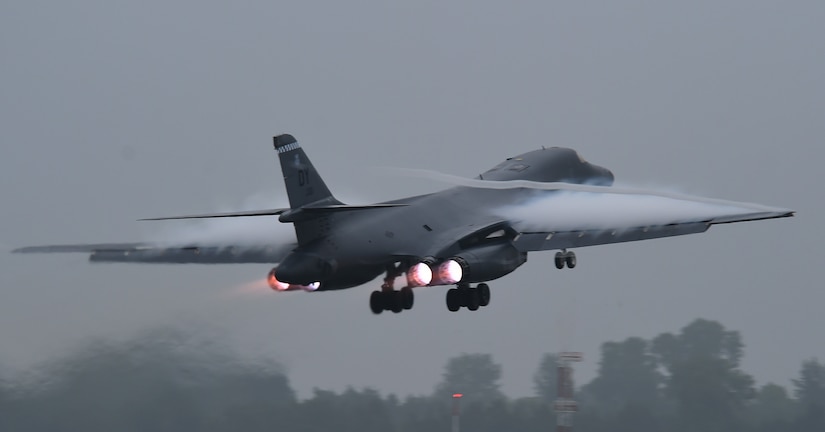
ROYAL AIR FORCE FAIRFORD, England -- Two B-1B Lancer bombers from Dyess Air Force Base, Texas, took part in missions supporting Exercise Baltic Operations June 4.

The B-1s conducted missions with inert Quickstrike Mark 62 mines, providing U.S. and coalition military forces the opportunity to train for the laying and recovering of mines. These inert mines are recoverable and reusable.

“Dropping naval mines gives the B-1 a lot of operational capability to complete the mission,” said Hojo, a B-1 pilot assigned to the 345th Expeditionary Bomb Squadron.

The pilot’s full name isn’t used due to security concerns.

The B-1 “can quickly deliver large quantities of precision and nonprecision weapons against any adversary, anywhere in the world, at any time,” the pilot said.

Annual, Joint, Multinational, Maritime-Focused Exercise

Exercise Baltic Operations, which began in 1972, is an annual joint, multinational, maritime-focused exercise. It is designed to improve training value for participants, enhance flexibility and interoperability, and demonstrate resolve among allied and partner forces in defending the Baltic Sea region. This year’s exercise commenced June 1 and runs through June 15.

The exercise involves maritime, ground and air forces to strengthen combined response capabilities necessary to ensure regional stability.

Training focus areas include air defense, anti-subsurface warfare, maritime interdiction, mine countermeasures and amphibious operations.

“We train how we fight,” Hojo said. “There is a lot of behind the scenes to working with mines, from building the munitions to dropping them on a designated target; you want to make sure that when you are called upon for a mission, that you can successfully complete the task the first time when it counts.”
B-1B Lancers support Exercise Baltic Operations

Exercising Key Bomber Capabilities

The inclusion of bombers in this exercise has been long planned and provides an opportunity for bomber crews to integrate and train with other U.S. European Command components, while exercising the United States’ key bomber capabilities. These flights demonstrate the ability of the U.S. bomber force to provide a credible, flexible, and always-ready capability to respond to a variety of potential threats and situations, when called to do so.

These bombers will perform sorties in the Baltic Sea region, providing support to NATO and partner forces. The exercise will enable the B-1 and its crews to enhance their combat readiness, so collectively NATO can immediately respond to a range of real-world situations.

Training with allied nations and joint partners improves coordination between nations and enables the Air Force to build enduring relationships necessary to confront a broad range of global challenges.

The exercise enhances flexibility and interoperability among allied and partner nations to strengthen combined response capabilities, as well as demonstrate international resolve to ensure stability in, and if necessary defend, the Baltic Sea region.

“We are here to reassure our NATO partners and allies that we have their back,” Hojo said. “The interoperability is a huge piece to our part in the exercise, but this is a great opportunity for our unit and everyone involved to do something they have never done before whether at home or in theater."

New NATO Initiatives Aim to Boost Alliance Readiness


By Jim Garamone, DoD News, Defense Media Activity

WASHINGTON -- NATO is stronger than ever and new initiatives will increase the alliance’s readiness capacity,

“High readiness is essential in a more unpredictable world,” Stoltenberg said.

Stoltenberg previewed the Defense Ministerial that will begin at NATO headquarters in Brussels tomorrow. Defense Secretary James N. Mattis is attending the gathering for the United States. The alliance defense ministers will be discussing the items that will be discussed by NATO heads of state at the NATO Summit in Brussels in July.

New NATO Joint Commands, Readiness Initiative

The secretary general expects the defense ministers to approve establishing two new NATO joint force commands: one in Norfolk, Virginia, for access across the Atlantic; and one in Ulm, Germany, for logistics inside Europe. This will increase the alliance’s command structure by about 1,200 personnel, he said.

“I expect we will also agree on the NATO Readiness Initiative -- the Four 30s,” Stoltenberg said. This means, he said, that by 2020, NATO allies would have 30 mechanized battalions, 30 air squadrons and 30 combat vessels ready ready for deployment in 30 days or less.

“This is not about setting up or deploying new forces,” Stoltenberg said. “It is about boosting readiness of existing forces across each and every ally.”

The NATO allies will discuss defense spending and burden-sharing, Stoltenberg said, noting that defense spending in Europe is up.

“Burden-sharing is not just about cash, but capabilities and contributions,” he added. “Here, too, the trend is up. Allies are investing more in major equipment and increasing their contributions to NATO missions and operations.”

Combating Terrorism

The ministers will also discuss NATO’s roles in war against violent extremism, the secretary general said. The alliance already has deployed Airborne Warning and Control System aircraft, he said, and the ministers are expected to approve the recommendation to launch a new NATO Training Mission in Iraq.

The mission will “help Iraq better fight terrorism” and prevent the return of the Islamic State of Iraq and Syria, the secretary general said.

Stoltenberg said the NATO ministers will also discuss alliance capacity building support for Jordan and Tunisia.

The alliance ministers will discuss growing NATO-European Union cooperation with EU Vice President for defense cooperation Frederica Mogherini, the secretary general said. Defense ministers from Sweden and Finland will also participate.

“We will take stock of progress in our joint work, including on hybrid and cyber defense, maritime operations and exercises,” Stoltenberg said. “Going forward, military mobility could become a flagship for our cooperation, and we are working together to eliminate obstacles -- whether legal, customs or infrastructure -- to ensure our forces can move across Europe when necessary.”

The ministerial will close after a discussion with partners on the NATO effort in Afghanistan, the secretary general said.

“Allies and partners are stepping up with both forces and funding,” he said. “We have added about 3,000 more trainers to our mission, and we are discussing how to extend funding for the Afghan forces beyond 2020. The Afghan forces are performing with professionalism and bravery and creating the conditions for a political settlement.”

Face of Defense: Youth Baseball Coach Makes a Difference


By Air Force Staff Sgt. Peter Thompson, 33rd Fighter Wing

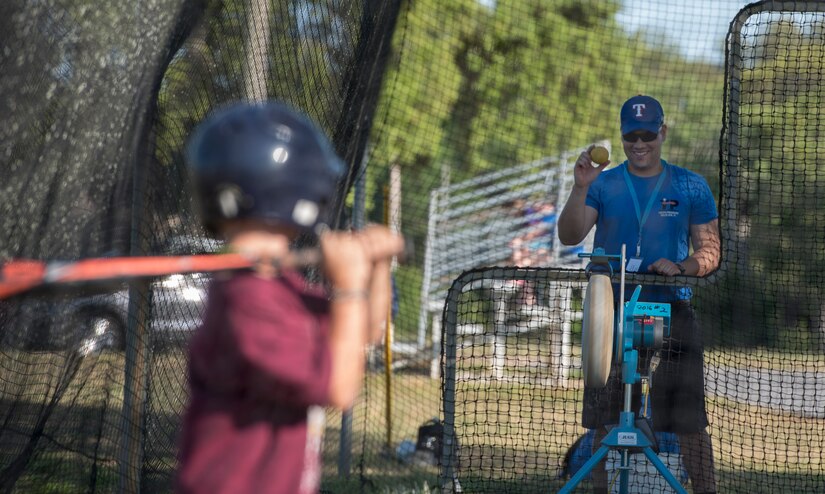
EGLIN AIR FORCE BASE, Fla. -- Air Force Capt. Joshua Gradaille said he enjoys “having a personal connection and bonding with the kids” as part of his volunteer service as a children’s baseball coach here.

Gradaille, the 33rd Fighter Wing’s executive officer, said he also appreciates “being able to connect and see them have those ‘aha’ moments while they are progressing.”

“That’s why I keep doing it,” he said.

Gradaille said he started coaching children’s baseball here a little over two years ago.

He recalled sitting on the bench of his son’s games thinking to himself: ‘There is more that can be done. Maybe they should do this or that.’”

Love of Baseball

He has a lifelong connection to the game. Growing up in Miami Beach, Fla., Gradaille played many sports, but baseball was always set apart from the rest.

“Baseball was the sport I like to say I was good at,” he said. “I played all sports but it was the one I truly enjoyed.”

He enrolled his son in the sport when he was five, hoping he would learn many of the lessons he learned as a child while filling a gap that existed in his own baseball experience.

“I grew up without my father in the picture. My mother raised me on her own,” Gradaille said. “I always thought how cool it would be to have your dad involved with you playing sports and cheering you on. I want to give him things that I didn’t have growing up, to include that support and involvement of parents playing sports.”

Since getting involved in coaching, Gradaille’s purpose has stretched beyond his own son to the other children on the team.

“I’m not only doing it for my child … I’m doing it for these other kids, too,” he said.

During one of the final games of the season, a father approached Gradaille about his son who changed over the course of the season.

“He thanked me and said that I made an impression on his son’s life,” said Gradaille, coach of the Rangers. “I don’t get to see how the things I teach these children translates outside of the time I am coaching them. They go home and go about their day. So, it reminded me and reinforced why I am here and why I do what I do.”

Validating the efforts of Josh and his players, the Rangers finished their season as the only undefeated team in their age group.