Wednesday, January 24, 2018

Mattis Visiting Indonesia, Vietnam to Build Relationships


By Jim Garamone DoD News, Defense Media Activity

WASHINGTON, Jan. 23, 2018 — Building alliances and partners are at the crux of Defense Secretary James N. Mattis’ trip to the Indo-Pacific region.

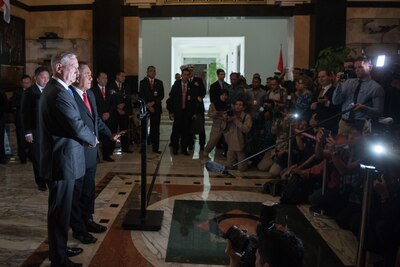
Mattis spoke to reporters on his way to Jakarta, Indonesia, where he will meet with President Joko “Jokowi” Widodo and Defense Minister Ryamizard Ryacudu.

“We probably engage with the Indonesian military more than any other nation anywhere in terms of mil-to-mil engagements,” Mattis said.

He tied the trip to a line of effort in the newly released National Defense Strategy: strengthening existing alliances and making new partners. “That's why we go out here on trips like this: … for the normal consultations with each other,” he said.

The secretary stressed that the United States is a Pacific power and has served as the guarantor of the international order in the region since the end of World War II. That has been good for all the countries of the region, he said, including those in competition with America.

‘A Peaceful, Prosperous, Freer Asia’

“What we want out here (is) … a peaceful, prosperous and freer Asia with a free and open regional order defined by the rule of law,” the secretary said. “What we're looking for here is … that small nations get the same respect, the same regard as … larger nations. Every nation matters and there should not be any bullying or shredding of trust toward others.”

Mattis wants to increase maritime cooperation in the region, and Indonesia -- the connection point between the Indian and Pacific oceans -- is key to that.

The secretary will also visit Vietnam where he expects to discuss freedom of navigation in the South China Sea, and the respect for international rule of law and national sovereignty.

Mattis is visiting Hanoi to hear more about how Vietnamese leaders see things developing as they maintain sovereignty over their territorial waters and economic zone, that they maintain oversight of that.

“Obviously, we want to know what level of engagement they want with us: Is it professional military education; is it joint training?” he said. “I want to sit down and just talk with them, get a better sense of the pragmatic steps that we can take as we move the relationship forward into one of trust and collaboration.”

Soldiers Test New Modular Handgun System at Fort Polk


By Sgt. Ryan Tatum, 1st Security Force Assistance Brigade

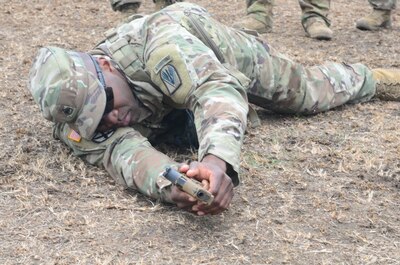
FORT POLK, La., Jan. 23, 2018 — Soldiers from 1st Battalion, 1st Security Forces Assistance Brigade familiarized themselves and qualified with the XM17 handgun at the Joint Readiness Training Center here, Jan. 19-20.

According to the Army, the XM17 and XM18 handgun systems are replacing the M9 pistol. The “X” in “XM” stands for experimental and will be used until February 2018 when the weapons complete Type Classification. Afterwards, the weapons will be referred to as the M17 and M18. The XM18 is the compact version of the XM17. Both weapons are capable of firing 9 mm rounds.

Army Maj. Lucas Leinberger, the chief range office from 3rd Battalion, 353th Armor Regiment, provided insight on the range and some of the fundamentals in basic marksmanship.

Familiarizing Training

“We are working with members of the 1st SFAB to get some familiarization with the M17 pistol,” Leinberger said. “Part of that training is going through fundamentals such as sight picture, proper grip and trigger squeeze.”

The Army currently has plans to buy approximately 238,000 units of the new pistol system.

“Personally, I noticed a better balance in the overall weapon -- how it feels in your hand compared to the M9 and the M11 [service pistol] both unloaded and loaded with a full magazine,” Leinberger said. “I believe it is much easier to use; it is more ergonomically correct. I believe it will make anyone who is firing the weapon more combat effective.”

The main reason for the change in weapon systems is to make the soldier and units more lethal. The XM17 and XM18 modular handgun system program is one of the first in what is expected to be a whole line of modernization efforts that the Army will pursue over the next few years, according to the Army.

Army Sgt. Max Gilbert, a combat engineer with 2nd Battalion, 1st SFAB, has learned about the weapon and put his trust in it to make him more lethal in combat.

“The instructors here at the range were professional,” Gilbert said. “Yes, I feel that I am combat effective and combat ready.”

Army Maj. Brennan Speaks, brigade operations officer for 1st SFAB, provided his take on the XM17.

‘It is a Great Pistol’

“Overall it is a great pistol; I am extremely pleased with it,” Speaks said. “I have fired over 500 rounds and not once did it jam or misfire. The fact that we are deploying and the Army has made their commitment to move these pistols to us, to me, says a lot about the Army’s commitment to the SFAB to ensure we have the best equipment to go overseas.”

SFABs allow the Army to reduce, over time, the demand for conventional brigade combat teams for combat advising. In this way, the service’s Brigade Combat Teams can focus on readiness for warfighting against near-peer threats.

U.S. Service Members Train With Djiboutian Military Partners


By Army Staff Sgt. Timothy Moore Combined Joint Task Force Horn of Africa

CAMP LEMONNIER, Djibouti, Jan. 23, 2018 — Soldiers assigned to Combined Joint Task Force-Horn of Africa’s communications directorate finished training with Djiboutian service members during a military-to-military exchange of best practices here, Jan. 8-17.

The communications experts exchanged information with Djiboutian military partners on how to effectively operate, maintain and troubleshoot their communications equipment throughout the two-week period.

“They’ve been doing a great job overall,” said Army Spc. Taylor Noble, a multisystem transmission operator and maintainer. “They came in with a great deal of knowledge already, so I’m easily able to teach them more advanced techniques on how to operate their equipment.”

The Djiboutians also had the opportunity to teach fellow service members about the new expertise they’d acquired during the exchange.

“I’m a big fan of when you teach, you learn,” Noble said. “Every time I’ve taught, I’ve run into problems that make me think on my feet, make me think critically. For them to go and teach not only shows they effectively know what I’ve taught them, but also shows they can further their knowledge when they go back and show this to their troops.”

Communications Training

Participants learned how to setup and breakdown antennas, acquire satellite signals, create and connect cables and troubleshoot connection problems.

“A lot of the time they use this equipment for information to support their mission, to keep them safe as well as keep whoever they’re supporting safe,” Noble said.

As a troop contributing country to the African Union Mission in Somalia, Djibouti works with other African nations and CJTF-HOA to strengthen the defense capabilities against violent extremist organizations in Somalia and the rest of the region.

According to its official website, AMISOM is an active regional peace support mission set up by the Peace and Security Council of the African Union with the full support of the United Nations.

AMISOM’s principal aim is to provide support for the Federal Government of Somalia in its efforts to stabilize the country and foster political dialogue and reconciliation. While its military component has members from 13 African nations, the bulk of its troops come from six countries: Uganda, Burundi, Djibouti, Kenya, Ethiopia and Sierra Leone.

Sharing Knowledge

“Our goal is that the Djiboutians can effectively pass their acquired knowledge on without us being there because we want to assist them become more self-sustained,” Noble said.

Because they are from different countries, language can be a hindrance to the exchanges between militaries, but that stress was alleviated as one of the U.S. soldiers spoke French and was able to act as a translator during the exchange.

“[Acting as a translator] lets them know that we are here for them,” said Army Spc. Matthew Jousselin, a multisystem transmission operator and maintainer. “It helps them better understand our system and helps us better understand their questions, as well.”

Jousselin added, “We’re exchanging information that helps them and us, particularly information that helps with national security and how to suppress. You’re able to shake hands with other people who have a common interest, and are here for the same mission. It’s a great opportunity.”