Saturday, December 10, 2011

Wisconsin Air Guardsman first recipient of Thomas E. Wortham IV Achievement Award

Wisconsin National Guard Public Affairs Office

A seven-year veteran of the Wisconsin Air National Guard is the first recipient of the Thomas E. Wortham IV Achievement Award.

Tech. Sgt. Robert Garrelts of Sparta, a mechanic with the 128th Air Control Squadron at Volk Field Combat Readiness Training Center, received the award during a Dec. 2 ceremony at Joint Force Headquarters in Madison. The award recognizes Wisconsin National Guard member accomplishments off duty.

Garrelts, who joined the Illinois Army National Guard in 1987 and served in various units as well as the Army Reserve before joining the 128th ACS, struggled to express what receiving the Thomas E. Wortham IV Achievement Award meant to him.

"I really wish I could have gotten the chance to meet Thomas and serve with him," Garrelts said.

Garrelts is active with the Sparta Boys and Girls Club, serving as an executive board member and helped the organization raise $40,000 by volunteering for the club's annual haunted house fundraiser.

"I've seen numerous kids grow up in that house," he said, explaining that he works with Boys and Girls Club members for months constructing the new haunted house interior. Some youth appreciate the adult mentorship, while others learn how to use tools or build walls for the first time, he said.

Garrelts volunteers for the Sparta Fire Department, where he serves as the training officer and fire inspector for a 284-square-mile area of responsibility.

"I grew up around it," Garrelts said. "My dad was a firefighter - he still is. My brother is in a fire department. It's a family thing."

He noted that he has missed some holiday meals answering fire calls.

"I'd rather protect and save life," he said. "Who else is going to do it?"

He also volunteers with the Monroe County Hazardous Materials Team, and had volunteered with the Camp Douglas Ambulance from 2008-2010.

Garrelts has been a member of the Volk Field color guard team the past three years, and said every veteran deserves military honors at their funeral. He is also an executive committee member for the Wisconsin National Guard Youth Camp, where he serves as assistant security director.

The award is named for 1st Lt. Thomas Wortham IV, a member of the Wisconsin Army National Guard's Troop A, 105th Cavalry as well as a member of the Chicago Police Department. He was murdered outside of his parents' Chicago home May 19, 2010 when four men attempted to steal his motorcycle. The Bronze Star recipient and veteran of two Iraq deployments as well as a tour of duty performing airport security as part of Operation Noble Eagle joined the Chicago Police Department in 2007.

"As impressive as his uniformed contributions were to nation, state and community, they don't paint the entire picture," said Capt. Matthew MacDonald, Wortham's commander in Troop A. Wortham served as president of the Cole Park Advisory Council in Chatham, and worked to make the neighborhood safe for children to play in area parks as a youth mentor and community watch coordinator. His fellow Soldiers learned about these accomplishments after his death.

"In a way, Tom's humility is the genesis of this achievement award," MacDonald said. "Tom represents the best traditions of the colonial militias going back to the days of America's founding. His embodiment of the warrior ethos is enhanced and made all the more impressive by his spirited embrace of what it means to be a citizen in the fullest sense."

Wortham's father, retired Chicago Police Officer Thomas Wortham III, was on hand to help present the award, and thanked the Wisconsin National Guard for developing the award.

"It is a great honor to my son and my family and I," he said. "It's truly something that we never expected, and we're truly grateful to all of you for doing this. I think this will keep my son alive forever. Giving this award out every year, young people not even born yet will know who he was and what he stood for. And for that, I thank you."

"This is Tommy's award," MacDonald added. "I'm confident that, long after everyone in this room is gone, the Wisconsin National Guard will continue to find and recognize Soldiers and Airmen in our ranks worthy of his legacy."

The Thomas E. Wortham IV Achievement Award was announced last year during a halftime ceremony at Soldier Field, part of a Sept. 27 Monday Night Football game between the Chicago Bears and Green Bay Packers. The Chicago Police Department developed their own version of the Wortham Award, given to police officers.

Garrelts said the award lets the public know how Guard members give back to their communities.

"I'm going to do my best to get the word out about this award," he said.

Face of Defense: U.S. Troops Combat Floods in Thailand

By Marine Corps Lance Cpl. Matheus J. Hernandez
Marine Corps Bases Japan

BANGKOK  – U.S. Marines, airmen and sailors worked in tandem with their Thai military counterparts to provide flood relief late last month at the Don Mueang International Airport here.

The U.S. service members and Royal Thai soldiers and airmen transported equipment from the Laem Chabang port to fight flooding at the water-inundated airport Nov. 29.

Marines and sailors assigned to Combat Logistics Regiment 3, part of the 3rd Marine Expeditionary Force’s 3rd Marine Logistics Group, performed water removal operations with the Thai air force. Before the operation, Thai airmen placed sandbags as barriers around the airport’s four flooded maintenance facilities.

“The Marines were tasked to drain a specific area of the airport that the Royal Thai Air Force had isolated,” said Marine Corps Maj. Jonathan A. Derosier, engineering officer for the 3rd MEF’s flood relief command element. “They had a mission, which was to drain a specific targeted area, and that was within the scope of our capability.”

U.S. forces provided equipment to assist in draining the area, including hose-and-reel systems, 600-gallon-per-minute fuel pumps and vehicles to transport the equipment.

“They wanted to accelerate the natural drainage of the flood water, and to do that we deployed the hose reel to pump the water from the isolated area and routed it through the hose down to a drainage canal,” Derosier said. “That was going to allow the water to naturally flow [from the canal].”

U.S. Marine Corps and Army engineers and civil engineers with the U.S. Air Force’s 36th Contingency Response Group worked with Thai service members, officials said, to determine how to conduct the flood-relief operations, including routing flood water to minimize the length of hose needed, and determining the amount of water to be moved.

Marine Corps Chief Warrant Officer Julio C. Dominguez, the engineering detachment officer in- charge with the logistics regiment, said the American and Thai service members worked diligently during the successful operations.

“The Marines were able to adapt to the environment and complete their mission,” Dominguez said. “Completing our mission allowed the Thai people to get back to work by gaining access to their buildings.”

Army-Navy Game Rich in Rivalry, Tradition

By Terri Moon Cronk
American Forces Press Service

WASHINGTON  – The Army and Navy football teams are preparing to collide at FedEx Field in Landover, Md., continuing a tradition of athletic competition and military tradition that’s spanned over a century.

This year’s Army-Navy football game, the 112th, begins at 2:30 p.m. EST. CBS and the American Forces Network will broadcast the game live. President Barack Obama, Vice President Joe Biden and his wife, Jill, Defense Secretary Leon E. Panetta, and Army Gen. Martin E. Dempsey, the chairman of the Joint Chiefs of Staff, are scheduled to attend.

FedEx, a 85,000-seat stadium that’s home to the NFL Washington Redskins football team is located in the National Capital Region, which is a fitting venue for the annual Army-Navy football clash, the Army’s Black Knights head coach Rich Ellerson told reporters last week at Army-Navy Country Club in Arlington, Va.

“There's a special connection between both of our institutions and our nation's capital,” he said.

The Army and Navy Pep Bands will be in the Pentagon today with their cheerleaders and mascots to fire up the military crowd. As they do every year, the pep bands will march through the Pentagon’s halls, making stops at the offices of senior leaders and performing a pep rally or two.

The longstanding “Beat Navy” and “Beat Army” banter between the two squads, Ellerson said, showcases the teams’ competitive spirit.

“The meaning and symbolism go so much farther than what you see on the field,” said Navy Cdr. William Marks, the Naval Academy’s public affairs officer.

“Only in this game do brothers-in-arms become rivals for one day, knowing that … they will be side by side defending the nation,” he added.

Fans of these friendly rivals feel game anticipation early before the kick-off, particularly with the pregame spirit videos, said Dennis Herring, mass communications chief in the Naval Academy public affairs office. "It really gets your adrenaline pumping,” he said.

That rivalry has been part of the game’s storied history since its inception in 1890, when a Navy football player challenged an Army cadet to a game.

Just three years into the tradition, the Army-Navy game was suspended from 1894 to 1898 after a Navy win in 1893 reportedly caused an incident between a rear admiral and a brigadier general that nearly led to a duel.

When the game returned in 1899, it was moved to Philadelphia -- a neutral venue that was about halfway between West Point, N.Y., and Annapolis, Md. Most of the subsequent games were played in various Philadelphia stadiums.

Army cancelled its season in 1909 after the death of a cadet in a game against Harvard. War suspended the games during World War I in 1917 and 1918. They were suspended again in 1928 and 1929 because of player eligibility issues. The games have continued each year since.

President Theodore Roosevelt was the first president to attend an Army-Navy game in 1905.By 1944, President Franklin D. Roosevelt, who hoped the Army-Navy game would boost a war-weary nation, connected the game to a war bond drive. That year's 70,000 attendees were required to purchase war bonds with their tickets.

Army Gen. Douglas MacArthur cabled West Point head coach Army Col. Earl H. "Red" Blaik from his Pacific base following Army's 23-7 win against a tough Navy team, 23-7. MacArthur’s cable read: "We have stopped the war to celebrate your magnificent success.”

Perhaps central to the Army-Navy game rivalry are the traditions of gags among team members, such as the cadets' annual goat-kidnapping of the middies' mascot.

Since 1982, the midshipmen of 13th Company have run the game football from Annapolis to the playing field to try to get the "unlucky" company off the yard.

A more involved gag in the name of rivalry is the teams' prisoner exchange, when certain cadets and middies spend a semester of their junior year in “enemy territory.” On game day, the middies and cadets return to their own school’s sides of the field for the duration of the game during the “prisoner exchange.”

Another tradition is the Victory Bells, two of which flank the steps of the Naval Academy's Bancroft Hall.

One, the Enterprise Bell, originated from World War II's most-decorated ship, the aircraft carrier USS Enterprise. A kamikaze attack off Japan destroyed its forward elevator and killed 14 people. The carrier was decommissioned in 1947 and eventually scrapped.

Now the ship's bell rings continually from the time of the game's final score until the team returns to Bancroft Hall.

On the other side of Bancroft Hall stands the Japanese Bell, a replica of the bell presented to Navy Commodore Matthew C. Perry in 1854.

Each time Navy defeats Army, the Enterprise Bell is rung from the time the results are known until the team returns.

At the team’s reception, the Navy score is rung on the Japanese bell by the team captain, coach, superintendent and commandant, followed by each team member.

On the field just before the kick-off is the March On, the military presentation of the Brigade of Midshipmen and Corps of Cadets marching onto the field.

Herring called it “truly one of the greatest spectacles in all of sports."

For the many that can’t attend the game or watch it in the comfort of their homes stateside, the American Forces Network broadcasts the game to service members worldwide.

Marks recalled watching the game last year on a movie screen at 2 a.m. aboard the USS Abraham Lincoln while deployed in the Arabian Gulf.

“You could feel the electricity among the 5,000 crew members,” he said. “It was an amazing experience and it meant the world to us to be able to cheer on Navy during our overseas deployment.

“I think as a country,” Marks added, “we can take a moment to step back and marvel at the quality of these men and the virtues and values they represent.”

LCAC 91 Achieves Navy's Fastest Maritime Surface Craft Speed on Algal Fuel Blend

From Naval Sea Systems Command Public Affairs

PANAMA CITY, Fla. (NNS) -- The Navy successfully concluded its final alternative fuel demonstration for the year today with the Dec. 7-9 operational tests of the 50/50 algae-derived, hydro-processed algal oil and petroleum F-76 blend in a landing craft air cushion (LCAC) amphibious transport vehicle.

The tests also marked the fastest speed achieved to date by a U.S. Navy surface craft using alternative fuel blends, as LCAC 91 reached 50 knots, Dec. 7. The fastest speed demonstrated on the 50/50 algal blend in previous tests was 44.5 knots by the Riverine Command Boat (experimental) (RCB-X) in October 2010 at Naval Base Norfolk, Va.

"Our Navy is working to be resilient to any potential energy future. Pursuing sustainable resources, such as alternative fuels that are drop-in replacements, assures our performance and mobility while protecting us from the volatility of the fossil fuel market. This demonstration is another Wright Brothers-moment for the Navy. We have shown that we can achieve more than 50 knots on the water and Mach 1.7 in the air - all on biofuel blends," said Rear Adm. Philip Cullom, director, Chief of Naval Operations Energy and Environmental Readiness Division.

LCACs move elements of a Marine Air/Ground Task Force - weapons systems, equipment, cargo, and personnel - from ship to shore and over the beach. The vehicles have four gas turbine engines, and two generators that traditionally run on NATO F76 or NATO F44. They have a 7,000 gallon fuel capacity, an average range of 200 nautical miles, and can carry up to 150,000 pounds.

"For the test, the craft was operated out in the Gulf of Mexico using two different fuel configurations so we could compare the craft's operations as powered by each fuel type," said Naval Sea Systems Command's Navy Fuels Engineering Manager Richard Leung. "After draining the diesel, LCAC 91 received approximately 5,000 gallons of the 50/50 algal blend. We assessed the engine performance capabilities on the biofuel blend, and collected data on engine torque, acceleration rates, craft speed, fuel flow rates, propeller pitch, compressor discharge pressure, and inlet and exhaust gas temperatures"

Mechanical engineers bore scoped the engines and collected the technical data. LCAC operators then provided input on how the craft performed and operated.

"We are going to compare how the engines performed during the test both on the straight diesel and on the 50/50 mix. Results from the comparison will help us assess the performance of the fuel," said mechanical engineer Ben Canilang, NSWC Carderock's Naval Ship Systems Engineering Station, Philadelphia, Pa.

"To see what type of numbers came out, we connected a laptop with a harness that read into our digital and analogue data collectors," said mechanical engineer Peter Diamond. "The type of analysis is simply comparing numbers. We'll plug in a stream of numbers and compare results from each of the tests."

"The test run on the 50/50 alternative fuel mix was very successful," said Scott Feenstra, mission director, Landing Craft Air Cushion, NSWC Panama City Division. "LCAC 91 performed without issue. The operators were able to use high power; and reported that the craft handled beautifully and without problems."

Meeting the secretary of the Navy's call for a drop-in fuel replacement, no changes were required to the LCAC or fueling equipment infrastructures for the test. Alternative fuel efforts also support the secretary's overall energy strategy to increase energy security and safeguard the environment; as well as his goals to demonstrate a 'green' strike group by 2012, and deploy a strike group composed completely of alternatively powered ships, "The Great Green Fleet," by 2016.

Wisconsin Air National Guard Airmen honored for service

Wisconsin National Guard Public Affairs Office

Senior Wisconsin National Guard leaders recognized Airmen for deployments and meritorious service at Volk Field Combat Readiness Training Center Dec. 3 and the 128th Air Refueling Wing in Milwaukee Dec. 4.

"Every Air National Guard family member has proudly served and supported the Air National Guard mission," master of ceremonies 1st Lt. Orman House said at the Volk Field ceremony Dec. 3. "We hope that every spouse or significant other, child and extended family member knows the important role they have in what we do."

Gov. Scott Walker, commander-in-chief of the Wisconsin National Guard, thanked the Airmen at Volk Field for their service and sacrifice.

"We take it for granted that, come Christmastime we'll have our families together, and many of you won't always be together with family," he said. "We appreciate that sacrifice.

"You are the best and brightest we have to offer in this state," Walker continued. "Not just when you're deployed, but for what you do every day. Thank you for what you're doing to be willing, prepared and qualified to accept that call when it comes. If we didn't have the National Guard, we would not be the country we are today."

Brig. Gen. John McCoy, commander of the Wisconsin Air National Guard, observed that the term "hometown hero" may call to mind sports legends.

"I like to talk about our heroes, and really America's true heroes," McCoy said. "They don't have numbers on the front and back of their uniforms. We truly are the Citizen Soldiers, Citizen Airmen, citizen military that this country depends on."

Maj. Gen. Don Dunbar, adjutant general of Wisconsin, told Airmen at Volk Field that Congress recently recommended that the chief of the National Guard be given a seat on the Joint Chiefs of Staff, and that it was the performance of the Soldiers and Airmen of the National Guard who prompted that action.

"There was a time when our country thought it was better to do all this without the National Guard," Dunbar said. "Not today - we are part of that team. And you, each and every person in this room, you bring the Air Force values - integrity, service before self, excellence in all we do - to everything you do. I couldn't be prouder of the men and women in this room."

Volk Field Airmen of the year were recognized as well. Staff Sgt. Ryan Swieter was named Airman of the Year, Staff Sgt. Jacqueline Griffis was named Noncommissioned Officer of the Year, Master Sgt. Michael Mullenberg was named Senior Noncommissioned Officer of the Year, and Capt. Anthony Hart was named Company Grade Officer of the Year. They will advance for consideration at the state level.

Col. Gary Ebben, Volk Field commander, noted that Senior Master Sgt. Jessica Maple, a member of the 128th Air Control Squadron, was named the 2010 Senior Noncommissioned Officer for the entire Air National Guard.

"That's 106,000 across the nation," Ebben said. "So there's no reason that, potentially, one of the folks identified today can't end up in those same shoes."

Master Sgt. Kenneth Williamson was recognized as the 2011 Honor Guard Member of the Year, and Master Sgt. Brian Gruber received the 2011 Lt. Col. Thomas A. Reis Citizenship Award.

"This ceremony is not about the general officers, command chief or special guests," Col. Ted Metzgar, commander of the 128th Air Refueling Wing, said in Milwaukee Dec. 4. "It is about you, who have sacrificed so much."

McCoy agreed.

"It's important that we recognize the fact that you've deployed," he said Dec. 4. "I truly appreciate what you do every day, either here or abroad.

"We do the work America asked of us."

Master Sgt. Jeffrey Venus, a 128th Civil Engineering firefighter, said the Hometown Hero award he received was more for his family than himself. "It’s for their staying home while I was over there," he said.

"That's why we do what we do," added Master Sgt. Mike Schmaling, the first sergeant of the 128th Mission Group.

Schmaling and Command Chief Master Sgt. Joe Parlato were presented with detailed European swords in wooden display cases for their duty and service to both the 128th Air Refueling Wing and the 313th Air Expeditionary Wing.

"These guys, in a figurative way, slew a lot of dragons," Metzgar said, explaining the "dragons" as continuous and demanding rigors of working in a deployed location while being available to the deployed Airmen of the 313th Air Expeditionary Wing at all times and for all causes.

The Hometown Heroes Salute campaign began in 2008 to recognize Airmen, their families and communities.

Senior Airman Ryan Kuntze, 128th Air Refueling Wing, contributed to this report.

Friday, December 09, 2011

Biden Welcomes Sailors Home From Deployment

By Elaine Sanchez
American Forces Press Service

WASHINGTON  – Alongside hundreds of military family members and friends, Vice President Joe Biden today welcomed about 350 sailors home as the USS Gettysburg returned to Mayport Naval Station in Jacksonville, Fla., after a seven-month deployment.

"You did a great job,” Biden told the sailors. “We're proud of you." The vice president personally thanked each sailor, shook hands, and handed out vice presidential coins to everyone on the ship.

The guided missile cruiser and its crew were deployed with the George H.W. Bush Carrier Strike Group. While deployed, the strike group supported military operations in Afghanistan and Iraq, along with maritime security operations in the Mediterranean and Arabian seas.

Hundreds of family members and friends turned out to welcome the sailors home. Some held up homemade welcome home signs and others danced to the beat of a New Orleans-style jazz band to keep warm as they waited in the chilly weather.

The vice president greeted the sailors’ family and friends, and also thanked them for their sacrifice and service. "It's an honor to be with you today to welcome home your sailors," Biden said.

"They've missed weddings. They have missed funerals. They have missed holidays," he added. "And let me tell you, you've missed it with them."

Seven sailors would be meeting their new infants for the first time today, the vice president noted. "I've spoken to each one of them,” he said. “They're brilliant.

“They all said the same thing: Beat Army Saturday," joked Biden, referring to the fierce rivalry between the Army Black Knights and the Navy Midshipmen, who will square off Dec. 10 on FedEx Field here.

Biden kept his remarks brief. He said he understands from personal experience not to stand in the way of a family reunion. He recalled when his son, Army Maj. Beau Biden of the Delaware Army National Guard, would return home after a military-related absence.

"I learned early, early on, if anyone got -- no matter who it was, the president, the Lord almighty -- got between his mother and him or his wife and him as he was getting off that bus and on a ship, they would have been trampled,” Biden said. “I promise I'm not going to get between you and that ship coming in here."

Also sailing into Mayport was the USS George H.W. Bush, which was on its first deployment since being commissioned. Nearly 6,000 sailors aboard the carrier strike group’s ships, including the George H.W. Bush, are scheduled to return to their homeport in Norfolk, Va., Dec. 10.

Navy Rear Admiral Nora Tyson, the commander of the carrier strike group, joined Biden in thanking each sailor who exited the Gettysburg.

Family Matters Blog: Scholarship Paves Way to Better Future for Army Spouse

By Alicia Brown
Special to American Forces Press Service

WASHINGTON  – Army Sgt. 1st Class Lizandro Mateo-Ortiz suffered serious injuries when he was run over while serving in Iraq in 2007. At the time, he was the family's sole breadwinner, supporting his wife and two teenage daughters.

Suddenly, Milena Mateo-Ortiz found her life changed. She now had to find a way to support her family, and knew education was the answer. Their daughter, Stephanie, decided to postpone her college experience so that her mom could earn a degree.

Milena now has a bachelor's degree in health administration, and is working on her master's degree, thanks to the generosity of companies and organizations such as Dominion Virginia Power, which recently presented $250,000 to the National Military Family Association. NMFA provides scholarships to military spouses like Milena, who wish to improve their education and become more employable.

Military spouses don’t always fare well against the civilian workforce. According to the Defense Department’s Military Spouse Employment Partnership, 85 percent of military spouses want or need to work, and military wives earn 25 percent less than their civilian counterparts. The program is one of many that experts encourage spouses to seek out for guidance, information and empowerment.

Without the assistance, Milena said, she couldn't have afforded to pursue a degree that will land her a good enough job to support her daughters and her husband, who remains on a feeding tube. Now she's also well on her way to what will be a proud accomplishment when she graduates in 2013.

New Brace Salvages Limbs, Mobility, Morale

By Elaine Sanchez
American Forces Press Service

SAN ANTONIO  – A wounded warrior limped into Ryan Blanck’s office at the Center for the Intrepid here one day with a plea for help.

The doctors at San Antonio Military Medical Center had saved the service member’s leg after a combat injury, but due to the pain, he couldn’t walk comfortably, let alone run.

Blanck, a leading prosthetist at the state-of-the-art rehab center, found himself in an unfamiliar position: at a loss. “There wasn’t a go-to option,” he said, referring to devices for wounded warriors with lower leg injuries.

So Blanck created one. He designed the Intrepid Dynamic Exoskeletal Orthosis, or IDEO, a streamlined, energy-storing brace that delivers nearly instantaneous results. Now, most troops with salvaged limbs who wheel or limp into his office walk out a short time later, pain and limp-free.

The injured warriors are impressed by the results. When they strap on the brace for the first time and start walking, Blanck said, some stumble midway across the room, but not due to discomfort.

“They’re uncontrollably weeping,” he said. “It’s the first time they’ve walked without pain in two or three, or seven years in one guy’s case.”

Brace Proves to be ‘Game-Changer’

Blanck’s creation is a lightweight, streamlined carbon-fiber device that can be tucked under a pant leg and into a boot or sneaker. It comprises a cuff that wraps around the leg just under the knee connected to a footplate by carbon-fiber rods.

The brace works by offloading the limb and allowing the patient to operate the lower limb in a way that avoids pain, he explained. When a service member’s heel strikes, the device stores energy through the gait cycle, then delivers it back to propel the foot forward.

“That’s the concept behind it all; energy storage and power,” he said.

Prior to IDEO, Blanck noted, “there wasn’t a combination device that would allow offloading, adequate range restriction and then power generation.”

The device is proving a “game-changer” for service members with salvaged limbs, said Johnny Owens, a CFI physical therapist who is working hand-in-hand with Blanck in treating IDEO-fitted warriors. “We’re seeing immediate changes we don’t usually see,” he said.

Owens said the device also is singlehandedly helping to turn the tide on a trend of wounded warriors opting for delayed amputations -- amputations several months after injury. He attributes the trend to the slow, and sometimes frustrating, recovery for troops with lower leg injuries.

“Prior to all this, limb salvage was a little bit of an unknown,” Blanck explained. “You couldn’t tell a patient, ‘you’re going to run.’”

But amputees -- depending on the situation and barring other injuries -- can regain significant functions about six months after amputation, he noted. Meanwhile, limb salvage patients sit on the sidelines watching their amputee battle buddies walking or running as their own progress proceeds painfully slow.

Frustrated by their limitations, some troops with salvaged limbs opted for late amputations.

“It’s enticing,” Owens said. “You’re in pain, but if you cut your leg off, you can run. Many invested a year or two in recovery and then decided to cut [a limb] off. It was psychologically frustrating to see these guys work so hard and then just cut it off.”

Thanks to IDEO, these troops now have another option, he said, that enables them to not only walk, but run, sprint and jump.

Returning to Service

Word is spreading of IDEO and its astounding results, and Blanck now is fitting troops from around the country with his device. After hearing of Blanck’s and Owens’ success, Army 1st Lt. Matthew Anderson traveled here from his unit at Fort Carson, Colo., hoping for similar results.

Anderson, an infantry platoon leader, was injured in October 2010 while on a dismounted combat patrol in Kandahar, Afghanistan. As his unit cleared a building, he stepped on a landmine. “It felt like a jackhammer hitting my ankle,” he recalled. The explosive shattered his heel into a dozen pieces.

The doctors salvaged his limb, but the injury left Anderson in pain and with a pronounced limp. While he was able to start walking again after about six months, this strapping, lifelong athlete figured his running days were over.

It took Blanck just a few minutes to prove him wrong. With the IDEO, Anderson was walking comfortably within minutes and running within days.

“It put the biggest smile on my face,” the infantry platoon leader said. He had stopped by the CFI early one morning so Blanck could make adjustments to his device and fit him for another.

“I went from walking with a severe gait issue and a limp to walking normally,” Anderson said.

Blanck finished his adjustments, and Anderson pulled a sneaker over the foot plate and walked across the office with a smooth stride.

Once he got the brace, “I could run on it, jump vertically, laterally shuffle,” Anderson said. “Things that there’s no way I’d be doing with that much speed, efficiency or lack of pain.

“For a guy that’s in his late 20s that’s always been a jock athlete, being hampered by these injuries is pretty tough mentally,” he continued. “When you’re given the option to get back into it, it’s huge; it means a lot to me.”

Anderson soon will return to duty at Fort Carson. Of the nearly 200 cases they’ve seen, Owens noted, more than 30 have returned to service and 11 have combat deployed.

As they test and improve the current design, Blanck and Owens also are looking into what they call a “widespread potential” for people with issues such as ankle arthritis, strokes and head, back and other injuries.

The program’s success has one limitation: space. Between amputees and warriors with salvaged limbs, the CFI can get crowded at times. The pair would like to see a rehab center like the CFI, but devoted to wounded warriors with salvaged limbs. There would be no shortage of demand, Owens said, noting that for every one amputee, there are about 10 limb salvage patients.

Meanwhile, they have no plans to cut back, no matter how great the demand. Just seeing the joy in a wounded warrior’s face at walking again pain-free, they said, makes every extra hour at work worthwhile.

“I never thought I’d come to work and get hugged by a 220-pound, 6-foot-4, Special Forces guy,” said Blanck with a smile, “but I’ve had a few hugs.

“I loved my job before this, but this is a whole new level.”

Dempsey Accepts USO Award on Behalf of Military Members

By Donna Miles
American Forces Press Service

NEW YORK  – Last night turned out to be a family affair for Army Gen. Martin E. Dempsey as he accepted the USO’s Distinguished Service award on behalf of 2.2 million men and women in uniform, along with his wife, Deanie, who he said has served alongside him for the past 35 years.

The chairman of the Joint Chiefs of Staff was honored here at the 50th USO Armed Forces Gala, where he and Albert P. Carey, CEO of PepsiCo American Beverages, received the USO’s award for service in support of the armed forces.

Lance B. Boxer, chairman of the board for the USO of Metropolitan New York, saluted Dempsey and Carey for earning the prestigious award. “Their outstanding service to our country epitomizes the standard of selfless commitment to others we seek to live by each day,” he said.

Introduced by his son, Army Capt. Christopher Dempsey, a history instructor at the U.S. Military Academy, the chairman expressed pride in his family’s military tradition. All three Dempsey children followed their father into Army service. Dempsey also praised his wife for the key role she has played in helping military families deal with challenging times and become stronger as a result.

Last night’s USO gala proved to be a special treat for Dempsey, who got his first opportunity to meet his month-old granddaughter. “I can’t think of a better place to meet her,” he told the group. Pausing, he added with a laugh, “I hope it makes it into the baby book.”

Turning serious, Dempsey recognized the USO’s establishment 70 years ago and its continued support to the military through many milestones, including the Pearl Harbor attack 70 years ago, Operation Desert Shield and Desert Storm 20 years ago, and the 9/11 attacks 10 years ago.

He noted the USO support he and his family have experienced during his career and thanked the organization and its legion of volunteers for their work that benefits all military members and their families. “Keep it up, and thanks for doing it, because it does make a difference,” he said.

Dempsey noted the demands U.S. service members are facing around the world, many of them far from their loved ones and in harm’s way, working to protect the United States and its interests.

Looking to the future, he said he doesn’t expect that requirement to go away.

“We should probably expect to be challenged because of what we stand for, because of who we are,” he said. “We stand for what’s right. And as we stand for what’s right, those that don’t stand for the same things as us will often challenge us. And when we are challenged, we will respond.”

With that response, Dempsey said Americans will strive, in the words of Will Rogers, “to leave the woodpile a little higher than we found it.”

Dempsey said he’s proud of the entire military team -- troops on the ground, carrier battle groups at sea with their embarked Marine expeditionary units, tactical air squadrons, logisticians maintaining and sustaining the force -- who exemplify Will Rogers’ standard.

“It’s a remarkable enterprise, and I couldn’t be more proud to be a part of it, and I couldn’t be more proud of all the services for what they do,” he said. “So I am honored to accept this award on their behalf.”

While acknowledging that he doesn’t know what the future holds, Dempsey said he’s confident that America’s military members will be up to anything that’s asked of them.

“Whatever is next, that group of young men and women … they are out there, and we’ll be OK,” he said.

Transition Benefits: OCHR Launches Civilian Careers Campaign

By Mass Communication Specialist 3rd Class (SW) Mikelle D. Smith, Defense Media Activity - Navy

WASHINGTON (NNS) -- The Department of the Navy's (DoN) Office of Civilian Human Resources (OCHR) held a leadership conference at the Admiral Gooding Center on board Washington Navy Yard, Dec. 8.

Assistant Secretary of the Navy (Manpower and Reserve Affairs) Juan M. Garcia III., a speaker at the event, announced DoN's official launch of the new Civilian Careers campaign.

The campaign, developed as a response after OCHR recognized the changing environments that currently exist in the DoN, will address and modernize tools and processes in recruiting non-military personnel and veterans to the civilian component of the Navy.

"The Department of the Navy is one of the largest most complex organizations in the world," said Garcia. "We need the best talent we can get, so we go from corner to corner in the country searching for the best of the best ... if they have the desire to serve we can use their talents."

During the event, Garcia touched on a variety of discussion topics, including Enlisted Retention Boards (ERB), Perform-to-Serve (PTS), and Selective Early Retirement Boards (SERB).

"With an unprecedented level of retention [in the Navy] we had to make some very tough decisions," said Garcia. "We had to ask a lot of great Americans and exceptional Sailors to leave the active component. But, it is important to know that over 50 percent of our civilian teammates are veterans, and we need more of those folks to go from shipmates to workmates."

Former Sailor and Civilian Careers spokesperson Connie Vitiello, said she decided to rejoin the ranks of the military when she applied for a position with the Marine Corps.

"The sense of urgency and pride that I felt while I was in the Navy was my motivation for pursuing a civilian career with the military," said Vitiello. "In the Navy I valued the camaraderie and the work ethic that I found while I served ... I found what I was looking for when I realized I could still feel that and support the active duty military while continuing to be with my family."

A web site has been setup to help encourage Sailors who may be affected by ERB, PTS and SERB to consider continuing their service to country in the civilian sector of the DoN. Visit the site at http://www.public.navy.mil/donhr/Employment/Vets/Pages/Default.aspx.

"We hope the Sailors we had to ask to leave active duty will consider bringing those talents and training they received in the Navy over to the civilian side," said Garcia. "If we [the Navy] are going to ask the private sector to hire our Sailors it only makes sense that we lead from the front and transition those individuals that want to stay Navy to our civilian services."

George H.W. Bush CSG Homecoming Goes Social: Streamed Live on Internet

From U.S. Fleet Forces Public Affairs

NORFOLK (NNS) -- When the nearly 6,000 Sailors of the George H.W. Bush Carrier Strike Group (GHWB CSG) return from a seven month deployment to their homeport of Norfolk Dec. 10, Navy friends and families will be able to see it live on the internet.

To enhance the homecoming experience, the Navy is using social media to allow individuals to participate virtually, while encouraging those present to share their experience from the pier.

Navy family, friends and fans may view the homecoming of USS George H.W. Bush live via the U.S. Navy Facebook page (www.facebook.com/usnavy) or on the Navy Livestream channel directly at http://www.livestream.com/usnavy on Saturday beginning at 10 am EST.

Livestream is a web based platform that the Navy and other government agencies use for real time audience engagement by streaming live video and chat over their social media properties. The Navy has found this type of technology useful in sharing events and experiences predominantly located near the coast with interested viewers who are unable to attend in person.

A Foursquare event entitled "George H.W. Bush Carrier Strike Group Homecoming" has also been created for in-person attendees to "check-in" to. Foursquare, is a location-based social networking site for mobile devices where users "check-in" at events or venues by selecting from a list the program locates nearby. The Navy intends to use this type of engagement platform for fleet events like deployments and homecomings as well as community outreach events like Navy and Fleet Weeks during its upcoming bicentennial commemoration of the War of 1812.

The homecoming, as well as the seven-month deployment supporting operations with the U.S. Navy's 5th and 6th Fleets, will be highlighted and discussed on Navy and command specific Facebook and Twitter accounts as well. The Twitter hashtag for this event will be #GHWBCSG.

Thursday, December 08, 2011

Face of Defense: Grandson Carries on Grandfather’s Service

By Stefan Bocchino
377th Air Base Wing

KIRTLAND AIR FORCE BASE, N.M.  – Air Force Col. Paul W. Tibbets IV, the Air Force Inspection Agency’s commander, is the grandson of retired Brig. Gen. Paul W. Tibbets Jr., the pilot in command of the "Enola Gay" when it dropped the atomic bomb on Hiroshima, Japan, on Aug. 6, 1945.

Tibbets said that while growing up he was aware of his grandfather’s World War II accomplishments. His father spent a 30-year career in the Army reserve as a pharmacist and hospital administrator, he said, retiring as a colonel.

"My father had the biggest influence on me joining the Air Force," Tibbets said. "When I was in 9th grade, I became involved in youth service projects. It was a passion of mine to serve. My father said ‘You seem to be very interested in serving -- what do you want to do with your life?' I told him I was interested in serving, and he told me to look into something like the ROTC or service academies."

Tibbets applied to the service academies and was accepted to the Air Force Academy, where he spent four years.

"The time that I spent with my grandfather was very limited growing up," Tibbets said. "It was an honor being a Tibbets, and I will always consider him a hero. The last time I saw him before leaving for the Air Force Academy, he told me, 'Paul, just remember, people are going to know you because of who I am. You be who you are and don't worry about who I was.' What I found out later was that he was really concerned his service would somehow have a negative effect on my career. I took his advice to heart the best I could."

Tibbets said he was interested in flying at the academy. Following graduation, he was selected to attend pilot training.

"There was no favoritism when I was chosen for bombers," Tibbets said, who has been in the Air Force for 22 years. "The Air Force can't afford to put someone in a job for which they're not qualified. I was told that it wasn't because of who I was, but because it was the best fit."

During World War II, General Tibbets flew B-17s in Europe. Later in the war, he returned to the United States to test-fly the B-29 Superfortress. He was selected to command the 509th Composite Group that was connected to the Manhattan Project. On Aug. 6, 1945, he flew a B-29, which he dubbed “Enola Gay” after his mother's name, during the bombing of Hiroshima.

"Even though there was controversy over the bombings of Hiroshima and Nagasaki, my grandfather said he never lost one minute of sleep," Tibbets said. "He emphasized that, 'My country asked me to do something, and I set forth with the men in the 509th Composite Group to accomplish it to the best of our ability, and it helped bring the war to an end.' It is interesting being a senior officer now and thinking about the challenges those men went through. They never lost focus on the mission they were to carry out, and they did it beautifully."

Tibbets was previously assigned to the 509th Bomb Wing at Whiteman Air Force Base, Mo. That was the same unit his grandfather commanded during the bombing of Hiroshima.
 
"I competed to go to the 509th and was selected," the colonel said. "It was quite an honor to be in that organization. It's a highly skilled, highly capable organization with a very unique mission. Later, I was selected to command."
 
He commanded the 393rd Bomb Squadron, an operational squadron of B-2 “Spirit” aircraft at Whiteman, within the same wing his grandfather commanded.
 
"The wing commander made the decision that commanding the unit was where my skills were needed," Tibbets said. "It was one of those opportunities that the Air Force has given me, to command an operational squadron, and I'm obviously honored and thrilled to be a part of something like that. You add on that it was my grandfather's squadron and it meant just the world to me. Just as my grandfather did, I was focused on serving those entrusted to my command to the best of my ability. I thought, 'I won't let them down, I can't let my grandfather down, and I don't want to let my Air Force down.'"
 
General Tibbets died in Columbus, Ohio, on Nov. 1, 2007, at 92.
 
"It is a real privilege to serve our great nation, being part of something bigger than ourselves," said Colonel Tibbets, who took command of AFIA in July. "I am so proud of all our airmen and joint partners, who are a very small percentage of all Americans who are wearing the uniform and defending freedom. I love it."
 
(EDITOR’S NOTE: This feature is part of the "Through Airmen's Eyes" series on AF.mil. These stories and commentaries focus on a single airman, highlighting their Air Force story.)

Canadian Army

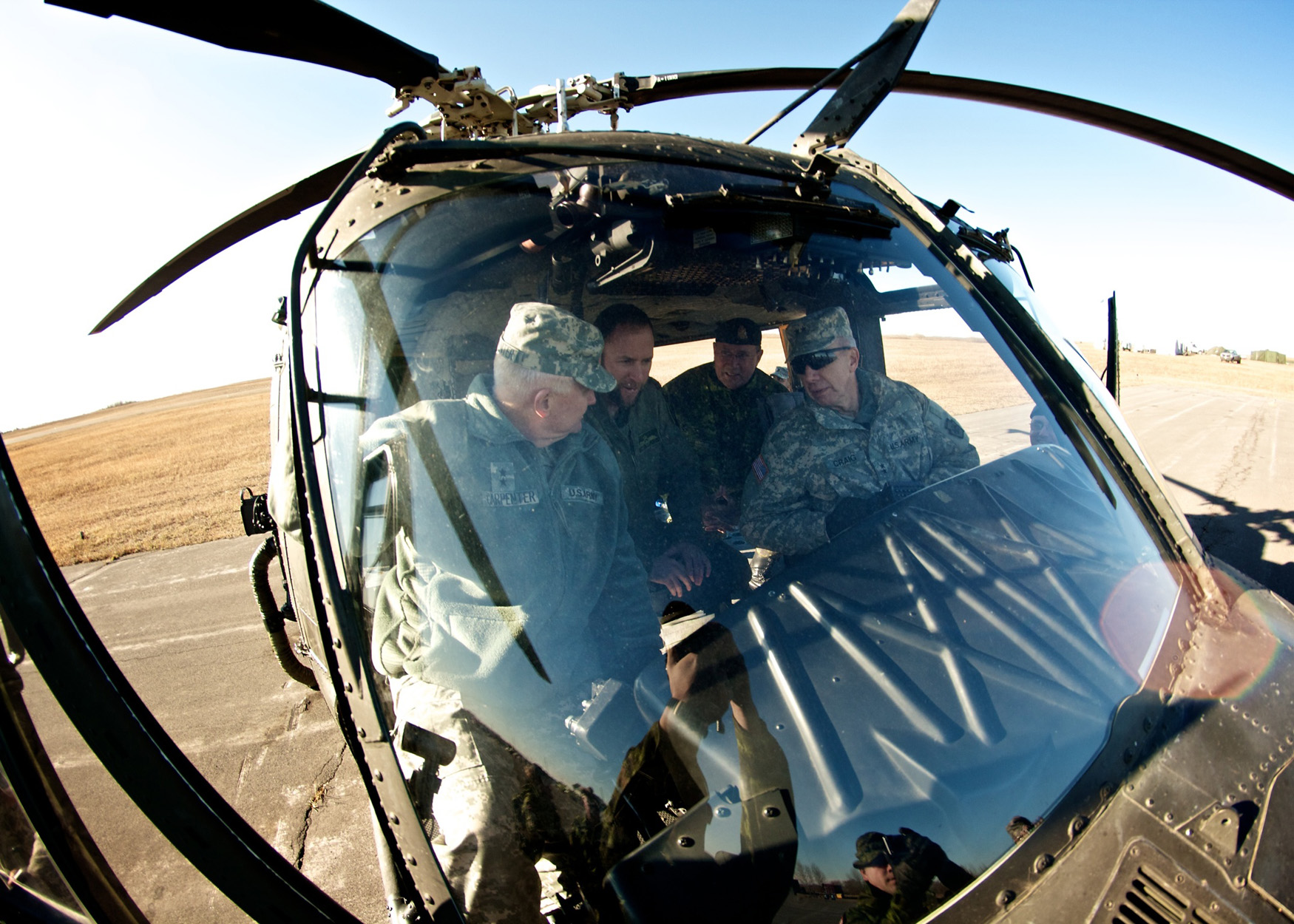
Canadian army pilot gives tour of helicopter
The pilot of a Canadian CH-146 “Griffon” orients Army Maj. Gen. Raymond Carpenter, acting director of the Army National Guard, and Maj. Gen. Wesley Craig Jr., the adjutant general of the Pennsylvania National Guard during Exercise Maple Resolve in October 2011. (Canadian army photo by 2nd Lt. Javin Lau)

CH-47F Chinook crew prepare for night operations
A CH-47F Chinook helicopter crew with the Pennsylvania Army National Guard’s B Company, 2nd of the 104th General Support Aviation Battalion prepares for night operations during Exercise Maple Reserve in October 2011. The Pennsylvania National Guard, due to its assets and proximity to the Canadian border, were called on to help the Canadian army with pre-deployment training requirements. (Canadian army photo by 2nd Lt. Javin Lau)

Wreath Laying at Lone Sailor Held in Remembrance of Pearl Harbor

By Mass Communication Specialist 3rd Class Shannon Burns, Defense Media Activity

WASHINGTON (NNS) -- Naval District Washington hosted a wreath laying ceremony at the U.S. Navy Memorial in Washington, D.C., Dec. 7, to commemorate the 70th anniversary of the attack on Pearl Harbor.

Among those in attendance were Pearl Harbor survivors and their family members as well as retired Rear Admiral Edward K. Walker Jr. At the time of the attacks Walker was just nine years old and stationed with his family at Pearl Harbor. At the time Walkers' father was a Lt. Cmdr. as the operations officer of a staff command. Walker said he remembers watching the smoke rise.

"I climbed up on the roof of our house and from there I could see the smoke. I was close enough that I could feel the concussions from the bombs, that went on for about an hour," said Walker. "Then the second wave came in. The planes flew over the mountain behind our house and on into Pearl Harbor."

Walker said he was honored to be a part of the wreath laying and that it was very personal to him.

"I'm very emotionally involved in the wreath laying," Walker said. "I served 38 years in the Navy and my father served 33.

Walker also said that remembering Pearl Harbor is important for several reasons.

"Most important is remembering the sacrifices, dedication and courage of the nearly 2,400 people who lost their lives that day," said Walker. "Pearl Harbor teaches us that we as military people must always be prepared to meet an enemy capability."

Walker invited retirees to come and enjoy the Navy Memorial.

"I want to ask all of the Navy, Marine Corps, and Coast Guard veterans to please visit your Navy Memorial," said Walker. "You helped build it, you help keep it running. This memorial represents you, your dedication, your sacrifices, and your courage."

Following the wreath laying a panel discussion was held in the Navy Memorial Historical Society with Pearl Harbor survivors sharing their memories of that day.

Wednesday, December 07, 2011

Message to Pearl Harbor Survivors

As Delivered by Secretary of Defense Leon E. Panetta

Seventy years ago on a December morning, our nation sustained a cruel and destructive attack at Pearl Harbor.  Our enemies thought that by this sudden and deliberate raid, they could weaken America.  Instead, they only strengthened it.  That day truly awoke a sleeping giant.

As we join you in remembering the events of December 7, 1941, we honor you and your fallen comrades for your indomitable will – and we remember the sacrifice and shared purpose of the American people, as well as the strength of our elected and military leaders during the war.

December 7, 1941 was indeed a day that will live in infamy.  But in the memories of that day we continue to draw determination and conviction to protect our freedoms, to sacrifice for our fellow citizens, and to serve a purpose larger than self.  You, the survivors of Pearl Harbor and of the war that followed, embody this conviction, this determination to raise high the torch of freedom and sacrifice.  From your stories, posterity records for all subsequent generations the emotion, the heroism, and the tragedy of a harrowing attack and the titanic struggle that would later unfold.

As a young boy, I remember seeing troops move through Fort Ord during the war years in Monterey, California.  My parents would invite soldiers into our home for Christmas dinner, and I remember seeing young men from all over the country about to go to war.  And I remember thinking in that uncertain time: “This is going to be the last opportunity these young men have to enjoy the comforts of home for a long time.”

You are the veterans of that greatest generation.  You have lived full lives and witnessed years of great prosperity because of the freedom you helped to secure for America and her allies.  I know you take great pride, as I do, that your legacy lives on in today’s men and women in uniform, who have borne the burden of a decade of war, and who are truly this nation’s next greatest generation.  The 9/11 generation, like you, has stepped forward in your image of service and sacrifice, volunteering for military duty after another sudden and terrible attack on our shores.

We treasure you.  You have brought everlasting credit to your fallen comrades.  The men and women in today’s military stand on the shoulders of your individual and combined sacrifice and service to our nation.  Your example inspires those in uniform today, strengthens our nation’s moral fiber, and proves that with united resolve our country can surmount any challenge.  Thank you for your service, for your sacrifice, and for your endless zeal to see to it that our children and grandchildren can pass along a better life to the next generation.  This has always been the American dream, a dream we can realize because of the determination of our citizens to defend it.

God bless you, God bless our troops, and God bless the United States of America.