Monday, June 08, 2026

104th Fighter Wing Strengthens Regional Medical Readiness With Multiday Emergency Decontamination Course

The Massachusetts National Guard's 104th Fighter Wing Medical Group enhanced regional medical readiness by hosting the Air Combat Command Emergency Decontamination Course at Barnes Air National Guard Base in Westfield, Massachusetts, June 1-6, marking the first time the Air National Guard has hosted a remote training team for this course.
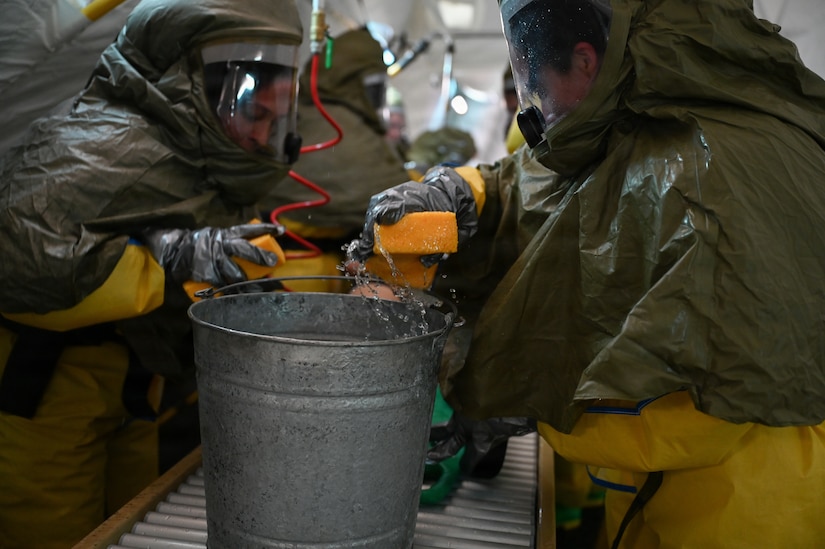
Two people wearing hazmat gear rinse out a steel bucket with a red water hose while scrubbing it with sponges.

The multiday training brought together more than 70 airmen from Region 1 and other regions, including the 103rd Airlift Wing, 114th Fighter Wing, 150th Special Operations Wing, 158th Fighter Wing and 161st Air Refueling Wing. Through two iterations of the course, participants completed hands-on instruction in equipment setup, personal protective measures, patient handling and full-scale decontamination operations.

Patient decontamination, or PT Decon, is a 19-person unit type code designed to decontaminate patients before they enter a medical facility during chemical, biological, radiological or industrial contamination events. The capability is essential for protecting medical staff, maintaining facility operations and stabilizing victims before they receive further care.

"The importance of [emergency management decontamination training] is the ability to safeguard a medical facility in the event of having to support victims [who] come in with contamination," said Saulo Ugarte, the course lead instructor. "The purpose is to teach these medical teams the process of setting up and decontaminating victims prior to going inside a medical facility in order to ensure that the staff inside is protected, as well as the facility itself. The PT Decon course extends beyond contamination removal."
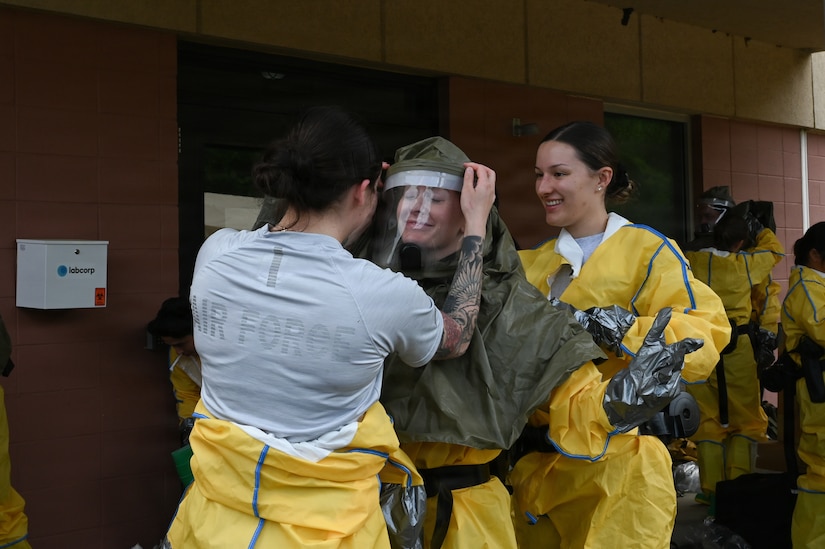
Three women help each other put on hazmat protective clothing and gear.

"The second part [of the PT Decon course] is ensuring that we do lifesaving situations; for example, stabilizing the victims and making sure they're stabilized through the process in order to get the medical needs they need in a clean facility after they've been decontaminated," Ugarte said.

For the 104th Fighter Wing, hosting the course represented a significant milestone in both capability and readiness.

"This is the first time that the guard has ever done the remote team," said Air Force Chief Master Sgt. Timothy Mutti, senior enlisted leader assigned to the 104th Fighter Wing Medical Group. "The Air National Guard Medical Training Division was here the last two days evaluating to see if it was up to par. Overall, it went really well."

Bringing the course to Barnes Air National Guard Base allowed multiple units to train together, strengthening regional interoperability. The collaboration also tested the airmen's abilities to operate under the demands while in full protective gear.

"My favorite part from this course is the teamwork that is involved, not only in putting it together, but the barrier of communications and how we work around that," said Air Force Senior Airman Malachi Paiz, an aerospace medical technician assigned to the 150th Special Operations Wing. "You have limited communications when having the hazmat on. It's hard to hear, and you have to communicate in different ways, such as hand signals, touching, just trying to be creative in a chaotic environment."
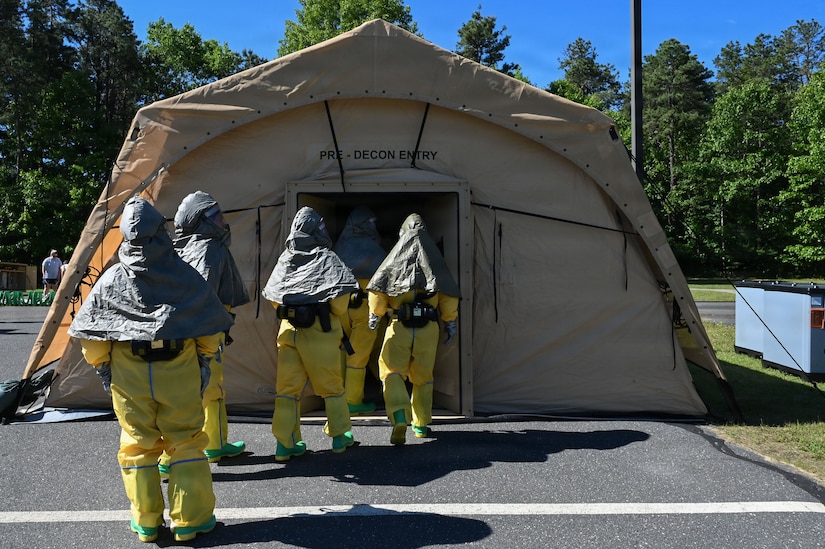
Four people wearing hazmat gear enter a tent.

Aside from the technical challenges, airmen had the opportunity to build relationships outside of their units and gain a better understanding of their shared mission.

"I think meeting all the other people [who] came from the other bases was the best part of the course," said Air Force Airman 1st Class Meledith LeBron, a bioenvironmental engineer specialist assigned to the 104th Fighter Wing. "You get so used to the people [who] you're with, then you meet other people and you realize we're all doing the same thing, and we all know what we're going through."

The 104th Fighter Wing wanting to network and build relationships contributed to the decision to host the training locally.

"It was about getting the region fully trained," Mutti said. "Hosting it [at the 104th Fighter Wing] meant we could get a large portion of units trained at once."
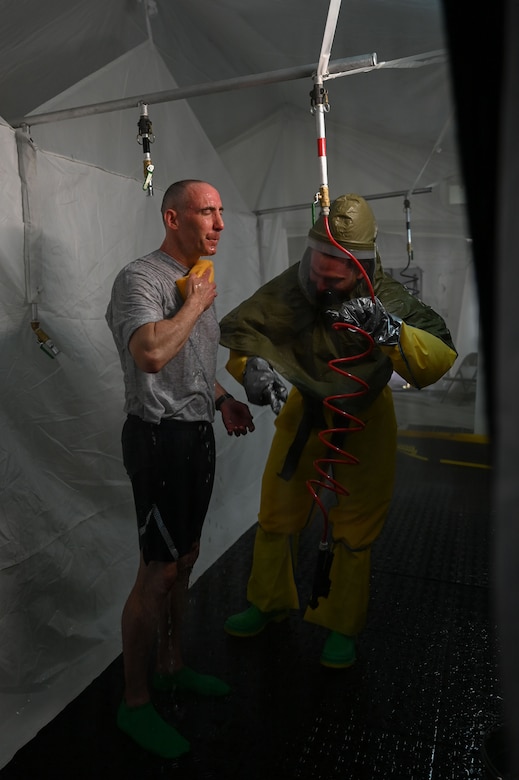
A man wearing hazmat gear rinses off while another man wearing athletic gear standing next to him does the same.

Throughout the course, instructors guided airmen through realistic scenarios using operational equipment. The final day featured a capstone event with simulated patients, requiring teams to demonstrate communication, coordination and technical proficiency under pressure.

"The airmen are doing a really good job with what time they've had," said Brandy Tarala, a course instructor. "Everybody steps in, and you don't even have to tell them. They say, 'OK, what can I do?' The teamwork makes the process go a lot more efficiently. We don't get that all the time, because not everybody [who] takes this class wants to be here."

The course also supports broader goals within the 104th Medical Group to strengthen team cohesion and ensure deployable capability.

"My overarching goal is bringing our readiness back to where we need to be for the medical enterprise," Mutti said. "But my interior goal is team building, ensuring the 19-person team works together, understanding each other's strengths and building confidence."

As the week concluded, leaders emphasized the importance of continued regional collaboration and recurring training opportunities.

"If we can get the region ready, we will be a better asset," Mutti said.

By hosting the ACC Emergency Decontamination Course for the first time, the 104th Fighter Wing strengthened its medical readiness posture, expanded regional capability and ensured that airmen remain prepared to respond to contamination events in any environment.

DOW Releases List of Chinese Military Companies in Accordance With Section 1260H of the National Defense Authorization Act for Fiscal Year 2021

Today, the Department of War released an update to the names of "Chinese military companies" operating directly or indirectly in the United States in accordance with the statutory requirement of Section 1260H of the National Defense Authorization Act for Fiscal Year 2021, which is available on the Public Inspection Issue of the Federal Register. After the Department conducted its due diligence, it identified 188 entities that meet the statutory requirements for inclusion on the most recent 1260H List.

The Department will update the list with additional entities as appropriate. The United States Government reserves the right to take additional actions on these entities under authorities other than Section 1260H. The list is available here.

About the Office of the Assistant Secretary of War for Industrial Base Policy (OASW(IBP))

The Assistant Secretary of War for Industrial Base Policy (ASW IBP) works with domestic and international partners to forge and sustain a robust, secure, and resilient industrial base enabling the warfighter, now and in the future.

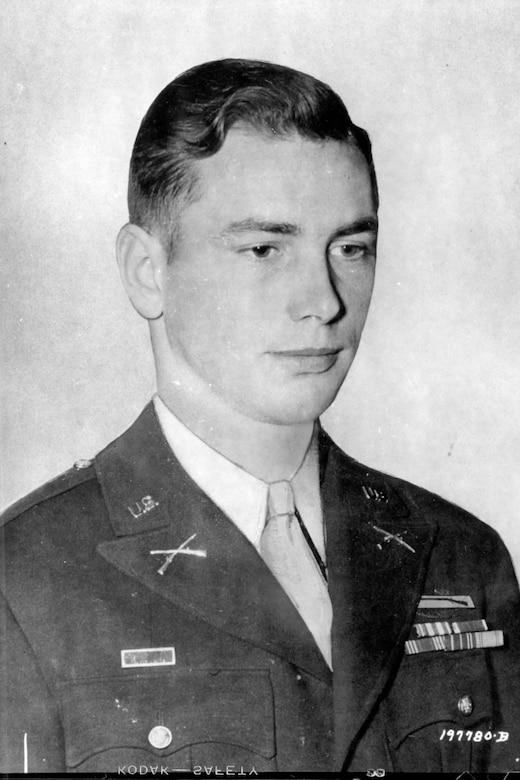
Medal of Honor Monday: Army 2nd Lt. Walter D. Ehlers

Army 2nd Lt. Walter D. Ehlers served in Europe and North Africa as an infantryman during World War II.

A man wearing an Army dress uniform poses for a photo.

He was born, May 7, 1921, on a farm in Junction City, Kansas, to John and Marie Ehlers. He married Dorothy Decker in 1955. They had three children and many grandchildren. 

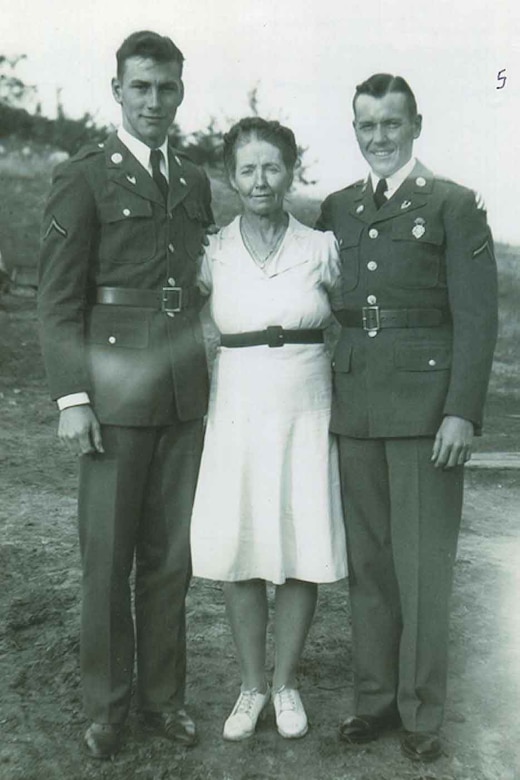
Ehlers and his older brother Roland enlisted in the Army in October 1940 and completed basic training at the Presidio of San Francisco. 

They served together in the 1st Infantry Division, fighting in North Africa from November 1942 to May 1943, and in Sicily in July and August 1943. 

After Sicily, the brothers were split up and assigned to different units to lessen the chance that both would be killed. Both were squad leaders with the rank of sergeant during the June 6, 1944, D-Day landings on Omaha Beach in Normandy, France.

The landing craft that Roland was on was hit by a German artillery round, just as it hit the beach, killing him and his entire squad.

Two men wearing military uniforms and a woman pose for a photo.

That day, Ehlers led his squad — 3rd Squad, 3rd Platoon, Company L, 3rd Battalion, 18th Infantry — across the beach and up a bluff, where they captured German machine gunners manning a pillbox. 

On June 9, 1944, Ehlers was leading his squad through a field when they were ambushed by German machine guns. Ehlers ran around the German flank, killing a number of them. 

The next day, his squad crossed an open field toward enemy positions. When the Germans opened fire, Ehlers and his automatic rifleman jumped up out of cover and began shooting into enemy positions, drawing all attention to themselves while the rest of the men escaped. Although he was wounded, Ehlers carried a wounded comrade to the rear for treatment. 

His Medal of Honor is for valor on those two days. 

Shortly thereafter, Ehlers was promoted to staff sergeant and then to second lieutenant, in recognition of his leadership. In March 1945, he led his platoon across the Rhine River at the bridge over Remagen, Germany. The following month, he was wounded in the leg and hip by friendly fire. 

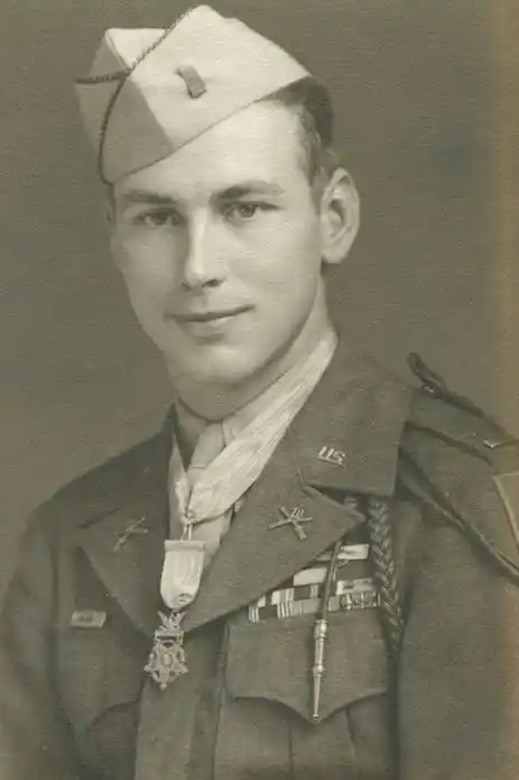
His Medal of Honor was presented to him by Army Lt. Gen. John C.H. Lee in Paris. Lee had also made the D-Day landings.

A man wearing a military uniform and a medal around his neck poses for a photo.

After World War II ended, Ehlers moved to California and worked for the Veterans Administration. 

On June 6, 1994, marking the 50th anniversary of the D-Day invasion, Ehlers returned to France and gave a speech on Omaha Beach. President Bill Clinton and Queen Elizabeth were also in attendance. 

"I pray that the price we paid on this beach will never be mortgaged, that my grandsons and granddaughters will never face the terror and horror that we faced here," Ehlers said in his speech. "But they must know that without freedom there is no life, and that the things most worth living for may sometimes demand dying for."  

Ehlers appeared in the 1955 film "The Long Gray Line," starring Tyrone Power. Power served in the Marine Corps during World War II. 

Ehlers died Feb. 20, 2014. He was the last surviving Medal of Honor recipient who participated in the D-Day landing in Normandy. 

He is buried at Riverside National Cemetery in Riverside, California. His medal is on display at the National WWII Museum in New Orleans. 

Friday, June 05, 2026

Maine Air National Guard Surges Support for Operation Epic Fury

 June 5, 2026 | By Air Force Senior Master Sgt. Andrew Sinclair, 101st Air Refueling Wing

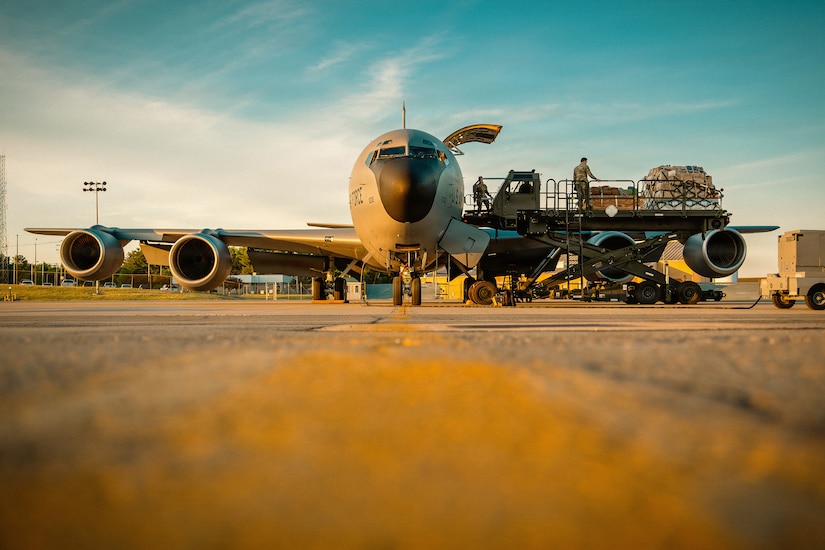
A large military aircraft sits on a flight line with the door open as people in camouflage military uniforms load cargo.

Air Transportation Function airmen assigned to the Maine Air National Guard's 101st Air Refueling Wing helped move more than 747,000 pounds of cargo and 312 passengers since the start of Operation Epic Fury.  

The effort helps keep vital supplies flowing to the U.S. Central Command area of operations. 

Since the operation began, the wing's distribution team has handled 302 pieces of cargo, including loose items, shipping containers, baggage pallets, hazardous explosives, weapons systems awaiting parts and miscellaneous aircraft parts. The team supported 97 missions made up of 15 C-17 Globemaster III aircraft, four KC-46 Pegasus aircraft, 76 KC-135 Stratotankers, two C-130J Super Hercules aircraft and one C-5 Galaxy, while also managing 67,472 pounds of passenger weight. 

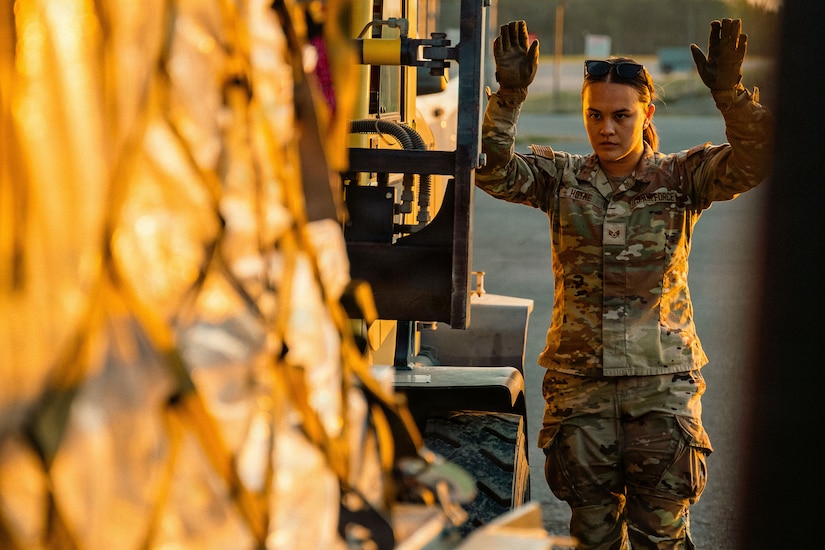
A woman in a camouflage military uniform directs a military loading machine carrying a pallet of supplies.
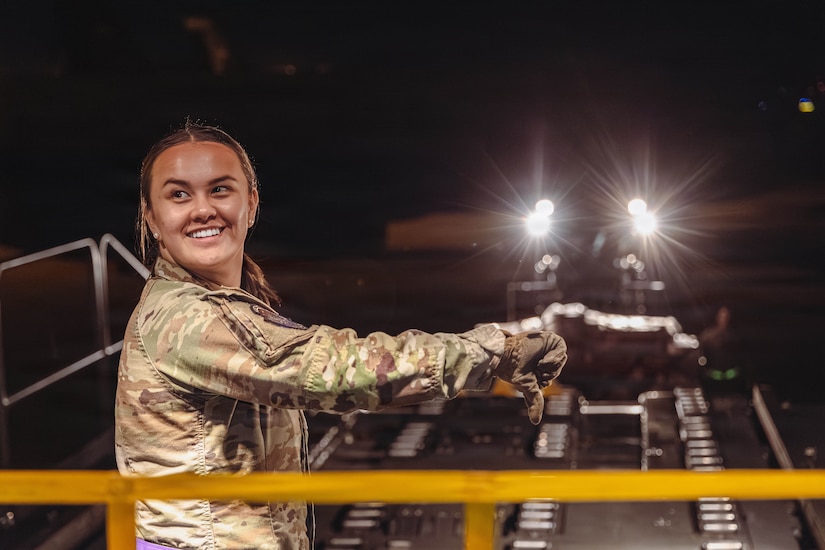
A woman in a camouflage military uniform smiles and looks back while giving a thumbs down during the evening hours on a flight line. Vehicle headlights shine in the distance.
The team received 70 inbound nonmilitary shipments from vendors, Air Mobility Command and other organizations headed for the Centcom area of responsibility. Outbound, they packed, marked, labeled and processed 394 shipments under the military standard requisitioning and issue procedure — weighing about 5,000 pounds. 

To keep up with the faster pace, distribution members from five different units, plus one civil engineering airman, joined the wing. These augmentees brought valuable experience in cargo and passenger operations. Among them was Air Force Staff Sgt. Eric LeFave, an air terminal operations center information controller assigned to Pease Air National Guard Base in New Hampshire. 

"So far, my job here has been assisting in the forward movement of mostly critical cargo and [mission impaired capability awaiting parts] to support my fellow wingmen and broken aircraft downrange," LeFave said. 

The work has special meaning for LeFave, who returned from overseas in October. 

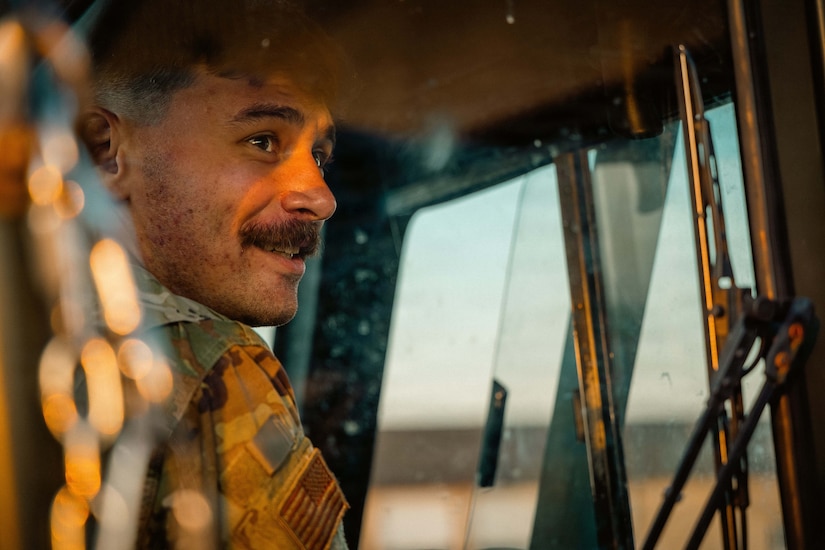
A man in a camouflage military uniform looks out the window of a military loading vehicle.

"I know who's currently out in the Middle East and helped get them spun up before I left," he said. "Being able to come up here to Maine and help get them anything they need is important to me. This is the job, and this is what I signed up for. I give this career my best because that's what the Air Force needs at all times."

Air Force Chief Master Sgt. Grady Thurlow borrowed three additional pieces of material handling equipment from partner units to keep cargo moving smoothly. Ground transportation crew members also borrowed an extra bus from a geographically separated unit in South Portland. 

"The true measure of this team was tested during the heightened operational tempo," said Air Force Capt. Alyssa Nelson, a distribution officer assigned to the wing. "The willingness of other units to integrate into our operations reflects the highest standard of teamwork. The collaborative effort not only builds professional relationships but is vital to mission success."

U.S. Navy to Christen Future USNS Thurgood Marshall

The U.S. Navy will christen its newest John Lewis-class fleet replenishment oiler, USNS Thurgood Marshall (T-AO 211), during a 10 a.m. PDT ceremony on Saturday, June 6, 2026, at General Dynamics National Steel and Shipbuilding Company (NASSCO) shipyard in San Diego, California.

Marine Corps Maj. Gen. David Bligh, Judge Advocate General of the Navy, will deliver the principal address. Additional remarks will be provided by Vice Adm. Doug Verissimo, Commander, Naval Air Forces/Commander, Naval Air Force, U.S. Pacific Fleet; Rear Adm. Benjamin Nicholson, Commander, Military Sealift Command; and David Carver, President of General Dynamics NASSCO.

In a time-honored tradition, the ship sponsors, the namesake's granddaughters, Cecilia L. Marshall and Melonie Tibbs, and granddaughter-in-law, Alissa Kamens Marshall, will christen the ship by breaking a bottle of champagne across the bow.

T-AO 211 is named in honor of former Justice Thurgood Marshall, who served on the Supreme Court for nearly 25 years. The future USNS Thurgood Marshall (T-AO 211) is the seventh ship of the John Lewis-class fleet replenishment oilers and will be operated by the Navy's Military Sealift Command.

The John Lewis-class ships are based on commercial design standards and will recapitalize the current T-AO 187-class fleet replenishment oilers to provide underway replenishment of fuel to U.S. Navy ships at sea. These ships are part of the Navy's Combat Logistics Force.

The future USNS Thurgood Marshall (T-AO 211) represents a proud lineage, serving as the thirteenth naval support logistics ship to be named in honor of a U.S. Supreme Court Justice. This tradition began in 1942 with the launch of the EC2-S-C1 liberty cargo ship SS John Jay, which provided vital wartime support by transporting essential military cargo to build the massive logistics reserve required for Operation Neptune — the historic D-Day landings.

As we commemorate the anniversary of D-Day today, we remember a hard-won victory that dramatically reshaped the course of human history, bringing the promise of freedom to generations worldwide. Yet, this monumental triumph would not have been possible without the unprecedented Allied shipbuilding programs that preceded the war, and the tireless logistics and replenishment ships that sustained the fight — delivering the critical fuel, ammunition, and supplies that kept our troops and Allied partners moving forward to victory.

Echoing the historic mission of the SS John Jay, the addition of T-AO 211 to the fleet provides the Navy with a reinforced ability to sustain distributed maritime operations, enhance mobility, and deliver the critical resupply capacity needed to support a more resilient, ready, and globally present fleet.

The christening of T-AO 211 underscores the Navy's commitment to building America's Fleet of the Future. For 250 years, American naval power has projected strength globally. That mission continues — and intensifies. We operate forward 24/7, 365 days a year. This operational tempo demands continuous capability delivery, and the Fleet of the Future is our answer

Washington National Guard Builds Counter-UAS Partnerships Ahead of World Cup 2026

As unmanned aerial systems continue to evolve from recreational tools into potential threats to public safety, critical infrastructure and major public events, the Washington National Guard is positioning itself at the forefront of counter-UAS training and readiness.

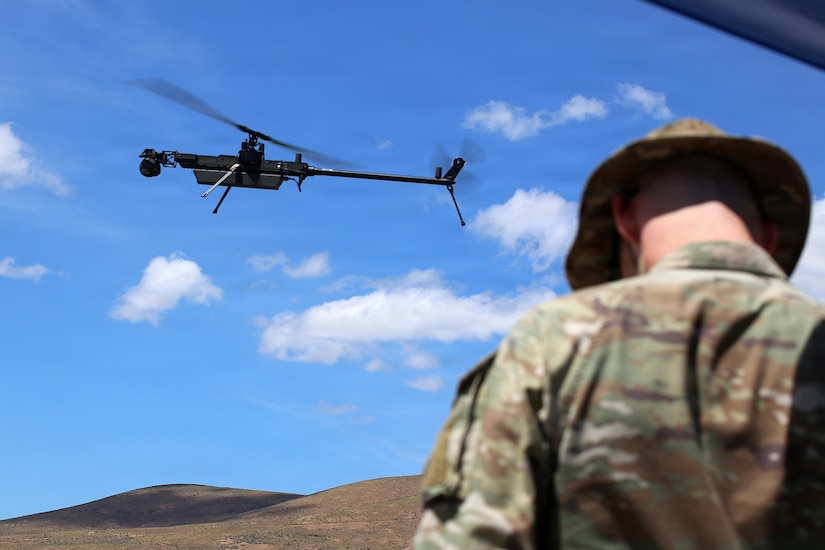
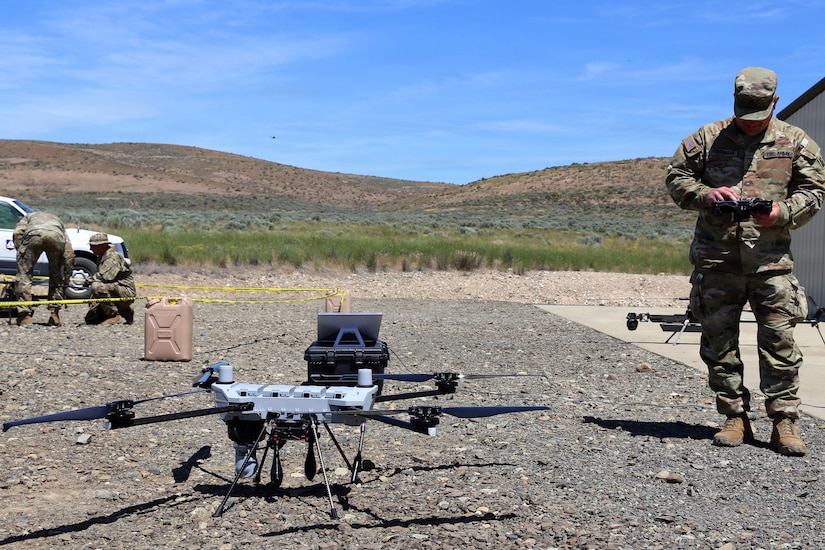
A drone flies in a blue sky with clouds as a rear-facing person in a camouflage military uniform looks down to pilot it; hills are in the distance.

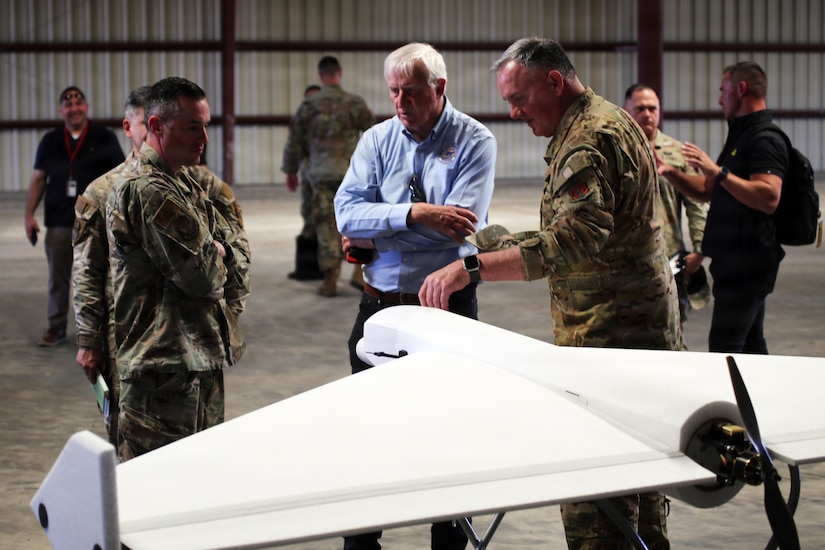
Representatives from federal, state and local law enforcement agencies gathered for a counter-UAS field demonstration day at the Yakima Training Center, Washington, June 2.  
 
The event included multiple active-duty and National Guard units, state defense forces, the Washington Emergency Management Division and the Civil Air Patrol. It showcased emerging technologies and operational tactics designed to detect, track and mitigate drone threats while highlighting the Washington National Guard's growing role in developing a regional schoolhouse for counter-UAS training and innovation. 
 
Air Force Maj. Gen. Gent Welsh, the adjutant general and homeland security advisor for Washington, said the event represents a milestone not only for Washington but for the nation. 

Nearly a dozen people, some in camouflage military uniforms and others in casual attire, stand and talk in a hangar; a white drone sits on the floor in the foreground.

 
"When you look at all the FIFA states, all the FIFA cities and all the different challenges that people are dealing with, Washington is the only state that actually brought people together to rehearse and discuss any of this stuff," Welsh said. "This is the only one-of-its-kind event in the entire country that's going on." 
 
The demonstration marked the latest step in a yearlong effort by the Washington Military Department and Washington National Guard to build a comprehensive counter-UAS program ahead of the FIFA World Cup 2026, which will bring millions of visitors to the greater Seattle area. 
 
Recognizing the growing threat posed by UASs, the Washington Military Department hosted a counter-UAS summit in late 2025, which brought together leaders from government, public safety, academia and industry to discuss emerging challenges and opportunities in the rapidly evolving drone environment. The summit laid the groundwork for expanded partnerships and highlighted the need for a coordinated approach to airspace security. 
 
Building on that momentum, the Washington National Guard's Western Regional Counterdrug Training Center launched a counter-UAS fundamentals course to provide military, law enforcement and public safety professionals with foundational training in drone detection, identification, legal authorities and response planning. The program has attracted interest from agencies across the region as organizations prepare for large-scale public events and the growing presence of drones in everyday life. 
 
"A year ago, we were not in this space," said FBI agent Phil Randolph. "A year ago, we wouldn't have thought about drone detection around NFL stadiums. Now we're leaning forward." 
 
Among those preparing for the challenges ahead is the Seattle Police Department, which sent officers to specialized counter-UAS training in Huntsville, Alabama, as part of its preparations for the FIFA World Cup.  
 
While preparations for the World Cup have helped accelerate the effort, Welsh emphasized that the challenge extends far beyond a single event. 
 
"Don't just look at this as, 'Hey, we've got to get through FIFA, and then we'll go back to work,'" Welsh said. "We're going to be dealing with the threat for the rest of our lives." 
 
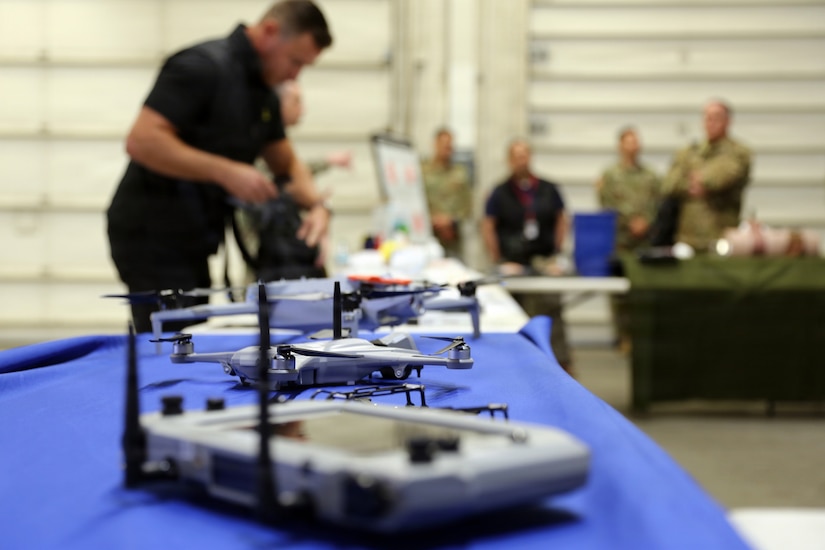
During the counter-UAS field demonstration day, participants observed a series of live demonstrations showcasing drone detection systems, swarm operations, interception techniques, radio-frequency mitigation capabilities and render-safe procedures. Attendees evaluated emerging technologies while discussing how those capabilities could be integrated into real-world operations. 

A drone sits on rocky terrain as a man in a camouflage military uniform looks down to pilot it; people in similar attire are in the background, and hills are in the distance.

 
For Washington National Guard leaders, Yakima Training Center also offers an ideal location to expand those efforts. 
 
"This really is the Kevin Costner moment from 'Field of Dreams,'" said Army Col. Phillip Lamb, Washington National Guard's senior Army advisor. "We have 327,000 acres of untouched, unobstructed training area right here at Yakima Training Center." 
 
Lamb, who served as the garrison commander for Joint Base Lewis-McChord, Washington, which also covers Yakima Training Center, said the installation's vast maneuver space provides a unique environment for agencies to train together, test emerging technologies and conduct realistic counter-UAS operations. 
 
"We can do a lot here and host so many organizations here," he said. "This space is underutilized, and I would love to see Yakima Training Center become that place that leads the way in counter-UAS." 
 
That vision extends beyond individual demonstrations and training events. 
 
"We want to build an Army counter-UAS center of excellence right here at Yakima Training Center," said Army Col. Craig Broyles, Washington National Guard's counterdrug program director. 
 
Broyles noted that the installation already possesses many of the resources necessary to support a comprehensive training pipeline. 
 
"We have the classroom space for the beginner-level instruction and the training areas needed for practical exercises and advanced courses," he said. 

A close-up of several drones and remote controls sitting on a table; people in camouflage military uniforms and others in casual attire stand in the background.

 
Welsh said recent organizational changes have further strengthened the state's ability to address emerging aerial threats. 
 
"Bringing the Civil Air Patrol under the Washington Military Department has elevated our capabilities in the counter-UAS environment," he said. 
 
As drone technology becomes increasingly affordable and accessible, public safety officials continue working to develop policies, procedures and capabilities that can keep pace with a rapidly evolving threat environment. 
 
"Unmanned aircraft systems provide significant benefits for commercial, agricultural and public safety applications, but their potential misuse requires government agencies to remain vigilant," Welsh said. "Some people look at these drones and see a great tool to do agricultural spraying with; I look at these things, and I literally see an [improvised explosive device] with wings." 
 
For the Washington National Guard, the demonstration represented more than a technology showcase. It provided a glimpse into the future of counter-UAS training and highlighted Washington's efforts to bring together military, law enforcement, emergency management and industry partners to stay ahead of emerging threats.  
 
As preparations continue for the FIFA World Cup and other major events, leaders believe the partnerships, training opportunities and capabilities developed at the Yakima Training Center will help shape the future of counter-UAS operations not only in Washington but across the nation.

Signers of the Declaration of Independence: Georgia

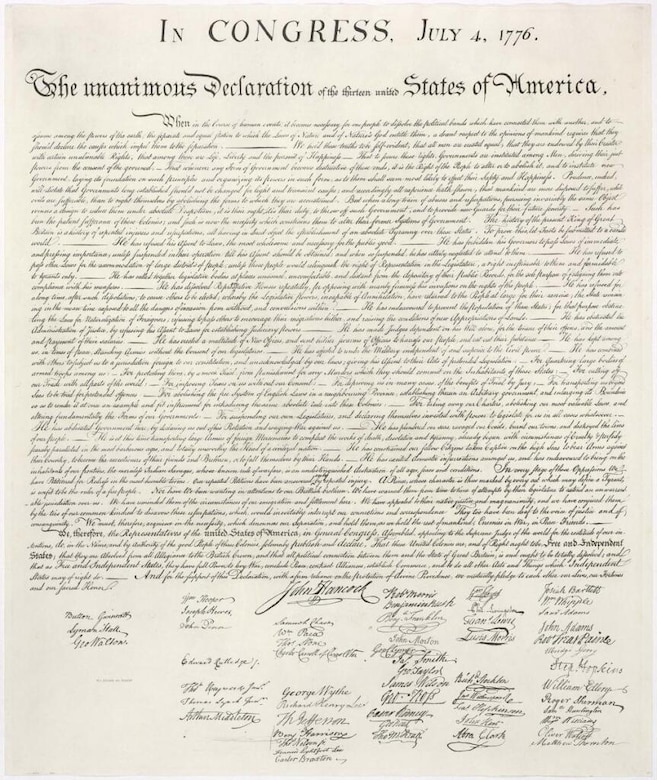
Delegates to the Second Continental Congress adopted the Declaration of Independence July 4, 1776. The 56 delegates who signed the formal break from Britain are all considered Founding Fathers; three represented Georgia.  

A document written in cursive with many signatures.

The Georgia delegates included Button Gwinnett, Lyman Hall and George Walton. Their signatures are on the far left of the document.

Button Gwinnett

Gwinnett was born in Gloucestershire, England, March 3, 1735, to the Rev. Samuel Gwinnett and his wife, Anne.

His early work included selling fruits and vegetables and metal work.

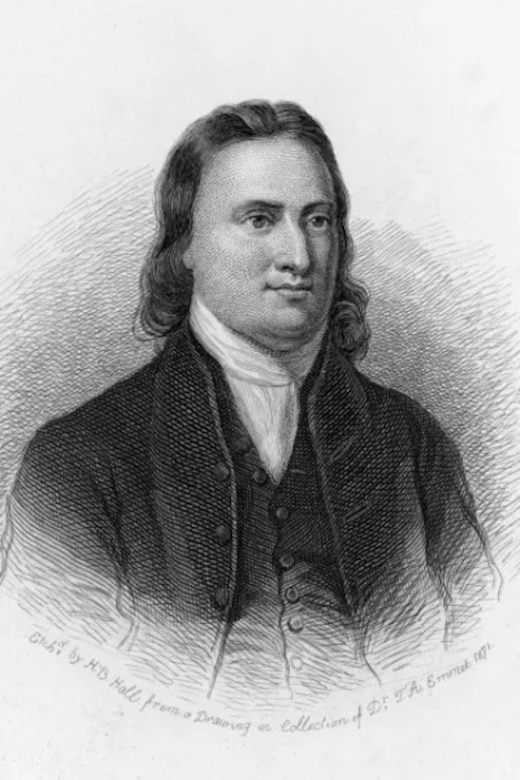
A black and white illustration of a man in formal attire.

On April 19, 1757, he married Ann Bourne. By 1762, the couple had three daughters and began moving to various places in North America in search of opportunities. 

In 1765, he moved to the Georgia coast, eventually settling on a plantation on St. Catherine's Island, where he met Hall. He held several political positions, and in 1775, Gwinnett joined Hall in Philadelphia at the Second Continental Congress.

After signing the declaration, he was elected speaker of the Georgia assembly.

In 1777, after the failed attack by Georgia troops on British East Florida, Gwinnett argued with Continental Army Brig. Gen. Lachlan McIntosh.

Reportedly, McIntosh called Gwinnett "a scoundrel and lying rascal." As a result, Gwinnett challenged McIntosh to a duel on May 16, 1777. The two stood 12 paces apart and fired their pistols; both were shot, but Gwinnett's wound eventually proved fatal.

Gwinnett died May 19, 1777, from an infected gunshot wound, and is buried in Colonial Park Cemetery, Savannah, Georgia.

Gwinnett County, Georgia, is named after him, as was the SS Button Gwinnett, a World War II Liberty ship launched in May 1943.

Lyman Hall

Hall was born April 12, 1724, in Wallingford, Connecticut. His parents were John and Mary Hall; John Hall was a minister. In 1747, he graduated from Yale College. For a brief time, he served as a minister, following in his father's footsteps.

A black and white illustration of a man in formal attire.

He married Abigail Burr in 1752, but she died a year later. He married Mary Osborne in 1757, and they moved to South Carolina, where he worked as a physician. Shortly before the Revolutionary War, they moved to Georgia, and in 1783, just before it ended, he was elected governor of Georgia.

Hall later left politics to resume a career in medicine. He died Oct. 19, 1790, and was buried on his land overlooking the Savannah River.

Hall's remains were exhumed in 1848 and reinterred beneath the Signers Monument, an obelisk that stands in front of what is now the Augusta, Georgia, Municipal Center. The obelisk memorializes the three Georgia representatives who signed the Declaration of Independence.

Hall County, Georgia, is named for him.

George Walton

Walton was born in Cumberland County, Virginia, around the middle of the 18th century. His parents, Robert and Mary Walton, both died before he was 12, and his uncle adopted him. He grew up poor and apprenticed as a carpenter, but he studied at night.

In 1769, Walton moved to Savannah, Georgia, to study law.

A black and white illustration of a man in formal attire.

During the Revolutionary War, he was a militia colonel in the First Georgia Regiment.

During the Battle of Savannah in 1778, he was wounded and taken prisoner by the British. In a 1779 prisoner exchange, he was released. He held several political positions, including secretary of the Georgia provincial congress, the Continental Congress and governor of Georgia.

In 1795, he was appointed to the U.S. Senate. He died Feb. 2, 1804, and was buried at Rosney Cemetery in Augusta. In 1848, his remains were exhumed and reinterred beneath the Signers Monument with Hall.

Walton County, Georgia, is named after him.

This is the first installment in a series of articles about the men who signed the Declaration of Independence. The 56 delegates to the Second Continental Congress, representing the 13 colonies, are all considered Founding Fathers.

Thursday, June 04, 2026

Exercise Red Flag-Alaska Launches Multinational Air Combat Training

Exercise Red Flag-Alaska 26-2 commenced May 28, bringing together more than 2,100 service members from the U.S. and partner nations for realistic air combat training at Eielson Air Force Base and Joint Base Elmendorf-Richardson, Alaska.

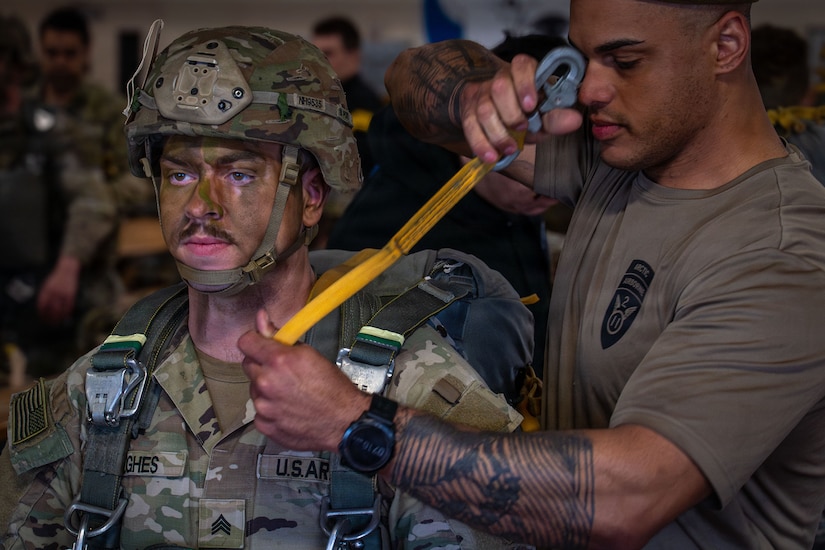
A man in a camouflage military uniform stands still as another man in similar attire checks his parachute.

The exercise integrates joint and coalition forces into a realistic threat environment using the approximate 120,000 square miles of airspace in the Joint Pacific Alaska Range Complex, enhancing readiness and warfighting capabilities with the largest combat training range in the world.

"This iteration focuses on strengthening partnerships by practicing operations together to improve response capabilities," said Air Force Maj. Gregory Guiney, assistant director of operations for the 354th Operations Group Detachment 1.

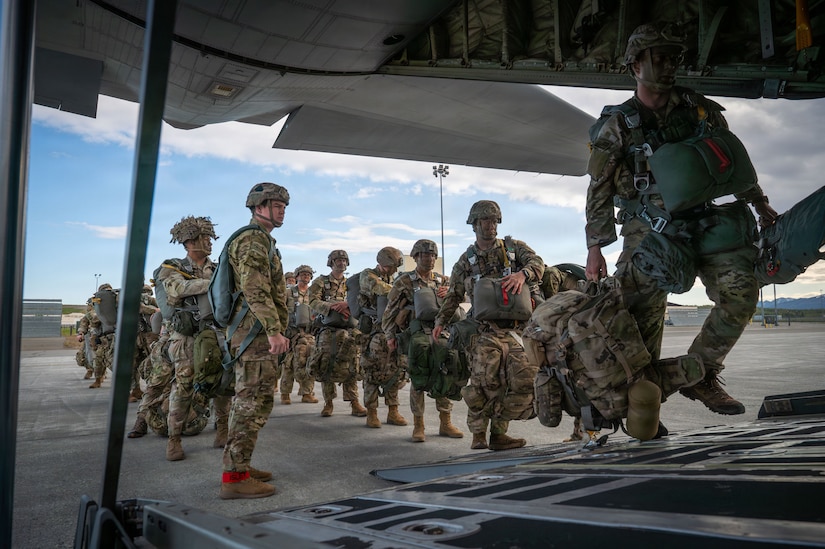
People in camouflage military uniforms are lined up at the back of a military cargo airplane.
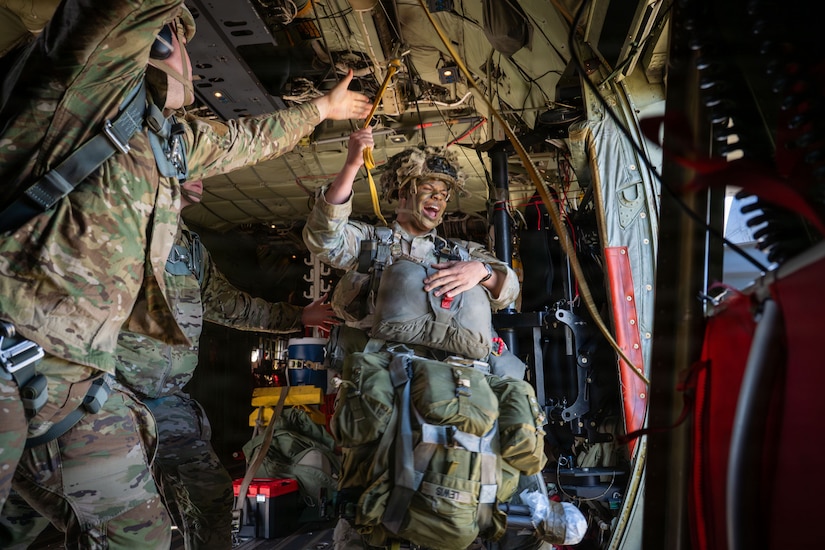
A man in a camouflage military uniform and jump gear prepares to jump out of a military aircraft. Another man in a camouflage military uniform reaches up to grab a jump line.
The training exercise includes participants from the U.S. Air Force, U.S. Army, Royal Air Force, Royal New Zealand Air Force, Royal Canadian Air Force and Republic of Singapore Air Force. Aircrews and support personnel will exchange tactics, techniques and procedures when executing mission sets, enhancing interoperability.

Joint Base Elmendorf-Richardson operations began with a C-130J Super Hercules aircraft assigned to the 36th Airlift Squadron from Yokota Air Base, Japan, conducting joint airborne operations involving an airdrop of two door bundles and 50 paratroopers from the 11th Airborne Division.

"The importance of this exercise is to build joint interoperability to project forces in the Indo-Pacific," said Army Capt. Zachary Tarble, air officer assigned to the 2nd Infantry Brigade Combat Team, 11th Airborne Division.

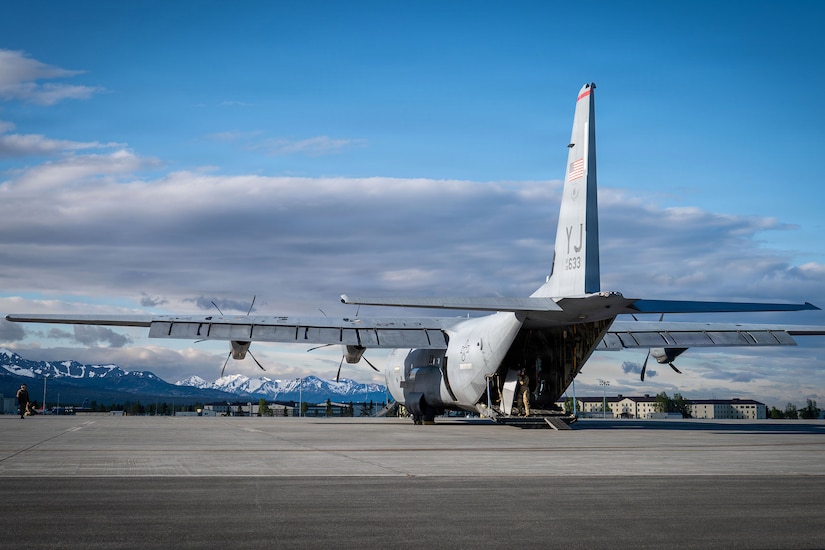
A military cargo airplane sits on a flight line. Buildings and mountains are in the background.

Exercise Red Flag-Alaska replicates Indo-Pacific region operational conditions, focusing on combined training with international partners and joint forces to enhance readiness and reinforce a shared commitment to regional security and stability.

The exercise is scheduled to continue until June 12.

DOW Announces Winners of the 2026 Commander in Chief's Annual Award for Installation Excellence

Secretary of War Pete Hegseth announced the 2026 recipients of the Commander in Chief's Annual Award for Installation Excellence.

The Commander in Chief's Annual Award for Installation Excellence recognizes the outstanding and innovative efforts of the people who operate and maintain U.S. military installations. The six recipients of this highly competitive presidential award were selected for their exemplary support of Department of War missions.

Recipients of the 2026 Commander in Chief's Annual Award for Installation Excellence are:

U.S. Army Garrison Fort Bliss, Texas
Installation Commander: Major General Curtis D. Taylor, U.S. Army
Garrison Commander: Colonel Brendan R. Gallagher, U.S. Army

Marine Corps Air Station Yuma, Arizona
Commanding Officer: Colonel Jared K. Stone, U.S. Marine Corps

Naval Station Mayport, Florida
Commanding Officer: Rear Admiral John Hewitt, U.S. Navy

Joint Base Andrews, Maryland
Commanding Officer: Colonel Jun S. Oh, U.S. Air Force

Peterson Space Force Base, Colorado
Commanding Officer: Colonel Kenneth F. L. Klock, U.S. Space Force

Defense Supply Center Columbus, Ohio
Commanding Officer: Rear Admiral Julie M. Treanor, U.S. Navy

Installations compete on how well they achieve the Department's objectives in several areas of installation management, including mission support, quality of life and unit morale, real property management, safety, health and security, communications, and public relations.

Excellent installations enable better mission performance and enhance the working and living conditions for military men and women, DoW civilians, and their families. Each of the winning installations succeeded at being the best in performing installation management within their military service and the Defense Logistics Agency. Each winning installation will receive a commemorative trophy, Installation Excellence flag, and a congratulatory letter from the President.

DOW Identifies Army Casualty

The Department of War announced the death of an Active Duty Soldier who was supporting Operation Inherent Resolve.

Sergeant Devin A. Seibel, 26, of Robinson, Texas, died on May 31, 2026, in Erbil Airbase, Iraq, during a training-related incident. The Soldier was assigned to the Air Ambulance Company, 2nd Battalion, 4th Combat Aviation Brigade, Fort Carson, Colo. The incident is under investigation.

For more information regarding Sgt. Seibel, members of the media may contact 4th Infantry Division's Public Affairs Office, Fort Carson, Colo., at usarmy.carson.hqda-ocpa.list.pao-media-relations@army.mil.

Wednesday, June 03, 2026

Joint Interagency Task Force 401 Conducts Multicommand Counter-UAS Qualification

Airmen assigned to the 90th Missile Wing joined personnel assigned to the Air Force Global Strike Command, Air Combat Command, U.S. Strategic Command and the Air National Guard for a counter-small unmanned aircraft systems firing qualification conducted in partnership with Joint Interagency Task Force 401 at Camp Guernsey Joint Training Center, Wyoming, May 14-15, 2026. 

As the battlefield continues to evolve, tactics, techniques and procedures must adapt alongside emerging threats. One of the most rapidly developing areas is the counter-small UAS environment, where technology, training and operational requirements are transforming quickly. 

Two people wearing camouflage military uniforms tie yellow latex balloons to a string attached to a drone flying in the blue sky overhead.

In August 2025, the War Department established JIATF 401 as the lead organization for synchronizing efforts to rapidly deliver counter-small UAS capabilities at scale to defend the homeland, protect U.S. and allied forces, defend critical infrastructure and assist federal agencies.  

The task force has one measure of effectiveness: rapidly delivering state-of-the-art counter-small UAS capabilities to warfighters at home and abroad. 

The two-day firing qualification tested and enhanced operators' ability to engage ground and aerial targets at varying distances using technologically advanced small-arms target acquisition systems. 

"Protecting our power projection platforms is a critical component of enhancing warfighter lethality," said Army Brig. Gen. Matt Ross, JIATF 401 director. "I am grateful for the partnership with the 90th Missile Wing, Air Combat Command and Air Force Global Strike Command that is enhancing [counter]-UAS training to keep our warfighters, installations and critical assets safe from drone threats." 

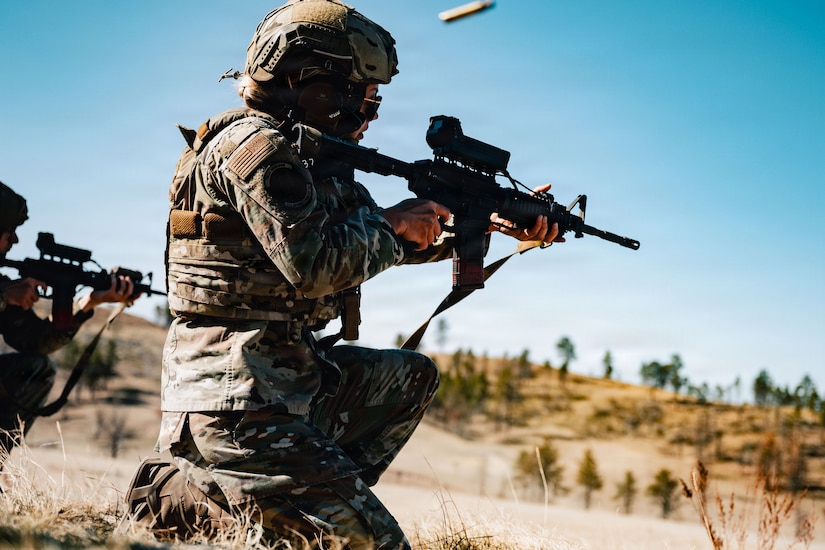
A person wearing a camouflage military uniform and helmet kneels in a grassy terrain and fires a military weapon; an ammunition round disperses out of the weapon.

Beyond supporting department-level counter-small UAS objectives, the qualification also provided 90th Missile Wing personnel with hands-on experience using emerging capabilities that support the Air Force Global Strike Command's broader modernization efforts and strengthen the wing's national security mission. 

The qualification comes as the Air Force Global Strike Command continues to modernize the tools and platforms that support missile field security and nuclear deterrence. With the transition from Humvees to Joint Light Tactical Vehicles and the replacement of UH-1N Hueys with MH-139A Grey Wolf helicopters, the command is adapting its capabilities to meet current and future security demands.  

Counter-small UAS training represents another layer of that modernization, preparing defenders to counter emerging unmanned threats to critical assets, personnel and the intercontinental ballistic missile mission. 

A close-up view of hands holding a flip-up remote control with levers, buttons and a screen.
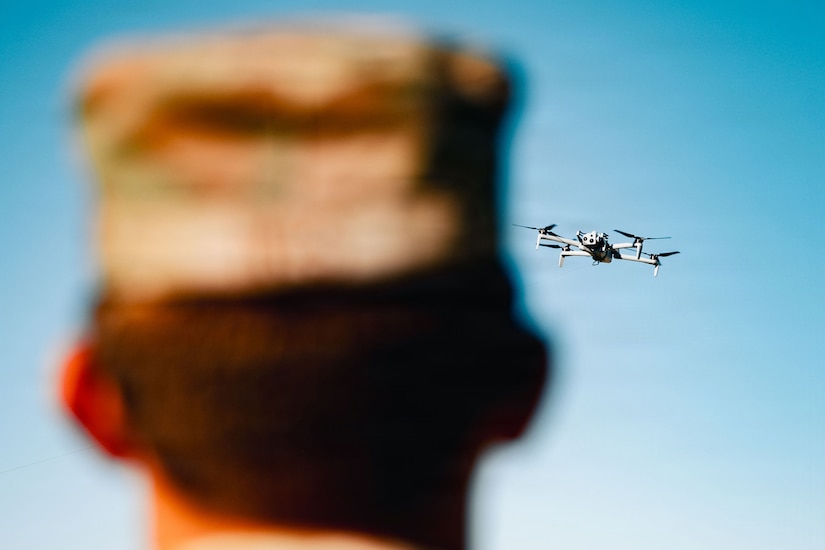
A close-up view of a rear-facing person watching a drone fly through a blue sky overhead.

"The system is a game changer," said Air Force Col. Jeremy Sheppard, 90th Security Forces Group commander. "When you hear one of our young defenders say they feel more confident and prepared, that's the metric that matters most to me as a commander. That confidence, born from having the best tools and training, translates directly into a more lethal and decisive force on the ground. This isn't just about fielding new technology; it's a direct investment from our [major command] in our most critical weapon system: the individual defender. We are sharpening the spear at every level, and this is what it looks like." 

For the airmen who participated, the qualification offered direct experience with systems designed to counter emerging threats and improve defender readiness in operational environments. 

"This training makes me more effective by giving me hands-on experience with systems designed to counter hostile drones," said Air Force Senior Airman Preston Reiger, a small UAS specialist assigned to the 90th Missile Security Operations Squadron. "It shows the wing is taking [counter-small UAS] seriously and actively building another layer of defense to protect our mission, assets and personnel." 

The qualification provided practical experience with capabilities designed to meet an evolving threat environment. Through continued collaboration with JIATF 401, the 90th Missile Wing is strengthening its ability to defend the nation's intercontinental ballistic missile mission today, while preparing for the security challenges of tomorrow.
Monday, June 01, 2026

Face of Defense: Damage Controlman Develops Next Generation of Warfighters


Face of Defense: Damage Controlman Develops Next Generation of Warfighters

Meet Navy Petty Officer 2nd Class Crystal Avila, an instructor assigned to Navy Recruit Training Command in Great Lakes, Illinois, the service's only boot camp.

Navy Petty Officer 2nd Class Crystal Avila
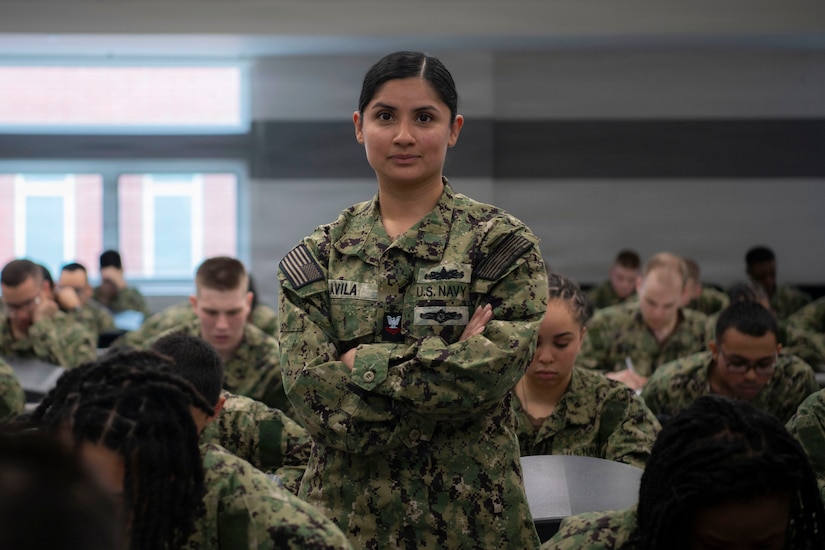
A sailor in a camouflage uniform stands with her arms crossed in a classroom setting, as sailors in similar attire sit at desks around her.
Job: Damage Controlman and Instructor
Stationed: Recruit Training Command, Great Lakes, Ill.
Unit: Navy
Hometown: Waukegan, Ill.
A native of Waukegan, Illinois, Avila joined the military 11 years ago looking for opportunity and a way to build a more stable future for her family. 

"I joined the Navy for the educational opportunities and the chance to travel and experience different cultures," Avila said. "It's also given my family financial stability and allowed my children to benefit from the unique experiences that come with military life." 

Building on her desire for learning and growth, Avila gained experience while serving aboard the aircraft carrier USS Dwight D. Eisenhower, the amphibious assault ship USS Essex, the destroyer USS Sampson and at Afloat Training Group Pacific Northwest in Everett, Washington. Across those assignments, she developed technical expertise in damage control and shipboard firefighting — skills that now shape how she trains the Navy's newest sailors. 

Avila said one of her earliest defining moments came during her first underway period aboard a carrier, when she experienced the scale and rhythm of life at sea for the first time. 

"I had been on the ship for a few months, but my first time going underway was completely different," she said. "Watching everyone prepare to be gone for a month made me realize how much there was to learn. I also hadn't realized how many people an aircraft carrier can hold. By the end of that underway, I understood what I needed to prepare and even started to appreciate how peaceful it can be in the middle of the ocean." 

'Every Sailor Is a Firefighter' 

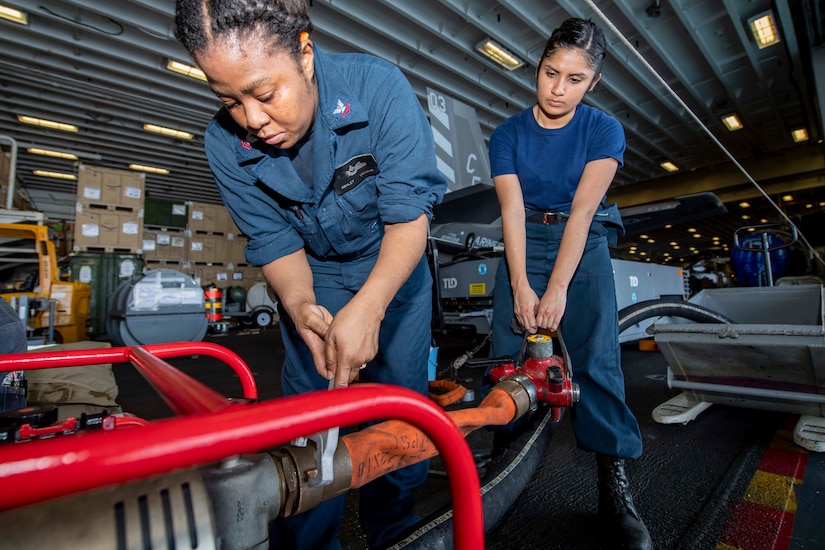
Two sailors, one using a wrench-like device to attach a hose to a pump as the other holds an attached piece of equipment, work in the hangar bay of a vessel.
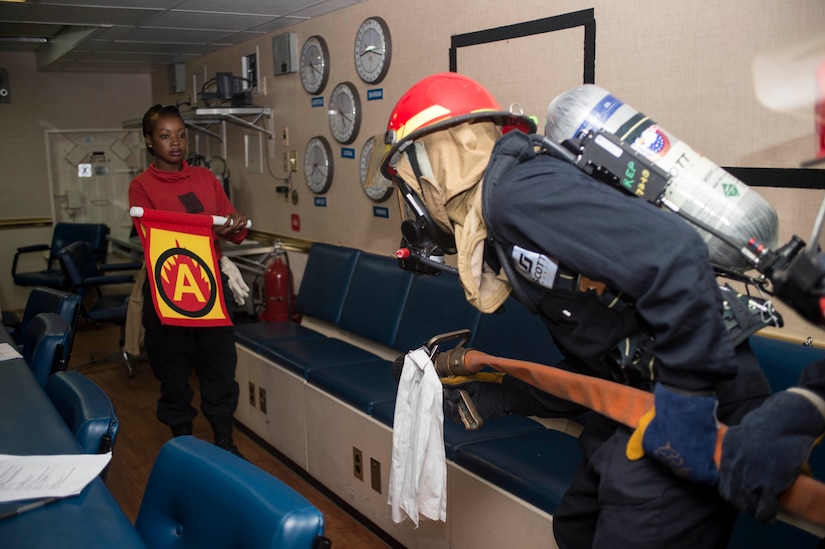
A sailor in firefighting gear holds a large hose and crouches in front of another sailor holding a red and yellow flag with an "A" on it indoors.
Inspired by stories from her recruiter, Avila chose the damage controlman rating — one that quickly revealed its importance to the safety of every sailor at sea. 

"The sea stories my recruiter told me about damage control had a big impact," she said. "Being a damage controlman, you really learn how important our equipment and training are. It also gave me the opportunity to train other sailors to control or mitigate casualties so everyone can make it home to their families. At the end of the day, every sailor is a firefighter." 

At Navy Recruit Training Command, Avila serves as both an instructor and testing proctor, responsible for teaching and evaluating recruits on required academic material and tactical combat casualty care assessments. 

"My job is to make sure recruits understand the material they need to succeed in boot camp," she said. "Whether it's an academic test or a [tactical combat casualty care] assessment, attention to detail is critical. Those habits carry over into everything we do in the Navy." 

Instructor of the Year 

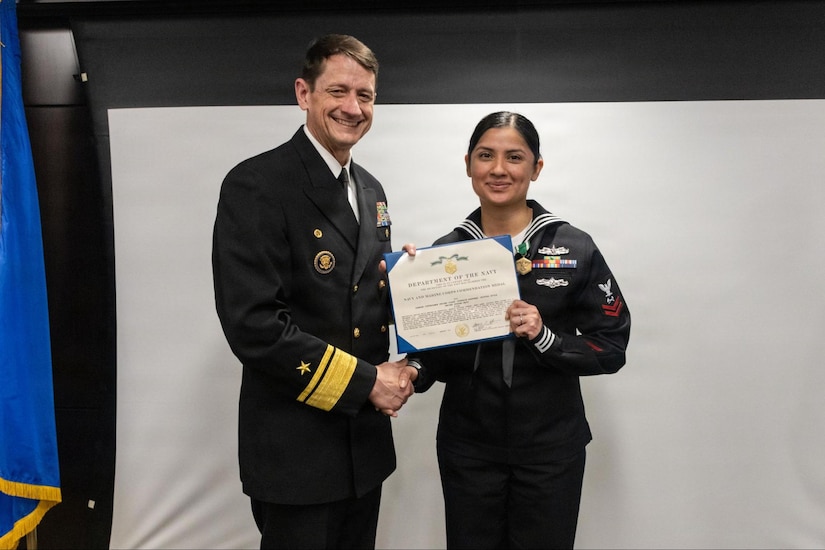
A person in a military dress uniform shakes the hand of a sailor as both of them hold a certificate and smile indoors.

Avila's dedication to instruction recently earned her recognition as the Naval Education and Training Command Junior Instructor of the Year — an honor awarded to instructors who demonstrate exceptional performance, leadership and mentorship in developing the next generation of warfighters. 

"Being named Junior Instructor of the Year didn't change me — it reassured me that the way I teach is making a positive impact," she said. "Teaching isn't just about delivering information. It's about making sure sailors understand it and retain it, because everyone learns differently." 

For Avila, the most rewarding part of her role comes from watching recruits grow in confidence throughout the training process. 

"In the beginning, many recruits are shy or unsure of themselves and don't want to participate," she said. "But as they get closer to graduation, you see their confidence grow and the way they start working together as a team improves. Being a sailor means being part of something bigger than yourself and learning how to work together toward one mission." 

Like many instructors, Avila said balancing time constraints while ensuring recruits fully understand complex material can be challenging. 

"One of the biggest challenges is figuring out how to tailor certain topics so recruits understand them while still staying within the time we're given for each lesson," she said. "It's made me more efficient and adaptable as a result." 

Inspired by Family 

Avila credits her family for instilling the values that have helped her succeed throughout her naval career. 

"My family taught me accountability, discipline and respect," she said. "My mom always emphasized taking responsibility for your actions and giving your best effort. The support from my husband and kids has also helped me stay resilient throughout my career." 

Outside of her professional role, Avila enjoys spending time with her family and pursuing creative hobbies. 

"When I have free time, I enjoy crafting on my [design machine]," she said. 

Looking to the future, Avila is motivated to pursue further growth, both personally and professionally. 

"My goal is to earn my bachelor's degree," she said. "In the next five years, I hope to either commission as an officer or be selected for chief." 

In all, Avila's efforts ensure that the Navy's mission continues through the recruits she prepares, equipping them with the knowledge, discipline and confidence to succeed in the fleet. 

Navy Recruit Training Command boot camp lasts approximately nine weeks, and all enlisted sailors begin their Navy careers at the command. More than 40,000 recruits train there annually.

Maintainers Honor Flying Tiger Heritage With Aircraft Paint Restoration

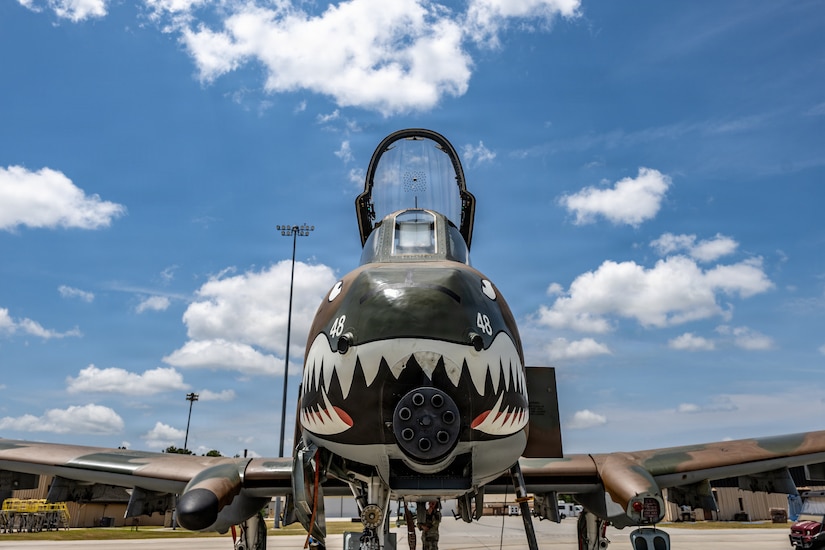
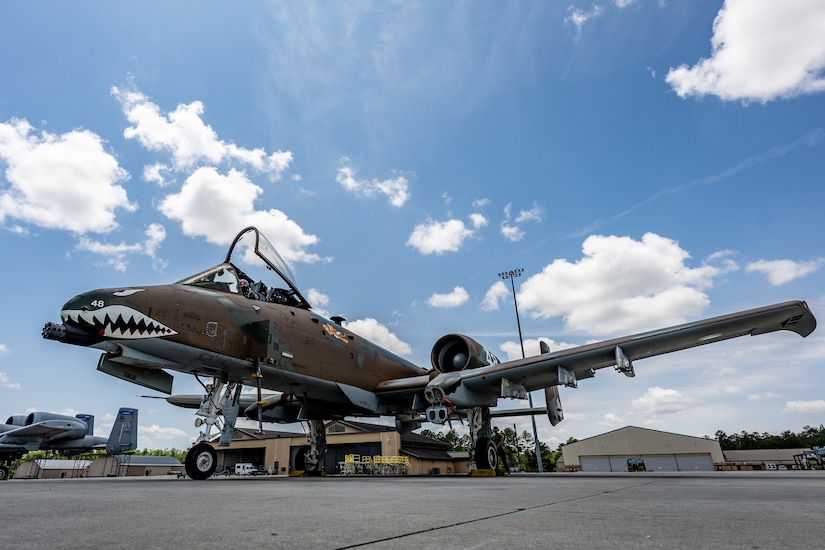
Among rows of gray A-10C Thunderbolt IIs on the flight line at Moody Air Force Base, Georgia, one Thunderbolt aircraft commands attention before its engines even start.

The front of a military jet parked on a tarmac with a paint job resembling a shark's head with a large mouth and jagged teeth.

Sweeping camouflage stretches across the aircraft while a bold blue fuselage stripe and the unmistakable Flying Tiger emblem cut through the gray backdrop of modern airpower. More than heritage paint, the aircraft serves as a tribute to Army Air Corps Brig. Gen. David Lee "Tex" Hill, the legendary Flying Tigers and the combat legacy carried on today by the 23rd Fighter Group stationed at Moody. 
 
Hill was a member of Claire Chennault's American Volunteer Group, famously known as the Flying Tigers, said William Godwin, 23rd Wing historian. He flew P-40 Warhawks with the 2nd Pursuit Squadron as a flight leader and was credited with 12 1/4 aerial victories during his time with the World War II group.

On July 4, 1942, the group disbanded, and the 23rd Fighter Group was activated. Hill joined the 23rd FG as a major and was the first commander of the 75 Fighter Squadron; he took command of the 23rd a year later. Hill would go on to fly the P-51 Mustang with the 23rd and raised his total number of aerial victories to 18 1/4. 
 
Aviation history runs deep on base. Hill served as a commander within the American Volunteer Group, whose combat missions in the China-Burma-India theater became legendary during the war. After the group was disbanded, its mission and fighting spirit lived on through the 23rd Fighter Group, with the 75th Fighter Squadron continuing that lineage.

Today, that heritage is reflected not only in the aircraft's design but in the airmen who brought it to life. Behind the scenes, 11 airmen assigned to the 23rd Maintenance Squadron dedicated an extended amount of time to transform the jet. The project demanded technical expertise, coordination and attention to detail, ensuring the finished aircraft honored both the squadron's heritage and the airmen who carried that legacy forward. 
 
"First, it was just another project to us, but once we got into it, we realized it was something different," said Air Force Senior Airman Memphis Waller, maintenance squadron aircraft structural maintainer. "It gave us a chance to learn new techniques and be part of something we knew people would remember. The process itself was a lot of work."

A person in a flight suit sits in the cockpit of an aircraft parked on a tarmac with a paint job resembling a shark's head with a large mouth and jagged teeth.

The team sanded the aircraft and cleaned up the old paint, then wiped everything down to ensure the surface was ready for the legacy design. After that, they had to prepare the plane and track down where every stencil belonged so they could repaint each one correctly.

"The [painting] process was different from what we usually do, so there was definitely a learning curve, but seeing it all come together made it worth it," Waller said. 
 
The aircraft's story began long before the camouflage pattern and Flying Tiger insignia took shape on the Moody flight line. Following an asset transfer from South Korea, maintainers at Moody accepted and processed the A-10 before taking on the extensive restoration project.

What started as a routine transfer quickly became something more, an opportunity to transform the aircraft into a visual reminder of the squadron's enduring history. For the airmen involved, the project carried meaning beyond restoring an aircraft. 
 
"When people see the heritage aircraft alongside the P-40 in the air park, they can immediately connect the history," said Air Force Staff Sgt. Tucker Lee, maintenance squadron noncommissioned officer in charge of corrosion control. "It's a continuation of the Flying Tigers legacy, and that's something this wing takes a lot of pride in. We just hope to keep carrying that tradition forward. 
 
"If the original Flying Tigers hadn't been successful, we wouldn't be here today carrying that name and history," he continued. "The shark teeth that people associate with the A-10 started back with the P-40s, and now they've become part of what makes the Warthog iconic. Keeping that heritage paint scheme and the nose art reminds us [of] where we came from and pushes us to continue that legacy of success." 
 
That pride was reflected in every stage of the project. From carefully matching historical details to working long hours as a team, maintainers ensured the aircraft would stand as a faithful tribute, reinforcing a shared connection between generations of airmen, past and present. 
 
Now complete, the aircraft serves a dual purpose: it remains a fully mission-capable platform while also standing as a visible reminder of the squadron's heritage. Each time it takes to the skies, it carries forward a legacy that began with the Flying Tigers, proving that while technology evolves, the spirit of the mission endures. 
 
"[The] American Volunteer Group and the 23rd Fighter Group set the standard for the Flying Tigers for future generations," Godwin said. "The American Volunteer Group, in 1941, were told they would not last two weeks. Eighty-five years later, the Flying Tigers are still going strong. The men and women of the 23rd Wing are standing on the shoulders of giants and leading the way with close air support and combat search and rescue."

Medal of Honor Monday: Army Pfc. Charles N. DeGlopper

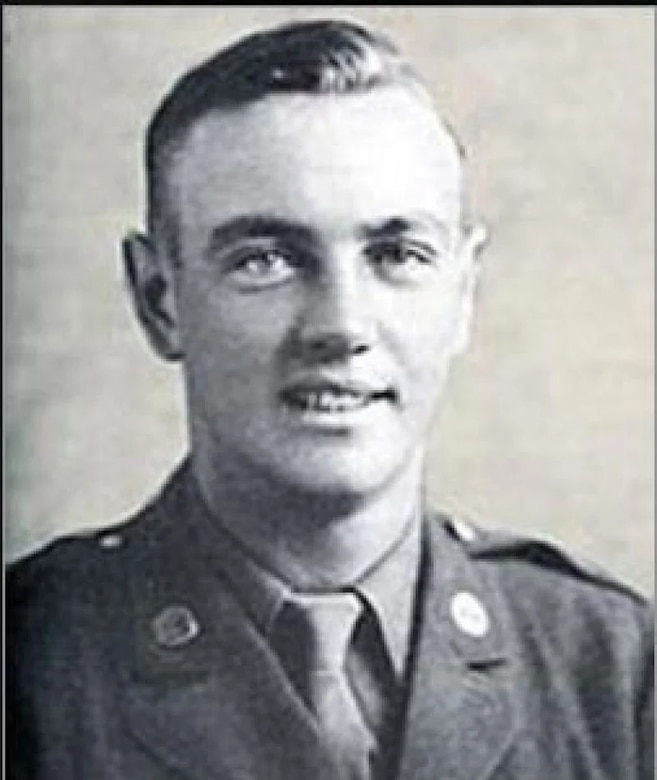
Army Pfc. Charles N. DeGlopper served as a paratrooper during World War II in North Africa and Italy. However, it was for his selfless actions in France, three days after D-Day, that earned him the Medal of Honor posthumously.

A man in a formal military uniform smiles for a portrait.
DeGlopper was born in Grand Island, New York, Nov. 30, 1921, to Charles and Mary DeGlopper. He grew up on a cattle farm and was the youngest of his siblings: John, Robert and Lillias. DeGlopper attended a one-room school until eighth grade, then graduated from Tonawanda High School in 1941.  
He didn't play sports in high school; instead, he joined a bachelors' club for cooking and sewing with his childhood friend Harold Long, according to Long during a 2022 interview with Niagara Frontier Publications.  

"We had a great time. The teacher always said, 'We've got to teach you sewing.' But we wanted to cook. That's how I got to know Charlie," Long recalled. 

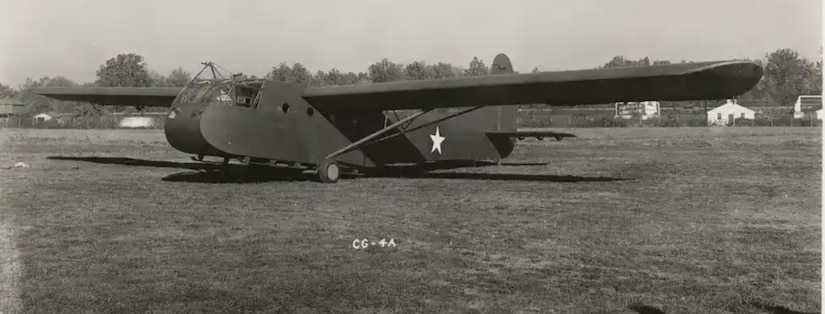
DeGlopper enlisted in the Army in November 1942 when he received his draft notice. It was difficult to fit the 6-foot-7-inch-240-pound private in uniform, since he wore size 15 boots. Following basic training at Camp Croft, South Carolina, he boarded a ship in April 1943, serving with Company C, 325th Glider Infantry Regiment, 82nd Airborne Division.

A black-and-white photo of a World War II-era glider sitting in a grassy field.

On June 9, 1944, after crash-landing his glider near the Normandy town of Sainte-Mère-Église, France, he was advanced with the forward platoon to secure a bridgehead across the Merderet River at La Fière, France. 

"At dawn, the platoon had penetrated an outer line of machine guns and riflemen, but in so doing had become cut off from the rest of the company. Vastly superior forces began a decimation of the stricken unit and put in motion a flanking maneuver, which would have completely exposed the American platoon in a shallow roadside ditch where it had taken cover," his Medal of Honor citation reads. 

Detecting this danger, DeGlopper volunteered to support his comrades by firing his automatic rifle while they attempted a withdrawal through a break in a hedgerow. 

With disregard for his own safety in a concentration of enemy automatic weapons fire, he walked from the ditch onto the road in full view of the Germans. He sprayed the hostile positions with assault fire. 

"He volunteered to cover the movement of his buddies to more advantageous terrain. Standing at 6'7" tall, it was hard for him not to be conspicuous. He certainly knew that he would be an easy target for the Germans, for the Nazis. Yet, with remarkable bravery, he acted above and beyond the call of duty to protect his fellow soldiers and accomplish the mission," said Army Maj. Gen. David Conboy, who served as the guest speaker during a 2024 ceremony to dedicate a park to DeGlopper in his hometown.  

Although wounded twice, DeGlopper continued firing. Kneeling in the roadway, weakened by his wounds, he leveled his weapon against the enemy and fired burst after burst until he was killed.  

He was successful in drawing the enemy action away from his fellow soldiers, who continued the fight from a more advantageous position and established the first bridgehead over the river.  

In the area where he made his intrepid stand, his comrades later found the ground strewn with dead Germans and many machine guns and automatic weapons.  

On March 10, 1946, DeGlopper's father received the Medal of Honor from Army Maj. Gen. Leland S. Hobbs at Trinity Evangelical United Brethren Church in Grand Island. 

Hobbs had commanded the 30th Infantry Division at Normandy. 

"He did all he could. We did all we could. Nothing more could be done. Charles DeGlopper did not fear fear. He admitted it. It should be a lesson to all of us," said Hobbs at the ceremony, according to the March 11, 1946, newspaper "The Buffalo News."

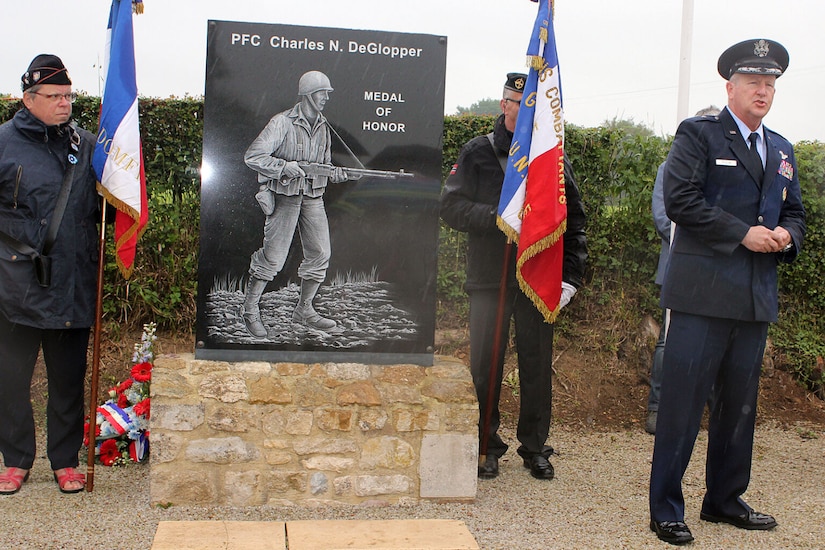
A man in a formal military uniform speaks outdoors in front of a plaque featuring a soldier holding a weapon. Behind him are two men in similar attire, holding flags on each side of the plaque.

His legacy lives on in his hometown and throughout the Army. 

On Dec. 3, 1947, the Army Transport Englin Victory was renamed the Pvt. Charles N. DeGlopper at the Brooklyn Army Base in Brooklyn, New York. A road at Fort Bragg, North Carolina, is named for him, and in January 2015, the Fort Bragg Air Assault School was dedicated and renamed the DeGlopper Air Assault School.  

The Army Reserve Training Center in Tonawanda, New York, is named the Charles DeGlopper Center. On June 9, 2024, 80 years after he paid the ultimate sacrifice, his hometown dedicated the DeGlopper Memorial Park with a rifle salute and a military helicopter flyover. 

DeGlopper is buried in Maple Grove Cemetery in Grand Island.

Friday, May 29, 2026

Gunsmiths Play Essential Role in Winning Revolutionary War

During the American Revolutionary War, gunsmiths were essential to the patriot cause, providing, repairing and maintaining firearms for the Continental Army, Navy, Marine Corps and state militias.

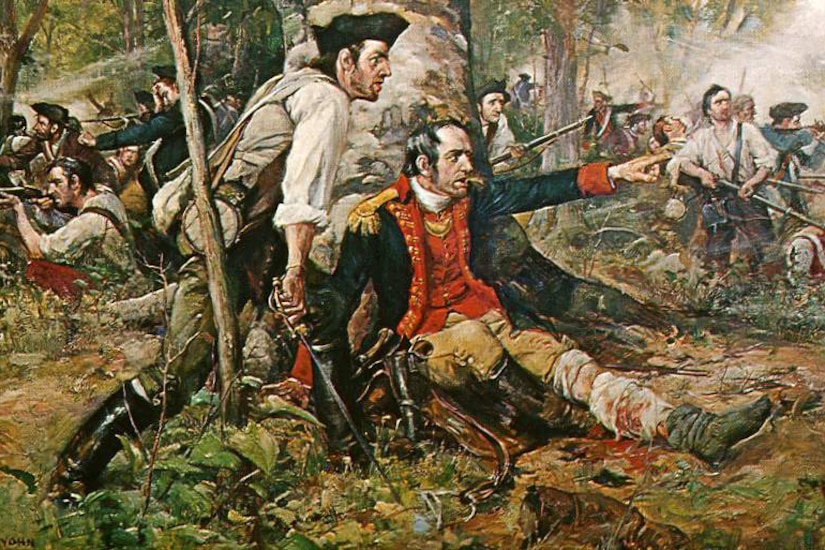
A painting depicts men in Revolutionary War uniforms fighting with long guns while some are wounded.

Operating in small shops, they created American-made, handcrafted rifles, pistols and muskets.  

While some parts were imported, gunsmiths often made complete firearms from scratch, including custom iron barrels and wooden stocks. Each gun was hand-filed and fitted, making every weapon a unique, one-of-a-kind piece.  

Unlike the guns of today, parts were not interchangeable, a huge drawback. Soldiers could not cannibalize parts from broken weapons on the battlefield to fix their own. Because parts were hand-forged and unique to each gun, there was no quick fix for a broken internal part. 

Only bore size, aka caliber, was somewhat standardized so that soldiers could use the same size lead balls.

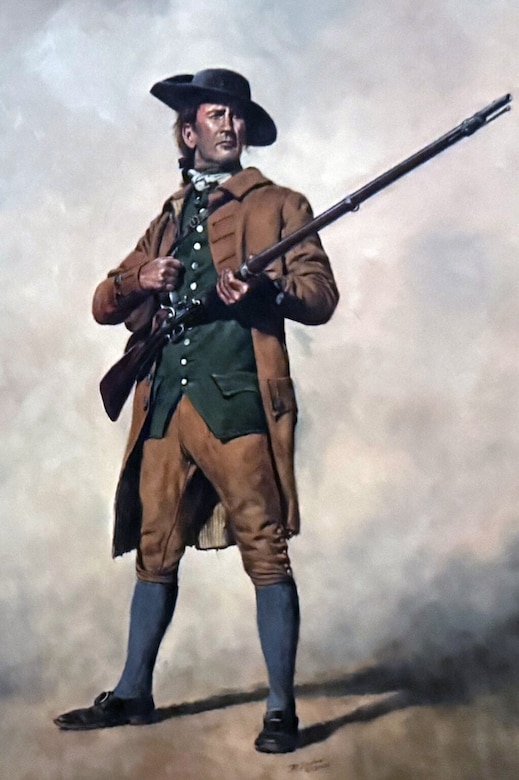
A painting shows a man in a Revolutionary War uniform holding a musket.
In the heat of battle, black powder residue called fouling, broken flints, or mechanical failures would often render a significant percentage of a unit's muskets useless after just a few shots. 

A flash in the pan occurred when the priming powder in the external pan ignited, but the spark failed to travel through the main charge in the barrel. This resulted in the gun making a puff of smoke but not firing. 

Flints typically lasted for only 20 to 30 shots before they became too dull to produce a spark. The hammer would strike the steel, but no spark would fall into the powder. 

Black powder is highly sensitive to moisture. Even high humidity could turn the powder into useless sludge. The flint would spark, but the damp powder would fail to catch fire.

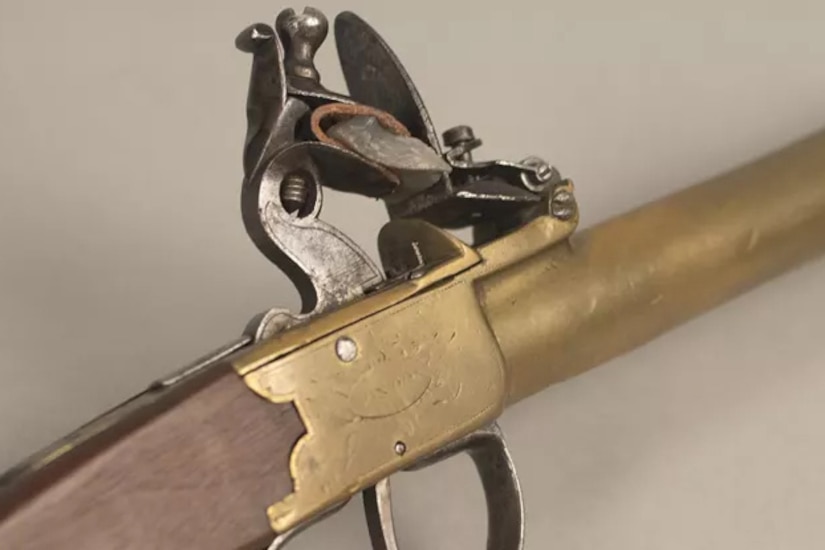
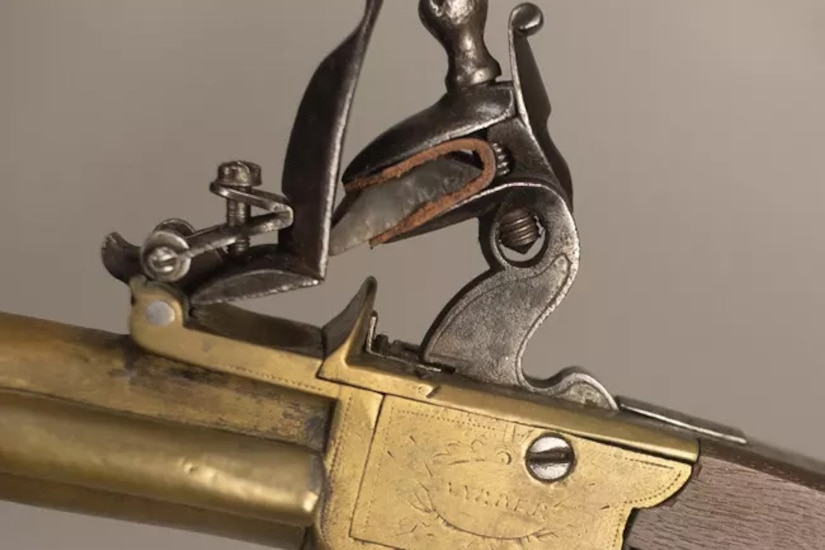
A pistol trigger mechanism is on display.
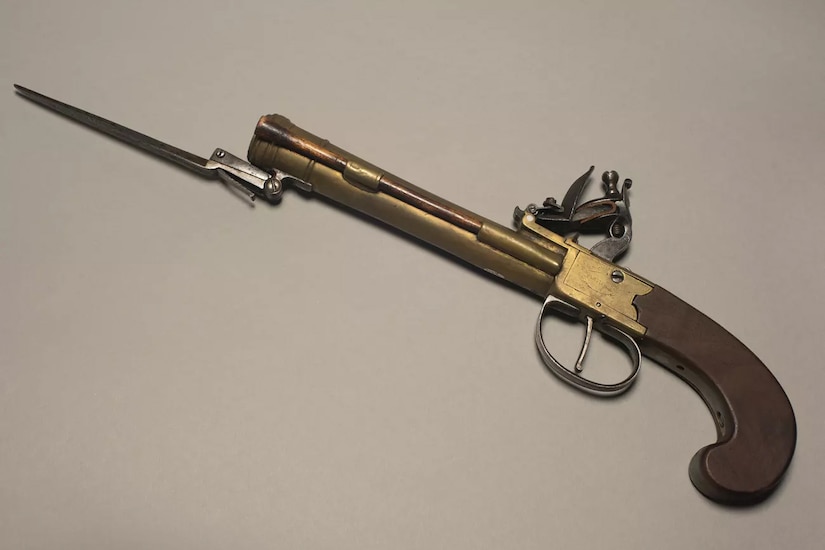
A wood and brass pistol with a small bayonet is on display.
The heavy spring that drives the hammer forward was under immense tension. If it snapped, the hammer would simply hang loose, making the weapon completely inoperable. 

Sear spring failure is the smaller internal spring holding the hammer at half-cock safety or full-cock, ready to fire. If it broke, the gun might fire prematurely or fail to stay cocked. 

The wooden stock was thinnest at the wrist where the soldier grips it. Dropping the gun or using it too forcefully in a bayonet charge often caused the wood to splinter or snap entirely. 

Broken hammers were often a weak point and could shear off at the neck after repeated use.

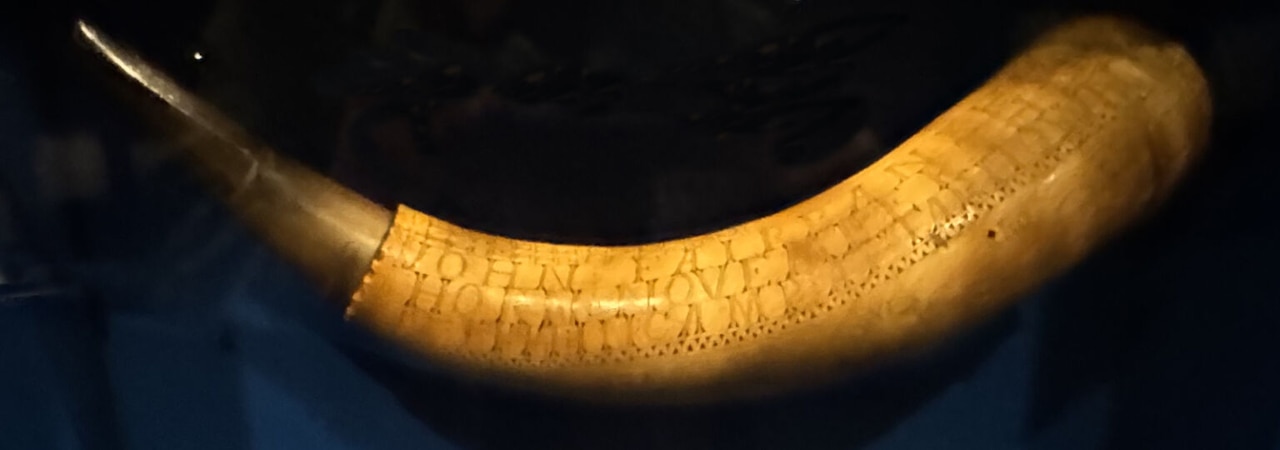
A golden color powder horn with engravings is on display.

If the gun's firing mechanism broke, it was still an effective 5-foot spear with the bayonet affixed. 

A gunsmith was as much a craftsman as a manufacturer. They had to be capable carpenters, blacksmiths and engravers to produce their rifles. A single rifle could take weeks or even months to make, depending on the desired quality and access to needed materials. Wood was plentiful in the dense forests of Colonial America, but materials like steel and the proper tools had to be obtained from cities or even Europe.

In most cases, a master gunsmith would have several apprentices who would spend years learning the trade. Once they were deemed sufficiently trained, usually after completing a weapon entirely by themselves, the apprentice would craft a set of their own tools based on the master's and set up their own shop.

The most difficult, but most valued, step was rifling the barrel. Rifling is spiral grooves inside the barrel. It increases the ball's range and accuracy. While this was done by hand with a specialized drill at first, later gunsmiths were aided by the invention of rifle-boring machines, which greatly eased the process.

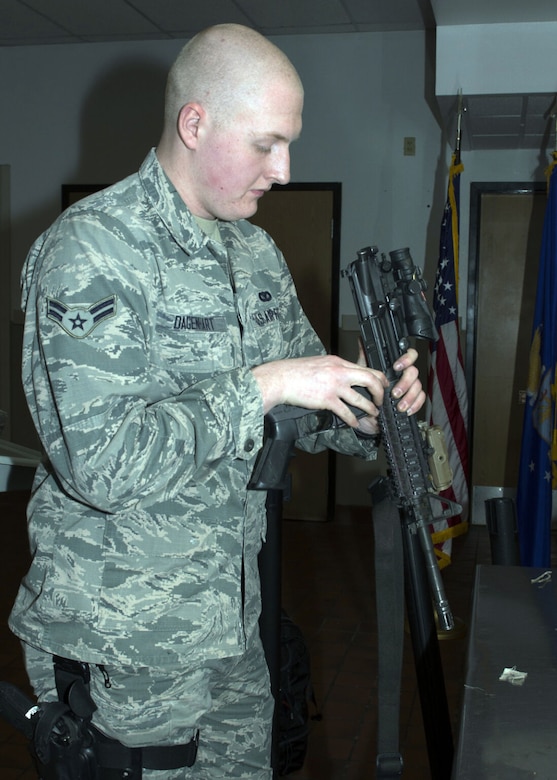
A man wearing a camouflage uniform inspects a weapon in an armory.

Until the Industrial Revolution of the late-1800s, the gun manufacturing process remained largely the same. The advent of interchangeable parts increased gun manufacturing as pieces could be made individually and replaced as needed. Parts could also be swapped, meaning a person could have two barrels for the same gun and switch them as they needed.

Prior to this, if a gun was damaged, the gunsmith would often need to spend days crafting a replacement piece specifically for that weapon. 

Now parts are stamped from sheets of metal or cast into molds that can be used repeatedly. This ability to produce intricate, delicate mechanisms from tiny, machined parts enabled the invention of automatic firearms.

Modern soldiers carry spare parts, cleaning kits, firing pins and other supplies. Revolutionary War soldiers carried almost nothing for repairs except extra flints. 

A modern armorer maintains and repairs firearms with factory-provided parts, ensuring the unit's weapons meet technical standards for combat readiness.  

A gunsmith is a skilled artisan capable of everything an armorer does, as well as custom fabrication and machining.