Thursday, January 22, 2026

Space Forces Southern Officially Activated During Ceremony in Arizona

The Space Force and U.S. Southern Command officially marked the activation of U.S. Space Forces Southern during a ceremony yesterday at Davis-Monthan Air Force Base, Arizona, formalizing the command's role in integrating space capabilities across the Western Hemisphere.

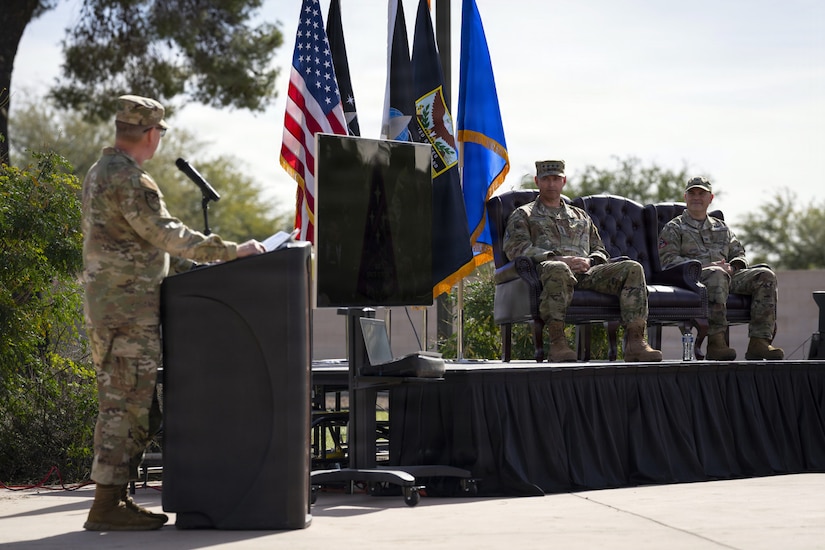
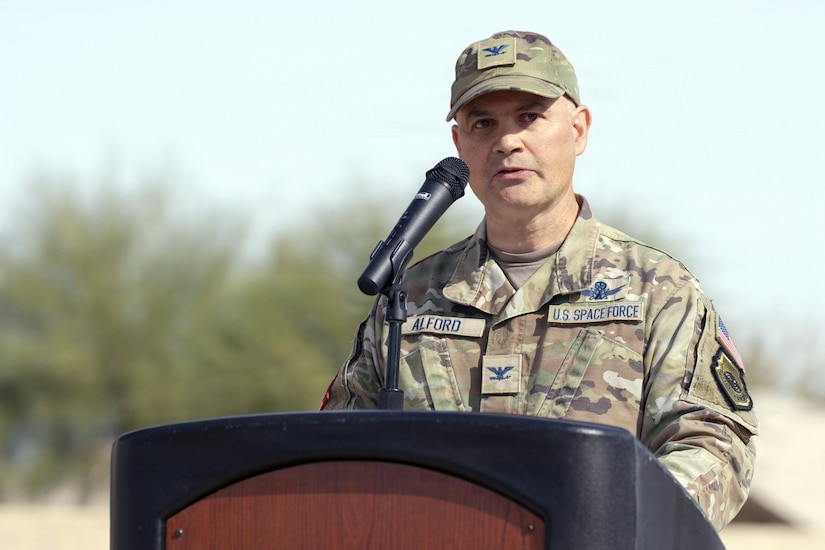
A man in a camouflage military uniform speaks into a microphone while standing behind a lectern.
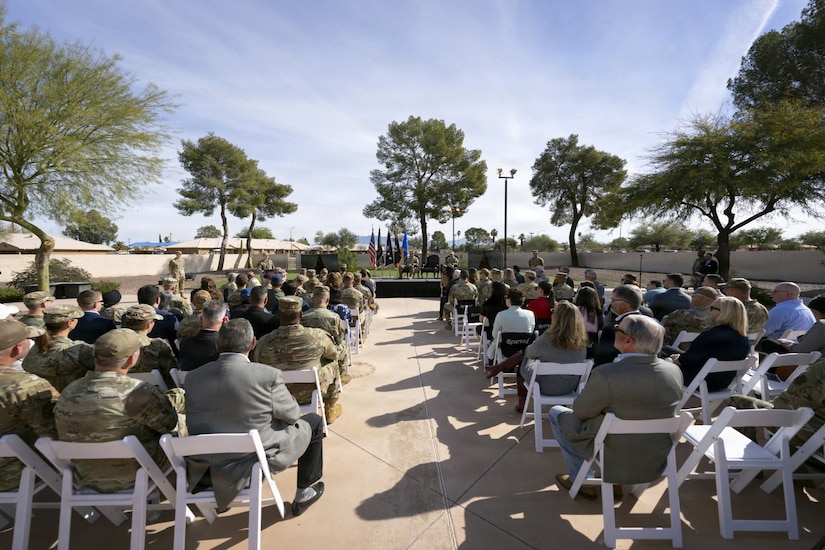
Dozens of people in business attire and camouflage military uniforms sit outside in rows of chairs facing a stage where two men in camouflage military uniforms are sitting. There are three other people in camouflage military uniforms standing in front of the stage.
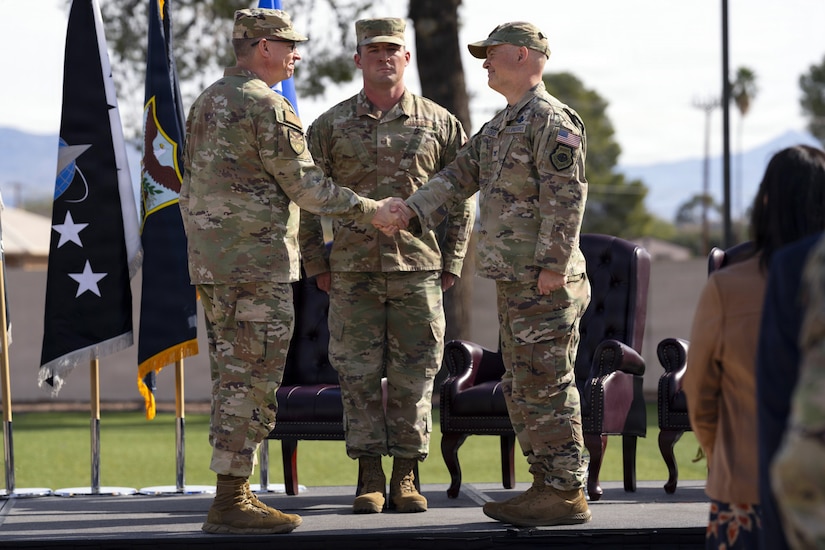
Although the command became operationally effective Dec. 1, 2025, the ceremony formally recognized the activation with the assumption of command by Space Force Col. Brandon P. Alford, and the digital unveiling of the Space Forces Southern emblem, symbolizing the command's mission and regional focus. 

Space Forces Southern serves as the space component to Southcom, responsible for integrating space power with joint, interagency and multinational partners to support regional security, deterrence and stability across Central America, South America and the Caribbean. 

"This new organization reaffirms our commitment to address local threats of all shapes and sizes, ranging from malign state actors to violent extremist organizations and to transnational criminal organizations," said Chief of Space Operations Gen. B. Chance Saltzman. "Space Forces Southern will continue to be a force for good in the region, using space to maintain peace and stability and defend the homeland."

Two men in camouflage military uniforms shake hands while standing on a stage. There is another man in similar attire standing at attention behind them. There are flags displayed and three chairs on stage behind the men.

Saltzman emphasized that space capabilities are not just support elements for the joint force, but a fully integrated and critical component in their own right. 

"As we clearly saw in recent operations in the Southcom [area of responsibility], without space, kill chains don't close, our strategic advantage evaporates and we can't complete our joint missions," Saltzman said.  

As the first commander of Space Forces Southern, Alford said the activation reflects the growing operational importance of space to missions conducted daily in the Southcom area of responsibility.

"Today marks the beginning of a future that is more connected, more informed, agile and more united in building together to be more capable," he said. "As the first commander of Space Forces Southern, I accept this responsibility with humility and optimism. I am confident that together we will shape a space domain that reflects our shared values and shared aspirations.

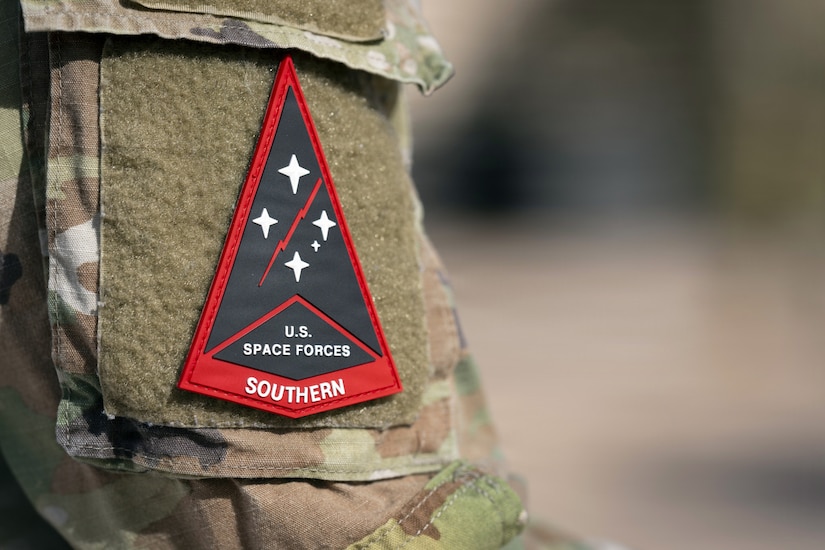
A red triangular patch with the words U.S. Space Forces Southern is shown on a camouflage military uniform.

"We are not just standing up a command today," he added. "Together, we are shaping the space domain so that what lies above us strengthens everything we value below." 

A career space professional, Alford brings extensive experience across the enterprise, including operational, instructional and staff assignments supporting missile warning, space control and joint space integration. Prior to assuming command, he served in senior leadership roles aligned with Southcom, providing continuity between the command's initial operational capability and its formal activation. 

The ceremony included the unveiling of the official Space Forces Southern emblem. The design features the Crux constellation, also known as the Southern Cross, to signify that the command is the space component focused on South America. It also has a lightning bolt to symbolize the speed and responsiveness of space-enabled support to joint and partner forces throughout the region. 

In the Southcom area of responsibility, space-enabled capabilities support operations across vast distances and complex environments. Guardians secure satellite communications and provide positioning, navigation, timing and space-enabled awareness for counter-illicit trafficking operations, multinational exercises, partnership building and crisis response — strengthening regional stability and deterrence.

Two men in camouflage military uniforms sit in chairs on a stage outside while looking at another man in similar attire as he speaks into a microphone. There are several flags displayed on the stage next to the men.

"The activation of Space Forces Southern affirms a simple and powerful idea: we are one hemisphere, stronger together," Alford said. "Bound together by geography, values and a shared future above us — connected by shared challenges and shared opportunity." 

The ceremony was attended by War Department senior leaders including Air Force Lt. Gen. Evan L. Pettus, acting commander of Southcom acting commander; Air Force Maj. Gen. David Mineau, Air Forces Southern commander; and Undersecretary of the Air Force Matthew Lohmeier, underscoring the importance of space integration in support of joint and departmental priorities. 

Headquartered at Davis-Monthan Air Force Base, Space Forces Southern will work closely with U.S. Space Command, Southcom, U.S. Northern Command, the Air National Guard's State Partnership Program and international partners to enhance interoperability and strengthen space domain awareness throughout the region. 

The activation marks another significant step in formally establishing space as a warfighting domain critical to joint operations, reinforcing security and stability across the Western Hemisphere. 

Alaska Army National Guardsmen Conduct a Nighttime Medical Evacuation

Alaska Army National Guardsmen assigned to the 207th Aviation Troop Command medically evacuated an individual Jan. 21 from Southwest Alaska. 

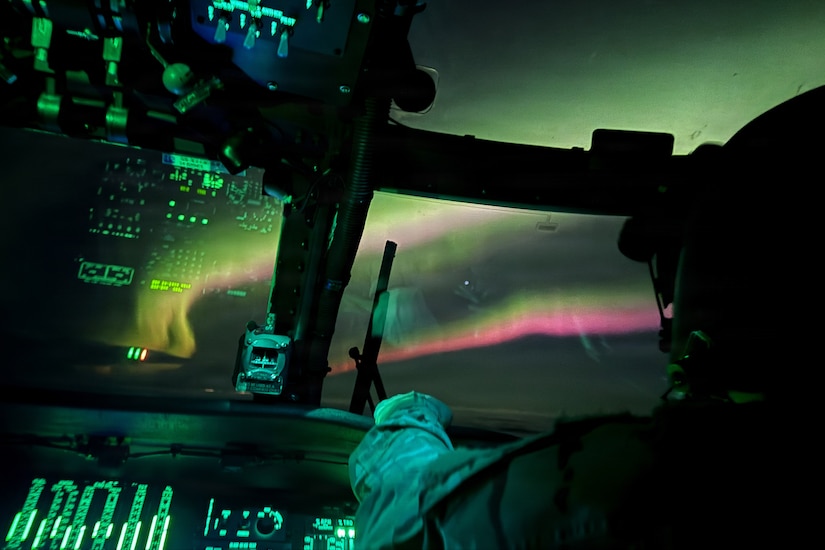
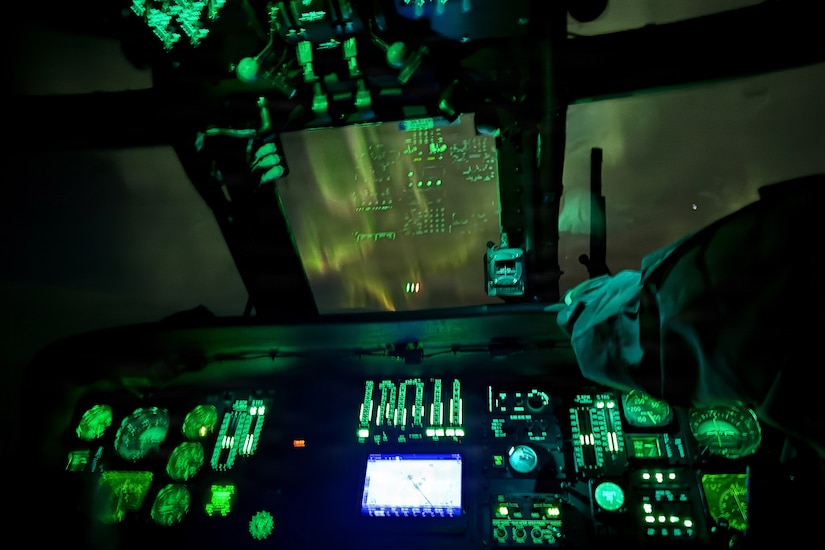
A helicopter pilot wearing a military uniform reaches his arm up toward the cockpit. In the night sky, a ribbon of soft colorful lights can be seen.

In response to a request for assistance from medical staff at Kanakanak Hospital, Dillingham, Alaska, the Alaska Rescue Coordination Center opened a medevac mission for an individual experiencing a medical emergency. 

Daylight restrictions prevented local civilian air ambulance services from conducting the mission.  

The Alaska Army National Guard accepted the mission and dispatched a UH-60L Black Hawk helicopter, based in Bethel, Alaska. 

Using night-vision goggles, Alaska Army National Guard Black Hawk aviators Chief Warrant Officer 3 Bryan Kruse, Chief Warrant Officer 3 Colten Bell and Chief Warrant Officer 3 Nick Lime, with Bethel Fire Department medics Kelly Parker and Lauren Konig aboard, flew about 180 miles southeast to New Stuyahok, Alaska.

A helicopter pilot wearing a military uniform reaches his arm up toward the cockpit. In the night sky, a ribbon of soft colorful lights can be seen.

The Black Hawk crew arrived on scene and loaded the patient for transport to Dillingham, about 50 miles southwest. Parker and Konig rendered medical aid to keep the patient stable en route. 

Upon arrival in Dillingham, the patient was transported and released to Kanakanak Hospital staff. 

The effort continued the Alaska Army National Guard's ongoing relationship with western Alaska communities. 

The Alaska Army National Guard frequently supports emergency response operations across the state in partnership with the Alaska State Troopers, Alaska Rescue Coordination Center and local agencies. The Black Hawk crew, based in Bethel, Alaska, is not a designated rescue asset with hoist capabilities or paramedic teams. Despite that, the crew is crucial in supplementing traditional emergency services that are not often available in western Alaska, an area where rural communities are not connected by roads.

Wednesday, January 21, 2026

Painting of Benedict Arnold as Battle of Saratoga Hero to be Restored for Display in NY

A massive oil painting on canvas memorializing Benedict Arnold's heroism during the 1777 Battle of Saratoga was unrolled for the first time since 2013 at the New York State Military Museum in Saratoga Springs, New York, Jan. 16.

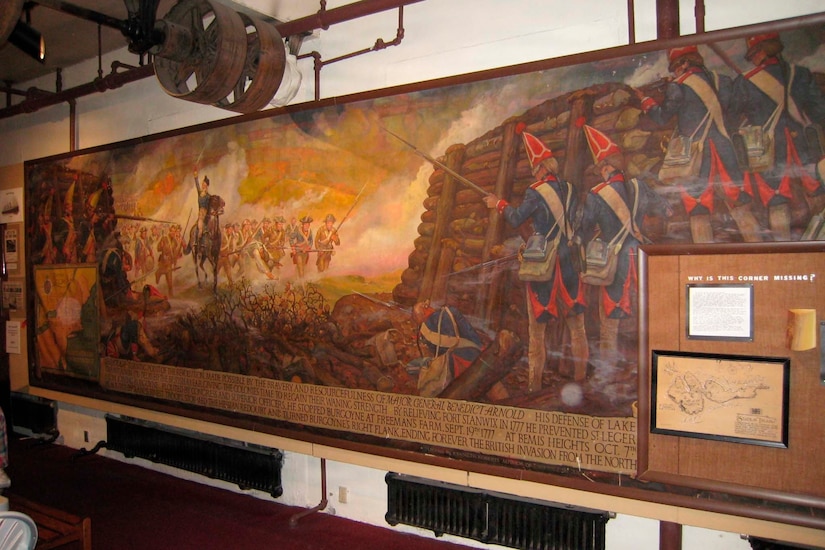
A large painting depicting people in Revolutionary War uniforms hangs on a white brick wall.

 
The 25-foot-long by 7-foot-high painting, "Benedict Arnold, Triumphant at Saratoga," was opened across eight tables so that a painting conservation expert could examine its condition. 

The painting has been in storage since it was originally donated.  
 
The goal, according to museum director Courtney Burns, is to have the painting restored and displayed in the museum in time for the 250th anniversary of the Battles of Saratoga in 2027. 

A large painting depicting a battle scene is laid out on tables. A similar painting hangs on a white brick wall in the background.

 
Arnold is remembered as an infamous traitor for attempting to betray the American forts at West Point and the visiting Gen. George Washington to the British during the American Revolution. 
 
But before that, he played a key role in delaying a British invasion of northern New York and leading a key charge that forced the British to retreat during the fighting at Saratoga. 
 
The painting by George Gray depicts Arnold leading American soldiers in storming the Breymann Redoubt, a Hessian-held fortification. 
 
The narration in the painting, explaining the scene's significance, is by Kenneth Roberts, a historical novelist from the 1920s to 1940s, who wrote two books featuring Arnold as a heroic figure. 
 
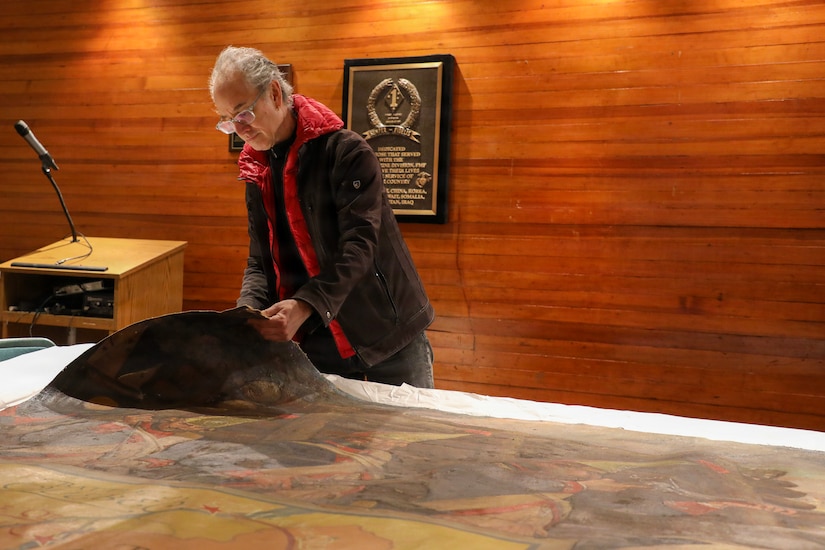
John Lippert, a partner at a Livingston, New York, art conservation and restoration company, looked the painting over and took photographs. 

A man wearing glasses and casual attire lifts the corner of an old, large painting to examine it.

 
Lippert said his company will clean the painting and do touch-up work to bring out the original colors. The varnish on the 1937 painting has darkened with time, he explained, so his team will remove that. 
 
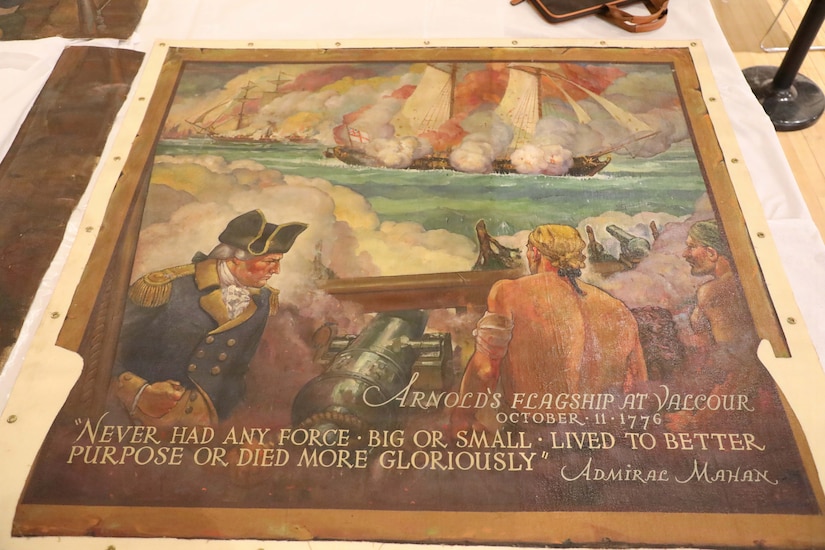
The conservators will also need to repair a corner of the painting where an inset depicting Arnold at the 1776 naval fight at Lake Champlain's Valcour Island was cut out, Lippert said. 
 
The military museum has that piece, so that will be worked back into the painting, Lippert said. 
 
His team will also put the painting onto a wooden stretcher frame, so it is ready to be displayed in the museum. 

The restoration work will likely take about six months. 
 
Lippert's company has repaired other historic paintings for the Division of Military and Naval Affairs, Burns said. This includes artwork in the Lexington Avenue Armory in Manhattan and the Jamaica Armory in Queens. 

He said the project's cost could reach $30,000. 
 
The money, Burns said, is being provided through the Friends of the New York State Military Museum, a private not-for-profit, which is receiving it from an anonymous donor. 
 
The painting was donated to the New York State Military Museum in 2013 by the H. Lee White Marine Museum in Oswego, New York. 
 
It was one of 233 Gray completed for the American Hotel Corporation in the 1930s to commemorate local history in their hotels, according to a 2025 article in the Lehigh Valley News. 
 
In this case, the painting was in the Hendrick Hudson Hotel in Troy, New York, which closed in 1966. 
 
A companion piece by Gray, which also hung in the Hendrick Hudson Hotel and commemorated the 27th Division of the New York National Guard in World War I, is currently on display at the military museum. 

A painting depicting a man wearing a Revolutionary War uniform standing on a ship firing a cannon toward other ships in the distance.

 
Arnold played a critical role in military campaigns in Canada and northern New York in the early years of the Revolutionary War. He led an attack on Quebec through the Maine wilderness, fought a naval battle on Lake Champlain that delayed a British attack south for a year and then picked the ground where the successful Battle of Saratoga was fought. 
 
The New York State Military Museum and Veterans Research Center tells the story of New York's rich military history and the service and sacrifice of its citizens through interpretive exhibitions, public programs, and the collection and preservation of artifacts and archival materials related to the state's military forces and veterans. 

Tuesday, January 20, 2026

U.S. Army, Polish Land Forces Conduct Operation Winter Falcon 2026

Soldiers assigned to the 3rd Battalion, 66th Armored Regiment, 1st Armored Brigade Combat Team, conducted an armored live-fire exercise and technology demonstrations during Operation Winter Falcon 26 at the Drawsko Combat Training Center in Oleszno, Poland, Jan. 13.

A man in a camouflage military uniform lifts his hand up as he releases a military drone. Other people in similar attire stand in the background.

The event demonstrated how modern military operations rely on integrating multiple systems, including unmanned aerial systems and counter-UAS capabilities, to strengthen defensive capabilities. The demonstration reflected how the United States and its NATO allies are modernizing to reinforce defenses in Poland and across the alliance.

Polish and U.S. forces fired their M1A2 Abrams tanks side by side on the firing line. This marked the first time Polish forces fired their M1A2 SEPv3 Abrams tanks alongside U.S. forces, demonstrating both the platform's firepower and the coordination among partner nations. The commander of the 1st Armored Brigade Combat Team, Army Col. Matthew Kelley, emphasized the importance of communication when building relationships to deliver interoperability.

A man in a camouflage military uniform holds a drone busting piece of equipment in his hands as he looks through its viewfinder. There is another man in similar attire standing next to him.

"We train to be ready for anything that might happen in the future," Kelley said. "There is no way you could do that on your own."

The commander also spoke about the importance of training in Poland and the value it brings to his troops.

"The strength of our allies together is how we demonstrate that resolve, that commitment, and you've [got to] do that in the place you may have to defend," he said.

A man wearing winter camouflage military gear looks down at a piece of military equipment.
After the live-fire exercise, a static display of UASs featured drones that can provide reconnaissance for ground and armored forces and engage enemy vehicles while the pilot remains in a secure position.

Polish vehicles, such as the M142 High Mobility Artillery Rocket System and the AH-64D Apache helicopter, were displayed alongside U.S. technology systems to counter opposing UAS.

The static display illustrated how both UAS and counter-UAS systems complement armored platforms such as the Abrams by providing reconnaissance, identifying potential threats at a distance and preventing adversaries from locating friendly forces.

Men in military uniforms stand in front of a military tank talking, while others in similar attire stand next to it.

When presented together, the systems demonstrated the growing role of UAS and counter-UAS technologies in reinforcing NATO's defensive posture along Poland's eastern region.

Operation Winter Falcon 26 underscored the importance of innovation for NATO's armed forces in modern military operations. By linking armored elements, such as the Abrams tank, with UAS, U.S. and NATO forces demonstrated how coordinated technologies enhance readiness and strengthen overall defense.

Monday, January 19, 2026

Medal of Honor Monday: Army Sgt. Gordon Yntema

Army Sgt. Gordon Douglas Yntema, a Green Beret, fought until his last breath to make sure the Vietnamese troops with whom he served could withdraw in the face of a firefight they couldn't win. His selflessness and dedication to the cause earned him a posthumous Medal of Honor.

A man in a military dress uniform and beret poses for a photo.

Yntema was born June 26, 1945, in Bethesda, Maryland, to Dwight and Cynthia Yntema. He had a brother named David.

When he was a little more than a year old, the family moved to Holland, Michigan, so his father could work as a professor of business administration at Hope College, according to The Grand Rapids Press.

After first going to public school, Yntema attended two preparatory schools, Culver Military Academy in Indiana and Fountain Valley School in Colorado. His military education must have stuck with him because in July 1963, shortly after he turned 18, he enlisted in the Army.

Around the same time, Yntema married Peggy Brown, also from Holland. They had two daughters, Elizabeth and Jane.

After graduating from airborne school, Yntema was assigned to the 82nd Airborne Division, where he learned helicopter mechanics. After deploying for four months to the Dominican Republic in the summer of 1965, Yntema decided he wanted more of a challenge. He then went to U.S. Army Ranger School, qualifying in 1966, before joining Special Forces in January 1967, earning his green beret.

By this time, the U.S. military presence in Vietnam was building, so Yntema was sent to the country in October 1967 with a detachment assigned to Company D of the 5th Special Forces Group, 1st Special Forces. That same month, he received a Purple Heart for wounds he suffered while stationed in a Special Forces camp west of Saigon.

Two men in military uniforms stand at attention while a third man pins something to one of their uniforms. Other people in military uniforms stand at attention in the background.

By mid-January 1968, Yntema was serving as an advisor to a Vietnamese reconnaissance platoon at Camp Cai Cai, along the Cambodia border. On Jan. 16, 1968, his team and another platoon were sent to block enemy movements near the village of Thong Binh when a firefight broke out with the Viet Cong.

The group's friendly South Vietnamese commander was seriously wounded, so Yntema assumed control of the platoons and moved them forward to within 50 meters of the enemy's bunkers. After 30 fierce minutes of fighting, they were forced to pull back to a trench for better protection so they could still carry out their blocking mission.

The situation went from bad to worse. A company of enemy soldiers moved into a position that pinned the platoons down on three sides before unleashing a mortar barrage that inflicted heavy casualties on exposed soldiers. Yntema's remaining platoonmates were low on ammunition, so many of them chose to flee.

Yntema was seriously wounded and also ordered to withdraw, but he refused to leave his fallen comrades. As enemy fire continued, the sergeant carried the wounded Vietnamese commander and another mortally wounded U.S. Special Forces advisor to a small gully about 50 meters away to try and give them some form of protection.

A man in a camouflage military uniform holds a grenade launcher against his shoulder while a man in similar attire beside him looks toward where it’s aimed. Other people in similar attire are standing in the grassy background.

He then continued to push back the attackers, who were trying to overrun the position, until he ran out of ammunition and was surrounded. The enemy gave him the opportunity to surrender, Yntema's Medal of Honor citation stated, but he refused. Instead, he used his rifle as a club to fend off about 15 Viet Cong. His resistance was so fierce that the enemy was forced to shoot him.

Despite insurmountable odds, Yntema refused to give up, instead giving his life to make sure his surviving platoonmates could escape.

For that supreme sacrifice, Yntema received a posthumous Medal of Honor from Vice President Spiro Agnew Nov. 18, 1969, during a White House ceremony. His wife, Peggy, accepted it on his behalf.

Yntema's body was eventually returned home and buried in the Pilgrim Home Cemetery in Holland.

His sacrifice has not been forgotten. A dining facility at the U.S. Army John F. Kennedy Special Warfare Center and School at Fort Bragg, North Carolina, is named in Yntema's honor. In 2011, a section of highway near his hometown was designated the "Medal of Honor Recipients Highway" in his honor and that of three other Michigan recipients: Army Sgt. Paul Chambers, Army Lt. Col. Matt Urban and Army Cpl. John Essebagger Jr. 

Saturday, January 17, 2026

$1,776 'Warrior Dividend' Tax-Free, IRS Confirms

The Internal Revenue Service today confirmed that the $1,776 "Warrior Dividend" more than 1.5 million service members received last year, at the direction of President Donald J. Trump, would be tax-free. 

Soldiers, shown from behind in silhouette, look over arid, hilly terrain against a sunny, blue sky.

In a press release posted today, the IRS confirmed the tax-free status of the dividend

"The Department of the Treasury and the Internal Revenue Service today confirmed that supplemental basic allowance for housing payments made to members of the uniformed services in December 2025 are not to be included in income by those who received the payments; they are not taxable," the statement reads. 

According to the IRS, U.S. tax law excludes from gross income a "qualified military benefit." The Warrior Dividend is just such a benefit and is therefore not taxable. Service members will keep all of the dividend to use as they see fit. 

"The tax-free Warrior Dividend places $1,776 directly in the hands of our warfighters and their families," Pentagon Press Secretary Kingsley Wilson said today. "The department is proud to recognize their sacrifice." 

On Dec. 17, 2025, the president announced that nearly 1.5 million service members would receive a $1,776 bonus to both thank them for their military service and to commemorate the 250 years the U.S. military has been defending the nation. 

"Nobody deserves it more than our military," he said. "I say, 'congratulations' to everybody." 

In a related statement, Secretary of War Pete Hegseth said the dividend illustrates the nation's commitment to military service members. 

"This Warrior Dividend serves as yet another example of how the War Department is working to improve the quality of life for our military personnel and their families," Hegseth said. "All elements of what we're doing are to rebuild our military." 

Friday, January 16, 2026

Missouri Man Who Neglected Veteran and Concealed His Corpse Sentenced to 156 Months in Prison

ST. LOUIS – U.S. District Judge Zachary M. Bluestone on Thursday sentenced a man to 156 months in prison for neglecting his uncle, a U.S. Army veteran with quadriplegia, for years and concealing his corpse to fraudulently obtain $1.8 million in his uncle’s disability benefits.

Brian K. Ditch, now 45, of Salem, Missouri, became solely responsible for his uncle’s care in 2008. At some point, instead of properly caring for his uncle, Ditch kept him locked away and subjected him to insufficient care and verbal abuse. Ditch fraudulently gained access to his uncle’s financial accounts and regularly wired himself money. After his uncle’s death around 2019, Ditch concealed his death from relatives, the U.S. Department of Veterans Affairs (VA) and the Social Security Administration so that he could continue to steal his uncle’s money. Ditch hid the body in a shed behind his house, telling relatives that he had moved his uncle into a nursing home and police that his uncle was living with someone else.

Since 2008, the VA’s Disability Compensation program deposited approximately $1.6 million into the victim’s account. Ditch’s uncle also received a total of $235,210 in benefits from the Social Security Administration. Ditch used the money for personal purchases, including exotic reptiles and firearms. As a convicted felon, Ditch is barred from possessing firearms. On Thursday, Judge Bluestone ordered Ditch to repay the money.
“Our veterans, particularly those who were wounded while serving our country, deserve our profound respect and admiration, not a life afflicted by neglect, abuse, and exploitation,” said U.S. Attorney Thomas C. Albus. “I hope that this sentence sends a message that we will not tolerate this conduct, or the defrauding of programs intended to support veterans and those with disabilities.”

“This sentencing sends a clear message that the Department of Veterans Affairs Office of Inspector General will vigorously investigate and hold accountable those who exploit veterans,” said Special Agent in Charge Gregory Billingsley with the VA OIG’s Central Field Office. “Egregious crimes against those who served our nation will not be tolerated, and the VA OIG extends its gratitude to the U.S. Attorney’s Office and our law enforcement partners for their unwavering commitment to achieving justice in this case.”

"For over a decade, Brian Ditch was entrusted as the sole caregiver for his uncle, a vulnerable Army veteran; yet he betrayed that trust in the most egregious way. Once his uncle passed away, Ditch then concealed his uncle’s death, hiding his body in a shed, all to keep siphoning Social Security benefits," said Michelle L. Anderson, Assistant Inspector General for Audit as First Assistant, Social Security Administration (SSA), Office of the Inspector General.  “This was not just theft; it was a calculated scheme to defraud SSA of over $235,000, carried out with shocking deception and disregard for human dignity. We will continue to pursue those who abuse Social Security for personal gain.”

Ditch pleaded guilty in October to four felony counts of wire fraud, one count of aggravated identity theft and one count of being a felon in possession of a firearm.

The Salem Police Department, the Department of Veterans Affairs Office of Inspector General, the Social Security Administration Office of Inspector General and the Bureau of Alcohol, Tobacco, Firearms and Explosives investigated the case. Assistant U.S. Attorney Derek Wiseman prosecuted the case.

Army Recruiter Recognized for Blending Social Media Strategy, Personal Advocacy

An Army recruiter is earning national recognition for combining modern social media strategy with a deeply personal approach to mentoring future soldiers.

Three service members wearing military dress uniforms smile as they pose for a photo. There are people standing and seated at tables in the background.

Army Staff Sgt. Victoria Ortiz's method emphasizes authentic online engagement and direct advocacy for her applicants, a formula that builds trust with both recruits and their families. For her successful efforts, Ortiz will receive recognition as one of the top recruiters in fiscal year 2025 at a ceremony in the Pentagon, Jan. 21. 
"My focus has never been recognition, but the well-being of future generations," Ortiz said. "When people feel valued from the start, they carry that same commitment forward and lead with care in return."

A soldier wearing a military dress uniform poses for a photo with a football player who is holding a plaque.

Ortiz's commitment is evident in the experience of Kaitlin Waterman, a recent recruit who sought to join the Army as part of her journey of personal growth. The decisive moment of trust in her recruiting process occurred at the Military Entrance Processing Station. 

Waterman was told her mother could not be present for the contract signing because of a policy issue. Ortiz advocated for the family, reaching out to a MEPS guidance counselor to ensure the mother could be present. 

For Waterman, the action was significant, remarking that "the experience highlighted the importance of having a trustworthy recruiter."

Five service members, each wearing their service’s military dress uniform, stand in a front-facing line while holding wreaths in a cemetery. There are people standing in the background watching the ceremony.

The parents of other recruits share this sentiment. 

"Staff Sgt. Ortiz was a blessing in disguise," said Jason Smith Sr., the father of another soldier recruited by Ortiz. "You hear a lot of horror stories about recruiters, but she really wanted to make sure that she was doing right by him. She needs to be cloned." 

Beyond one-on-one advocacy, Ortiz leverages social media to build connections. She said Facebook and Instagram have been her most effective platforms because they allow direct engagement with her target audience. Her content strategy is guided by the feedback and concerns she monitors from current applicants.

A soldier, wearing a camouflage military uniform, sits in the back seat of a car with a laptop computer in her lap points her fingers up while a soldier sitting next to her in similar dress takes the photo. There is another soldier sitting in the front seat.

"Social media has allowed me to connect with prospects I may never have reached through traditional recruiting methods," Ortiz said. 

To streamline her process, she collaborates with a digital media specialist, Army Staff Sgt. Samantha Estrella, who helps produce content based on her concepts. 

Ortiz advises other recruiters who are hesitant to use social media to remember the intimidation an applicant can feel. 

"Start simple, be yourself and let authenticity guide your presence online," she said. 

Ortiz believes her success comes down to a core principle.

A soldier wearing a camouflage military uniform poses for a photo surrounded by recruits wearing black T-shirts in an office setting. There are two soldiers in the background, one standing and the other sitting in front of a computer.

"The key takeaway is to lead with authenticity," she said. "Consistent, honest communication builds trust, drives engagement and ultimately strengthens recruiting outcomes."

Thursday, January 15, 2026

War Department Enacts New Cybersecurity Program to Safeguard Service Member Data

The War Department began implementing the Cybersecurity Maturity Model Certification, a landmark cybersecurity program, in November 2025 to better protect sensitive information across the U.S. defense industrial base. 

CMMC establishes a mandatory framework to ensure that thousands of companies contracting with DOW have verified cybersecurity measures in place to protect the department's data they handle. 

The program is especially critical for protecting the personally identifiable information of service members and their families, particularly during the permanent change of station process. 

A graphic explaining a cybersecurity program is shown.

What is CMMC and Why is it Important for PCS? 

The CMMC program functions as a verification mechanism, ensuring DOW contractors meet the department's cybersecurity standards. The CMMC program will require that a contractor's leaders provide an assessment of their company's compliance for CMMC levels 1 and 2. 

This verification mechanism directly impacts the security of military families' personally identifiable information. The PCS process, a regular part of military life, requires service members to share vast amounts of PII, including names, Social Security numbers, birthdates, telephone numbers and financial details, with numerous third-party contractors that manage moving, travel and housing. Without robust security measures in place, this sensitive data is a prime target for cybercriminals and foreign intelligence entities, potentially leading to identity theft and financial fraud. 

"The CMMC program provides increased assurance to the DOW that a defense contractor can adequately protect sensitive unclassified information at a level commensurate with the risk," the department states in the rule. By mandating CMMC, the DOW ensures that any company involved in the PCS process must maintain a certified level of cybersecurity, directly protecting service members' personal data from compromise. 

How the CMMC Program Works 

  • The CMMC framework is designed to be scalable, matching the level of certification required to the sensitivity of the information being handled. 
  • Tiered levels: The program has multiple levels. A contractor handling basic federal contract information will need to comply with CMMC Level 1, which can be accomplished through a self-assessment, or CMMC Level 2, which can be achieved through a self-assessment or through a certified third-party organization or the DOW's Industrial Base Cybersecurity Assessment Center once every three years. 
  • Verification and reporting: Contractors must report their CMMC status in the government's Supplier Performance Risk System. DOW contracting officers will verify a bidder's or contractor's CMMC status before awarding any new contracts or exercising options on existing ones. Contractors must also make an annual affirmation of their continued compliance. 
  • Phased implementation: The DOW will phase in the CMMC requirements over a three-year period to minimize the financial impact and disruption to the defense industrial base, particularly for small businesses. Following this period, the CMMC requirements will apply to all applicable DOW contracts. As part of the CMMC program implementation, all federal contractors remain subject to a DOW audit to ensure compliance. 

Phased implementation of the CMMC program represents a significant step forward in securing the defense industrial base. 

For service members and their families, it provides much-needed peace of mind, knowing their personally identifiable information is protected by a more resilient and cyber-aware network of defense contractors. 

Wednesday, January 14, 2026

U.S., Regional Partners Establish New Air Defense Operations Cell in Qatar

U.S. Central Command and regional partners opened a new coordination cell at Al Udeid Air Base in Qatar this week to enhance integrated air and missile defense.

A large military bomber aircraft flies information with two military fighter jets flying on each side of it.

The new Middle Eastern Air Defense — Combined Defense Operations Cell is located in the Combined Air Operations Center on base and comprised of personnel from the U.S. and regional partners. 

The Qatar-based operations center, established more than 20 years ago, currently includes representatives from 17 nations who coordinate the employment of military air assets across the Middle East. The new operations cell is designed to enhance coordination and integration for air and missile defense efforts among regional partners.

A large military tank points its cannon in the air while sitting in the desert. Two military helicopters are flying in the background.
A rocket takes off from a stand with flames shooting out the back and a cloud of dust coming off the ground.
"This is a significant step forward in strengthening regional defense cooperation," said Navy Adm. Brad Cooper, Centcom commander. "This cell will improve how regional forces coordinate and share air and missile defense responsibilities across the Middle East." 

U.S. Air Force Central service members will work alongside regional counterparts at the operations cell in planning multinational exercises, conducting drills and responding to contingencies. The cell will also be responsible for sharing information and threat warnings.

A close-up view of a service member in a flight suit and helmet sitting in the cockpit of a military fighter jet on a tarmac.
Three military fighter jets taxi on a tarmac in the desert. There are aircraft facilities and shipping containers in the background.
"The [cell] creates a consistent venue to share expertise and collectively create new solutions together with our regional partners," said Air Force Lt. Gen Derek France, U.S. Air Force Central commander. "This strengthens our integrated air and missile defense throughout the region." 

The formation of the cell follows the opening of two bilateral combined command posts last year for air and missile defense. The new facilities, opened by U.S Army Central in partnership with Qatar and Bahrain, will serve as hubs for integrated air defense planning, coordination and operations.

Pennsylvania Airmen Train in Water Survival to Ensure Readiness

Air Force Reserve airmen assigned to the 911th Airlift Wing conducted water survival training at Montour High School, McKees Rocks, Pennsylvania, Jan. 10.

Two people in orange water survival suits, swim toward a life raft in a large indoor pool.
A group of military personnel sit inside a life raft in an indoor pool. Other people in military uniform swim outside the life raft.
Aircrew assigned to the 911th Operations Group are required to accomplish the training every 36 months to stay prepared for potential isolation in bodies of water by learning essential skills — like underwater egress from downed aircraft, parachute disentanglement, raft deployment and self-rescue. 

The airmen demonstrated various abilities, including swimming in survival gear, inflating life vests and rafts, boarding a raft from the water, setting up life raft canopies and the importance of teamwork. To be prepared for any potential conflict, it is essential for aircrew, which includes pilots, loadmasters and aeromedical evacuation teams, to be ready and confident in their abilities if their aircraft goes down over open waters. 

"If they end up getting separated, they're alone and afraid," said Air Force Master Sgt. Kristopher Peterson, 911th Operation Support Squadron Survival, Evasion, Resistance and Escape section chief. "Everything that we give them, everything that we try and do is to make sure if something happens, those guys have some confidence in what they are doing."

Three men put on orange water survival suits.

Mistakes happen, and ideally, airmen learn from them during training rather than in the field. 

Peterson said the most common mistakes he sees during water survival training are failing to inflate buoyancy devices properly and not checking for sharp objects before boarding a raft, which can result in punctures. Above all, he expressed the importance of working as a team during survival situations. 

"If these guys can't work as a team out on the open ocean and [are] stuck in a raft, it will get miserable after a couple of hours," Peterson said. "Something's always to blame. If they can't get past that, it's going to cause fighting, it's going to cause separation between the team and it's going to make things a lot more difficult."

A group of people in military uniform sit in a life raft in a large indoor pool.

That breakdown doesn't just erode morale — it directly affects survival. Once the chaos of a crash settles and reality sets in, teamwork isn't optional. Especially when injuries are added to the equation. 

There are bound to be injuries, especially when a plane hits the water, Peterson said. Members of the team will have to rely on one another to survive. 

Water survival is only one aspect of survival training, and it is the mission of the Air Force Survival, Evasion, Resistance and Escape program to ensure high-risk personnel have the knowledge and skills to "return with honor" from hostile environments. 

Tuesday, January 13, 2026

The War Department Overhauls Innovation Ecosystem to Accelerate Technology to the American Warfighter

The Department of War today announced a transformative realignment of the DoW's innovation ecosystem under the leadership of Emil Michael, the Under Secretary of Research and Engineering (USW(R&E)) and Chief Technology Officer (CTO) of the Department. This overhaul replaces a historically fragmented system with a more unified and fast-paced innovation enterprise built to deliver technology to the warfighter with greater urgency. Commercial innovation demands clarity and speed, not long delays or uncertainty. This realignment is designed to push technology to the warfighter through faster decisions and a more focused innovation enterprise.

Effective today, the Defense Innovation Unit (DIU) is designated a Department of War Field Activity. DIU will continue to provide technology scouting, rapid contracting, and commercial adoption services at the speed of industry and will work closely with the Mission Engineering and Integration Activity (MEIA) to connect operational problems directly to commercial solutions. The CTO will support DIU on administrative and resource matters and align its work with Department priorities, while the Director of DIU will continue to report directly to the Secretary as a Principal Staff Assistant (PSA). Leading DIU through this mandate is Owen West, appointed by Secretary Hegseth as its next Director.  Serving as Assistant Secretary of War for Special Operations and Low-Intensity Conflict in President Trump's first administration, West brings Marine Corps combat experience, private capital expertise and a warfighter's mindset to DIU's mission of moving commercial technology into the hands of the American warfighter.

The Strategic Capabilities Office (SCO) is also being designated a Department of War Field Activity. SCO will continue to identify and prototype disruptive applications of new systems, unconventional uses of existing systems, and near-term technologies that create strategic effects. SCO will maintain its statutory reporting relationship to the Deputy Secretary but will be operationally aligned under the CTO to eliminate duplication and drive daily focus on delivering near-term capabilities.

DIU and SCO will both adopt term-limited appointments to maintain organizational agility and bring in top talent from the private sector and the operational force, ensuring a consistent flow of fresh ideas and technical insight.
Alongside this realignment, Cameron Stanley has been named as the new Chief Digital and Artificial Intelligence Officer (CDAO). Stanley will drive Department-wide AI adoption across warfighting, intelligence, and enterprise use cases to deliver on President Trump's mandate of American AI dominance.

These changes anchor a unified innovation ecosystem built around six execution organizations that will operate under the purview of the CTO:

  • Chief Digital and Artificial Intelligence Office (CDAO)
  • Defense Advanced Research Projects Agency (DARPA)
  • Defense Innovation Unit (DIU) 
  • Office of Strategic Capital (OSC)
  • Strategic Capabilities Office (SCO)
  • Test Resource Management Center (TRMC) 

The newly established CTO Action Group (CAG) will anchor innovation alignment across the Department, driving accountability, clearing legacy blockers and ensuring transparency on transition decisions. In support of the CAG, the Military Services will reorganize their innovation ecosystems and present Service Innovation Plans that describe how they will focus the efforts of labs, research enterprises, experimental units and rapid capability offices around the three innovation outcomes of technology, product and operational capability innovation. These plans will also identify how acquisition portfolios will onramp innovation and what policy or legislative barriers require action. Services are valuable contributors to this ecosystem, not bystanders.

"We are rolling out the red carpet for innovators who want to work with the War Department," said Emil Michael, Under Secretary of War for Research and Engineering. "This new structure creates a stronger identity for our innovation ecosystem and gives industry a more direct path to move technology into the hands of the American warfighter." 

This realignment is a direct signal to industry that the War Department is focused on making faster decisions and transitioning breakthrough technology into the hands of America's bravest warriors.

Read the official Innovation Ecosystem Memo here.

Monday, January 12, 2026

The War Department Overhauls Innovation Ecosystem to Accelerate Technology to the American Warfighter

The Department of War today announced a transformative realignment of the DoW's innovation ecosystem under the leadership of Emil Michael, the Under Secretary of Research and Engineering (USW(R&E)) and Chief Technology Officer (CTO) of the Department. This overhaul replaces a historically fragmented system with a more unified and fast-paced innovation enterprise built to deliver technology to the warfighter with greater urgency. Commercial innovation demands clarity and speed, not long delays or uncertainty. This realignment is designed to push technology to the warfighter through faster decisions and a more focused innovation enterprise.

Effective today, the Defense Innovation Unit (DIU) is designated a Department of War Field Activity. DIU will continue to provide technology scouting, rapid contracting, and commercial adoption services at the speed of industry and will work closely with the Mission Engineering and Integration Activity (MEIA) to connect operational problems directly to commercial solutions. The CTO will support DIU on administrative and resource matters and align its work with Department priorities, while the Director of DIU will continue to report directly to the Secretary as a Principal Staff Assistant (PSA). Leading DIU through this mandate is Owen West, appointed by Secretary Hegseth as its next Director.  Serving as Assistant Secretary of War for Special Operations and Low-Intensity Conflict in President Trump's first administration, West brings Marine Corps combat experience, private capital expertise and a warfighter's mindset to DIU's mission of moving commercial technology into the hands of the American warfighter.

The Strategic Capabilities Office (SCO) is also being designated a Department of War Field Activity. SCO will continue to identify and prototype disruptive applications of new systems, unconventional uses of existing systems, and near-term technologies that create strategic effects. SCO will maintain its statutory reporting relationship to the Deputy Secretary but will be operationally aligned under the CTO to eliminate duplication and drive daily focus on delivering near-term capabilities.

DIU and SCO will both adopt term-limited appointments to maintain organizational agility and bring in top talent from the private sector and the operational force, ensuring a consistent flow of fresh ideas and technical insight.
Alongside this realignment, Cameron Stanley has been named as the new Chief Digital and Artificial Intelligence Officer (CDAO). Stanley will drive Department-wide AI adoption across warfighting, intelligence, and enterprise use cases to deliver on President Trump's mandate of American AI dominance.

These changes anchor a unified innovation ecosystem built around six execution organizations that will operate under the purview of the CTO:

  • Chief Digital and Artificial Intelligence Office (CDAO)
  • Defense Advanced Research Projects Agency (DARPA)
  • Defense Innovation Unit (DIU) 
  • Office of Strategic Capital (OSC)
  • Strategic Capabilities Office (SCO)
  • Test Resource Management Center (TRMC) 

The newly established CTO Action Group (CAG) will anchor innovation alignment across the Department, driving accountability, clearing legacy blockers and ensuring transparency on transition decisions. In support of the CAG, the Military Services will reorganize their innovation ecosystems and present Service Innovation Plans that describe how they will focus the efforts of labs, research enterprises, experimental units and rapid capability offices around the three innovation outcomes of technology, product and operational capability innovation. These plans will also identify how acquisition portfolios will onramp innovation and what policy or legislative barriers require action. Services are valuable contributors to this ecosystem, not bystanders.

"We are rolling out the red carpet for innovators who want to work with the War Department," said Emil Michael, Under Secretary of War for Research and Engineering. "This new structure creates a stronger identity for our innovation ecosystem and gives industry a more direct path to move technology into the hands of the American warfighter." 

This realignment is a direct signal to industry that the War Department is focused on making faster decisions and transitioning breakthrough technology into the hands of America's bravest warriors.

Medal of Honor Monday: Army Lt. Col. Harold Fritz

When his platoon was faced with impossible odds during an ambush in Vietnam, Army Lt. Col. Harold Arthur Fritz didn't hesitate to do everything he could to save his fellow soldiers and stave off the enemy. He miraculously survived the fight. His bravery and actions that day earned him the Medal of Honor.

A man wearing a military dress uniform poses for a photo beside an American flag.

Fritz was born Feb. 21, 1944, in Chicago; however, by 1949, his parents moved him and his younger brother, Terrence, to Lake Geneva, Wisconsin, where Fritz grew up fishing, hunting and participating in the Boy Scouts. He wrestled, played baseball and was active in the National FFA Organization at Badger High School before graduating in 1962. Fritz's high school principal once referred to him as a reliable teen who everyone expected to succeed.

By age 21, Fritz was working on an education degree at the University of Tampa while working in a factory to support his high school sweetheart-turned-wife, Mary Ellen, who was pregnant with their first child, Kimberly. In a Library of Congress Veterans History Project interview in the early 2000s, Fritz said he received a draft notice after dropping a few classes to pick up more hours at work. With his daughter's upcoming birth, he decided it would be better for the family if he enlisted instead, so he did so in April 1966.

Shortly after starting his military journey, Fritz was accepted into officer candidate school. After graduating, he was assigned to the 11th Armored Cavalry Regiment.

Fritz was deployed to Vietnam in January 1968. He had nearly finished his yearlong deployment when, as a platoon leader for Troop A of the 11th's 1st Squadron, he took charge during a firefight that would change his life.

A man peeking out of the top of an armored vehicle fires a mounted gun into a jungle.

On Jan. 11, 1969, then-1st Lt. Fritz was leading a seven-vehicle armored column south along a highway away from the Quan Loi Army base in South Vietnam to meet and escort a convoy of trucks. Out of nowhere, they were ambushed by about 270 North Vietnamese soldiers positioned along the route. The column didn't even have time to move off the road before Fritz's vehicle was hit, seriously wounding him.

Despite his injuries, Fritz quickly realized the platoon was surrounded, outnumbered and in danger of being overrun. So, he leapt onto his burning vehicle and began repositioning the two dozen men who could still fight and the remaining vehicles to give the platoon a chance at survival.

"You don't have time to think about yourself," Fritz told the Veterans History Project. "You've got to remember you have to survive long enough to get your people out of there."

Without regard for his own safety, Fritz then ran from vehicle to vehicle, completely exposed, to continue repositioning men and improve their defenses. He helped the wounded, passed out ammunition, directed fire at the enemy and encouraged the few men who were left to continue the fight.

A man in uniform poses for a photo.

At one point, Fritz grabbed a machine gun and went to work, which inspired his fellow soldiers to deliver deadly fire that broke the assault and caused the attackers to flee.

However, minutes later, a second enemy force moved to within 7 feet of their position, again threatening to overwhelm the platoon. Armed with only a pistol and bayonet, Fritz led a small group of soldiers in a charge that inflicted heavy casualties and again pushed the attackers back.

"When the odds are the greatest, then you've got to be the most daring in what you do to turn them around," Fritz said. "That's what happened."

A relief force eventually arrived, but Fritz noticed it wasn't effectively deployed, so he moved through heavy enemy fire to redirect their positioning, which ultimately forced the enemy to abandon the ambush altogether and withdraw.

"The North Vietnamese found we were a little tougher [of a] force than they thought," Fritz told the Veterans History Project.

Soldiers run toward three helicopters landing in heavy brush during daytime.

Fritz waited to get medical attention until all his wounded comrades had been treated and evacuated. Only then did he allow himself to be helicoptered to a hospital, where he was treated for shrapnel in his neck and back and a few gunshot wounds. Fritz, who was a smoker at the time, said a Zippo lighter from his wife that was stored in his left breast pocket actually stopped one of the rifle rounds.

"If it had not been there, it probably would have hit me in the heart and killed me," Fritz recalled. "Not that I'm advocating smoking, but had I not been a smoker at that particular point in time, maybe I wouldn't be here to tell the story."

He said that lighter is one of the few items he brought back with him from Vietnam in March 1969.

By early 1971, Fritz was serving at Fort Lewis, Washington, preparing for a move to Fort Benning, Georgia, when he got a call notifying him that he would be receiving the Medal of Honor.

"At first, it was disbelief," Fritz said of the call. "It takes a while for it to really sink in."

On March 2, 1971, then-Capt. Fritz received the nation's highest medal for valor from President Richard M. Nixon during a White House ceremony. Five other soldiers and one Marine also received the medal that day.

"It was really overwhelming," Fritz later said of the honor. "I feel very humble and proud to be a recipient."

A man in the passenger seat of an old military vehicle waves during a parade in which two girls carry a banner in front of the vehicle that states the man's name.
Four people prop up a large wreath on a mount as others look on from a distance.
By then, Fritz's family had expanded to include two sons, Christopher and Jeffrey. Fritz continued in the military and eventually returned to school to complete his degree in 1975, according to the University of Tampa.

Fritz retired as a lieutenant colonel in 1993 after nearly 28 years of service. Since then, he has taken part in several veteran-related events and attends speaking engagements with student groups to talk about the Medal of Honor and what it means to be a recipient.

"I try to tell people the important job that the military plays in keeping this country safe," he told the Veterans History Project.

Fritz's name is well-known among military circles. As recently as 2015, he was president of the Congressional Medal of Honor Society. In November 2024, the Peoria County, Illinois, Veterans Assistance Commission was officially named in his honor. Fritz Field at Fort Irwin, California, also bears his name.

Friday, January 09, 2026

U.S. Navy to Christen Future USNS Lansing

The U.S. Navy will christen the future USNS Lansing (EPF 16) during a ceremony at Austal USA in Mobile, Alabama, Jan. 10 at 10:30 a.m. (CDT).

The principal address will be delivered by The Honorable Hung Cao, Under Secretary of the Navy. Additional speakers will include Vice Adm. Seiko Okano, principal military deputy to the Assistant Secretary of the Navy for Research, Development, and Acquisition; Rear Adm. Benjamin Nicholson, commander, Military Sealift Command; Ms. Michelle Kruger, president of Austal USA; and Mr. Scott Bonk, director of Future Combatants and Mission Systems, General Dynamics Mission Systems.

"As we christen the future USNS Lansing, we celebrate another symbol of the unbreakable linkage that ties the workmanship of our shipyard workers to those of our American mariners who will man these ships. This also marks the pivotal transition from construction to the rigorous test and trials phase to ensure these platforms are ready to answer the call," said Under Secretary of the Navy Hung Cao.

In a time-honored tradition, the ship's sponsors, the Honorable Gretchen Whitmer, Governor of Michigan, and the Honorable Lisa McClain, U.S. Representative, Michigan's 9th District, will christen the ship by breaking a bottle of sparkling wine across the bow.

"The future USNS Lansing is one step closer to joining the U.S. fleet and Military Sealift Command to answer the call to action, any ocean, any time," said Cao.

The ship is named in honor of Michigan's capital city Lansing. USNS Lansing is the first ship to be named after the city, a manufacturing hub that has produced supplies for our nation's military since the Civil War.

The christening of the future USNS Lansing symbolizes the Navy's 250-year commitment to innovation and maritime dominance. From seabed to space, the Navy delivers power for peace – always ready to fight and win. This milestone marks the Navy's enduring legacy and commitment to shaping the future of maritime power.

EPF 16, as the final "Flight II" ship of the Spearhead class, will be able to deploy as an expeditionary fast transport, as a Role 2 medical-capable platform, or as a combination of both. The ship is currently designated to be crewed by 31 civilian mariners and is capable of embarking up to 155 embarked forces, or an Expeditionary Medical Unit as required.

Media may direct queries to the Navy Office of Information at (703) 697-5342.