Tuesday, October 09, 2018

Democracy Providing Stability, Security in the Hemisphere, Mattis Says in Mexico


By Jim Garamone, Defense.gov

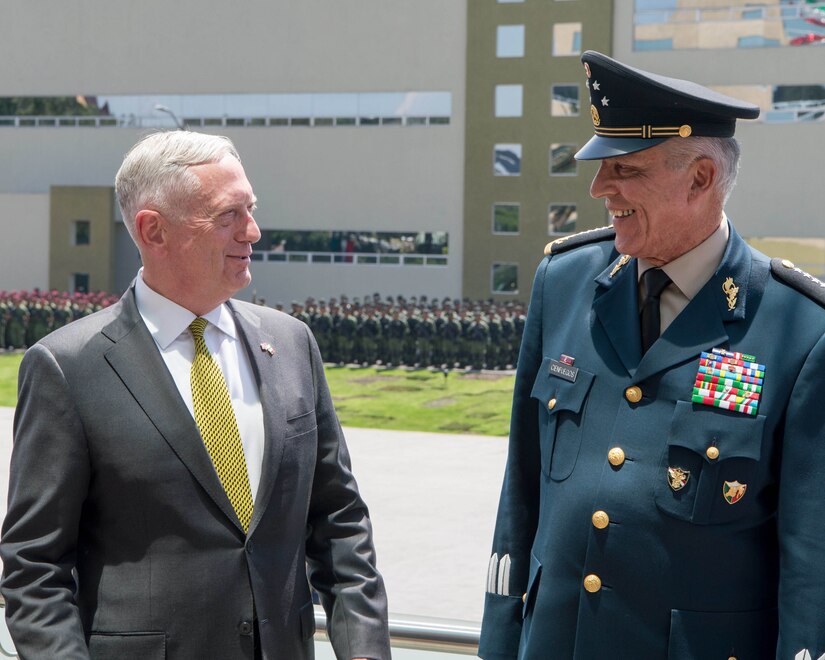
WASHINGTON -- Democracy is succeeding in Latin America and can be a beacon to the rest of the world, Defense Secretary James N. Mattis said yesterday at the Defense Ministerial in Cancun, Mexico.

The Conference of Defense Ministers of the Americas, co-hosted by Mexican Secretary of National Defense Gen. Salvador Cienfuegos Zepeda and Mexican Secretary of Navy Adm. Vidal Francisco Soberon Sanz, allows defense ministers from Canada to Chile to gather and discuss shared hemispheric defense challenges. The forum was founded by then-Defense Secretary William J. Perry.

“From Ottawa to Buenos Aires to Santiago, from south to north and from east to west, our nations increasingly represent an island of democratic stability amidst a global sea of instability due to malign influence,” Mattis said during his address. “In bringing us together, Mexico continues to show important strategic leadership building trusted relationships between us based on respect, cooperation, and mutual understanding.”

Mattis said there are challenges to stability and security in the Americas, from transnational criminal syndicates to illegal immigration to humanitarian issues.

Partnership is Crucial

Partnership among the nations of the hemisphere is crucial to addressing these challenges, he said.

Cuba, Nicaragua and Venezuela are the exceptions to the rule in the region. Mattis called the leadership in Cuba “sad and unresponsive.” Nicaragua and Venezuela tried to model their countries after Cuba. But the nations, “cannot hide from the reality they face as the world recognizes that the Cuba model no longer works for anyone, even Cuba,” he said.

“Democracy is working,” Mattis said. “Our democratic nations send a message as we uphold our shared values, including respect for human rights, the rule of law, and sovereignty. And that message reverberates around the globe.”

The success is seen even in nations like Russia and China that still try to tear down the existing international order to emplace something that benefits them alone. Mattis said those countries “threaten sovereignty with predatory investments, piling up massive debt and seeking undue influence over other countries diplomatic, political, and economic decisions.”

Fostering Understanding, Cooperation

He called on the hemispheric nations to remain steadfast in the commitment to foster greater understanding and cooperation. “We see the positive impact our growing partnerships have for ensuring peace and stability in this region and beyond,” Mattis said. “We see it in this very room as we listen with respect to each other and the vision we have so we can collaborate better together.”

The challenges in the hemisphere cannot be addressed by one nation alone, Mattis said. “In tackling such difficult challenges together, we prove that like-minded nations are stronger when we collaborate, that we are then more responsive in serving our populations when disaster strikes,” he said. “So I express my support for making humanitarian assistance and disaster relief a permanent theme for the CDMA and for the Inter-American Defense Board to play a more intense role in strengthening regional humanitarian assistance/disaster relief cooperation, and my Department will stand with you, will stand alongside you, when trouble looms.”

Mattis noted the decision to send the hospital ship USNS Comfort is one example of cooperation. The ship will help relieve the strain on local health care systems overburdened by caring for refugees from Venezuela.

“We note that in the midst of … this man-made disaster in Venezuela that Russia is sending a bomber, while the U.S. Navy is sending a hospital ship with doctors,” he said.
The Comfort’s medical staff will come from the U.S. Navy, as well as Mexico and other area countries.

Monday, October 08, 2018

Passing the Decanter, the U.S. Naval Academy Way


By Jim Garamone, Defense.gov

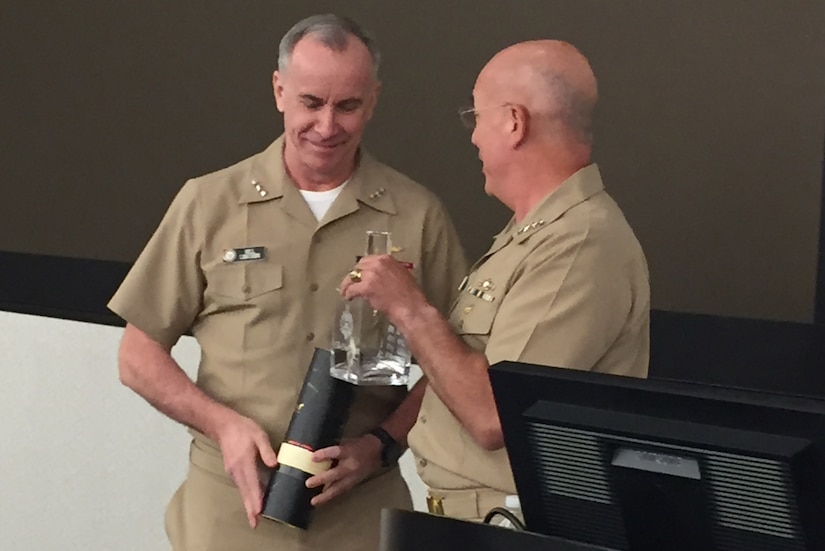
WASHINGTON -- The reign of the Naval Academy’s Class of 1978 is over as Navy Adm. Kurt Tidd passed the Old Goat Award decanter to Vice Adm. Bill Lesher during a ceremony at the Navy Yard, here last week.

The Old Goat Award is held by the oldest serving Naval Academy graduate, said Academy Superintendent Vice Adm. Ted Carter. Tidd, the current U.S. Southern Command commander, actually will hold the award until he retires.

Tidd is the last of four members of the class of 1978 to hold the award – a record for the academy. Retired Admirals Mark Ferguson, Cecil Haney and Harry Harris are all previous members of the class who were Old Goats.

The lighthearted ceremony was part of the chief of naval operations three- and four-star gathering. Navy Adm. John Richardson, the class of 1982, poked fun at “the old and gray” goats.

Lesher serves at the Pentagon as the deputy chief of naval operations for integration of capabilities and resources.

“This is one of those dubious distinctions,” Tidd said in the unofficial ceremony. “Dubious because there is certainly no one who enters the Naval Academy on induction day and says, ‘Man, I hope I can be the Old Goat.’ Usually they are hoping they can just make it through the day!”

Exchange Modified

Tidd also modified the exchange of the crystal decanter, which has the initials and class years of the recipients engraved on it. “I’m a big believer in a learning culture and a learning institution, and when I got this from my classmate Harry Harris, I looked at it and said there is something wrong with this,” Tidd said. “I have taken it on myself to modify this slightly and I pass this on to everyone who holds this subsequently that at least as long as the trophy is a decanter, it should no longer be empty.”

Tidd, highlighting his time in Central and South America, also presented Lesher with a bottle of 23-year old Zacapa rum from Guatemala to fill the decanter.

Lesher thanked Tidd, not only for the decanter and rum, but for his 40-year Navy career. “I really want to congratulate Admiral Tidd on his impressive and accomplished career,” he said. “I appreciate the honor and privilege of following you, and I look forward to passing this on to somebody else here.”

For the Navy this is a relatively recent tradition, starting with Navy Rear Adm. Alton Stock, who graduated from the academy in 1972.

Sunday, October 07, 2018

NATO’s Trident Juncture Exercise Tests Deterrence Capabilities


By Jim Garamone, Defense.gov

WASHINGTON -- The world’s preeminent defensive alliance is readying to demonstrate its capabilities in its largest exercise since 2002, said Navy Adm. James Foggo, the commander of NATO’s Allied Joint Force Command in Italy.


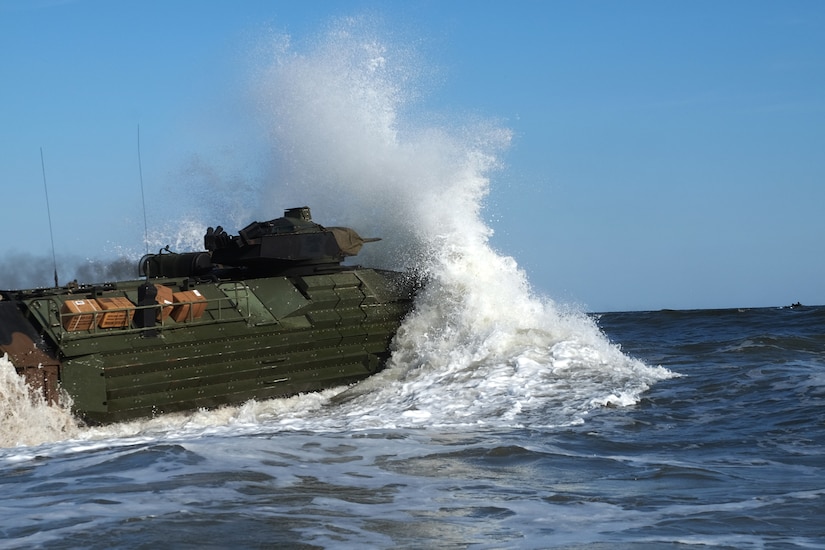
The exercise brings together 45,000 personnel from the 29 NATO allies, and partner nations Sweden and Finland. “Allies are contributing about 150 aircraft over 60 ships and 10,000 rolling or tracked vehicles,” Foggo said.

The purpose of the exercise is to test alliance readiness and responsiveness. “Let me emphasize that this is an exercise,” he said. “This is for training, but it is real because the lessons we learned are very real and they'll benefit us in our desire to become more resilient and stronger together as an alliance.”

Simply holding the exercise and demonstrating the capabilities of NATO has a deterrent effect, the admiral said.

NATO has invited observers to the exercise including Russia. “Exercises like this show that NATO is strong,” he said. “Together, we're more effective at upholding our common values and preserving peace. Trident Juncture will prove that in this very unpredictable world … NATO remains an anchor of stability; 70 years young, 70 years old, the strongest alliance in the history of Europe.”

Testing Interoperability

Trident Juncture will exercise all aspects of the alliance and test capabilities in all domains. Air, land, maritime, special operations and amphibious forces will participate. It is designed to test the interoperability of national forces.

Foggo’s Canadian deputy, army Lt. Gen. Christian Juneau, will command the land forces. “I will be where I belong, at sea on either USS Mount Whitney or bouncing around some of the other ships out there,” he said. “And it's going to be sporty because this is wintertime. This is the North Atlantic. And I think it'll be a challenge for all those nations to come up, some are more used to it than others. The Norwegians are certainly used to that kind of weather and those kind of seas. The American Marines that come over, this is going to be a great opportunity for them to fight in the archipelago, fight without their boots in the sand, and come ashore in Norway and work in cold weather operations.”

Testing NATO’s 5,000-strong Response Force is at the core of the exercise, but it also tests logistics. “I call it the sixth domain of warfare,” he said. “Moving 45,000 people, and 10,000 vehicles, and 60 some odd ships, and 120 aircraft around the theater is not easy, so this is a test of our ability to do that rapidly.”

U.S. forces handle logistics on a global scale, and NATO is looking to develop the same capabilities. “In order to deter, you have to be present,” Foggo said. “You've got to be there and you've got to be there quickly.”
NATO’s Trident Juncture Exercise Tests Deterrence Capabilities
By Jim Garamone, Defense.gov

WASHINGTON -- The world’s preeminent defensive alliance is readying to demonstrate its capabilities in its largest exercise since 2002, said Navy Adm. James Foggo, the commander of NATO’s Allied Joint Force Command in Italy.


The exercise brings together 45,000 personnel from the 29 NATO allies, and partner nations Sweden and Finland. “Allies are contributing about 150 aircraft over 60 ships and 10,000 rolling or tracked vehicles,” Foggo said.

The purpose of the exercise is to test alliance readiness and responsiveness. “Let me emphasize that this is an exercise,” he said. “This is for training, but it is real because the lessons we learned are very real and they'll benefit us in our desire to become more resilient and stronger together as an alliance.”

Simply holding the exercise and demonstrating the capabilities of NATO has a deterrent effect, the admiral said.

NATO has invited observers to the exercise including Russia. “Exercises like this show that NATO is strong,” he said. “Together, we're more effective at upholding our common values and preserving peace. Trident Juncture will prove that in this very unpredictable world … NATO remains an anchor of stability; 70 years young, 70 years old, the strongest alliance in the history of Europe.”

Testing Interoperability

Trident Juncture will exercise all aspects of the alliance and test capabilities in all domains. Air, land, maritime, special operations and amphibious forces will participate. It is designed to test the interoperability of national forces.

Foggo’s Canadian deputy, army Lt. Gen. Christian Juneau, will command the land forces. “I will be where I belong, at sea on either USS Mount Whitney or bouncing around some of the other ships out there,” he said. “And it's going to be sporty because this is wintertime. This is the North Atlantic. And I think it'll be a challenge for all those nations to come up, some are more used to it than others. The Norwegians are certainly used to that kind of weather and those kind of seas. The American Marines that come over, this is going to be a great opportunity for them to fight in the archipelago, fight without their boots in the sand, and come ashore in Norway and work in cold weather operations.”

Testing NATO’s 5,000-strong Response Force is at the core of the exercise, but it also tests logistics. “I call it the sixth domain of warfare,” he said. “Moving 45,000 people, and 10,000 vehicles, and 60 some odd ships, and 120 aircraft around the theater is not easy, so this is a test of our ability to do that rapidly.”

U.S. forces handle logistics on a global scale, and NATO is looking to develop the same capabilities. “In order to deter, you have to be present,” Foggo said. “You've got to be there and you've got to be there quickly.”