Wednesday, May 23, 2018

Former U.S. Air Force Staff Sergeant Pleads Guilty to Accepting Bribe While Serving in Afghanistan


A former U.S. Air Force staff sergeant pleaded guilty today to seeking and receiving a bribe from an Afghan contractor while serving in Afghanistan.  The sergeant worked at the Humanitarian Aid Yard (HA Yard) at Bagram Airfield in Afghanistan and was involved in the issuance of contracts to replenish supplies at the HA Yard under the Commander’s Emergency Response Program (CERP).  The sergeant is the eighth defendant to plead guilty in the investigation of this matter.

Acting Assistant Attorney General John P. Cronan of the Justice Department’s Criminal Division, U.S. Attorney McGregor W. Scott of the Eastern District of California, Special Agent in Charge Matthew J. DeSarno of the FBI’s Washington Field Office’s Criminal Division, Special Inspector General for Afghanistan Reconstruction (SIGAR) John F. Sopko, Special Agent in Charge Robert Craig of the Defense Criminal Investigative Service’s (DCIS) Mid-Atlantic Field Office, Director Frank Robey of the U.S. Army Criminal Investigation Command’s (CID) Major Procurement Fraud Unit (MPFU) and Colonel Kirk B. Stabler, Commander of the Air Force Office of Special Investigations (OSI) made the announcement.

David A. Turcios, 41, currently of San Jose, California, was charged in an indictment filed in July 2017 in the Eastern District of California with two counts of seeking and receiving bribes.  The indictment charges him with seeking and receiving $8,500 in bribes from two Afghan contractors who sought contracts for companies with which they were associated.  Turcios pleaded guilty to count two of the indictment before U.S. District Court Judge John A. Mendez of the Eastern District of California, in Sacramento.  Turcios is scheduled to be sentenced by Judge Mendez on Aug. 28.

Turcios admitted at the time of the guilty plea that, from November 2010 until November 2011, he worked as a U.S. Air Force staff sergeant at the HA Yard.  He was the yard supervisor responsible for replenishing supplies such as rice, beans and clothing at the HA Yard and overseeing the loading of trucks that took the supplies off the base.  During Turcios’s tenure, approximately nine contracts in which Turcios was involved were awarded to Afghan vendors with a value of over $2 million.

Turcios admitted that as part of his duties at the HA Yard, Turcios worked closely with, among others, an Afghan vendor (the Vendor) who sought to obtain contracts to replenish supplies in the HA Yard for companies with which he was associated.  In September 2011, Turcios agreed to allow the Vendor to provide the names of the three companies to be selected on each of the replenishment contracts he oversaw, effectively allowing the Vendor to select the company awarded the respective contract.  Because Turcios was nearing the end of his deployment in Afghanistan, he only had time to prepare approximately two contracts with the Vendor and, in October 2011, two contracts in which Turcios was involved were awarded to companies owned by individuals associated with the Vendor.

In late October or early November 2011, just prior to Turcios’s re-deployment to the United States, the Vendor offered Turcios $3,500 in return for Turcios’s actions on behalf of the Vendor as to HA Yard replenishment contracts, Turcios admitted.  Turcios thereafter sent several emails urging U.S. Army officials to approve payments to the Vendor in connection with the Vendor’s HA Yard contracts and obtained from the U.S. Army a voucher authorizing payment to the Vendor.  In February 2013, the Vendor wire transferred to Turcios’ wife’s bank account $500 of the $3,500 promised.

This matter was investigated by the FBI, SIGAR, DCIS, Army CID-MPFU and Air Force OSI.  Trial Attorney Daniel Butler of the Criminal Division’s Fraud Section is prosecuting the case, with assistance from Assistant U.S. Attorney Matthew Yelovich of the Eastern District of California.

Air Force Medical Team Supports Humanitarian Exercise in Panama


By Air Force Senior Airman Dustin Mullen,  325th Fighter Wing

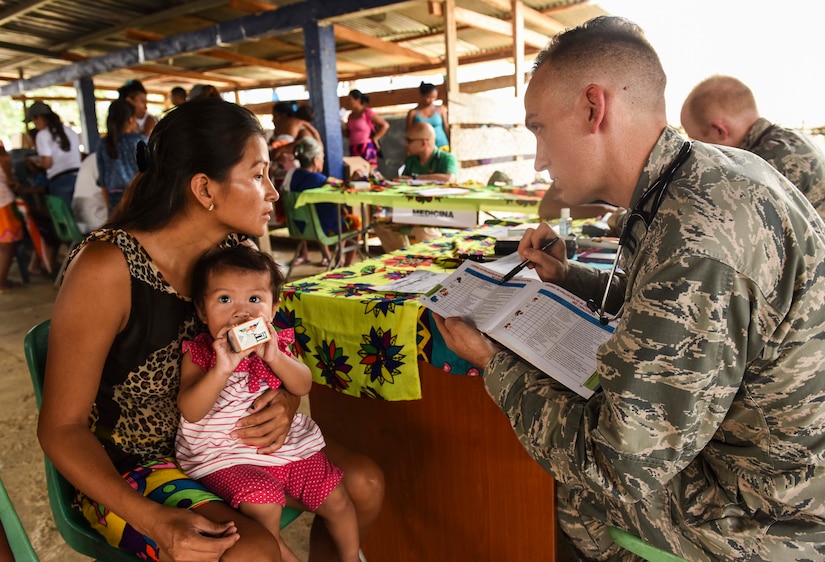
COCLE, Panama -- Five members of the 2nd Medical Group, Barksdale Air Force Base, Louisiana, joined other teams of airmen, Marines and soldiers in support of the New Horizons 2018 humanitarian exercise in Panama.

New Horizons 2018 is a joint training exercise which provides training to U.S. military members in engineering, medical, and support services, as well as providing support to the Panamanian people.

Barksdale’s team of four dental personnel and one logistics technician joined 10 Panamanian dentists and five U.S. Army dental personnel to deliver needed services to communities in Panama.

The dental team leader is Air Force Lt. Col Joanna McPherson, 2nd Dental Squadron clinical flight commander, who said she’s excited to participate in New Horizons 2018 and grateful for the training it provides.

Valuable Training

“We have been able to train on equipment usage and utilization of our deployment dental units,” McPherson said. “We don’t get a lot of hands-on time with those units, but here we are able to learn about trouble shooting and maintenance for them.

“We also get to train on mission planning, logistics and preparations for operations of a large magnitude,” she added.

During the exercise, the medical team has participated in three separate medical readiness training exercises, each in a different location. The dental team’s goal is to provide care to as many people as possible.

“This is such a valuable service to them because they don’t typically have the capability of getting a teeth cleaning, without having to travel a long distance,” McPherson said. “Some here would go their entire lives without a cleaning.”

McPherson has participated in civilian humanitarian missions through dental groups, nonprofit organizations and church groups in Africa, Mexico and Jamaica. She has never participated in a military-led humanitarian exercise and is impressed with the number of patients the team has been able to treat.

“Overall we will see around 1,500 dental patients,” McPherson said. “Other missions I have been on, we saw quite a few patients but still a much smaller population.”

Combating Dental Diseases

Due to the dental equipment the team was able to bring, the level of care they are able to provide will go a long way in reducing oral diseases and conditions, she said.

The dentists were able to provide teeth cleanings that only credentialed providers are able to, cleaning far below the gum line. Cleanings that deep are able to relive pain and prevent periodontal disease, which causes pain, abscesses and bone loss, McPherson added.

For the medical logistics technician, the exercise has provided a unique experience.

“This has been my first deployment and it was definitely a training opportunity,” said Air Force Staff Sgt. Christopher Heard, 346th Expeditionary Medical Operations Squadron medical logistics technician who is deployed from Barksdale. “It has been an opportunity to see how we can set up a bare bone clinic, run efficiently and provide supplies for all the clinics. We are learning how to work with a plan and adapt on the fly, and this has been very helpful to being able to work around problems.”

Heard added, “New Horizons has also helped me understand the supplies acquisition process and how to provide input in order to try to prevent future loss by sending too much or too little.”

The New Horizons team brought enough supplies to care for more than 5,000 patients, said McPherson, who noted she’s proud of her comrades.

Building Bonds With Comrades

“Anytime you are working in close quarters in a stressful environment where you really rely on each other, you build a bond that is really unique,” she said. “I knew they were great before so I was really excited to get assigned to this team with them. They are very capable, smart and hardworking people. I am excited we are experiencing this together.”

The Barksdale team has also been working closely with Panamanian dentists.

“Working with them and seeing how quick they are taking care of patients is kind of eye-opening for us,” McPherson said. “In the United States, we have different standards and expectations. To see a patient and get a tooth pulled in about six minutes is unheard of, but they are used to that here.”

McPherson has also enjoyed her interactions with the local dentists and the experience it provides.

“It has been nice to work with them, and they are interested in what we are doing and happy that we can expand their services,” she said. “Some of them have been able to use our equipment and have really appreciated it. It expands our horizons to work with other cultures and learn their practices and share knowledge.”

McPherson said her best experience is being able to help those in need.

“When you are away from your family, no matter how long, it’s always difficult,” she said. “But when you have made an impact on people in an underserved population, it really makes that time apart worth it. A lot of us in the health career field have typically chosen it to help those in need. That’s how our team has approached this -- if we have to be away from our families and our unit, then we are going to work our hardest to help as many people as possible.”

Tuesday, May 22, 2018

Service Members Must be Physically Ready for Deployment, Troxell Says


By Jim Garamone, DoD News, Defense Media Activity

WASHINGTON -- The U.S. military’s mission is to fight and win the nation’s wars, and service members must be physically, mentally and emotionally ready to fight when needed, Army Command Sgt. Maj. John W. Troxell said in an interview May 10.

And in this tumultuous era, that could be at any time, the senior enlisted advisor to the chairman of the Joint Chiefs of Staff added.

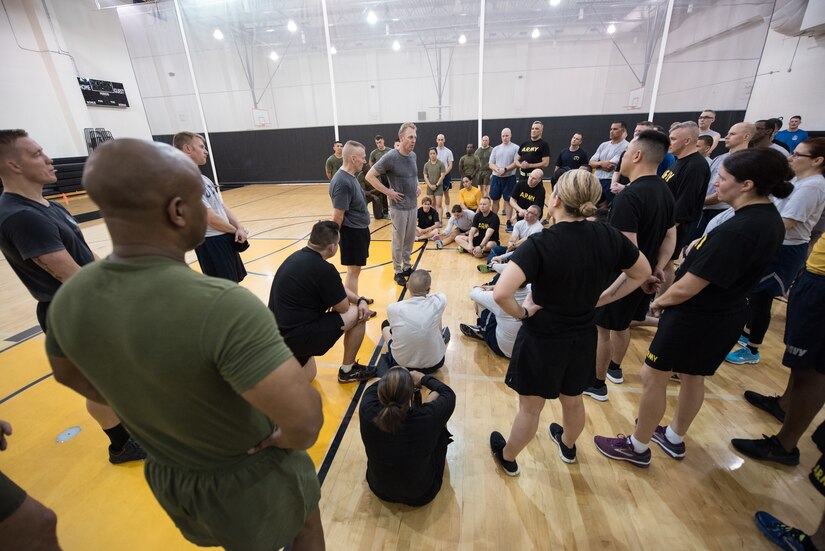
Troxell attended the inaugural DoD Readiness and Resilience Workshop held April 17 at Fort McNair in Washington. The workshop featured speakers and covered topics to optimize human performance through the body, mind, and spirit.

Deputy Defense Secretary Patrick M. Shanahan also participated in the workshop. Shanahan opened the workshop by joining service members in a workout.

“He’s in good shape,” the sergeant major said of the deputy defense secretary.

Be Ready for the ‘Worst Day’

Troxell said he constantly tells service members they must always be ready to engage in combat, which he describes as the “worst day.”

Troxell said he’s concerned about recent statistics regarding military deployability.

Defense Secretary James N. Mattis recently came out with a deployment and readiness policy. Essentially, the policy stipulates that if a service member is nondeployable for more than a year, then he or she is processed for separation. This does not affect service members wounded in combat.

“We have this deployability problem in terms of injuries and obesity -- we are talking about 100,000 service members,” Troxell said. “On top of that, 17 percent of the troops have been diagnosed as overweight or obese.”

The sergeant major said he brought together civilian and military fitness and dietary experts to discuss fitness, performance, nutrition and recovery at the Fort McNair workshop.

“I brought in 50 service members from around the services who are high-speed individuals -- the Marine martial arts instructors, master trainers from the Army, the Navy brought in a number of medical folks and dietitians,” Troxell said. “It was a lot of very physically fit people who were there to speak with each other and share best practices and strategies to address the obesity and the nondeployability problem.”

Promote Warrior/Athlete Culture

Noncommissioned officers and petty officers need to promote and encourage “a warrior/athlete culture and mentality” across the military services, Troxell said.

“Our special operations force[s] already do this very well, and there’s episodes in the services where it goes well,” he said. “But there are too many cultures out there where fitness training is just something we do for an hour in the morning and it is a ‘check the block’ kind of thing.”

And, some physical fitness training seems designed to prepare people to just pass the test, Troxell said.

“What physical training needs to be is a process to get someone prepared physically, mentally and emotionally for the conditions they may face on the worst day of their life,” he said.

That worst day comes in a variety of guises, Troxell said. For a soldier or Marine, it may be armed individual combat. For a sailor it could be dealing with disaster and firefighting. For an airman it could be in a convoy or on an airfield where disaster strikes or an enemy attacks.

“In any event, we shouldn’t be training to pass a fitness test,” he said. “We would be training for what we need to do on that worst day. We don’t do that enough.”

In extreme cases, there are service members who have been nondeployable for three or four years, the sergeant major said. Someone else still has to go. The sergeant major described one specialty with just 32 people. Only eight are deployable and they shoulder that burden.

Physical fitness helps mentally as well, Troxell said. “It’s a medical fact that the more physically fit you are, the more mental and emotional preparedness you are going to have,” he said. “You are already used to pushing against boundaries in physical training. You have already conditioned your body and your mind to handle adversity in training and that has a payout when you go through the worst day of your life.”

Medical experts who deal with post-traumatic stress say that developing physical fitness is a factor in combating that condition.

Making Change Happen

Troxell said he believes that the NCO and petty officer ranks need to make change happen.

“I want those mid-range noncommissioned officer and the petty officers to own this,” he said. “They need to say there won’t be unfit people in their formations. They have to have people they can count on physically, mentally, emotionally, technically to thrive on the worst day. They shouldn’t be discovery learning on the worst days of their lives that the buddies next to them can’t carry someone out of a bad situation.”

Regardless of how good the U.S. military is bad things can happen and “we have to prepare, and it starts every day with this culture of ‘I am a warrior/athlete,’” Troxell said.

He practices what he preaches. Troxell has embraced a tough physical training program. The 54-year-old senior NCO still qualifies in the Ranger School five-mile standard in under 40 minutes.

Passing a physical training test requires a 60 percent score. “We can’t be a 60 percent force,” Troxell said. “We have to strive for perfection.”