Wednesday, March 14, 2018

Arctic-Deployed Navy Submarines Participate in Ice Exercise 2018


By Navy Cmdr. Corey B. Barker, Submarine Force Pacific

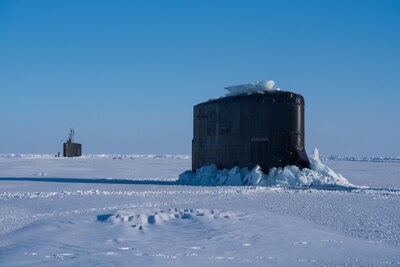
BEAUFORT SEA, Arctic Circle, March 13, 2018 — The Navy’s fast attack submarines USS Hartford and USS Connecticut both surfaced in the Arctic Circle north of Alaska during the multinational maritime Ice Exercise 2018, March 10.

Both submarines, as well the U.K. Royal Navy submarine HMS Trenchant, are participating in the biennial exercise in the Arctic to train and validate the warfighting capabilities of submarines in extreme cold-water conditions.

“From a military, geographic, and scientific perspective, the Arctic Ocean is truly unique, and remains one of the most challenging ocean environments on earth,” said Navy Rear Admiral James Pitts, commander of the Undersea Warfighting Development Center.

Ice Canopy

ICEX provides the U.S. submarine force and partners from the British navy an opportunity to test combat and weapons systems, sonar systems, communications and navigation systems in a challenging operational environment, officials said. The unique acoustic undersea environment is further compounded by the presence of a contoured, reflective ice canopy when submerged.

According to Pitts, operating in the Arctic ice alters methods and practices by which submarines operate, communicate and navigate.

“We must constantly train together with our submarine units and partners to remain proficient in this hemisphere,” Pitts said. “Having both submarines on the surface is a clear demonstration of our proficiency in the Arctic.”
Members of Ice Camp Skate drill a hole in the ice in support of Ice Exercise 2018 in the Arctic Circle.

In recent years, the Arctic has been used as a transit route for submarines. The most recent ICEX was conducted in 2016 with the U.S. submarines USS Hampton and USS Hartford.

The first Arctic under-ice operations by submarines were conducted in 1947-49. On August 1, 1947, the diesel submarine USS Boarfish, with Arctic Submarine Laboratory's founder Waldo Lyon serving onboard as an ice pilot, conducted the first under-ice transit of an ice floe in the Chukchi Sea.

USS Nautilus Makes Undersea Passage

In 1958, the nuclear-powered submarine USS Nautilus made the first crossing of the Arctic Ocean beneath the pack ice. The first Arctic surfacing was done by USS Skate in March 1959. USS Sargo was the first submarine to conduct a winter Bering Strait transit in 1960.

The units participating in the exercise are supported by Ice Camp Skate, a temporary ice camp on a moving ice floe approximately 150 miles off the coast of the northern slope of Alaska in international waters.

The ice camp is a remote Arctic drifting ice station built on multiyear sea ice especially for ICEX that is logistically supported with contract aircraft from Deadhorse, Alaska. The camp will close once the exercise is over.

Face of Defense: ‘Lunch and Learn’ Event Saves Airman’s Career


By Air Force Senior Master Sgt. Emily Beightol-Deyerle 167th Airlift Wing, West Virginia Air National Guard

MARTINSBURG, W.Va., March 14, 2018 — “Lunch and Learn” events have become rather popular at the West Virginia Air National Guard’s 167th Airlift Wing here.

Scheduled during the lunch hour, these events invite airmen to eat their packed lunch while listening to discussions on topics such retirement, finances, legal issues and health.

For one airman, attending such an event in November significantly impacted his life.

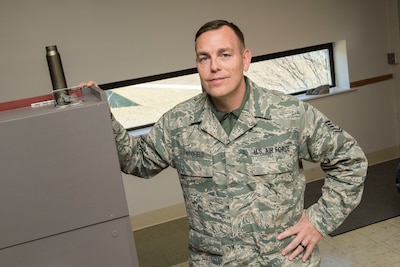
“The briefing provided in November saved my career,” said Air Force Tech. Sgt. Robert Scofield, a budget analyst for the 167th Comptroller Flight.

Air Force Capt. Jacqueline Shoemaker, an aerospace nurse practitioner for the 167th Medical Group, discussed the history of the food pyramid in the U.S. and why 70 percent of Americans struggle with weight at the lunch and learn event, the first offered by the medical group. She offered an alternate food plan that optimizes performance, energy and stamina.

Education Improves Readiness

“Our goal in the medical group is to improve the overall health and fitness readiness of the airmen,” Shoemaker said. “The [medical group] has developed educational programs [to do this].”

The food plan limits sugars and starches and can facilitate healing and the reversal of disease.

“Leading up to November drill I had been working out and eating better based off what I thought was best -- smaller portions, limit calories, etc. The problem was that I wasn't losing any weight,” Scofield said. “I was coming to the realization that I wasn't going to pass my [fitness] test and my military career was coming to an end.”

Shoemaker introduced Scofield to a new way of thinking about food and nutrition.

He went home that evening, did some more research on the nutritional plan and began implementing it the next day.

“I was desperate and unlike other diets this seemed like something that I could really get behind,” Scofield said.

He lost 10 pounds the first week.

“A lot of that was water weight due to the lack of carb intake,” he said. “More importantly, I started feeling much better within the first couple of weeks. I had more energy and focus from the change.”

Since beginning the diet, Scofield has lost 40 pounds and five inches from his waist. He passed his fitness assessment in January and is living a healthier lifestyle, all because he attended a “Lunch and Learn” event.
“The tools are available, and if used properly one can have amazing success. I am so proud of Jim Scofield. This is what health care, healing and serving my country is all about,” Shoemaker said.

Tuesday, March 13, 2018

Joint Staff Approves Humanitarian Service Medal for Hurricane Response


By Lisa Ferdinando DoD News, Defense Media Activity

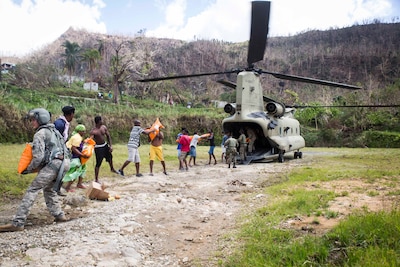
WASHINGTON, March 12, 2018 — Eligible military members who served in disaster relief efforts for Hurricanes Harvey, Irma or Maria are to receive the Humanitarian Service Medal.

The Joint Staff recently approved the military honor for qualified members in any branch of the armed services. The military departments are responsible for determining individual eligibility. Service members are advised to direct any questions to their respective military department.

For Hurricane Harvey, the award period starts Aug. 23, 2017, and ends Oct. 31, 2017, for the geographic area of Texas and Louisiana.

The Texas counties are: Aransas, Austin, Bastrop, Bee, Brazoria, Calhoun, Chambers, Colorado, DeWitt, Fayette, Fort Bend, Galveston, Goliad, Gonzales, Hardin, Harris, Jackson, Jasper, Jefferson, Karnes, Kleberg, Lavaca, Lee, Liberty, Matagorda, Montgomery, Newton, Nueces, Orange, Polk, Refugio, Sabine, San Jacinto, San Patricio, Tyler, Victoria, Waller and Wharton.

The Louisiana parishes are: Acadia, Allen, Beauregard, Calcasieu, Cameron, Iberia, Jefferson Davis, Natchitoches, Rapides, Sabine, Vermilion and Vernon.

For Hurricanes Irma and Maria, the dates for eligibility run from Sept. 8, 2017, to Oct. 20, 2017, and cover the state of Florida and the Caribbean Sea and adjacent waters from Barbados northward to Anguilla, and then westward to the Florida Straits.