Monday, March 12, 2018

Vietnam Vascular Registry Helps Combat Veteran Reunite with Doctors


By Sarah Marshall Uniformed Services University of the Health Sciences

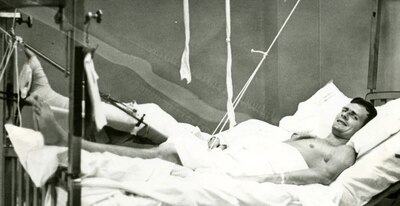
BETHESDA, Md., March 12, 2018 — Five decades after being shot in Vietnam and almost losing his leg, former Army Spc. John Fogle will make good on a promise he made to the surgeons at the 22nd Surgical Hospital in Vietnam who saved his life.

Before he was transported to a general hospital in Japan, Fogle told his surgeons he would drop them a line and let them know how he was doing. He never did write, but instead, in May he will fulfill his promise of reconnecting -- in person.

Fogle was injured in combat on July 25, 1969. Although over time he forgot their names, he never forgot the doctors who saved him and when he learned of a reunion planned for the surviving members of the 22nd Surgical Hospital staff, Fogle decided to seek them out in hopes of inviting them to the event.

Vietnam Vascular Registry

One of his first stops in his search was the Vietnam Vascular Registry, developed by Dr. Norman Rich, chair emeritus of the surgery department at the Uniformed Services University of the Health Sciences.

In 1966, the Vietnam Vascular Registry was developed by Rich at the Walter Reed General Hospital based on cases he had seen while serving in Vietnam along with hundreds of other cases added by colleagues. The registry documented and analyzed blood vessel injuries in Vietnam, resulting in documentation of more than 10,000 injuries from about 7,500 American casualties in Southeast Asia. Each patient entered into the registry was assigned a consecutive number and given a vascular registry card stating the registry’s purpose.

Rich has maintained the registry for more than 50 years. If stretched out completely, the entire registry itself would be about 114 linear feet, he noted. In 2016, the registry was digitized by the Office of the Secretary of Defense, making it much easier to search and find records from vascular patients seen during Vietnam. The originals were sent to the National Archives and Records Center in St. Louis.

Fogle had held onto his registry card, sent by Rich from the Vietnam Vascular Registry, for more than 50 years. Once he connected with Rich, he was able to reference his assigned registry card number, making it relatively easy for Rich to access his medical records from the 22nd Surgical Hospital. The records provided the names of Fogle’s doctors, among them Dr. Monroe Levine, who assisted in the surgery on his right leg and arm.

‘They Performed Miracles’

Fogle has foggy memories of the day he was injured, so over the years it was hard for him to remember the names of those doctors who first operated on him in the 22nd Surgical Hospital. However, he will never forget being shot while flying in an observation helicopter.

He was on the lookout for signs of enemy activity, as the crew chief, and as they flew over a canyon, they surprised the Viet Cong, who began firing at their helicopter. Fogle was shot three times down his right side, leaving him with a severed femoral artery and a compound fracture in his femur. He remained conscious, though, and continued firing back to suppress the enemy’s fire and protect his crew, which included the pilot, who sat just two feet away. They were able to get out of there quickly and landed safely, arriving at the 22nd Surgical Hospital which was only 12 miles away. Fogle’s actions later earned him an Air Medal.

About 10 minutes after he had been shot, Fogle was being pulled into the 22nd Surgical Hospital, which he recalls had four fully equipped operating rooms, totally air conditioned. The unit’s mission was to help stabilize the wounded before transporting them to the 249th General Hospital at Camp Drake in Japan.

“They performed miracles in there,” Fogle said. At the time, he said, his leg was a big “question mark.” Surgeons in that unit prepared him for transport to Japan, and told him he “wasn’t out of the woods just yet.” He made it to the general hospital, where he underwent more surgeries. His recovery, over the years, was smooth and he has not had any other major issues.

“I was very fortunate,” Fogle added. “I could’ve easily lost my leg.”

He added that many surgeries were performed at the 22nd Surgical Hospital, over a long period of time, so it would have been hard for the doctors to remember each patient. In looking through his records obtained through the registry, Fogle said he learned that Levine had seen four other patients that same day.

“That’s why these notes [in my records] are so important,” he said.

Reconnecting

After learning Levine’s full name, it didn’t take long for Fogle to find that the doctor is still practicing medicine in Colorado. The two connected over the phone, and are now looking forward to meeting again, after all these years, at the reunion, which will take place in Florida. Fogle sent his records to Levine to look through, hoping to help jog his memory before they meet in May.

Fogle considers himself very lucky. After leaving the military, he’s really only had to limit himself to certain sports and activities because he did suffer muscle loss, which throws off his balance to this day. He was able to go back to school after his military service and became an electrical engineer. A few years ago, he retired after a fulfilling, 38-year career.

Had it not been for the work of Levine, as well as the others in that unit and throughout his care and recovery, Fogle might not be where he is today.

“I’m looking forward to meeting him again in person,” Fogle said.

Rich was pleased to hear Fogle reconnected with one of the surgeons who saved his leg.
“This is what makes it valuable,” he said, referring to the extensive Vietnam Vascular Registry. “It is really reassuring that what we were doing has merit.”

Sunday, March 11, 2018

Face of Defense: Army Logistics Officer Improves Troops’ Quality of Life


By Army Staff Sgt. Scott J. Evans 22nd Mobile Public Affairs Detachment

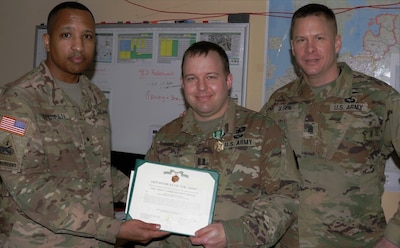
POZNAN, Poland, March 9, 2018 — A Mission Command Element liaison officer assigned to the 21st Theater Sustainment Command was recognized for his contributions to the Atlantic Resolve mission at the MCE headquarters here, Feb. 19.

Army Capt. Jason M. Spalding was awarded the Army Commendation Medal by Army Brig. Gen. William L. Thigpen, deputy commanding general, 4th Infantry Division, for his work to improve conditions for the service members currently serving here.

“Whether its gym equipment or furniture and supplies for our Morale, Welfare and Recreation, Captain Spalding has contributed an incredible amount for the quality of life of this organization,” Thigpen said.

Spalding, who hails from Stuarts Draft, Virginia, is a logistics officer assigned to the 21st Theater Sustainment Command based in Kaiserslautern, Germany. He has been assigned in Europe at different points in his career, and has experience handling what can be tedious paperwork and other administrative requirements that ensure border crossings for cargo and transportation are up to standard.

Spalding has served with 21st Theater Sustainment Command since September 2017 and was assigned as a liaison officer with the MCE in Poznan, Poland, November 2017 in order to facilitate a closer working relationship between the two units.

Supply Coordination

He handles supply coordination between 21st TSC and 4th ID MCE and subordinate brigades ensuring that items such as water, fuel, and ammunition reach training areas throughout the Atlantic Resolve area of operations. He ensures mission accomplishment and improves the quality of life of service members.

During his time at the MCE, Spalding drove approximately 2,500 miles and delivered $1.1 million worth of equipment to subordinate unit locations in an effort to build more capacity, said Army Maj. Christian Gatbonton, the 4th Infantry Division’s MCE transportation officer.

Because of Spalding’s efforts, service members stationed at locations such as the Mission Command Element have been able to maintain physical readiness, said Army Staff Sgt. Brian Pierce, originally from Fort Wayne, Indiana, serving here with the 44th Expeditionary Signal Battalion, 2nd Signal Brigade.

“Being able to have these types of facilities with various types of fitness equipment is definitely helpful with keeping us in shape,” Pierce said.

Due to working in various countries, regulations for U.S. Army Europe can be very different from what supply offices encounter back in the United States. As a liaison officer, Spalding provides the subject matter expertise in areas that fall outside the scope of the typical division supply experience.

Spalding said he appreciates the camaraderie he finds each time he gets the opportunity to serve in Europe.

“I find that soldiers tend to be closer [when serving] abroad than back home,” he said. “It seems that it’s because we have to rely on each other more to get by.”
(Editor’s Note: The 4th Infantry Division transferred authority of the Atlantic Resolve Mission Command Element to the 1st Infantry Division in a ceremony at Poznan, Poland, Feb. 28, 2018. Three years ago, in response to increased regional tensions, the 4th Inf. Div. formed the first Atlantic Resolve MCE, serving as the intermediate headquarters between U.S. Army Europe and U.S. Regionally Aligned Forces deployed throughout the eight eastern European Atlantic Resolve countries of Bulgaria, Estonia, Hungary, Latvia, Lithuania, Poland, Romania and Slovakia.)

Ballistic Missile Defense Remains Focal Point of Juniper Cobra 2018


By Air Force Tech. Sgt. Matthew Plew 48th Fighter Wing

TEL AVIV, Israel, March 9, 2018 — Juniper Cobra is a U.S. European Command bilateral exercise.

The exercise is part of a routine training cycle, designed to improve coordination between the U.S. forces and the Israel Defense Force, through a variety of computer-assisted simulations that range from rocket threats to crisis resupply, foreign disaster response and foreign humanitarian assistance.

However, the focal point of Juniper Cobra remains clear -- to provide integrated ballistic missile defense to counter regional threats to Israel and maintaining U.S. support of Israel's qualitative military edge.

Defense Partnership

"We are proud to welcome our friends and partners," said Brig. Gen. Zvika Haimovich, Israeli aerial defense commander. "Together we will prepare ourselves to meet the challenges of the future."

The U.S. Army has deployed the MIM-104 Patriot air defense missiles – a surface-to-air missile system and the Army’s primary high-to-medium air defense system -- to work in tandem with the IDF's Iron Dome air defense missiles in support of this premier training event.

The Patriot system is designed to provide multitier theater defense against adversary missile threats using peer-to-peer engagement coordination, early warning track data, and battle management situational awareness.

Air Defense System

Similarly, the Iron Dome is the IDF’s mobile all-weather air defense system designed to intercept and destroy regional short-range rockets directed at populated areas.

Each Iron Dome battery boasts a 90 percent intercept success rate. When paired with the Patroit system, they provide Israel with a near impenetrable layer of defense against attack.

“We're training to answer the call," said U.S. Air Force Lt. Gen. Richard Clark, Joint Task Force Israel commander. "The call to defend Israel."

Operating cohesively, U.S. and IDF forces will train over the next two weeks during Juniper Cobra to increase regional security, stability and military readiness.