Tuesday, October 24, 2017

Workplace Violence Survivors Unite to Turn Tragedy Into Hope


By Elaine Sanchez Brooke Army Medical Center

JOINT BASE SAN ANTONIO-FORT SAM HOUSTON, Texas, Oct. 24, 2017 — A little over a year ago, shortly after 5 p.m., Army 1st Lt. Katie Ann Blanchard was shutting down her computer for the day, eager to get home to her three young sons, when she saw him coming out of the corner of her eye.

He was holding a plastic bottle filled with a brownish-tinged liquid and she felt a sudden rush of fear. Before she could react, he splashed the liquid on her face and struck a match.

What happened in those moments changed the course of Blanchard’s life. The Army nurse was severely burned and attacked by a man she supervised on Sept. 7, 2016, at Munson Army Health Center on Fort Leavenworth, Kansas.

‘I Felt Hopeless’

“I was consumed with anger,” said Blanchard, who is still in recovery at Brooke Army Medical Center here. “I felt robbed of time with my family and my career as an Army nurse. I felt hopeless.”

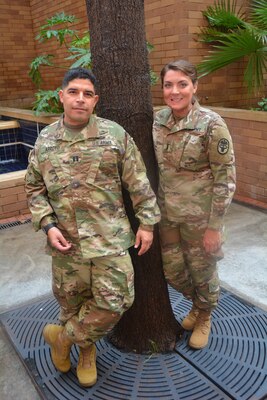
Today, Blanchard is working to turn that senseless act of violence into a message of hope, thanks to the support of her family and a new friendship with Army Capt. John Arroyo, a fellow survivor of workplace violence.

Blanchard said she’s found the strength to share her story in the hopes of inspiring others dealing with hurt and pain.

“It’s a difficult story to share, but if I can help even one person, one soldier, it will make all of this worth it,” she said.

Arroyo, who also recovered at BAMC, is familiar with the devastating pain and aftermath of workplace violence. Two years before the Army nurse was set on fire, Arroyo -- a Green Beret -- had been shot at Fort Hood, Texas, and left to die.

In April 2014, Arroyo had just stepped out of his car at brigade headquarters when Army Spc. Ivan Lopez walked up to him and shot him in his throat at close range with a .45-caliber pistol.

Gasping for breath, Arroyo held his throat to staunch the bleeding and managed to stumble toward some nearby soldiers, who rushed him to the hospital. Lopez killed three people and wounded 15 others that day before turning the gun on himself.

Doctors told Arroyo his voice box and right arm were damaged beyond repair, but after months of intense rehabilitation he was talking and had regained the use of his hand. He now serves as the plans and training officer in charge of the Basic Officer Leaders Course here and shares his story to encourage others.

Sharing Experiences

He went to visit Blanchard just weeks after her arrival with that same intent in mind. When Arroyo entered the dimly lit hospital room, he knew the best way he could connect with the soldier swathed in bandages in front of him was to show her she was not alone. He pulled down the collar of his tan T-shirt and showed her the jagged scar marking where he had been shot.

“It may not seem like it now,” he told her, “but you can come back from the worst of situations and be functional and useful again.”

In pain and despair, Blanchard had one question for Arroyo: “How do you deal with the nightmares?”

“My faith,” Arroyo responded without hesitation. Blanchard thought of her family and how they pulled her through in the early days after the attack.

Blanchard was only two years into her first tour of duty when she was stationed at Munson Army Health Center. The young lieutenant and military wife became a first-time supervisor of 15 military and civilian staff, including then-54-year-old Clifford Currie.

“Mr. Currie was difficult from the start,” she recalled. “I kept telling myself, it will get better.”

Terrifying Ordeal

But it got worse. “He was blowing up twice a day or not coming into work,” she said. Blanchard expressed her fear and concern about Currie’s erratic and aggressive behavior to her leadership, who encouraged her to stay the course despite the red flags.

Shortly after 5 p.m. on Sept. 7, 2016, Blanchard noticed the light on in Currie’s office. Afraid to go on her own, she asked a physician to accompany her and told Currie it was time to go home.

She returned to her office alone and began to shut down her computer. She had just texted her husband that she was on her way when she saw Currie approach.

“He’s going to try to kill me,” she thought. Before she could react, he splashed the liquid onto her face, mostly dousing the right side. As she stood up to run, he tossed two lit matches at her and there was a burst of flames.

Her vision obstructed by flames, she stumbled out of the room and ran down the hall screaming. She banged on the first office to no response but heard her co-workers down the hall. “Katie! Katie!” her co-worker yelled as she grabbed a blanket and smothered the flames.

Blanchard was still on the floor when Currie reappeared, this time brandishing a large pair of scissors and a straightedge razor blade.

“He put his foot on my neck and started stabbing at me, trying to stomp on me. I put my hand and foot up trying to protect myself, to get away,” Blanchard recalled. A sergeant approached and grabbed Currie in a bear hug and he finally dropped the weapons.

Blanchard struggled for breath and as the adrenaline abated, the pain set in. “It was excruciating pain,” she said. “I thought I was going to die and I didn’t want to die alone.”

Blanchard was rushed to the hospital and later transferred to the Institute of Surgical Research Burn Center at BAMC.

Currie stood trial in August and he faces up to 20 years in prison after being convicted of assault with attempt to commit murder. His sentencing takes place next month.

Recovery

As she heals from the physical wounds, Blanchard struggles with the invisible ones -- severe post-traumatic stress and anger about the incident and the circumstances that led up to it.

Shortly after her arrival at BAMC, Arroyo met Blanchard and assured her that her journey was not at an end. Like Arroyo, she had survived for a purpose. The captain shares his story around the nation, speaking to groups on the importance of making the most of second chances.

Last month, Arroyo was invited to speak to students attending the National Registry Paramedic Recertification Course at the Army Medical Department Center and School here, and he immediately thought of Blanchard.

“We can make a difference for these soldiers,” he told her. Blanchard reluctantly agreed.

The experience was incredibly healing, she said. “I realized that day that I can do something. I can share my story and the warning signs of workplace violence so what happened to me won’t happen to someone else.”

Blanchard has continued her quest to combat workplace violence. She’s a key member of the newly formed Regional Health Command-Central Workplace Violence Working Group, which is taking swift action to add more security to military health care facilities, drafting a workplace violence guide, and working to institute violence prevention education and training for supervisors and employees.

‘My Anger Has Turned Into Passion’

“My anger has turned to passion,” she said. “I want to figure out how we can make the system better. I’m hoping Capt. Arroyo and I have future opportunities to speak to service members and civilians.”

Anyone can make a tremendous impact, whether in a combat zone or back home, Arroyo said. “We can help service members understand their skills are needed now,” he said. “There’s a perception that these skills are only needed overseas, but Lieutenant Blanchard and I are living proof that’s not the case. We must be vigilant and ready at all times, and not grow complacent.”

Last year, Arroyo had entered Blanchard’s hospital room and told her not to give up hope. He predicted the young lieutenant would have a bright future; one she now believes is possible.

As Blanchard talked with Arroyo about the officers’ aspirations to speak to and inspire service members around the world, he smiled.

“This is what tomorrow looks like,” he said.

Dunford: DoD Owes Families, Nation Information on Niger Action


By Jim Garamone DoD News, Defense Media Activity

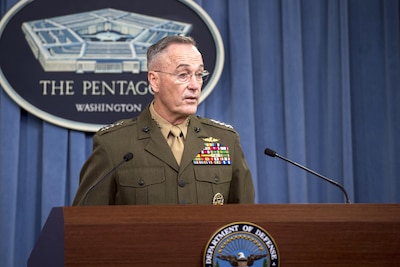
WASHINGTON, Oct. 23, 2017 — The Defense Department owes the families of the soldiers lost in Niger and the American people an explanation of what the soldiers were doing in Niger and why it was important, the chairman of the Joint Chiefs of Staff said here today.

Marine Corps Gen. Joe Dunford said the four Special Forces soldiers who were killed and the two who were wounded in the Oct. 4 action, were conducting an important train, advise and assist mission with Nigerien forces.

Building Capacity of Local Forces

“Our soldiers are operating in Niger to build the capacity of local forces to defeat violent extremism in West Africa,” the general said at a Pentagon news conference. “Their presence is part of a global strategy.”

The soldiers were on patrol with forces from Niger, he said, when a group linked to the Islamic State of Iraq and Syria attacked. “As we've seen many times, groups like ISIS and al-Qaida pose a threat to the United States, the American people and our allies,” Dunford said. “They’re a global threat enabled by the flow of foreign fighters, resources and their narrative.”

The four soldiers -- Staff Sgt. Bryan Black, Sgt. La David Johnson, Staff Sgt. Jeremiah Johnson and Staff Sgt. Dustin Wright -- were training local forces to conduct security in their own country. The four Americans were part of a multinational response to the threat these violent extremists pose.

Fighting ISIS

ISIS seeks to survive in the dark corners of the world where local inhabitants lack the power and expertise to control the violent group, Dunford said. ISIS operates where it can exploit weaknesses in local government and local security forces, he added. Libya, Somalia, West Africa, certain places in Central and Southeast Asia are places where ISIS and like groups choose to operate.

“If you think of those enablers as connective tissue between groups across the globe, our strategy is to cut that tissue, while enabling local security forces to deal with the challenges within their countries and region,” Dunford said.

The United States is working with nations around the world to improve their military capabilities and capacities, Dunford said. U.S. troops, he added, have been working with forces from Niger for 20 years, the general said, training more than 35,000 soldiers from the region to confront the threats of ISIS, al-Qaida and Boko Haram.

“Today, approximately 800 [U.S.] service members in Niger work as part of an international effort, led by 4,000 French troops, to defeat terrorists in West Africa,” Dunford said.

Dunford related what is known about the Oct. 4 operation in Niger.

“On the 3rd of October, 12 members of the U.S. Special Operations Task Force accompanied 30 Nigerian forces on a civil-military reconnaissance mission from the capital city of Niamey to an area near the village of Tongo Tongo,” he said. The village is located a little over 50 miles north of Niamey, and officials expected the chances of meeting an enemy were slight.

The next day, Dunford said, the forces began moving back, when they were attacked by approximately 50 enemy using small-arms fire, rocket-propelled grenades and technical vehicles.

“Approximately one hour after taking fire, the team requested support,” he said. “And within minutes the remotely piloted aircraft arrived overhead. Within an hour, French Mirage jets arrived on station.”

Still later, French attack helicopters arrived on station, and a Niger quick-reaction force arrived.

Firefight

During the firefight, two U.S. soldiers were wounded and evacuated by French aircraft to Niamey, and that was consistent with the casualty evacuation plan that was in place for this particular operation, Dunford said.

Three U.S. soldiers who were killed were evacuated the evening of Oct. 4, Dunford said.

“At that time, Sergeant La David Johnson was still missing,” the general said.

"On the evening of Oct. 6, Sergeant Johnson’s body was found and subsequently evacuated,” he said. “From the time the firefight was initiated until Sergeant Johnson’s body was recovered, French, Nigerien or U.S. forces remained in that area.”

Questions to be Answered

The combat was tough and confused, the chairman said. There are more questions that need to be answered, he added, and that is why U.S. Africa Command appointed a general officer to investigate.

The questions that need answers, he said, include:  Did the mission of U.S. forces change during the operation? Did U.S. forces have adequate intelligence, equipment and training? Was there a premission assessment of the threat in the area accurate? And, How did U.S. forces become separated during the engagement, specifically Sergeant Johnson?

And, why didn’t they take time to find and recover Sergeant Johnson? Dunford said.

“We owe the families of the fallen more information, and that's what the investigation is designed to identify,” he said.

The general said the campaign against violent extremists is making progress, but much more needs to be done.

Inflection Point

“Even with the fall of Mosul and Raqqa, we’re at an inflection point in the global campaign, not an end point,” he said.

The general said he’s hosting the chiefs of defense and representatives from 75 different countries will meet to improve the effectiveness of the military network to defeat terrorism.

“In our discussions over the next day or two, we’ll focus on improving information sharing between nations to detect and defeat attacks before they occur, and to improve the support we provide to nations confronted with violent extremism,” he said. “And that's exactly what our forces in Niger were doing.”

Monday, October 23, 2017

Dawn Blitz 2017: Realistic and Relevant Amphibious Training


By Navy Petty Officer 2nd Class Sean Gallagher, Expeditionary Strike Group Three

SAN DIEGO, Oct. 23, 2017 — The Navy’s Expeditionary Strike Group 3 and the Marine Corps’ 1st Marine Expeditionary Brigade kicked off the joint amphibious exercise Dawn Blitz here Oct. 20.

Dawn Blitz is an annual scenario-driven amphibious exercise designed to train and integrate the staffs of ESG-3 and 1st MEB. It provides the realistic, relevant training necessary for the effective global crisis response expected of the Navy and Marine Corps team.

The exercise takes place at sea off the coast of Southern California and will involve participation from ships homeported at Naval Base San Diego including the amphibious assault ship USS Essex, the amphibious transport dock USS Anchorage, the amphibious dock landing ship USS Rushmore and the guided missile destroyer USS Wayne E. Meyer. These ships will integrate with 1st MEB and Coastal Riverine Group 1 to demonstrate how U.S. forces are capable, interoperable and deployable on short notice while being fully combat ready.

“Dawn Blitz 2017 is an excellent opportunity to operationalize concepts the Navy and Marine Corps services have been discussing for some time,” said Navy Cmdr. Matthew Hoekstra, director of maritime operations for ESG-3 and lead exercise planner for Dawn Blitz. “While others continue to talk, wargame or tabletop future concepts, we are executing with live forces afloat and ashore.”

The exercise consists of various wartime events leading to the deployment of U.S. and allied forces against a hypothetical enemy. Forces will plan and execute an amphibious assault, engage in live-fire events, and establish expeditionary advanced bases in a land and maritime threat environment to improve naval amphibious core competencies.

Crucial Joint Training

“Dawn Blitz provides crucial training for our Navy-Marine Corps team,” said Navy Rear Adm. Cathal O'Connor, the commander of ESG-3. “The capability to conduct prompt and sustained amphibious operations anywhere in the world is essential to our Navy and our nation. The amphibious force's capabilities range from high-end warfighting to the disaster response capabilities our East Coast sailors and Marines are demonstrating today.”

“Since this is a multinational exercise,” he said, “working with our international partners helps foster and sustain cooperative relationships that enhance regional security, stability and prosperity around the globe.”

Dawn Blitz 2017 builds upon previous iterations of the exercise and affords the Navy and Marine Corps team the opportunity to capture lessons learned, develop amphibious staff expertise and test new capabilities and equipment for the future fight.

New to this year’s exercise is the integration of the F-35B Lighting II joint strike fighter and the High Mobility Artillery Rocket System to conduct a sea-based strike. This will allow commanders to validate a capability with platforms not traditionally used at this level.

Additionally, demonstration of the composite warfare construct and other command and control arrangements will help to promote unity of effort in littoral warfare.

"Our experiment in command and control structure is designed to provide the commander with greater flexibility and speed to employ assigned forces,” Hoekstra said. “The amphibious force has always been the vanguard of naval power in these qualities."

The Navy and Marine Corps enjoy a close working relationship based on past tradition, present requirements and future necessity to project power ashore. Leadership of both services share a common goal to refine and strengthen core amphibious competencies critical to maritime power projection.

Experiment, Refine Concepts

"Dawn Blitz 17 is an invaluable opportunity for I Marine Expeditionary Force and the 1st MEB to experiment with advanced maritime and naval warfighting concepts, as well as refine existing tactics, techniques and procedures,” said Marine Corps Lt. Col. Thomas Savage, the 1st MEB operations officer. “The exercise also reinforces the strong and enduring relationships between U.S. Third Fleet, Expeditionary Strike Group 3, I MEF and 1st MEB.”

An infantry company from the Japan Ground Self-Defense Force will also participate along with observers from Chile, Peru, Colombia and Mexico. The coordination with international partners will help foster and maintain critical relationships to preserve peace and promote stability.

This year’s exercise is an opportunity to meet the challenges of future conflicts, overseas contingency operations, humanitarian assistance and disaster response and national defense. The lessons learned are expected to improve the lethality and mission effectiveness of U.S. maritime forces.

“The experimentation results from Dawn Blitz 17 directly affect both the Navy and Marine Corps' future lethality and ability to fight and win in the future operating environment,” Savage said. “Although the path ahead may be a challenging one as we seek to operationalize concepts, shape force capabilities, and integrate future systems, the lessons learned leading up to and during exercise execution promise the naval force sound security as one of our nation's principal means to project power from the sea to all domains of the battlefield."