Monday, June 04, 2018

D-Day Forever Intertwines Past, Present, Future


By Army Staff Sgt. Tamika Dillard, U.S. Army Europe

TOURNIERES, France -- The village of Tournieres, like many other small French municipalities during World War II, was heavily occupied by German forces and very unaware of its fate. However, it would later realize the name Gen. Dwight D. Eisenhower, and his First Advance Headquarters Supreme Allied Expeditionary Force Headquarters, known today as Headquarters and Headquarters Battalion, U.S. Army Europe, would forever be a part of its history.

This year marks the 74th anniversary of Operation Overlord, the Allied invasion of Normandy on June 6, 1944 -- most commonly known as D-Day. The events of D-Day forged partnerships and reinforced trans-Atlantic bonds that remain strong today. Overall, U.S. service members from 20 units in Europe and the United States will participate in events and ceremonies in almost 40 locations throughout the Normandy region of France as part of Joint Task Force Normandy 74 until June 7.

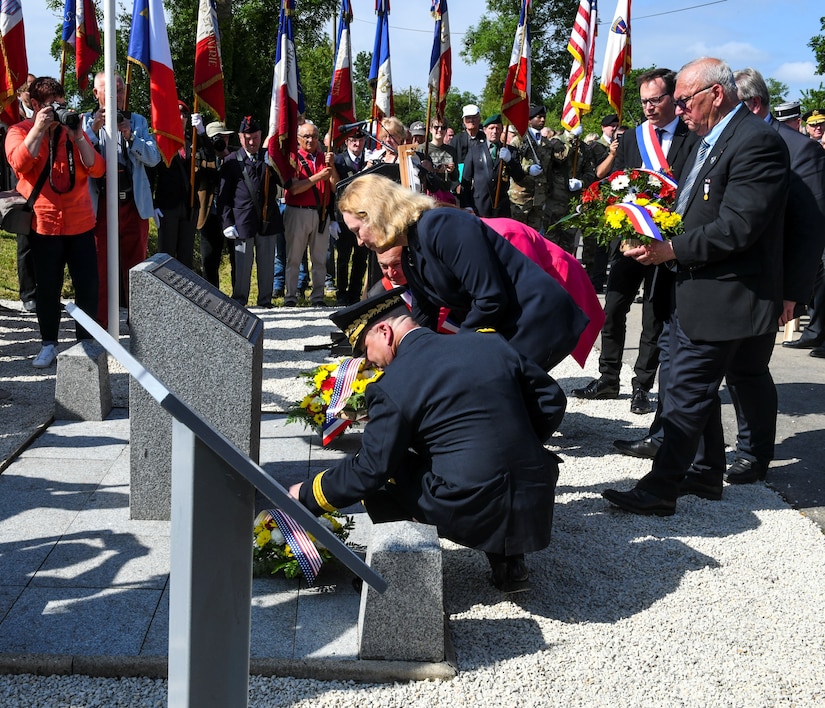
U.S Army Europe soldiers, World War II veterans, local leaders and residents gathered at the General Eisenhower Monument here June 2 for a wreath-laying ceremony to pay homage to the memory of the Americans who gave the ultimate sacrifice for liberation of the people in this region of France. Tournieres, liberated June 9, 1944, served as the hub for the first military command post on the European continent from August through September 1944.

Guest speakers for the occasion were Lt. Gen. Christopher Cavoli U.S. Army Europe commanding general, and Susan Eisenhower, the granddaughter of the late General Eisenhower.

U.S. Army Europe Patch

“It is a privilege, not least, because of the patch I wear as the commanding general of U.S. Army Europe,” Cavoli said. “It is similar to the patch that General Eisenhower’s headquarters used; in fact, we inherited directly the history of his headquarters.

“Every time I put on this patch, it reminds me of the sacrifice of the greatest generation as they brought peace to Europe,” he continued. “It reminds me of the huge price that the United States, France and all of our allies paid to liberate this continent.”

Cavoli then explained the symbolism of the patch he and all the soldiers of U.S. Army Europe wear on their uniforms every day.

“The symbolism of the patch is important and powerful,” Cavoli said. It began with a Norman shield, which was originally black, representing the occupied continent; the flaming sword is the sword of freedom, the sword of liberation and the sword of justice; the rainbow contains the colors of the national flags of the alliance. All of this is below a blue sky -- the symbol of a peaceful future for Europe.

Memorial in Washington Under Construction

Eisenhower’s granddaughter and newly appointed honorary citizen of Tournieres reverberated the same message before unveiling the design of the new Eisenhower Memorial, currently under construction in Washington, D.C.

“The new design will display the beaches of Normandy in peacetime,” she said. “It will be important for all of us as this memorial will link forever in the American mind our deepest connection to this part of France. It will serve to symbolize for all of America … the vital importance of our alliance.”

Cavoli emphasized the importance of this event and those taking place over the following days.

“Celebrating commemorations of the liberation of this continent is very important,” Cavoli said. “It serves as a reminder to ourselves, the cost of liberty and the price we’ve paid as a country along with our allies, for the freedom we all enjoy today.”

Families Experience Warrior Games Adaptive Sports at Two-Day Expo


By Shannon Collins, DoD News, Defense Media Activity

COLORADO SPRINGS, Colo. -- Members of the local community and families of athletes enjoyed the experience of being an adaptive sports athlete during the 2018 DoD Warrior Games’ first two-day exposition at the U.S. Air Force Academy here.

About 300 wounded, ill and injured service members representing teams from the Army, Marine Corps, Navy, Coast Guard, Air Force and U.S. Special Operations Command, along with allied armed forces from the United Kingdom, Australia, and for the first time at Warrior Games, Canada, are competing in shooting, archery, cycling, track and field, swimming sitting volleyball and wheelchair basketball through July 9.

The games are free and open to the public.

“In addition to putting on a top-notch athletic event for our athletes, the Warrior Games Expo was designed to give families, caregivers, military colleagues and the general public a first-hand experience of the world of adaptive sports,” said Air Force Col. Cary Hepp, lead public affairs officer for the 2018 DoD Warrior Games. “We also invited service organizations and adaptive sports' national governing bodies with chapters throughout the country. The intent was to link Warrior Games athletes and their families up with organizations they can connect with when they return home.”

Many Activities

Throughout the two-day event, visitors enjoyed face painting, games, science technology, engineering and mathematics demonstrations for kids and visits from Air Force Academy athletes and “Wings of Blue” parachute team members.

They also had a chance to meet national wheelchair rugby team members and head coach James Gumbert, and see a demonstration and experience the a little bit of the sport themselves.

Ryan Schwab, from Castle Rock, Colorado, said he brought his sons, Nikolas, 9, and Cohen, 5, out to the expo because he loves the military. His father, Leonard, served in the Army during Vietnam, and his father-in-law retired from the Army as a command sergeant major. He was also a Vietnam veteran.

Nikolas said he enjoyed rugby. “It was really run and entertaining,” he said. “Some kids out there might not play like we do but this is something they could do to entertain themselves and get their muscles up.”

Cohen said he enjoyed playing but got a little too much into the match. “I scored a point but the blue team stole that last point. I loved smashing into that blue team,” he said.

Air Force Capt. Alicia Hogan, 10th Medical Group, U.S. Air Force Academy, brought her twin 5-year-old daughters, Emma and Courtney, to the expo to give them perspective.

Gaining Perspective

“I wanted the girls to see some of the different abilities these wounded warriors had, and some of the modifications they made so that they can compete in the same sports we see on TV,” Hogan said. “It’s an incredible experience just to see it from that perspective, and to realize just how amazing some of the things they’re able to do are.”

Hogan said she thinks it’s a great opportunity for her fellow service members and the general public to see what the athletes have trained and worked toward. Hogan said she’s even pulling her daughters out of daycare to try to watch some of the events such as swimming and basketball.

“We’re at the pool all the time in the summer so for them to see how other people are able to swim, even with disabilities or physical limitations, it will be amazing,” she said.

Nikky Williams, from Atlanta, is part of a team of broadcasters from across the nation that came here to support the games and cheer on the athletes and their families throughout the week. She said the events have been an eye-opener.

“One of the main things you see when you get out here, especially for someone like me who hasn’t been around military and military families, is it really takes a village,” Williams said. “It’s not just the sacrifice that our servicemen and women make. It’s their families, as well.

“Saying, ‘Thank you for your service,’ just doesn’t seem like enough,” she continued. “I just feel like there’s nothing I could say to express my gratitude to what these strong heroes and their families sacrificed just so that we could be here to do what we love.”

Wheelchair Basketball

For Lauren Knoff, 17, participating in wheelchair basketball helped her learn that she could still be active. She visited the expo with her sister, Faith, 16, and mother, Cathy. They were there with their uncle, Air Force Master Sgt. Dave Long, from Holloman Air Force Base, New Mexico.

“I’ve had a lot of surgeries on my leg, and I struggle with a lot of sports-related stuff. It’s really cool to see that there’s stuff people like me can do and still be active,” Lauren said. “It’s cool to be able to try it and feel what it’s like to play the games like the warriors do.”

She said her favorite activity of the day was wheelchair basketball. “Basketball is so fun,” Lauren said. “It’s a lot of hard work. Your arms can get pretty sore but it’s really fun to fly across the field.”

Lauren said she spent a lot of time in a wheelchair during her surgeries on her leg but hadn’t interacted with people who were also in the chair. “I’m not used to being able to bump people and knock them away,” she said. “I’m not used to how the wheels are. You can go really fast. It’s nice. They’re super-light and super-tiny. You can be a speedster.”

Lauren said watching the track and field athletes compete on June 2 inspired her. “It was so awesome,” she said. “I almost cried so many times in the last two days, just like at everything. It’s overwhelming. They’re going above and beyond. It’s really inspiring to me. It makes me want to get out and do stuff like they do. It’s really cool.”

Athletes Heal, Regain Confidence

“Participation in adaptive sports programs saves lives,” Hepp said. “The Warrior Games and other rehabilitation and recovery programs offered by each service provide opportunities for athletes to heal and to regain confidence and purpose. Additionally, these athletes are competitors at heart, and the Games offer them the experience to enjoy the camaraderie of their fellow teammates throughout the week.”

Two-time Paralympian and Paralympian coach Karin Korb also led wheelchair clinics throughout the two-day event. She said her favorite part about wheelchair tennis is that it is an inclusive sport that helps disabled athletes be prideful in their disability.

“You can play standing. Amputees can play on their prosthetics. You can be a chair user; you can have a chronic health condition. Tennis is so inclusive,” she said. “Disability is something to be prideful about as a new identifier; just like people are proud of their color or sexual orientation.”

She said having a disability can be difficult because of barriers but “you can’t legislate attitudes but we can legislate what access looks like,” she said.

Korb said having events like this where people can experience, first-hand, disability through sport, help demonstrate that it’s okay to approach people with disabilities and have open conversations.

“Sport is the game-changer to so many people, and that’s why we love it so much,” she said.

DoD Offers Enhanced Support for Military Families With Special Needs


WASHINGTON -- The Defense Department now offers access to a wide array of newly enhanced and specialized support for military families with special needs.

Officials launched the Exceptional Family Member Program “ROC”  -- for resources, options and consultations -- May 30.

Available through Military OneSource, it offers additional expertise, specialized support and more ways to connect families with resources, all of which augment the services already provided by the EFMP staff at military installations around the world, officials said.

Officials hosted a Facebook Live event on the Military OneSource Facebook page to introduce service members and their families to the newly enhanced support available through the EFMP ROC and answer questions.

“One call or chat puts you in touch with an amazing team to help you find services and navigate the wide and sometimes complex array of resources, benefits, and care available to you,” A.T. Johnston, deputy assistant secretary of defense for military community and family policy, said. “The EFMP ROC connects you with subject matter experts, and can provide you with assistance in understanding and navigating the military health care system and TRICARE, as well referrals to local resources to meet your needs.”

Enhanced Level of Service

As Dr. Ed Tyner, director of the Office of Special Needs at Military Community and Family Policy, explained, “We continue to work with military and civilian leaders, service providers, and family members to ensure our programs are focused on the family with greater standardization across the services and locations. The EFMP ROC will enable us to provide an enhanced level of service.”

Military families can schedule an appointment 24/7 with a Military OneSource EFMP ROC special needs consultant by visiting the Military OneSource website or by calling 800-342-9647. Special needs consultations are available via phone or video session. The Military OneSource staff is also available to provide additional support to families through three-way calls with health care and other service providers.

Officials also encourage military families to enroll in the EFMP to ensure they have help working through their unique set of circumstances, and that their family members documented medical and educational needs are considered during the assignment coordination process.
To enroll, the family should complete DD Form 2792, “Family Member Medical Summary” and/or DD Form 2792-1, “Special Education/Early Intervention Summary,” and submit the forms according to the guidance of their military service. For assistance with this process, families can contact their installation Military and Family Support Center, or they can contact Military OneSource.