Wednesday, May 30, 2018

Air Force Maintainers Play Critical Role in Operation Inherent Resolve


By Air Force Staff Sgt. Christopher Stoltz, 386th Air Expeditionary Wing

SOUTHWEST ASIA --  With more than 1,000 successful missions in the last six months, the 5th Expeditionary Air Mobility Squadron, known as ‘The Jokers,’ supports Operation Inherent Resolve’s busiest aerial port here.

As a tenant unit under the 386th Air Expeditionary Wing, the 5th EAMS maintains C-17 Globemaster III aircraft, in addition to providing support for aircraft flying in and out of Iraq, Afghanistan and Southwest Asia.

Beyond their mission at the 386th, the ‘Jokers’ also perform maintenance on aircraft at forward-deployed locations.

“Without maintainers, these aircraft would eventually just sit on the runway,” said Air Force Senior Airman Eric Pashnick, a 5th EAMS crew chief deployed here from Joint Base McGuire-Dix-Lakehurst, New Jersey. “It is humbling to know that with our support, we are able to accomplish the mission. However, at the same time, it keeps you focused and ensures you pay attention to even the littlest detail -- because one mistake can be catastrophic.”

The attention to detail Pashnick mentioned is critical, as aircraft in the region are often subject to foreign object damage, or FOD. According to Pashnick, it is common for aircraft to arrive here with rocks, sand, animals, or combat damage. The maintainers repair or replace parts affected by the FOD, in addition to performing routine maintenance procedures.

Fast Service

“We are there working the moment the aircraft comes to a full stop,” said Air Force Senior Airman Clayton Cahoon, a 5th EAMS crew chief deployed here from Travis Air Force Base, California. “Time is of the essence, and the longer an aircraft is parked on our runway, the less it is in the air completing its mission. It’s our job to ensure it doesn’t sit on the runway for long.”

When an aircraft arrives the maintainers do a full inspection on it -- from the engines all the way down to the fluids, Cahoon said.

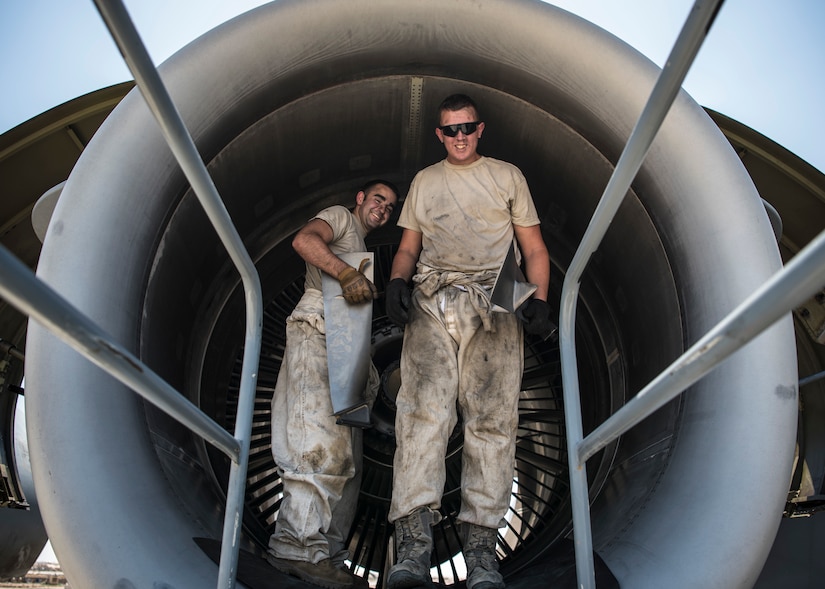
The airmen recently repaired jet engines on a C-17 by removing and replacing turbine blades, he said.

“What makes the airmen of the 5th EAMS the best is their passion for the mission, teamwork and pride in what they accomplish,” said Air Force Lt. Col. Clinton Varty, 5th EAMS commander.

Varty said his airmen’s achievements are the product of their hard work.

“Beyond the airmen of the 5th EAMS, the reason we are successful is due to amazing support we receive from the 386th AEW and the 387th Air Expeditionary Group,” he added. “This is a great place to make the mission happen -- and we all have a part in that.”

Face of Defense: Former Recording Artist Pursues Career as Military Doctor


By Sarah E. Marshall, Uniformed Services University of the Health Sciences

BETHESDA, Md. -- Former contemporary Christian singer-songwriter Paden Smith once sought to heal others with his music and lyrics.

Smith, who has served as a Navy linguist, graduated from a two-year medical degree preparatory program May 16 and will begin studies this summer at the F. Edward Hebert School of Medicine at the Uniformed Services University of the Health Sciences here.

He said he grew up listening to both genres and always considered contemporary Christian music to be a blend of the two, with gospel's uplifting messages and country's storytelling. His music career started in high school when he began writing his own songs.

“Christian music just felt natural to my taste in music and my upbringing,” he said. “Plus, I knew that I wanted my music to be a tool for good, and I felt that Christian music was a great way to make a positive and lasting impact on listeners.”

Collaboration

In college, he started working with friends on an album and eventually decided to make the leap to recording his own music. He collaborated with friends to co-write many of the tracks on his debut Christian/gospel album. Drawing on his own experiences, he said, he tailored the lyrics in hopes that others would find this music to be as uplifting and therapeutic as it had been for him.

Following the album’s successful release, he went on to film a military tribute music video inspired by the military town he calls home: Cheyenne, Wyoming.

Joining the Navy

Smith grew up surrounded by patriotic culture and looked up to several family members who served in the armed forces. While producing the tribute video, he worked closely with service members and surviving family members. He was so impressed by their level of sacrifice, he said, that this sparked his own interest in serving his country. Soon after, he enlisted in the Navy.

Smith spent his first eight years on active duty serving as a Chinese linguist, but he had dreams of becoming a doctor. In 2015, he learned about a physician pathway program for service members, USU’s Enlisted to Medical Degree Preparatory Program, or EMDP2. The 24-month program is a partnership with the U.S. armed forces and George Mason University’s Prince William campus that allows highly qualified enlisted service members to remain on active duty while completing pre-med coursework that makes them competitive for application to medical school.

Path to Medical School

Students are required to apply for medical school at the Uniformed Services University of the Health Sciences, but they may also apply to other accredited U.S. medical schools through the Armed Forces Health Professions Scholarship Program. Nearly 70 students -- including military combat medics and corpsmen, musicians, intelligence analysts, infantry soldiers and others -- have been accepted into the EMDP2 program since its inception.

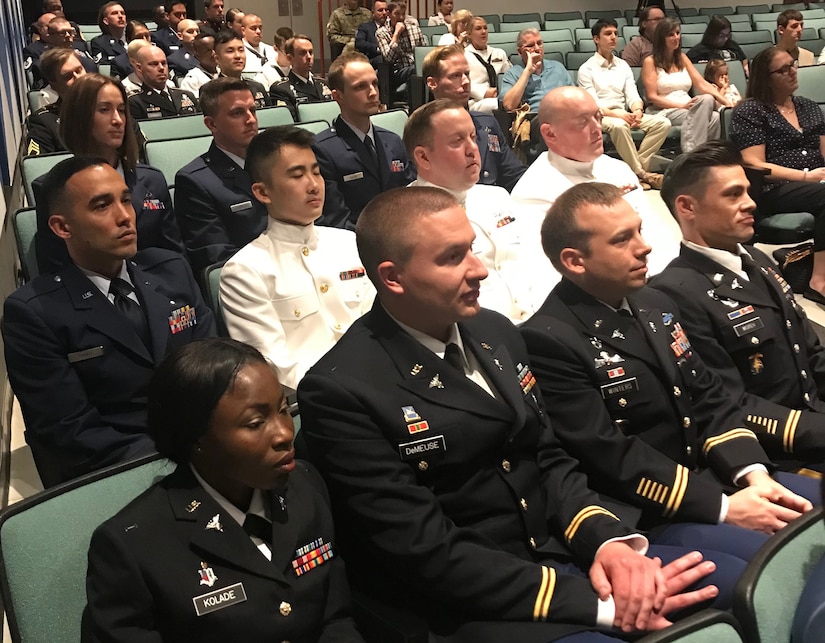
Smith graduated from the EMDP2 program along with 14 other enlisted members from the Army, Navy, Air Force and Marine Corps. He sang the national anthem in an auditorium filled with thousands of students, faculty, staff and family members at GMU’s graduation ceremony.

Immediately following the ceremony, Smith and his classmates were commissioned as ensigns or second lieutenants in their respective service branches.
“Whether through music or medicine, I have always wanted to help heal others, and I feel that this next chapter in my life will allow me to achieve that goal,” Smith said. “EMDP2 has given me the incredible opportunity to transition from my career as a Navy linguist to a career in the Navy Medical Corps, for which I will always be grateful. I am looking forward to the academic, personal and military experiences unique to Uniformed Services University.”

Maple Resolve Exercise Strengthens Bond between U.S., Canadian Forces


By Joshua Ford, U.S. Army North

WAINWRIGHT, Canada -- More than 3,500 Canadian, U.S., British, Australian and French forces participated in this year's Exercise Maple Resolve, providing an opportunity to enhance multinational interoperability in a brigade-level field training exercise.

U.S. Army North and the Canadian armed forces plan year-round for the Canadian army's Exercise Maple Resolve, the largest allied exercise conducted in North America.

More than 1,300 soldiers from the U.S. Army's active, Reserve and National Guard components participated in the exercise, which was held here May 13-24.

"If we're going to prepare brigade combat teams to go to combat, we want them to be able to train with our allies and train as we fight," said Dave Morrison, Canada branch chief, theater security cooperation division, U.S. Army North. "So if we're going to deploy with our partners, we want to train with them."

U.S. Army North coordinates theater security cooperation activities between the militaries of Canada and the United States to help maintain interoperability and improve both nations' ability to work together during global coalition operations.

‘We Know We Need to be Interoperable’

"There are certain areas where we know we need to be interoperable," said Canadian Lt. Col. Joseph Pospolita, deputy commander, Canadian Manoeuvre Training Centre. "We know communications is something we need interoperability with because that effects how we call in requests for fire and how you coordinate air assets."

Communication isn't the only focus area during the exercise. Other capabilities practiced included command and control of allied forces, logistics operations and personnel processing.

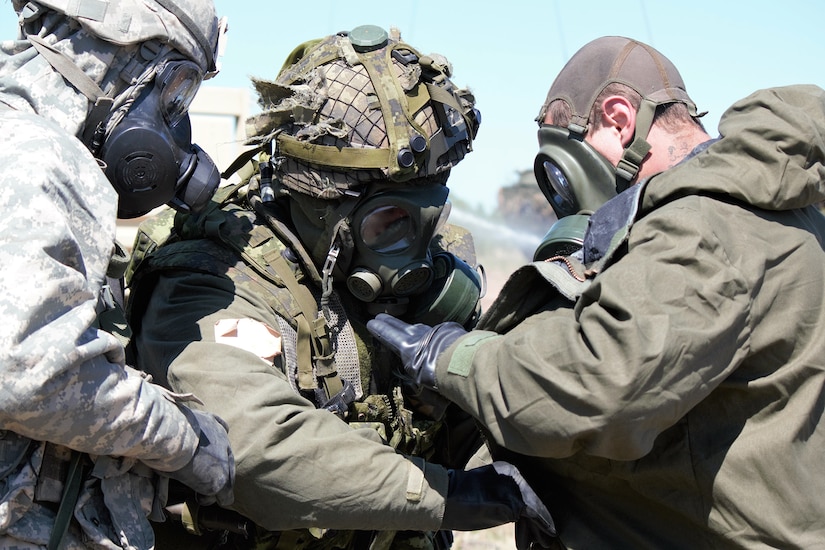
This year was the first time the U.S. Army sent an entire maneuver battalion to the exercise. Other American military assets included military intelligence, aviation, medical, chemical and logistics units.

The 650th Regional Support Group provided command and control of all U.S. forces during the exercise.

"It's good for us to get involved in exercises like Maple Resolve because it's real world versus simulation. We're actually working off demand to provide logistics, the fuel, the ammunition and the food to all forces in the field," said Army Col. Rodney J. Fischer, 650th Regional Support Group commander.

"Every year we look across the force to help identify which units would benefit most in participating in these exercises. We build the requirements at [U.S. Army North], including those from other services like the Marine Corps," Morrison said. "And then we work out how to get them there and what capabilities we need to support them while they're there."

Since the exercise is held in Canada, deploying units there is less resource intensive than sending them overseas to train with allies, but it still provides the experience of deploying to another nation.

Expeditionary Army

"Traveling to another nation for these exercises is good, because the Army is looking to
become more expeditionary, so we have to be able to deploy and project power," Fischer said.

The ultimate goal for the exercise is to certify Canada's high readiness brigade.

After the exercise, 5th Canadian Mechanized Brigade Group will be on standby to answer the call if Canada is put in a situation where it needs to deploy units overseas or within its borders for natural or man-made disasters.

"The High Readiness Brigade is prepped for any operation, whether it be domestic or international," Pospolita said. "If we get a mission overseas and we need a task force or battlegroup to respond, the country would look to the high readiness brigade immediately."

An exercise like Maple Resolve doesn't come without its challenges. Since each nation operates on different systems, getting those technologies to communicate can prove to be difficult.

"The perfect incident would be you could have multiple multination battlegroups or brigades operating where they are, each with different gear, and they seamlessly meld in with our systems," Pospolita said. "Plug and play is exactly where we're going for here."

Old Allies

U.S. and Canadian forces have been working closely together from World War II to Operations Enduring and Iraqi Freedom.

"When it comes to straight operability soldier to soldier, we know how to operate together," Pospolita said. "That's the easy part. Our soldiers know what they have to do in order to accomplish the mission."

"It's important for us to operate at the multinational level because the United States will most likely never go to war alone," Fischer said. "We rely on our coalition partners and working out any issues now makes us that more formidable in the future."

He added, "If we show that capability and our adversaries know that if they do something wrong then the United States and Canadians will be there to protect good.”

Maple Resolve continues to grow each year, bringing together troops from different allied nations and partners.

"It just keeps getting bigger and bigger," Morrison said.