Tuesday, May 29, 2018

USS Manchester Commissioned as Navy's Newest Surface Ship


By Navy Petty Officer 2nd Class Jacob I. Allison, Littoral Combat Ship Squadron 1

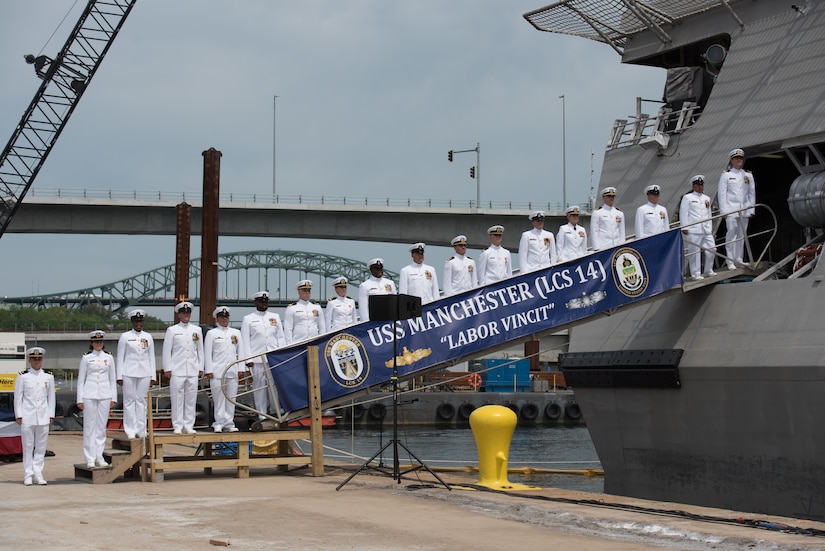
PORTSMOUTH, N.H. -- The littoral combat ship USS Manchester was commissioned as the Navy’s newest surface combatant vessel during a ceremony here, May 26.

The vessel is the Navy’s second ship to be named for the city of Manchester, New Hampshire.

Littoral combat ships are high speed, agile, shallow draft, surface combatant vessels designed for operations in the near-shore environment, yet fully capable of open-ocean operations.

“The faces of the sailors that ran to man this ship are the faces that I’ve seen day after day for the last 22 months as we worked to bring this ship to life,” Navy Cmdr. Emily Basset, Manchester’s commanding officer and a Seattle native, said during the vessel’s commissioning ceremony.

‘Each Sailor is Highly Trained’

Basset added, “They took the city of Manchester's Latin motto, ‘Labor Vincit’ -- work conquers -- and they have personified the spirit of our namesake city. Each sailor is highly trained and must do the duties that three or four would do on another ship. These sailors are reasons to make us all proud.”

The ship’s sponsor, Sen. Jeanne Shaheen representing New Hampshire, gave the traditional order to, “Man this ship and bring her to life,” signaling the sailors to embark and officially begin the vessel’s service as a Navy ship.

For the ship’s crew, the day was the culmination of months’ worth of work to get the Manchester prepared for commissioning. Having the commissioning in the ship’s namesake state was a special opportunity for some of Manchester’s sailors.

“It’s really amazing to be on a ship named for [a city in] my home state,” said Navy Petty Officer 1st Class Laryssa Noyes, an information systems technician from Derry, New Hampshire. “It’s really quite an honor that I’m here for this. It’s awesome because my family got to be here and see what I do on a daily basis.”

After the ceremony, the ship will transit to join Littoral Combat Ship Squadron 1 and eight other littoral combat ships currently homeported at Naval Base San Diego.

Manchester is the 12th littoral combat ship and the seventh of the Independence variant.

Litterol combat ships have the ability to counter and outpace evolving threats independently or within a network of surface combatants. Paired with advanced sonar and mine hunting capabilities, the vessels provide a major contribution, as well as a more diverse set of options to commanders, across the spectrum of operations.

Monday, May 28, 2018

Selva Pays Tribute to America’s Fallen ‘Brave Sons and Daughters’


By Lisa Ferdinando, DoD News, Defense Media Activity

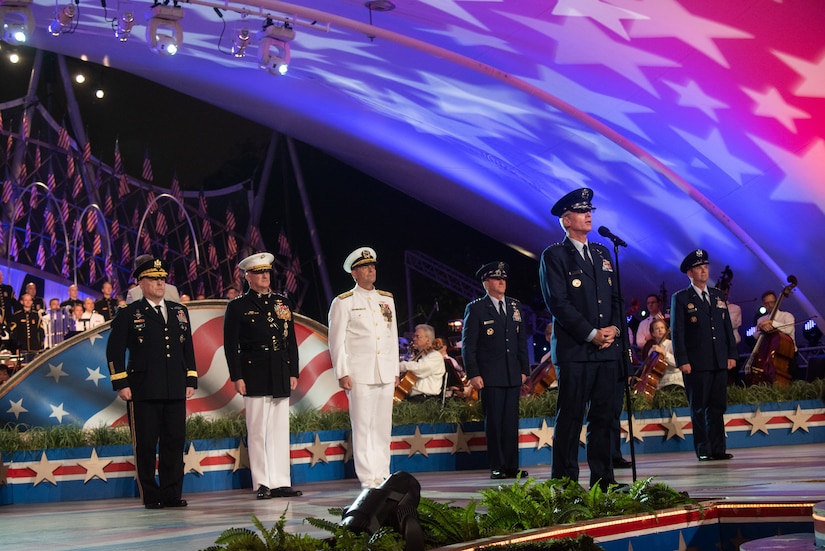
WASHINGTON -- America will forever remember the service and sacrifice of the men and women who gave all in service to the nation, the vice chairman of the Joint Chiefs of Staff said yesterday at the National Memorial Day Concert on the National Mall.

“I would like to thank you for pausing to remember America’s brave sons and daughters who have made the ultimate sacrifice protecting everything we hold dear as a nation,” Air Force Gen. Paul J. Selva said.

The concert honored current and past service members, as well as military families, fallen service members and military survivor families.

On the nation’s 150th Memorial Day, the country pauses to remember those who have laid down their lives in service from the American Revolution to present day, Selva said.

“We remember their courage. We remember their selflessness. We remember how gallant they were in their actions,” he said.

Honor Sacrifices of Military Families

The nation, Selva said, should pause to remember the extraordinary sacrifices made by the families of the fallen.

“Each person lost was a cherished member of a family or a community that continues to mourn to this day,” he said. “It’s our responsibility to never forget these sacrifices.”

The concert as well as Memorial Day services around the country testify to the sacrifice of the fallen and the fact that they will never be forgotten, Selva said.

Selva, saying he was speaking on behalf of the Joint Chiefs of Staff and the two-million men and women who wear the uniform, thanked America for remembering the fallen on this Memorial Day.

Sunday, May 27, 2018

Chairman Stresses Change, Tradition at West Point Graduation


By Jim Garamone, DoD News, Defense Media Activity

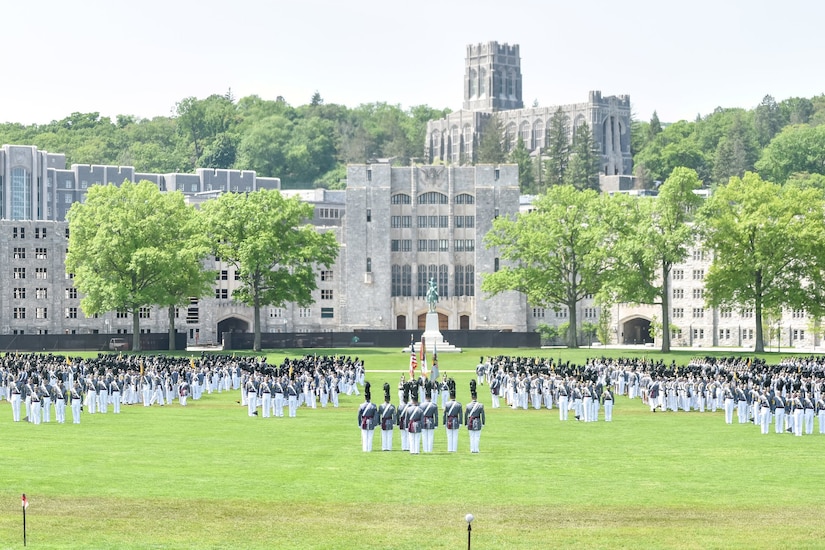
WASHINGTON -- Change and tradition seem mutually exclusive, but balancing those will lead to success for the U.S. military, Marine Corps Gen. Joe Dunford told graduating cadets at the U.S. Military Academy at West Point, N.Y., today.

The chairman thanked the cadets for volunteering to serve. Many of them were in day care when terrorists attacked the United States in 2001, sparking America’s longest conflict. “You chose to join an Army at war,” he said. “To that point, today there are more than 178,000 soldiers actively supporting missions around the world. Many are in harm’s way and they are joined by thousands more sailors, airmen and Marines. As we celebrate today, I ask you to keep them and their families in your thoughts and prayers.”

The cadets are being commissioned second lieutenants and will be called on to lead soldiers in that fight.

Embrace the Constant Changes

The chairman said he doesn’t remember what the commencement speaker at his own graduation said, but he does remember wondering if he was going to measure up to the challenges when he entered the Marine Corps in 1977.

“The profession of arms is dynamic and to be successful you have to anticipate and embrace the constant changes in the character of war,” he said. “Here at West Point, you studied military history. You recalled the price paid in the 20th century by armies that were slow to adapt.”

He noted that leaders on both sides of World War I were slow to grasp the significance of emerging technologies and the changing character of war. The price for that delay was 10 million in uniform were killed.

The allies on World War II failed to grasp the revolutionary nature of the German blitzkrieg mixture of armor with close-air support, he said.

“Frankly, if we look back at the change over the past century, most of the changes occurred after significant failure,” he said.

But not always -- he pointed to the development of air-mobile capabilities that preceded America’s involvement in Vietnam. West Point alumnus like Lt. Gen. Jim Gavin, Gen. Hamilton Howze and Lt. Gen. Hal Moore were key in developing a new capability that resulted in the deployment of the 1st Cavalry Division (Airmobile) to Vietnam in 1965.

Adapt to Meet Those Threats

“These soldiers drove innovation that combined emerging technology with operational concepts,” Dunford said. “They fundamentally changed Army maneuver and their ideas remain relevant today.”

The chairman said there is no substitute “for taking a clear-eyed look at the threats we will face and asking how our force will adapt to meet those threats.”

For the class of 2018, change is going to be particularly important. The pace of changed has accelerated. “In many ways, the environment you are going to lead in is very different than the ones that confronted lieutenants in 1918, 1968 or even 2008,” the chairman said. “Regardless of where you find yourself serving in our Army, challenge yourself to be the kind of leader that continues to think about, to write about and to lead change. Bring your intellectual curiosity and the openness to new ideas that you established here at West Point, bring that with you in your days as an Army leader.”

But there are things that will remain the same and Dunford told the graduates he remembers wondering how he would meet the expectations of his future platoon, and how he would respond if called on to lead it into harm’s way?

“The fundamentals of leadership are the most important aspect of our profession,” Dunford said. “And they are a part of the profession that hasn’t changed since President [Thomas] Jefferson founded this institution in 1802.”

After West Point, the most important aspect is building teams, not individual accomplishments, the chairman said. “Character, competence, courage and commitment is part of the sticker price of being an Army leader,” he said. “After West Point, you get no credit for that: It’s a given. When you check into your units, your soldiers will simply want to know that you will lead from the front and you will put their interests ahead of your own.

“If you take care of your soldier, they will take care of you,” he continued. “If you lead, they will follow and together you will take the hill.”