Friday, May 18, 2018

Exercise African Lion 2018 Concludes in Morocco


By Air Force 1st Lt. Michelle Fletcher, 86th Airlift Wing

KENITRA AIR BASE, Morocco -- Exercise African Lion 2018 has concluded, and approximately 900 U.S. service members redeployed from Morocco and Tunisia.

During the exercise, The U.S. military and Moroccan Royal Armed Forces strengthened interoperability and further developed tactics, techniques and procedures of participating nations to counter violent extremist organizations.

The exercise involved various types of training across the Moroccan coastline, including an aviation training exercise supported by airmen from Ramstein Air Base in Germany and soldiers from the 5th Quartermaster Company from Kaiserslautern, Germany, and the 173rd Infantry Brigade Combat Team (Airborne) from Vicenza, Italy.

Integrated Operations

“Ensuring familiarity with integration of operations and progressing mutual national interests is key to our worldwide capabilities and their effectiveness,” said Air Force Capt. Josh Kelsey, 37th Airlift Squadron pilot and African Lion 2018 deputy mission commander. “We’re working through the mechanics of integrating all of our operations so that if the time comes, we stand united against the threat.”

Throughout the two-week training exercise, service members conducted low-level mountain flying, aeromedical evacuation training, combat off-load and on-loads, 81 joint-personnel drops, 21 low-cost/low-altitude parachute drops, 19 dirt landings, 18 free-fall para-bundle drops and 12 emergency aircraft egress landings.

The team took on U.S. Air Forces in Europe and Africa’s first drop of the newly updated Joint Precision Airdrop System using an attached Modular Autonomous Guidance Unit to GPS-guide its cargo directly onto its target.

Airdrops

Aircrew dropped six bundles from a high altitude and all landed safely within meters of the desired target. This demonstrated the accuracy of the new system and a significant proof of concept for both the Army and the Air Force.


“It just showed the capability of our wing to start from scratch on a dirt field, survey, determine suitability and land a C-130J there,” said Air Force Capt. Laura K. Martineau, a pilot with the 37th, and African Lion 2018 mission commander.

Additionally, the Atlas Mountains presented the pilots with some great low-level performance challenges, Martineau explained. The higher the altitude, she said, the more difficult it is to quickly climb.

“Our training prepares us to ingress into a joint forcible entry-type situation and drop a considerable amount of personnel at once,” Martineau continued. “The Moroccans have also been observing procedures in-flight; it’s been incredible training for everyone involved.”

U.S.-Morocco Partnership

The U.S. Department of Defense recognizes Morocco’s role as a strong and stable partner in North Africa and Morocco’s contributions as part of coalition efforts to defeat the Islamic State of Iraq and Syria.

“When we have competent partners ready to aid in maintaining all of our freedoms, posturing against today’s security threats becomes exponentially easier,” Kelsey said. “It’s about building partnership capacity with cooperative nations.”

In this year’s iteration of African Lion, participating countries included Burkina Faso, Canada, Chad, Egypt, France, Germany, Italy, Mali, Mauritania, Senegal, Spain, Tunisia and the U.K., in addition to the U.S. and Morocco.

“We’re making sure we are building relationships that last beyond our current stay here,” Kelsey said.

U.S., U.K. Senior Enlisted Leaders Showcase Unity, Partnership


By Terri Moon Cronk, DoD News, Defense Media Activity

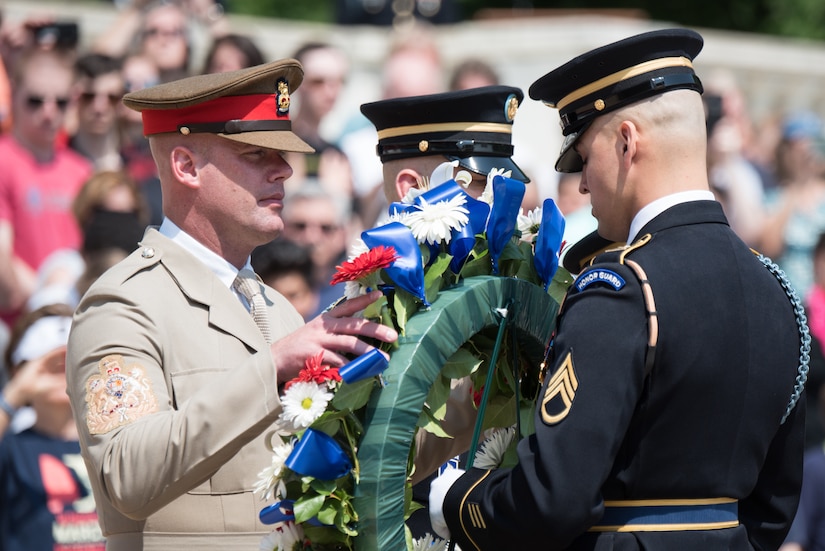
WASHINGTON -- In a show of unity, the senior enlisted leaders of the American and British armies together laid a wreath at the Tomb of the Unknown Soldier at Arlington National Cemetery, visited with U.S. junior enlisted service members and toured the Defense Department’s newest combatant command, U.S. Cyber Command, at Fort Meade, Maryland, May 15.

DoD’s senior enlisted advisor to the chairman of the Joint Chiefs of Staff, Army Command Sgt. Maj. John W. Troxell; and the United Kingdom’s first army sergeant major, Warrant Officer Class One Glenn Haughton, embody the alliance initiative of the National Defense Strategy, having worked well together for nearly four years.

“Glenn is not only a personal friend of mine, but he is well-known globally,” Troxell said of Haughton, who is visiting the Defense Department this week.

“We have a very strong senior enlisted global network. And even though he is the Army sergeant major in the U.K., he is known by leaders in the United States, in coalition [nations] and other services as well,” Troxell added.

Troxell said his military partnership with Haughton is fluid and dynamic. “We know each other so well it allows us to share information freely, and allows us to be honest with each other,” he said.

“That just doesn't happen overnight between two senior enlisted from different nations,” Troxell added. “That has to be built over time, and it’s important because one of the things that we focus on with our National Defense Strategy is reassuring our allies. That means more and more with people like Sergeant Major Haughton, I have to have a dynamic relationship because of the nature and the closeness of the U.K. and the U.S.”

Relying Upon Partners

Haughton said he relies heavily on his U.S. friends and colleagues across the services.

“I couldn't have done my job without the people that I've met,” the British army sergeant major said. “Everything I’ve tried to implement in the British army has been other people's ideas, and other people's visions and initiatives, and I’ve just drawn from that to better the lives of the enlisted in the British army.”

Haughton’s passions as the senior enlisted leader in the British army are personal development and education for his troops.

“Personal development and military education are changing for the better, and we've got people on some serious educational programs,” he said. “That's happened over the last four years and it's just going to continue and grow in strength.”

Haughton also is the first international mentor for the U.S. military’s Keystone Command Senior Enlisted Leader course, Troxell pointed out.

“My first thought was Glenn, because of his reputation globally, the charismatic kind of leader he is, and how he can deliver a message and people understand it,” he said.

Opening British Army Communication

His position as the British army’s first sergeant major has opened up the chains of communication between his sergeants, mid-grade noncommissioned officers and petty officers at the higher echelons, Haughton said.

“It’s another means of communication, and it's worked both ways. The senior echelons of the army now see that this job complements the chain of command. It only challenges it when it needs to for the benefit of the enlisted,” he said. “But for soldiers and officers, I think they look at this [sergeant major of the army] position as a benefit to the whole of the service itself.”

Troxell said this week’s meeting between he and Haughton -- and particularly the wreath-laying ceremony at Arlington -- is an opportunity to showcase the strength of the U.S.-U.K. alliance.

“The greatest competitive advantage we have over any threat -- whether it's a nation state or a non-state actor like [the Islamic State of Iraq and Syria], is our trained, educated, trusted and empowered enlisted force,” Troxell said.

He added, “The more our relationship is solid, and the more we continue to collaborate and share information and experiences, the more powerful we're going to be able to be, and the more we're going to be able to build on that [competitive] advantage.”

Trump, NATO Secretary General Discuss Alliance at White House Meeting


By Jim Garamone, DoD News, Defense Media Activity

WASHINGTON -- President Donald J. Trump and NATO Secretary General Jens Stoltenberg discussed alliance unity and the upcoming NATO summit in Brussels in July during a May 17 meeting at the White House.

Trump and Stoltenberg also discussed how NATO is gaining strength and capability.

“We've really strengthened NATO and the NATO alliance,” the president said. “The strong working partnership we forged has helped to produce significant increases in member-state contributions. We've worked very hard on that.”

At the Wales summit in 2014, NATO nations pledged to dedicate 2 percent of gross domestic product to defense matters. At that time, only the United States, the United Kingdom and Greece were above that goal. This year, eight members are expected to hit the goal -- Poland, Romania, Estonia, Latvia, Lithuania, Greece, the United Kingdom and the United States. A total of 15 nations are scheduled to make it by 2025. There are 29 nations in NATO.

Increased Commitment to Defense

“We're delighted to report that last year, as a result of our joint efforts, we witnessed the single-largest increase in defense spending among European member states and Canada in a quarter of a century,” Trump said.

Trump reaffirmed the U.S. commitment to Article 5 of the NATO pact, that an attack on any member state is an attack on all. The president has also called on NATO allies to improve their counterterrorism capabilities.

“I also discussed with Secretary General Stoltenberg our commitment to stopping nuclear proliferation, including the denuclearization of the Korean Peninsula,” the president said. “We want a future of safety, security, peace for all Koreans and for the entire world.”

The United States will continue to work with other nations to halt not only Iran's nuclear ambitions, but the country’s destabilizing activities throughout the Middle East.

‘Strength, But Peace’

“The strength of the NATO alliance does not depend on military might alone, but also the deep ties of history, culture and tradition that have long united our civilization,” Trump said. “Now we must renew these ties and rededicate ourselves to our shared heritage. And in heritage, we want a heritage of peace. Strength, but peace.”

Stoltenberg thanked the president for his strong commitment to the alliance.

“Last time we met, your main message was that NATO had to do more in the fight against terrorism and more on defense spending,” the secretary general said to the president. “All NATO leaders agreed and now we are delivering. We are stepping up our efforts in the fight against terrorism.”

Stoltenberg emphasized that NATO is integral to training Afghan forces, and he mentioned that the alliance is planning to launch a new training mission in Iraq. NATO leaders will discuss that plan at the summit in July.

“On defense spending, I would say that I agree with you,” Stoltenberg said. “We had to do more and I would like to thank you for your leadership. … It is impacting allies because all allies are now increasing defense spending.”