Thursday, May 17, 2018

NATO Must Adapt, Alliance’s Military Committee Chairman Says


By Jim Garamone, DoD News, Defense Media Activity

BRUSSELS -- The world situation is highly volatile, and NATO must be adaptable and constantly ready to respond to any threat or challenge, the chairman of the alliance’s Military Committee said here today.

Gen. Petr Pavel of the Czech army told reporters that this week’s meeting of NATO’s chiefs of defense addresses the range of challenges from defense and deterrence to threats from the Middle East and North Africa.

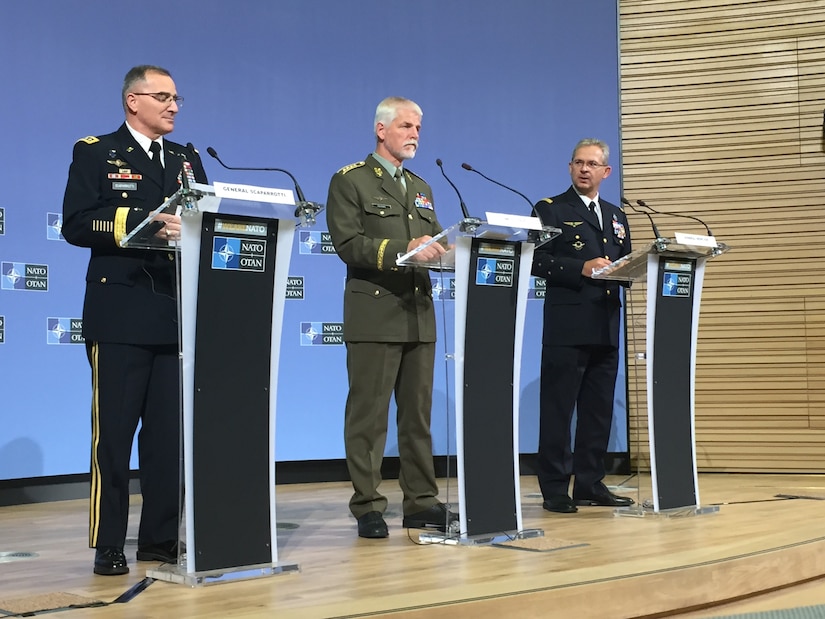
Pavel briefed alongside U.S. Army Gen. Curtis M. Scaparrotti, the alliance’s supreme allied commander for Europe, and Gen. Denis Mercier of the French air force, the supreme allied commander for transformation.

“With instability and conflict in the Middle East, North Africa and the Sahel, coupled with terrorism that continues to threaten our societies, the chiefs of defense exchanged views on what more the alliance can provide to our partners – such as, for example, training,” Pavel said.

The chiefs of defense also discussed the NATO training and capacity building effort in Iraq, as well as the need to discuss that effort with the new Iraqi government once it is formed, Pavel said. They also wanted to make sure the NATO effort in Iraq complements efforts in Iraq by other nations and the European Union.

Importance of Exercises

Scaparrotti and Mercier highlighted the exercises that the alliance is planning.

“This is an important element in alliance readiness and adaptation to new security challenges,” Scaparrotti said. “They ensure our troops are ready to respond to challenges from any direction and demonstrates the alliance stands ready to defend all allies and is committed that our alliance is committed to defending our values.”

Mercier said Trident Junction 2018 is designed to ensure that NATO forces are trained and ready. The exercise will encompass 40,000 service members and be held in and around Norway in November. “It will be an important test and a tremendous display of our collective abilities,” he said. In addition to the live exercise, it will include a tabletop exercise conducted in Naples, Italy.

A Deterrent Message

Scaparrotti said Trident Juncture is part of the deterrence of Russia. “It’s a demonstration of our capability and how we see the world and what we’re able to do,” the general said. “It’s a deterrent message. If you look at our exercise versus what Russia does, our exercise is focused on defense of the sovereign nations that are a part of NATO. That’s what we do, and that is what this will represent, as well.”

The exercise is a demonstration of alliance unity and outreach, as a number of NATO partners will participate, Mercier said. “It is also a good demonstration of our interoperability,” he added, calling Trident Junction a prime example of NATO allies and partners working together in peacetime as well as crisis.

Mercier also talked about the changes being contemplated to the NATO command structure to make the alliance operate at the speed it needs to in this challenging world.

“I firmly believe this change is only a step to keeping a competitive edge,” he said. “Our alliance has to continue to innovate and adapt to a very challenging environment.”

Wednesday, May 16, 2018

EOD Airmen Tackle Warfighter Challenge


By Samuel King Jr., Eglin Air Force Base

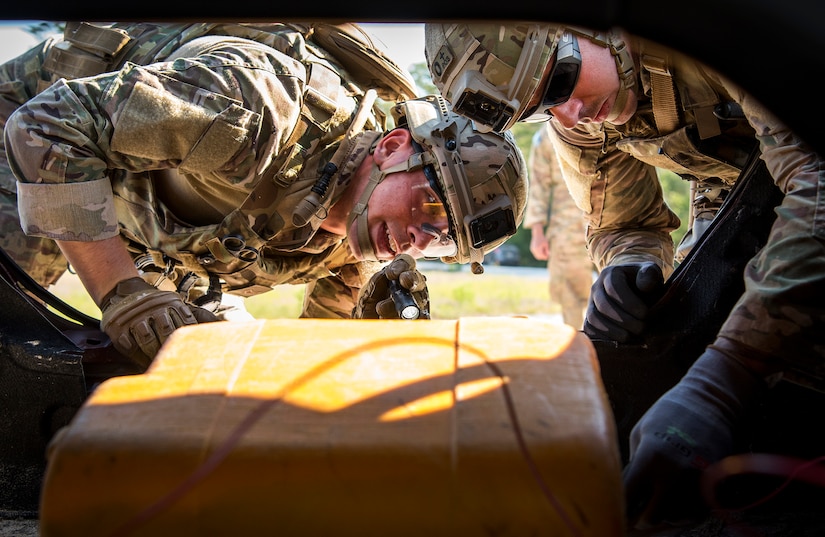
EGLIN AIR FORCE BASE, Fla. -- A three-person explosive ordnance disposal team approaches a bomb-laden vehicle with two hostages inside. As they reach the car, a hidden device explodes, damaging the leg of a team member.

What does the team do next?

This was just one of many difficult scenarios the airmen encountered during this year’s EOD Warfighter Challenge held here.

The two-week, situation-based training exercise was created last year by the 96th Civil Engineer Group. More than 90 airmen from more than 20 Air Force EOD units participated in this year’s exercise.

‘Overwhelming’ Response

“The response was so overwhelming we needed another week to handle the demand,” said Air Force Master Sgt. Joseph Burke, EOD Warfighter Challenge creator with the 96th Civil Engineer Squadron.

The event’s goal was to hone the airmens’ EOD and problem-solving skills with new environments, setups, gear and situations. Eglin’s range area, formally used to train deploying security forces airmen, was the site of urban and village exercise scenarios.

“The more realistic and challenging we can make the situations, the more the airmen will take away from it and remember when it is real,” said Air Force Staff Sgt. Michael Bodner, 96th EOD flight.

Another goal of the Warfighter Challenge was to provide opportunities for airmen to train in leadership positions on the three-person EOD teams.

“You have to see the situation differently and think about the whole team and what actions are required to keep not just yourself, but your team safe. I hadn’t seen that side of it until now,” said Air Force Senior Airman Aaron Parris, 633rd Civil Engineer Squadron, who acted as an EOD team lead for the first time during the exercise.

Different Scenarios

The teams encountered at least three scenarios each day. There were multiple improvised explosive device problems within each scenario the airmen would solve, along with human elements and equipment limitations. Each situation had numerous ways to solve each problem. It was up to the airmen to determine the best and safest solution.
EOD Warfighter Challenge

The situations varied from pressure plates to a pipe bomb around a victim’s neck, to vehicle-borne IEDs, roadside bombs and a mock electronics store filled with so many electrical parts that anything could be an IED. There was also a scenario with a simulated bomb strapped to a non-English speaking victim. In that situation, the victim would frantically try, but could not provide the EOD technician any information to help them.

The mental and physical puzzles of the training were only part of the Warfighter Challenge. Participants passed along lessons learned, equipment benefits and methods of mission improvement. That knowledge is taken back to their units.

For example, at last year’s exercise a piece of equipment for the technicians’ night vision was deemed a “must have” by the participants. The request was processed, and with a few months the new gear was added to the standard equipment required for all Air Force EOD technicians.

“This is larger for us than just these exercises. There’s so much more being accomplished,” said Air Force Capt. Cory McCart, Eglin’s EOD flight commander. “We are helping to improve the airmen who attend, their units, the career field and our mission as a whole.”

Face of Defense: Air Guardsman Earns Air Force Academy Appointment


By Air Force Tech. Sgt. Seth Bleuer, 194th Wing

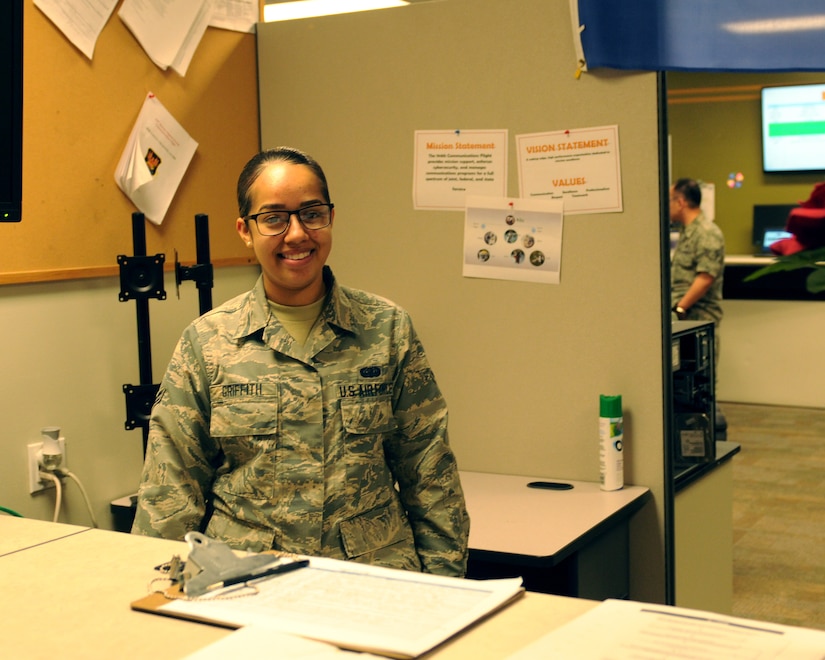
CAMP MURRAY, Wash. -- Air Force Airman 1st Class Jasmine Griffith, a client systems technician in the Washington Air National Guard’s 194th Communications Flight, has been selected to attend the U.S. Air Force Academy in Colorado Springs, Colorado.

Griffith said she was inspired to join the military by her father, a 20-year Army veteran, who, along with her high school calculus teacher, encouraged her to apply to the academy. After a tour of the academy, she was determined to attend.

Griffith didn't make the cut the first time she applied. Instead of being discouraged and giving up, she strengthened her resolve.

She joined the Washington Air National Guard as a way to serve the country while still pursuing her goal.

"I knew that I needed to show more growth since my first application, so I tried to volunteer for as many opportunities as I could when I got back from technical school,” Griffith said. “I volunteered for the fires. I volunteered to do Junior ROTC drill competition judging. I even gave a speech at a local high school about the Air National Guard's cyber security mission."

Getting In

In July, Airman 1st Class Griffith will become Cadet Griffith, an Air Force Academy student and future Air Force officer. "I'm nervous to go back to school in general, it's been about two years since I've been in high school but I'm more excited for the whole experience than I am nervous,” she said. “I've wanted this so bad and have been working towards it since 2015, and it's finally happening. I still can't believe it sometimes."

The application process was "very rigorous with tough physical, personal and academic standards," Griffith said.

She is hoping to major in computer and network security and work as an Air Force communications officer when she graduates.

Griffith has advice for fellow airmen who may be interested in the Air Force Academy. "Don't give up! If at first you don't get in, keep trying and keep improving and working towards your goal,” she said. “There were many times when I thought I wasn't good enough and didn't meet the standards, but I just kept at it, and now here I am."