Monday, March 26, 2018

Face of Defense: Identical Twins Serve in Same Air Force Squadron


By Robert Lingley, 21st Space Wing

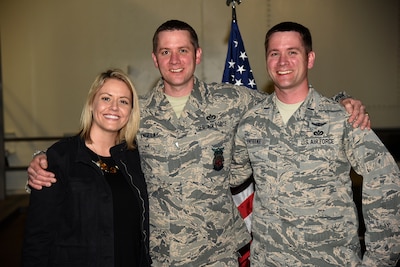
COLORADO SPRINGS, Colo., March 26, 2018 — It’s quite possible, if you’re at Cheyenne Mountain Air Force Station here in the near future, that you’ll come across identical twins working for the 721st Civil Engineer Squadron. You may think you’ve seen one of them but it could be the other.

The twins were born Sept. 1, 1982. Air Force Tech. Sgt. Chris Engelke was born first, one minute ahead of his brother, Air Force 1st Lt. Cody Engelke. They’re both highly competitive with each other and love sports and academics. Coincidentally, they were born on the same day that Air Force Space Command opened at Peterson Air Force Base, Colorado.

“I absolutely love being in the Air Force,” said Chris, the regional dispatch center superintendent here for the 721st Civil Engineer Squadron. “Personally I think it’s great having the structure above you to make sure you’re taken care of, but at the same time you’re developed and you’re doing it voluntarily 100-percent of the time for the national needs. It’s a humbling experience.”

Chris and Cody previously served together in South Korea, but at different bases, and for a short period of time they served together at Fairchild Air Force Base, Washington, where Cody pinned on staff sergeant, joining Chris at the same rank.

“That was fun for the commander, having twins, both staff sergeants, both in the same unit,” said Cody, who now serves as the deputy commander of training for the 18th Space Control Squadron at Vandenberg Air Force Base, California.

Reenlisting for Retirement

Cody flew in to be the presiding officer at Chris’ reenlistment March 8.

“I’d gone back and forth about reenlisting at my last assignment in Ramstein, Germany,” Chris said. “I finally figured it was best to just do it where I have the best job in the Air Force here at CMAFS.”

Chris was coming up for his date of separation on March 23. In order to get to 20 years of service he needed to be within 30 days of his date of separation to do a six year reenlistment. If he had done his reenlistment a month earlier it would have timed him out at 19 years active duty and he would have to reenlist again to reach 20-plus years of service.

“I knew if I did a six-year reenlistment it would get me to 20 years,” Chris said. “After that I could serve even longer if I wanted to.”

Cody took a break from the Air Force to attend the University of Washington but that didn’t last long.

“College didn’t work out financially for me,” Cody said. “I saw how the Air Force was working for Chris and he absolutely loved it. He convinced me to come back to the Air Force in civil engineering and pursue my degree using my GI Bill.”

In March 2015, Cody commissioned as a second lieutenant.

Future Assignments

Though there are no promises that the Air Force will station them at the same base, the twins hope to be working together soon. Chris said there is a tentative assignment for his brother to rejoin him at CMAFS in the near future.

“Both of us belong to the 21st Space Wing,” Cody said. “The 18th SPCS is one of the geographically separated units for the wing. I’m really hoping to get assigned to CMAFS with my brother.”

The twins enjoy serving in the Air Force, they said.

Air Force Master Sgt. Michael Moore, 721st CES superintendent and Chris’s supervisor, organized the event at CMAFS.
“Reenlistment is always a special moment in an airman’s career, but to have your twin brother deliver the oath of enlistment for you is truly special,” Moore said. “It will be a moment that both Chris and Cody will remember for the rest of their careers.”

Leap-Ahead Technology to Increase Soldier Readiness in Future Battles


By Argie Sarantinos-Perrin, U.S. Army Research, Development and Engineering Command

WASHINGTON, March 26, 2018 — For soldiers, survival depends on out-maneuvering the enemy. While the Army's current fleet of tanks, infantry fighting vehicles and aircraft can protect soldiers against near-peer threats, these vehicles lack the critical technologies to maintain tactical overmatch in future battles.

To counter these challenges, the Army identified the next-generation combat vehicle and future vertical lift programs as the second and third priority in its six-prong modernization strategy.

A cross-functional team was created to support each modernization priority, including one for both the NGCV and FVL programs. The teams are developing the blueprint for future technology with teams composed of subject matter experts from the requirements, acquisition, science and technology, test and evaluation, resourcing, contracting and cost and sustainment communities.

How U.S. Army Research, Development and Engineering Command scientists and engineers are supporting the NGCV and FVL will be the focus of "Next Generation Combat Vehicle and Future Vertical Lift Modernization Priorities" Warrior's Corner today from 12:40-1 p.m., at the Association of the U.S. Army’s annual meeting in Redstone, Alabama.

Research, Development and Engineering Command's Tank Automotive Center leads the NGCV effort. The center is developing technology for the next generation of ground vehicles that are not only more lethal and survivable, but also much smaller, lighter and more fuel efficient. Key areas of research and development include: power architecture, protection, vehicle electronic architecture and autonomy.

Developments in engine, transmission and power generation for ground vehicles provide scalable power solutions that increase protection and lethality, while maintaining Soldier mobility on the battlefield. Current projects include the advanced combat transmission, integrated starter-generator and advanced combat engine.

Advanced Combat Engine

The prototype ACE, which the center plans to use for future engines, will not only have more power and vehicle mobility, but also use less fuel. Lower fuel consumption will reduce the risk of attacks to soldiers during refueling conveys.

The Army has developed the Modular Active Protection System, to support the need for better protection without adding weight to vehicles. The MAPS framework consists of a modular, open-system architecture that supports an active protection system. The open-system architecture enables new and evolving sensors, processing and counter-measure solutions to be integrated into ground vehicles, giving commanders the ability to counter threats as they change.

"Open architectures in general are designed to allow for advances in technology, whether it's in autonomous systems, survivability, or any of the other several fields we develop, to be rapidly integrated onto our ground vehicles without wholesale redesigns or rebuilds of those vehicles," said Christopher Ostrowski, the center's associate director for NGCV.

Other areas of development include a flexible architecture for vehicle electronics that will meet increasing power demands and an open architecture for autonomous, tele-operated or driver-optional systems to enhance soldier safety.

"We're envisioning an autonomous architecture where new autonomous behaviors or capabilities are enabled through software updates and upgrades, not unlike how smartphones today get updated," Ostrowski said.

Future Vertical Lift

In response to the need for next generation Army aircraft with advanced technology, Research, Development and Engineering Command's Aviation and Missile Center is paving the way to modernize the Army's aviation fleet. FVL is an Army-led, multiservice initiative, focused on delivering the next generation of vertical lift aircraft to the joint warfighter with manned, unmanned teaming.

The Aviation and Missile Center partnered with industry to develop the Joint Multi-Role Technical Demonstrator, which incorporates existing and experimental capabilities that demonstrate vertical lift capabilities for future FVL programs. The Army is using the JMR-TD program to conduct ground and flight demonstrations to help inform requirements for next generation Army aircraft.

"The future operating environment demands a capability that is greater than what we have today," said Dan Bailey, JMR-TD program director. "We are going to need capabilities for the warfighter with a rapid acquisition process and the best way to accomplish that is open systems architecture. Advanced vertical lift capabilities provide the future joint force ground commander with flexibility and asymmetric opportunities required in the future multidomain battle."

Unmanned Aircraft Systems

The modular missile technologies program is developing technologies to support future Army aviation air-to-surface missiles. The program's modular open systems architecture will not only reduce life cycle costs, but also address lethality gaps for manned rotary wing and unmanned aircraft systems platforms.

The Aviation and Missile Center has responded to the increase in unmanned aircraft systems by developing the Next Generation Tactical Unmanned Aircraft System Technology Demonstrator program. The NexGen TUAS TD is developing unmanned air vehicle technologies and capabilities that will improve flight performance, survivability and reliability for future unmanned aircraft systems, which will need to perform a diverse set of missions in contested airspace against near-peer adversaries in a multi-domain battle.
To support the multidomain battle and the Army's pivot to a new modernization model, Research, Development and Engineering Command will continue to provide the research and development to build new capabilities and systems. These capabilities and systems will leverage the most mature technologies for soldiers to maintain tactical overmatch in future battles.

Friday, March 23, 2018

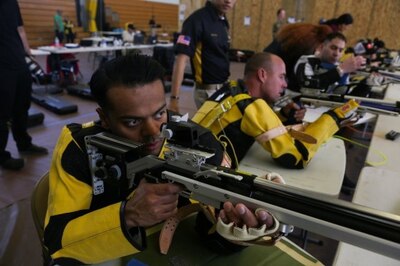
Face of Defense: Soldier From India Says Military Service is His Calling


By Mary Therese Griffin, Warrior Care and Transition

FORT BLISS, Texas, March 23, 2018 — Indiana Army National Guard Sgt. Manthan Patel says he has heard all the jokes and does not want to be a cliché.

"When I was younger I was in biomedical engineering pre-med and realized that I did not want to continue in that field. Every single Patel is a doctor -- it's too mainstream for me," he laughed while taking a break at the 2018 Army Trials here, where he earned a silver in the men's 800-meter race and a bronze for power lifting in his classification.

Patel grew up in India and moved to the United States when he was 17. He always wanted to serve in the military, but knowing his family was going to immigrate to the U.S., Patel could not make that commitment in India.

Patel and his family moved from India to Indiana, and that's where he heard about the Army National Guard and thought it would work for him since he could have a civilian life and serve in the military at the same time. Because of the balance, he decided to join the Indiana National Guard.

Bittersweet Milestone

Patel became a U.S. citizen before he deployed to Iraq in 2009. "I still remember preparing for the citizenship test, it felt different learning American history so quickly," Patel said of the 100-question test. However, the process of becoming a citizen and deploying was bittersweet because he had to give up his Indian citizenship for security clearance reasons -- a price he was willing to pay to serve the new country he loves.

In 2016, on a deployment to Cuba, an injury would change everything for the administration specialist. A bad fall resulted in herniated discs and massive nerve damage to his neck. However, Patel soldiered on until he demobilized at Fort Bliss. He then realized that he desperately needed surgery to replace two discs, followed by extensive physical therapy.

"I could not do basic things; no brisk walking, running, and no riding motorcycles -- which is my passion. My mobility is limited," he said. "I was very active and not being able to do those active things messes with your mind. You never realize how much your neck affects your overall body movement."

While recuperating at the Fort Bliss Warrior Transition Battalion, Patel learned about the Warrior Games and Army Trials.

"I've never been athletically inclined until I got to the WTB," he said. "Competing with these other athletes who are missing limbs, or have various other conditions and are so positive and strong gives me hope."

A New Normal

Patel credits the Warrior Care and Transition Program for opening his eyes to how the Army cares for soldiers and helps them find their new normal.

"I did not know the care and the amount of effort the WTB puts forth to make sure soldiers are taken care of. If you are injured and the opportunity to go to a WTB is presented to you, go and make sure you are taken care of," he said. "A lot of people will ignore their injuries and they try to tough it out, then down the road it worsens and they don't have the option of the WTB or even good health care."

As Patel continues to recover and work toward returning to duty, he is also thinking about starting a career in the field he considered to be "mainstream" years ago, the medical field.

"If I am able to return to duty I would like to finish my degree and I would love to try the Army Physician Assistant Program to become a physician assistant," he said. "That is the huge thing the WTB made me realize; when someone is injured and needs to heal, this intrigued me to really want to help. Now it feels like my calling."
The medal stand at the Army Trials has also been calling. Patel competed in five events, earning a silver in the men's 800-meter race and a bronze for powerlifting in his classification.