Saturday, March 17, 2018

European Command Continues Deterrence, Defense Strategy


By Marine Corps Sgt. David Staten DoD News, Defense Media Activity

WASHINGTON, March 15, 2018 — U.S. European Command has made significant progress under the deterrence initiative which has supported the largest reinforcement of the Euro-Atlantic defense in a generation, Army Gen. Curtis M. Scaparrotti, Eucom’s commander and NATO’s supreme allied commander for Europe, told the House Armed Services Committee today.

“Every challenge we face as a nation is best addressed with our allies, and I'm proud to report that the NATO alliance is strong, it is united and it’s committed to being fit for purpose,” Scaparrotti said.

NATO Defense Spending Increases

United States European allies have turned a corner on defense spending with increases in each of the past three years, the general said. During this time they've added $46 billion to the collective defense.

Between 2018 and 2024, at least 15 nations will reach or exceed NATO’s two percent spending target, which will enable NATO to ensure it is vigilant in peace, responsive in crisis and possesses the strategic depth for high-end, large-scale, multidomain conflict.

“Together with NATO, the U.S. has made significant progress, but we have much work to do as we execute our National Defense Strategy, fueling an increasingly lethal, agile and resilient joint force in long term strategic competition with Russia and ready to counter violent extremist organizations, Scaparrotti told the committee.

At sea, on land and in the air Russia’s increasingly modernized military is operating at levels not seen since the Cold War, according to Scaparrotti. The general said Russia is carrying out a campaign of destabilization to change the international order, fracture NATO and undermine U.S. leadership around the world.

“Throughout Europe -- along its periphery in the Middle East and beyond -- Russia has demonstrated a willingness and capability to use political provocation, spread different disinformation and undermine democratic institutions,” the general said.

Scaparrotti listed some actions taken by the U.S. and its allies to deter Russian forces in Europe:

-- Increased U.S. security posture in Europe by deploying rotational forces to include an armored brigade combat team and a combat aviation brigade;

-- Implemented the framework battalion task force for NATO's enhanced forward presence in Poland;

-- Prepositioned equipment for additional armored brigade combat teams and doubled their maritime deployments to the Black Sea; and

-- Exercised theater contingency and anti-submarine operations, executed bomber assurance and deterrence missions in Europe and deployed 5th-generation fighters to Europe for the first time.

In addition, NATO has implemented its enhanced forward presence with four multinational battle groups backed by 29 nations. It has also established a tailored forward presence in the Black Sea region.

Challenges

“The U.S. and NATO are putting a spotlight on Russian meddling and interference,” Scaparrotti told the committee. The U.S. and its allies, he added, are countering Russian misinformation with truthful and transparent information and reinforcing the narrative of sovereignty, freedom, the dignity of the individual and the rule of law.

Violent extremist groups pose the second major threat faced in the European area of operations, the general said. Since 2014, he added, Europe has experienced 18 major terrorist attacks.

The Islamic State of Iraq and Syria remains active and seeks to expand its operations across Europe, the general noted. Eucom provides forces for military operations against ISIS, such as Operation Inherent Resolve, and has increased information intelligence sharing among U.S. agencies, international partners and the private sector.

“Our European allies fight alongside us, deploying forces worldwide to support U.S.-led counterterrorism operations including OIR and Operation Freedom Sentinel and to conduct national counterterrorism missions,” Scaparrotti said.

Thanks to the resources provided by Congress, particularly through the European deterrence initiative, Eucom has made significant headway in establishing a defensive posture that is credible, capable and relevant to their strategic objectives.

“As our National Defense Strategy states a strong and free Europe bound by shared principles of democracy, national sovereignty and commitment to Article 5 of NATO's Washington treaty is vital to our security,” Scaparrotti told the committee.

Eucom’s service members and civilians are making this strategy a reality, he said, and they stand ready to protect the homeland, strengthen the alliance and ensure that Europe remains whole, free and at peace.

Friday, March 16, 2018

Special Operations Forces Exercise in Arctic Conditions


By Navy Petty Officer 1st Class Kiona Miller, Alaskan Command

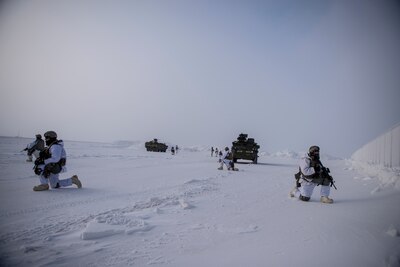
FAIRBANKS, Alaska, March 16, 2018 — The U.S. military conducts mission-based training events year-round, but Arctic Edge 2018 is a unique opportunity that has brought more than 1,500 U.S. military personnel from 20-plus units together to train in arctic conditions throughout the Alaska range.

For Special Operations Command North, a component of U.S. Special Operations Command with headquarters at Peterson Air Force Base, Colorado, it is an ideal environment to test their ability to operate in extreme weather conditions.

“It’s a chance for us to get up here in these extreme conditions and conduct training to make sure the equipment is working, and we are keeping those skill sets sharp,” said the director of operations for Joint Special Operations Task Force Alaska.

Names, ranks and service affiliations of special operations service members involved with the exercise are not included in this story for operational security and privacy reasons.

Conducting long-range movements in severe weather over treacherous terrain with limited visibility is challenging for even the most experienced operator. The teams have endured sub-zero temperatures and near whiteout conditions since the first team deployed March 7.

During the evolution, one advanced operating base team and two operational detachment alpha teams -- which consist of both mobility- and mountain-trained personnel -- were deployed to Alaska’s Utqiagvik and Anaktuvuk Pass. So far, the teams have completed long-range ground and air infiltration events, which included an airdrop of equipment as well as reconnaissance and direct-action operations. The teams also used new communication systems to enhance their capabilities in a cold-weather environment.

Biggest Obstacle

The company operations officer said the biggest obstacle the teams have overcome is identifying and, in some cases, developing new equipment needed for operations in such austere environments.

“We have guys in Anaktuvuk and we have guys in Barrow, two completely different terrains, and it requires two different load-outs,” he said. “So, [we’re] finding the solutions for equipment and getting people to understand that there is no one-size-fits-all [packing list].”

With the diverse terrains and cold weather, the company operations officer said, training events like Arctic Edge allow the teams to maintain perishable skills.
“It’s cold in Colorado,” the operations officer said, “but we don’t deal with the temperatures that they deal with up here. So the ability to come up here and train in Alaska is phenomenal.”

Medical Examiner System Personnel Train in Operation Joint Recovery


By Air Force Tech. Sgt. Robert M. Trujillo, Armed Forces Medical Examiner System

DOVER AIR FORCE BASE, Del., March 16, 2018 — More than 200 active duty and reserve service members and personnel from the Armed Forces Medical Examiner System participated in Operation Joint Recovery at Joint Base McGuire-Dix-Lakehurst, New Jersey, March 7-10.

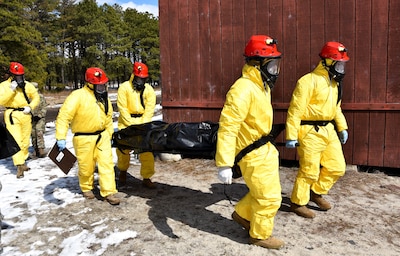
The Defense Department mortuary affairs exercise involved search and recovery missions in tactical and nontactical environments, operating a mortuary affairs contaminated remains mitigation site, and establishing and operating a mortuary affairs collection point and a theater mortuary evacuation point.

AFMES’ primary role in the exercise was to familiarize participants in contaminated remains recovery, processing and procedural guidance and to provide an operational assessment.

Army Col. Louis N. Finelli, the AFMES director, said the exercise was “a great opportunity” for his staff to share their knowledge with different services and with local and national agencies, explaining that the mortuary affairs contaminated remains mitigation site was developed to act as a stopgap to recovery of contaminated remains, which he called “a relatively new scenario.”

Contaminated remains are casualities from an attack of a chemical, biological, radiological, nuclear or explosive nature.

Evolving Idea

Finelli said that being unable to return contaminated remains first was recognized as a gap during the first years of Operation Iraqi Freedom, but the idea of a mortuary affairs contaminated remains mitigation site has evolved over the past two to three years, as technology and procedures are constantly evolving.

“In the past two years, we have made tremendous strides in the MACRMS process, but we are always examining for ways to improve the mission of bringing our troops home,” Finelli said.

Participants had to put these strides to the test during the exercise, as members were subjected to a simulated CBRNE attack and had to use techniques, tactics and procedures developed by the Joint Mortuary Affairs Center.

Application of protective suits, gloves, breathing filtration gear, wireless cameras and the use of drones were all used for safety and security during the simulated recovery of service members.

A Teaching Experience

“It was definitely a teaching experience -- for most, it was their first time seeing a MACRMS in the field,” said Navy Lt. Cmdr. Bryan Platt, AFMES forensic pathologist. “I tried to demonstrate what they would encounter during a real-world scenario.”

AFMES also provided medical examiners, investigators and mortuary affairs specialists to the exercise.

“Most people don’t know how U.S. service member causalities are recovered in foreign conflicts overseas or stateside,” said Jairo E. Portalatin, AFMES medicolegal death investigator. “It can be a very sensitive process, but we owe it to our service members to train and get it right.”

Mike Leone, AFMES safety, environmental and occupational health manager, acted as the exercise incident commander. He said that in addition to the MACRMS, scenarios also included a downed aircraft, a tornado disaster, and combat search and recovery missions.

In each case, he said, participants had to locate, recover and process simulated human remains, sometimes weighing more than 200 pounds.

“These exercises and training scenarios are extremely beneficial for us,” said Marine Corps Sgt. Keith A. Norman, logistics chief for Detachment Personnel Retrieval and Processing Company, Combat Logistics Regiment 45. “For some of our younger Marines, it’s the first time they’ve worked in a joint environment.”

Finelli said integration of multiple organizations in a joint environment is a key focus of these types of exercises.
“By conducting these exercises,” he said, “we hope to introduce to our service members the experience and training needed to support worldwide contingency operations and disaster response operations.”