Friday, March 16, 2018

Medical Examiner System Personnel Train in Operation Joint Recovery


By Air Force Tech. Sgt. Robert M. Trujillo, Armed Forces Medical Examiner System

DOVER AIR FORCE BASE, Del., March 16, 2018 — More than 200 active duty and reserve service members and personnel from the Armed Forces Medical Examiner System participated in Operation Joint Recovery at Joint Base McGuire-Dix-Lakehurst, New Jersey, March 7-10.

The Defense Department mortuary affairs exercise involved search and recovery missions in tactical and nontactical environments, operating a mortuary affairs contaminated remains mitigation site, and establishing and operating a mortuary affairs collection point and a theater mortuary evacuation point.

AFMES’ primary role in the exercise was to familiarize participants in contaminated remains recovery, processing and procedural guidance and to provide an operational assessment.

Army Col. Louis N. Finelli, the AFMES director, said the exercise was “a great opportunity” for his staff to share their knowledge with different services and with local and national agencies, explaining that the mortuary affairs contaminated remains mitigation site was developed to act as a stopgap to recovery of contaminated remains, which he called “a relatively new scenario.”

Contaminated remains are casualities from an attack of a chemical, biological, radiological, nuclear or explosive nature.

Evolving Idea

Finelli said that being unable to return contaminated remains first was recognized as a gap during the first years of Operation Iraqi Freedom, but the idea of a mortuary affairs contaminated remains mitigation site has evolved over the past two to three years, as technology and procedures are constantly evolving.

“In the past two years, we have made tremendous strides in the MACRMS process, but we are always examining for ways to improve the mission of bringing our troops home,” Finelli said.

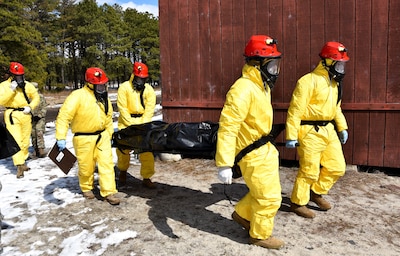
Participants had to put these strides to the test during the exercise, as members were subjected to a simulated CBRNE attack and had to use techniques, tactics and procedures developed by the Joint Mortuary Affairs Center.

Application of protective suits, gloves, breathing filtration gear, wireless cameras and the use of drones were all used for safety and security during the simulated recovery of service members.

A Teaching Experience

“It was definitely a teaching experience -- for most, it was their first time seeing a MACRMS in the field,” said Navy Lt. Cmdr. Bryan Platt, AFMES forensic pathologist. “I tried to demonstrate what they would encounter during a real-world scenario.”

AFMES also provided medical examiners, investigators and mortuary affairs specialists to the exercise.

“Most people don’t know how U.S. service member causalities are recovered in foreign conflicts overseas or stateside,” said Jairo E. Portalatin, AFMES medicolegal death investigator. “It can be a very sensitive process, but we owe it to our service members to train and get it right.”

Mike Leone, AFMES safety, environmental and occupational health manager, acted as the exercise incident commander. He said that in addition to the MACRMS, scenarios also included a downed aircraft, a tornado disaster, and combat search and recovery missions.

In each case, he said, participants had to locate, recover and process simulated human remains, sometimes weighing more than 200 pounds.

“These exercises and training scenarios are extremely beneficial for us,” said Marine Corps Sgt. Keith A. Norman, logistics chief for Detachment Personnel Retrieval and Processing Company, Combat Logistics Regiment 45. “For some of our younger Marines, it’s the first time they’ve worked in a joint environment.”

Finelli said integration of multiple organizations in a joint environment is a key focus of these types of exercises.
“By conducting these exercises,” he said, “we hope to introduce to our service members the experience and training needed to support worldwide contingency operations and disaster response operations.”

Thursday, March 15, 2018

U.S. Army Works With NATO Allies in Estonia


By Army Spc. Hubert Delany 22nd Mobile Public Affairs Detachment

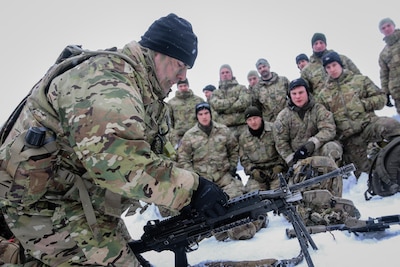
TAPA, Estonia, March 15, 2018 — Among the things that stand out to many who visit the training area here are the frigid temperatures.

Given this challenge, soldiers with the 82nd Brigade Engineer Battalion tested their mettle during a series of training events March 6-14.

Making it through these challenges required each soldier to trust the training they’d completed up to this point in their deployment to Europe. It also required them to depend on and trust their NATO allies.

Partnership

“This is one of the most tightly knit teams I've seen in my 26 years in the Army,” said Command Sgt. Maj. Paul Vedros, the senior enlisted member of the 82nd BEB.

Within hours of an order to move to the Baltics, Vedros and his men packed their gear and moved more than a thousand miles from Grafenwoehr, Germany, to a location previously unknown to most of them.

“These men have done a terrific job,” said Vedros, while reminiscing of previous deployments and Army experiences. “It was like watching an 82nd Airborne Division rapid deployment. Before anybody knew it, these soldiers were coming to Estonia loaded up and ready to go, and our NATO allies knew exactly what to do when we sent them."

Upon arrival in Estonia, U.S. troops worked with the Estonian, British, Canadian, and Danish armies to establish and solidify a mutually-beneficial training schedule. Among the first training events lined up for the Americans was cold-water immersion drills with the British Army's 1st Royal Welsh Battalion. This was followed by other training events with the Canadian Royal 22nd Regiment and the Danish Guard Hussars Regiment.

The goal for all the training is to build upon previously-established relations between the U.S. and NATO allies, said Army Lt. Col. Jesse Curry, the 82nd BEB commander.

Preparedness

Additionally, Curry wanted to ensure that his unit stands ready to act within a moment’s notice. His unit is in Europe to support Atlantic Resolve, a U.S. Army Europe effort to deter aggression in the region.

“Our brigade is here to show that we can move and project power across all of Europe,” Curry said. “When you can take an element from anywhere in Europe and push them like we have to the most forward point within NATO, it sends a tremendous message. That we can, and absolutely have the capability, to defend our NATO allies … and to be lethal if necessary.”

To close out their time in Estonia, the U.S. soldiers provided chemical, biological, radiological and nuclear defense training to the Estonian army's 1st Infantry Brigade.

Army Spc. Dewight Young, a CBRN specialist with the 82nd BEB, participated throughout the weeklong mission and said he believes that what his fellow soldiers completed in Estonia will have a lasting, positive impact.

“I’ve never worked with so many people from so many different countries before, but I am glad we did,” Young said. “It’s not just Americans, but English, Danish, Estonian and everyone else, working together to do something good in the world.”

AF Secretary: Proposed Budget Aligns With National Defense Strategy


By Air Force Staff Sgt. Rusty Frank Secretary of the Air Force Public Affairs

WASHINGTON, March 15, 2018 — Secretary of the Air Force Heather Wilson and Air Force Chief of Staff Gen. David L. Goldfein yesterday testified before the House of Representatives’ Committee on Appropriations about the Air Force’s proposed fiscal year 2019 budget.

The proposed budget “aligns with the National Defense Strategy,” Wilson said.

She said the budget also recognizes and reflects that the United States is experiencing “a more competitive and dangerous international security environment than we have faced in decades.”

Wilson added, “We have returned to great power competition and the central challenge to security and prosperity is one we must meet. That’s what you expect of your Air Force and of your joint force, and we’re here to deliver.”

Bold Moves

According to Wilson, there are “two bold moves” in this budget.

“The first is accelerating defendable space. We need to deter, defend and prevail against anyone who seeks to deny our ability to freely operate in space,” Wilson said.

“The second is the shift to multi-domain operations,” she added. “We are proposing to change the way we do command, control and communication on the battlefield. A mission we perform for the joint force and particularly for the ground forces.”

In addition to the two bold moves, the Air Force will continue to prioritize the readiness of the force to win any fight, any time, Wilson said.

“Let there be no doubt, your airmen stand ready to defend the homeland, deter nuclear conflict through nuclear readiness, own the high ground with air and space superiority and project global vigilance, reach and power with our joint teammates, allies and partners,” Goldfein said.

Fiscal year 2019 funds will expand pilot training and address experience shortfalls, continue incentive pay and bonuses, improve administrative support at the squadron level and support flying hours to executable levels, officials said. The funding also will address gaps in space, nuclear, cyber and intelligence career fields and support battlefield airmen -- the service’s air-to-ground integration force.

“Airmen participate in some way in every mission the joint force performs,” Goldfein said. “We operate from below the surface in a remote missile silo to the outer reaches of space, and everywhere in between. We can do all of this only with the unwavering support of the American people and the leadership and support of Congress.

The general added, “This Air Force budget request allows our nation to confront today’s threats and moves us toward the Air Force we need to face tomorrow’s challenges.”

The Air Force’s fiscal 2019 budget request of $156.3 billion builds on the progress made in 2018 to restore the readiness of the force, increase lethality and modernize in a cost-effective manner, officials said.