Thursday, October 26, 2017

Marine Corps World War II Vets Visit Pohakuloa Training Area


By Marine Corps Lance Cpl. Isabelo Tabanguil III Marine Expeditionary Force

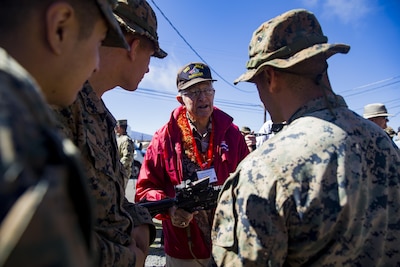
POHAKULOA TRAINING AREA, Hawaii, Oct. 25, 2017 — Veterans of the 5th Marine Division visited here Oct. 20 as part of the 68th annual reunion of the 5th Marine Division Association.

During their stay they viewed displays of the current weapons and equipment used by Marines with 2nd Battalion, 3rd Marine Regiment.

“It was really nice to meet the Iwo Jima veterans as everyone in the Marine Corps knows Iwo Jima was a huge part of our history and background,” said Marine Corps Pfc. Nick Bensette, a machine gunner with 2nd Battalion, 3rd Marines. “I never got to meet my grandfather who served during World War II and passed away when I was still young, so meeting all of these veterans is a good way for me to get new knowledge and pass it on to the next generation.”

Bensette said he was proud to demonstrate and explain how the modern equipment belonging to the current generation of Marines works.

“It’s nice to give back to the people who have served us before,” he said. “I’m kind of following in their footsteps, which is a big accomplishment for me to do what they did as Marines.”

Personal Memories

Ralph Simoneau said he was immediately reminded of his time on Iwo Jima with the 5th Marines when he arrived at PTA.

“I worked with the 60-millimeter mortars, and when they opened the door of the bus at the training camp [today] I could instantly smell it,” he said. “I went straight to the mortar like a bird dog, and knew exactly where it was going to be.”

Simoneau said he was amazed how the equipment he saw compared to what they had during his time in the Marines.

“I was telling one young Marine the difference between his equipment and mine was that we had bows and arrows, and they had guns that could shoot,” he said. “The only real superior weapon we had was the Browning automatic rifle. You could bury that in the sand, take it back out, and it would never misfire.”

Louie Lepore said he trained at nearby Camp Tarawa before he deployed to Iwo Jima with the 5th Marine Division.

“We had regimental practice landings for the invasion of Japan, but they dropped the atom bombs,” he said. “We went aboard ship right away down at Hilo, and went to participate in the occupation of Japan.”

Gratitude

Lepore said he was relieved that Marines never had to invade Japan after witnessing what he saw during the occupation.

“We went through Nagasaki and I saw the devastation of the A-Bomb there,” he said. “On the island of Kyushu, where we were supposed to land for the invasion, we saw a kamikaze base and caves with planes in them. I wouldn’t be here today after seeing the way they were prepared for us.”

Lepore said he’s extremely grateful and glad that history unfolded as it did.
“I’m very lucky to be here and I know it,” he said. “I’m 94 years old; I went through World War II and the Korean War. I retired in 1971 with almost 29 years in service. They wanted me to go to Vietnam because of my knowledge of French, and I said: ‘Forget it. Once was enough.’”

Face of Defense: Citizen-Soldier Helps Others in Dual Careers


By Army Sgt. 1st Class Ryan Matson U.S. Army Reserve Command

COLUMBIA, S.C., Oct. 26, 2017 — Whether the situation is a child facing problems at home or in school, or a person who is displaced hundreds of miles from their home in the aftermath of Hurricane Maria, Army Maj. Karean Troy is ready to help.
Caring for others

Troy is a patient administration officer in the Army Reserve and a full-time elementary school counselor. She is a citizen-soldier. But the common theme in her military and civilian occupations, as well as her life in general, is a devotion to caring for others.

“From getting to know Miss Troy over the last couple of years, whether it’s in the military or with our students at school, she is always looking out for everyone else,” said Spencer Bobian, a school counselor with Troy at Fairfield Elementary School in Winnsboro, South Carolina.

Bobian was not at all surprised when he found out Troy was one of the key players in the Army Reserve-led Federal Coordination Center Columbia. Based out of a hangar at the Columbia Metropolitan Airport, the team was responsible for receiving evacuated patients on flights from either Puerto Rico or the U.S. Virgin Islands, evaluating the patients, and then setting them up with care at a local hospital.

Troy’s duty was to track the patients from the time they boarded a plane until the time they arrived in the care of a local hospital. She received basic information on the condition of the patients, and served as a liaison between the military and local hospitals by maintaining a data base of available beds for the patients.

Helping Others

“I guess when I look back on it, in either situation I’m in a helping profession,” Troy said. “Many times things I do here in the FCC is troubleshooting. Someone may come up to me with an issue and it may not have anything to do with patient administration but I’ll kind of troubleshoot it, and look at the problem and say ‘Hey, maybe have you tried this?’ I do the same thing with my students as an elementary school counselor. I think my greatest ability is linking people together and getting them where they need to be, and I just bring it to this particular mission.”

Troy grew up in Detroit, Michigan, and attended Henry Ford High School. She dreamed of being a lawyer, until she had what would prove to be a life-changing experience.

“While I was in college, I changed my major to communications and I had a scholarship to do graduate work in communications,” Troy said. “Part of the scholarship was that I had to teach a speech class and have office hours. What I found was, the students would come in and see me during office hours, and I really enjoyed sitting there and talking to them about their problems or whatever was going on. Someone suggested I take a counseling class, and I loved it.”

As a result of the experience, Troy actually forfeited her scholarship in communications to pursue a career in counseling. It was a natural fit, and she’s been doing it ever since.

Answering the Call to Serve

Troy has served as a counselor in a variety of positions through the years. She was an academic advisor at Wayne State University, a high school counselor for several years, and also worked with the Families First program as a counselor to help resolve issues for parents who were in jeopardy of losing their children.

While studying counseling at Central Michigan, Troy’s college roommate, who was in the military, spurred her interest in joining. She decided to take the Armed Services Vocational Aptitude Battery test, and scored very highly, especially in the science categories.

Troy again felt the calling to help other people. She decided to enlist in 1990 as an operating room technician. Her first unit was the 323rd Combat Support Hospital in Southfield, Michigan. She climbed from the rank of private first class to sergeant before earning a direct commission in the Medical Service Corps.

“It was never my intention to make it a career,” Troy said, chuckling. She’s now been in the Army Reserve for 27 years.

“I figured I’d get in, do my time [and] get some experience. But at about the 10-year mark, I knew I had to make the decision: I decided I’d try something different,” she said. “I was mobilized here at Fort Jackson and worked in operations. The second year I was here, I had a friend who talked me in to talking to the hospital commander about being the commander of the Warrior Transition Unit, a job I really had no interest in doing. I went over there and what they were actually doing was interviewing me for the job. I ended up taking the job.”

Troy spent two years working with wounded soldiers in the WTU, and, she said, it was one of the most rewarding experiences of her career.

Outside of her civilian and military careers, Troy has been active in a wide array of voluntary services. She was a den mother for her son, Allen, volunteered at his school, and is active in her church, Journey United Methodist Church in Columbia, where she serves as a lay shepherd and has taught bible study classes. She said one of her main life goals is to participate in a ministry mission.

Journey United Methodist Church Pastor George Ashford has known Troy for about seven years.

“She has a passion for helping others and not everyone is necessarily given to that,” Ashford said. “She has a way of understanding people’s lives and hearts that many others may not possess.”

Though Troy has been working long hours with the FCC as part of the hurricane evacuation mission, Bobian said she has a host of children awaiting her return to the school.

“Every day they keep asking me when she’s coming back,” he said. “They look forward to seeing her and look at her almost as another parent or mother figure.”

Wednesday, October 25, 2017

Face of Defense: Dominican-Born Airman Inspires Serenity


By Air Force Staff Sgt. Marjorie Bowlden, 380th Air Expeditionary Wing

AL DHAFRA AIR BASE, United Arab Emirates, Oct. 25, 2017 — Every airman has a story, a path that led them to where they stand today. Whether they joined the Air Force for personal advancement or for love of country, their commitment started with a single choice. At a definitive point in time, they decided to serve something bigger than themselves.

Most airmen begin their military path on United States soil. But for others, the beginning of the Air Force journey can be traced across oceans and beyond borders to a culture much different from our own.

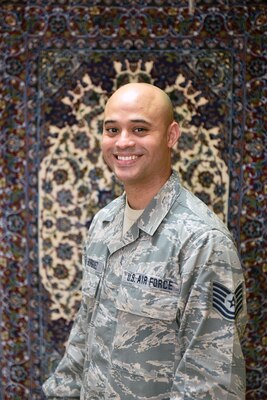
Such is the case with Air Force Tech. Sgt. Siddartha Sosa-Rodriguez, the noncommissioned officer in charge of plans and programs for the 380th Air Expeditionary Wing chapel.

“Every immigrant that is able to come to the military and grow within the military should feel very, very proud,” Sosa-Rodriguez said. “On top of all the natural obstacles that the military puts on us to make us stronger, we also have to deal with the language barrier and culture differences. It says a lot about the strength of people, no matter what country they come from.”

Deployed from the 157th Air Refueling Wing in New Hampshire, Sosa-Rodriguez brings valued diversity to the 380 AEW chapel staff as a Hispanic-American Hindu in a predominantly Christian career field. He is known for his efforts to elevate the morale of those around him, whether by handing out ice pops or challenging various offices to bean-bag toss “throw downs” after work.

“A chaplain assistant is essentially responsible for being good at a plethora of tasks all at the same time,” said Chaplain (Capt.) Piers Osborne with the 380 AEW chapel. “The immense variety of life experiences he has had allows him to relate to a wide span of people from just about every background out there.”

Spiritual Journey

Sosa-Rodriguez was born in the Dominican Republic into a family that followed the state religion of Roman Catholicism. Because his parents were separated and his father lived in New York, he stayed in the Dominican Republic with his mother and other family members for most of his early life.

He knew early on that his destiny was to serve others, specifically through military service. At age 7 he saw a military recruitment ad on television that was followed by a commercial  with an image of a sickened old woman in need of help.

“I remember this overwhelming feeling inside of me, and I went running to my mother crying,” Sosa-Rodriguez said. “I don’t know if I said it out loud or if I just thought about it when she asked, but I said to myself, ‘I know what I want to do when I grow up.’”

Though he was certain about eventually joining the military, he was full of questions about the world around him. He would consistently ask the same three questions: who is God, why do we exist the way we do, and who are we as humans? But he was mostly unsatisfied with the answers provided.

Later, while living with his father in New York, Sosa-Rodriguez found a book in the street that discussed the basic beliefs of the world’s major religions. He read it cover to cover, wondering if maybe one of the religions inside was what he was looking for; instead he was left with more questions.

He returned to the Dominican Republic unsatisfied, but said a festival at the Indian embassy changed his life forever. The embassy was displaying different aspects of Indian culture. A religious group took the stage and sang Bajans -- Hindu spiritual songs. Though Sosa-Rodriguez didn’t understand Sanskrit, he felt as if something had fallen into place in his heart.

“My skin started getting goosebumps and I just felt so attracted to it,” he said.

After discovering a nearby Hindu temple, he started attending every day before and after school to do more research. At 13, Sosa-Rodriguez became an initiate and a full member of the Hindu faith.

Hard Work

When he was 16, he returned to the U.S. and was emancipated, but he could not return to the Dominican Republic to live on his own until he was 18.

He worked in a fabric factory in New Jersey to raise enough money to return to the Dominican Republic live in the Hindu temple where he had studied. The conditions were hard, Sosa-Rodriguez said, and he barely made enough money to get by, let alone enough to save the $190 for his plane ticket.

“I think that I was only person who was legally in the United States in that place,” he said. “I remember it was on the fifth floor in the winter with broken windows. Nobody would complain because they were afraid. My job was to cut fabric with scissors, and I would have to hold my hands over the heater just to bring back enough feeling.”

Eventually, he made it to the temple and was ordained as a Pujari, a Hindu priest.

After five years at the temple, Sosa-Rodriguez moved to back to the United States to join the military. He enlisted with the 157th ARW and moved more than 1,500 miles to pursue a different kind of service with the New Hampshire Air National Guard -- a service that he excels at, Osborne said.

“I have known him three years, since I started with the New Hampshire ANG,” Osborne said. “We overuse this word, but he truly is an outstanding airman . He consistently gives way more than is required, works hard, stays late, and is always looking out for others.”

Serenity

Sosa-Rodriguez said he doesn’t plan to end his career anytime soon, either. He hopes to eventually become a command chief and retire after a full term of service. He also plans to start his own civilian organization to help others grow physically, intellectually, emotionally and spiritually.

Though his path was not without difficulty or struggle, he said he believes it helped him bring serenity into the lives of others.
“Absolutely my experiences have shaped me, changed me, and I think for the better,” Sosa-Rodriguez said. “It’s taken its toll. Nothing is for free in the universe, but it did shape me in a way that I believe I can help people better. It has made me stronger, and it has helped me to help others become stronger.”